Chinese Proverbs About Love
Chinese love poetry stretches back over three thousand years, and much of what modern speakers call a "proverb" actually began as a line of verse written by a specific poet on a specific occasion. These compact expressions—four characters in the case of 成语 (chengyu), or a full couplet for longer phrases—carry both literary history and emotional weight in a way that casual English sayings rarely achieve. For visitors to China, a well-placed classical phrase at a wedding toast or a Mid-Autumn Festival text transforms a tourist gesture into a culturally literate one. This guide works through the most useful love-related proverbs, explains where each one comes from, and shows exactly how to deploy it.
The sources covered here include the oldest strata of Chinese literature—the Classic of Poetry (Shijing, compiled between the 11th and 7th centuries BCE)—through Tang and Song dynasty high poetry, down to Jin dynasty and folk tradition. Every character sequence and pinyin is reproduced faithfully from its source text, and each entry explains the historical moment that gave the line its enduring power.
Quick Facts
Classical Love Proverbs from Ancient Chinese Poetry
Chinese Proverbs About Love
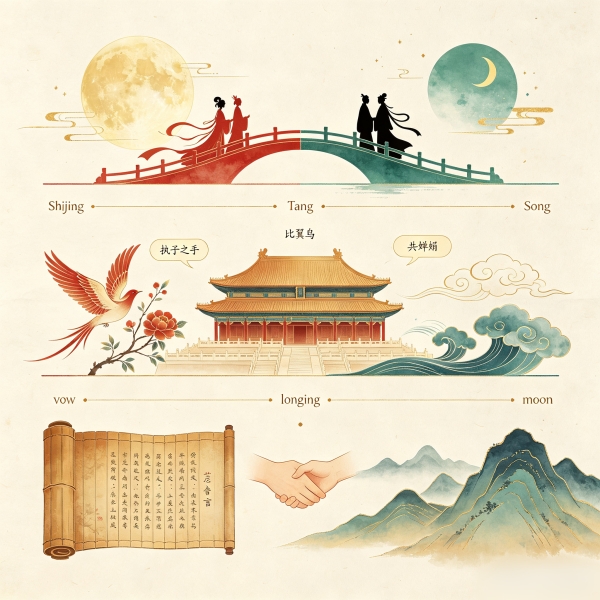
Unlike English proverbs, which often emerge from folk wisdom and anonymous tradition, the great majority of Chinese love proverbs have a known author, a specific occasion, and a documented text. This creates a distinctive advantage for learners: every phrase comes with a story. The poet wrote it because something happened—exile, grief, a wedding, a festival—and that story explains why the words feel heavy with meaning. What follows are the three major literary layers that together form the backbone of classical Chinese love expression.
Tang Dynasty Vows from Bai Juyi and Yuan Zhen
The Tang dynasty (618–907 CE) represents the high point of Chinese court poetry, and two Tang poets gave language to love with unusual directness.
- 在天愿作比翼鸟,在地愿为连理枝 — zài tiān yuàn zuò bǐyìniǎo, zài dì yuàn wéi liánlǐzhī — "In heaven I wish to be a paired-winged bird; on earth I wish to be an intertwined branch." Bai Juyi wrote this couplet around 806 CE in Chang hen ge (Song of Everlasting Sorrow), his narrative poem about Emperor Xuanzong and Consort Yang Guifei. The bǐyìniǎo (比翼鸟) is a mythical creature with one eye and one wing that must fly in tandem with its partner; the liánlǐzhī (连理枝) refers to two trees whose trunks grow together. Use this when you want to express the wish for an inseparable bond—appropriate at engagements, anniversaries, or as a tattoo.
- 曾经沧海难为水 — céngjīng cānghǎi nán wéi shuǐ — "Once you have seen the ocean, other waters are not worth seeing." Yuan Zhen (c. 779–831) composed this line in a poem mourning his deceased first wife Cui Wuniang. He later reused it in another poem addressed to a new romantic interest, arguing that no one after a true love can compare. Today it is deployed to tell someone: no one else measures up. The four-character completion 除却巫山不是云 (chú què Wūshān bù shì yún, "apart from the clouds of Mount Wu, no others are clouds") makes the full couplet used in modern speech.
Song Dynasty Yearning from Su Shi and Qin Guan
The Song dynasty (960–1279 CE) shifted the dominant poetic mode from court ceremony to personal exile and private feeling—a change that produced some of the most quoted love lines in Chinese history.
- 但愿人长久,千里共婵娟 — dàn yuàn rén chángjiǔ, qiānlǐ gòng chánjuān — "I only wish that we be healthy and eternal; a thousand miles apart, we share the same beautiful moon." Su Shi (1037–1101) wrote this in 1076 while exiled in Mizhou, on the night of the Mid-Autumn Festival. He sent it to his brother Su Zhe, seven years separated by official banishment. The moon functions as a messenger—visible to both parties regardless of distance. This line works as a seasonal greeting during Mid-Autumn or as a genuine expression of connection across any physical gap.
- 两情若是久长时,又岂在朝朝暮暮 — liǎngqíng ruòshì jiǔchángshí, yòu qǐ zài zhāozhāomùmù — "If the feelings of two people are truly lasting, why must they be together morning and evening?" Qin Guan (1049–1100) penned this line in Immortal at the Magpie Bridge (《鹊桥仙》), written for the Qixi Festival (Chinese Valentine's Day). The festival commemorates the Cowherd and Weaver Girl, who cross the Milky Way to meet once a year—proof that devotion transcends physical proximity. The line is the standard classical answer to long-distance anxiety.
Earliest Origins in the Classic of Poetry
The Shijing (《诗经》), or Classic of Poetry, was compiled between the 11th and 7th centuries BCE and forms the oldest layer of Chinese love expression. Its language is deliberately plain—the poems were collected as folk songs as well as court verses—which is why they remain accessible to modern readers without specialized training.
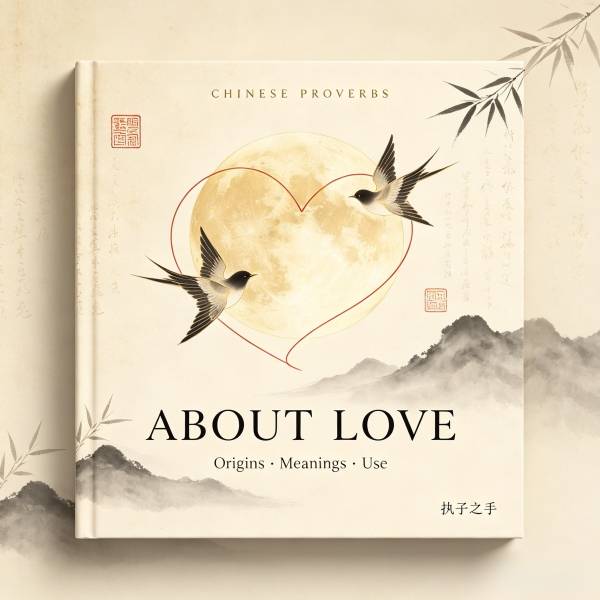
- 执子之手,与子偕老 — zhí zǐ zhī shǒu, yǔ zǐ xié lǎo — "Hold your hand, and with you grow old." This line appears in the Drumbeats poem (《邶风·击鼓》) from the Bei Airs section of the Classic of Poetry. The original context is a soldier's lament—his hand was clasped in oath to his brothers-in-arms before they marched to war. Over two millennia of use, the phrase has been entirely reclaimed as a marriage vow. It appears on wedding banners, jewelry, and social media posts across China. The tone is solemn and sincere; this is the closest classical equivalent to a formal wedding oath.
- 山无棱,天地合,乃敢与君绝 — shān wú léng, tiāndì hé, nǎi gǎi yǔ jūn jué — "Only when mountains lose their ridges, only when heaven and earth merge—only then will I part from you." This oath appears in another Classic of Poetry poem, a pledge of fidelity between lovers. The three hyperbolic conditions (mountains flattened, heaven and earth fused into one) make the vow absolute. In modern usage it functions as a dramatic declaration of loyalty—best suited to moments of serious emotional commitment or as a written promise.
💬 Digital Chat Shorthand: Curious how modern romance translates into digital texting, where numbers like 520 represent "I love you"? Read our breakdown of Chinese Number Slang.
Wedding and Marriage Blessing Sayings
Chinese Proverbs About Love
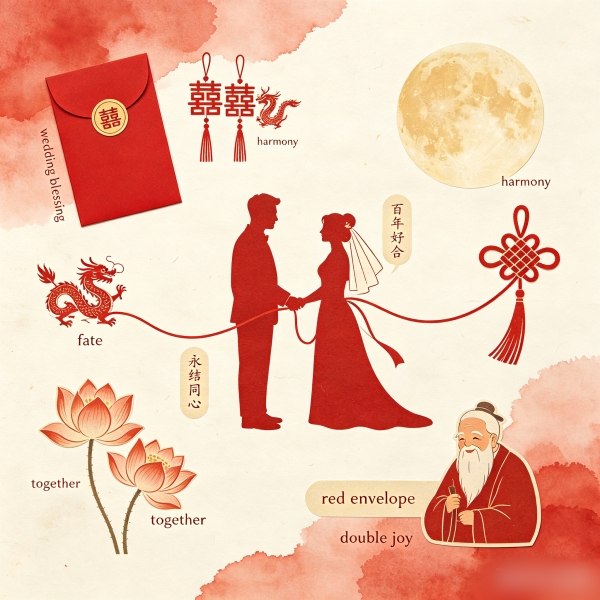
Chinese wedding vocabulary relies heavily on 四字成语—four-character idioms—because brevity signals cultural literacy. A 成语 sounds like something a scholar would know, which raises the register of any card, toast, or banner. The cultural frame that underlies all wedding blessing language is the idea of 缘分 (yuánfèn, fate-destiny) and the deity 月下老人 (Yuè Lǎo, the Old Man under the Moon) who is said to tie an invisible red thread (红线, hóngxiàn) between destined lovers. When you use a wedding blessing, you are invoking that tradition of cosmic match-making.
Phrases for the Ceremony Itself
The following four proverbs are spoken aloud at the ceremony or written in the guest book. Each carries a formal, slightly literary tone appropriate for a solemn occasion.
- 百年好合 — bǎinián hǎo hé — A harmonious union lasting a hundred years. The most common wedding blessing in modern Chinese; appears on red envelopes, banners, and greeting cards nationwide.
- 白头偕老 — báitóu xié lǎo — To grow old together, with white hair. Emphasizes the long arc of married life; appropriate for vows, toasts, and written messages to the couple.
- 永结同心 — yǒngjié tóngxīn — Forever joined in one heart. A chengyu that works well on wedding favors, napkins, or as part of a spoken toast.
- 天作之合 — tiān zuò zhī hé — A union made by heaven. Slightly more literary than 百年好合; ideal for formal written cards where you want to signal knowledge of classical phrasing.
Words for Banners and Red Envelopes
Wedding wall banners (usually flanked by the 囍 character, the doubled joy symbol) and red envelopes (红包, hóngbāo) call for visually balanced, four-character blessings. The following four are the standard selections for this purpose.
- 佳偶天成 — jiā'ǒu tiānchéng — A perfect match made by heaven. Pairs well with the 囍 character on a wall banner; works in both speech and print.
- 早生贵子 — zǎoshēng guìzǐ — May you soon have a noble son. This is the traditional blessing for offspring, and it appears on nearly every standard red envelope. Be aware of its dated framing: avoid it if the couple has stated they do not plan to have children.
- 龙凤呈祥 — lóngfèng chéngxiáng — Dragon and phoenix bring auspiciousness. The dragon represents the groom's family, the phoenix the bride's; this blessing invokes complementary harmony. Popular on banners and in speeches.
- 花开并蒂 — huākāi bìngdì — Twin flowers blooming on one stem. A botanical metaphor for the couple; visually evocative and often used on wedding decorations and favor packaging.
🧧 Auspicious Love & Marriage Symbols: Many classical love proverbs are frequently paired with visual motifs of double happiness and good fortune at weddings. Discover these icons in Chinese Prosperity Symbol.
Long-Distance Love and Yearning Proverbs
Chinese Proverbs About Love
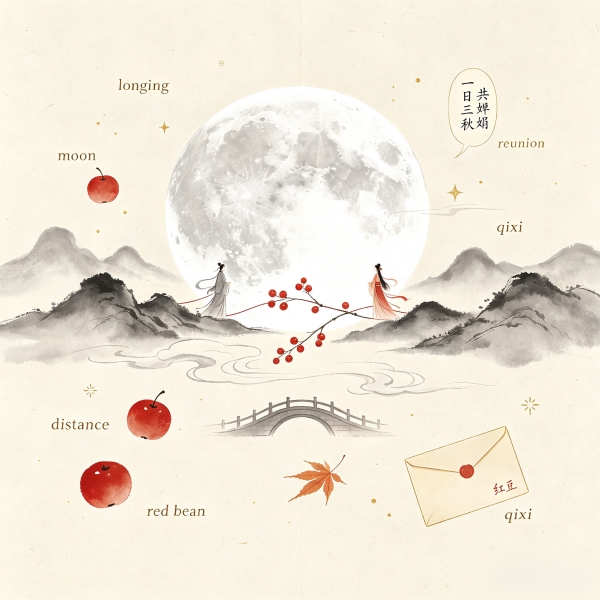
The theme of 思 (sī, longing) runs through Chinese poetry like a ground bass, and it received its most elaborate treatment during the Tang and Song dynasties. Physical separation—caused by war, official banishment, or the simple distances of premodern travel—gave poets occasion to find symbolic language for the ache of absence. Two festivals crystallize this tradition: the Mid-Autumn Festival (中秋节, 15th day of the 8th lunar month) and Qixi Festival (七夕, the 7th day of the 7th lunar month). Understanding these occasions helps you choose the right phrase for the right moment.
For Partners Far Apart
Whether the separation is temporary or prolonged, these three lines address the experience of distance directly.
- 一日不见,如三秋兮 — yī rì bù jiàn, rú sān qiū xī — "One day without seeing you feels like three autumns." From the Classic of Poetry (Wang Feng · Cǎi Gě, 《王风·采葛》). The exaggeration creates emotional intensity; use this in a text or message when you want to express that time apart feels extended and painful.
- 红豆生南国,春来发几枝 — hóngdòu shēng nánguó, chūn lái fā jǐzhī — "The red beans grow in the southern land; in spring they sprout several branches." Wang Wei (701–761) wrote this in a Tang dynasty poem, and the hóngdòu (红豆, Ormosia seeds) became a cultural shorthand for yearning and unfulfilled love. Send this line as a message to express that you are thinking of someone, or give a piece of red bean jewelry as a token.
- 海内存知己,天涯若比邻 — hǎi nèi cún zhījǐ, tiānyá ruò bǐlín — "Within the four seas, all true friends are neighbors, even if separated by the edge of the sky." Wang Bo (650–676) wrote this line, which balances the pain of separation with the steadiness of genuine connection. It applies to both romantic and platonic relationships; use it when you want to offer reassurance rather than express longing.
Mid-Autumn Festival Lines
The Mid-Autumn Festival centers on the full moon as a symbol of reunion. Any message sent during this festival carries additional resonance if it references the moon or the theme of shared sight across distance.
- 但愿人长久,千里共婵娟 — dàn yuàn rén chángjiǔ, qiānlǐ gòng chánjuān — "May we live long and share the same beautiful moon." Su Shi's line is the definitive Mid-Autumn message. Send it as a text or write it on a card to a partner, family member, or close friend who is far away. The seasonal reference is unmistakable.
- 月圆人团圆 — yuè yuán rén tuányuán — "The moon is full; people are reunited." This folk saying pairs the lunar event with its human counterpart. Short and direct, it works as a festive greeting or a social media caption during the festival period.
- 露从今夜白,月是故乡明 — lù cóng jīnyè bái, yuè shì gùxiāng míng — "From tonight the dew turns white; the moon over home is brightest." Du Fu (712–770) composed this line, and it captures the particular ache of Mid-Autumn when away from family. Use it when texting a parent or partner during the festival—it carries a slightly melancholic, literary register.
🌸 Nature & Time in Classical Verse: To understand the seasonal context behind famous love couplets—from spring blossoms to autumn moonlit nights—browse our guide to Seasons in Chinese.
Proverb Scenarios for Visitors
📛 Poetic Influence on Names: Many historical figures and modern individuals derive their personal names directly from classical poetry and auspicious proverbs. Explore structure and heritage in Typical Chinese Name.
Family Bonds and Letting Go
Chinese Proverbs About Love
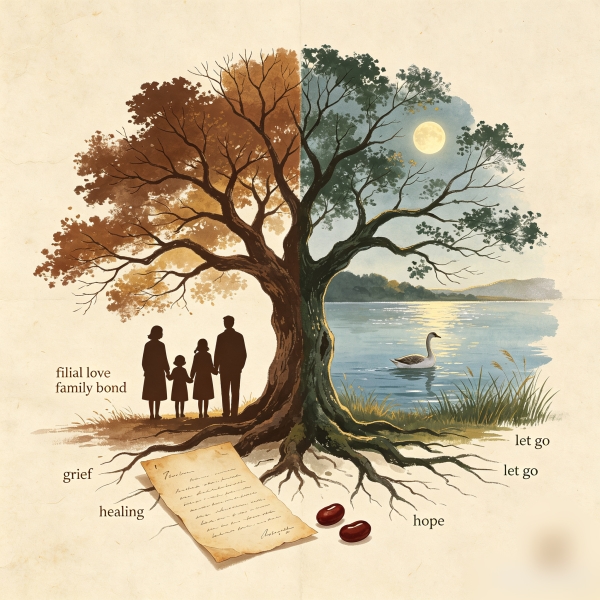
Chinese literature treats love not only as a romantic bond but also as a network of obligations and losses that extends across generations. Filial piety—the duty owed to parents—carries its own vocabulary of devotion, while the experience of heartbreak has produced its own classical language of consolation. The two short subsections below capture the range beyond the wedding aisle.
Filial Love and Family Devotion
Family love in Chinese culture operates on a different axis than romantic love—it is asymmetrical, hierarchical, and bound by obligation rather than choice. Two classical lines address the emotional truth embedded in that structure.
树欲静而风不止,子欲养而亲不待 — shù yù jìng ér fēng bù zhǐ, zǐ yù yǎng ér qīn bù dài — "The tree wants stillness but the wind will not stop; the child wants to provide care, but the parents are no longer there to receive it." This line comes from the Han dynasty commentary tradition (Han Shi Waizhuan, 《韩诗外传》). It functions as a solemn reminder: do not delay showing gratitude to living parents because time is not guaranteed. Use it when you want to express the weight of filial duty or to counsel someone who has been putting off a visit home.
养儿方知父母恩 — yǎng'ér fāng zhī fùmǔ ēn — "Only by raising children does one understand parental grace." This folk saying closes a circle: only after becoming a parent can you fully comprehend what your own parents sacrificed. It is a gentle, reflective line—appropriate in conversation with new parents or when reflecting on your own upbringing.
Heartbreak and Finding Peace
Chinese poets have long grappled with the pain of unrequited love, death, and separation, and the language they developed for these experiences still offers comfort today.
问世间情为何物,直教生死相许 — wèn shìjiān qíng wèi hé wù, zhí jiào shēngsǐ xiāngxǔ — "Ask what this thing called love is in the world—it simply commands one to pledge life and death in return." Yuan Haowen (1190–1257), a Jin dynasty poet, wrote this line after witnessing a scene where one of a pair of geese died and the survivor refused to leave, eventually starving beside the body. The line later became immortalized when Jin Yong quoted it in The Legend of the Condor Heroes (《射雕英雄传》). Today it is quoted when trying to articulate the all-consuming nature of deep love.
天涯何处无芳草 — tiānyá héchù wú fāngcǎo — "There is fragrant grass everywhere under heaven." Su Shi wrote this during his Song dynasty exile, and the original context is slightly different (he was writing about talents, not romance). However, it has long been repurposed as a gentle consolation after heartbreak: there are other good people in the world. Use it to reassure a friend after a breakup—the tone is warm but not dismissive of the loss.
Frequently Asked Questions
Q: What is the most famous Chinese proverb about love?
执子之手,与子偕老 (zhí zǐ zhī shǒu, yǔ zǐ xié lǎo) — "Hold hands and grow old together" — is the most widely recognized love proverb in Chinese. It appears on wedding banners, jewelry engravings, and social media posts across China. Its source is the Classic of Poetry (Bei Feng · Jigu, 《邶风·击鼓》), compiled between the 11th and 7th centuries BCE, making it one of the oldest recorded love expressions in any language.
Q: How do you say "I love you" in a poetic Chinese way?
The direct modern phrasing is 我爱你 (wǒ ài nǐ), which is perfectly acceptable in contemporary speech. For a classical register, 山无棱,天地合,乃敢与君绝 (shān wú léng, tiāndì hé, nǎi gǎn yǔ jūn jué) — "Only when mountains lose edges and heaven meets earth will I part from you" — carries the weight of a solemn oath. Alternatively, 愿得一人心,白首不相离 (yuàn dé yī rénxīn, bái shǒu bù xiānglí) — "Win one true heart and never part, even when old" — offers a romantic promise with a more tender tone.
Q: Which Chinese proverb is used most at weddings?
百年好合 (bǎinián hǎo hé) — "a harmonious union lasting a hundred years" — and 早生贵子 (zǎoshēng guìzǐ) — "may you soon have a noble son" — appear on the majority of Chinese wedding cards and red envelopes. 白头偕老 (báitóu xié lǎo) — "grow old together" — and 永结同心 (yǒngjié tóngxīn) — "forever joined in one heart" — are commonly spoken aloud during the ceremony itself.
Q: Can a foreigner use these proverbs at a Chinese wedding without offending anyone?
Yes — Chinese families generally appreciate the effort of learning a classical phrase, and a well-pronounced proverb signals cultural respect. However, avoid 早生贵子 (zǎoshēng guìzǐ) if the couple has stated they do not plan to have children; in that case, 天作之合 (tiān zuò zhī hé) or 永结同心 (yǒngjié tóngxīn) are safer choices. Even an imperfect tonal attempt at pronunciation communicates genuine respect, and practicing with a Chinese-speaking friend beforehand is the best preparation.
Q: What is the red string of fate (红线) in Chinese love tradition?
月下老人 (Yuè Lǎo, the Old Man under the Moon) is the deity who ties an invisible red thread (红线, hóngxàn) around the ankles of those who are destined to be together. The imagery appears in Tang dynasty literature and remains central to Chinese romantic belief today. The matching proverb is 有缘千里来相会 (yǒu yuán qiānlǐ lái xiānghuì) — "fate brings people together from a thousand miles apart."
Q: What does 青梅竹马 mean and where does it come from?
青梅竹马 (qīngméi zhúmǎ) literally translates as "green plums and bamboo horse" and refers to childhood sweethearts — two people who have known each other since childhood. Li Bai (701–762) used the image in his Tang dynasty poem 《长干行》 (《长干行》), describing a boy and girl who grew up as neighbors playing with plums and toy horses. Today it is the standard term for any couple whose relationship began in childhood.
Q: Is there a Chinese proverb for loving oneself?
自爱 (zì'ài, self-love) is a recognized concept in classical Chinese ethics, though it does not have the single iconic proverb that romantic love commands. The closest classical line is 修身齐家 (xiūshēn qíjiā) — "cultivate yourself, then order the household" — from the Book of Rites (Liji · Daxue, 《礼记·大学》), which frames self-cultivation as the foundation of all other relationships. A modern saying sometimes quoted is 爱自己才能爱别人 (ài zìjǐ cáinéng ài biérén) — "only by loving yourself can you love others" — which combines classical sentiment with contemporary self-care language.