Seasons in Chinese:Vibrant Spring, Sweltering Summer, Golden Autumn, Cozy Winter
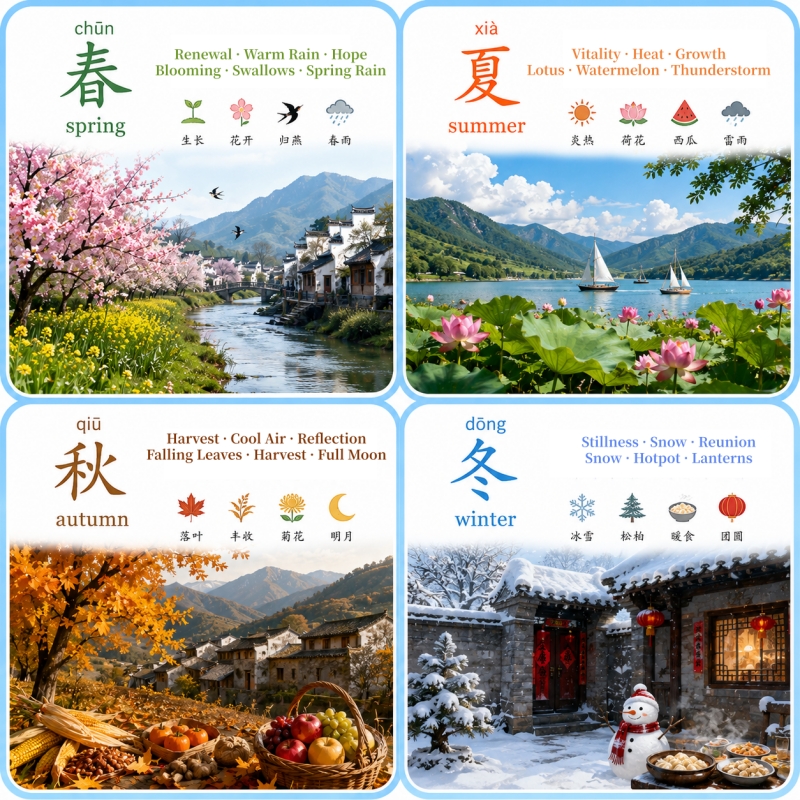
In Chinese, the four seasons are called 四季 (sìjì)–the four periods of spring ( 春( chūn), summer ( 夏 (xià), autumn ( 秋 (qiū), and winter ( 冬(dōng))–together 春夏秋冬 reflects the complete annual cycle of nature: the four elements of germination, flourishing, harvest, and storage. To grasp seasons in Chinese is to unveil an entire universe of raw emotional expression, festival traditions, meanings in cooking, and poetic living. It is to holds the keys to the rhythm of life in China, as well the cultural psyche and natural philosophy.
Chinese seasons have this double rhythm. The other one is of the universal Gregorian calendar, with our four that all the world beyond China recognizes. But our seasons are also of the old lunar calendar and the quaint Chinese 24 Solar Terms. So let this journey start from simple names and lead through some layers of meaning to experiencing China's four seasons in their entirety. Let the words become our instruments for sizing life warmer and deeper than cold characters.
Seasonal Overview: The Four Seasons at a Glance
The seasonal data in the table below draw from the two time systems Chinese people traverse side-by-side — the Gregorian Calendar (公历 Gōnglì) for modern life and international dealings, with its 4 seasons once again; and the Lunar Calendar (农历 Nónglì) which is the soul of traditional life, governing festivals like Spring Festival (春节) and Mid-Autumn Festival (中秋节), and the key to the 24 Solar Terms (二十四节气 Èrshísì Jiéqì) system dividing the sun’s passage about the year into 24 segments. Since 1912, we’ve been keeping both — Gregorian for modern purposes, Lunar for the cultural rhythm.
| Season | Chinese Name | Approximate Months (Gregorian) | Core Characteristics | Representative Imagery & Feelings |
|---|---|---|---|---|
| Spring | 春天 (Chūntiān) | March - May | Germination, rebirth, warm and rainy | Hope, revival, youth, gentleness |
| Summer | 夏天 (Xiàtiān) | June - August | Flourishing, scorching heat, peak vitality | Passion, energy, abundance, challenge |
| Autumn | 秋天 (Qiūtiān) | September - November | Maturity, cool weather, harvest and cooling | Abundance, poetry, contemplation, transition |
| Winter | 冬天 (Dōngtiān) | December - February | Storage, cold, silence and pause | Introspection, reunion, resilience, anticipation |
🌸 Spring (春 Chūn): Renewal and Gentle Awakening
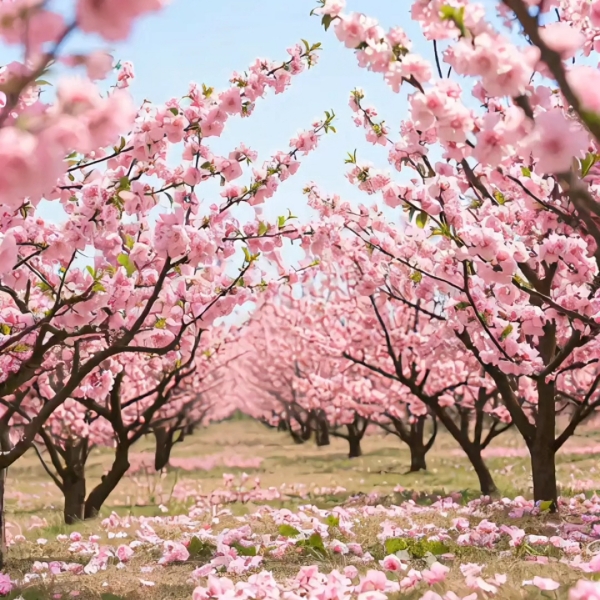
Spring (春 Chūn): The season of new beginnings in seasons in chinese
Core Chinese Character: 春 (chūn). The character's form resembles grass and trees breaking through soil under sunlight. Its original meaning represents growth and beginning.
Seasonal Timeline: Spring on the Gregorian calendar typically spans March to May. However, from the traditional solar terms perspective, Lichun (立春, around February 4) marks spring's beginning. It continues until Lixia (立夏, around May 6).
Seasonal Overview: Spring stands as the first of four seasons. It symbolizes renewal, hope, and vibrant vitality. In the Chinese linguistic context, everything related to "spring" carries this gentle yet vigorous essence.
Basic Vocabulary and Daily Life
| Category | Example Vocabulary | English Translation | Pinyin & Explanation |
|---|---|---|---|
| Names & Weather: | 春天 / 春季 | Spring / Spring Season | Chūntiān / Chūnjì |
| 多雨 | Rainy | Duō yǔ (Rainy) | |
| 温暖 | Warm | Wēnnuǎn (Warm) | |
| 春风 | Spring Breeze | Chūnfēng (Spring breeze) | |
| Clothing: | 风衣 | Windbreaker | Fēngyī (Windbreaker) |
| 雨衣 / 雨靴 | Raincoat / Rain Boots | Yǔyī / Yǔxuē (Raincoat / Rain boots) | |
| Activities: | 骑自行车 | Cycling | Qí zìxíngchē (Cycling) |
| 种花 / 放风筝 | Planting Flowers / Flying Kites | Zhòng huā / Fàng fēngzheng (Planting flowers / Flying kites) | |
| Food: | 春卷 | Spring Rolls | Chūnjuǎn (Spring rolls) |
Cultural Significance and Extended Vocabulary
| Vocabulary | English | Connotation & Example |
|---|---|---|
| 春节 (Chūnjié) | Spring Festival / Lunar New Year | Lunar New Year, the most important family reunion festival. If you want to explore deeper into spring celebrations, check out our guide on the best spring festivals in China for more cultural insights. |
| 青春 (Qīngchūn) | Youth / Prime of Life | "Young spring," referring to youth and youthful years. |
| 春心 (Chūnxīn) | Romantic Feelings | Budding feelings of affection, as in "spring heart stirring." |
| 春雨 (Chūnyǔ) | Spring Rain | Gentle rain that nourishes all things, often metaphor for grace. |
Corresponding Solar Terms
Key Spring Solar Terms: Lichun (立春 Beginning of Spring), Yushui (雨水 Rain Water), Jingzhe (惊蛰 Awakening of Insects), Chunfen (春分 Spring Equinox), Qingming (清明 Pure Brightness), Guyu (谷雨 Grain Rain).
The Qingming solar term holds special cultural significance. To understand its traditional customs and meaning within seasons in Chinese culture, explore Qingming Festival traditions. Similarly, Guyu marks the final spring solar term before summer begins. Learn about Guyu's agricultural importance in Chinese seasonal cycles.
Seasonal Travel Recommendations
March to May is the prime season for spring outings across China, when mild temperatures and blooming landscapes create ideal travel conditions. Key spring destinations include:
- Jiangnan water towns such as Suzhou and Hangzhou, which offer poetic misty-rain scenery nourished by spring showers.
- Wuhan University's cherry blossoms (March) and Luoyang's peony festival (April), both celebrated spring highlights.
- Southern China, where spring arrives early and vibrantly — discover what Guangzhou spring brings in terms of weather and activities.
☀️ Summer (夏 Xià): Heat and Vibrant Abundance

Summer (夏 Xià): The season of growth in seasons in chinese
Core Chinese Character: 夏 (xià). The character's form resembles a person stretching limbs, feeling the sun's scorching heat and fullness.
Seasonal Timeline: Summer on the Gregorian calendar typically spans June to August. Traditional solar terms mark Lixia (立夏, around May 6) as summer's beginning. It continues until Liqiu (立秋, around August 8).
Seasonal Overview: Summer represents the season when life energy reaches its peak. It overflows with light, heat, and abundance. It symbolizes both vitality and prosperity as well as the test of sweltering weather.
Basic Vocabulary and Daily Life
| Category | Example Vocabulary | English Translation | Pinyin & Explanation |
|---|---|---|---|
| Names & Weather: | 夏天 / 夏季 | Summer / Summer Season | Xiàtiān / Xiàjì |
| 炎热 | Scorching Hot | Yánrè (Hot) | |
| 酷暑 | Extreme Heat | Kùshǔ (Scorching heat) | |
| Clothing: | 短袖 / 短裤 | Short Sleeves / Shorts | Duǎnxiù / Duǎnkù (Short sleeves / Shorts) |
| 裙子 / 凉鞋 | Dress / Sandals | Qúnzi / Liángxié (Dress / Sandals) | |
| 游泳衣 | Swimsuit | Yóuyǒngyī (Swimsuit) | |
| Activities: | 游泳 | Swimming | Yóuyǒng (Swimming) |
| 玩沙 | Playing in Sand | Wán shā (Playing in sand) | |
| Food: | 西瓜 (Xīguā) | Watermelon | Classic summer fruit for beating the heat. |
| 绿豆汤 | Mung Bean Soup | Lǜdòu tāng (Mung bean soup) |
Cultural Significance and Extended Vocabulary
| Vocabulary | English | Connotation & Example |
|---|---|---|
| 夏至 (Xiàzhì) | Summer Solstice | Summer Solstice, the longest day of the year (around June 21). |
| 夏夜 (Xiàyè) | Summer Night | Summer nights filled with insect chirping and relaxing chatter. |
| 蝉 (Chán) | Cicada | Cicadas, the iconic sound of summer. |
| 苦夏 (Kǔxià) | Summer Fatigue | Summer suffering caused by heat, leading to poor appetite and fatigue. |
| 华夏 (Huáxià) | Huaxia (Ancient Name for China) | An ancient name for China, where "xià" carries connotations of civilization and elegance. |
Corresponding Solar Terms
Key Summer Solar Terms: Lixia (立夏 Beginning of Summer), Xiaoman (小满 Grain Buds), Mangzhong (芒种 Grain in Ear), Xiazhi (夏至 Summer Solstice), Xiaoshu (小暑 Minor Heat), Dashu (大暑 Major Heat).
The Lixia solar term traditionally signals summer's arrival in seasons in Chinese tradition. Discover Lixia Festival customs that mark this seasonal transition. Furthermore, the Dragon Boat Festival often falls during early summer. Learn about traditional Dragon Boat Festival food enjoyed during this period.
Seasonal Travel Recommendations
June to August is ideal for coastal and mountain escapes that offer relief from the heat. Summer travel highlights include:
- Qingdao and Xiamen for sunshine, beaches, and fresh seafood along China's eastern coast.
- Shangri-La in Yunnan and Changbai Mountain in Northeast China, both renowned as cool summer retreats at high altitude.
- City night markets and late-night food culture, which come alive during summer evenings across major urban centers.
- For timing around major events, refer to Shanghai holidays 2026 to plan around seasons in Chinese celebrations. Southern regions also offer Chinese litchi season in early summer.
🍂 Autumn (秋 Qiū): Harvest and Contemplative Beauty
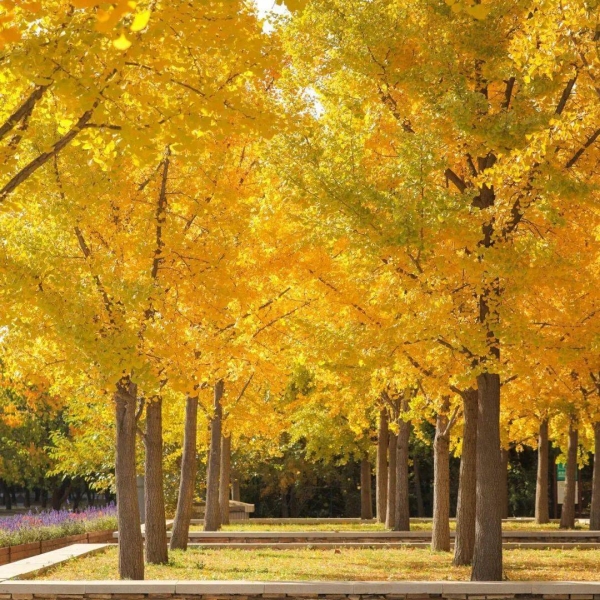
Autumn (秋 Qiū): The season of abundance in seasons in chinese
Core Chinese Character: 秋 (qiū). The character combines "禾" (grain) with "火" (fire, symbolizing golden ripeness or burning fields for fertilization). Its original meaning represents harvest and transition.
Seasonal Timeline: Autumn on the Gregorian calendar typically spans September to November. Traditional solar terms mark Liqiu (立秋, around August 8) as autumn's beginning. It continues until Lidong (立冬, around November 7).
Seasonal Overview: Autumn is the season of maturity and harvest. It also marks the starting point toward desolation. It overflows with poetic beauty while carrying a tinge of melancholy. Therefore, it is the season with the most complex and profound emotions.
Basic Vocabulary and Daily Life
| Category | Example Vocabulary | English Translation | Pinyin & Explanation |
|---|---|---|---|
| Names & Weather: | 秋天 / 秋季 | Autumn / Autumn Season | Qiūtiān / Qiūjì |
| 凉爽 | Cool and Refreshing | Liángshuǎng (Cool) | |
| 干燥 | Dry | Gānzào (Dry) | |
| 秋高气爽 | Clear Autumn Sky | Qiū gāo qì shuǎng (Clear autumn sky) | |
| Clothing: | 外套 | Coat | Wàitào (Coat) |
| 夹克 | Jacket | Jiákè (Jacket) | |
| Activities: | 登高 | Mountain Climbing | Dēnggāo (Mountain climbing) |
| 踢球 / 打篮球 | Playing Soccer / Basketball | Tī qiú / Dǎ lánqiú (Playing soccer / Basketball) | |
| Food: | 月饼 (Yuèbǐng) | Mooncake | Traditional Mid-Autumn Festival food. |
| 螃蟹 | Crab | Pángxiè (Crab) |
Cultural Significance and Extended Vocabulary
| Vocabulary | English | Connotation & Example |
|---|---|---|
| 中秋节 (Zhōngqiū Jié) | Mid-Autumn Festival | Mid-Autumn Festival on lunar August 15th, celebrating moon viewing and reunion. |
| 秋收 (Qiūshōu) | Autumn Harvest | Autumn harvest of crops. |
| 秋叶 (Qiūyè) | Autumn Leaves | Specifically refers to color-changing red and yellow leaves, autumn scenery. |
| 多事之秋 (Duō shì zhī qiū) | Troubled Times | Metaphor for a period with many troubles and changes. |
| 愁 (Chóu) | Melancholy / Sorrow | "Autumn" plus "heart," vividly embodying autumn's melancholic mood. |
Corresponding Solar Terms
Key Autumn Solar Terms: Liqiu (立秋 Beginning of Autumn), Chushu (处暑 End of Heat), Bailu (白露 White Dew), Qiufen (秋分 Autumn Equinox), Hanlu (寒露 Cold Dew), Shuangjiang (霜降 Frost's Descent).
Seasonal Travel Recommendations
September to November is widely regarded as the golden season for witnessing China's most spectacular color transformations. The cool, clear weather makes it perfect for outdoor exploration. Top autumn destinations include:
- Beijing's Fragrant Hills and Nanjing's Qixia Mountain, famous for vivid red foliage from late October through November.
- Xinjiang's Kanas Lake and Inner Mongolia's Ejina Banner, offering fairytale-like golden poplar forests from late September to October.
- Major cities that showcase spectacular autumn scenery — explore Beijing's autumn colors when seasons in Chinese tradition celebrate harvest and beauty.
❄️ Winter (冬 Dōng): Stillness and Warmth in Gathering

Winter (冬 Dōng):The season of quiet rest in seasons in chinese
Core Chinese Character: 冬 (dōng). The pictograph represents the two ends of a rope knot. It expresses conclusion and storage, like seeds hibernating underground.
Seasonal Timeline: Winter on the Gregorian calendar typically spans December to February. Traditional solar terms mark Lidong (立冬, around November 7) as winter's beginning. It continues until next year's Lichun.
Seasonal Overview: Winter is the season of conclusion and storage. It symbolizes cold, silence, and pause. However, it also means introspection, reunion, and quiet waiting for a new cycle.
Basic Vocabulary and Daily Life
| Category | Example Vocabulary | English Translation | Pinyin & Explanation |
|---|---|---|---|
| Names & Weather: | 冬天 / 冬季 | Winter / Winter Season | Dōngtiān / Dōngjì |
| 寒冷 | Cold | Hánlěng (Cold) | |
| 下雪 / 结冰 | Snowing / Freezing | Xià xuě / Jié bīng (Snowing / Freezing) | |
| Clothing: | 大衣 / 毛衣 | Overcoat / Sweater | Dàyī / Máoyī (Overcoat / Sweater) |
| 靴子 / 手套 | Boots / Gloves | Xuēzi / Shǒutào (Boots / Gloves) | |
| 帽子 | Hat | Màozi (Hat) | |
| Activities: | 滑雪 / 溜冰 | Skiing / Ice Skating | Huá xuě / Liū bīng (Skiing / Ice skating) |
| 堆雪人 | Building Snowmen | Duī xuěrén (Building snowmen) | |
| Food: | 火锅 (Huǒguō) | Hotpot | Best choice for winter gatherings and warmth. |
| 饺子 | Dumplings | Jiǎozi (Dumplings) |
Cultural Significance and Extended Vocabulary
| Vocabulary | English | Connotation & Example |
|---|---|---|
| 冬至 (Dōngzhì) | Winter Solstice | Winter Solstice, shortest day of the year (around December 22). Folk saying goes "Winter Solstice is as important as the New Year." |
| 冬眠 (Dōngmián) | Hibernation | Animal hibernation, extended meaning of rest and recuperation. |
| 寒冬 (Hándōng) | Harsh Winter | Harsh winter, also metaphor for difficult times. |
| 岁寒三友 (Suìhán sānyǒu) | Three Friends of Winter | Three Friends of Winter: pine, bamboo, and plum, symbolizing noble character in adversity. |
Corresponding Solar Terms
Key Winter Solar Terms: Lidong (立冬 Beginning of Winter), Xiaoxue (小雪 Minor Snow), Daxue (大雪 Major Snow), Dongzhi (冬至 Winter Solstice), Xiaohan (小寒 Minor Cold), Dahan (大寒 Major Cold).
Seasonal Travel Recommendations
December to February presents sharply contrasting winter experiences across China's vast geography, offering something memorable for every type of traveler. Key winter destinations include:
- Northern China for magnificent ice and snow worlds — Harbin's internationally renowned ice sculpture festival and Jilin's ethereal rime wonders are seasonal highlights not to be missed. For a full look at what the north offers, explore winter activities in China.
- Southern escapes to Hainan Island or Yunnan's Xishuangbanna for warm weather and tropical scenery during the coldest months.
- Lunar New Year (usually January or February), the best time to experience China's most vibrant traditional winter celebrations in cities and rural areas alike.
- Urban winter culture in major cities, where seasons in Chinese life shape everyday rhythms — experience Shanghai in winter to see how the season transforms city life. Also look ahead to Chinese New Year 2027 zodiac animal to understand how seasons connect to annual cycles.
The 24 Solar Terms: China's Micro-seasonal Rhythm
If the four seasons are grand chapters, then the 24 Solar Terms (二十四节气 Èrshísì Jiéqì) are their exquisite verses. This ancient wisdom system originates from the Yellow River Basin. It has over two thousand years of history. It divides the sun's annual movement trajectory precisely into 24 equal parts. Each solar term lasts about 15 days.
It extends far beyond mere calendar marking. Rather, it served as ancient Chinese agricultural civilization's "time bible" and concentrated expression of life philosophy. Its monthly distribution roughly covers the following Gregorian calendar periods:
- Spring Solar Terms: Lichun (February), Yushui (February), Jingzhe (March), Chunfen (March), Qingming (April), Guyu (April).
- Summer Solar Terms: Lixia (May), Xiaoman (May), Mangzhong (June), Xiazhi (June), Xiaoshu (July), Dashu (July).
- Autumn Solar Terms: Liqiu (August), Chushu (August), Bailu (September), Qiufen (September), Hanlu (October), Shuangjiang (October).
- Winter Solar Terms: Lidong (November), Xiaoxue (November), Daxue (December), Dongzhi (December), Xiaohan (January), Dahan (January).
Its scientific nature lies in purely relying on solar position ("fixed qi method") for determination. It reflects precise climate and phenological changes. Functionally, each solar term name acts like a brief agricultural instruction or weather forecast. It guides sowing, cultivating, harvesting, and storing. This represents ancient people's vivid practice of "following nature's way."
Even today, it still affects Chinese people's: diet ("Winter Solstice dumplings, Summer Solstice noodles"), health cultivation ("cover up in spring, expose in autumn"), festivals (Qingming, Winter Solstice). If you know a solar term, you can take time with a finer scale. You can feel this connection between astronomy, geography, and humanity through its many points. In every fifteen days, the Chinese sense the breath of heaven and earth.
How to Bring Seasons in Chinese to Life in Your Learning
- Establish Cultural Anchors: Link each season with one core festival and typical activity for memory binding (for example: Spring-Spring Festival-kite flying; Summer-Dragon Boat-dragon boat racing; Autumn-Mid-Autumn-moon viewing; Winter-Winter Solstice-eating dumplings).
- Learn Emotional Vocabulary: Actively accumulate words using season characters to express emotions and states (like "youth," "suffering summer," "melancholic feelings," "harsh winter"). This is key to understanding Chinese thinking patterns.
- Identify in Daily Life: Wherever you are, observe current weather, scenery, and people's activities. Mentally label them with Chinese vocabulary for seasons and solar terms.
- Use Solar Terms for Refined Perception: From each season, select one or two most representative solar terms (like Qingming's spring outings, Mangzhong's farming rush, Bailu's cooling, Daxue's storage) for in-depth understanding. Experience time's subtle scales.
- Integrate into Language Application: In sentence construction, diaries, or conversations, consciously use seasons and solar terms as time adverbials. For example, "Last autumn, I visited Beijing's Fragrant Hills red leaves" or "Winter Solstice is approaching; time to eat lamb."
By such all-round study you do not just learn the four words, spring-summer-autumn-winter, but also full possession of the keys to Chinese natural philosophy, aesthetics of life and literary feelings, to turn time into spring breeze, summer cicadas, autumn moon, winter snow, a cyclie poem of generation, abounding life, harvest enabling care and making possible preservation.
FAQs: Common Questions About Seasons in Chinese
Q: What are the four seasons called in Chinese?
The four seasons in Chinese are 春天 (chūntiān) for spring, 夏天 (xiàtiān) for summer, 秋天 (qiūtiān) for autumn, and 冬天 (dōngtiān) for winter. Learning seasons in Chinese opens doors to understanding traditional festivals, agricultural wisdom, and poetic expressions deeply embedded in Chinese culture. Each season character carries symbolic meanings beyond simple weather descriptions, connecting to life cycles and philosophical concepts.
Q: How do the 24 Solar Terms relate to seasons in Chinese culture?
The 24 Solar Terms (二十四节气) divide each season into six micro-seasons of approximately 15 days each. Understanding seasons in Chinese tradition means recognizing these solar terms as precise markers for agricultural activities, dietary changes, and health practices. For instance, Lichun marks spring's beginning while Qingming signals ancestor worship time. These terms reflect how Chinese culture perceives nature's rhythms with remarkable precision and integration.
Q: Why does China use both lunar and Gregorian calendars for seasons?
China adopted the Gregorian calendar in 1912 for international alignment while preserving the lunar calendar for cultural continuity. When discussing seasons in Chinese contexts, both systems coexist harmoniously. The Gregorian calendar governs modern work schedules, while the lunar calendar determines traditional festival dates and solar terms. This dual system enriches how Chinese people experience time, blending practical modernity with ancestral wisdom throughout the year.
Q: What seasonal foods are most important in Chinese culture?
Seasonal eating deeply connects to seasons in Chinese philosophy and health practices. Spring features spring rolls and fresh greens, summer brings watermelon and mung bean soup for cooling, autumn showcases mooncakes and hairy crabs, while winter centers on hotpot and dumplings for warmth. Each season's foods align with Traditional Chinese Medicine principles, balancing the body's needs with nature's offerings and demonstrating the practical wisdom embedded in seasonal living.
Q: How do Chinese people greet each other during different seasons?
Seasonal greetings in Chinese often reference weather and seasonal characteristics. Learning seasons in Chinese includes understanding phrases like "春天好" (spring greetings), "天气很热" (it's hot) in summer, "秋高气爽" (clear autumn weather) in fall, and "冬天冷" (cold winter) greetings. Additionally, people exchange specific wishes during solar terms and seasonal festivals, reflecting how deeply seasons permeate daily communication and social interactions throughout Chinese-speaking regions.
Q: What's the best season to visit China?
The best visiting season depends on your interests when exploring seasons in Chinese landscapes and culture. Spring (March-May) and autumn (September-November) offer mild weather nationwide and stunning natural scenery. Summer suits coastal areas and high-altitude regions, while winter provides unique experiences like ice festivals in Harbin or warm escapes to southern China. Each season showcases different regional characteristics, festivals, and landscapes, making every period valuable for distinct cultural and natural encounters.