Tang Dynasty Neckline Styles
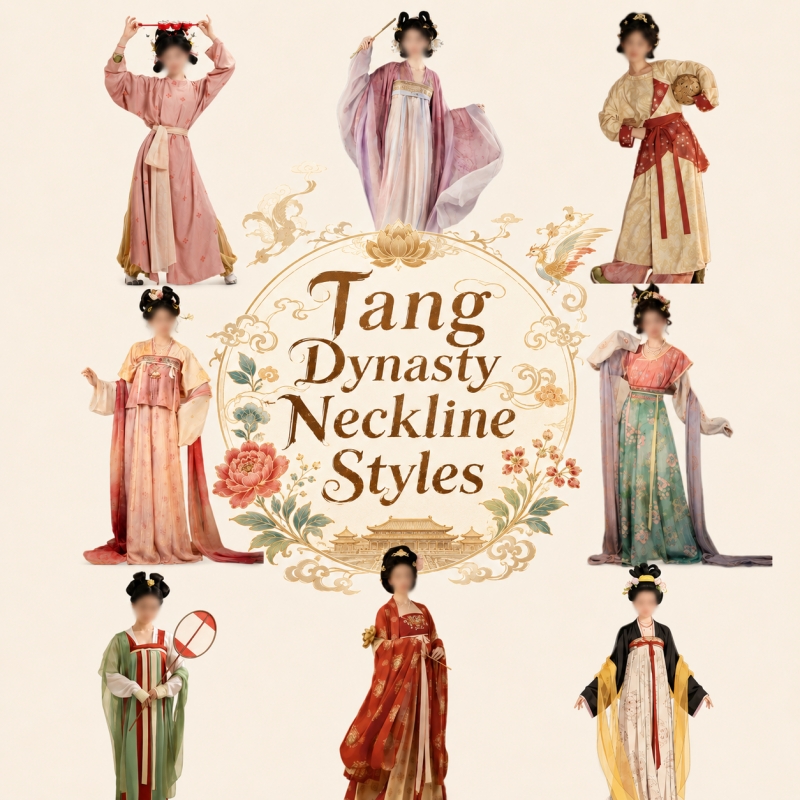
The Tang Dynasty (618–907 CE) gave Chinese dress its most visually striking feature. The low-cut Tang Dynasty neckline sat at the center of that look, and it is still the single most recognizable element of Tang women's fashion today. Far more revealing than anything that came before or after, the deep-cut tanling collar broke with Confucian modesty in favor of Silk Road openness, reflecting a court that measured itself against the world rather than against tradition. This guide unpacks the specific Tang Dynasty neckline types, traces how they shifted across four eras, and tells visitors to Xi'an where to see and wear them in person.
Quick Facts
The Tanling: Tang Dynasty's Most Iconic Low-Cut Neckline
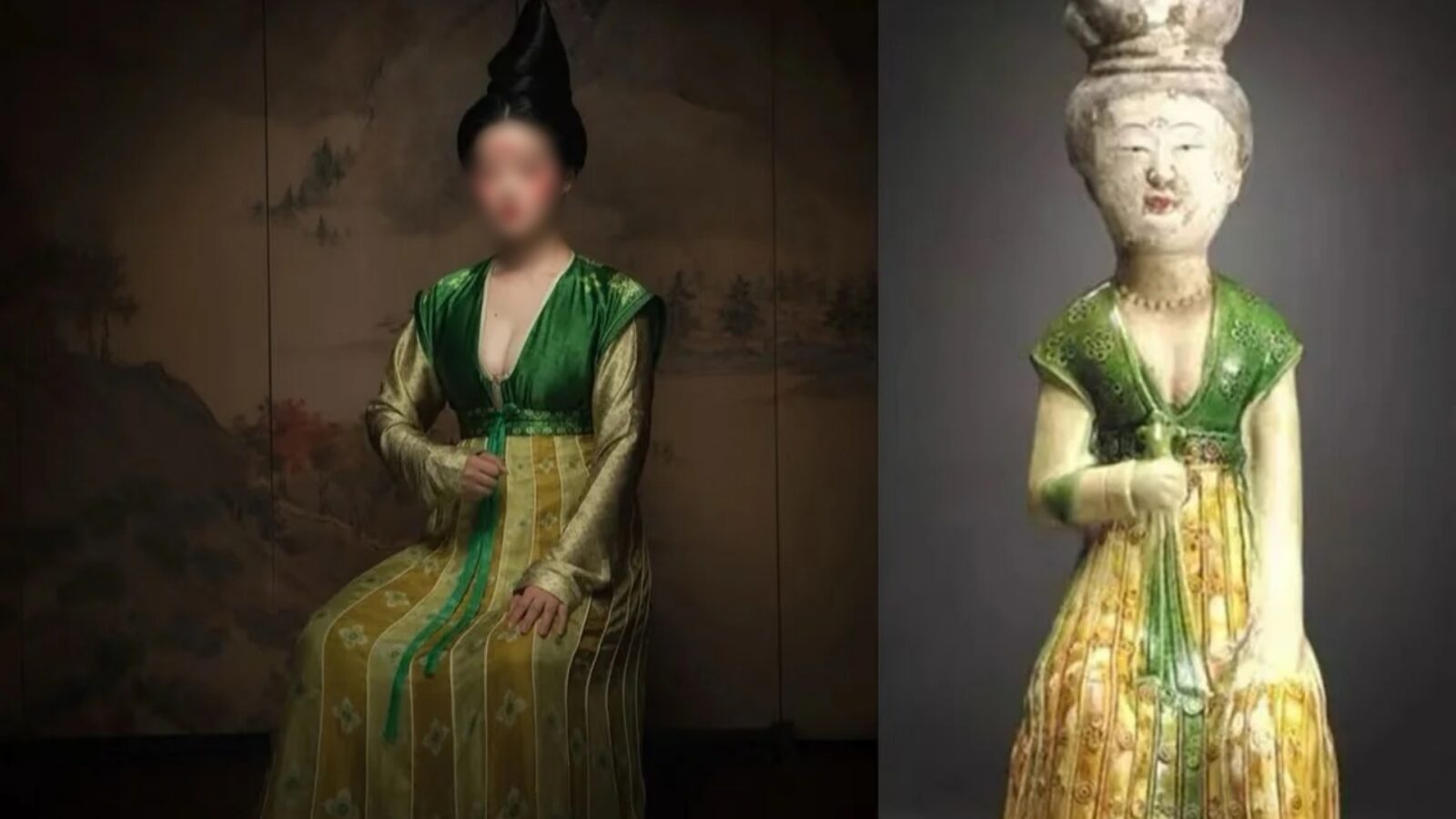
Elegant Tanling Neckline
The tanling (袒领) is the Tang Dynasty neckline most people picture when they think of Tang dress. The inner shirt's neckline was cut in a deep U or heart shape, and the skirt was tied up to bust level — the chest and the upper portion of the shirt sat exposed above the knot. The effect came from the shirt being drawn tight across the bust and knotted there, so the fabric above the knot fell open into a wide curve. This is the opposite of the high-collar Han norm; it is what gave Tang women's dress its cosmopolitan, almost Hellenistic feel to Western eyes. An outer banbi jacket or daxiushen long robe covered the shoulders and arms, so the body remained largely covered — only the chest line and upper shirt were visible above the knot.
Fashion, Silhouette and Social Status in Tang Dynasty
The tanling construction was deceptively sophisticated. A tanling set consisted of an inner shirt cut wide and low, a skirt hoisted to the bust and knotted, and an optional outer layer — a short banbi jacket or a flowing daxiushen robe — covering the shoulders and arms. Sleeves billowed at the wrist during the Middle and Late Tang periods. The exposed chest was not accidental but tasteful: the shirt fabric itself framed the line, turning an exposed area into a deliberate design element.
The tanling Tang Dynasty neckline was a status marker as much as a fashion statement. Fuller figures were fashionable in the High Tang era because Silk Road and Central Asian ideals favored a rounder silhouette, and the low cut showed that figure off to advantage. After the An Lushan Rebellion in 755 CE muted court colors, the silhouette grew heavier and more layered, yet the tanling cut itself persisted — softened, not abandoned. By Late Tang, the inner shirt was made of near-sheer silk and worn without an underlayer, making the tanling the boldest visible element on the body. Throughout the dynasty, the tanling was a sign of being cosmopolitan — the Tang equivalent of a fashion-forward silhouette.
💃 Complete Your Traditional Cultural Look: When renting Tang Dynasty attire or posing for cultural photoshoots in Xi'an, traditional fans serve as the perfect classic accessory. Read our complete feature on Chinese Dance Fans.
Other Tang Dynasty Neckline Types Worth Knowing
-
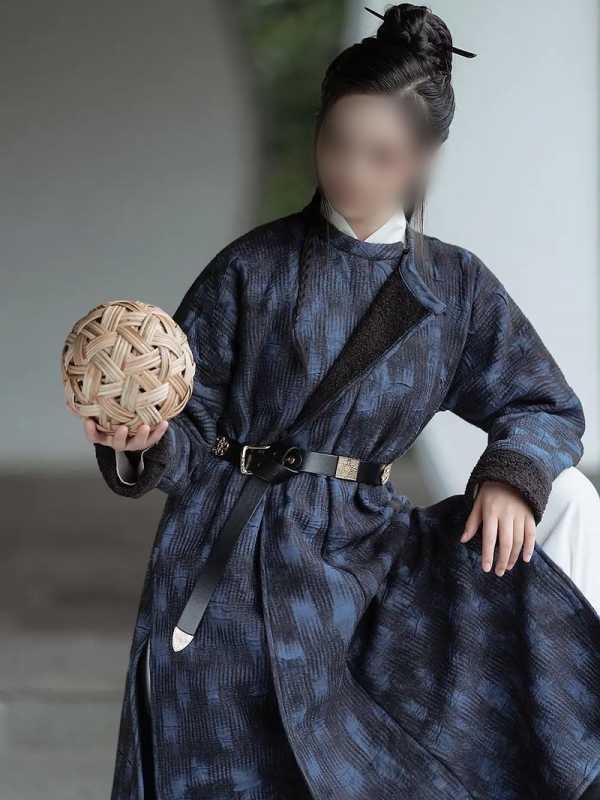

- Yuanling (Round Collar)
-
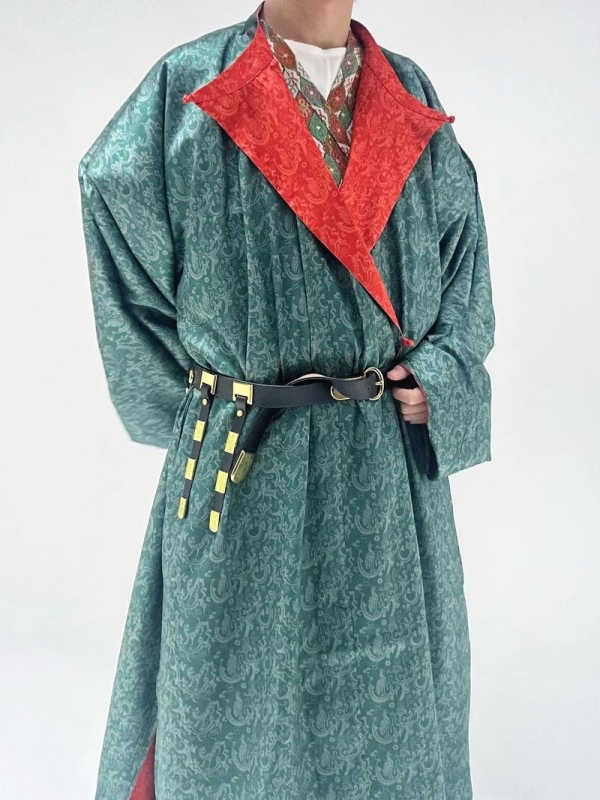
- Jiaoling (Crossed Collar)
-
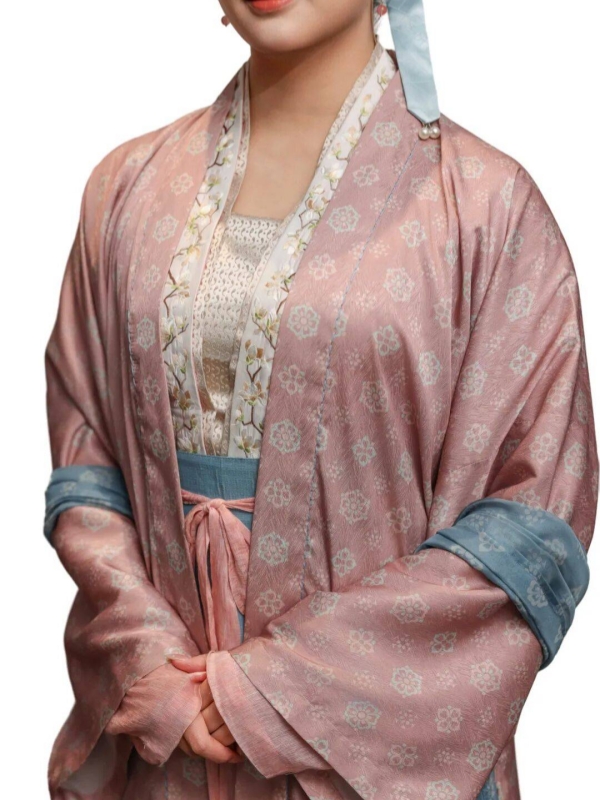
- The Zhiling
Not every Tang Dynasty neckline was a tanling. Three other collar types recur across surviving figurines, tomb murals, and silk paintings. The yuanling (圆领) — a closed round neck opening with no overlap — was the standard men's robe collar and came from Xianbei nomadic riding robes of the north; Wu Zetian pushed it into everyday women's wear. The jiaoling (交领) was the traditional Han-Chinese two-panel overlap, typically left over right, retained in Tang formal and ceremonial robes and as the inner shirt worn beneath the tanling.
The zhiling (直领) and jixinling (鸡心领) — straight parallel and heart-shaped collars — appeared on ceremonial wear and dancers' costumes, the heart shape being essentially a sharper-cornered tanling. These four collar types were not mutually exclusive; a Tang woman might wear a jiaoling inner shirt beneath a tanling outer construction. The yuanling in particular had a long afterlife: it became the structural basis of the Korean hanbok and shaped early Japanese kimono construction during the Nara period (710–794 CE).
Yuanling (Round Collar)
The yuanling was a closed round neckline with no overlap across the chest. It was the defining collar of the men's yuanlingpao robe and the most "nomadic" of the Tang collar types. Originally worn by Xianbei horsemen of the northern steppes, it entered the Tang court wardrobe and was adopted into everyday women's clothing during the reign of Wu Zetian (r. 624–705 CE), making it the first major break from the Han-derived crossed collar tradition.
Jiaoling (Crossed Collar)
The jiaoling consisted of two fabric panels overlapping across the chest, traditionally left over right — the standard Han-Chinese collar that had been the norm for centuries before the Tang. In Tang dress it was retained for formal ceremonial robes and served as the inner shirt worn beneath the tanling, giving the wearer a modesty layer that the outer cut could reveal or conceal depending on setting.
Zhiling and Jixinling
Zhiling described a straight, symmetrical collar with parallel edges running down the front. Jixinling — the heart-shaped collar — was essentially a tanling with sharper, more angular corners rather than the wide U curve. Both appeared on Late Tang ceremonial wear and on dancers' costumes, giving court tailors a way to signal formality while retaining the revealing spirit of the era's fashion.
How Tang Dynasty Necklines Changed Across the Four Eras
Tang Dynasty Necklines
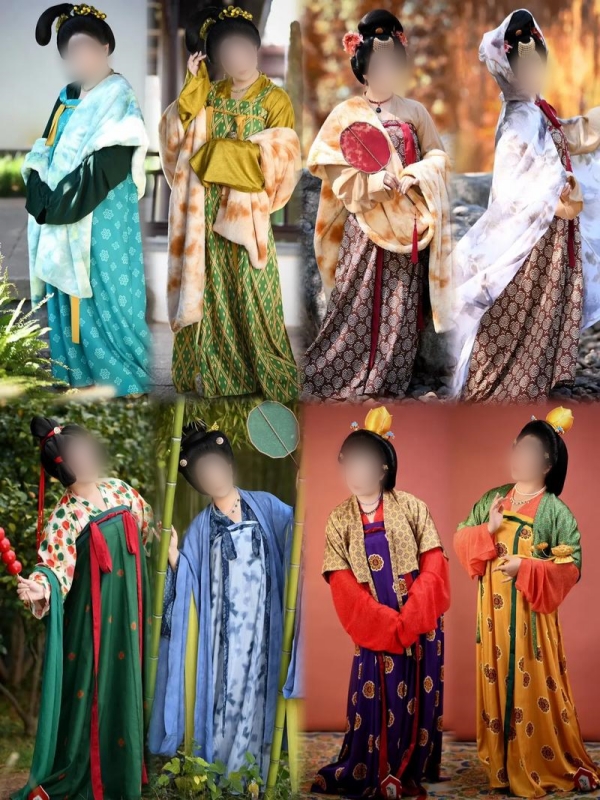
The Tang Dynasty neckline was not a fixed tradition but shifted with politics, trade, and taste across four named eras. Early Tang (618–713 CE) kept the tanling visible but relatively shallow, paired with short banbi jackets and slim skirts tied high — a silhouette that reads as restrained compared to what followed. High Tang (713–766 CE) brought the apex: the tanling cut ran deepest, sleeves stretched longer and wider, and floral silk in vivid hues dominated. This was the most revealing Tang Dynasty neckline in the dynasty's history.
Middle Tang (766–835 CE) arrived after the An Lushan Rebellion in 755 CE shifted the court's mood; colors darkened, sleeves billowed further, and more layers accumulated over the chest, yet the tanling cut survived — softened by inner panels rather than abandoned. Late Tang (835–907 CE) took the aesthetic to its logical extreme: near-sheer silk replaced opaque cloth, the inner shirt was worn without an underlayer, and the tanling became the single most dramatic element on display. Face decoration — huadian, xiehong, mianye — was layered on top, turning the head and chest into a coordinated visual statement.
Early Tang Necklines
Early Tang dress paired a short banbi jacket over a slim skirt tied high, with the tanling neckline visible but shallower than it would become. Blocky floral patterns marked the fabrics. The silhouette was close-cut and modest by High Tang standards, reflecting a court still drawing on Sui dynasty conventions while slowly opening to nomadic influences from the north.
High Tang Necklines
The High Tang era (713–766 CE) cut the tanling at its deepest and widest. Sleeves stretched longer and wider than in any previous period, sleeves often terminating in exaggerated cuffs. Floral-print silk in bright colors — pomegranate red, saffron yellow — became the court norm. The fuller-figure ideal from Central Asia meant the revealing tanling was doing exactly what it was designed to do: displaying a status-driven silhouette that communicated both wealth and cosmopolitan confidence.
Middle Tang Necklines
The An Lushan Rebellion in 755 CE darkened more than the political horizon. Court fashion shifted toward deeper colors and heavier fabrics, and sleeves billowed further to signal a different kind of presence — one rooted in material weight rather than cut exposure. More layers were added over the chest, and inner panels partially re-covered what the tanling had left bare. The cut persisted but grew more guarded, a fashion that remembered High Tang openness while responding to a changed world.
Late Tang Necklines
Late Tang pushed the tanling to its most extreme expression yet. Near-sheer silk replaced the opaque fabrics of earlier eras, and the inner shirt was frequently worn without an underlayer, making the tanling not just a collar but the dominant visual event of the costume. Face decoration — the three-part huadian, xiehong, and mianye — was applied elaborately, so the head and the chest operated as a single coordinated canvas. This was Tang fashion at its most theatrical.
👗 Trace the Evolution of Chinese Dress: While the low-cut Tang collar represented a unique peak of ancient openness, Chinese fashion underwent another dramatic, globalized transformation centuries later with the rise of the tailored qipao. Explore this modern style shift in our guide to Chinese 1920s Fashion.
Silk Road Influence on the Tang Dynasty Neckline
Xianbei Nomadic Riding Robes
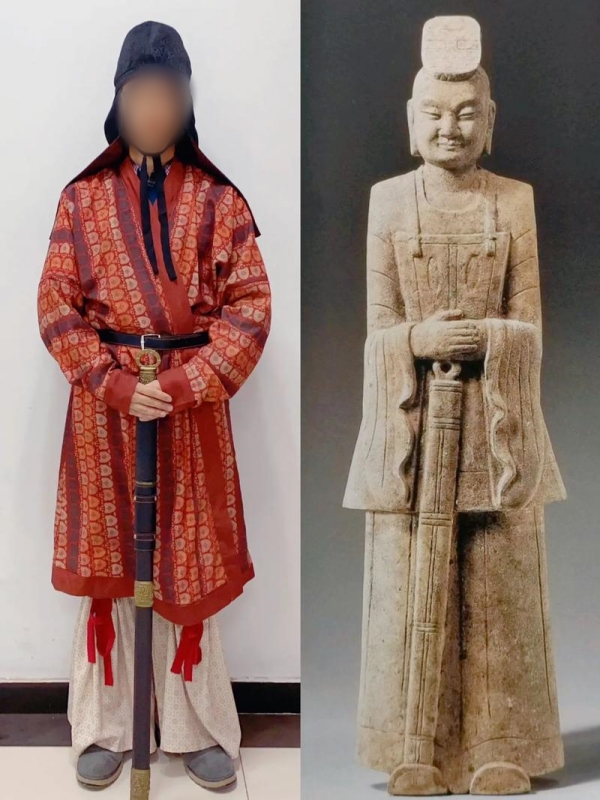
The Tang Dynasty neckline is not purely Chinese in origin. The tanling's deep cut and the yuanling's round collar both carry non-Han roots that entered through the Silk Road and the steppe cultures north of the Great Wall. The Xianbei nomads wore round-collared riding robes with high-tied skirts — practical for horse riding, adapted by the Sui-Tang court into court dress, then exaggerated into the tanling at the height of the High Tang era. Wu Zetian (r. 624–705 CE), China's only female emperor, made one of the most consequential fashion decisions in Chinese history: she normalized the men's yuanlingpao — a round-collared robe — as everyday women's wear.
The move signaled both political openness and a willingness to embrace "foreign" fashion as a form of cultural confidence. The fuller-figure beauty ideal — rounder faces and bodies replacing the slim Han ideal — arrived from Central Asia and Persia via trade routes, and the tanling's cut was designed to display it. The outward flow was equally strong: Tang court fashion shaped the Korean hanbok (Silla dynasty, 57 BCE–935 CE) and early Japanese kimono (Nara period, 710–794 CE), as ambassadors carried the high-tied skirt and banbi jacket as diplomatic gifts and cultural symbols.
The Xianbei and Nomadic Origins
The yuanling round collar and the high-tied skirt of Tang women's dress both trace back to Xianbei nomadic riding robes. Xianbei horsemen needed a collar that did not restrict movement and a skirt tied high enough to sit a horse comfortably. The Sui-Tang court adopted both forms — a political act as much as an aesthetic one — and then during the High Tang era exaggerated them into the tanling's signature deep curve. The nomadic base never fully disappeared from the garment's DNA.
Wu Zetian and the Yuanlingpao Shift
Wu Zetian (624–705 CE) did not just rule the Tang Dynasty — she reshaped its fashion landscape. Her decision to promote the yuanlingpao, the men's round-collared robe, into everyday women's clothing was the most dramatic shift in the Tang Dynasty neckline's history. The yuanling had long been a men's garment, but under her reign it became a marker of women's expanded social authority and a political statement in fabric. The fact that a woman could dictate what a collar meant — and that the court followed — tells you everything about where Tang fashion power actually sat.
Where to See Tang Dynasty Neckline Fashion Today
Tang Dynasty Neckline at Shaanxi History Museum
Xi'an, built on the site of Tang capital Chang'an, offers three on-the-ground channels for seeing or wearing a Tang Dynasty neckline today. The city's museums hold the densest collections of Tang artifacts in the world; live theatre puts the tanling on stage with live music; and a growing costume-rental industry lets visitors wear the look themselves. The best months to visit Xi'an are March–May and September–November, when temperatures are comfortable for walking between outdoor and indoor venues.
Museums and Galleries in Xi'an
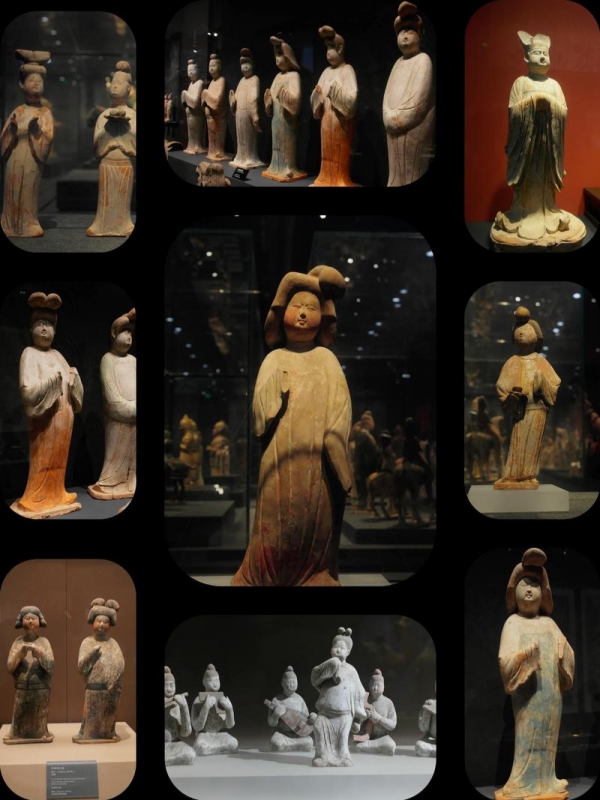
The Shaanxi History Museum is the single best place in China to see Tang Dynasty neckline fashion in surviving artifacts. Gold figurines, silk fragments, and tomb murals display the tanling, yuanling, and jiaoling in detail that no reproduction can match. Entry to the permanent collection is free with an advance reservation; special exhibitions charge roughly $4–7 (¥30–50). Allocate at least half a day — the Tang collection alone spans multiple galleries.
🏺 View Original Artifacts: To see the actual pottery figurines, paintings, and murals that preserved these deep-cut collar designs through the centuries, a visit to one of China's premier national galleries is essential. Learn how to secure your tickets and what masterpieces to look for in our guide to the Shaanxi History Museum, Xi'an, China.
Tang Dynasty Shows and Performances
Two venues in Xi'an put the tanling on stage with live orchestral music. "Tang Dynasty Legend," performed near the Big Wild Goose Pagoda, and the Tang Paradise evening show in Qujiang both feature dancers in tanling ruqun sets, accompanied by period instruments. Tickets are bookable on Trip.com and typically run $42–56 (¥300–400). The performances run year-round, but the evening outdoor shows at Tang Paradise are most atmospheric in spring and autumn.
Costume Rental Shops in Xi'an
A cluster of hanfu and Tang costume rental shops near the Big Wild Goose Pagoda and Tang Paradise lets visitors wear a tanling ruqun set in real time. Basic rental — dress yourself in a standard tanling ruqun — costs $14–21 (¥100–150). Premium packages add professional hair styling and face painting to match the Late Tang huadian aesthetic, running $42–70 (¥300–500). Most shops take walk-ins, but booking through Trip.com Experiences is more reliable during peak season.
🕌 See and Wear It in Person: If you are visiting the ancient Tang capital to experience this historic dress firsthand, there are several iconic parks, historical blocks, and ancient walls where visitors can rent and wear traditional Hanfu. Plan your sightseeing itinerary with our guide to the best Xian Tourist Places.
Frequently Asked Questions
Q: What is the most famous Tang Dynasty neckline?
The tanling (袒领) — a deep U- or heart-shaped opening created by tying the inner shirt's skirt up to the bust. It is the signature Tang Dynasty neckline, reproduced in figurines, murals, and modern hanfu sets worldwide.
Q: Why did Tang Dynasty dresses have such low necklines?
The tanling reflected Silk Road openness and the High Tang preference for fuller figures imported from Central Asia. Political stability and cosmopolitan confidence under the Tang court made a revealing cut fashionable rather than scandalous by contemporary standards.
Q: What did Tang Dynasty women wear under the low-cut neckline?
A thin inner shirt, often silk, tied just below or above the bust to create the tanling curve. In Late Tang the inner shirt was near-sheer. Outer layers — a short banbi jacket or long daxiushen robe — covered the shoulders and arms.
Q: How is the Tang Dynasty neckline different from Hanfu?
"Hanfu" is the umbrella term for Chinese historical clothing across all dynasties. The tanling is specific to Tang. Han, Song, and Ming hanfu typically feature higher, modest crossed collars (jiaoling); only the Tang Dynasty neckline showcases the deep tanling cut.
Q: Can tourists rent Tang Dynasty style clothing today?
Yes. Hanfu and Tang costume rental shops in Xi'an near Big Wild Goose Pagoda and Tang Paradise fit visitors in tanling ruqun sets. Basic rental costs $14–21 (¥100–150); premium packages with professional hair and makeup run $42–70 (¥300–500). Bookable through Trip.com Experiences.
Q: Where is the best place to see Tang Dynasty fashion in China?
Xi'an (modern Chang'an, the Tang capital). The Shaanxi History Museum holds the densest collection of Tang figurines and silk fragments; Tang Paradise and the "Tang Dynasty Legend" theatre put tanling costumes on stage with live performance. Best months: March–May and September–November.
Q: What is the yuanlingpao and is it a Tang Dynasty neckline?
The yuanlingpao (圆领袍) is a round-collared robe with a closed round neckline (yuanling). It entered everyday Tang women's wear under Wu Zetian (624–705 CE) after being adopted from the Xianbei nomads. It is a Tang Dynasty neckline, but it belongs to the men's robe tradition rather than the women's tanling.
Q: Did all Tang Dynasty women wear low necklines?
No. The tanling was most visible at court and in the capital; jiaoling and zhiling collars persisted for formal and ceremonial wear throughout all four Tang eras. Working-class and rural women generally wore higher, more modest crossed collars. The tanling was a courtly aesthetic, not a universal rule.