Jiayuguan Pass, Gansu
The fortress sits low and rectangular against bare gravel ridges, hemmed in by the Black Mountains to the north and the Gobi flats to the west. Jiayuguan Pass anchors the narrowest pinch of the Hexi Corridor, the Gansu corridor that funnelled Silk Road caravans for over a thousand years between Chang'an and Dunhuang. Today's visitor sees three linked sites: the working fortress itself, a short wall section cantilevered up a black cliff, and a beacon tower standing alone on the desert floor.
Foreign travelers usually arrive by high-speed rail from Lanzhou or by direct flight into Jiayuguan Jiuquan Airport, then spend a full day walking the walls before continuing west to Dunhuang. The pass has drawn visitors since the Ming court finished it in 1372, and UNESCO has listed it since 1987 as part of the Great Wall. What follows covers the three sites, the Silk Road context, and the practical details that decide a trip.
Quick Facts
Why Jiayuguan Pass Matters
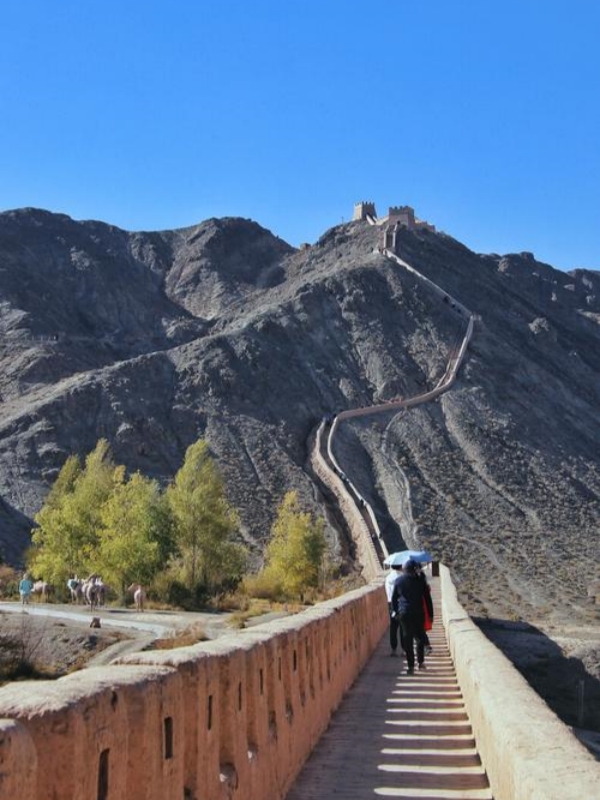
Great Wall of Jiayuguan
Jiayuguan marks the western end of the Ming Great Wall. A plaque over the east gate reads "First Pass Under Heaven" — a title the site has carried since at least the Qing era. It closed the open end of China: east of the fortress lay the heartland, west lay the Western Regions and the Silk Road.
The Ming court built the wall here to seal the Hexi Corridor. Caravans had used that corridor for over a thousand years, and the pass guarded its bottleneck. The new Ming frontier wall ran thousands of kilometers east from here to the Bohai Sea. Jiayuguan sits at its terminus, where the rebuilt rampart finally stops climbing into the desert.
UNESCO listed the site in 1987 as part of the Great Wall. Three monuments stand inside a 15-km loop: a working fortress, a short Wall section on a black cliff, and a lone beacon tower. Few Wall sites combine all three in a single drive. Most visitors cover them in a long day.
🏰 Compare with the Capital: While Jiayuguan marks the rugged desert terminus of the Ming wall, the sections near the capital showcase a completely different style of stone defense. Plan your capital exploration with our guide to a Beijing Great Wall Day Trip.
Jiayuguan Fortress, the Wall's Western End
The Inner and Outer Cities
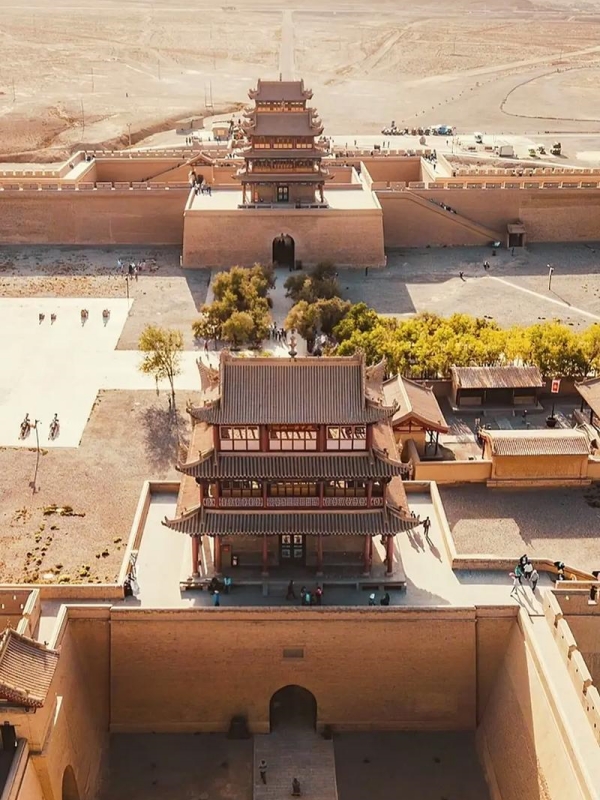
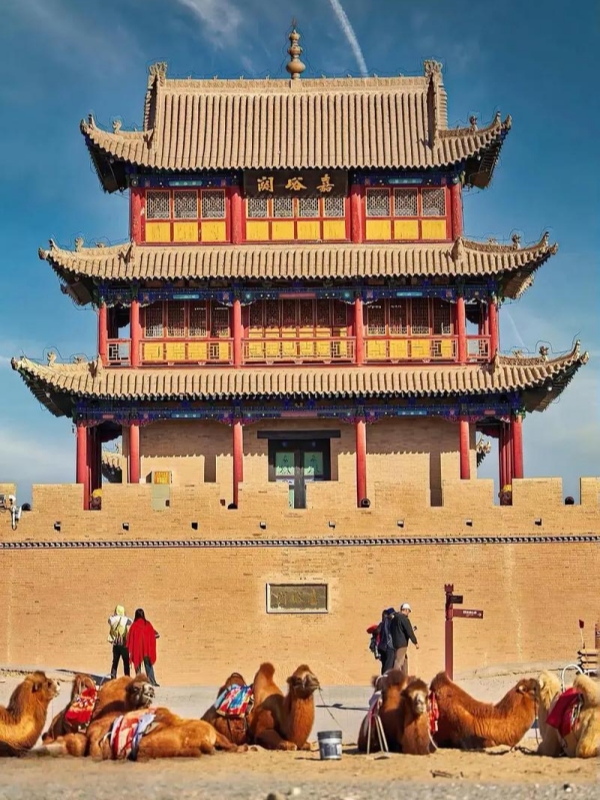
Jiayuguan Fortress
The main citadel is a roughly trapezoidal compound. An inner city and an outer city (wengcheng) sit inside a moat, watched by four gate towers. The perimeter runs about 733 meters, with walls roughly 11 meters high.
Two gates face each other across the compound: the east gate toward the heartland, the west gate toward the desert. Both work as photo stops, and the rooftops of the gate towers give a clean view of the surrounding ridges and the Wall line running east. The wengcheng sits beyond the inner gate — a second walled courtyard that trapped any attacker who got past the first.
Towers, Gates, and Inscriptions
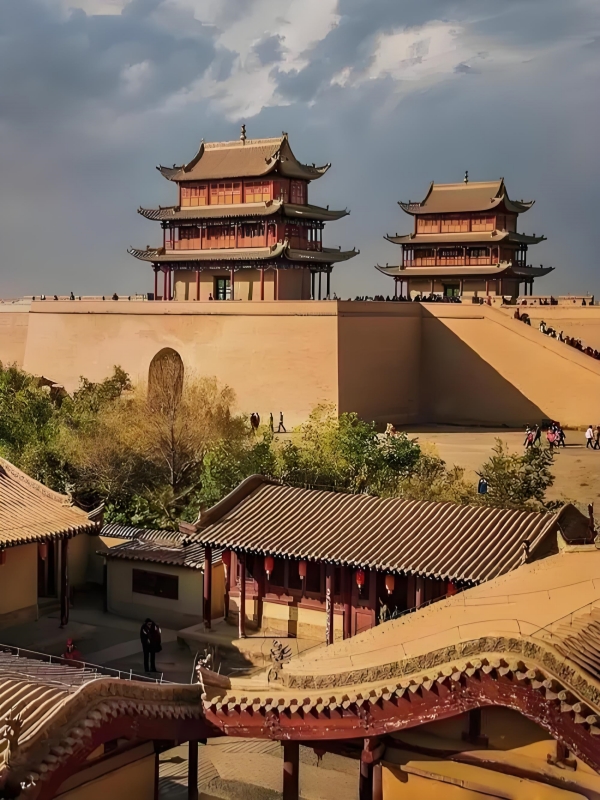
Jiayuguan Fortress
Three plaques anchor the visit. Over the east gate: "First Pass Under Heaven" (Tianxia Diyi Xiongguan). Inside, in the inner courtyard: "Rouyuan Tower" (Rouyuan Lou). Over the west gate: "Jiayuguan" — the pass's own name, carved in standing characters.
A small timber pavilion built as an opera stage sits in the inner courtyard. Opposite it, set aside inside the outer city, stands a General's Office (Youji Jiangjun Fu) — the original garrison commander's residence. Both are walk-through reconstructions rather than Ming originals; the timber work on display dates to later rebuilds.
Overhanging Great Wall and First Beacon Tower
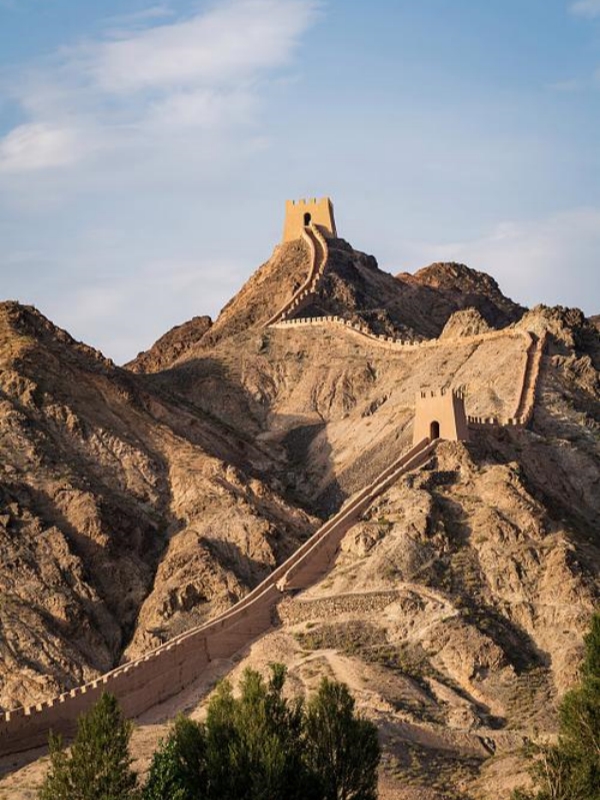
Jiayuguan Overhanging Great Wall
Overhanging Great Wall
The Overhanging Great Wall climbs the cliff face of Heishan, or Black Mountain, about 7 to 8 km north of the main fortress. The trail rises roughly 200 meters in about 30 minutes; a restored rampart runs around 750 meters along the ridge. It is short, steep, and exposed.
The west-facing slope is bare black rock — the silhouette most visitors come to photograph. The path switches back up the cliff in a series of tight flights. Plan 1.5 to 2 hours round-trip, including the climb and time on the ridge. Bring water: there is no shade.
First Beacon Tower
The First Beacon Tower sits on a low platform above the Babao River, about 7 km west of the fortress. It is the westernmost anchor of the Ming signalling system and the third signed stop on the scenic area.
The site is small and rebuilt, but the position is what matters. The platform opens onto the empty plain west of Jiayuguan and gets the cleanest sunset of the loop. It is quieter than the fortress because it is harder to reach without a driver. Allow about 1 hour on site.
History, Silk Road, and the Ming Frontier
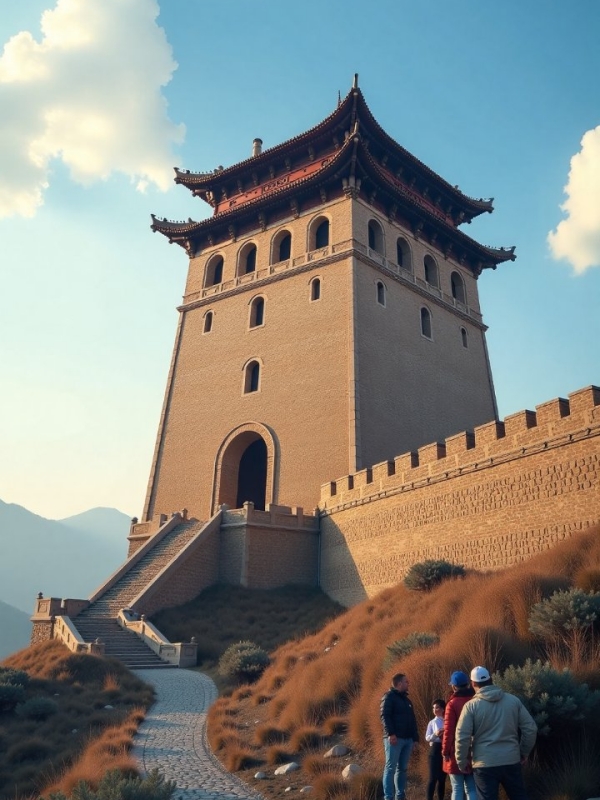
Jiayuguan, Gansu
The Ming general Xu Fu broke ground here in 1372. The court had decided to rebuild the northern frontier wall after the Yuan collapse, and the new fort was the western terminus of that effort. Everything west of Jiayuguan was open steppe; everything east was Ming territory.
The pass anchored the Hexi Corridor, the narrow Gansu strip that carried Silk Road caravans for over a millennium between Chang'an and Dunhuang. Earlier dynasties had held the same ground. Huo Qubing's Han campaigns in the late 2nd century BC pushed Chinese control as far west as the Jade Gate near Dunhuang. Tang garrisons held it again two dynasties later. Each wave of control relied on the same corridor.
Jiayuguan remained a working military post into the Qing dynasty. The modern city that surrounds the site today was founded in the 1950s as a steel-industry centre built on the coal and iron deposits of the Hexi Corridor. The Ming fortress now sits inside that city as a museum piece, no longer a frontier post.
🏛️ Explore the Artifacts: To see the treasures and ancient Silk Road relics unearthed along this historical corridor—including the famous Flying Horse of Gansu—visit the Gansu Provincial Museum.
Reaching Jiayuguan Pass by Air and Rail
Foreign visitors reach Jiayuguan by air into Jiayuguan Jiuquan Airport (JGN) or by high-speed rail into Jiayuguan South, which sits on the Lanzhou–Urumqi HSR line. Local transfers run on tourist bus route 4, by city taxi, or by pre-booked car. Rideshare apps such as Didi require a mainland Chinese phone number — plan to use taxis or arrange a car through your hotel.
Most Jiayuguan Pass visitors continue west to Dunhuang by HSR. The trip runs 3.5–4.5 hours and saves a second flight. From the airport, taxi is the cleanest option — the fare to the fortress sits around $7–10 (¥50–70).
Tickets, Hours, and Visitor Tips
Tickets are sold at each of the three sites and as a combo at the main gate. The fortress is the priciest individual stop; the Overhanging Wall and the First Beacon Tower are cheaper on their own. A combo covering all three saves roughly 20 percent.
Half-price tickets go to students with valid ID. Children under 1.2 meters enter free. Senior discounts apply to PRC residents only — foreign visitors pay full fare. The official scenic-area website is the most reliable source for the current combo-ticket price; check it before you go.
Most visitors arrive at opening (8:00 in summer, 8:30 in winter) to beat the coach groups that pull in on the morning rail services. Allow a full day for all three sites; the fortress alone takes half a day. Bring water and sun protection — there is almost no shade and the wind is constant. English signage inside the fortress is sparse. Book an English-speaking guide in advance through Trip.com, Klook, or a Jiayuguan hotel concierge. Photography is unrestricted outside the marked exhibition halls.
Frequently Asked Questions
Q: Is Jiayuguan Pass part of the Great Wall?
Yes. It is the western terminus of the Ming Great Wall, UNESCO-listed since 1987.
Q: How much time do I need at Jiayuguan Pass?
Half a day for the fortress alone, a full day for all three sites. Add another day if you continue on to Dunhuang.
Q: Can I visit Jiayuguan Pass and Dunhuang in one trip?
Yes. The two sit on the same HSR line, 3.5–4.5 hours apart. Most travelers do Jiayuguan first, then continue west.
Q: Is there an English-speaking guide at Jiayuguan Pass?
Limited. English signage inside the fortress is sparse; book an English-speaking guide through Trip.com, Klook, or your hotel.
Q: What is the best month to visit Jiayuguan Pass?
May to October. July and August run hot and dusty; March and April bring the strongest winds.
Q: Where do I fly into for Jiayuguan Pass?
Jiayuguan Jiuquan Airport (JGN), with direct flights from Beijing and seasonal service from other major cities.
Q: Are there hotels walking distance from the fortress?
Yes. A cluster of mid-range hotels sits near the south gate; budget about $40–70 (¥280–500) per night in high season.
Q: Is the Jiayuguan Pass area safe for foreign visitors?
Yes. Jiayuguan is a small, orderly industrial city with steady tourist traffic. Standard travel precautions apply.
Q: Do I need a Chinese visa to visit Gansu?
Yes — a standard PRC tourist (L) visa. Check current transit-visa exemptions for Beijing or Shanghai entries.