Chinese Prosperity Symbols
Traditional New Year Decor & GiftsWalk into any Chinese temple, teahouse, or palace courtyard and you are surrounded by visual code: a 福 character pasted upside down on a doorway, a pair of stone lions flanking an entrance, peonies carved into wooden screens, a fish motif on a restaurant menu. To visitors who cannot read Chinese, these motifs read as decoration. They are not. Each one is a deliberate Chinese prosperity symbol, a centuries-old shorthand for wealth, success, longevity, or good fortune. This guide decodes the characters, animals, plants, objects, and food motifs a traveler actually sees across China, and points to where to look for them in palaces, temples, gardens, and markets.
The most important thing to know is that Chinese prosperity symbols work through three channels: the shape of an object, the sound of its name, and the color it appears in. A fish is lucky because 鱼 (yú) sounds like 余 (yú, surplus). A tangerine is lucky because 桔 (jú) sounds like 吉 (jí, auspicious) and it is golden. A dumpling is lucky because it resembles the ancient gold ingot called a yuan bao. Once you know the logic, the entire visual landscape of China starts to make sense.
Quick Facts
Character Symbols of Prosperity
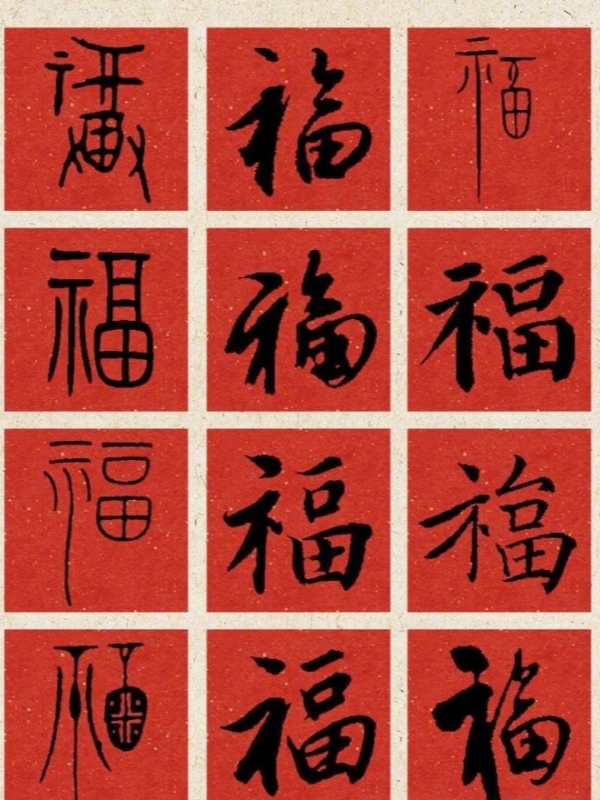
Character Symbols of Prosperity
The five blessings — 五福 (wǔ fú) — form the backbone of Chinese prosperity symbolism. The classical set covers fortune (福), official salary and prosperity (禄), longevity (寿), happiness (喜), and direct wealth (财). Together these five characters appear across calligraphy scrolls, embroidered silk, porcelain patterns, and carved palace screens. The most important for travelers to recognize is 福, and the most important three-character combination is 福禄寿, which appears on almost every imperial interior surface from the Forbidden City to temple gates.
福 (Fu) — The Quintessential Fortune Character
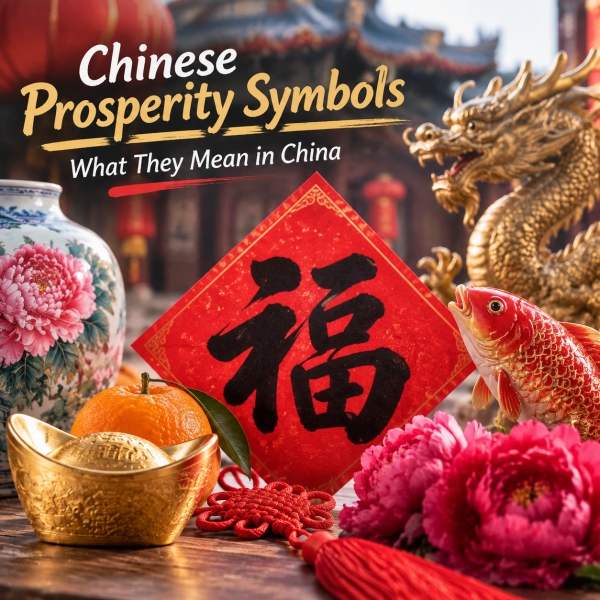
福 (fú) is the single most-recognized Chinese prosperity symbol in the world. It means good fortune and blessings, and it appears everywhere — painted black on red paper for New Year, printed in gold on red cloth for temples, carved into door lintels across Beijing and Shanghai. The character itself is a composition of five visual elements, each traditionally read as a different kind of luck: one's field (示, shì),一口 grain (米), house (宀), and body (田).
The inverted 福 is the most photographed quirk of Chinese streetscapes. The word 倒 (dào) means upside down; it sounds identical to 到 (dào), meaning arrive. A 福 pasted upside down therefore reads as 倒贴 (fortune has arrived) rather than (fortune is here). This pun appears on doorways across China from January through February, and occasionally year-round in restaurants and hotels.
禄 (Lu) — Prosperity and Official Rank
禄 (lù) bridges prosperity and career. Historically, it meant the salary paid to officials who passed the imperial examination system — a passing score meant lifelong income, prestige, and security. In that sense, 禄 was wealth earned through merit, not inherited.
Today 禄 pairs with 福 on door scrolls and in calligraphy sets. The two characters together, 福禄, appear on porcelain, silk paintings, and carved wooden panels in classical gardens. Visitors encounter them most often in the Forbidden City and in temple gift shops selling reproductions of imperial motifs.
寿 (Shou) — Longevity as a Form of Wealth
寿 (shòu) means longevity. In Chinese thought, a long life is itself a form of prosperity — it is the time in which wealth can be accumulated, enjoyed, and passed to descendants. The character dominates birthday celebrations, gift-giving for elders, and any context where long life is wished for.
寿 appears on birthday cakes, longevity lanterns, and peach-shaped cakes (the peach is a separate longevity symbol associated with the Queen Mother of the West). In the imperial trinity 福禄寿, longevity completes the picture: fortune, career success, and the years to enjoy both. Visitors find 寿 most often on calligraphy scrolls in teahouses and on carved stone panels in temple grounds.
囍 (Double Happiness) — Marital and Household Joy
囍 (xǐ) is the doubled character for happiness (喜). It is reserved almost exclusively for weddings and is therefore the least commonly seen of the five-character set — but when it appears, it dominates. The character appears on wedding invitations, the bridal chamber door, red ribbons tied around wedding gifts, and the wedding bed itself.
The double form dates to the Tang dynasty and is tied to the legendary happy marriage of the scholar Qin Qian and the maid Wan Shi. Today it is printed on red paper, embroidered on silk, and stamped on gift boxes. Visitors in China during the Chinese New Year or mid-autumn festival window are unlikely to encounter it unless they attend a wedding; however, it appears prominently in classical garden carvings in Suzhou, where marital motifs were deliberately incorporated into garden design for wealthy households.
财 (Cai) — Direct Wealth
财 (cái) means money or wealth directly, without metaphor. It is the most literal Chinese prosperity symbol — what Western visitors might recognize as the "wealth" character. 财 appears on storefront signs across every Chinese city, on feng shui mirrors hung above shop counters, and in the iconography of 财神 (Cáishén, the god of wealth).
In the full five-blessing set (福禄寿喜财), 财 anchors the practical end of the spectrum: the others represent conditions of life, while 财 represents the resource itself. Visitors encounter it most often in red calligraphy above restaurant cash registers, on red paper pasted in shop doorways, and on the small jade and metal charms sold at temple entrances as wealth amulets.
🔢 Explore Number Homophones & Modern Slang: Just as traditional lucky symbols rely on wordplay—like yú for fish and surplus—modern Chinese culture uses numeric homophones for lucky numbers and online slang. Discover the meanings behind 520, 888, and more in our guide to Chinese Number Slang.
Animal and Mythical Creature Symbols
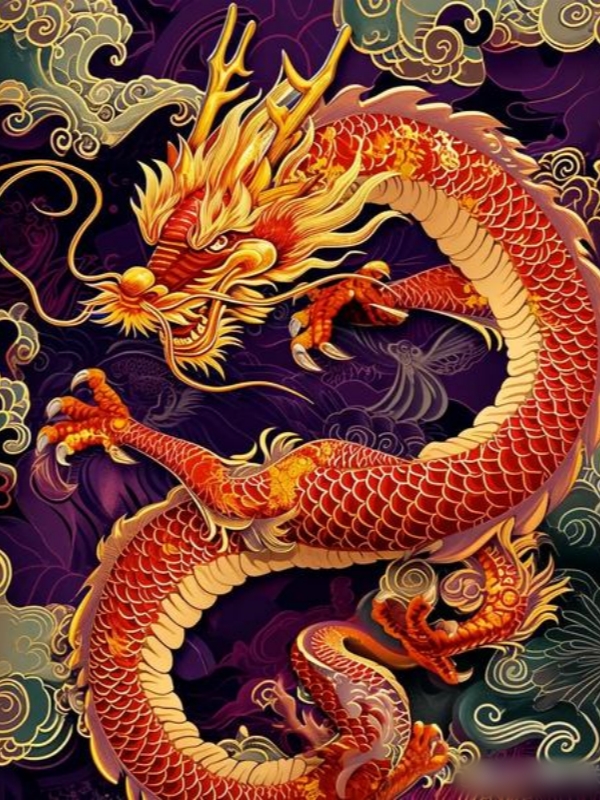
Animal and Mythical Creature Symbols
China's animal symbolism runs deeper than almost any other visual tradition. The creatures fall into two groups: real animals elevated to symbol status through legend or homophone (dragon, phoenix, carp, bat), and mythical beasts invented to carry specific moral and prosperity meanings (qilin, guardian lion). The following six appear most frequently in tourist sites, markets, and hotel decor.
Dragon (龙) — Imperial Power and Success
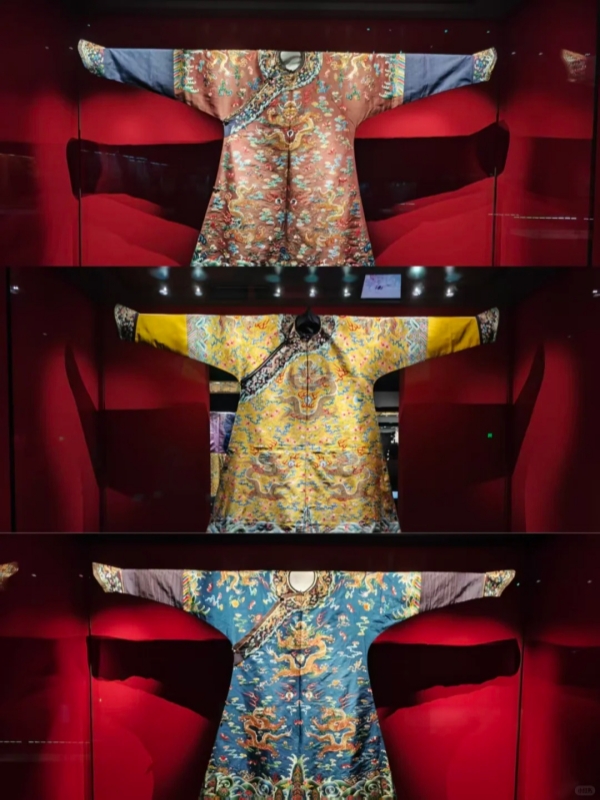
The dragon is the supreme Chinese prosperity symbol. It stands for imperial power, control of water and rain, and ultimate success. The five-clawed dragon was exclusive to the Qing dynasty emperor; four-clawed dragons appeared on princes, and three-clawed versions on common goods. This hierarchy means the dragon carries both power and accessibility — everyone can use a dragon, but the emperor's version is distinct.
Because the dragon controls water and rain, it is also the symbol of agricultural prosperity — a direct link to wealth through harvest. In modern usage, dragon imagery appears on business logos, hotel names, restaurant menus, and festival decorations without any imperial restriction. Visitors will find dragon carvings on nearly every roof ridge and bracket in the Forbidden City, and dragon motifs painted on restaurant walls across China.
Phoenix (凤) — Harmony Paired With the Dragon
The phoenix (凤, fèng) is the female counterpart to the dragon. Where the dragon represents power and yang energy, the phoenix represents grace, harmony, and yin. The 龙凤 pairing — dragon and phoenix together — is the definitive symbol of a complete and harmonious marriage, and it appears on wedding invitations, bridal chamber doors, and emperor-empress iconography alike.
In classical art the phoenix carries the five Confucian virtues in its feathers: benevolence, righteousness, propriety, wisdom, and sincerity. For visitors, the phoenix is easiest to spot in the context of wedding decoration and imperial palace carvings, where it appears alongside the dragon on beams, screens, and floor tiles. A phoenix alone is unusual — look for the pair.
Carp (鲤) — Career Advancement
The carp carries one of the most specific prosperity meanings in Chinese symbolism: career and examination success. The legend of 鲤鱼跳龙门 (lǐyú tiào lóngmén) tells of carp that swim upstream and leap over the Dragon Gate waterfall — those that succeed transform into dragons. The story is a metaphor for passing the imperial civil service examinations, which was the primary path to wealth and official rank.
Modern usage extends this to promotion, business success, and examination results generally. A painting of nine red carp (九鲤, jiǔlǐ) is a common gift for students and new employees. Visitors encounter carp most often in restaurant paintings (especially near doors, for incoming business), in gift shop prints, and in classical garden carvings where they swim in ornamental ponds in Suzhou and Hangzhou.
Bat (蝠) — The Hidden Homophone for Fortune
The bat confuses many Western visitors. It looks ominous to eyes trained on European symbolism, but 蝠 (biānfú) sounds nearly identical to 福 (fú, fortune) — and in Chinese, that is all that matters. The bat is a top-tier Chinese prosperity symbol purely because of sound.
The most powerful bat motif is 五福 (wǔ fú) — five bats surrounding a 福 character or a peony. This directly invokes the five blessings: longevity, wealth, health, love of virtue, and a peaceful end. Five bats appearing with a peach represents the complete five-blessing set. A single bat is weaker; groups are auspicious. Visitors should not be alarmed when they spot bat carvings on temple eaves — in this context, they are a blessing.
Qilin (麒麟) — Auspicious Arrival
The qilin is a single-horned mythical beast, part deer, part dragon, part lion, with a body covered in scales. It is the gentlest of Chinese mythological creatures — it never harms a living thing and appears only when a sage is born or a good ruler sits on the throne. In feng shui and gift-giving, a qilin statue is presented at housewarming ceremonies to attract good fortune and a virtuous occupant.
For visitors, the qilin appears most often as a carved decorative element in imperial palaces and Buddhist temple courtyards. It is less common in everyday markets than the dragon, phoenix, or guardian lion, which makes spotting one a minor accomplishment. The qilin is most reliably found in the Forbidden City, the Summer Palace, and the Temple of Heaven complex in Beijing.
Guardian Lions (狮子) — Wealth Protection at Doors
The stone guardian lions flanking an entrance are among the easiest Chinese prosperity symbols for visitors to recognize. Called 狮子 (shīzi, stone lions) or sometimes "foo dogs" in English, these paired creatures stand at the gates of palaces, government buildings, banks, luxury hotels, and wealthy family homes. The male lion holds a globe under his paw, representing supreme authority; the female holds a cub, representing nurturing prosperity.
Together they repel misfortune and protect the wealth within. This is not metaphorical — the specific feng shui function of a guardian lion pair is to guard the threshold. Visitors will encounter them at the entrance of nearly every major palace in Beijing, at the gates of major Buddhist temples, and at bank buildings throughout Chinese cities. The pair should always be complete; a single lion is incomplete protection.
🐉 Find Your Lunar Zodiac Sign: Animal motifs like dragons, tigers, and oxen frequently appear on New Year decorations and gifts to mark the changing zodiac years. Calculate your personal birth sign in our guide to What Is My Chinese Zodiac Sign.
Plants, Objects, and Talismans
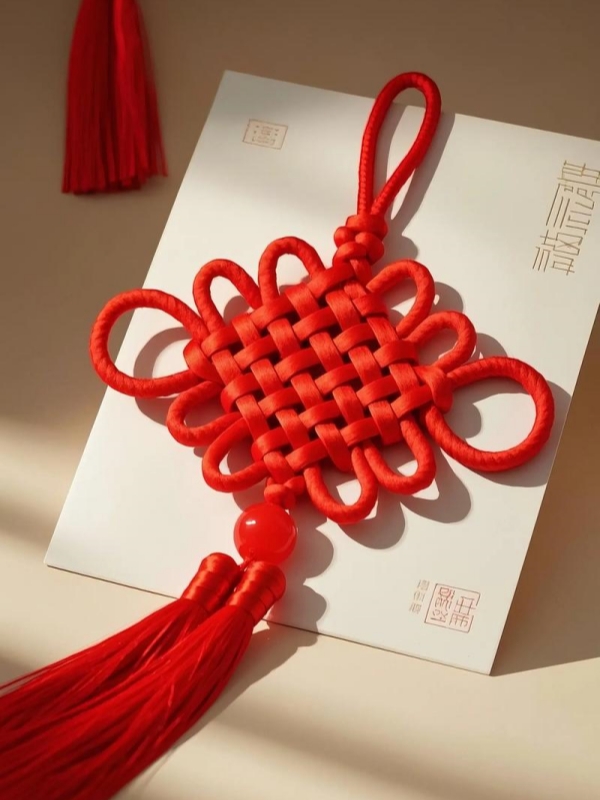
Plants, Objects, and Talismans
A parallel set of prosperity symbols comes from the plant world and from crafted objects. These seven items appear most often in gardens, jewelry shops, and souvenir markets — they are the layer of symbolism a traveler encounters away from the imperial palaces. Peonies, plum blossoms, and bamboo dominate garden carvings; jade, yuan bao, feng shui coins, and Chinese knots dominate market stalls.
Floral Cultural Symbols
- Peony (牡丹 mǔdān): The king of flowers and the most direct floral prosperity symbol. Called 富贵花 (fùguì huā, "flower of riches and honor"). Dominates imperial robes, Suzhou garden carvings, and Cantonese porcelain. Look for it in lattice windows and on silk panels.
- Plum Blossom (梅花 méihuā): Blooms in late winter snow, representing prosperity earned through adversity. One of the "four Gentlemen" of Chinese art alongside orchid, bamboo, and chrysanthemum. Common in classical gardens and winter festival decoration.
- Bamboo (竹 zhú): Bends without breaking, symbolizing resilience and the steady accumulation of wealth. Fast-growing and hollow-hearted (room for fortune to pass through). Pairs with plum and pine in the "three friends of winter" motif.
Traditional Wealth Ornaments
- Chinese Knot (中国结 zhōngguó jié): A continuous woven cord with no beginning or end, symbolizing the unbroken cycle of good fortune. Sold as wall hangings, keychains, and purse ornaments in every market from Beijing to Xi'an.
- Yuan Bao (元宝 yuánbǎo): The boat-shaped gold and silver ingots used as currency under the Ming and Qing dynasties. The most literal wealth symbol in the collection. Appears in display bowls, on Cáishén statues, and as decorative charms sold at temple entrances.
- Feng Shui Coins: Round coins with square holes, traditionally strung in threes with red cord, representing heaven (round), earth (square hole), and harmony between them. Hung in homes and businesses to attract cash flow. Available as keychains and zipper pulls in most Chinese markets.
- Jade (玉 yù): Treated as condensed fortune and virtue. The five virtues of jade — charity, rectitude, wisdom, courage, and equity — make it the most morally loaded prosperity symbol. Jade bangles and pendants are the most common gifting item for visitors buying at markets.
📛 How Auspicious Characters Influence Names: The same characters representing wealth, health, and peace in decorations are frequently chosen by parents to convey good wishes in personal names. Learn how names are structured in our guide to a Typical Chinese Name.
Food and Festival Items as Prosperity Symbols
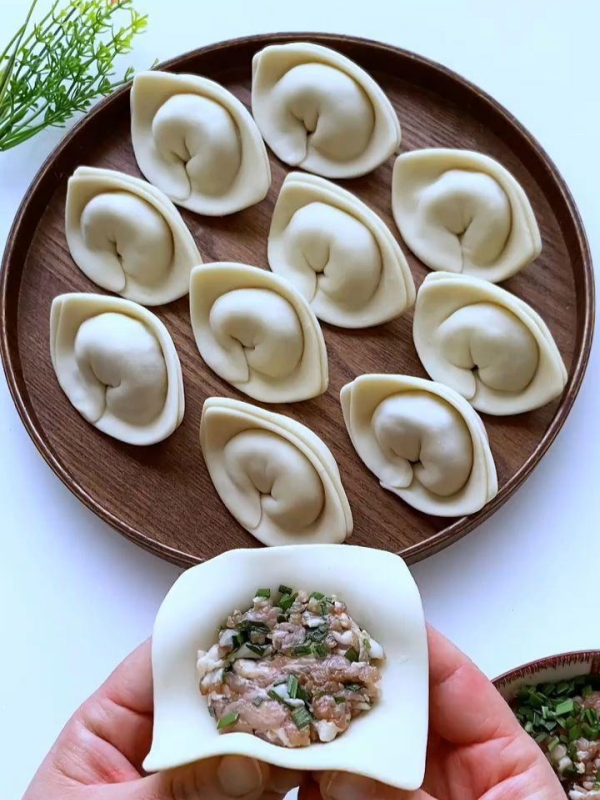
Food and Festival Items as Prosperity Symbols
Some of the richest Chinese prosperity symbolism is edible or seasonal. These items appear at markets, banquet tables, and street decorations rather than in museums — they are the layer of symbol a traveler encounters most directly. The logic is consistent: sound (homophones), shape, and color all work together to make ordinary objects carry extraordinary meaning.
Lucky Festival Foods
- Tangerines and Mandarin Oranges (桔/橙): The word 桔 (jú) sounds identical to 吉 (jí, auspicious luck); the golden color signals wealth. Potted mandarin trees with red ribbons are the standard Chinese New Year gift. A bowl of oranges on a hotel counter or restaurant table carries the same meaning — fortune and wealth, freely given.
- Whole Fish (鱼 yú): The homophone here is 余 (yú, surplus), not 余 (yú, fish) — but the characters are identical. A whole fish served head-and-tail intact at New Year dinner symbolizes "more than enough from beginning to end." It is the single most universal symbol on every Chinese New Year banquet table.
- Dumplings (饺子 jiǎozi): The crescent shape closely resembles the ancient yuan bao gold ingot. Eating dumplings at midnight on Chinese New Year is the most direct edible wealth ritual in the calendar. Shops and market stalls sell dumpling-making kits as Chinese New Year gifts in January.
- Nian Gao (年糕 niángāo): A glutinous rice cake whose name is a homophone for 年高 (niángāo, "the year rises higher"). The meaning is literal: rising income, rising status, rising prosperity year by year. Steamed and sliced, it appears at New Year markets throughout January and February.
Traditional New Year Decor & Gifts
- Red Envelopes (红包 hóngbāo): Red packets holding money, given at New Year, weddings, and births. The red color signals fortune; the money inside is the wealth being shared. Souvenir versions, empty and folded, are sold at market stalls as gifts visitors can take home.
- Spring Festival Couplets and Lanterns: Red banners flanking doorways (春联, chūnlián) repeat 福, 春 (spring), and 财 in paired verses. Red lanterns hang from eaves and streetscapes throughout January and February. Together these two items define the visual character of Chinese streets during the New Year period.
Where Travelers Actually See These Symbols
The densest Chinese prosperity symbol environments are concentrated in a handful of cities. Knowing which location carries which symbols lets a traveler prioritize — and recognize what they are looking at when they get there.
Imperial Palaces (Forbidden City, Summer Palace)
Beijing's Forbidden City is the single densest concentration of Chinese prosperity symbols in the world. Dragon, phoenix, qilin, guardian lion, bat, peony, and 福 motifs cover every roof ridge, eave bracket, and balustrade from the Meridian Gate to the Gate of Divine Might. The Hall of Supreme Harmony alone carries tens of thousands of dragon carvings, a figure the Palace Museum itself notes in its official materials.
The Summer Palace repeats the same imperial iconographic set in a lakeside garden context — fewer roof carvings, more landscape integration of lotus, carp, and bamboo around Kunming Lake. A half-day at the Summer Palace covers the outdoor symbol set efficiently; the Forbidden City requires at least three to four hours to move through the three main axial halls.
Buddhist and Taoist Temples
Temples carry a different symbolic vocabulary than palaces. The emphasis shifts toward longevity (寿 peaches, cranes, pine), the bat-and-fortune connection, and guardian lions at gates. Buddhist and Taoist iconography adds its own layer — the Buddha's hand citrus, lotus symbolism, and incense ash — but the core prosperity set survives.
Beijing's Lama Temple (Yonghegong) is the most symbol-rich temple in northern China. Stone-carved bats appear on the outer walls, guardian lions guard each gate, and dragon and phoenix motifs frame the main prayer halls. The Temple of Heaven's circular Hall of Prayer for Good Harvests uses imperial dragon and phoenix roof decoration within a purely religious building — the only major imperial structure in Beijing not in the palace complex itself.
Classical Gardens (Suzhou, Hangzhou)
Suzhou's classical gardens — the Humble Administrator's Garden, Lingering Garden, and the Garden of the Master of the Nets — embed prosperity symbolism more subtly than the palaces. Peony motifs appear in carved lattice windows. Bamboo grows along pathways. Carp swim in ornamental ponds. Chinese knot patterns repeat in carved railings and stone门槛.
The advantage of the garden setting is that the symbols feel less like official imperial declarations and more like domestic decoration — the layer a wealthy Suzhou merchant would have chosen for his own home. The motifs are easier to photograph in natural light, and the gardens are walkable in a single morning. Hangzhou's West Lake area adds lotus and willow motifs to the same set, framed by mountain scenery.
Teahouses, Restaurants, and Shop Signs
The everyday layer of Chinese prosperity symbolism is the most immediately accessible to travelers. An inverted 福 on a doorway, a carp painting near a restaurant entrance, a bowl of tangerines on a hotel reception counter, a 财 character above a cash register — these require no museum ticket and no guide.
This layer also reveals which symbols carry forward into modern commercial life. The dragon appears on business names. The carp appears in dining rooms for business prosperity. The inverted 福 appears on teahouse doors in Hangzhou's West Lake area and on noodle shop entrances in Chengdu. A visitor who learns to recognize just three symbols — Fu, carp, tangerine — will find them on every city block during the New Year period.
Souvenir Markets and Jewelry Counters
Beijing's Liulichang, Shanghai's Yu Garden bazaar, Xi'an's Muslim Quarter, and tourist-area jewelry counters sell the physical objects travelers take home as portable prosperity symbols. The standard range includes jade pendants and bangles, feng shui coin sets on red cord, Chinese knot wall hangings and keychains, replica Fu prints in red and gold, yuan bao-shaped paperweights and keyrings, and guardian lion statues in jade or stone.
Prices at these markets are negotiable. A small jade pendant costs roughly $15–70 (¥100–500); a feng shui coin set runs about $3–7 (¥20–50); a Chinese knot ranges from $5–15 (¥35–100). Liulichang in Beijing skews toward calligraphy and prints; the Yu Garden bazaar in Shanghai favors jade and silk; Xi'an's Muslim Quarter covers a wide range at lower price points. All three are bookable through Trip.com and Klook, or available on-site with cash or mobile payment.
🖐️ Navigate Hand Gestures & Local Etiquette: While visual symbols bring good fortune, understanding everyday body language and avoiding accidental misunderstandings is just as essential. Read our cultural guide on Chinese Middle Finger Meaning: Myths and Real Etiquette.
Colors and Numbers of Prosperity
A Chinese prosperity symbol rarely operates in isolation. Color amplifies meaning — red and gold are inseparable from the prosperity vocabulary. Numbers add their own layer, because certain digits sound like auspicious or inauspicious words. Together, color and number turn a single symbol into a compound statement that most travelers read without realizing it.
- Red: The defining color of Chinese prosperity symbolism. Red envelopes, red doors with Fu, red wedding dresses, red lanterns — red signals fortune and celebration. It appears on nearly every prosperity symbol at some point in the calendar. The one context where red is avoided is funerals.
- Gold and Imperial Yellow: Gold signals wealth directly. Imperial yellow — historically restricted to the emperor — now signals supreme luxury. Modern gold-on-red combinations (a Fu in gold on red paper, gold lettering on red shop signs) carry both the emperor's exclusivity and ordinary commercial prosperity.
- Number 8 (八 bā): The luckiest digit in Chinese culture because it sounds like 发 (fā, "to prosper" or "to get rich"). Phone numbers and license plates with multiple 8s trade at a premium. The Beijing Olympics opening ceremony began at 8:08 PM on 8/8/08 — a date chosen deliberately for its prosperity resonance.
- Number 9 (九 jiǔ): The emperor's number. It sounds like 久 (jiǔ, "long-lasting"), making it the digit of longevity and wholeness. The Forbidden City is officially cited as containing 9,999.5 rooms — deliberately short of the heaven-number 10,000. Nine-dragon walls (九龙壁) appear across imperial Beijing.
- Numbers to Approach Carefully: The number 4 (四 sì) sounds like 死 (sǐ, death). Many Chinese buildings skip the 4th floor; room 404 is rare. Visitors should avoid giving gifts in sets of four items, and should not be surprised if a hotel room or restaurant table skips directly from 3 to 5.
Frequently Asked Questions
Q: What is the single Chinese symbol for prosperity?
福 (fú) is the most recognized single Chinese prosperity symbol — a character meaning good fortune, typically painted black on red paper or printed in gold on red cloth. Hung on doorways during New Year and year-round in homes and businesses. For direct wealth specifically, 财 (cái) is the equivalent.
Q: Why is a tangerine a Chinese symbol of prosperity?
Two reasons: the word 桔 (jú, tangerine) sounds identical to 吉 (jí, auspicious luck), and the golden-orange color of the fruit signals wealth. Potted mandarin trees with red ribbons are the standard Chinese New Year gift in southern China. A bowl of oranges on a counter carries the same message in everyday commercial settings.
Q: Which three Chinese New Year items symbolize prosperity?
The classic trio is tangerines or mandarins (golden color plus 桔 sounds like 吉), whole fish (鱼 sounds like 余, surplus), and dumplings (shaped like the ancient yuan bao gold ingot). Red envelopes, nian gao rice cake, and inverted 福 banners complete the New Year symbol set.
Q: What is the Chinese symbol of hope and prosperity?
The single character 福 (fú) combines hope for good fortune with present prosperity. The three-character combination 福禄寿 (fú-lù-shòu) — fortune, prosperity, and longevity — is the most photographed cluster on imperial carvings and the most common trio in calligraphy sets sold at temple gift shops.
Q: Is it appropriate to gift Chinese prosperity symbols?
Yes. Chinese knots, jade pendants, feng shui coins, and Fu-themed prints are standard souvenirs and gifts. Avoid giving sets of four items (四 sounds like death) and avoid clocks or sharp objects as gifts to elders, as the words carry funeral-related connotations.
Q: What does the dragon symbolize in Chinese culture?
The dragon is the supreme Chinese prosperity symbol — imperial power, control of water and rain, success, and authority. The five-clawed dragon was exclusive to the emperor; four- and three-clawed versions appear on common goods. It is paired with the phoenix (龙凤) to represent marital harmony and a complete household.
Q: What Chinese prosperity symbol should visitors avoid?
Avoid the number 4 (四 sì) in floors, room numbers, and gifts. Avoid the bat symbol displayed alone — bats must appear in groups (ideally five as 五福, the five blessings) to read as auspicious. Peonies, dragons, jade, and Chinese knots are universally safe and carry no cultural risk for visitors.
Q: What is the crossword-clue answer for "Chinese symbol of prosperity"?
The most common crossword answer is FU (福). For a three-letter slot, CAI (财) means direct wealth. For longer clues, FULUSHOU or FULU appear depending on grid length. The single-character answer in most crossword databases is FU.