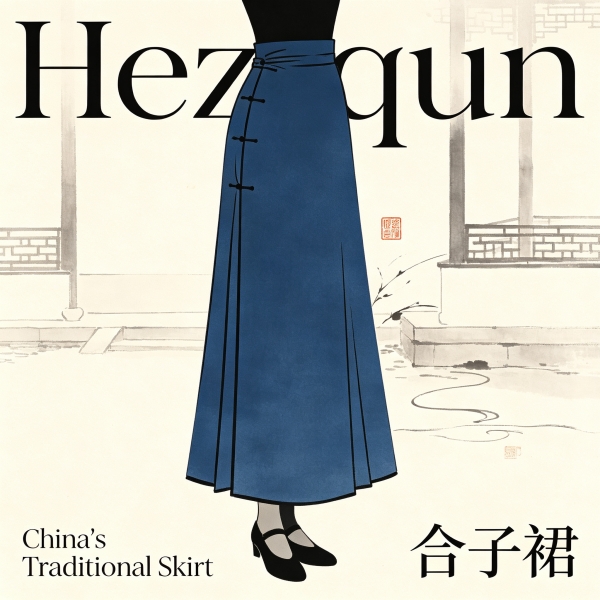
Heziqun (合子裙)
The heziqun is one of the least documented garments in the history of Chinese dress. It appears in few museum catalogs and almost no Western-language sources, yet it occupied a genuine place in women's wardrobes from the late Qing dynasty through the early 20th century. A gathered or pleated skirt secured at the natural waist, it served both everyday and ceremonial roles depending on the fabric and region. Today it survives as a reference point in hanfu revival circles and as a rare find in textile museums and specialty costume shops.
This guide covers what a heziqun is, how it was constructed, where you can see or buy one, and how it fits into the broader picture of Chinese traditional dress. It is written for visitors and collectors who want facts rather than folklore about this obscure but distinctive garment.
Quick Facts
What Is a Heziqun?
The heziqun is a traditional Chinese lower-body garment. In literal terms, 合 (hé) means "combine" or "join," and 裙 (qún) simply means "skirt." The suffix 子 (zi) was a common nominal marker in classical garment terminology. The name itself points to a construction method: the skirt was assembled from joined panels that created volume at the waist and fell toward the hem.
This places the heziqun squarely in the broader family of Chinese skirts. It shares territory with the mamianqun (horse-face skirt), which uses stiff pleating and a distinctive X-fold at the front. It also sits alongside the qipao as a lower-body garment, though the qipao is a one-piece dress rather than a separate skirt. The heziqun is distinct from hanfu-style wrapped skirts because those garments cross panels at the front and use a different fastening system.
The heziqun was worn by women across social classes in its peak era. The cut remained consistent, but the fabric and embellishment varied with wealth and occasion. A cotton indigo-dyed piece served as everyday dress for rural and working-class women, while silk embroidered skirts appeared in wealthier urban wardrobes.
🌸 Classical Neckline Transformations: Discover how early imperial upper-body tailoring laid the foundation for multi-piece sets by exploring the Tang Dynasty Neckline.
History and Origins
Skirt forms of this general type trace back through Qing dynasty women's dress. The specific heziqun construction—gathered or pleated panels joined at the waistband—circulated in late Qing and Republican-era wardrobes across Jiangsu, Zhejiang, and parts of northern China. Regional textile workshops in these areas produced the fabrics and finished garments that entered both local and urban markets.
The term itself faded from everyday use after the mid-20th century. As modernized dress replaced traditional garments across mainland China, the heziqun disappeared from regular wardrobe rotation. It was not a victim of suppression; it simply lost its practical context as women adopted pants, modern dresses, and Western-influenced clothing en masse.
Today the heziqun survives mainly as a heritage reference. It appears in museum textile collections, in the vocabulary of hanfu revival communities, and occasionally in historical dramas where costume designers seek period accuracy for Qing or early Republican scenes.
👠 Early 20th-Century Tailoring: Learn how tailored Republican-era silhouettes superseded multi-piece skirts during the urban fashion boom with our guide to Chinese 1920s Fashion.
Design and Construction
The heziqun's design is functional and deliberate. Every element—waistband, pleating, hem, closure—served a purpose in how the skirt fit, moved, and was worn with other garments.
Silhouette and Cut
The skirt falls from the natural waist or slightly below it. Its overall shape ranges from A-line to gently flared. The length typically reached mid-calf to the ankle, depending on the era and the wearer's region. Below are the defining construction features.
- Waistline Position: Sits at the natural waist or just below; adjustable waistband with pleats or gathers for fit
- Opening Style: Side or front opening; secured with fabric buttons, toggles, or ties rather than zippers or snaps
- Hem Length: Historically mid-calf to ankle; later versions trended shorter during the Republican period
- Fullness Method: Pleats or soft gathers at the waistband create volume through the hip and thigh
- Closure Type: Fabric frog buttons or simple loop-and-toggle fasteners; designed to be动手 (dòngshǒu)—hand-operated without assistance
Fabrics, Colors, and Embellishment
Fabric choice divided everyday wear from festival dress. Cotton and indigo-dyed cloth dominated practical wardrobes, while silk, brocade, and embroidery marked ceremonial use.
- Everyday Cotton: Indigo-dyed cotton was standard for rural and working-class wear; durable, washable, and suited to manual labor
- Festival Silk: Smooth silk in reds, greens, and blues appeared for weddings, festivals, and formal occasions
- Indigo Dye: A signature colorway for the heziqun; achieved through repeated dyeing of cotton or silk in indigo vats
- Embroidered Hem: Simple floral or geometric motifs stitched along the bottom edge of festival pieces; not heavy beading
- Woven Border: Contrast trim applied along pleat lines and the hem; woven rather than printed for durability
Where to See and Buy a Heziqun
Accessing a heziqun today requires knowing where to look. Museums, fabric markets, and online channels each offer different levels of access and authenticity.
Heziqun in Modern China
The heziqun has no everyday presence in contemporary Chinese dress. It has, however, found new contexts in cultural revival, tourism, and the entertainment industry. These roles are modest but growing.
The hanfu movement has brought renewed attention to traditional Chinese garments that fell out of common use. The heziqun appears occasionally in hanfu events and online communities focused on historical accuracy, though it remains less common than qipao or mamianqun in these circles.
- Hanfu Revival: Part of a broader effort to document and recreate pre-20th-century dress; small but dedicated community of researchers and makers
- Photo Studio Tourism: Hanfu rental studios in historic districts increasingly offer Qing-style ensembles; the heziqun surfaces in period-accurate costume packages
- Drama and Stage Costume: Television productions and folk-performance troupes use the heziqun when period accuracy requires a separate skirt rather than a one-piece dress
- Cross-Border E-Commerce: Specialty hanfu retailers now ship internationally; made-to-order pieces available through platforms that accept foreign payment methods
👗 Modern Style Trends: Explore how ancient heritage cuts influence street fashion and modern design interpretations in our overview of Contemporary Chinese Clothing.
Frequently Asked Questions
Q: What does "heziqun" mean in English?
There is no standard English translation. The characters 合 (hé) mean "combine" and 裙 (qún) means "skirt," so "combined skirt" or "joined skirt" is the literal reading. Most English-language sources keep the pinyin term "heziqun" rather than inventing an equivalent phrase.
Q: Is a heziqun the same as a qipao or hanfu skirt?
No. The heziqun is a separate lower-body garment (a skirt worn with a jacket or top). The qipao and cheongsam are one-piece dresses. Hanfu-style wrapped skirts use crossed front panels and a different closure system, making them distinct in construction and wear.
Q: When was the heziqun traditionally worn?
Peak use spans the late Qing dynasty through the early Republican period (roughly the late 19th century to the 1930s). It appeared in everyday, festival, and semi-formal contexts, with fabric and embellishment varying by occasion and social class.
Q: Where can foreigners see a heziqun in China?
Large textile and costume museums are the most reliable option. The China Silk Museum in Hangzhou and museums in the Beijing area hold textile collections that may include heziqun examples. Hanfu photo studios in historic districts also stock period-accurate costumes for rental.
Q: Can tourists buy a heziqun online?
Yes, through cross-border platforms that ship internationally. Specialty hanfu retailers and Taobao Global (via shipping agents) offer handmade pieces. Handmade pieces typically cost about $70–280 (¥500–2,000), with bespoke silk versions priced higher.
Q: How much does a heziqun cost?
Ready-to-wear cotton pieces start at about $28–55 (¥200–400). Mid-range silk skirts run about $70–140 (¥500–1,000). Bespoke or heavily embroidered festival versions reach $140–280 (¥1,000–2,000). Antique pieces from dealers are priced individually based on condition and provenance.
Q: Is the heziqun still worn in modern China?
Not as everyday clothing. It appears in hanfu revival events, traditional-photo tourism, stage costumes for historical dramas, and cultural-festival parades. The garment has cultural and educational value today rather than a practical wear context.