How to Write a Name in Mandarin
Mandarin Chinese uses a completely different writing system from English. Letters do not map one-to-one onto sounds, and characters carry meaning rather than phonetic value. For visitors, learners, and business travelers, a Mandarin name — chosen for sound rather than spelling — bridges that gap. The process takes about ten to fifteen minutes. No prior Chinese is needed.
This guide covers the conversion method, pinyin and hanzi basics, real-world usage from hotel check-ins to WeChat profiles, and the tools that make it reliable.
Quick Facts
How to Convert and Write a Name in Mandarin

How to Write a Name in Mandarin
The core principle: Mandarin names are chosen for sound, not spelled letter by letter. Mandarin is a syllabic language — English letters do not map onto Mandarin sounds in any reliable way. The correct method is to find two or three Mandarin syllables that approximate how the original name sounds, then build a surname plus given name from those syllables.
Why Sound Beats Letter-by-Letter Spelling
Mandarin uses fixed syllables with tonal patterns. English letters, by contrast, represent sounds that shift depending on context. A letter-by-letter approach produces something no native speaker would recognize. Sound-based conversion works because Chinese readers see the pinyin and apply their own phonetics. For example, "Michael" becomes Mài·kè·ěr — a recognizable approximation — rather than an unpronounceable Mi-cha-el.
Pick a Mandarin Name Based on Sound
There are three common starting points. An online converter gives an automatic first pass. A syllable chart lets users match sounds by ear. A native speaker or tutor refines the result.
- Online converter: Produces a sound-based starting point quickly; useful for getting a first draft.
- Syllable chart: Browse the set of possible pinyin syllables and select by ear; good for hands-on learners.
- Native speaker or tutor: Ask a Mandarin-speaking friend or an iTalki community tutor to confirm the chosen syllables sound natural.
For the surname, foreigners often choose freely: either a transliteration of the foreign surname or a common Chinese surname with a meaning the user likes, such as Wang, Li, Zhang, or Lin.
Write It in Pinyin
Pinyin is the official romanization system for Mandarin. Each syllable carries one of four tones marked with diacritics: ā á ǎ à. Tone marks go on the main vowel in priority order: a first, then o, e, i, u, ü.
- Tone-mark priority: The mark falls on a > o > e > i > u > ü, following that order.
- Capitalization: Surname initial capital, given-name syllables lower-case (e.g., Wang Mei).
- Syllable count: Monosyllabic English names may need a neutral-tone suffix like ·zi or ·er to feel natural.
- Apostrophes: Separate syllables that could blur together, such as Xi'an versus Xian.
Write It in Hanzi
Hanzi are the logographic Chinese characters. Each pinyin syllable corresponds to multiple possible characters, so character choice shapes the name's meaning. Three selection criteria apply.
- Sound match: The character's reading must equal the chosen pinyin syllable.
- Positive meaning: Avoid characters with negative meanings such as death, loss, sickness, or ugliness.
- Writing simplicity: Prefer characters with fewer than 15 strokes; obscure characters with 20+ strokes are hard to reproduce by hand.
For example, Michael becomes 迈克尔 — 迈 (stride), 克 (overcome), 尔 (you). Simplified characters are the default in mainland China.
Stroke Order Basics
Stroke order determines whether a character is recognizable and whether phone input methods accept it. Eight universal rules apply.
- Top to bottom: Horizontal strokes come before vertical strokes in most characters.
- Left to right: Left-side strokes come before right-side strokes.
- Horizontal before vertical: Where both exist in a character.
- Left-falling before right-falling: The 丿 stroke before the 乀 stroke.
- Outside before inside: Enclosure characters write the outer frame first.
- Bottom enclosure sealed last: The final horizontal stroke closes the bottom of enclosure characters.
- Dot last: The central dot or accent stroke is written last.
- Center before sides: Central strokes in symmetric characters come first.
For a beginner, memorizing the order for five to ten frequently used characters is enough. The rest can be copied from free stroke-order diagrams on Pleco or Skritter.
👤 Common Surnames & Naming Conventions: Explore how native naming systems are structured by reading about the most popular Typical Chinese Name formats.
Using a Mandarin Name Across China

How to Write a Name in Mandarin
A Mandarin name becomes practical the moment a visitor needs to interact with local systems. Hotels, daily service encounters, apps, and business cards are the four highest-traffic touchpoints.
At Hotels and on Registration Forms
Every licensed hotel in China photographs the guest's passport and enters the name into a registration system that prints it in hanzi on the receipt. A pre-prepared Mandarin name — shown in hanzi on the phone or a small printed card — speeds check-in, prevents spelling errors, and lets the front desk confirm the room assignment by name. For PSB-registered hotels, the hanzi form becomes part of the official record.
At Restaurants, in Taxis, and When Shopping
Most daily interactions do not strictly require a Mandarin name. Pointing and translation apps usually suffice. However, a written name helps in specific situations.
- Group meals: The host wants to address the guest by name during the meal.
- Lost-and-found: Items left at a hotel can be tagged with a name for return.
- Fixed-line taxi calls: A driver phoning from a dispatch line reads the name from a list.
- Gift cards and calligraphy souvenirs: A restaurant reservation slip or a calligraphy piece benefits from a written name.
None of these require fluency. A phone-screen display or a small card is enough.
On WeChat, Alipay, and Other Apps
WeChat accepts both English and hanzi in the displayed name. The separate WeChat ID field should stay in pinyin so international contacts can search in Latin characters. Alipay's real-name verification for transactions above roughly $14 (¥100) requires the passport name as it appears on the document, but the visible profile name can be hanzi. Apple ID, Taobao, and Ctrip profiles similarly accept either script.
On Business Cards and in Formal Settings
Bilingual business cards — one side English, one side hanzi — are standard in Chinese business culture. The hanzi side should include the following.
- Surname + given name: In hanzi, two or three characters total.
- Pinyin in parentheses: Below the hanzi name for international readers.
- Title: Position or role in the organization.
- Phone and email: Laid out top-to-bottom in traditional style or left-to-right in modern style.
Business-card printers in Shanghai's Hongqiao area and Beijing's Sanlitun produce same-day bilingual cards for roughly $5–15 (¥35–100).
🎧 Mastering Mandarin Audio & Tones: Practice listening and tonal pronunciation with audio-based tools covered in our breakdown of Pimsleur Chinese Mandarin.
Common Mistakes and Cultural Tips
Native speakers generally read a foreigner's use of a Mandarin name as a sign of respect, even when imperfect. The following mistakes are the most common.
- Tone-mark errors: A misplaced tone mark changes meaning entirely — mā (mother) versus mǎ (horse).
- Negative character meanings: Choosing hanzi that sound close but carry negative connotations.
- Reversed name order: Writing "Mei Wang" in English contexts instead of "Wang Mei" — Chinese names put the surname first.
- Mock-Chinese combinations: Inventing name forms no native speaker would actually use.
- Skipping native-speaker review: Failing to check the chosen name with a Chinese speaker before committing to it on documents.
The cultural tip: ask a Chinese friend or an iTalki tutor to review the hanzi before using it on permanent documents.
Tools and Resources for Getting It Right
The table below compares the most useful tools for building and checking a Mandarin name.
Frequently Asked Questions
Q: Do I need a Mandarin name to travel in China?
No. Millions of visitors travel using only English names, especially in Tier-1 cities. A Mandarin name is helpful for hotel forms, apps, and showing effort, but it is not a prerequisite. Staff in Tier-3 and Tier-4 cities encounter English names less often and may appreciate it more.
Q: Can I just pronounce my English name in Mandarin?
Yes, with caveats. Chinese speakers typically adapt the sounds — "Sarah" becomes Sà·lā, for example. For casual use this is fine. For hotels and formal documents, having a written hanzi form is cleaner and avoids the front desk guessing your syllables.
Q: How is my name actually pronounced in Mandarin?
It depends on which pinyin syllables were chosen. An online converter produces one phonetic reading; a native speaker may refine it. The fastest way to confirm: record the name with a Chinese friend or an iTalki tutor saying it, then use that recording as the standard.
Q: Should I get my Mandarin name written by a calligrapher?
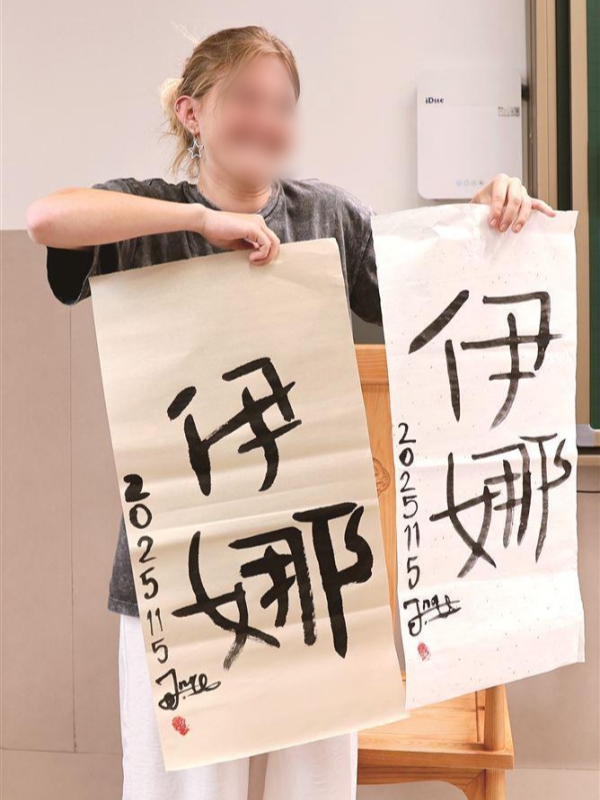
Optional but a popular souvenir. Calligraphy artists in tourist areas — Wangfujing in Beijing, Yu Garden in Shanghai, the City God Temple area — hand-write a name on rice paper or a folding fan for roughly $5–25 (¥35–175) depending on size and framing.
Q: How do I set my Mandarin name on WeChat?
Go to Me, then Profile, then Name. WeChat accepts hanzi directly — paste or type the characters. The separate WeChat ID field (Me, Profile, WeChat ID) should stay in pinyin so international contacts can search for you in Latin characters.
Q: What if no Mandarin name sounds like mine?
Pick a name by meaning instead of sound. Many long-term expats choose names whose characters carry meanings they like — "harmony," "bright," "spring" — and ignore the sound match entirely. This is normal and accepted; plenty of native Chinese names work this way.
Q: Is it rude to give myself a Mandarin name?
The opposite. It is usually read as a sign of respect and effort. Chinese hosts, colleagues, and friends typically respond warmly. The cultural misstep to avoid is choosing a name with negative or arrogant character meanings; a quick native-speaker check prevents that.