On early mobile keypads, typing Chinese was much slower than entering a number — and so, numeric shortcuts proliferated across China. Ever wondered why your Chinese friend texts “520” instead of “I love you”? Chinese number slang (数字黑话 shùzì hēihuà, meaning “digital black words”) is a secret language in plain sight — with digits as sounds, feelings as codes, and whole chats happening with zero letters. Created by Mandarin homophones where numbers sound like common words, popularized by pages and SMS in the 90s, and turbocharged by social media today, these codes are crucial for moving around in today’s Chinese Internet. Texting that crush? Gaming with Chinese teammates? Or just scrolling through WeChat? Here’s your cheat sheet.
🗣️Number Homophone Working Principles
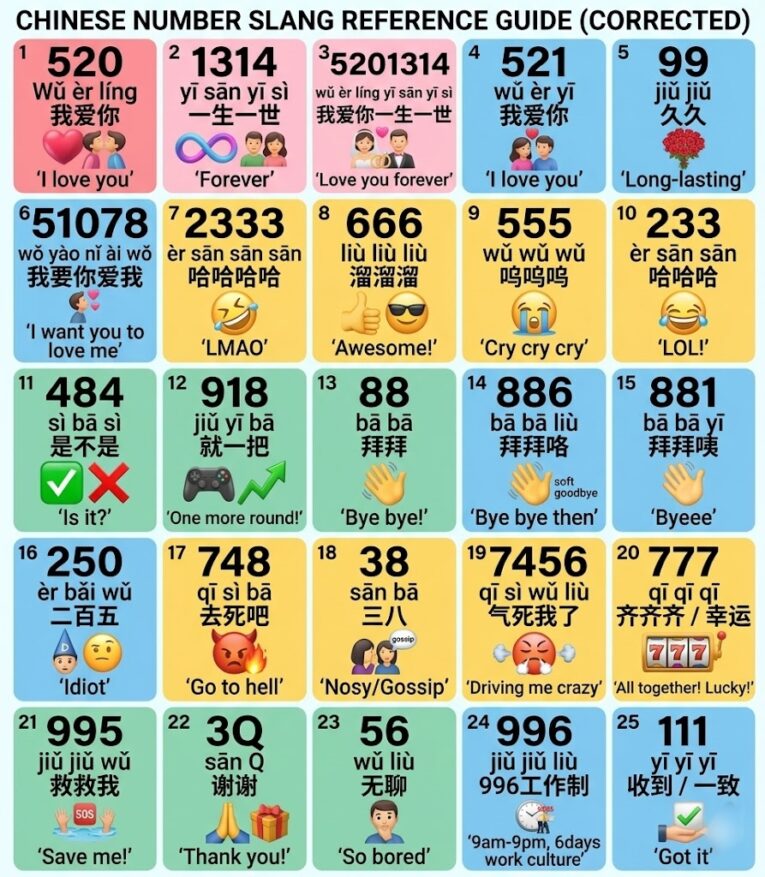
Troubling through these puzzles, every code you decoded works on the same principle. Chinese number slang exists because Mandarin is a tonal language with dangerously high homophone density — many totally unrelated words share similarly sounding syllables. Every digit (0–9) has a 1-to-1 standard sound (líng, yī, èr, sān, sì, wǔ, liù, qī, bā, jiǔ), and just like in code words, stringing together numbers returns phrases with the phonotactics of actual words and sentences. For example, 5 sounds a lot like wǔ which is also phonetically very similar to 我 (wǒ = I) and so 520 sounds like wǔ ài nǐ, or “I love you.” This logic mechanism will help crack every type of code coming up.
- Mandarin Chinese is a tonal language with limited syllable variety — many unrelated words sound nearly identical
- Numbers 0–9 each have a standard pronunciation (líng, yī, èr, sān, sì, wǔ, liù, qī, bā, jiǔ)
- Multi-digit numbers create phonetic phrases that mimic real words or sentences
- Example: 5 (wǔ) sounds like 我 (wǒ = I) — combine 520 and you get wǒ ài nǐ = “I love you”
- This practice exploded during the pager/BB machine era (1990s) when sending text was expensive and slow
- Fully revived by WeChat, Weibo, livestreaming culture, and gaming chat
📖 Cultural Note: This linguistic phenomenon is called a numeronym — using numbers to represent words or phrases based on sound or abbreviation. Chinese is uniquely suited to this because of its rich homophone density.
💕Love and Romance Slang
Romance Expression Through Numbers
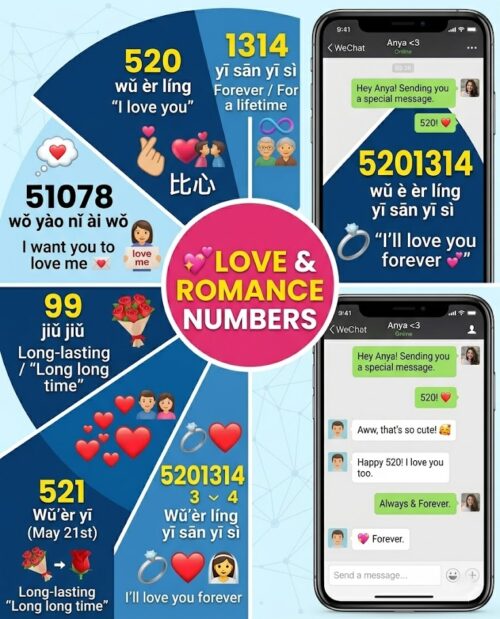
Chinese romance codes are some of the wittiest uses of number slang. Simply put, 520 (wǔ èr líng) sounds like “wǒ ài nǐ” — I love you — so May 20th has become China’s digital Valentine’s Day. Tag on 1314 (yī sān yī sì), meaning one lifetime, one world (一生一世), and you have the ultimate declaration 5201314: “I will love you forever.” Adding 521, 99, and 51078 makes for a more nuanced and vulnerable exchange in the digital sphere. These fascinating codes destroy WeChat Moments, Weibo posts, and Douyin every May 20th.
- May 20th (5/20) is celebrated as a digital Valentine’s Day in China — millions send 520 gifts on this date
- November 11th (11/11) = Singles’ Day; the opposite energy — 光棍节 (guānggùn jié)
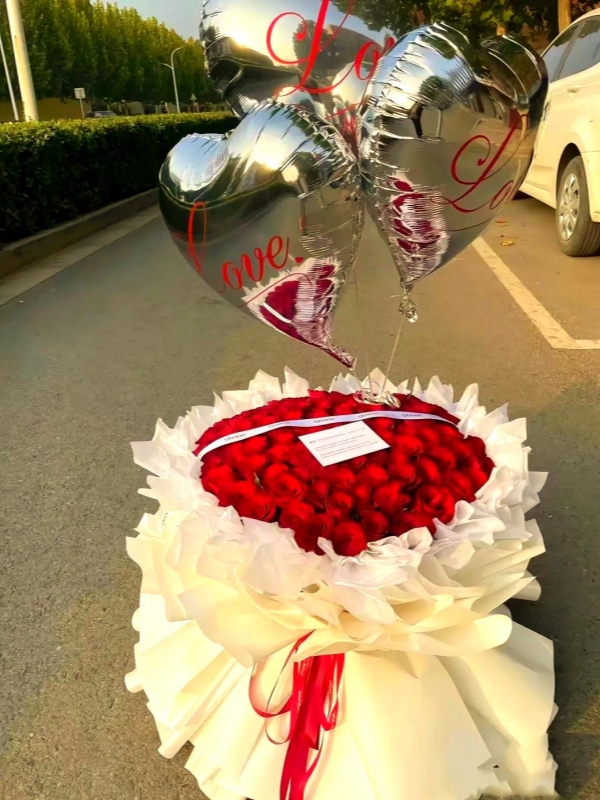
- Gifting 99 roses = symbolizing eternal love; 108 roses = will you marry me?
- These codes are especially popular on WeChat Moments, Weibo, and Douyin (TikTok)
😂Humor and Reaction Slang
Decoding Amazing Number 666
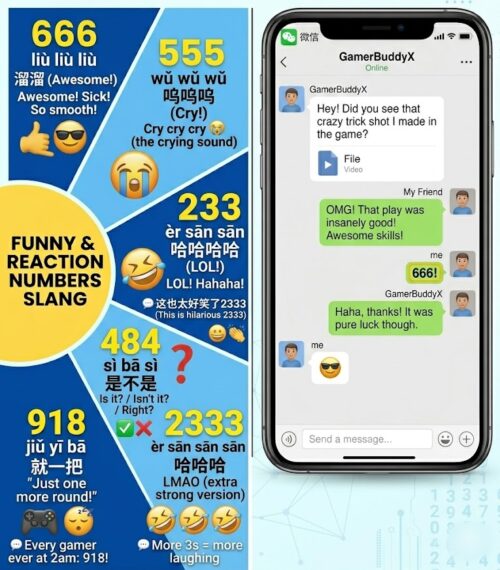
666 in China is exclusively positive – and figuring out why gives great insight into Chinese internet culture. The digit 6 (liù) sounds like 溜 (liù), meaning smooth, skilled, or slick. 666 therefore means ultra-skilled or impressively smooth (really smooth). This took hold among Chinese gaming and livestreaming communities on sites like Bilibili and Douyu where flooding a chat with 666 became the default hype for an incredible move made by a player. The Chinese 666 has none of the “devil number” associations of its western cousin, it is pure fanfare.
Origin Story of 233
The number 233 is arguably the most historically significant piece of Chinese number slang. It originated on Mop.com (猫扑), China’s earliest major internet forum, where emoticon #233 in the platform’s library was a laughing GIF. Users began typing “233” to reference it, and the code spread from forums to QQ to WeChat to virtually every platform. Adding more 3s amplifies the laughing intensity — 2333 means you’re laughing harder, 23333 even harder still — making it one of the most expressive and flexible reaction codes in Chinese internet culture.
- 233 originated from Mop.com (猫扑), China’s earliest internet forum (think: China’s Reddit in 2003)
- Emoji #233 in Mop’s emoticon library was a laughing GIF — users started typing “233” to reference it
- It spread from forums → QQ → WeChat → Weibo → everywhere
- Adding more 3s increases the laugh intensity: 2333 > 233 > just “lol”
- Today, 233 functions exactly like “lmao” or “💀” in English internet speak
🌍 Cultural Contrast: 666 means “devil” in Western culture — a chilling number. In China, 6 (liù) sounds like 溜 (liù = smooth/skilled). Three of them = triple the skill. That’s why Chinese gamers spam 666 when someone pulls off an incredible move!
👋Greeting and Goodbye Slang
Iconic Goodbye Number 88
88 (bā bā) is the pioneer Chinese number slang success story. On a 1990s pager machine that could only pass digits, 88 naturally emerged because “bā bā” sounds identical to the formal “拜拜 bàibài, the Chinese phonetic call-up of bye bye//”: a simple, sensible choice, it stuck! Decades later, 88 survived the smartphone era, and now is popular across the generations. Other variations, such as 886 and 881, show the functional range of a pager-age code.
- 88 was one of the first number slang codes ever used — on pager machines in the 1990s
- Pagers could only send numbers, so 88 = “bā bā” = “拜拜” = “bye bye” was natural and efficient
- When smartphones arrived, 88 survived — it’s now used across all generations, from grandparents to Gen Z
- In gaming: sometimes used as a “GG” equivalent when leaving a match
- Note: 88 also means “lucky” (double 8 = double fortune) — context matters!
⚠️Warning and Insult Slang
Meaning of Insult 250
The number 250 (二百五, èr bǎi wǔ) is one of the oldest Chinese insults. And somehow, its origins stretch all the way back to ancient currency. In imperial China, a unit of copper coins (一吊钱) amounted to 1,000 coins, and half of that — 500 — was known as “半吊” (half-a-string), slang for an unreliable person. Half again would be 250, or someone barely capable. The layered history here is what makes the insult resilient; it’s still extremely widely used today across all demographics, ranging from Boomer generation to Gen Z, as a clear and biting insult, meaning “idiot” or “fool.”
🚨 Read this first: These number insults are real and commonly understood in Chinese internet culture. This section exists for educational awareness — so you recognize them and aren't accidentally caught off guard (or accidentally use one).
Cultural Roots of 250
- In ancient China, 1,000 copper coins (一吊钱) was a standard unit of currency
- Half of that = 500 coins = “半吊” (half a string) — slang for an unreliable person
- Half of that = 250 = 二百五 — meaning someone not even half-competent
- The insult evolved: 半吊子 (half-a-string-guy) → 二百五 (250) → ultimate dummy
- Today it’s widely understood across China — even older generations recognize it
⚠️ Usage Warning: 38 (三八) originally referred to Women’s Day (March 8th) but evolved into a gendered insult. Using it can be considered sexist. 748 is one of the harshest things you can type in Chinese. These are included here for literacy, not use!
🌟Rare and Hidden Slang
Obscure Secret Number Slang
Beyond the household names of Chinese number slang, there’s a whole additional layer which reveals the true creativity of Chinese internet sleuths. Codes like 777 (all together! / lucky!), 995 (save me!), and 3Q (thank you – a bilingual blend of “sān” and the English letter “Q”), alongside 996 (the brutal 9am-to-9pm, six-days-a-week work schedule that promised to put “the whole of China to work”), show just how much overlap there is between number slang and the impulses behind bigger memes. Take a minute to explore and it will be well worth your time.
- 996 became a cultural flashpoint in 2019 — Chinese tech workers started a GitHub protest against the exhausting work schedule
- 777 is often used in gaming when a team syncs perfectly — echoes the “jackpot” slot machine visual
- 3Q blends Chinese sound (sān) with English letter (Q) — a bilingual mashup typical of modern Chinese netspeak
- 995 is humorous when used for minor complaints and sincere when used in genuine distress — tone of context is everything
✅Safe Slang Usage Guidelines
Professional Rules for Usage
Knowing Chinese number slang is one thing — using it correctly is another. So some simple ‘rules of thumb’ come in handy. Codes that are safe to use include 520, 666, 88, 233, 555 – these will work in nearly any environment. Codes that carry social capital include 748, 250, and 38. 748 is ‘qī sì bā’ or ‘go to hell’ – so avoid! Context is key – 555 can be heartfelt sorrow or playful melodrama, depending on emojis and tone. Stick to the universally good codes and let the negatives guide your reading.
Freely Usable Safe Slang
- 520 / 1314 / 5201314 — Any romantic context; texting a crush, anniversary messages, WeChat stickers
- 666 — Gaming chats, complimenting someone’s skills, livestream comments
- 88 — Saying goodbye to anyone, any age, any platform
- 233 / 2333 — Reacting to something funny; equivalent to “lol” or “💀”
- 555 — Expressing sadness or sympathy; totally safe and widely understood
- 3Q — Casual thanks among friends
Extreme Caution Required Slang
- 748 — One of the harshest insults in Chinese — avoid entirely in any context
- 250 — Only use in clearly joking, close-friend contexts where tone is obvious
- 38 — Has sexist connotations; best avoided unless you know exactly how it lands
- 7456 — Frustration expression; fine in casual venting, not professional settings
Pro Tips from Chinese Internet Culture
- In gaming: 666 is always safe — it’s the universal compliment
- On Douyin/TikTok livestreams: viewers spam 666 to hype up creators — do the same!
- Context is everything: 555 can be genuine crying or playful whining — read the room
- When in doubt with insult numbers: just don’t — recognition > usage
- These codes work great as WeChat / QQ status messages — try 520 on May 20th!
- Non-Chinese using these codes is generally seen as charming and culturally aware — go for it (with the safe ones)!
❓FAQ — Your Top 10 Questions Answered
Q: What does 233 mean in Chinese slang?
The number 233 is Chinese internet slang for laughter — the equivalent of “LOL” or “hahaha.” This chinese number slang originated from emoticon #233 on Mop.com, China’s earliest major internet forum, where it depicted a laughing GIF. Users began typing “233” to reference it, and the code spread to every platform. Add more 3s — 2333, 23333 — and the laughing intensity scales up proportionally. It’s completely safe and universally understood today.
Q: What does 777 mean in China?
In Chinese internet culture, 777 (qī qī qī) is a lucky and celebratory number used primarily in gaming and group celebrations. This chinese number slang evokes both the slot machine jackpot visual and the character 齐 (qí = together/in sync), giving 777 a distinctly communal “we all made it!” energy. Unlike Western lucky 7, the Chinese 777 emphasizes collective harmony and perfect teamwork, making it especially common in multiplayer gaming contexts.
Q: What does 555 mean in Chinese slang?
The chinese number slang 555 (wǔ wǔ wǔ) mimics the sound of crying in Mandarin — specifically 呜呜呜 (wū wū wū), the phonetic representation of sobbing. It works exactly like “😭😭😭” in English, covering both genuine sadness (“555 I failed my exam”) and playful over-dramatization (“555 he didn’t text back”). Surrounding context and emoji tell you which. It’s one of the most universally recognized number codes across all Chinese platforms.
Q: What does 748 mean in Chinese?
The chinese number slang 748 (qī sì bā) sounds like 去死吧 (qù sǐ ba) — “go die” or “go to hell.” It originated in the pager era as a number-coded expression of extreme frustration, but today it carries the full weight of a serious and deeply offensive insult. Understanding it helps you recognize online aggression — but we strongly recommend never using it yourself, regardless of context or intent.
Q: What does 520 mean in Chinese and when should I use it?
The chinese number slang 520 (wǔ èr líng) sounds like 我爱你 (wǒ ài nǐ) — “I love you.” It’s the single most iconic code in the entire Chinese number slang system. Use it on May 20th (China’s digital Valentine’s Day), in texts to a partner or crush, in WeChat gift captions, or as a romantic sign-off. Pair it with 1314 (“forever”) for maximum impact: 5201314 means “I’ll love you forever” — a declaration that millions exchange online every May 20th.
Q: Why does 666 mean “awesome” in Chinese gaming?
This chinese number slang works because 6 (liù) in Mandarin sounds similar to 溜 (liù) — meaning smooth, skilled, or slick. Triple 6 therefore signals ultra-skilled or impressively smooth play. The code took off in Chinese gaming and livestreaming culture, particularly on platforms like Douyin, Bilibili, and Douyu, as a hype comment when a player executes something impressive. Unlike the Western “devil number” association, Chinese 666 is purely enthusiastic praise.
Q: What are the most common Chinese number slang codes I should know first?
If you’re starting out with chinese number slang, prioritize these five essential codes: 520 (I love you), 666 (awesome!), 88 (bye bye), 555 (crying), and 233 (LOL). These five cover the vast majority of situations you’ll encounter on Chinese social media, in gaming chats, and in everyday messaging with Chinese friends or colleagues. Master these first, then expand to the full 25+ code vocabulary as your exposure grows.
Q: Where did Chinese number slang originally come from?
Chinese number slang has two key origin points that shaped the phenomenon we know today. First, the pager era of the 1990s — when pagers transmitted only numbers, prompting users to encode words into digits (88 = “bā bā” = “bye bye” is the classic example of this chinese number slang tradition). Second, early internet forums of the 2000s, especially Mop.com, where numbered emoticons gave us 233 for laughter. Cheap SMS pricing and gaming culture then accelerated adoption across the entire country.
Q: Is it weird for a non-Chinese person to use Chinese number slang?
Not at all — in fact, using positive chinese number slang codes like 520, 666, 88, or 233 is generally received as charming and culturally curious by Chinese speakers. It signals genuine effort to understand their internet culture. Stick to the positive and neutral codes, avoid the insults entirely, and you’ll likely get a warm — and possibly surprised — reaction. For people connecting with Chinese friends, gaming teammates, or colleagues online, it’s an excellent icebreaker.
Q: What is the difference between 520 and 521 in Chinese?
Both 520 and 521 express “I love you” (我爱你 / wǒ ài nǐ) in chinese number slang, since both pronunciations approximate the phrase closely enough. However, May 20th (5/20) is significantly more popular — brands, couples, and social media all treat it as China’s primary digital Valentine’s Day. May 21st (5/21) is recognized as a secondary date, sometimes framed as “the response day” after the declaration. Between the two, 520 is far more widely used and culturally embedded.