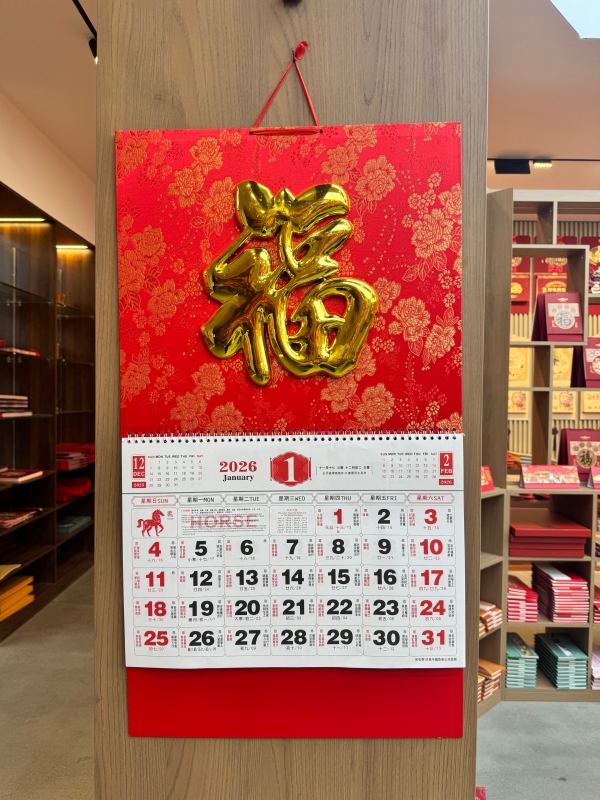
Chinese Calendar Conversion 2026/2027
The Chinese calendar governs everything that matters to visitors — when festivals fall, which weeks to avoid, and why the same Gregorian date shifts every year. If you are booking flights, trains, or attractions for 2026 or 2027, you need the lunar conversion, not just the public-holiday list. This guide gives you both years side by side, explains how the lunisolar system works, and translates every date into the practical travel advice you actually need.
The calendar splits into two parallel tracks: lunar months anchored to new moons, and fixed solar anchors (Qingming, National Day) that stay on the same Gregorian date. Master those two rules and you can navigate any year. Below you will find tables, conversion charts, and a plain-English breakdown of every major festival and the weeks that surround it.
Quick Facts
How the Chinese Lunar Calendar Works
The Chinese calendar is lunisolar — it tracks the Moon's cycle but stays anchored to the solar year. Each month begins on the astronomical new moon, when the Moon sits between Earth and the Sun. A lunar month can be 29 or 30 days, depending on whether the Moon completes its orbit in the shorter or longer window. That variance is why some months feel shorter than others.
The year begins on the second new moon after the winter solstice, which is why Chinese New Year drifts between late January and mid-February. Every few years a lunar month contains no principal solar term (中气); in that case, a leap month (闰月) is inserted to keep the lunar months from drifting too far from the solar seasons. Neither 2026 nor 2027 contains a leap month — the next one is expected in 2028. The practical effect is simple: the same Gregorian date maps to a different lunar date every year, and the tables below tell you exactly which.
2026 Chinese Calendar & Festival Dates
Chinese Calendar Conversion
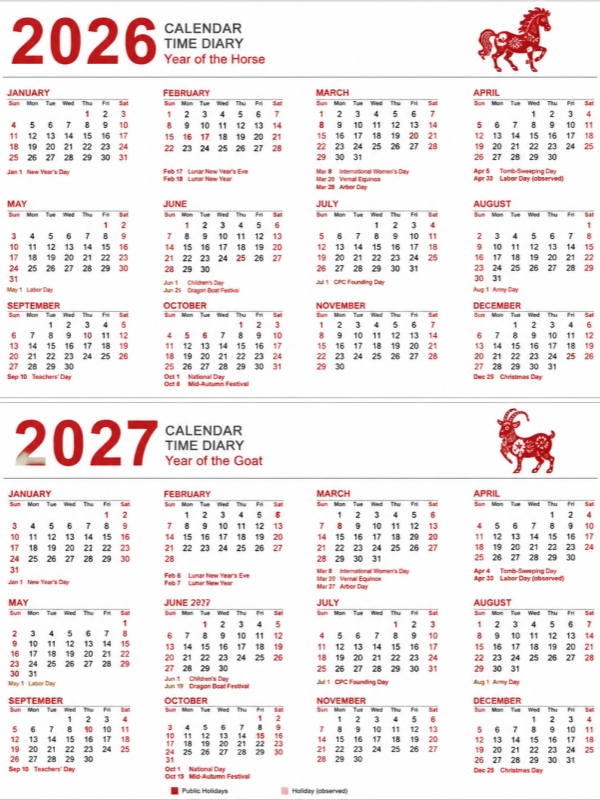
2026 is the Year of the Horse (丙午). Chinese New Year falls on Tuesday, February 17. The year contains 12 lunar months with no leap month inserted. The tables below give the approximate Gregorian start of each lunar month and the corresponding full-moon (15th-day) date. New-moon dates are approximate to ±1 day; fixed solar festivals are exact.
2026 Lunar–Solar Month Conversion
Note: Dates are approximate to ±1 day for lunar month starts; full-moon 15th-day dates are calculated from those starts.
2026 Major Festival & Holiday Dates
🗓️ Understand China's Public Holiday Adjustments: When planning around major festivals, keep in mind that China often adjusts weekend workdays to create longer holiday stretches. Learn how these mandatory makeup workdays operate in our guide to Tiaoxiu (Adjusted Workdays).
2027 Chinese Calendar & Festival Dates
2027 is the Year of the Goat/Sheep (丁未). Chinese New Year falls on Saturday, February 6. Like 2026, this year contains 12 lunar months with no leap month — the next leap month is expected in 2028. Use the tables below to convert any Gregorian date to its lunar counterpart for travel planning or cultural context.
2027 Lunar–Solar Month Conversion
Note: Dates are approximate to ±1 day for lunar month starts; full-moon 15th-day dates are calculated from those starts.
2027 Major Festival & Holiday Dates
Major Chinese Festivals Explained

Spring Festival (Chinese New Year)
Six festivals anchor the Chinese year for travelers — here is what each one marks and when foreign visitors typically encounter them.
- Spring Festival (Chinese New Year): The biggest annual holiday in China. A 7-day public holiday falls in both years (Feb 16–22, 2026 and Feb 5–11, 2027), triggering the Chunyun travel rush that sees billions of domestic trips. Many small shops and restaurants close around New Year's Eve and Day.
- Lantern Festival: Celebrated on the 15th day of the first lunar month, it marks the end of the New Year period. Lantern displays light up parks and temples — look for them on Mar 3, 2026 and Feb 20, 2027.
- Qingming (Tomb-Sweeping Day): A fixed solar-date holiday on Apr 5 in both years, honoring ancestors by visiting and tending graves. The 3-day window also draws families to spring outings and parks.
- Dragon Boat Festival: Held on the 5th day of the 5th lunar month (Jun 19, 2026 and Jun 9, 2027). The 3-day holiday features dragon boat races in southern cities and the traditional sticky-rice dumpling called zongzi.
- Mid-Autumn Festival: Falling on the 15th day of the 8th lunar month (Sep 25, 2026 and Sep 15, 2027), this 3-day holiday centers on family reunions, mooncakes, and outdoor viewing of the full moon.
- National Day & Golden Week: Fixed at Oct 1–7 in both years, this is China's second-largest travel rush after Spring Festival. Tourist sites hit their highest daily visitor counts of the year.
Planning Travel Around the Chinese Calendar
The Chinese calendar is a planning tool, not just a curiosity. Once you know which weeks are crowded and which are quiet, you can time your trip for lower prices, shorter queues, and a more genuine experience. The rule of thumb: avoid the two 7-day peak windows and target the 2–3 week shoulders on either side.
Best & Worst Times to Visit China
Avoid the 7-day Spring Festival and National Day windows; target the 2–3 week shoulders either side of them. Here is how that breaks down for 2026 and 2027.
- Best: Mid-March to mid-April 2026 (pre-Qingming shoulder; weather thaws, crowds are light)
- Best: Mid-April to late April 2026 (pre-Labor Day window; spring scenery peaks in the south)
- Best: Mid-September to late September 2026 (pre-Golden Week; comfortable autumn weather)
- Best: Early March to mid-April 2027 (similar shoulder pattern; cooler and less crowded)
- Best: Late April 2027 (pre-Labor Day; good for outdoor sightseeing before summer heat)
- Avoid: Spring Festival week — Feb 16–22, 2026 and Feb 5–11, 2027 (highest demand, closed businesses, sold-out trains)
- Avoid: Labor Day week — May 1–5 in both years (short surge, popular sites hit capacity)
- Avoid: National Day Golden Week — Oct 1–7 in both years (second-busiest travel period, peak pricing)
- Avoid: Dragon Boat and Mid-Autumn 3-day weekends when adjacent to a regular weekend (weekend-plus-holiday combinations create mini-rushes)
What to Expect During Festival Travel
Festival travel is workable but needs 4–6 weeks of lead time on bookings. Here is what to expect.
- Booking lead time: Book HSR and flights 4–6 weeks ahead for Spring Festival and Golden Week. HSR second-class Beijing–Shanghai runs about $78 (¥553); tickets sell out within hours of release on 12306. Domestic flights surge more sharply — book as soon as fares appear.
- Business closures: Many small shops and family-run restaurants close for 2–4 days around Chinese New Year (Feb 16–22, 2026 and Feb 5–11, 2027). Large hotel chains, major restaurant groups, and tourist sites stay open with reduced hours.
- Site crowd caps: The Forbidden City, Great Wall, West Lake, and Terracotta Army impose daily visitor limits. Reserve timed-entry tickets 1–2 weeks in advance on Trip.com or each site's English-language page.
- Hotel pricing: Domestic hotel rates often rise 1.5–2× during peak weeks. A standard room in Beijing or Shanghai running $70–110 (¥500–800) per night can reach $140–200 (¥1,000–1,450) during Golden Week. Book early on Trip.com or Booking.com.
Frequently Asked Questions
Q: When is Chinese New Year in 2026 and 2027?
Chinese New Year falls on Tuesday, February 17, 2026 (Year of the Horse), and Saturday, February 6, 2027 (Year of the Goat/Sheep). The standard 7-day public holiday runs the day before through a few days after — February 16–22, 2026 and February 5–11, 2027.
Q: How do I convert a Gregorian date to the Chinese lunar calendar?
Lunar months begin on the astronomical new moon, and the first lunar month always contains the second new moon after the winter solstice. Use the 2026 and 2027 month-by-month conversion tables in this guide for the corresponding year. Be aware that new-moon-based month starts are approximate to ±1 day.
Q: Why does the Chinese calendar have a leap month in some years?
A leap month (闰月) is inserted when a lunar month contains no principal solar term (中气), keeping lunar months aligned with the solar year. Neither 2026 nor 2027 has a leap month; the next one is expected in 2028.
Q: Are tourist sites open during Chinese New Year?
Major paid attractions — the Forbidden City, Great Wall, Shanghai Disneyland, Terracotta Army — stay open but often with reduced hours and visitor caps. Many smaller shops, restaurants, and family-run businesses close for 2–4 days around New Year's Eve and Day. Check each site's official English page for exact holiday hours.
Q: Which is the busiest week in China for travel?
Spring Festival week — February 16–22, 2026 and February 5–11, 2027 — sees the largest annual travel rush (Chunyun, billions of domestic trips). National Day Golden Week (Oct 1–7 in both years) is the second-busiest.
Q: What zodiac animal is 2026 and 2027?
2026 is the Year of the Horse (马, 丙午). 2027 is the Year of the Goat/Sheep (羊, 丁未). The 12-year zodiac cycle means these animals repeat every 12 years.
Q: Do I need to book HSR or flights differently during Chinese holidays?
Yes — book 4–6 weeks ahead for Spring Festival, Labor Day, and Golden Week. HSR tickets (regulated fare about $78 (¥553) Beijing–Shanghai second class, no formal surge pricing) sell out within hours of release on 12306. Domestic flights surge more sharply. Use Trip.com for English-language booking with international payment options.