China Dental Implant Cost Comparison (2026):Price vs. Other Countries, Top Brands, & Breakdown
The dental implant cost in China starts at just $1,200 for a complete single implant in 2026. That is 60% less than the $4,500–$6,000 you pay in the US or UK. And you get the exact same Swiss and Swedish brands. In fact, China is now among the world's top medical tourism destinations for affordable dental work. Searches for dental implant cost China have tripled since 2022—a clear sign that international patients are actively discovering these savings.
Government price caps for surgical fees were set at ¥4,500 (~$630) per implant in 2022. As a result, the national average cost decreased by over 55%. In this guide we break down every cost item: fixture, abutment, crown, imaging, and bone grafting. So you arrive armed with a realistic budget and not just a guess. As well as compare China against Thailand, South Korea, Australia, and more. And reveal which cities and clinics offer the best bang for your buck outside China.
Looking for a full clinic-by-clinic guide? See our best dental implants in China: full clinic guide for foreign patients 2026.
China vs. The World: Dental Implant Costs Compared Across 6 Countries (2026)
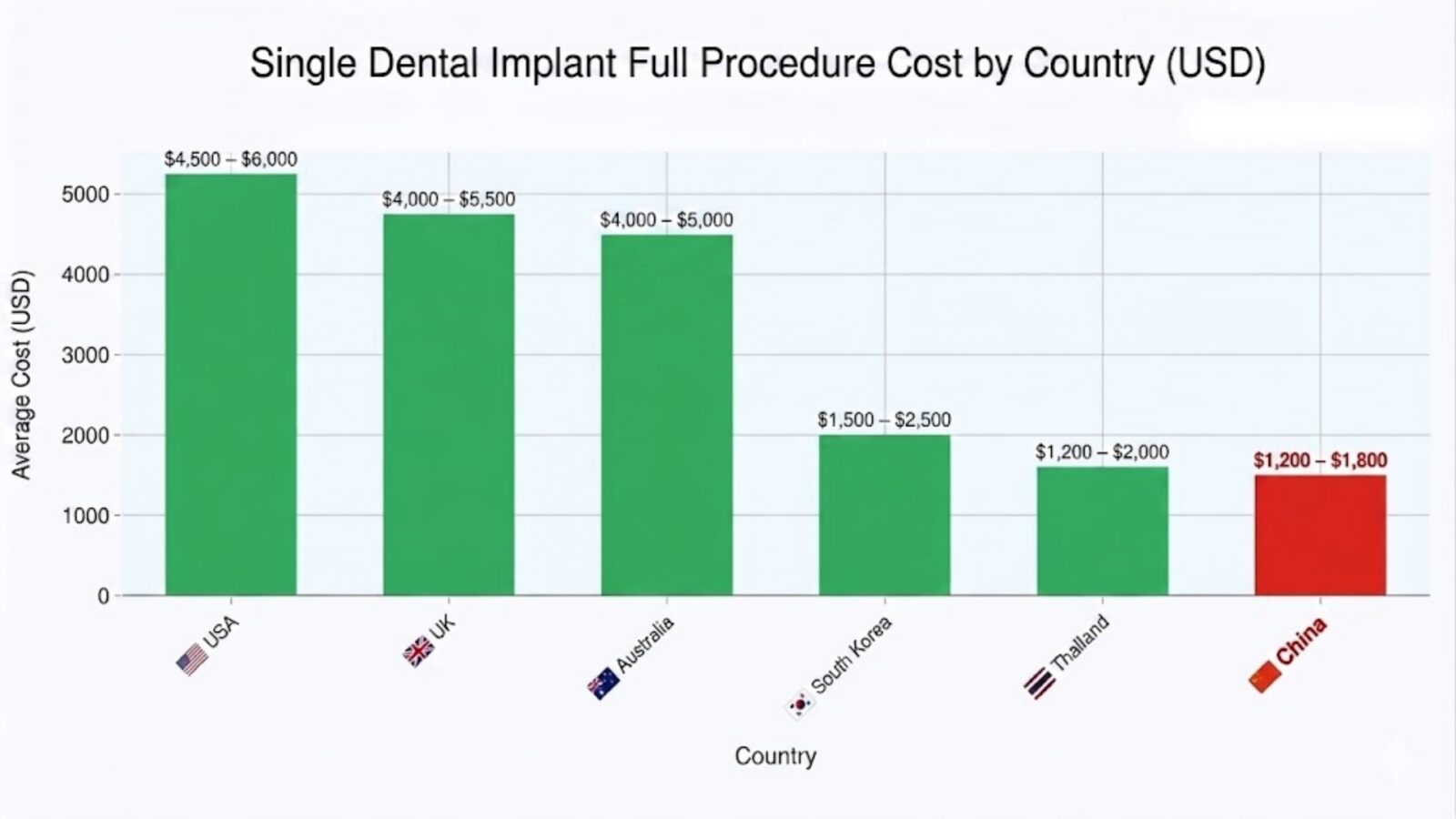
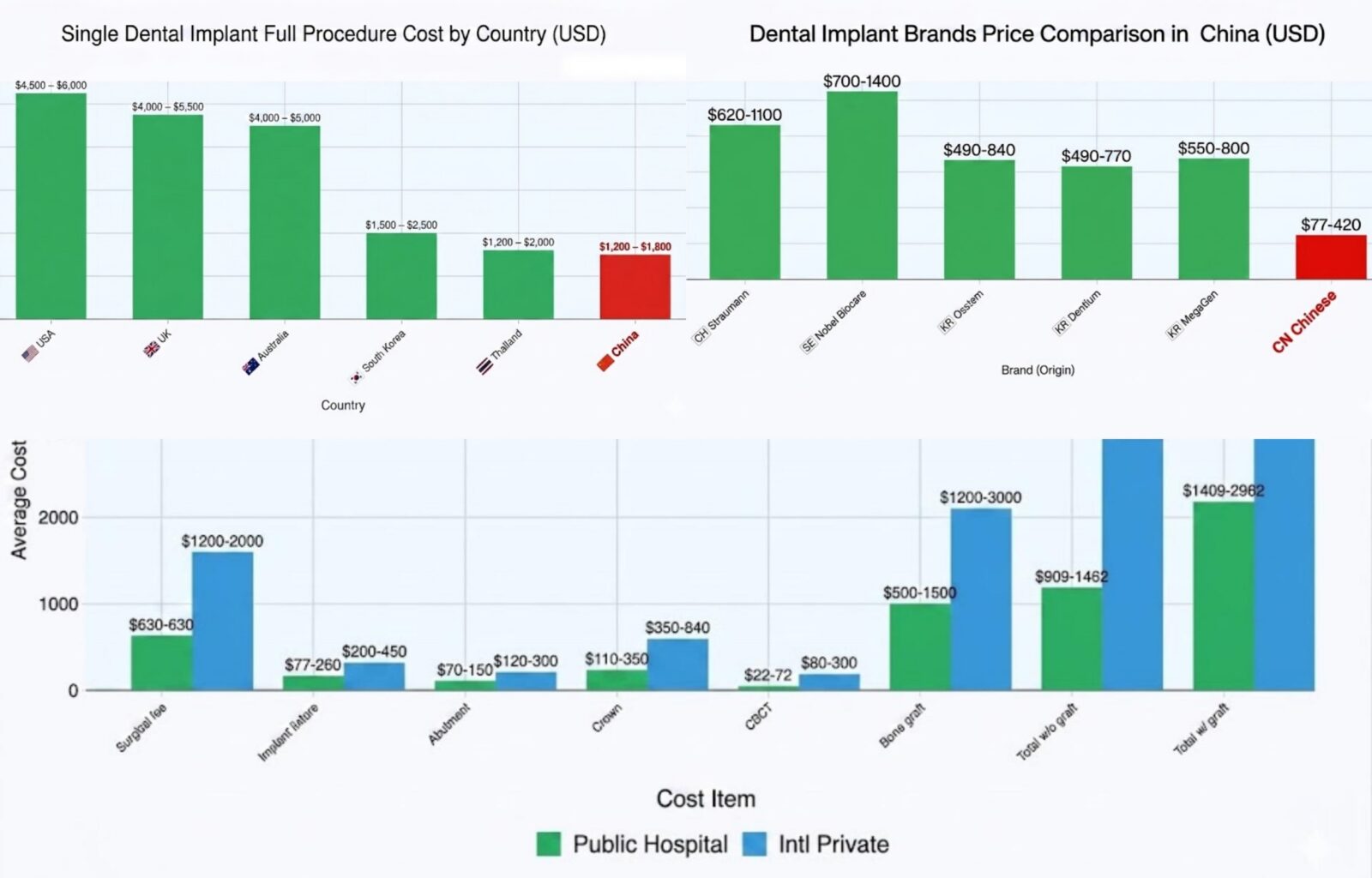
Global Comparison of Single Dental Implant Costs (Full Procedure in USD)
China offers the lowest total price for premium-brand dental implants in the world. The table below shows the full single-implant cost by country in 2026. These figures include fixture, abutment, crown, and basic imaging.
| Country | Single Implant – Full Procedure (USD) | Notes |
|---|---|---|
| 🇺🇸 USA | $4,500 – $6,000 | Private pay; most insurance plans exclude implants |
| 🇬🇧 UK | $4,000 – $5,500 | NHS does not cover implants; private clinics only |
| 🇦🇺 Australia | $4,000 – $5,000 | Medicare excludes dental; private health gives partial coverage |
| 🇰🇷 South Korea | $1,500 – $2,500 | Seoul clinics popular for medical tourism |
| 🇹🇭 Thailand | $1,200 – $2,000 | Bangkok private clinics; convenient one-trip option |
| 🇨🇳 China | $1,200 – $1,800 | Government VBP price controls; same international brands |
China and Thailand are more or less in the same price range. But China easily beats Thailand on Swiss and Swedish premium brands. Straumann implants for example are only $620–$1,100 in Chinese clinics. In Thailand this same brand runs $1,200–$1,800 and $1,400–$2,000 in Mexico. This massive difference is attributed to China’s government Volume-Based Procurement (VBP) policy whereby manufacturers were forced to cut their prices by 40–63% to gain access to the Chinese hospital market. And the brands—Straumann. Nobel Biocare. Osstem etc—have not changed their materials or quality at all. Many patients also combine their dental trip with a comprehensive health checkup in China to get more value from one single trip.
Why Is China Cheaper? Quality and Value Explained
Most first-time patients ask the same question: the price is this low—is the quality still good? The answer is yes. Here is exactly why.
Straumann’s average selling price in China fell about 40-45% since VBP was implemented. Its China sales volume grew 25% in that period. This indicates growing patient trust. The implants sent to Chinese hospitals are produced with the same specifications as units sent to US and European clinics. Only the distributor markup was chopped, not the product quality.
Some of China’s largest dental hospitals have real international accreditation. Beijing United Family Hospital and several in Shanghai have JCI accreditation. This is the same global standard used to certify elite hospitals in the USA, Europe and the Middle East. Surgeons at Peking University Hospital of Stomatology often publish in international journals and many have trained at European and North American academic centres.
Straumann, Nobel Biocare, and Korean Brands: Same Quality, Lower Price
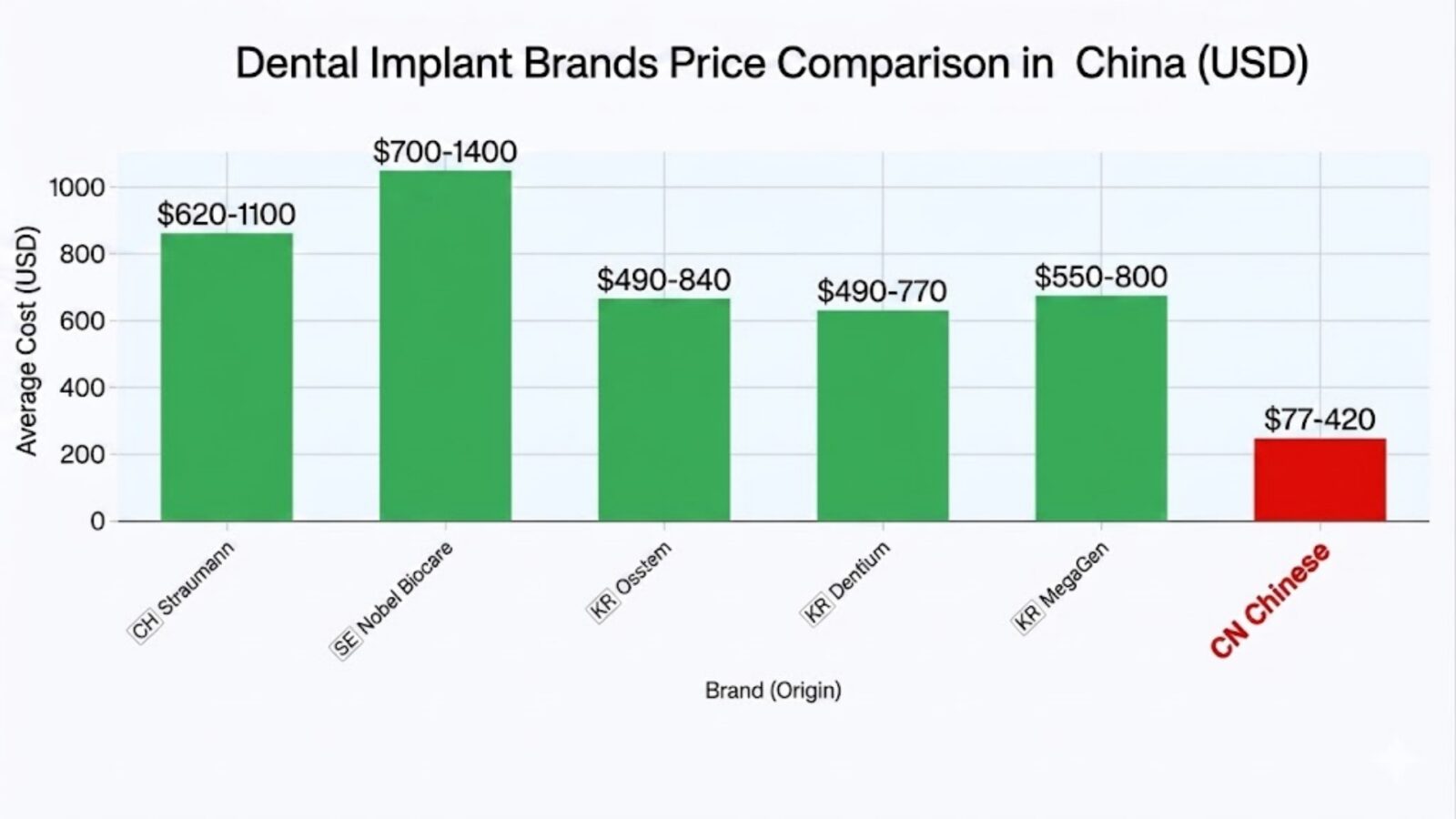
Dental Implant Brands in China:Price Ranges (USD)
Below is a comparison of major implant brands available in China, their 2026 prices, and key clinical data.
| Brand (Origin) | Price in China (USD) | 5-Year Success Rate | Best For |
|---|---|---|---|
| Straumann (Switzerland) | $620 – $1,100 | 98.2% | Complex cases, long-term durability, 30+ year track record |
| Nobel Biocare (Sweden) | $700 – $1,400 | 97.5% | Immediate loading, poor bone density cases |
| Osstem (South Korea) | $490 – $840 | 98.8% | Standard cases, best price-to-quality ratio |
| Dentium SuperLine (South Korea) | $490 – $770 | 97.8% | Standard cases, budget-conscious patients |
| MegaGen AnyRidge (South Korea) | $550 – $800 | 97.5% | Low bone density, narrow ridges |
| Chinese domestic brands | $77 – $420 | 97.5% | Budget option, adequate bone, shorter treatment term |
Korean brands have 44% of the implant market in China in 2026 and include Osstem, Dentium, and MegaGen. Osstem TSIII implants received FDA clearance back in 1997, CE mark, and ISO certification. For basic routine single tooth cases, Korean brands offer $300 to $500 cheaper per tooth than Swiss brands, and practical clinical differences between the two are negligible. Go for Straumann or Nobel Biocare only if facing a big task, such as poor bone density, same-day teeth, or where long-term global warranty is paramount.
Chinese Domestic Implants: Good Value with a Proven Track Record
Chinese domestic implants: Beijing Daqing Xige ($280 – $420) and Trausim/Bioconcept ($350 – $630) use titanium from Germany, are CE marked, and are exported to over 60 countries. The company claims a 4-year clinical success rate of 97.5%, just shy of international brands. The key disadvantage however, is the age of data. Many Chinese brands now have just 10 to 15 years of implanted clinical information. Straumann implant data is now over 30 years old - meaning that for patients who want the longest warranty, international brands are still the safer option.
Dental Implant Cost in China: Complete Breakdown of Every Fee (2026)
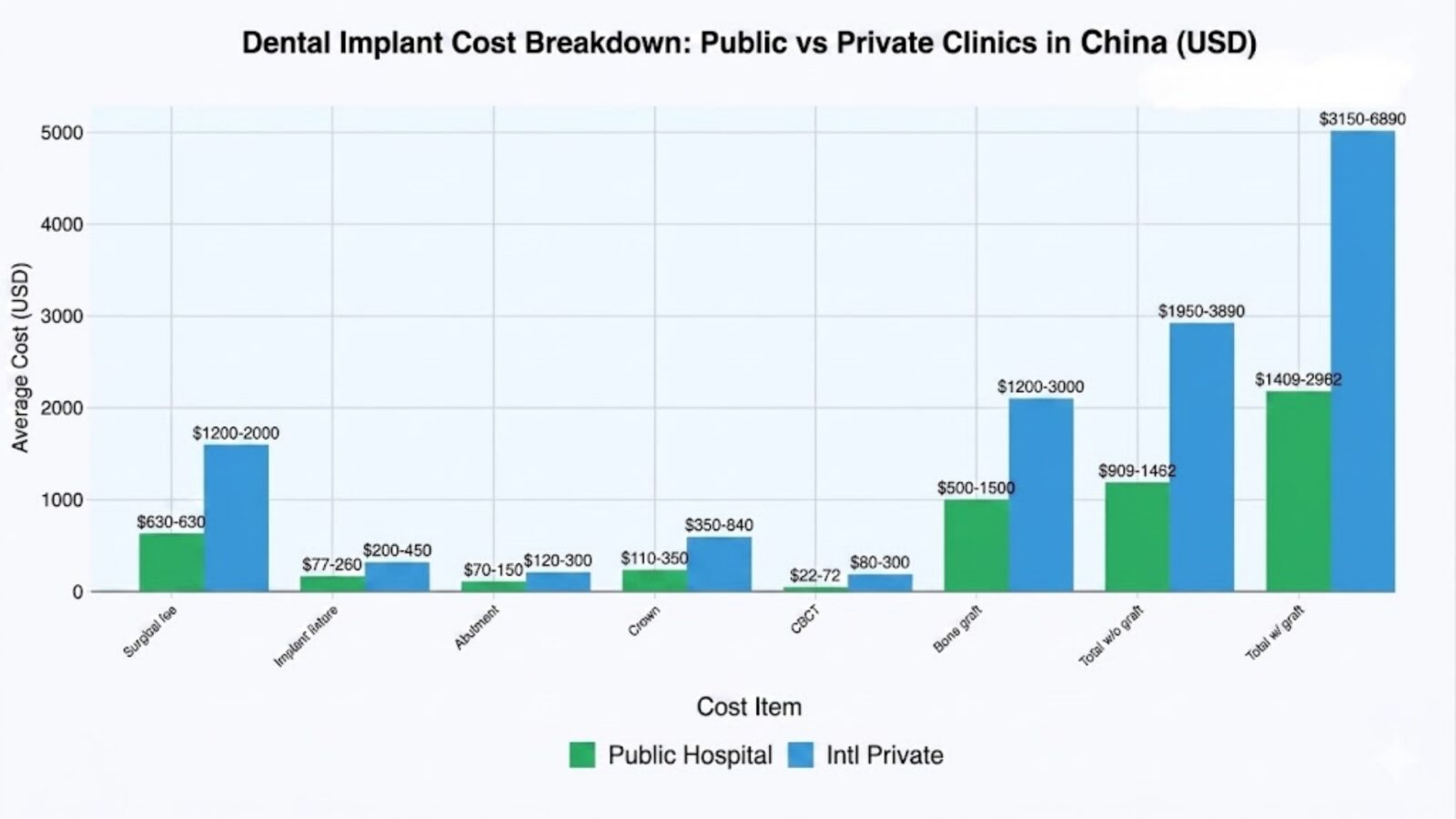
Detailed Cost Breakdown for Dental Implants in China:Public Hospital vs. International Private Clinics (USD)
A complete implant involves several separate cost items. When a clinic advertises a headline price, it usually covers just one of them. Therefore, always ask for a full itemized quote before you book. The table below shows every cost item you should expect.
| Cost Item | Public Hospital (USD) | International Private Clinic (USD) | What It Covers |
|---|---|---|---|
| Surgical service fee (gov. cap) | $630 (¥4,500 cap) | $1,200 – $2,000 | Consultation, surgery, anesthesia, follow-up visits |
| Implant fixture (titanium post) | $77 – $260 (domestic / Korean) | $200 – $450 (Swiss / Swedish) | The post inserted into the jawbone |
| Abutment | $70 – $150 | $120 – $300 | Connector between post and visible crown |
| Crown | $110 – $350 (porcelain / zirconia) | $350 – $840 (zirconia / E.max) | The artificial visible tooth |
| CBCT imaging (3D CT scan) | $22 – $72 | $80 – $300 | Bone volume assessment; required by most clinics |
| Bone graft (if required) | $500 – $1,500 | $1,200 – $3,000 | Only when bone volume is insufficient; not always needed |
| Total – without bone graft | ~$909 – $1,462 | ~$1,950 – $3,890 | Standard single implant, all components included |
| Total – with bone graft | ~$1,409 – $2,962 | ~$3,150 – $6,890 | Cases involving bone loss |
Note: When a clinic advertises "$620 dental implants in China," this is only the government-capped surgical service fee. Fixture, abutment, crown, and imaging are all billed separately. Always request a full written itemized quote before you commit.
Implant Brand Tiers: Which One Should You Choose?
China’s VBP is the main reason Chinese implants are cheaper than Swiss implants in every other country. Pre-2022 reform, Straumann’s fixture sold for about $700 in China. Post-VBP, hospitals pay ~ $260 for the same fixture - a drop of ~63% - with no change in specs. In other words, it’s a price drop gained entirely by eliminating distributor markups, not slashing product quality.
For most international patients, with reasonably healthy bones and no complications, Korean brands offer the strongest value. They’re FDA and CE certified, clinically proven for 25 years, and $300 to $500 cheaper per tooth than Swiss brands. Use Straumann or Nobel Biocare for solutions for poor bone density, same-day teeth, or a long-term global manufacturers warranty.
Before leaving China, ask your clinic for an Implant Record Card. This document lists the implant brand, model, lot number, and includes a DICOM copy of your post-operative CT scan. As a result, your dentist at home can access the manufacturer's global warranty and manage follow-up care with no complications.
Bone Grafting: When Is It Needed and What Does It Cost?
About 20–40% of implant patients need some bone grafting first. Bone loss happens when a tooth has been missing for six or more months. The jaw slowly resorbs bone without a root present. Additionally, a history of gum disease or low bone density (under 40 Hounsfield Units on CT) also calls for grafting before placement.
There are three main graft types used in China:
- Autogenous graft (your own bone): Most biocompatible and lowest rejection risk. However, it requires a second surgical site. Cost: $500–$1,200.
- Xenograft (bovine-derived bone): Most commonly used. No second surgical site is needed. Well-documented success rates. Cost: $600–$1,500.
- Synthetic bone substitute: A good option for patients with dietary restrictions or allergies. Cost: $700–$2,000.
- Sinus lift (upper jaw only): Required when the sinus floor sits too close to the implant site. It adds 3–6 months to treatment. Cost: $1,500–$3,000 per side.
If your tooth has been missing more than six months, ask for a bone volume assessment before the clinic quotes you a final price. A bone graft can add $500–$3,000 to your total. So, knowing this upfront prevents surprises.
Understanding the Government ¥4,500 Service Fee Cap
In 2022, China’s NHSA set a cap of ¥4,500 (~$630) for the medical service fee for one implant, applicable to VBP-participating public hospitals. This amount covers the consultation, surgery, anesthesia, post-op care, and follow-up visits, but not the fixture, abutment, crown, imaging, etc. These are all billed separately based on the brand and materials you choose.
To confirm that a clinic participates in VBP, you can visit nhsa.gov.cn or search for “国家医保服务平台” on WeChat and check the “口腔种植价格治理医疗机构名单.”Participating clinics are required to disclose a price board on-site. Private international clinics usually don’t sign up for VBP, but many offer competitive all-inclusive pricing. Still, always ask for a written, itemized quote!
Recommended Hospitals & Clinics by City: Best Value for Dental Implants in China (2026)
| City | Average All-In Price (USD) | Top Pick for International Patients |
|---|---|---|
| Shanghai | $1,400 – $2,200 | Arrail Dental – widest English service, direct insurance billing |
| Beijing | $1,300 – $2,000 | PKU Stomatology – lowest VBP-regulated prices; UFH for English service |
| Shenzhen | $1,200 – $1,800 | Luohu & Futian clinics – best value for Hong Kong residents |
| Guangzhou | $1,100 – $1,700 | Sun Yat-sen Stomatology – lowest prices among major cities |
| Chengdu / Xi'an | $630 – $900 | VBP public hospitals – absolute lowest nationally; minimal English |
Prices for dental implants vary significantly not only between cities, but between individual hospitals and clinic chains within the same city. The recommendations below highlight specific institutions and focus on where each one delivers a clear price advantage for international patients. For full profiles, patient reviews, English-service ratings, and WeChat booking contacts, see our dedicated guide: best dental clinics in China for foreign patients 2026.
Beijing: Peking University Hospital of Stomatology (北京大学口腔医院)
| Implant Type | Brand Tier | All-In Price (USD) | Price Advantage vs. Shanghai Private |
|---|---|---|---|
| Single tooth | Chinese domestic (e.g., Xige, Trausim) | $530 – $680 | Save ~$200–$400 vs Shanghai private |
| Single tooth | Korean (Osstem, Dentium) | $810 – $960 | Save ~$150–$300 vs Shanghai private |
| Single tooth | Swiss (Straumann) | $1,510 – $2,000 | Save ~$300–$500 vs Shanghai private |
| All-on-4 (single arch) | Korean brands | $8,000 – $12,000 | Save $2,000–$5,000 vs Shanghai private |
| All-on-4 (single arch) | Swiss / Swedish | $12,000 – $18,000 | Still 60–70% less than USA or Australia |
Peking University Hospital of Stomatology is China's most academically prestigious public dental institution and the single best choice for price-conscious international patients who want proven clinical depth. It is a VBP-participating hospital, which means the surgical service fee is capped at ¥4,500 (~$630) per implant by government mandate. This alone saves $570–$1,370 compared to the same service at international private clinics. The hospital offers every major implant brand—domestic Chinese, Korean (Osstem, Dentium), and Swiss (Straumann)—each priced under strict NHSA-approved rates. Surgeons here regularly publish in international peer-reviewed journals and manage complex cases including bone grafting and full-arch reconstructions.
The only caveat is logistics: most first appointments will require 3-4 weeks advance booking and English support is limited to the international department of the hospital, which adds on to $50-$100 per visit. For patients who can make arrangements ahead of time, and are fine with slightly spotty translations, no hospital provides comparable clinical qualifications for the price in China.
Beijing: Beijing United Family Hospital Dental Department (北京和睦家医院口腔科)
Beijing United Family Hospital (UFH) is the preferred option for international patients who prioritise seamless English communication, insurance billing, and a private-clinic experience over rock-bottom prices. Its dental department carries JCI accreditation—the same global standard applied to top hospitals in the USA and Europe—and offers direct insurance billing with CIGNA Global and Allianz Care. This removes the reimbursement paperwork burden entirely for covered patients.
Single implants at UFH start at about $2500 all-in using Korean brands, or up to $3200-4500 for Swiss Straumann with zirconia crown. That is noticeably higher than Peking University Hospital of Stomatology, but still $1500-2500 less than equivalent private clinics in the USA or UK. The key cost advantage here is not vs other Beijing clinics - it is vs getting the same English-language, insurance-compatible service at home. CIGNA or Allianz dental coverage holders need to confirm active policy eligibility with UFH prior to booking as up to $1000/year implant benefit offsets a meaningful share of total cost.
Shanghai: Arrail Dental (瑞尔齿科)
| Brand | Single Implant All-In (USD) | Crown Material | Price vs. USA Equivalent |
|---|---|---|---|
| Chinese domestic | $530 – $840 | Porcelain / zirconia | Save $3,700 – $5,200 vs USA |
| Korean (Osstem / Aodent) | $490 – $950 | Zirconia (most popular) | Save $3,550 – $5,110 vs USA |
| Swiss (Straumann / ITI) | $980 – $1,820 | Zirconia / E.max | Save $2,680 – $5,020 vs USA |
| Swedish (Nobel Biocare) | $1,050 – $2,240 | E.max / zirconia | Save $2,260 – $4,950 vs USA |
Arrail Dental is the most practical choice for cost-conscious international patients in Shanghai who also need English-language service. With more than 20 branches across the city—concentrated in Pudong, Jing'an, and Changning—it books new patient appointments within 48 hours via WeChat, far faster than any public hospital. It offers direct insurance billing with CIGNA and Allianz, eliminating upfront out-of-pocket costs for covered patients. Pricing sits above public hospitals but below fully international-tier clinics, making it the strongest mid-range option in Shanghai.
For a single-tooth implant, Arrail’s all-in pricing with Korean brands (Osstem, Aodent) is on par with the city average, however the pricing differential we’ve found with premium rivals such as Shanghai United Family or the dental departments of international hospitals is $400–$800 per tooth for the same brand of implant and crown material. For those fitted with three or more implants it adds up.
Even at Arrail's top Shanghai private-clinic pricing, a full-arch All-on-4 using Swiss implants still saves $8,000–$16,000 compared to the same procedure in the USA or Australia.
Shanghai: Yonghua Dental (永华口腔)
Yonghua Dental is Arrail's closest peer in the English-service private clinic segment and offers a useful second-quote benchmark. Like Arrail, it provides direct billing with CIGNA and Allianz, English-speaking clinical staff, and locations accessible via metro in Pudong and Jing'an. Pricing is broadly comparable to Arrail—Korean-brand single implants all-in from $500 to $980, Swiss from $1,000 to $1,900—with occasional promotional rates on domestic-brand implants as low as $277 per tooth on single-bracket offers.
For patients needing complicated work (like bone grafting) along with implants, it’s worth getting parallel quotes from Arrail and Yonghua. Bone graft pricing at Shanghai private clinics ($1,200–$3,000) is one of the larger variable costs, and if one clinic is $300–$500 cheaper on this item alone, it will justify a second consultation. Both clinics will arrange a virtual pre-operative assessment before you arrive, and this allows you to fix a firm total before booking flights.
Shenzhen: Luohu & Futian District Clinics
| Brand | Shenzhen All-In (USD) | Hong Kong Private Equivalent (USD) | Saving Per Tooth |
|---|---|---|---|
| Chinese domestic | $560 – $750 | $1,400 – $1,900 | ~$840 – $1,150 |
| Korean (Osstem / Dentium) | $840 – $1,200 | $1,900 – $2,550 | ~$1,000 – $1,650 |
| Swiss (Straumann) | $1,200 – $1,800 | $3,200 – $4,500 | ~$2,000 – $2,700 |
Shenzhen has the best overall value among China’s tier-one cities for cost-conscious international patients, and is the most compelling option if you happen to live in Hong Kong as well. Implant prices are 30-40% lower than top end private clinics in Shanghai, thanks to lower real estate prices and fierce competition in a high density of specialist dental clinics. Korean brand single-tooth implants with zirconia crown can be had for $840-$1,200 all-in at well-equipped private clinics in Luohu and Futian districts (well developed for cross border HK patients).
The price comparison with Hong Kong is stark: an Osstem implant in Shenzhen costs approximately $900 all-in. The same procedure at a Hong Kong private clinic runs HK$15,000–$20,000 (~$1,900–$2,550)—a $1,000–$1,650 saving per tooth. For HK residents needing three or more implants, the trip-plus-treatment total still represents savings of $3,000–$5,000 over staying local. Several clinics near Luohu Port offer Saturday appointment slots specifically to accommodate cross-border visitors. Travel time from Hong Kong's East Kowloon by high-speed rail is approximately 15 minutes.
Some patients also use their Shenzhen trip to look into laser eye surgery in China—another treatment where savings vs. the West exceed 60%, making it efficient to combine both procedures in one visit. For public hospitals without English service, professional medical interpreters are available in Shenzhen at $30–$50 per day. The Baidu Translate camera function also handles most dental terminology effectively.
Guangzhou: Sun Yat-sen University Hospital of Stomatology (中山大学光华口腔医学院附属口腔医院)
| Brand Tier | Guangzhou All-In (USD) | Shanghai Private Equivalent (USD) | Saving vs. Shanghai |
|---|---|---|---|
| Chinese domestic | $530 – $700 | $530 – $840 | Broadly similar; Guangzhou skews lower |
| Korean (Osstem / Dentium) | $750 – $1,050 | $490 – $950 | $100 – $400 cheaper in Guangzhou |
| Swiss (Straumann) | $1,100 – $1,700 | $980 – $1,820 | $0 – $400 cheaper in Guangzhou |
For those of you who focus on finding the lowest price option in any major city in China, and you speak Mandarin or bring a translator, Guangzhou is your answer. The city’s best academic dental institution and a VBP-participating public hospital is Sun Yat-sen University Hospital of Stomatology. Prices start from $530 for single-tooth implants with domestic Chinese brands and $750–$950 all-in with Korean brands. These are probably some of the lowest verified prices of an academically accredited institution anywhere in the country.
The all-in price range across Guangzhou's private clinic market is $1,100–$1,700—consistently $300–$500 below comparable Shanghai private-clinic rates. The practical limitation for most international visitors is language: English-language support is rare at public facilities, and private clinic English capability is less consistent than in Shanghai or Shenzhen. For patients who can navigate this, Guangzhou represents a meaningful additional saving over Shenzhen, particularly for multi-tooth cases where the per-tooth gap compounds. As a rule of thumb, budget an extra $30–$50 per appointment for a freelance medical interpreter if travelling without a Mandarin-speaking companion.
International Insurance Rarely Covers Implants, But Payment Plans Are Available
Most international health insurance policies classify dental implants as elective or cosmetic. Therefore, they exclude them from standard coverage. However, limited exceptions exist. High-tier expat dental plans from Allianz Care and CIGNA Global include partial implant coverage—typically up to $1,000 per year. But these require a 10-month qualifying wait before claims are valid. William Russell's Dental Plus plan provides up to £1,000 per year toward implants. Before traveling, verify your dental schedule with your insurer in writing. Also confirm the clinic issues Fapiao (official tax receipts) in your insurer's format for reimbursement. For a full comparison of China expat health plans, see our guide to the best health insurance for expats in China 2026.
Payment Options in China
Public hospitals only accept cash in Chinese yuan (CNY) and UnionPay card. Visa and Mastercard generally not accepted at public dental facilities. International private clinics do accept both cards, usually with a 2–3% foreign transaction fee. WeChat Pay and Alipay require a linked Chinese bank account, and therefore are not easy for most short-term visitors. ATM withdrawals work in most Bank of China, ICBC and HSBC China machines with Visa or Mastercard (though not all machines). Expect fees of about $3–$5 flat plus 1-3% FX conversion. Additionally, if your treatment takes multiple days, applying for a China medical visa (S2 type) simplifies your hospital admission process significantly.
For patients on an extended stay, opening a Bank of China account with your passport is straightforward in major cities. As a result, all per-transaction fees disappear for subsequent clinic visits.
Installment Plans for Larger Treatments
Many private clinics offer the option to pay in installments for the cost of your total treatment, especially when the costs top the $5,000 mark such as for All-on-4 or full mouth restoration cases. You will commonly be required to deposit 30–50% prior to surgery, with the remaining balance split over a term of 3–6 months and financed at 0–8% interest via a third party finance provider. The clinics will often require a copy of your passport and proof of hotel booking before you will be accepted on these terms. For single tooth implants costing under $2,000, payment at the time of treatment is the standard practice.
Other Dental Treatment Costs in China: Crowns, Root Canals, and More
Many patients combine other dental work with their implant procedure. It makes good sense to handle everything in one trip. The table below shows standard prices at Chinese clinics for common treatments in 2026. For a full breakdown of crown materials, lifespan, and recommendations by tooth position, see our guide to dental crown costs in China 2026.
| Treatment | Price in China (USD) | Typical USA Price (USD) |
|---|---|---|
| Crown – Porcelain-fused-to-metal (PFM) | $110 – $350 | $800 – $1,500 |
| Crown – Monolithic zirconia | $210 – $490 | $1,000 – $1,800 |
| Crown – E.max lithium disilicate | $350 – $840 | $1,200 – $2,000 |
| Root canal – front tooth | $100 – $250 | $700 – $1,200 |
| Root canal – molar | $200 – $450 | $1,000 – $1,800 |
| Scale and polish (professional cleaning) | $30 – $80 | $100 – $250 |
| Porcelain veneer (per tooth) | $300 – $700 | $1,000 – $2,000 |
| All-on-4 full mouth (both arches) | $16,000 – $25,000 | $50,000 – $70,000 |
For crown material choice next to an implant: monolithic zirconia is the most practical pick for back teeth. It lasts 15+ years, has zero metal allergy risk, and handles normal chewing force well. E.max lithium disilicate gives the closest aesthetic match for front teeth. However, it is less durable under heavy biting force. So, it suits incisors and canines better than molars.
💰 The dramatic price gap illustrated here reflects a core truth about Medical Tourism in China — international patients consistently save 50–70% on major procedures without sacrificing quality or safety.
FAQs: Dental Implant Cost in China
Q: How much does a single dental implant cost in China in 2026?
The dental implant cost China patients pay for a complete single implant using international brands is $1,200–$1,800. At public hospitals with domestic brands, the total can drop to $909–$1,200. Premium Swiss brands at private clinics run $1,950–$2,800 all-in. However, bone grafting adds $500–$3,000 if needed—and those figures do not include it.
Q: Is it safe to get dental implants in China?
Yes—if you pick accredited clinics carefully. The dental implant cost China delivers comes with proper government oversight. Look for VBP-listed clinics on nhsa.gov.cn. Verify NMPA material certification and the dentist's license on the National Health Commission website. JCI-accredited hospitals meet the same safety standards as top US and UK facilities. In short, the main challenge is language, not clinical quality.
Q: What is the cheapest country to get dental implants?
For absolute budget-brand options, Mexico (~$400–$750) and Turkey (~$450–$800) come in lowest. However, for premium Swiss and Swedish brands, the dental implant cost China offers is the lowest globally. Straumann costs $620–$1,100 here vs $800–$1,500 in Turkey and $1,200–$1,800 in Thailand. Therefore, if brand quality and documented warranty history matter, China wins clearly.
Q: How much can I save compared to the USA or UK?
A Straumann implant at a Shanghai private clinic costs $1,800–$2,400 all-in. The same procedure in the USA costs $4,500–$6,000. Therefore, even after adding $800–$1,500 for flights and $300–$600 for a 7-night hotel, you still save $1,400–$2,900. The dental implant cost China patients pay delivers even bigger returns for those needing three or more implants.
Q: Do Chinese clinics use genuine Straumann and Nobel Biocare implants?
Yes. Both brands have official manufacturing and distribution partnerships in China. Straumann operates a Shanghai campus and supplies hospitals directly through VBP. To verify, ask the clinic to show the sealed implant packaging and lot number before surgery. The dental implant cost China clinics charge reflects genuine brand products, not imitations. Cross-check the lot number on the official Straumann or Nobel Biocare global warranty portal.
Q: Can people with autoimmune disease get dental implants in China?
Autoimmune conditions need individual clinical assessment before placement. Some do not significantly affect osseointegration. However, conditions requiring immunosuppressants—like corticosteroids—can impair healing and raise failure risk. Disclose all conditions during consultation to get an accurate dental implant cost China estimate for your specific case. Major Beijing and Shanghai hospitals offer virtual pre-operative assessments before you travel.
Q: Do English-speaking dentists work at Chinese hospitals?
At public hospitals, English staff are rare outside international departments that add $50–$100 per visit. In contrast, international private clinics—Arrail Dental, Yonghua Dental, Beijing United Family—offer English service as standard. For public clinics, a medical interpreter at $30–$50/day bridges most gaps. You can also find English-speaking doctors in China through our dedicated clinic guide—a key step for any dental implant cost China trip.
Q: What if my implant fails after I return home?
Reputable Chinese clinics provide 5–10 year warranties covering fixture fracture and loosening. Therefore, before leaving China, collect your full implant record: brand, model, lot number, abutment specs, and a DICOM copy of your CT scan. Your dentist at home can then contact the manufacturer's global warranty desk. Also, check our guide on bringing prescription medications to China—knowing these rules is part of a smooth dental implant cost China recovery plan.
Q: How much does All-on-4 cost in China?
All-on-4 costs $8,000–$12,000 per arch with Korean brands and $12,000–$18,000 per arch with Swiss/Swedish implants. Full-mouth restoration (both arches) with Korean implants runs $16,000–$22,000. In comparison, the dental implant cost China patients save vs the USA is enormous—the same US procedure runs $50,000–$70,000. Treatment requires two trips: 10–14 days for surgery, then 3–6 months later to fit the final bridge.
Q: How do I verify a clinic participates in the government price cap program?
Visit nhsa.gov.cn directly. Or, search "国家医保服务平台" on WeChat and navigate to "口腔种植价格治理医疗机构名单." When you visit the clinic, look for the mandatory price board showing the ¥4,500 service fee cap. Most dental implant cost China clinics now display this board prominently near the reception desk. Always request a written itemized quote before agreeing to any procedure—public or private.