Best Health Insurance for Expats in China
Navigating the various health care options for expatriates living in China has a direct effect on quality of life and financial wellness. While hospitals in China’s public system offer low-cost care, language barriers exist. In addition, international clinics often charge ¥1,000-1,500 per visit for English-speaking physicians, meaning that a single sudden medical emergency may require out-of-pocket expenses of thousands of dollars. This blog provides four detailed insurance plan models that other expatriates have used and can assist you in comparing rates and choosing the best plan for your needs and budget.
The Value of Professional Insurance Services for Expats
1. Expert Consultation Simplifies Complex Policy Comparisons
Insurers' Policies have hundreds of pages of terms and conditions and Professional advisors understand the difference between plans and coverage levels; they take into account factors such as age, health status, and budget. The advisor recommends one or more insurance products that best meet the client's needs based on a comparison of multiple insurers. This expertise will save you many hours of research, reduce the chances of making costly errors, and provide you with tailored recommendations, rather than generic information about products. Using the Consultation process, you can eliminate confusion related to deductible payments, co-payments, or maximum benefit limits.
2. Local Knowledge Proves Invaluable in China's Unique Healthcare System
Experienced advisors understand China's dual healthcare landscape intimately. They know which hospitals operate in which cities across China. Advisors can confirm which facilities offer direct billing services. This city-specific knowledge prevents unpleasant surprises when seeking care. They recommend reputable international hospitals and English-speaking clinics. Understanding local medical culture helps advisors guide you effectively. Knowledge of hospital quality variations across regions protects your health outcomes.
3. Ongoing Support Extends Far Beyond the Initial Purchase
Throughout the claims process, quality advisors will be there to lead you step-by-step. They'll assist with the preparation of all required documentation necessary to obtain reimbursement. Your annual renewal reminder provides an easy way to maintain uninterrupted coverage on an ongoing basis. As your circumstances change, your advisor will modify the terms of your existing policy to ensure it accurately reflects those changes. For example, if you get married or have a baby, your advisor will create a policy that reflects this new situation. Because of the relationship-based nature of these services, they will provide you with ongoing support for the duration of your time in China, ensuring you have peace of mind.
4. Multilingual Capabilities Eliminate Critical Communication Barriers
Professional services typically offer Chinese and English support seamlessly. Bilingual staff prevent misunderstandings about complex policy terms. They ensure you fully comprehend your coverage details and limitations. This clarity becomes critical during stressful medical emergencies. Translation services help navigate hospital documentation and medical reports. Cultural understanding bridges gaps between Western and Chinese medical practices. Language support extends to claims processing and dispute resolution.
5. Time Savings Allow You to Focus on Work and Life
Comparing dozens of insurance companies consumes significant time and energy. Professional advisors streamline this process dramatically and efficiently. They quickly generate multiple quotes for direct comparison. You receive expert analysis without bearing the research burden. The time saved can focus on your career and family. Quick decision-making prevents coverage gaps during relocation. Efficient service reduces stress during an already challenging transition period.
Top 4 Health Insurance Recommendations for Expats in China

Allianz Care
NO. 1Pacific Prime China - Best for Comprehensive International Coverage
Pacific Prime China brings over 20 years of experience serving expatriates. This licensed insurance brokerage operates differently from single-provider companies. They maintain five offices across China's major cities. Shanghai, Beijing, Shenzhen, and Guangzhou all host local teams. Their global network spans 10+ additional locations worldwide. The company provides support in 28 different languages.
Core advantages distinguish Pacific Prime from competitors:
- Local expertise matters: Their China-based teams understand the local medical system. Advisors know which hospitals operate in each city.
- Multiple insurer comparison: Pacific Prime represents major international insurance companies. These include Cigna, Allianz, AXA, and Bupa among others.
- Comprehensive service delivery: Support extends from initial consultation through claims processing. Multilingual staff assist with policy questions and renewals.
- No additional fees: Consultation and comparison services cost nothing extra. Pacific Prime earns commissions from insurance providers directly.
- Flexible plan options: They offer individual, family, maternity, and group coverage. Travel insurance and specialized plans address diverse needs.
Coverage features include:
- Geographic flexibility: Choose between global coverage (including USA) or regional Asia-Pacific plans. Both options cover China's major international hospitals.
- Network access: All major international hospitals participate in their networks. Direct billing reduces out-of-pocket stress during treatment.
- Emergency protection: Medical evacuation coverage handles serious situations. Policies transport patients to appropriate care facilities.
NO. 2 Cigna Global - Best for Worldwide Coverage Including USA
The Cigna Global is one of the frontline health insurance providers on the international scale. Their reach is now across 190+ countries/territories. Cigna Global also has very solid operational bases in the United States which enables them to provide a very competitive and strong partnership to hospitals all across China due to years of experience.
Key strengths define Cigna's value proposition:
- Extensive medical network: China's major international hospitals all participate. Network providers offer seamless direct billing.
- High benefit limits: Annual maximum benefits reach $2,000,000-5,000,000. These limits protect against catastrophic medical expenses.
- Modular flexibility: Core coverage includes hospitalization and emergency care. Outpatient, dental, and maternity modules add as needed.
- 24/7 global support: English-speaking representatives assist at any hour. Emergency coordination happens regardless of time zones.
Coverage characteristics include:
- Geographic options: Choose worldwide anywhere coverage or excluding-USA plans. Both versions maintain excellent China networks.
- Service range: Hospitalization, outpatient care, emergency treatment, and evacuation form the base. Optional riders add maternity, dental, and vision benefits.
- Pre-existing condition policies: Some conditions may receive coverage after waiting periods. Individual assessment determines eligibility and terms.
NO. 3 Allianz Care - Best for Families with Children
Representing the International Health Insurance Division of Allianz Group, Allianz Care is a large-scale insurance organisation which is supported by one of the largest insurance conglomerates globally Allianz Group. Allianz Care has been providing services to the China market for many years, and the majority of their products are designed specifically for families.
Primary benefits for family coverage:
- Family-oriented plan design: Policies specifically address families' unique healthcare needs. Children's routine care receives comprehensive coverage.
- Comprehensive pediatric coverage: Vaccinations follow international immunization schedules. Regular developmental check-ups monitor children's growth.
- Mature maternity benefits: Prenatal, delivery, and postnatal care receive full coverage. International hospital deliveries become financially manageable.
- Bilingual customer service: Chinese and English support serves diverse families. Communication barriers disappear during stressful situations.
Coverage features include:
- Hospital network: Beijing, Shanghai, Guangzhou, and Shenzhen international hospitals participate. Reputable pediatric clinics join the network.
- Pediatric services: International vaccination schedules ensure proper immunization. Regular development assessments monitor children's health.
- Maternity packages: Waiting periods of 10-12 months apply before coverage begins. Natural delivery and cesarean sections both receive benefits.
NO. 4 MSH China (Now Cigna + Chubb) - Best for Regional Asia-Pacific Coverage
Cigna and Chubb recently merged with MSH China as part of a larger plan for brand integration and continued operational excellence, leveraging four decades of experience in Asia-Pacific International Health Insurance to provide customers with the best possible service and results. Through their extensive experience in providing healthcare coverage and services specifically focused on the Chinese market, MSH demonstrates a strong advantage in serving their client base.
Competitive advantages for regional coverage:
- Cost efficiency advantage: Regional plans cost 30-40% less than worldwide coverage. This represents significant savings for Asia-focused expats.
- Deep network penetration: Second and third-tier Chinese cities receive strong coverage. Many competitors focus only on Beijing, Shanghai, and Guangzhou.
- Direct billing relationships: Numerous Chinese hospitals participate in direct billing. Claim processing understands local medical documentation.
- China-based claims teams: Staff members understand Chinese healthcare systems intimately. They navigate local hospitals and procedures efficiently.
Coverage specifications include:
- Geographic scope: Greater China, Southeast Asia, Japan, Korea, Australia, and New Zealand receive coverage. Temporary visits to other countries typically receive emergency protection.
- Service options: Hospitalization forms the base coverage. Outpatient care adds as an optional module. Flexibility allows budget alignment.
- Provider networks: Major city international hospitals participate fully. Selected top-tier public hospitals join the network. This breadth offers choice and accessibility.
🛡️ Protecting your journey: Securing robust health coverage ensures you are financially protected against severe incidents, while everyday problem-solving—from navigating language barriers to hailing taxis to hospitals—is mapped out in the extensive China Travel Survival Guide.
Understanding Health Insurance Costs in China
What Affects Your Premium
Six primary factors determine your health insurance for expats in China premiums.
- Age: Stable before 45; 10-15% annual increases after 45; significant rises after 60.
- Geographic coverage: China-only (lowest), Asia-Pacific (moderate), including USA (30-50% higher).
- Deductible: High deductibles ($3,000-5,000) reduce premiums by 25-30%; $1,000-2,000 offers balanced savings.
- Coverage breadth: Hospitalization-only (baseline); outpatient adds 40-60%; maternity adds $1,500-3,000 annually.
- Benefit limits: Basic ($100k-500k), standard ($1M-2M), premium ($5M+).
- Health status: Pre-existing conditions may increase premiums by 15-30% or be excluded; honest declarations prevent claim denials.
Understanding these variables helps you make informed budget decisions. Strategic choices can reduce costs without sacrificing essential protection.
Typical Price Ranges for 2026
Comprehensive International Coverage: These plans offer flexible geographic coverage options (global or regional) suitable for professionals who value international mobility. They provide mid-range premiums with access to major international hospitals across China's tier-one cities.
| Age Range | Annual Premium | Representative Options |
|---|---|---|
| 25-35 years | $3,500-$6,000 | Pacific Prime plans |
| 36-45 years | $4,500-$8,000 | Cigna, Allianz, AXA |
| 46-55 years | $7,000-$12,000 | Cigna, Allianz, AXA |
| 56-65 years | $11,000-$18,000 | Cigna, Allianz, AXA |
Worldwide + USA Coverage: Premium plans designed for American citizens or frequent US travelers who require seamless coverage in both China and the United States. These policies feature the highest benefit limits and most comprehensive global networks.
| Age Range | Annual Premium | Representative Options |
|---|---|---|
| 25-35 years | $6,000-$10,000 | Cigna Global |
| 36-45 years | $8,000-$13,000 | Cigna Global, GeoBlue |
| 46-55 years | $12,000-$19,000 | Cigna Global, GeoBlue |
| 56-65 years | $18,000-$28,000 | Cigna Global, GeoBlue |
Families with Children: Family-optimized plans bundling coverage for parents and children with 10-15% multi-person discounts. These packages emphasize pediatric care, vaccinations, and optional maternity benefits for growing families.
| Family Configuration | Annual Premium | Representative Options |
|---|---|---|
| 2 adults + 2 children | $8,000-$15,000 | Allianz Care |
| With maternity coverage | $10,000-$18,000 | AXA, Bupa |
| Global including USA | $15,000-$25,000 | Allianz Care, AXA |
Regional Asia-Pacific Coverage: Cost-effective plans focusing exclusively on Asia-Pacific regions (China, Hong Kong, Southeast Asia, Japan, Korea). By excluding expensive markets like the USA, these policies offer 30-40% savings compared to worldwide coverage.
| Age Range | Annual Premium | Representative Options |
|---|---|---|
| 25-35 years | $2,500-$4,000 | MSH China |
| 36-45 years | $3,500-$5,500 | MSH China, Bupa Asia |
| 46-55 years | $5,000-$8,000 | MSH China, Bupa Asia |
| 56-65 years | $8,000-$12,000 | MSH China, Bupa Asia |
A Step-by-Step Process: Deciding, Buying, and Using Insurance
How to Purchase Health Insurance in China
Making Your Decision: 5 Key Questions
Answer these questions before selecting a plan:
- Length of Stay: Short-term (3-12 months) → travel insurance/month-to-month plans; long-term (1-3 years) → annual international plans; uncertain duration → flexible cancellation policies.
- Home Country Medical Access: Americans traveling home regularly need USA coverage; others evaluate visit frequency vs. travel insurance costs; China-focused expats save 30-40% with regional plans.
- Healthcare Preferences: Verify network and direct billing for international hospitals; willingness to use public hospitals expands options; consider city-specific needs.
- Family Situation: Singles → high-deductible emergency-focused plans; families → pediatric/vaccination coverage; pregnancy planning → maternity coverage (12 months pre-conception).
- Budget Capacity: Limited ($2k-3k) → high-deductible regional plans; moderate ($4k-6k) → standard outpatient coverage; generous ($8k+) → comprehensive global coverage.
After answering, request quotes from 2-3 providers. Compare coverage details, not just prices.
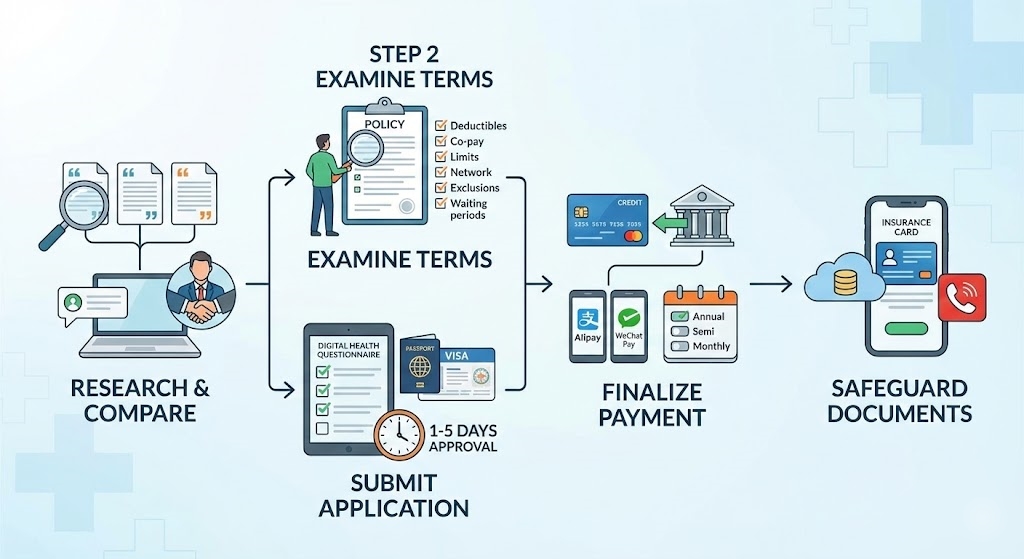
How to Purchase: Step-by-Step
Step 1: Conduct Research and Comparison Engage insurance brokers such as Pacific Prime to obtain multiple quotes, or contact insurers directly. Conduct a comparative analysis of no fewer than three insurance plans.
Step 2: Examine Policy Terms Thoroughly understand deductibles, co-payments, annual benefit limits, hospital networks, exclusions, and waiting periods specified in the policy.
Step 3: Submit Application Materials Complete health questionnaires with full honesty—misrepresentation of information may invalidate coverage. Provide passport and visa documents, and allow 1 to 5 business days for underwriting approval.
Step 4: Finalize Premium Payment Select a payment frequency (annual, semi-annual, or monthly). Acceptable payment methods include credit cards, bank transfers, and Alipay/WeChat Pay (where supported by the insurer).
Step 5: Safeguard Policy Documents Save electronic copies of policy documents to cloud storage, download the insurer’s mobile application for digital insurance cards, and store emergency hotline numbers for quick access.
Using Your Insurance: Practical Steps
Before Visiting the Doctor: Check network hospitals via app/website, call to confirm insurance acceptance and direct billing, and obtain pre-authorization if required.
At the Hospital: Bring your passport and insurance card. Direct billing requires signature confirmation; reimbursement requires paying in full and collecting all receipts.
For Reimbursement Claims :Gather original receipts, medical reports, prescriptions, and itemized bills. Submit online, by mail, or email. Simple claims: 7-15 days; complex claims: 3-4 weeks.
During Emergencies: Go to the nearest hospital immediately. Notify the insurer within 48 hours via 24/7 hotline. Emergency claims process faster with full coverage.
Key Terms:
- Direct Billing: Eliminates large upfront payments (pay only deductibles/co-payments).
- Reimbursement: Pay upfront, then claim repayment from the insurer.
- Pre-authorization: Insurer approval required before planned procedures.
💊 For planned procedures that fall outside your policy, Medical Tourism in China offers an affordable self-pay alternative — often at 50–70% less than equivalent Western costs.
FAQs: Common Questions About Choosing Health Insurance for Expats in China
Q: Can I use my US health insurance in China?
Many domestic health insurance options (like Blue Cross Blue Shield) in the United States do not typically provide coverage for medical expenses incurred while traveling internationally; Generally, Medicare does not provide benefits for services received outside of the U.S. In order to receive the most appropriate health insurance as an expatriate in China, it is recommended that the expatriate obtain specialized international health insurance plans. International health insurance plans offer broad-ranging coverage for many medical expenses and will cover the expatriate while living in China and possibly in other countries as well.
Q: How much does a doctor visit cost without insurance in China?
Public hospitals charge ¥10-50 ($1.50-$7) for consultations. However, language barriers make communication extremely difficult. Waiting times often exceed 2-3 hours. International private hospitals like Beijing United Family charge ¥1,000-1,500 ($140-$210). English-speaking doctors and modern facilities justify higher costs. The best health insurance for expats in China makes these quality facilities financially accessible.
Q: Do I need coverage for pre-existing conditions?
Ongoing medical needs like diabetes or hypertension require coverage. Pre-existing conditions typically face 12-24 month waiting periods. Some budget plans exclude them entirely. Always disclose your complete medical history honestly. Hiding conditions voids coverage when you file claims. Quality health insurance for expats in China should address pre-existing conditions transparently.
Q: What's the difference between inpatient and outpatient coverage?
Inpatient coverage pays for hospital admissions requiring overnight stays. Surgeries and serious illnesses receive this coverage. Outpatient coverage includes doctor visits, lab tests, and prescriptions. No hospital admission is necessary. The best health insurance for expats in China often combines both. Families with children benefit from comprehensive outpatient coverage.
Q: Is dental and vision care included in health insurance for expats?
Most basic expat health insurance excludes dental and vision. These appear as optional add-ons instead. Dental cleanings cost ¥200-500 at local Chinese clinics. International clinics charge ¥800-1,200 for the same service. Regular dental needs justify purchasing supplemental coverage. Annual premiums of $200-$500 typically pay for themselves.
Q: Can I buy health insurance after arriving in China?
Yes, though purchasing before arrival avoids waiting periods. Some international insurers require application from outside China. Others impose 30-90 day waiting periods for in-country applications. Emergency coverage typically starts immediately regardless. Shop around for the best health insurance for expats in China even after arrival.
Q: What happens if I need emergency medical evacuation?
Medical evacuation to Hong Kong, Singapore, or home costs $50,000-150,000. Distance and medical complexity determine final expenses. Mid-to-high-tier expat insurance includes evacuation coverage as standard. Insurance companies coordinate and pay for air ambulance transport. The best health insurance for expats in China includes this non-negotiable benefit.
Q: How long does reimbursement take for medical claims?
Straightforward outpatient claims process in 7-15 business days. Complex inpatient claims requiring additional review take 3-4 weeks. Direct billing hospitals eliminate waiting entirely. You pay only deductibles and co-payments upfront. Quality health insurance for expats in China offers efficient claims processing.
Q: Do I need separate travel insurance with expat health insurance?
This depends on your health plan's geographic coverage. China-only health insurance requires travel coverage for other countries. Regional Asia-Pacific or global plans already protect you abroad. However, the best health insurance for expats in China may not cover trip cancellation. Adventure activities may need specialized travel insurance.
Q: Can I cancel my insurance if I leave China?
Most annual contracts allow mid-term cancellation for permanent relocation. Cancellation fees typically equal one month's premium. Monthly plans like SafetyWing or World Nomads cancel with 30 days notice. Always review cancellation terms before purchasing. Choose flexible month-to-month plans if uncertain about duration.