Chinese New Year Couplets Meaning
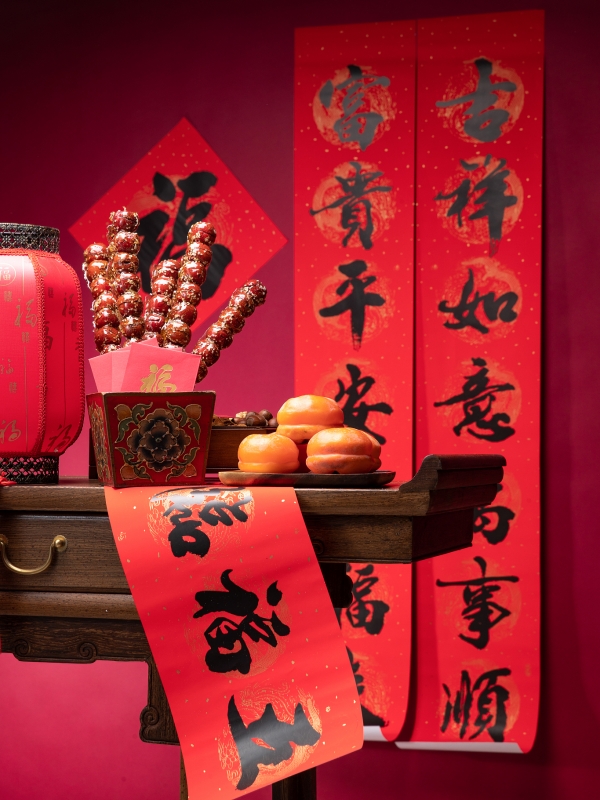
Chinese New Year couplets express wishes for a good year through two matching lines of Chinese writing, usually displayed beside a doorway. To understand Chinese New Year couplets meaning, start with the words and their relationship: one line introduces an image or wish, and the other answers it. Red paper announces the festive setting, while the wording may emphasize family happiness, spring renewal, or business prosperity. You do not need to read every character to recognize the structure. Look for the two vertical strips, identify the short banner above them, and then ask what this particular pair wishes for its household or shop.
Quick Facts
Paired Wishes at the Door
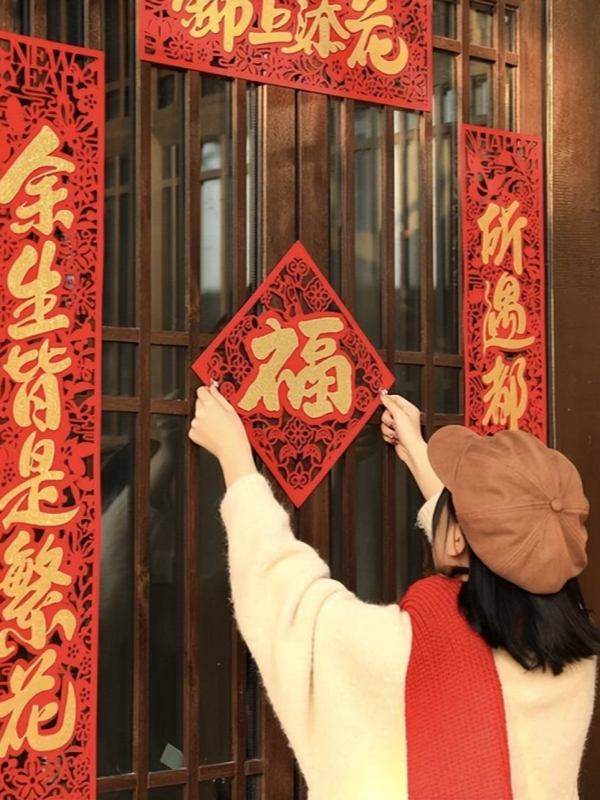
Pasting Spring Couplets
Spring couplets turn a general New Year greeting into a small piece of writing chosen for a particular entrance. A family may favor peace and happiness; a shop may choose prosperous trade. The difference lies in the message, even when both sets use similar red paper and calligraphy.
Spring Couplets and Other Couplets
The broader term 「对联」 (paired lines or couplets) covers writing for many occasions. You may also encounter 「楹联」 (pillar couplets). A pair displayed permanently at a historic building can describe its setting, honor a person, or state an ideal without referring to New Year.
Spring couplets are the seasonal branch. Their words welcome renewal and convey auspicious wishes. Consequently, seeing two vertical inscriptions at a temple does not automatically mean you have found New Year decorations. Read the setting and the message together before deciding what kind of pair you are looking at.
- Festival pair: Wishes connected with the New Year and the return of spring.
- Celebration pair: Writing for an occasion such as a wedding or birthday.
- Architectural pair: An inscription associated with a building, landscape, or owner's values.
China's national intangible cultural heritage description treats couplet customs as a literary practice carried by calligraphy. It includes several kinds of couplets, rather than identifying every pair as a Spring Festival object. This distinction helps when the same visual arrangement appears in different places during a trip.
Wishes Rather Than Predictions
The useful starting point for Chinese New Year couplets meaning is intention. A line about wealth expresses a hope for prosperity. A line about long life offers a blessing. Neither tells you that the family expects a particular amount of money or believes a written sentence guarantees its future.
Similarly, spring can carry more than a literal weather report. In festive writing, it provides language for renewal and a fresh beginning. You can appreciate that association without assuming every region experiences the same season outdoors when the lunar holiday arrives.
🧧 Household Celebration Customs:Curious how hanging doorway couplets fits alongside reunion dinners, red envelopes, and other holiday rituals? Explore what takes place inside the home in Chinese New Year Family Traditions & Reunion Customs.
Reading the Two Lines
Read each vertical strip from top to bottom. Then establish which strip begins the pair. The labels for the lines describe their order in the composition, rather than their height on the doorframe: both strips normally stand beside each other.
First Line, Second Line, Banner
The first line is 「上联」 (upper or first line), and the second is 「下联」 (lower or second line). “Upper” does not mean that one strip belongs above the other. Meanwhile, 「横批」 (horizontal inscription) names the short banner placed across the top.
The banner usually condenses or frames the wishes below. However, it is not a third matching line in the same sense as the two vertical strips. When translating a set, keep those functions separate: first line, answering line, then the short heading or concluding theme above them.
- Identify the strips: Find the two long pieces of writing beside the opening.
- Read downward: Keep each vertical sentence intact before translating the next one.
- Establish the sequence: Look for labels, the intended banner direction, or guidance from the writer.
Traditional presentation begins with the strip on your right as you face the entrance. Some modern sets follow the left-to-right direction of their horizontal banner instead. Public cultural explanations describe both arrangements, so a photograph with the first line on the left is not sufficient evidence of a mistake.
Meaning, Sound, and Matching Structure
The two lines correspond in language as well as appearance. Equal character counts are an important feature, alongside relationships in grammar, rhythm, tone, and meaning. In a well-formed pair, the second sentence responds to the first rather than merely placing another unrelated wish beside it.
For Chinese New Year couplets meaning, that relationship is more useful than translating isolated characters. Notice whether time answers time, a place answers a place, or one blessing answers another. An English translation can make those connections visible even when it cannot reproduce the Chinese rhythm.
For a set you intend to display, ask the seller or calligrapher to identify the first line and banner direction before separating the pieces. This is more practical than attempting a complete analysis of Chinese verse while standing at the stall, especially if the writing uses a flowing calligraphic style.
🐐 2027 Zodiac Sign & Symbolism:Want to know which zodiac animal takes center stage in 2027 and how its motifs appear in seasonal greetings? Discover the cultural background in Chinese New Year 2027 Zodiac Animal & Traditions.
Chinese New Year Couplets Meaning in Examples
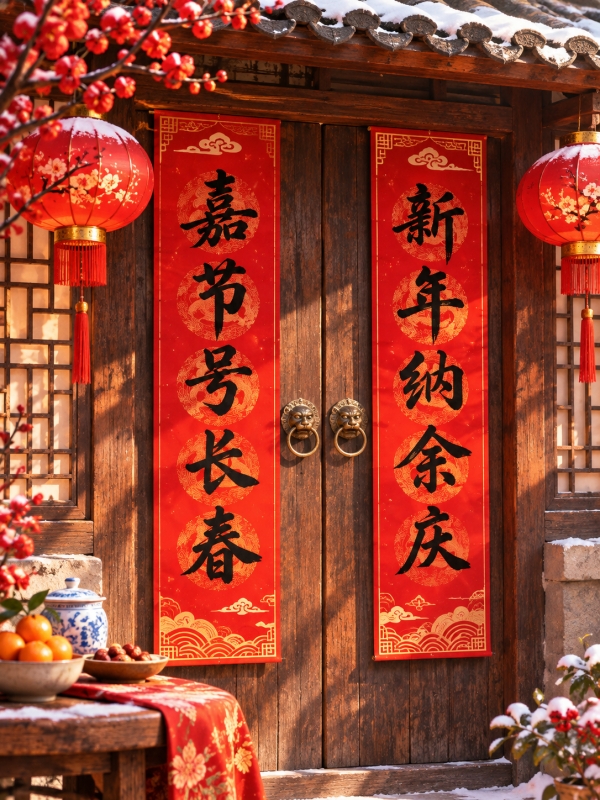
Spring Couplets On Wooden Door
For Chinese New Year couplets meaning, complete examples make the relationship between the lines easier to see. The translations below convey the wishes in natural English; they do not attempt to reproduce every sound pattern or claim to be official translations. Keep each pair together when comparing its words.
New Year and Lasting Spring
「新年纳余庆」 (May the New Year receive abundant blessings) pairs with 「嘉节号长春」 (May the auspicious festival herald lasting spring). This famous early New Year inscription is traditionally associated with Meng Chang, ruler of Later Shu in the tenth century.
The first line welcomes blessings into the new year. The second extends the hope through the image of enduring spring. Here, “lasting spring” evokes renewal and favorable life, rather than promising that winter will disappear. The two wishes look forward together, giving the pair its seasonal coherence.
Long Life and a Blessed Home
「天增岁月人增寿」 (As heaven adds years, people gain longevity) pairs with 「春满乾坤福满堂」 (As spring fills heaven and earth, blessings fill the hall). The wishes bring the passing of time and the renewal of the season into a household setting.
The repeated structure matters: years increase, life increases; spring fills the wider world, blessings fill the home. You can see the pairing without reducing the sentence to a list of lucky words. The repetition creates balance between the larger setting and the people living within it.
- Longevity: A wish for continued life, rather than a numerical prediction.
- Heaven and earth: The broad setting against which the household's blessing appears.
- Hall or doorway: A domestic destination for the good wishes, with wording that varies between versions.
Prosperity for a Shop
「生意兴隆通四海」 (May business flourish across the four seas) pairs with 「财源茂盛达三江」 (May abundant sources of wealth reach the three rivers). The wording addresses trade and income, making its emphasis particularly suitable for a commercial entrance.
“Four seas” and “three rivers” give the wish geographical breadth. In this context, read them as expansive images of reach and circulation, rather than as instructions to identify a shop's actual shipping routes. The writing celebrates prosperous connections; it does not list the business's service area.
Spring Shared Beyond One Household
「春降千门福」 (Spring brings blessings to a thousand doorways) pairs with 「花开万户欢」 (Flowers bloom with joy in ten thousand homes). The large numbers widen the greeting beyond one family. They are expansive poetic expressions, not a count of houses participating in a celebration.
Notice the balance between spring arriving and flowers opening, then between doorways and homes. The second line develops the first image instead of changing the subject. This is a useful pair for learning how the literary structure carries the blessing, even before you study the finer rules of tone.
👗 Festive Attire & Red Symbolism:Just as red paper brings auspicious color to doorways, traditional holiday clothing carries its own lucky meanings—see what people wear for the celebrations in Traditional Chinese New Year Outfits & Festive Styles.
Peachwood, Red Paper, and Renewal
Spring couplets have a history connected with older protective doorway decorations. That relationship explains part of their symbolism, but it does not mean that today's printed red-paper sets existed unchanged throughout ancient China. Separate the material object, the written wishes, and the stories later told about them.
The Peachwood Connection
「桃符」 (peachwood charms) were doorway objects associated with protection. Chengdu Museum's account links them with historical descriptions of peachwood placed at entrances and with stories about protective figures. The older protective function provides context for the later practice of placing auspicious writing around a doorway.
In the associated legend, the figures Shentu and Yulei control harmful spirits. Read this as a traditional narrative explaining protective belief, rather than as a historical event involving real guards and ghosts. A museum's discussion of a legend records its cultural significance; it does not establish that the supernatural events occurred.
- Object history: Peachwood decorations and later written doorway wishes.
- Literary history: The development and circulation of matching lines.
- Folk narrative: Stories explaining protection, blessings, or the origin of a custom.
These strands overlap, but they answer different questions. “What did people display?” concerns the object. “What does the sentence wish for?” concerns language. “What story explains its power?” concerns belief. Keeping them separate avoids turning a colorful origin tale into an unsupported date for every feature of the modern custom.
Red Paper and Annual Beginnings
Red paper gives the writing a visibly festive setting. The words still do much of the interpretive work, however: the color alone cannot tell you whether the pair celebrates spring, wishes an elder long life, or hopes for a successful business year.
The movement from protective doorway objects toward auspicious written greetings was a development over time. Different popular histories compress that development differently. It is safer to explain the connection than to claim that one ruler, one decree, or one particular year created every part of today's practice.
Handwritten and printed sets can both carry a meaningful greeting. Handwriting highlights the calligrapher's choices; printing allows the same wording to circulate more widely. The method of production does not replace the need to understand the message, especially when selecting a pair for someone else's home.
🏮 Year of the Sheep Folklore:Interested in the auspicious traits, cultural stories, and celebratory customs associated with the Sheep in the Chinese zodiac? Learn more in Chinese Sheep New Year Traditions & Cultural Meanings.
Display Customs and the Fu Character
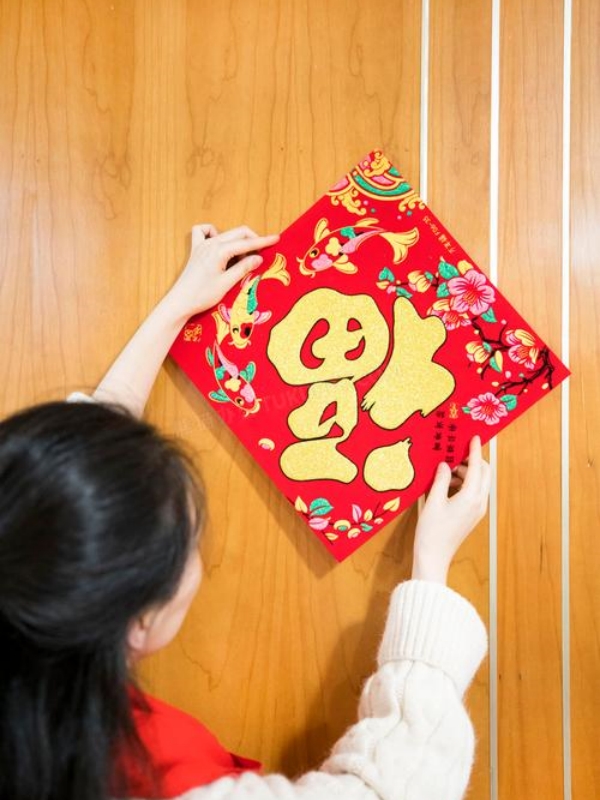
Pasting Fu Character On Door
Chinese New Year couplets meaning starts with the text; display a pair with its writing upright and its intended sequence clear. Beyond that basic reading task, habits vary between families and communities. Follow the household's preference when helping with decorations, especially if you are a visitor rather than the person responsible for the entrance.
A Pair Versus a Single Character
「福」 (blessings or good fortune) often appears on a separate piece of paper. Its message can stand alone, so it may accompany a couplet without becoming one of the paired lines. Two vertical strips and a single-character decoration perform related but distinct jobs.
The inverted character plays on the sound of 「倒」 (upside down) and 「到」 (arrive). Both are pronounced dao with the same Mandarin tone. Turning the character over can therefore suggest that blessings have arrived. This wordplay concerns the single character, not a reason to invert an entire spring couplet.
- Paired strips: Read the sentences upright, in their intended order.
- Horizontal banner: Read according to the direction intended for that inscription.
- Separate fu character: Ask how the household prefers to display it; upright and inverted practices both exist.
Some traditional explanations favor an upright fu character at the main entrance and allow inverted versions in selected indoor settings. Other public community accounts describe inverted fu more generally. Therefore, present the pun as a recognizable custom while avoiding a claim that every family must use the same placement.
Helping Without Imposing a Rule
Ask 「哪一句是上联?」 (Which sentence is the first line?) if you need to identify the strips. For the banner, ask 「横批从哪边读?」 (From which side should the horizontal inscription be read?). These questions seek the writer's intention without assuming that one quick visual rule settles every set.
Before attaching anything in a hotel, rental, or someone else's home, ask for permission and an appropriate way to fix it in place. This is practical advice about the space and its surfaces. It should not be presented as an ancient custom or a nationwide festival regulation.
There is also no need to correct a stranger's doorway based only on a general online guide. If you are curious, ask about the words or local practice. A conversation about the chosen blessing is likely to tell you more than an assumption that unfamiliar placement must be wrong.
For a souvenir, choose wording you can explain and carry the two lines together. A compact, clearly written household blessing may be easier to share at home than a pair whose vocabulary you cannot identify. The aim is to bring back a greeting with its meaning, not merely two matching red shapes.
Frequently Asked Questions
Q: Are spring couplets the same as all Chinese couplets?
No. Spring couplets are the New Year branch of a broader literary tradition. Other pairs may celebrate weddings, birthdays, buildings, or landscapes, and some express remembrance. Look at the words and occasion as well as the two-strip format. A permanent inscription at a historic site is not automatically a seasonal decoration.
Q: Do both lines have to rhyme in English?
No. English translations explain the wishes and relationships between the Chinese lines; they do not need to recreate the original sound pattern. Chinese couplet structure involves correspondence in wording, rhythm, grammar, and tone. A useful translation preserves the paired ideas even when the English sentences differ in length or do not rhyme.
Q: Can I display spring couplets without a horizontal banner?
Yes, a couplet is fundamentally the pair of corresponding lines. A horizontal inscription can frame their theme, but it is distinct from those lines. If your set lacks a banner, ask the writer or seller to identify its intended order. The traditional arrangement begins on your right when you face the doorway.
Q: Should I turn the whole couplet upside down for luck?
No. The familiar upside-down custom concerns the separate fu character and its sound association with blessings arriving. Keep the sentences of a couplet upright so they can be read. For an accompanying fu decoration, follow the household's practice rather than assuming that every entrance or indoor location uses the same arrangement.
Q: Does Chinese New Year couplets meaning depend on the zodiac animal?
No. Wishes for spring, peace, blessings, longevity, and prosperity can stand without naming a zodiac animal. The meaning comes from the complete pair, not from including an annual animal reference. If you want wording suitable beyond one particular year, ask for a general New Year blessing and have its text explained.
Q: Is there one correct day and hour to put them up?
Household and regional practices differ, so a single timetable cannot describe every celebration. Couplets belong to New Year preparations, but local accounts give different days and routines. When helping a host, ask when they plan to decorate. Follow that arrangement instead of treating a specific hour from an online list as a national rule.