Little New Year traditions in China
Little New Year traditions mark the run-up to Chinese New Year, with two common dates in 2027: January 30 in much of northern China and January 31 in many southern communities. The day is called Xiaonian, and its customs include honoring the Kitchen God, offering sweets, and cleaning for the new year. Start by checking which lunar date and name people use where you are. In Shanghai, for example, a related phrase can mean the evening before New Year’s Eve. Here’s how to read the calendar, understand the stories behind the sweets, and recognize the preparations you might see.
Quick Facts
🐐 2027 Zodiac Insights:Curious about the cultural symbolism and animal sign welcoming visitors as the lunar calendar turns on February 6? Explore our complete guide to Chinese New Year 2027 Zodiac Animal & Traditions.
The 2027 Dates and Why They Differ
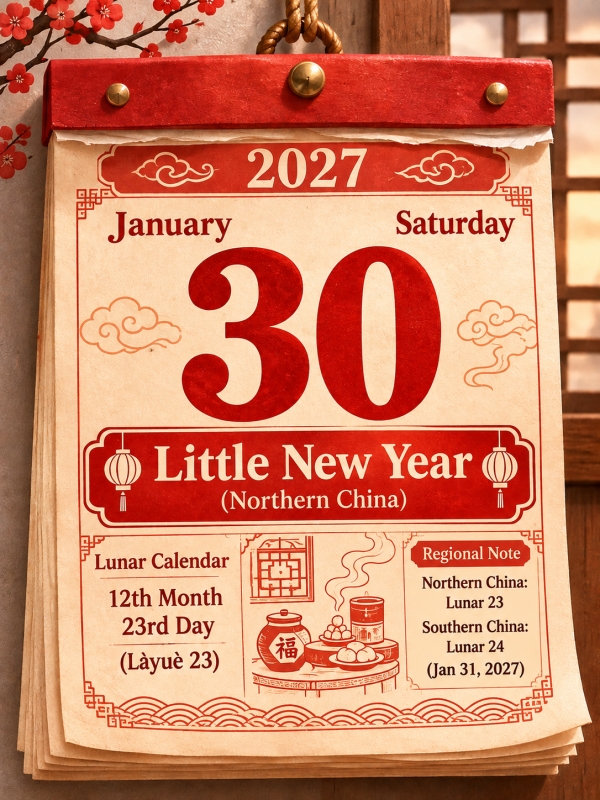
2027 Northern China Little New Year Calendar
Read the lunar date first
January 30 and 31 in 2027 are two calendar translations of two different customary days. In a Chinese notice, look for 腊月, the twelfth lunar month, followed by 廿三 for the twenty-third or 廿四 for the twenty-fourth. The same lunar dates fall on different Gregorian dates in other years.
You can check the conversion directly in the Hong Kong Observatory’s annual table. Read the number at the top as the Gregorian day of the month, then find the corresponding entry in the lunar row. January 30 lines up with 23 and January 31 with 24.
Lunar New Year Eve
The February row shows when the lunar year turns. February 5 is the last day of the twelfth lunar month, which has 29 days that year. February 6 begins the first lunar month. This is why the eve still falls on February 5 even without a lunar day 30.
That distinction helps when a calendar uses Chuxi (除夕), the usual term for New Year’s Eve, beside a more colloquial name such as 大年三十. Treat the eve as the final day of the lunar year. For a dinner invitation or booking, confirm the Gregorian date printed by the host or venue.
Regional dates and exceptions
The twenty-third in the north and the twenty-fourth in much of the south are useful starting points when you encounter Little New Year traditions. You can use that distinction to interpret a general calendar or a shop’s seasonal greeting. A local account may describe a different timing or more than one observance.
Fuzhou offers a good example. The city’s gazetteer office recounts an older pattern in which some households made richer offerings with wine and savory food on the twenty-third, then offered produce on the twenty-fourth. The two evenings carried different meanings even though both concerned the Kitchen God.
Hear the extra word in Shanghai
In a Shanghai usage discussed by folklorist Zhong Fulan, Xiaonianye (小年夜) refers to the evening before Chuxi. That points to February 4 in 2027. The same interview discusses the custom of sending off the Kitchen God separately, so the added word ye, meaning night, matters here.
If a friend in Shanghai mentions a Xiaonianye meal, ask for the day on the regular calendar before you arrange your evening. That small question is more useful than trying to settle which definition of “Little New Year” everyone should use. The word matters because it can shift your plan by several days.
🏮 Year of the Sheep Lore:Want to learn more about the folklore, auspicious meanings, and seasonal customs tied to the Sheep in Chinese culture? Discover the stories behind the celebration in Chinese Sheep New Year Traditions & Cultural Meanings.
The Kitchen God and His Year-End Report
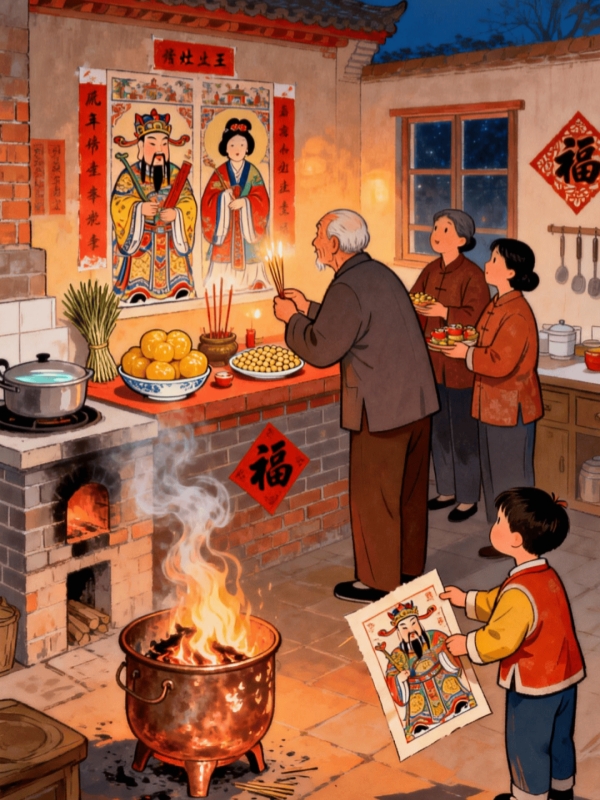
Kitchen God Worship On Little New Year
The household deity
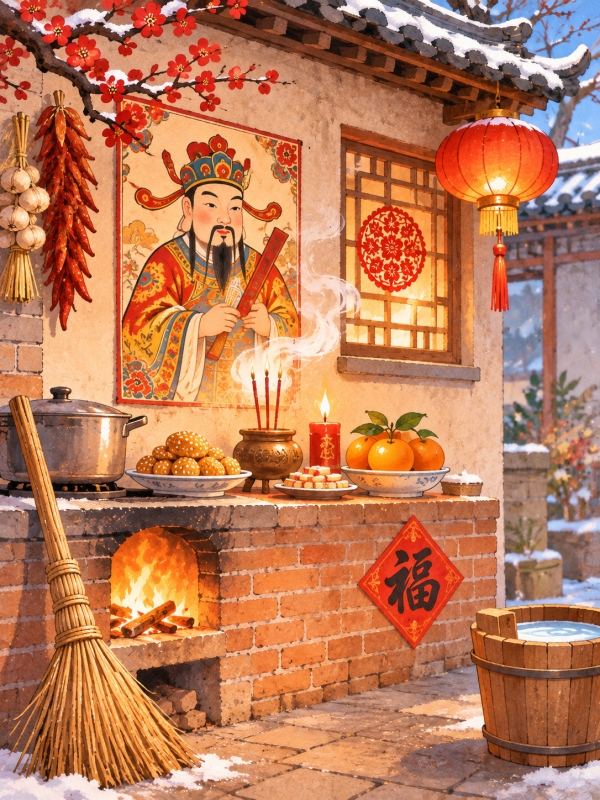
The Kitchen God is a household deity associated with the stove. You may see the names 灶神 (zàoshén) or 灶王爷 (zàowángyé) in Chinese. Both can point to the figure in the familiar year-end story, where the place that feeds a household is also where its conduct is watched.
In the folk account, the deity leaves for heaven near the end of the lunar year and reports on the family to the Jade Emperor. The family hopes for a favorable account and good fortune in the year ahead. That is the story behind the atmosphere of farewell and hospitality.
A wish for good fortune
The Fuzhou gazetteer office describes an earlier household scene with incense, candles, food, and prayers. One memorable detail is a children’s song asking the deity to carry good news upward and bring blessings home. The song gives the offering a family voice beyond the familiar image of a plate of sweets.
An old description can help you understand a display of objects even when the label is short. An offering dish belongs to the act of welcoming or feeding the deity. A stove image identifies the figure being honored. A children’s verse shows how the wish for a good report was passed along.
Local and family memories
That is also where Little New Year traditions can look different from one place to another. The story travels easily, but the date, offering, and way a family marks the occasion belong to a more local history. Even within the same city, a memory from a grandparent’s kitchen may describe a custom the next generation remembers mainly through food.
Museums and home visits
If you see a reconstructed kitchen or a picture of a stove deity at an exhibition, read the label for the place and period it represents. A reconstruction can show how an offering was arranged. A dated program can tell you whether a curator will give a talk or lead a hands-on activity.
At someone’s home, let your hosts tell you what they are doing. If they mention an offering, an open question about its meaning gives them space to explain. Ask before taking photos, and let them tell you whether any food on the table is ready to share.
🧧 Family Reunion Customs:Once the house is swept and decorated, how do households celebrate the main holiday together? See what happens next in Chinese New Year Family Traditions & Reunion Customs.
Sticky Sweets for the Kitchen God
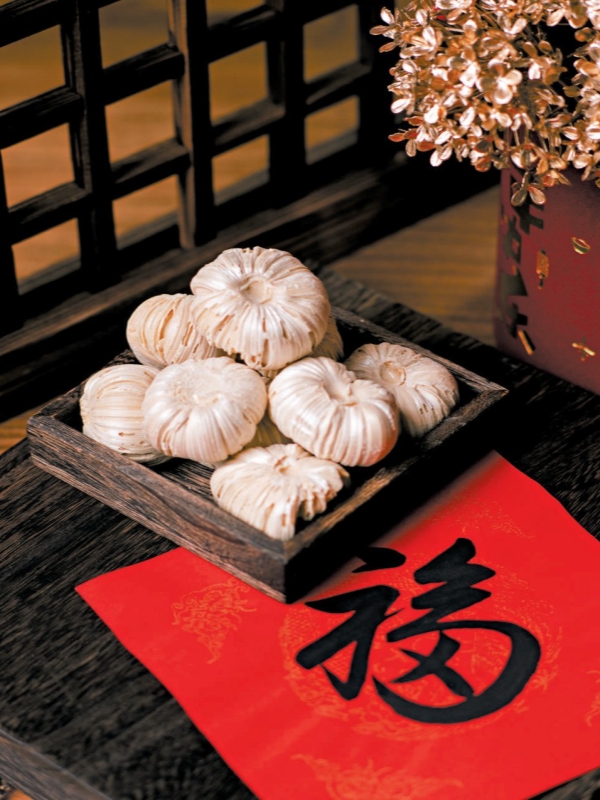
Tanggua Candy For Kitchen God Offering
Recognize tanggua by name
Tanggua (糖瓜) is the small, gourd-shaped malt candy often associated with the northern Little New Year. Its name combines the characters for sugar and melon or gourd. The point of the shape is easiest to see when the pieces are whole. The stickiness matters more to the story than the outline does.
You may also come across 灶糖 (zàotáng), which means stove candy. This is a useful broader term when reading about sweets linked to the Kitchen God. The heritage museum’s account describes sticky malt sweets and notes that early references to malt candy as a festive food existed apart from the stove offering.
Look beyond one candy
The sweets in Little New Year traditions differ with place and household. The Fuzhou account recalls older family members giving children packets of stove candy and cakes after the offering. That detail points to a different local memory from the gourd-shaped candy commonly used to illustrate the northern story.
- What do people call this food here?
- Was it historically presented as an offering?
- Is this version packaged to eat or give away?
In a shop, you can point to the package and ask 这是糖瓜吗? (Zhè shì tángguā ma?), meaning “Is this tanggua?” If the reply uses a different local name, ask what it is made from. That turns an unfamiliar label into a useful conversation without assuming every festive sweet has a ritual role.
Sharing a seasonal sweet
If the candy comes from a shop, decide whether you want it as a snack or a gift to take away. If it is on a household offering plate, let the host offer it first. A packaged version and a piece set beside a stove can look alike while serving very different purposes.
Likewise, the fact that you can buy a sweet gives you no reason to infer how every family observes the occasion. What the candy carries especially well is the story: a sticky or sweet thing sends the departing deity off with good wishes. That is enough to appreciate it even when it is eaten simply as a treat.
Sweeping Out the Old Year
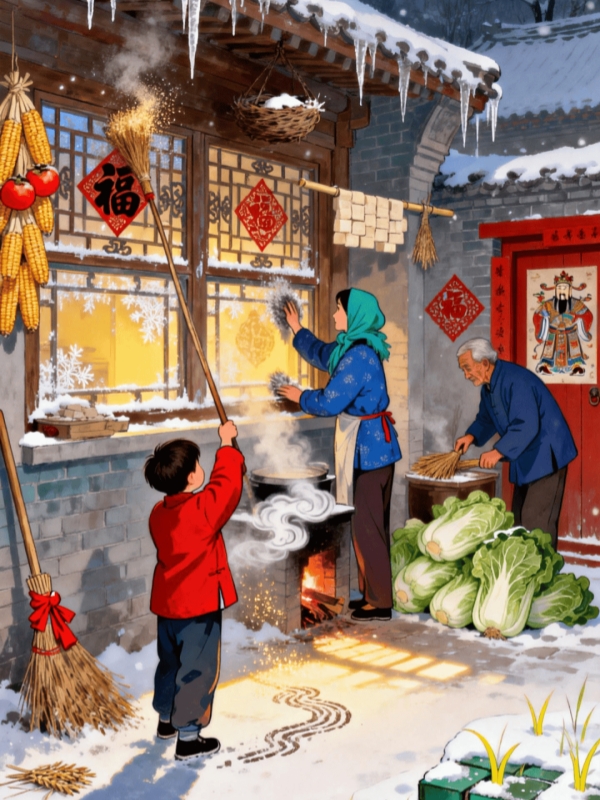
Little New Year House Cleaning Scene
Cleaning belongs to the preparations
Saochen (扫尘), literally sweeping away dust, is the year-end cleaning associated with the approach to Spring Festival. It has a straightforward household meaning and a symbolic one. Rooms get ready for the holiday, while removing the accumulated dust expresses a wish to leave the old year’s troubles behind.
Among Little New Year traditions, cleaning can be the easiest one to recognize without seeing any ceremony. The heritage overview lists it alongside honoring the stove deity and making window decorations. That grouping describes the range of tasks and customs around the season. It leaves room for people to do them on different days.
Clues in the decorations
A shop with a display of red paper cuttings or couplets is showing preparations for the wider New Year season. That is a good opportunity to learn what the items are called and where they go in a home. The display alone cannot tell you which day the people running the shop observe Xiaonian.
If a family mentions two jobs together, listen for the verbs. 扫尘 is cleaning. 贴春联 (tiē chūnlián) means putting up Spring Festival couplets. 祭灶 is the offering to the Kitchen God. These terms let you follow the conversation without treating every step as a single prescribed observance.
Asking about family preparations
When visiting, a practical question is “Are you getting ready for New Year?” It invites someone to talk about what they actually do. If they tell you their cleaning day is later than Xiaonian, take that as a description of their calendar. Their answer can coexist with an older festival account assigning cleaning to an earlier stage.
A family may do the housework and buy the sweets without discussing a deity at all. Another may tell the Kitchen God story as a family memory alongside preparations they still do. Those different combinations help explain how a festival can remain familiar even when the form of its observance changes.
Recognizing Xiaonian on a Visit
Match the name to the plan
Start with what you actually saw or heard. 小年 on a greeting may simply mark the time of year. 小年夜 in a Shanghai dinner invitation may refer to a particular evening close to Chuxi. A display labeled 祭灶 may be illustrating a historical custom. Each gives you a different next step.
To distinguish them, ask 这里哪天过小年? (Zhèlǐ nǎ tiān guò xiǎonián?), or “When is Little New Year observed here?” For an invitation, confirm the month and day in the Gregorian calendar too. A family’s date is what you need to get to the meal on time.
Checking public programs
A calendar date can help you search, but a date alone gives you no event details. If you want a public introduction to Little New Year traditions, look for a dated notice from a museum, cultural center, or venue in the city you will visit. Try the city name with 小年 or 祭灶.
Read the program title and description before deciding to go. A lecture, a folk-art workshop, and a reenactment give you different experiences. Then confirm the day, venue, opening time, reservation requirement, and whether your group can attend. If a listing is from a previous year, use it as a search clue for the organizer.
Leave room for everyday encounters
If there is no confirmed program for your dates, you can still pay attention to ordinary seasonal details. Look at how shops label candy and couplets, or ask someone who brings up the holiday what they did at home growing up. Those are opportunities to hear which details belong to that place or family.
A private invitation works differently. Ask what time to arrive and whether the host would like you to bring anything. Follow their lead about eating, helping, or watching. You can learn more from the way a host explains their own custom than from trying to match every detail to a festival checklist.
Frequently Asked Questions
Q: Does Little New Year fall on January 30 every year?
January 30 is the 2027 conversion for the twenty-third day of the twelfth lunar month. Communities that favor the twenty-fourth reach their common date on January 31 that year. To find either date in another year, use that year’s lunar conversion table and then check which day the people you are visiting observe.
Q: What is the difference between Xiaonian and Xiaonianye in Shanghai?
Xiaonian means Little New Year. In one Shanghai usage, Xiaonianye means the evening before New Year’s Eve, which is February 4 in 2027. Local accounts also describe sending off the Kitchen God earlier in the lunar month. If someone invites you over for Xiaonianye, confirming the regular calendar date will clear up the distinction.
Q: Why offer candy to the Kitchen God?
In the folk story, the Kitchen God reports on the household at the end of the lunar year. A sweet offering is supposed to encourage a favorable report. The sticky candy also inspires a joking explanation that his mouth will stick. Both ideas explain the sweet’s association with the farewell ritual.
Q: Does everyone eat tanggua during Little New Year?
Tanggua is a familiar malt candy associated with northern observances. Local food customs vary, and some Fuzhou accounts remember stove candy and cakes in a different form. If you spot a sweet on a shop counter, ask what it is called and what it contains. A label can tell you more than its shape.
Q: Can visitors watch a Little New Year ceremony in China?
Some customs belong to households, where a host’s invitation matters. To find a public introduction, look for a current notice from a venue or cultural institution in your destination. Check the activity description, date, and booking instructions before going. A calendar entry for Xiaonian by itself establishes the date people associate with the custom.
Q: What should I say if someone wishes me a happy Xiaonian?
You can reply 小年快乐 (Xiǎonián kuàilè), which means “Happy Little New Year.” If you are curious about what it means to that person, ask when their family marks it or what they remember eating. Let them decide how much to share, particularly if the conversation turns to a household offering or family gathering.