Chinese New Year Attire
Chinese New Year is the largest annual migration on Earth, and what people wear matters as much as where they go. The holiday centers on renewal, family, and good fortune — and traditional dress signals alignment with those values. For foreign visitors attending a Spring Festival celebration, a family reunion dinner, or a tourist event at a heritage site, choosing the right outfit means understanding two things: which colors carry symbolic weight, and where to actually get the clothes. Most guides cover the first part well. Few address the second.
This article covers both. It explains why red and gold dominate, which hues work as alternatives, and what traditional garments like the qipao, Tang suit, and hanfu actually look like. It then walks through the four practical channels visitors use to buy or rent Chinese New Year attire — in China, online, at scenic areas, and from tailors — with price ranges and location names.
Quick Facts
Lucky and Unlucky Colors for Chinese New Year Attire
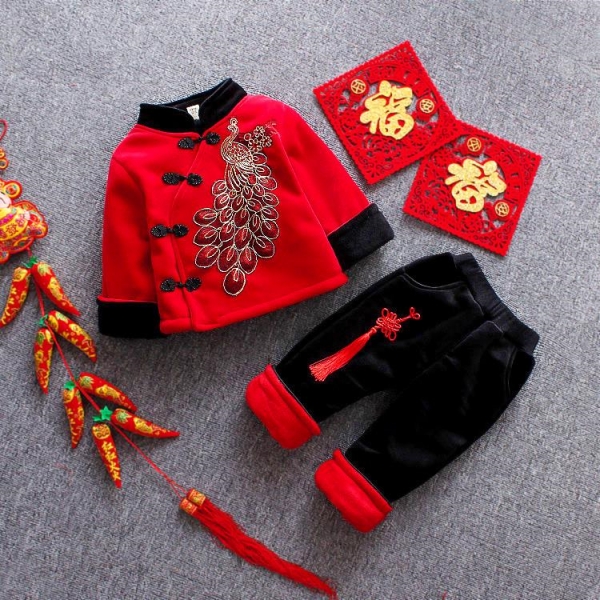
Red Lucky and Colors
The color rules for Chinese New Year attire trace back to the Nian myth — a beast that once devoured villagers on New Year's Day feared red, fire, and loud noise. People still surround themselves with all three during Spring Festival. Red signals good fortune, joy, and protection. Gold and yellow signal wealth and imperial prestige. Beyond the canonical pair, pink reads as joyful and romantic, orange as prosperous and warm, purple as noble in some regional traditions. The practical rule is simple: red can anchor a full outfit or appear as a single accessory; gold most often shows up in embroidery, brocade, buttons, or jewelry.
Red and Gold: The Auspicious Pair
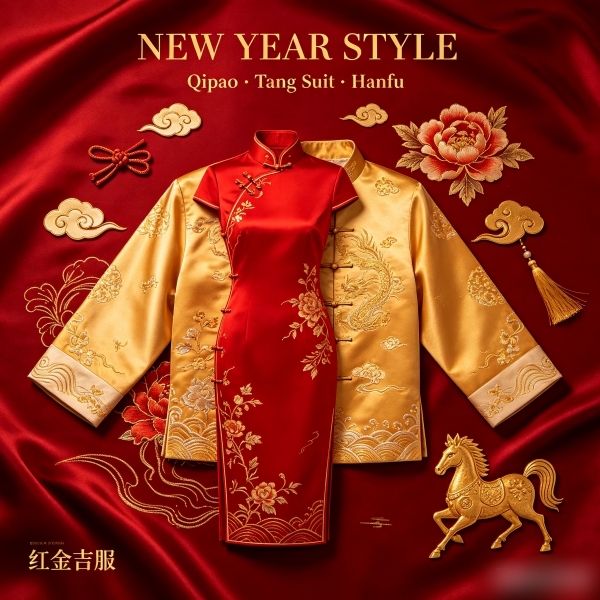
The Red and gold form the most common pairing in Chinese New Year attire. Red can serve as the dominant color — a full qipao, Tang suit, or hanfu — or function as an accent, appearing in a scarf, bag, or pair of shoes. Gold typically plays a supporting role, highlighting embroidery, brocade patterns, knot closures, or jewelry. The two colors read as festive even in small amounts.
Other Auspicious Hues Worth Trying
Several other colors carry positive meaning during the holiday. Pink reads as joyful and romantic, making it a popular alternative to bold red, especially among younger people at CNY parties. Orange carries warmth and prosperity, less traditional but still festive. Purple signifies nobility and wealth in some regional traditions and is not avoided.
- Pink: Romance and joy; softer, party-friendly alternative to red.
- Orange: Warmth and prosperity; less common but acceptable.
- Purple: Nobility and wealth; regional variation, not universal.
Colors to Avoid
The two colors that carry the strongest negative signal are black and white — both are associated with mourning in Chinese culture. Wearing either as the dominant color at a festive event sends an unintended message. Small accents are fine: a black belt on a red dress, white sneakers with red trousers. Beyond these, blue reads as cool and distant in a celebratory context, brown reads dull and earthy, and green carries negative associations in some traditions, making it a rare choice for Chinese New Year attire.
- Black: Primary mourning color; avoid as main outfit color.
- White: Associated with funerals; avoid as dominant color.
- Blue: Uncommon in festive dress; reads as cool or distant.
- Brown: Dull and earthy; does not convey festivity.
- Green: Some traditions associate it negatively; rarely chosen.
🧧 Auspicious Wardrobe Motifs: Traditional clothing often features embroidered characters and patterns designed to attract good fortune. Learn about the cultural significance behind these visual motifs in Chinese Prosperity Symbol.
Traditional Chinese New Year Attire: Qipao, Tang Suit, and Hanfu
Three garment categories anchor traditional Chinese New Year attire. The qipao (also called cheongsam) is a form-fitting dress with a high Mandarin collar, short sleeves, and a side slit, traditionally worn by women. The Tang suit is a jacket for men, featuring an upturned Mandarin collar and typically paired with matching trousers. Hanfu is the umbrella term for Han Chinese clothing predating the Qing dynasty, and its revival at CNY has grown notably among younger Chinese over the past decade. Children's miniatures of all three are widely sold for the holiday. The most common fabrics for all three during Spring Festival are red or gold silk, satin, or brocade.
Qipao and Cheongsam
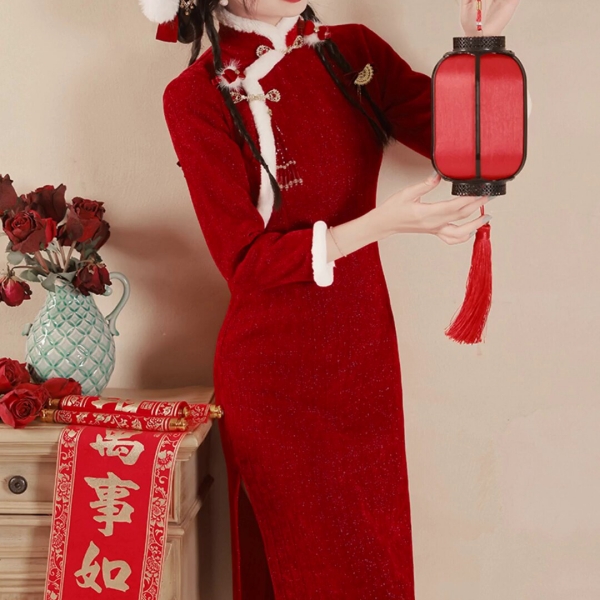
Chinese Qipao
The qipao is a women's dress cut close to the body, with a standing Mandarin collar, short sleeves, and a side slit. Chinese New Year versions are typically floor-length in red or gold silk, satin, or brocade. Embroidery commonly features peonies (symbolizing wealth), a phoenix (signifying auspiciousness), or plum blossoms (representing resilience). Budget polyester versions run about $25–60 (¥180–430); mid-range silk or satin pieces cost $80–250 (¥580–1,800); a premium silk or tailor-made garment starts at $300 (¥2,200) and can reach $800+ (¥5,800+).
Tang Suit
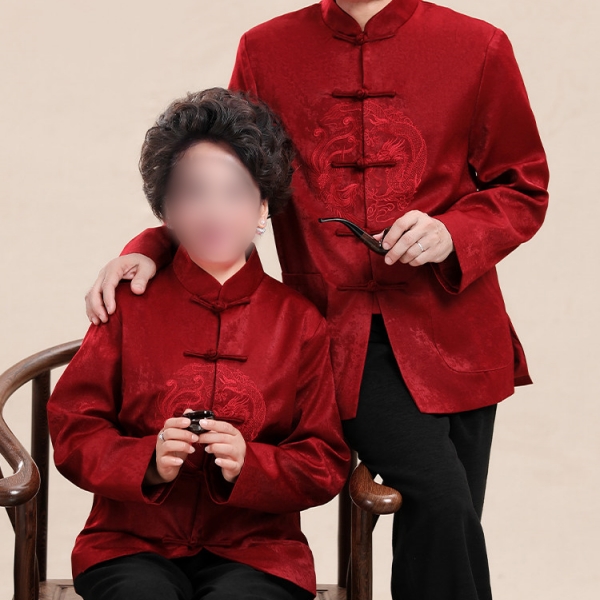
Chinese Tang Suit
The Tang suit is a men's jacket with an upturned Mandarin collar, worn with matching trousers. Chinese New Year versions use red or gold silk brocade, embroidered with dragons, clouds, bamboo, or longevity characters. Knotted frog closures in gold thread are a standard detail. Pricing falls roughly in line with qipao of equivalent quality. A more casual blazer-style modern variant is also widely sold.
Hanfu and the Broader Revival
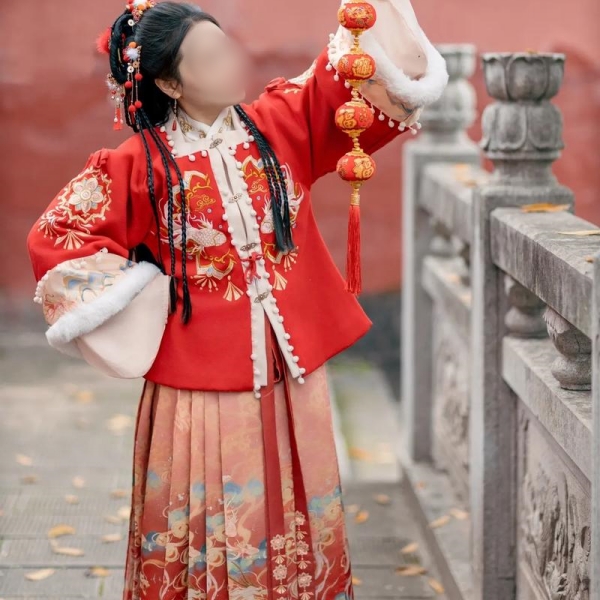
Chinese Hanfu
Hanfu covers the range of Han Chinese clothing from the Han through Ming dynasties, predating Qing dynasty influences. It features long flowing robes, wide sleeves, crossed collars (jiaoling), and sashes. Wearing hanfu at Chinese New Year has become a visible trend among younger Chinese, often paired with hair accessories and a fan. Several brands ship internationally: Minghuatang (premium, Ming-dynasty focus), Hanshanghuayi (mid-range), and Shisanyu (youth-oriented, lower price point). Full sets typically range $30–150 (¥210–1,080).
Children's Traditional Wear
Mini qipao for girls and mini Tang suits for boys sell widely during the holiday season, especially for toddlers and young children. Most are produced in red and gold, featuring embroidered zodiac animals of the year — the Horse for 2026 — or the 福 (fu) character meaning good fortune. You find them at department stores, Taobao's kids' section, and tourist-area shops. Prices run $15–50 (¥100–360).
🐉 Decode Traditional Clothing Patterns: From flying cranes and clouds to dragons and bats, discover the meanings behind the motifs woven into hanfu and Tang suits in Chinese Auspicious Symbols.
Modern Chinese New Year Attire for Parties
Modern Chinese New Year attire does not require a full traditional outfit. Two rules carry over from tradition: the outfit should be new (symbolizing a fresh start), and it should feature red or gold. Beyond that, mix-and-match options work well for parties. Red and gold function as the dominant colors; everything else stays neutral.
- Red dress with gold jewelry: The simplest party-ready combination.
- Red top with neutral skirt or trousers: Casual and flexible.
- All-red or all-gold ensemble: Strongest option for evening events.
- Zodiac-themed piece: A Horse motif (2026) on a clutch, scarf, or pin works as a single statement piece.
- Single red or gold accessory: Sufficient for those who prefer not to wear head-to-toe color on a full red or gold base.
Where to Buy or Rent Chinese New Year Attire
Foreign visitors have four practical channels for Chinese New Year attire. In-China retail covers silk markets and heritage stores. Online platforms serve those buying before arrival or using purchasing agents. Hanfu rental at scenic areas suits visitors who want the experience without owning the garment. Custom tailoring in Shanghai and Beijing produces a bespoke piece for those with time and a higher budget.
Shopping in China: Markets and Heritage Stores
Silk markets in major cities are the primary retail option for visitors. Bargaining is expected at market stalls; small-denomination cash or Alipay/WeChat Pay works best. Fixed-price heritage stores and department stores offer a more predictable experience.
- Xiushui Street, Beijing: Near the CBD; broad range, bargaining expected.
- Ruifuxiang, Beijing: Founded 1893; fixed prices, Qianmen Street location for tourists.
- Wulin Road, Hangzhou: Silk production hub; good selection, market-style pricing.
- Nanjing Road area, Shanghai: Multiple markets and department stores.
- Custom tailors, Shanghai Hongqiao / Beijing Sanlitun: 1–2 weeks for a bespoke silk cheongsam.
Online Stores International Visitors Can Use
Taobao requires a Chinese phone number and Alipay, so most international visitors use an agent service such as Superbuy or CSSBuy — the agent purchases on the buyer's behalf and forwards internationally. AliExpress carries the same sellers with direct English checkout and longer shipping. Several hanfu brands ship abroad without an agent.
- Minghuatang: Premium hanfu, Ming-dynasty focus; international shipping available.
- Hanshanghuayi: Mid-range hanfu; international shipping available.
- Shisanyu: Youth-oriented hanfu; lower prices, international shipping available.
- Sizing note: Chinese sizes run small; size up or request measurements from the seller.
Hanfu and Qipao Rental at Scenic Areas
Several heritage scenic areas have built their visitor experience around hanfu rental. This is now a standard service at water towns, ancient cities, and theme parks. Rental typically covers the outfit, a simple hairdo, and one or two accessories such as a fan or sachet.
- Wuzhen, Zhejiang: Water town; established hanfu rental culture; book via venue or Klook.
- Xitang, Zhejiang: Near Shanghai; rental shops clustered near the main entrance.
- Lijiang Old Town, Yunnan: Traditional Naxi architecture; rental includes basic accessories.
- Pingyao Ancient City, Shanxi: Ming-era walled city; hanfu rental available on-site.
- Typical cost: $15–40 (¥100–280) per day, including outfit and basic styling.
🏮 Matching the Festival Glow: When wearing traditional garments to evening temple fairs, learn about the history and symbolism behind the glowing red street displays in Chinese Lanterns Meaning.
Practical Tips for Foreign Visitors
A few practical issues come up repeatedly for international visitors shopping for Chinese New Year attire. Handling them in advance prevents frustration on the ground.
- Payment: International cards work at department stores and heritage stores. Markets prefer cash in RMB. Alipay and WeChat Pay dominate at most smaller venues.
- Bargaining: Appropriate at market stalls — start at 40–50% of the asking price. Fixed-price stores do not require negotiation.
- Weather: Chinese New Year falls in January–February; silk qipao without a layer is cold in northern China. Bring or buy a wool or down coat for outdoor events.
- Sizing: Chinese sizes run 1–2 sizes smaller than Western equivalents. Bring your bust, waist, hip, and shoulder measurements when shopping.
- Fitting rooms: Standard at department stores; uncommon at market stalls.
Price Ranges by Tier
Frequently Asked Questions
Q: What Chinese New Year attire should foreign visitors wear to a celebration?
Red or gold should be the dominant color. New clothes are preferred by tradition — they symbolize starting the year fresh. A traditional piece such as a qipao, Tang suit, or hanfu is welcome but not required. Avoid black or white as the main color. If a full festive outfit feels like too much, a single red or gold accessory on an otherwise neutral outfit still registers as an acknowledgment of the occasion.
Q: Is it okay to wear black to a Chinese New Year party?
Black as the dominant outfit color is best avoided because of mourning associations. Black accents — a belt, bag, or shoes — work fine with a red or gold outfit. An all-black ensemble sends the wrong signal at a festive event.
Q: Where can tourists buy a cheongsam or qipao in person?
Silk markets in major cities offer the widest selection at negotiable prices: Beijing's Xiushui Street, Hangzhou's Wulin Road, and the Nanjing Road area in Shanghai. Heritage stores like Ruifuxiang in Beijing sell fixed-price traditional garments. Department stores at Wangfujing and Shanghai No.1 Department Store carry branded pieces. For a custom fit, tailors in Shanghai's Hongqiao area or Beijing's Sanlitun can produce a bespoke silk cheongsam in one to two weeks.
Q: How much does good Chinese New Year attire cost?
A budget polyester qipao or hanfu set runs $20–60 (¥140–430). Mid-range silk or satin pieces cost $60–250 (¥430–1,800). A premium tailor-made silk cheongsam starts around $300 (¥2,200) and can reach $800+ (¥5,800+). Hanfu rental at scenic areas is available at $15–40/day (¥100–280).
Q: Can visitors rent Chinese New Year attire in China?
Yes. Hanfu and qipao rental is a standard service at several scenic areas, including Wuzhen, Xitang, Lijiang Old Town, Xi'an's Tang-themed areas, and Pingyao Ancient City. Typical rental costs $15–40/day (¥100–280) and includes the outfit, basic hair styling, and one or two accessories such as a fan. Book through the venue's official site or on Klook.
Q: What Chinese New Year attire works for kids?
Mini qipao for girls and mini Tang suits for boys are sold widely during the holiday. Most feature red or gold fabric with an embroidered zodiac animal of the year — the Horse for 2026 — or the 福 character. Available at department stores, Taobao's kids' section, and tourist-area shops. Prices range $15–50 (¥100–360).
Q: Do I need new Chinese New Year attire for the holiday?
Tradition says yes — new clothes symbolize starting the year fresh. It is not strictly required, but a clean, festive red or gold outfit serves as the practical stand-in if purchasing new attire is not an option.