Chinese Medallion Meaning
A round Chinese medallion is never just decorative. The form carries meaning that has accumulated over centuries — jade bi discs symbolized heaven in ancient cosmology, imperial pendants announced rank at court, and merit badges awarded under the Qing emperors (1644–1912) recorded specific acts of military service. Animal motifs like dragons, phoenixes, and cranes each held fixed readings. Single characters such as 壽 (longevity) or 福 (fortune) delivered a concentrated blessing at a glance. This guide explains what those layers meant, how the English word "medallion" translates into several Chinese terms, and where visitors can see real examples on public display.
Quick Facts
What Is a Chinese Medallion?
Chinese Medallion Meaning
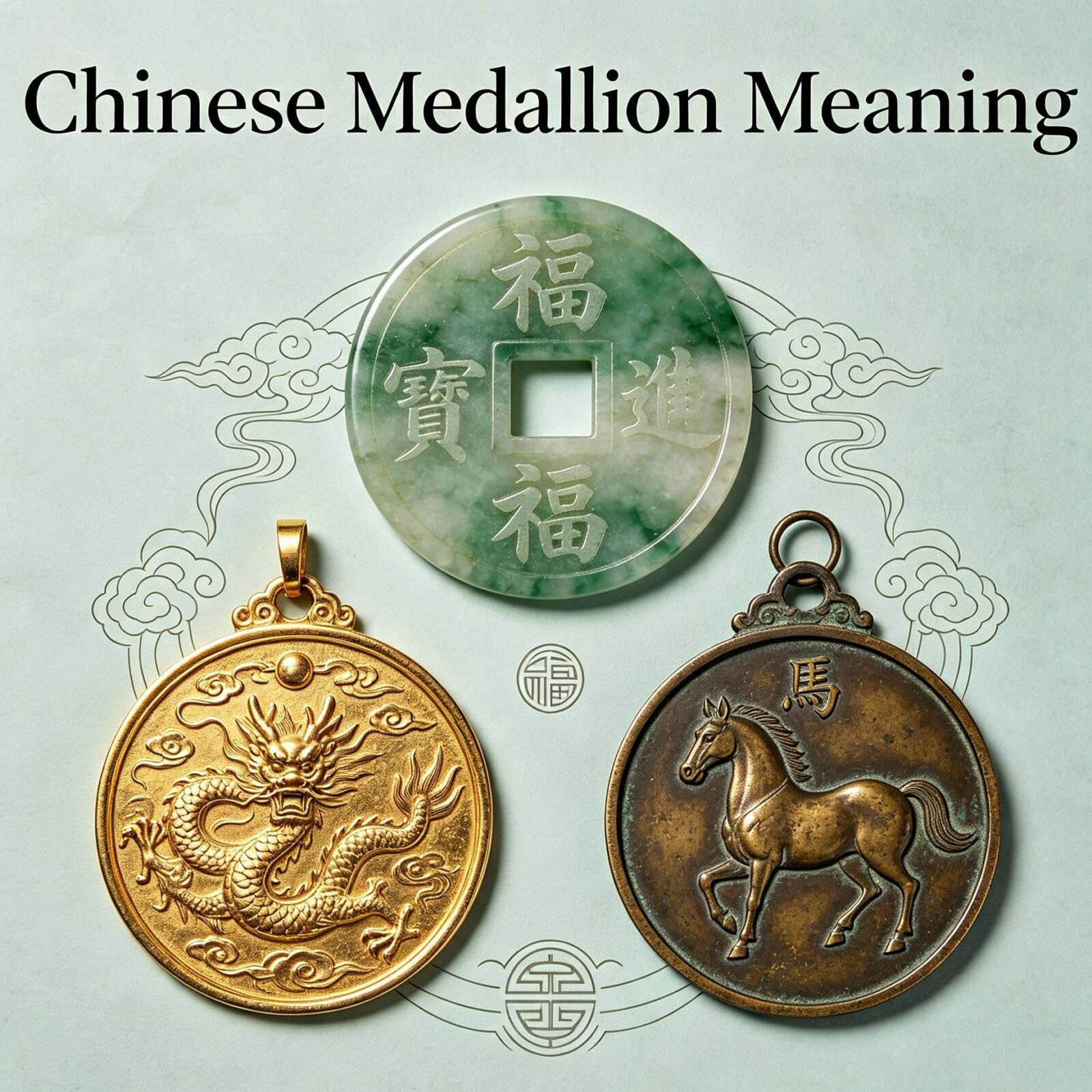
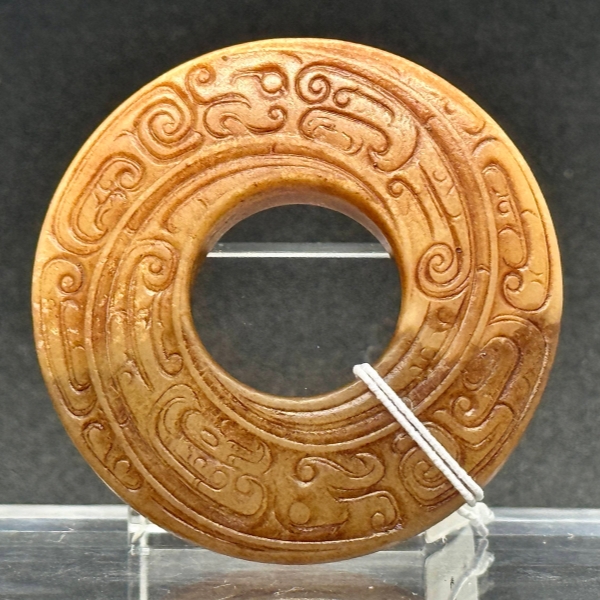
A Chinese medallion is broadly any round, often hole-centered disc that was worn, hung, displayed, or awarded. The form descends from the ancient jade bi (璧) disc, where round equaled heaven and square equaled earth in classical cosmology. Under the Qing dynasty (1644–1912), the term expanded to cover merit badges (功牌), imperial pendants (佩), honor feathers (花翎), commemorative pieces (紀念章), and jade pendants (玉牌). This means that when scholars discuss a "medallion," they may be referring to a military decoration, a court rank badge, or simply a decorative jade piece with symbolic carving.
Five main forms appear across Chinese history. Each shape corresponded to a different occasion and level of honor.
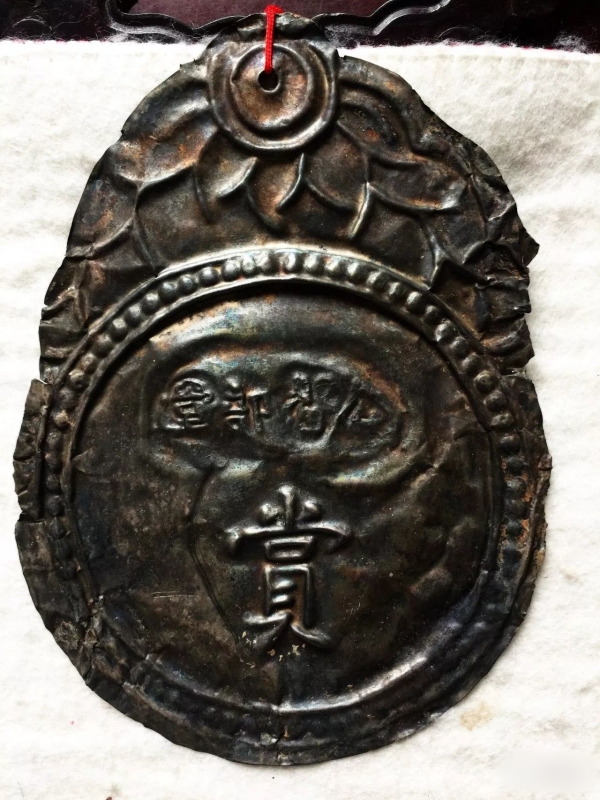
- 功牌 (gōngpái): Qing-era merit badge awarded for military or civil service; round, often inscribed with the reign mark on the reverse.
- 玉璧 (yùbì): Ancient round jade disc with a central hole; symbol of heaven and high ritual status.
- 御牌 (yùpái): Imperial pendant worn at court; marked rank or favor from the emperor.
- 紀念章 (jìniànzhāng): Commemorative medallion issued for a specific event, reign, or achievement.
- 平安牌 (píng'ánpái): Peace amulet worn or carried for protection during travel or uncertain times.
Forms, Materials, and Uses
Material choice signals rank and purpose. High-honor imperial gifts were carved from jade or cast in gold. Silver and bronze served military merit awards. Ivory, bone, and glass appeared in personal amulets and later commemorative pieces. The intended use determined both form and material.
- Imperial gift: Jade or gold pendants given directly by the emperor; highest honor possible.
- Military merit award: Bronze or silver 功牌 presented for distinguished service; often inscribed with reign marks.
- Court rank badge: Worn at court to indicate official grade; distinct from the square buzi (補子) sewn onto robes.
- Marriage or longevity gift: Jade or cloisonné pieces inscribed with 壽 (longevity) or 囍 (double happiness).
- Protective amulet: Smaller medallions carried on the person; typically jade or glass with 平安 inscriptions.
- Collector or decorative item: Display pieces, often in sets, with no official function beyond aesthetics.
🧧 Decode Auspicious Motifs & Blessings: Single characters and animal motifs carved into traditional medallions often serve to convey wealth and good fortune. Learn how to identify these traditional icons in our guide to the Chinese Prosperity Symbol.
What "Medallion" Means in Chinese
The English word "medallion" maps onto several distinct Chinese terms, and the right translation depends entirely on context. A Qing military merit badge is not called the same thing as a modern state decoration, and neither shares a name with an ancient jade disc. Understanding which term applies clarifies what kind of object you are looking at and what it meant to its original wearer or recipient.
- 勳章 (xūnzhāng): Modern state decoration; "merit seal." The character 勳 denotes military or civil achievement, while 章 means seal or chapter. Currently used for national awards and military honors.
- 獎章 (jiǎngzhāng): General award medal; broader than 勳章, covers sporting, commemorative, and civilian awards.
- 紀念章 (jìniànzhāng): Commemorative medallion; specifically issued to mark an event, anniversary, or expedition.
- 功牌 (gōngpái): Qing merit badge; the closest historical equivalent to a military medal under the imperial system. Awarded by the emperor for specific acts of service.
- 佩 (pèi): Pendant; describes the wearing action and the object simultaneously. Imperial 佩 badges were hung from the belt at court.
- 牌 (pái): Tablet, plaque, or badge; the root character for most medieval and Qing-era medallion terms. Combined with 圓 (round) it yields 圓牌, literally "round medallion."
- 璧 (bì): Ancient round jade disc with a central hole; the ancestor of all later round medallion forms. In classical texts, a jade bi symbolized heaven and was used in state rituals.
Chinese Characters on Medallions and Their Meanings
Chinese Medallion Meaning
Single characters dominate medallion inscriptions because they work at a distance, fit cleanly into seal script or regular script, and deliver one concentrated blessing without ambiguity. Where a Western viewer might expect a phrase or sentence, a Chinese viewer reads one character and immediately grasps the medallion's purpose. The most common characters combine honorific and auspicious readings that have remained stable for centuries.
- 壽 (shòu): Longevity; one of the most common auspicious characters on jade pieces.
- 福 (fú): Fortune and blessing; frequently paired with 壽 as 福壽.
- 祿 (lù): Official prosperity and salary; the reward for civil service.
- 禧 (xǐ): Happiness and good fortune; slightly more festive tone.
- 囍 (xǐ): Double happiness; used for marriages and wedding gifts.
- 龍 (lóng): Dragon; marks imperial ownership or favor directly.
- 卍 (wàn): Buddhist auspiciousness; an ancient swastika used in Chinese contexts long before any later political association.
- 吉祥 (jíxiáng): Auspicious; a general blessing often carved as a pair of characters.
🖌️ Explore Symbolic Characters in Historical Art: To see how foundational character values are expressed in calligraphy, stone carvings, and traditional pendants, check out our guide on the Chinese Character for Peace.
Animals and Nature Symbols on Medallions
Chinese Medallion Meaning
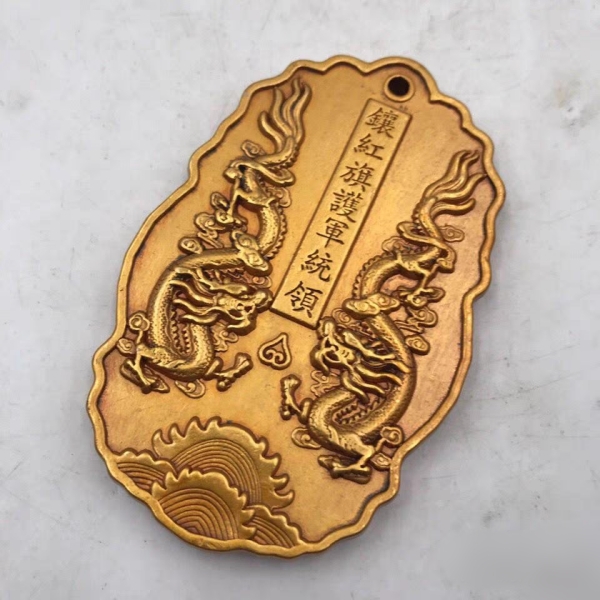
Animals form the most visible layer of meaning on most Chinese medallions. Each creature carries a fixed traditional reading, so a visitor who learns the main animals can decode a surprising amount of a medallion's message at a glance. The symbolism draws from cosmology, mythology, and homophone-based wordplay that makes certain animals especially popular for blessings.
- Dragon (龍): Imperial authority and celestial power; the emperor's emblem.
- Phoenix (鳳): Virtue, grace, and the empress; pairs with the dragon.
- Crane (鶴): Longevity and spiritual transcendence; often shown with pine.
- Deer (鹿): Longevity and prosperity; homophone for 祿 (official salary).
- Horse (馬): Perseverance and military merit; backbone of Qing cavalry.
- Tiger (虎): Courage and protection; used in military insignia.
- Lion (獅): Guarding power and authority; often appears in pairs.
- Qilin (麒麟): Auspicious celestial messenger; heralds good governance.
- Tortoise (龜): Longevity and stability; ancient symbol of the cosmos.
- Bat (蝠): Good fortune; homophone for 福 (blessing).
- Fish (魚): Abundance and surplus; homophone for 餘 (excess).
- Peach (桃): Immortality; associated with the Queen Mother of the West.
- Peony (牡丹): Wealth, honor, and feminine grace; "king of flowers."
- Lotus (蓮): Purity emerging from mud; Buddhist and Daoist associations.
Most Common Animals and Their Meanings
The animals that appear most frequently on surviving medallions are the dragon, phoenix, crane, deer, horse, and bat. These six cover imperial rank (dragon and phoenix), longevity (crane and deer), military service (horse), and general good fortune (bat). Medallions often combine two or more animals to layer meanings — for example, a dragon and phoenix together refer to imperial marriage or cosmic harmony, while a crane and deer together double down on longevity and prosperity.
The Jiaqing Officer's 5-Horse Medallion Explained
The Jiaqing Emperor ruled from 1796 to 1820, late in the Qing dynasty's golden era. During his reign, the imperial court awarded round merit medallions (功牌) to military officers for distinguished service in the field or in administration. These badges were distinct from the square buzi (補子) rank insignia sewn onto court robes — merit badges were separate awards that recognized specific achievements rather than permanent grade. A surviving sub-type of these Jiaqing-era merit badges features a five-horse (五馬) composition carved in relief or inscription.
The horse motif carried direct military meaning. Horses were the engine of Qing cavalry and the backbone of frontier campaigns. An officer awarded a horse medallion was being recognized for contributions to mounted operations, logistical success, or battlefield leadership involving horses. The five-horse (五馬) composition layers additional significance. In classical Chinese officialdom, 五馬 was a literary term for a prefect-level magistrate — the imagery of five horses therefore signaled high rank or the command of a substantial mounted force. A 5-horse Jiaqing medallion thus reads as a high-ranking officer's award for military merit with imperial favor attached.
Authentic examples bear Jiaqing reign marks (嘉慶) on the reverse, confirming both the emperor who granted them and the approximate date range. The medallion's round form, combined with a central auspicious character on the obverse, marks it as an imperial gift. Today these pieces appear in Qing imperial collections and specialist dealers; the Jiaqing-era 功牌 category is well-documented in collector references describing Qing insignia records.
👑 Discover Tang Dynasty Court Fashion & Pendants: Medallions and jade pendants were integral to historical court attire, hanging elegantly against the distinctive garments of the era. Explore the fashion trends and dress codes of the period in our feature on the Tang Dynasty Neckline.
Where to See Real Chinese Medallions Today
Frequently Asked Questions
Q: What does "medallion" mean in Chinese?
It maps to several terms depending on context: 功牌 for a Qing merit badge, 勳章 for a modern state decoration, 獎章 for a general award, or 牌 for a round tablet or plaque. The right translation depends on whether you are discussing imperial history, contemporary honors, or jade artifacts.
Q: What is the Chinese word for a military medal?
勳章 (xūnzhāng) is the standard modern term for a military medal. During the Qing dynasty, military officers received 功牌 (gōngpái) instead — round merit badges often inscribed with the reign mark on the reverse.
Q: What does a 5-horse Jiaqing medallion mean?
It is a Jiaqing-era (1796–1820) Qing 功牌 awarded to officers for military service. Horses symbolize merit, speed, and perseverance. The five-horse (五馬) composition signals high official rank or the scale of an officer's cavalry command, as 五馬 was a classical term for prefect-level officials.
Q: Are Chinese medallions lucky?
Most were made as blessings. Characters like 壽 (longevity), 福 (fortune), and 龍 (imperial dragon) were inscribed to invite those qualities. Some functioned specifically as 平安 amulets for protection during travel or in uncertain times.
Q: What is the difference between a medallion and a Chinese amulet?
A medallion (勳章/獎章/功牌) is primarily an award, honor, or decorative piece. An amulet (護身符/平安符) is specifically worn or carried for protection. The two overlap when a medallion form carries protective characters like 平安, but the primary purpose differs.
Q: Where can tourists see real Chinese medallions?
The Palace Museum Beijing holds the largest Qing imperial collection, including jade and enamel medallions. The National Palace Museum Taipei has rich Qing court holdings. Shanghai Museum covers earlier jade bi discs. The British Museum (London) and the Metropolitan Museum of Art (New York) both display Chinese medallions in their permanent Asian galleries.
Q: What materials are traditional Chinese medallions made from?
Jade was reserved for the highest honors. Gold and silver appeared on imperial and merit badges. Bronze was common for earlier military awards. Ivory, bone, glass, and cloisonné enamel were used for personal amulets and commemorative pieces. Weight, patina, and inscription style help authenticate traditional examples.