Chinese Character for Peace
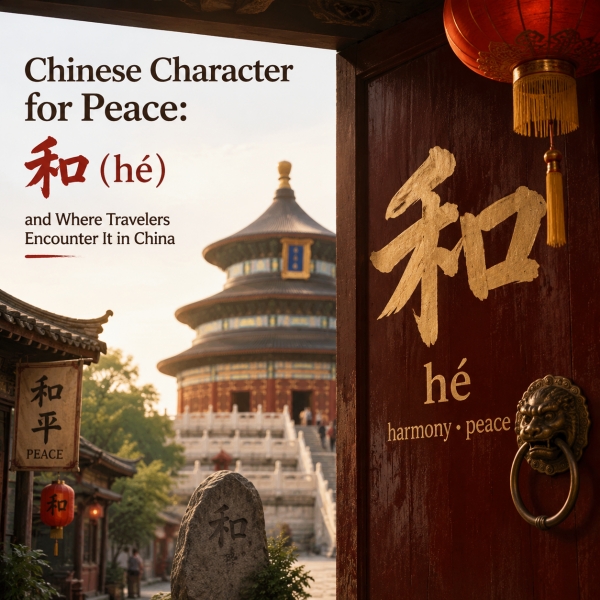
For travelers arriving in China, one character shows up almost everywhere — on temple gates, tea-house signs, old-town alleyways, hotel façades, and souvenir stalls. It is 和 hé, the modern Chinese character for peace, harmony, and togetherness. You will see it carved into stone, embroidered on cushions, painted across restaurant walls, and stamped on the side of the Peace Hotel in Shanghai. This guide explains what 和 means, breaks down its strokes, and walks through every other peace character a visitor is likely to meet on the road — from 静 jìng on a meditation hall to 平安 on a Spring Festival couplet.
Quick Facts
和 (hé) — The Peace Character Every Traveler Meets
和 is the dominant modern answer to "chinese character for peace." It carries three layered meanings — harmony between people, peace as the absence of conflict, and gentle or amiably as a tone. The character is identical in traditional and simplified form. One of the few Chinese characters that did not change during simplification. Standard pronunciation is hé (rising tone) when used alone as harmony or peace.
The character reads as hé, huo, huò, or hè in compounds. Only the hé reading carries the peace meaning. The compound 和平 (hépíng) combines both characters to mean world peace. 和气生财 (hé qì shēng cái) — harmony brings wealth — appears on tea houses and restaurant walls. In ancient philosophy, the character represents the balance between heaven, earth, and humanity (天人合一). Modern China uses 和谐社会 (harmonious society) as a political concept.
The Anatomy of "和"
The character is made of two stacked parts. The top component 禾 (grain) sits over the bottom component 口 (mouth).
- 禾 hé (grain): the top radical. Written with 5 strokes: horizontal, vertical, slash, dot, horizontal. Represents rice or grain in traditional Chinese culture.
- 口 kǒu (mouth): the bottom radical. Written with 4 strokes forming a square. One of the most basic Chinese radicals.
- Eight strokes total:禾 takes 5 strokes, 口 takes 3 strokes. Total: 8 strokes.
- Traditional and simplified identical: Travelers do not need to learn a separate character. 和 is written the same way in all Chinese communities.
How 和 Came to Mean Peace
The peace sense developed as a later, figurative extension of the older harmony sense. In Confucian and Taoist texts, 和 describes the harmony between heaven, earth, and humanity. This philosophical meaning flows naturally into the modern meaning of social peace.
For world peace specifically, Chinese uses the compound 和平 (hépíng) — literally "harmony + flat/even." The single character 和 appears in compounds that emphasize relationship and social harmony. Travelers will encounter 和 most often in this harmony-to-peace sense, not as a literal ceasefire term.
🔢 Discover Popular Internet & Chat Codes: Interested in how characters and numbers combine in modern Chinese online culture? Check out the most common numeric homophones and expressions in our breakdown of Chinese Number Slang.
Five More Peace Characters You Will See in China
Six peace characters appear regularly across China. The table below shows all six at a glance. Each carries a slightly different shade of meaning. The sections below explain each one in detail.
安 (ān) — Safety, Home, and the Exit Sign
安 covers peace as safety and security. Travelers see it daily on every emergency exit in hotels, malls, and subway stations. The compound 安全出口 (ānpíng chūkǒu) appears on green signs throughout China. This is the most frequently encountered peace character in daily travel life.
- 安全 (ānquán): safety. Appears on exit signs, fire exits, and equipment warnings.
- 安居乐业 (ān jū lè yè): live in peace, work in contentment. A classical blessing seen on business plaques and new-home ceremonies.
- 安吉 (Ānjí): a bamboo-growing region in Zhejiang. A popular day trip from Hangzhou for hiking and river rafting.
静 (jìng) — Silence in Temples and Gardens
静 (traditional: 靜) means quiet, still, and tranquil. The character appears frequently on temple signs and meditation hall entrances. In urban signage, it marks quiet zones and peaceful spaces.
- 静安寺 (Jìng'ān Sì): Jing'an Temple in central Shanghai. Named directly for "peaceful silence."
- 入静 (rù jìng): enter stillness. Displayed in Buddhist meditation halls and Taoist retreat centers.
- 安静 (ānjìng): quiet, peaceful. A common compound on park signs and library entrances.
平 (píng) — Greetings, Festivals, and Good Fortune
平 means level, even, and in compounds, peace. The most recognizable travel compound is 平安 (píng'ān). This two-character phrase appears on red paper during Lunar New Year and on good-luck charms year-round.
- 平安 (píng'ān): peace and safety. The default good-luck phrase. Appears on red couplets, taxi dashboard charms, and children's accessories.
- 太平 (tàipíng): great peace. Seen on temple names and historical place names across China.
- 平安夜 (píng'ān yè): Christmas Eve in Mandarin. A cultural borrowing that uses the peace character.
宁 (níng) — City Names and Tea
宁 (traditional: 寧) means peaceful, serene, and restful. It appears in several major place names that travelers read on train tickets and highway signs. The character also features in classical proverbs displayed in tea houses.
- 宁波 (Níngbo): Zhejiang port city. A major shipping hub and tourist destination.
- 南京 (Nánjīng): historic capital of China. Sun Yat-sen's Mausoleum and the Ming Xiaoling Tomb are UNESCO sites.
- 宁夏 (Níngxià): northwest autonomous region. Known for Helan Mountains wine country and Muslim culture.
- 宁静致远 (níng jìng zhì yuǎn): tranquility yields far-reaching vision. A common calligraphy subject in tea houses and study rooms.
泰 (tài) — Sacred Mountains and Beyond
泰 means great, peaceful, and safe. It appears most notably in the name of one of China's Five Sacred Mountains and in the name of a neighboring country. The character carries a sense of majestic calm.
- 泰山 (Tài Shān): Mount Tai in Shandong. UNESCO World Heritage Site. One of the most climbed mountains in China.
- 泰国 (Tàiguó): Thailand. Literally "land of peace" in Mandarin. A major travel destination for Chinese tourists.
- 国泰民安 (guó tài mín ān): the nation at peace, the people safe. A classical blessing seen on festival banners and temple inscriptions.
🌸 Understand Seasonal Vocabulary for Travelers: From spring blossom festivals to winter snowfall in historic towns, learn the core characters and vocabulary for every time of year in our guide to Seasons in Chinese.
Where You'll See 和 on the Road
The character 和 is not just a dictionary entry. It is one of the most photographed characters in China. Travelers encounter it at landmark buildings, UNESCO villages, tea houses, and souvenir markets. Below are the concrete locations where the peace character appears most frequently on the road.
- Peace Hotel Shanghai (和平饭店, Hépíng Fàndiàn): Art Deco landmark on the Bund. Opened in 1929. The characters 和平 (peace) appear on its façade.
- Heshun Ancient Town (和顺古城): UNESCO-listed Ming-and-Qing village in Shanxi. 和 appears on courtyard gates and ancestral halls throughout the town.
- Tea houses nationwide: The phrase 和气生财 (harmony brings wealth) is a standard tea-house decoration.
- Hotan (和田, Hétian): Silk Road oasis in Xinjiang. Famous for Hétian jade. The character 和 appears in the city name.
- Souvenir markets: Calligraphy scrolls and 平安 charm pendants available at Liulichang (Beijing), Yuyuan (Shanghai), and most tourist markets. Scrolls: $14–28 (¥99–198). Charm pendants: $5–14 (¥35–99).
Temple Gates, Tea Houses, and Old Streets
In UNESCO heritage villages and traditional neighborhoods, 和 is most often paired with 平 or 气 on wood plaques above doorways. Tea houses display 和静 (harmony plus silence) on hanging scrolls. Reading the character in context helps travelers understand whether it marks a business blessing or a spiritual space.
- 和气 on doorways: a business blessing. Usually paired with 招 (welcome) or 福 (fortune).
- 和平 above gates: harmony and peace. Common in traditional villages like Heshun, Pingyao, and Lijiang.
- 和静 on tea-house scrolls: harmony and tranquility. Indicates a space designed for calm conversation.
- 和 alone above an entrance: harmony-themed business. Likely a tea house, restaurant, or boutique hotel.
"和" in Place Names, Hotels, and Souvenirs
The character enters place names across China. Travelers may encounter it on train schedules, city maps, and hotel registrations. It also appears in business names for boutique and heritage properties.
- 和顺 (Héshùn): Shanxi village. UNESCO heritage site. 和 appears on gates and plaques throughout.
- 和平 (Hépíng): appears in several provincial and county names. Check train schedules for Hépíng County, Hépíng District.
- 和田 (Hétian): Xinjiang city. Famous for jade and the Silk Road trade route.
- 和平饭店 (Peace Hotel): Shanghai Bund landmark. The most recognizable hotel name containing the peace character.
- 和合 café and restaurant chains: boutique hospitality brands using the harmony character in their names.
"和" in Calligraphy Scrolls, Tattoos, and Crafts
和 is one of the most requested single-character calligraphies from street artists. Travelers can commission a quick brush piece in most major tourist areas. The character is also a popular tattoo choice for visitors who want a permanent reminder of their China trip.
- Liulichang (Beijing): historic book and calligraphy street. Street calligraphers available daily.
- City God Temple area (Shanghai): Yuyuan Garden district. Multiple calligraphy shops and street artists.
- Muslim Quarter (Xi'an): Souvenir market with calligraphers and custom crafts near the Great Mosque.
- Brush commission: $7–14 (¥50–99) on-site for a quick brush piece. Framed scrolls: $14–28 (¥99–198).
- Tattoo tip: 和 is preferred over 和平 for tattoos. One character reads cleanly at small sizes and fits better on wrists and ankles.
📛 How Meaningful Characters Are Chosen for Names: Meaningful concepts like 和 (harmony) and 平 (peace) are frequently chosen to express good wishes in personal names. Discover how Chinese names are structured and selected in our guide to a Typical Chinese Name.
Reading Peace Characters on Chinese Travel Signs
Foreign travelers who cannot read Chinese can learn to recognize peace characters by their context. The character plus its surroundings usually tells the full story. Below are seven patterns to watch for when navigating Chinese signs.
- 和 above a door: harmony-themed business. Usually a tea house, restaurant, or boutique hotel. Not a religious sign.
- 安 alone: usually part of a longer compound. Check for 全 (complete) for exit signs, or 居 (dwell) for real-estate slogans.
- 静 on a temple sign: temple of silence. On a park gate: quiet garden.
- 平安 on red paper: Lunar New Year wish. Appears on couplets, envelopes, and charms during Spring Festival.
- 宁 in a city name: read the second character. Ningbo (宁波), Nanjing (南京), Ningxia (宁夏) — all contain the peace character.
- 泰 in 国 or 山 compounds: peace or Mount Tai specifically. 泰国 = Thailand. 泰山 = Mount Tai.
- Tone cue: peace and peace-related readings always use hé, ān, jìng, píng, níng, or tài. These tones signal the peace meaning.
Frequently Asked Questions
Q: What is the Chinese character for peace?
和 (hé) is the standard modern Chinese character for peace and harmony. For world peace specifically, the compound 和平 (hépíng) is used — literally harmony plus evenness.
Q: Is 和 the only Chinese character for peace?
No. It is the most common, but travelers will also meet 安 ān (safety and peace), 静 jìng (tranquility), 平 píng (peace and even), 宁 níng (peaceful and serene), and 泰 tài (great peace). Each carries a slightly different shade of meaning.
Q: What is the difference between 和 and 平?
和 (hé) leans toward harmony between people and gentleness. 平 (píng) leans toward flatness, equality, and the absence of conflict. The compound 和平 combines both senses and is used specifically for world peace.
Q: How do you write 和 in calligraphy?
Eight strokes total. The top component 禾 (grain) takes five strokes. The bottom component 口 (mouth) takes three strokes, drawn as a square. Brush order follows top-to-bottom and left-to-right within each component.
Q: What does 平安 mean, and where will I see it in China?
平安 (píng'ān) means peace and safety. It is most visible during Spring Festival on red couplets. Travelers also see it on taxi dashboard charms and as a default good-luck phrase on year-round amulets.
Q: Is there a Chinese character for world peace?
Not a single dedicated character. World peace is expressed as 世界和平 (shìjiè hépíng) — world harmony-peace. Classically, 国泰民安 (guó tài mín ān) — the nation at peace, the people safe — conveys a similar meaning.
Q: Which peace character is best for a tattoo or souvenir?
和 is the most common pick. It is a single readable character that photographs well and reads cleanly at small sizes. For couples or family gifts, 平安 or the proverb 宁静致远 (tranquility yields far-reaching vision) are frequent alternatives.
Q: How do I read peace characters on Chinese hotel and temple signs?
Look for the peace character alongside a building-type hint. 寺 (temple), 饭/店 (restaurant/hotel), 山 (mountain), 馆 (hall), 出/口 (exit) — these markers help identify the sign type. One-character names place the peace character first or last.