Chinese Astrology Metal
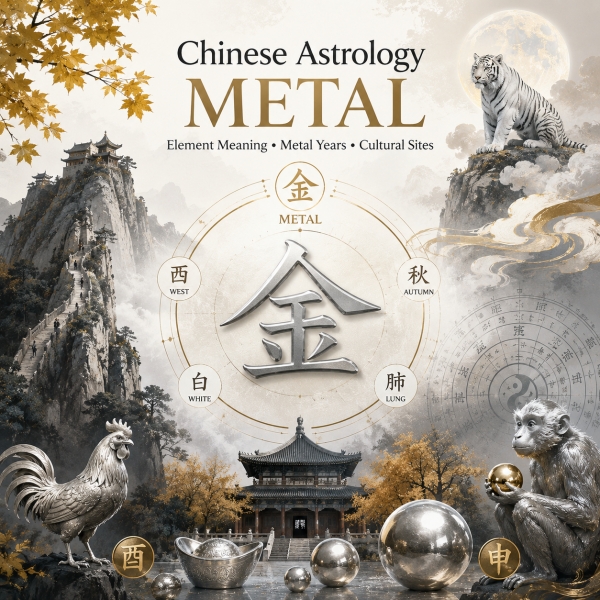
In the ancient cosmology of the Five Phases (Wu Xing), the element Metal (金, jīn) occupies a position of refined power. It is the fourth phase in the cyclical framework that has shaped Chinese thought for over two thousand years, representing the western direction, the autumn season, the planet Venus, and the White Tiger guardian spirit. Metal's energy is contracting and inward-moving — firm, persistent, and unyielding by nature, yin in its deepest character.
This guide covers what Metal means within the Wu Xing system, how Metal years are calculated within the 60-year sexagenary cycle, the personality traits of those born under Metal's influence, and the cultural geography where Metal's symbolism comes alive — from the steep paths of Mount Hua to autumn's chrysanthemum festivals and the White Tiger's ancient tomb art.
Quick Facts
What Metal Means in Chinese Astrology
The Five Phases, or Wu Xing (五行), form the foundational cosmological framework that underpins Chinese astrology, Feng Shui, Traditional Chinese Medicine, and Daoist philosophy. First formally articulated during the Spring and Autumn period, this system maps the dynamic relationships between five elemental forces — Wood, Fire, Earth, Metal, and Water — that together describe the rhythm of change in the natural world and in human life.
Metal holds the fourth position in the sequence. It represents the stage of decline and contraction, the moment when the harvest is gathered and energy turns inward. On the cosmological map of directions, Metal corresponds to the West — the direction of the setting sun, of twilight, and of the season's final act before winter arrives.
Core attributes of the Metal phase include firmness, rigidity, persistence, strength, and determination. These qualities echo the nature of the metals themselves: material that can be forged and sharpened but does not easily break. In human character, Metal's influence manifests as decisiveness, a clear sense of right and wrong, and an organized approach to work and ambition.
The Wu Xing framework further divides each element into Yin and Yang forms. For Metal, Yang Metal (庚, gēng) carries the sword-like quality — assertive, sharp, and active in the world. Yin Metal (辛, xīn) operates in the jewel-like register — refined, delicate, and precise. Both appear in the 60-year cycle, alternating by year.
Metal's position in the cycle also defines its relational dynamics. In the generative order, Earth engenders Metal (mineral ores form within the earth), and Metal begets Water (metal condenses moisture). In the overcoming cycle, Fire melts Metal, and Metal chops Wood. However, the cycle is not perfectly symmetrical — a very large volume of Wood can defeat Metal in return, a dynamic sometimes overlooked in simplified charts.
⚔️ Explore the Five Elements System: Discover how Metal balances Fire, Wood, Water, and Earth within traditional philosophy in our guide on Metal WuXing.
Metal Zodiac Signs: Dragon, Rooster, and Rabbit
The twelve Chinese zodiac animals each rotate through the five elements across the 60-year sexagenary cycle. This means every zodiac sign receives a Metal variant once every 60 years, producing twenty distinct Metal-year combinations that overlay each animal's classical character with Metal's particular qualities of sharpness, discipline, and resolve.
- Fixed signs: Monkey and Rooster are the two zodiac animals whose element is permanently Metal across the 60-year cycle — meaning every Monkey year and every Rooster year carries Metal energy, regardless of Heavenly Stem.
- Governed signs: Some systems also count Dog as a Metal-governed animal, adding it to the list of zodiacs with a strong Metal affinity alongside Monkey and Rooster.
- Most-searched Metal combinations: Metal Dragon (1940, 2000, 2060) and Metal Rooster (1921, 1981, 2041) each generate the highest search volume, followed closely by Metal Rabbit (1963, 2011, and every 12 years thereafter).
- 60-year reset: The full cycle always returns to its starting point — Metal Rat (庚子) in 1920, 1980, 2040 — so every person's zodiac-element chart resets when they reach 60.
Metal Dragon
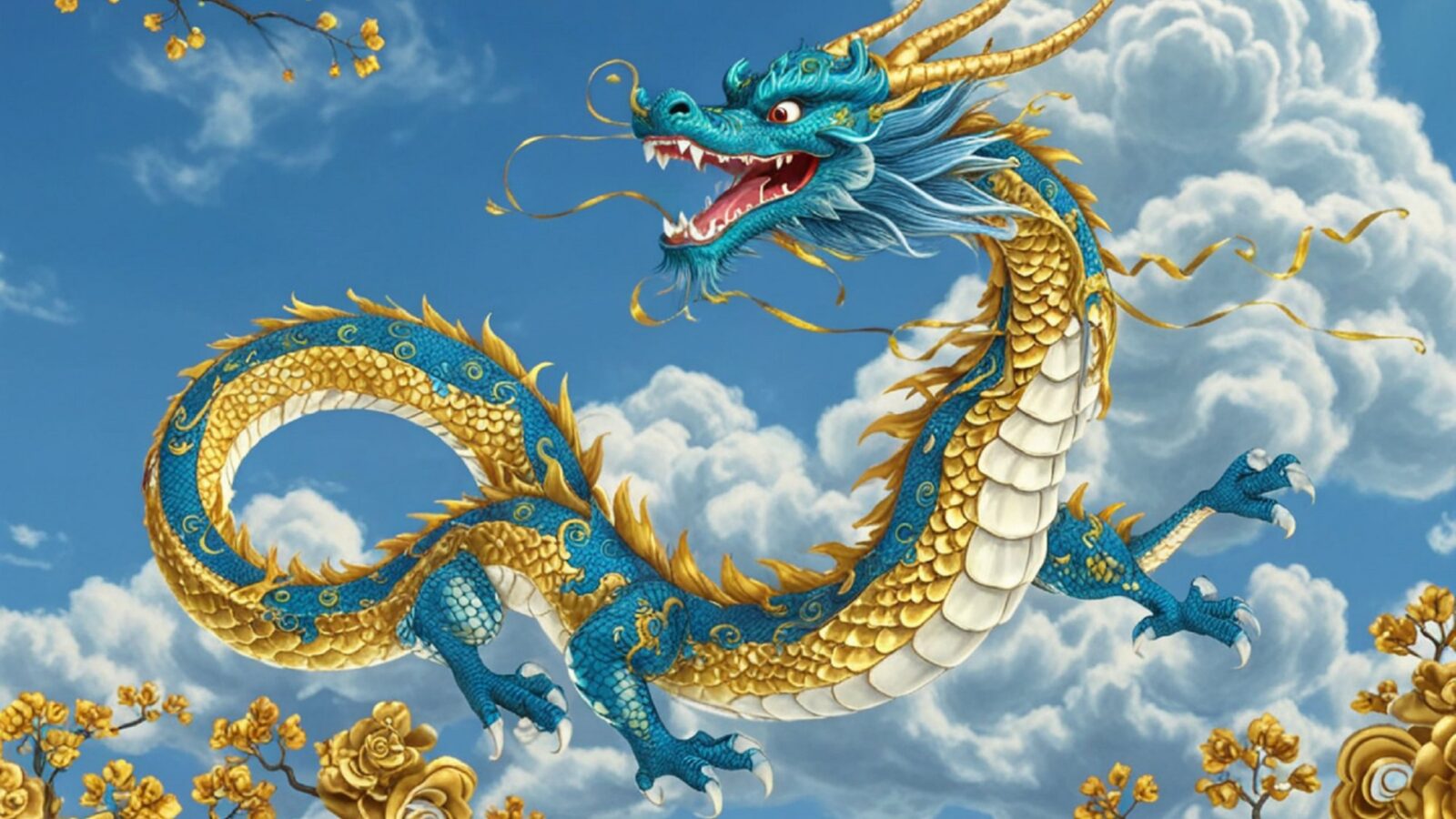
Metal Dragon
The Dragon is among the most energetic of the twelve zodiac animals, and Metal's influence adds a layer of disciplined command that can make the Metal Dragon particularly formidable. Natural ambition, already strong in the Dragon archetype, becomes sharpened into focused, goal-directed determination when paired with Metal's unwavering character.
- Decisive leadership: Dragon's native grandeur, filtered through Metal's clarity of purpose, produces a personality type that moves quickly from idea to action — often inspiring loyalty in others without seeking it explicitly.
- Moral rigidity: The Metal Dragon's sense of right and wrong tends to be uncompromising. Political compromise can feel unnatural to this type, which can be both a strength in ethical matters and a source of friction in nuanced situations.
- Intensity in work and romance: Energy runs high in both professional ambition and emotional commitment. This intensity can be magnetic, though it may also feel overwhelming to those who prefer a lighter touch.
- Generational note: The most recent Metal Dragon cohort was born in 2000 (Yang Metal Dragon, 庚辰), and they are now entering young adulthood — a generation often referred to in Chinese media as the "millennium babies."
🐉 Discover Fire Dragon Symbolism: While Metal brings structure and firmness, Fire brings warmth and expansion. Explore the language and mythology of this intense combination in Fire Dragon in Chinese.
Metal Rooster
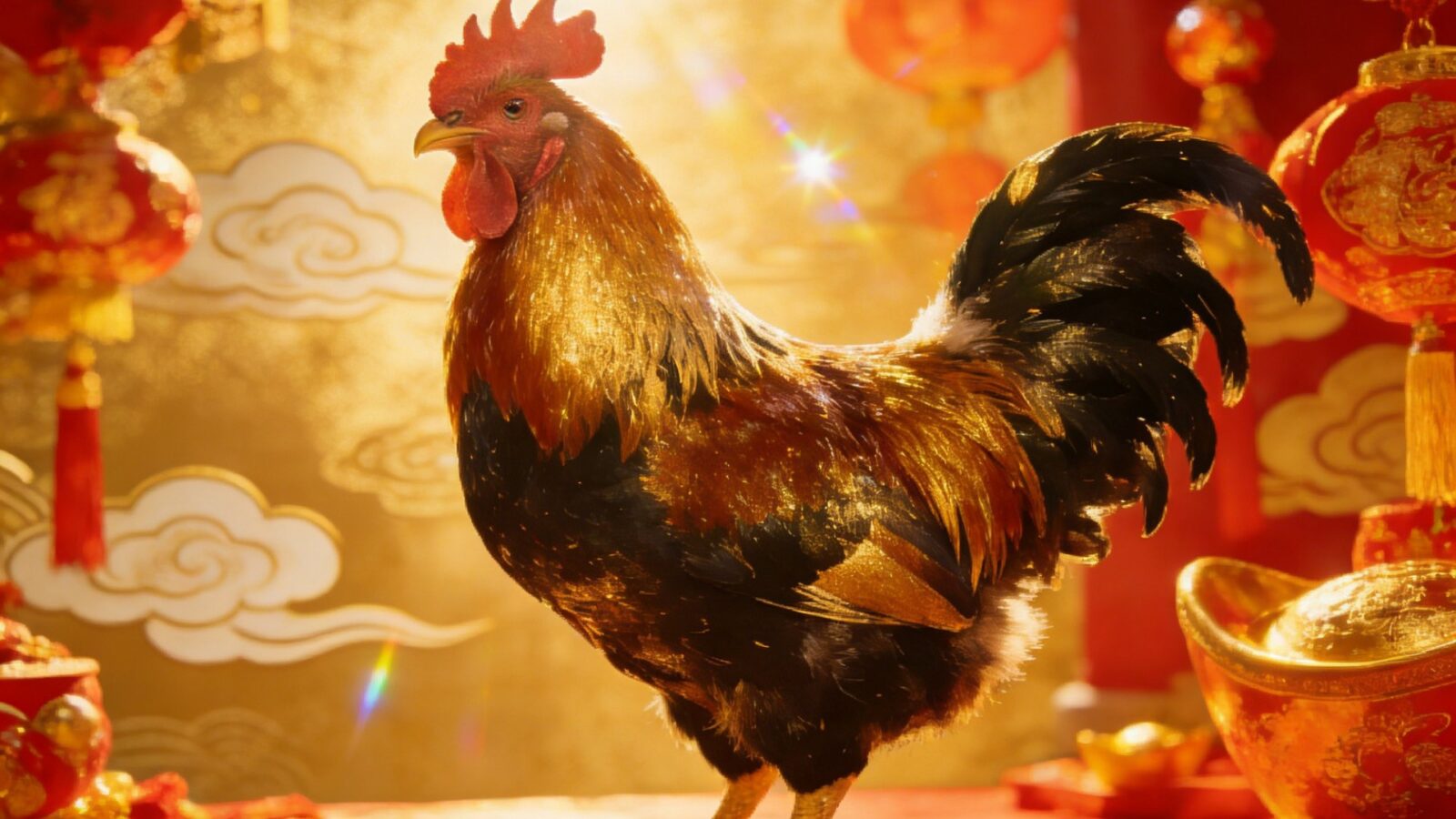
Metal Rooster
The Rooster is naturally sharp and observant, with a gift for precision that Metal amplifies considerably. The Metal Rooster combines the Rooster's native critical eye with Metal's unforgiving exactitude — a combination that produces some of the most meticulous and hardworking personalities in the zodiac system.
- Precision and directness: Where the Rooster alone might soften its criticism with charm, the Metal Rooster delivers assessments with minimal filtering. This candor is rarely malicious, but it can catch others off guard.
- Self-critical work ethic: The standard Rooster is already diligent; Metal raises the bar internally, sometimes to an uncomfortable degree. Metal Roosters may set personal standards that exceed what anyone around them expects.
- Rare combination: The next Metal Rooster year does not arrive until 2041 (Yin Metal Rooster, 辛酉). Most people researching a Metal Rooster are therefore looking at parents or grandparents, or planning ahead for a future child.
- Conflict style: Arguments with Metal Rooster natives tend to be short and sharp. They are unlikely to let a grievance pass unremarked, and they rarely hold grudges once the point has been made.
Metal Rabbit
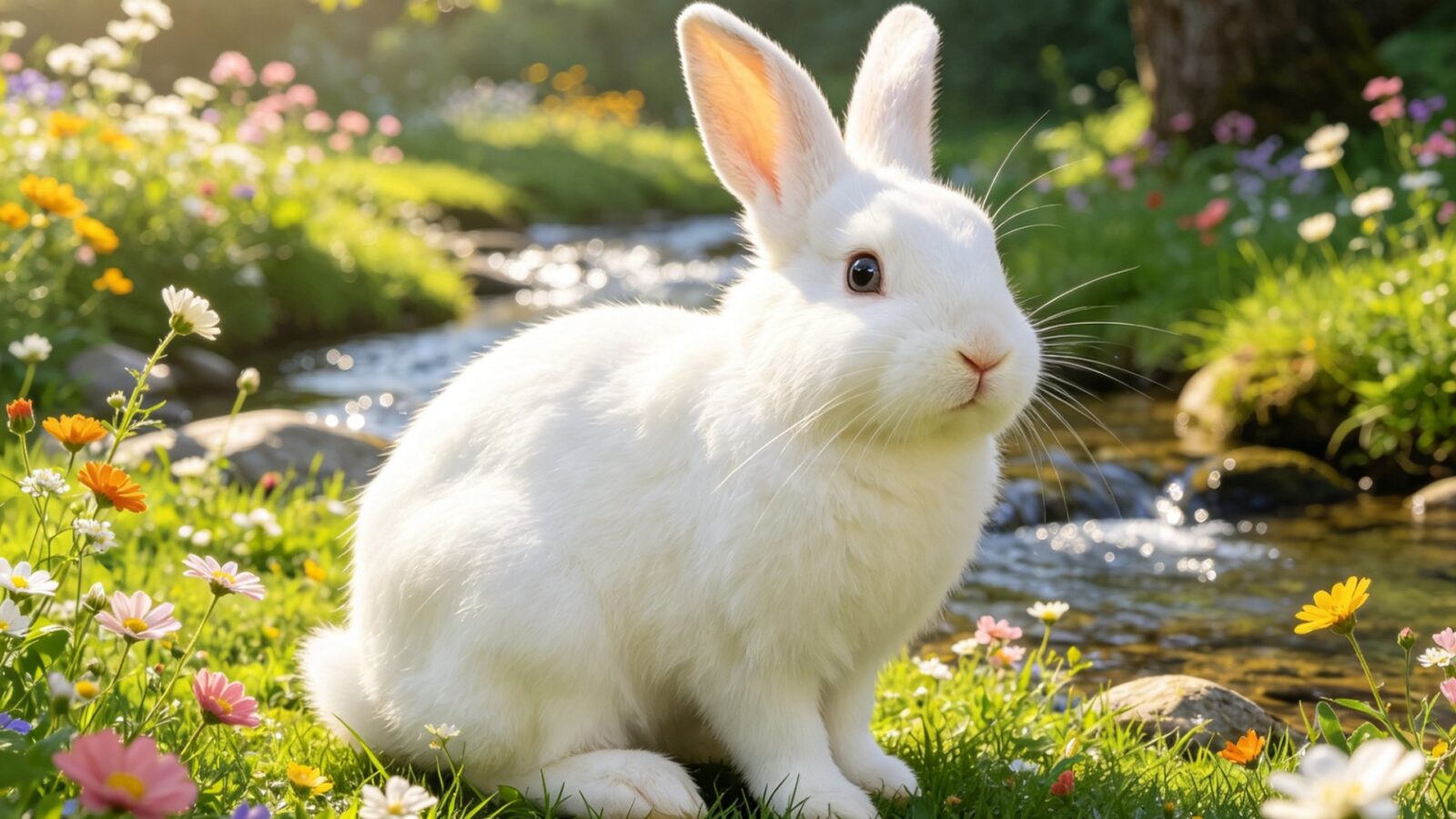
Metal Rabbit
The Rabbit archetype is gentle, diplomatic, and aesthetically attuned — qualities that sit in apparent tension with Metal's firmness. In practice, the Metal Rabbit resolves this tension elegantly: it takes the Rabbit's preference for harmony and adds a spine of quiet resolve that prevents the diplomatic instinct from curving into passivity.
- Graceful but firm: Metal Rabbit natives navigate disagreements with poise. They prefer negotiation over confrontation and will rarely raise their voice, but their position, once stated, tends to hold firm.
- Refined aesthetic sense: The Metal Rabbit often displays a strong interest in design, craft, and visual culture — a sensibility that benefits from Metal's association with precision and the careful shaping of material.
- Stability preference: In both career and relationships, the Metal Rabbit shows a marked preference for long-term stability over sudden change. Impulsive moves feel unnatural to this type.
- Generational note: The most recent Metal Rabbit year was 2011 (Yin Metal Rabbit, 辛卯), placing that cohort in their mid-teens. The next is 2055.
🐉 Calculate Your Lunar Zodiac Profile: Confirm whether your birth year falls under a Metal, Water, Wood, Fire, or Earth sign using What Is My Chinese Zodiac Sign.
Metal Years in the Chinese Calendar
The 60-year sexagenary cycle that governs Chinese astrology pairs ten Heavenly Stems (天干, tiān gān) with twelve Earthly Branches (地支, dì zhī) to produce sixty unique year identities. Each Stem carries an elemental and yin-yang charge, and two of those ten stems — 庚 (gēng) and 辛 (xīn) — carry Metal energy.
- Yang Metal (庚) years end in 0: 1940, 1950, 1960, 1970, 1980, 1990, 2000, 2010, 2020, 2030, 2040.
- Yin Metal (辛) years end in 1: 1941, 1951, 1961, 1971, 1981, 1991, 2001, 2011, 2021, 2031, 2041.
- Cycle position: Metal always follows Earth in the generating sequence. This means that every Metal year in the 60-year order is preceded by an Earth year of the same yin-yang polarity.
How Metal Years Are Calculated
The ten Heavenly Stems and twelve Earthly Branches interlock in a repeating pattern that takes sixty iterations to return to its starting point — hence the sexagenary ("sixty-based") cycle name. The Stems carry the elemental charge, while the Branches carry the zodiac animal. To calculate whether any given year is a Metal year, you simply check whether its Heavenly Stem is 庚 (Yang Metal, years ending in 0) or 辛 (Yin Metal, years ending in 1).
The same Stem-Branch pairing system also applies to months, days, and hours, giving rise to the Four Pillars of Destiny (四柱, sì zhù) — a person's full birth chart includes not just the year pillar but also month, day, and hour pillars. Within such a chart, an individual day or hour can also carry Metal energy independently of the year, which answers the "Metal day" or "Metal hour" dimension that feeds into detailed Chinese birth chart analysis.
Recent and Upcoming Metal Years
Metal Personality Traits and Element Qualities
The Metal personality type corresponds to the mature stage of the harvest cycle — refined by experience, clear in purpose, and organized in its dealings with the world. Those under strong Metal influence tend to approach life with a sense of structure that others often find both reassuring and, at times, demanding.
- Determined and decisive: Metal natives typically reach conclusions quickly and act on them without second-guessing. Hesitation can feel uncomfortable when Metal energy is prominent.
- Clear moral framework: Right and wrong are rarely gray areas for Metal types. This clarity lends integrity but can read as inflexibility in situations that reward nuance.
- Refined appearance and voice: Sources note a particular polish in personal presentation and communication — Metal types often have a pleasant, well-modulated speaking voice and pay attention to grooming.
- Self-reliant and ambitious: Metal natives tend to pursue goals independently, with a natural orientation toward business, organization, and stability rather than collective consensus.
- Appreciation for quality: An affinity for well-made things and comfortable surroundings is common. This can shade into materialism if unchecked.
- Strong willpower: Like metal that can be forged but not easily broken, Metal types recover from setbacks through sheer persistence rather than flexibility.
- Emotional range: The negative emotion associated with Metal is grief; the positive is courage. The Lung and Large Intestine, the TCM organs governed by Metal, are understood to be sensitive to emotional suppression in this framework.
In terms of elemental compatibility, Metal pairs naturally with Earth — Earth engenders Metal in the generating cycle, creating mutual support. Tension arises with Fire (which melts Metal in the overcoming cycle) and with Wood (which Metal, in turn, chops). A very large mass of Wood, however, can overcome Metal — a reminder that elemental dynamics are not absolute but depend on relative proportions.
Where the Metal Element Lives in Chinese Culture
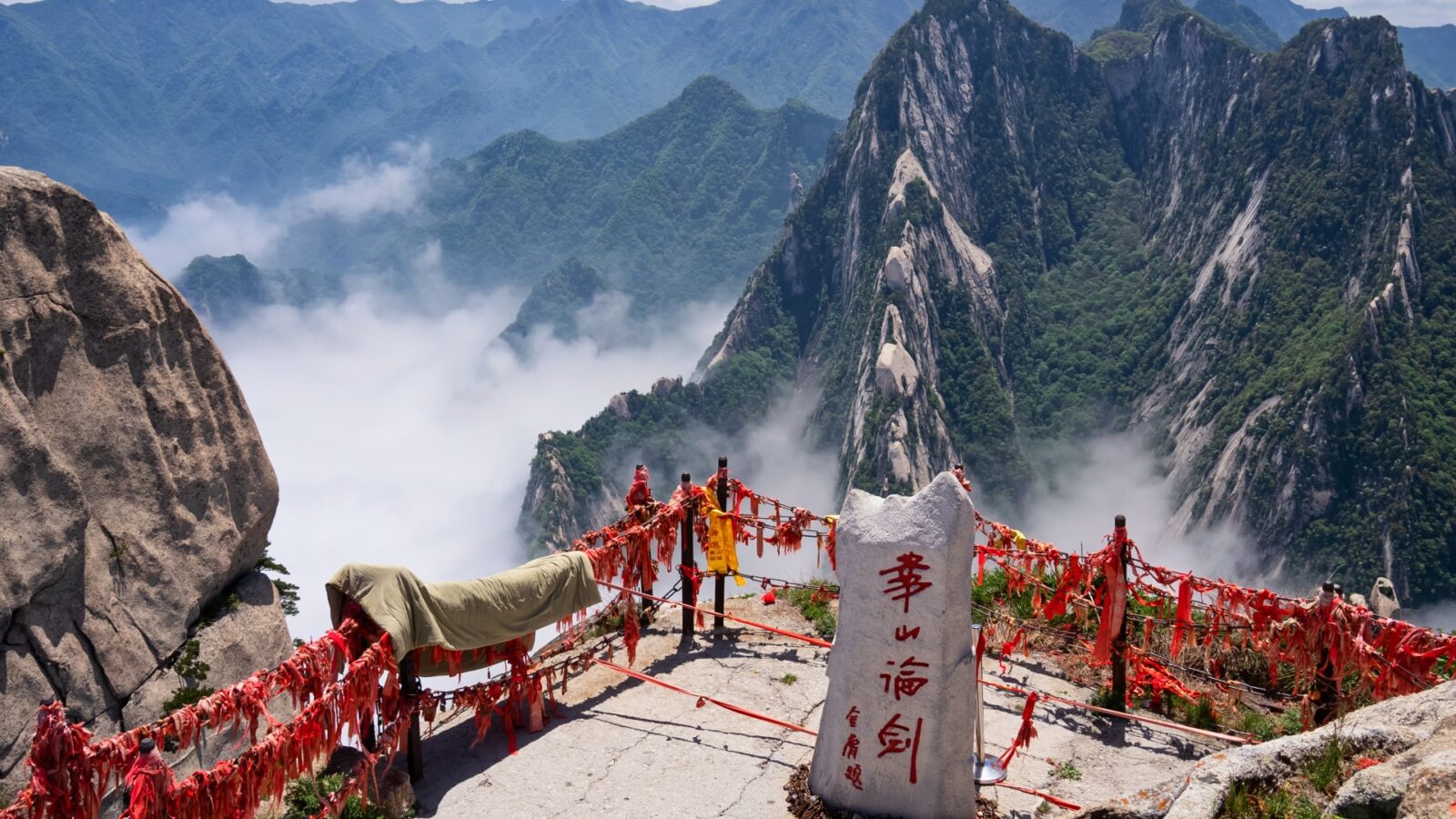
Mount Hua
The Five Phases cosmology was never purely abstract. Ancient Chinese geographers mapped the system directly onto the landscape, assigning each element to a cardinal direction and, correspondingly, to one of the Five Sacred Mountains (五岳, Wǔyuè). The West — Metal's direction — belongs to Mount Hua, the Western Sacred Mountain (西岳, Xīyuè). Visiting Mount Hua, attending an autumn festival, or encountering White Tiger imagery in an ancient tomb are all ways of engaging with Metal's physical cultural presence in China.
- Mount Hua (华山): The Western Sacred Mountain of the Five Sacred Mountains, ~120 km east of Xi'an in Shaanxi province — Metal's geographic home and the most direct travel destination for engaging with this element.
- Autumn festivals: The Mid-Autumn Festival and Double Ninth Festival fall within the Metal season and carry the element's symbolism in their imagery, foods, and rituals.
- White Tiger (白虎, Bai Hu): The guardian spirit of the West — appearing in Daoist temple iconography, Han Dynasty tomb art, and classical cosmological texts.
Mount Hua and the Western Sacred Mountain
Mount Hua (华山) rises about 120 kilometers east of Xi'an in Shaanxi province. Its North Peak sits at roughly 2,154 meters above sea level, while the highest summits reach approximately 2,160 meters — dramatic granite faces that have drawn pilgrims, poets, and warriors for over two thousand years. In the Five Phases geographic system, the West corresponds to Metal, and Mount Hua has been formally designated the Western Sacred Mountain (西岳) since at least the Han Dynasty, making it one of the most ancient and continuously venerated Metal-element sites in China.
- Entrance tickets: Single-peak access costs about $21–28 (¥160) per person; the full multi-peak pass covering all five peaks runs about $42–49 (¥300–350).
- Cable car: Round-trip cable car fares average about $35–55 (¥250–400), depending on the route and whether you include the western or eastern line.
- Transport from Xi'an: High-speed rail from Xi'an North to Huashan North station takes roughly 30 minutes (tickets around $5 / ¥34.5), followed by a short taxi ride to the visitor center.
- Best season: Autumn (September through mid-November) aligns directly with the Metal season and offers stable weather, clear skies, and vivid foliage — the most traditional time for a pilgrimage to the Western Mountain.
- Suggested itinerary: Combine a Mount Hua visit with Xi'an's Terracotta Army and Ancient City Wall for a 2–3 day Metal-element journey that moves from ancient military history to sacred natural geography.
Autumn Metal-Season Festivals and Travel
Autumn is the Metal season by cosmological definition — the time of harvest, contraction, and the turning inward that precedes winter. The visual language of the season reinforces the element's palette: white frost on morning fields, pale moons, golden chrysanthemums against cooling air. Two major traditional festivals anchor the season and carry Metal symbolism in their imagery and ritual.
- Mid-Autumn Festival (中秋节): Celebrated on the 15th day of the 8th lunar month, this festival centers on the full moon — a round, luminous white disc that echoes Metal's color and its association with Venus, the morning and evening star. Family reunions, mooncakes, and lantern displays are the primary expressions.
- Double Ninth Festival (重阳节): Held on the 9th day of the 9th lunar month, this festival traditionally involves climbing to high places and displaying chrysanthemums. The chrysanthemum, with its white and yellow petals, fits squarely within the Metal color palette and is among the most recognizable seasonal symbols of autumn in Chinese culture.
- Best travel window: September, October, and the first half of November offer the most comfortable conditions for outdoor travel and festival attendance across central and northern China.
- Chrysanthemum displays: Major Chinese cities — Hangzhou, Kaifeng, and Chengdu among them — stage chrysanthemum exhibitions during autumn, making them practical destinations for visitors who want to experience the Metal season without mountain hiking.
The White Tiger and Western Symbolism
The White Tiger (白虎, Bai Hu) is one of the Four Symbols (四象, Sìxiàng) — the celestial guardians assigned to each cardinal direction in Chinese cosmological tradition. Paired with the Azure Dragon (East/Wood), the Vermilion Bird (South/Fire), and the Black Tortoise (North/Water), the White Tiger governs the West and, by extension, the Metal element.
- Cosmological position: The White Tiger functions as the guardian of the western quadrant, overseeing autumn and the Metal phase in the same way the Azure Dragon presides over spring and Wood.
- Han Dynasty tomb art: White Tiger imagery appears extensively in Han Dynasty burial sites — carved stone reliefs in the area around Xi'an are among the most visited and well-preserved examples. These artworks were intended to protect the deceased in the afterlife.
- Mount Hua temples: At the summit temples of Mount Hua, the White Tiger is venerated as the guardian spirit of the Western Peak. Offerings and prayers directed to the western direction often invoke Bai Hu specifically.
- Physical presence in the landscape: The pale marble and light-colored limestone formations visible at certain sacred sites across central China provide a literal, geological echo of the white coloring that defines Metal's visual identity.
Frequently Asked Questions
Q: Is there a double metal dog in Chinese astrology?
In some folk-astrology commentary, a "double Metal" year occurs when Metal energy stacks across two layers — for example, a Metal-element year that also carries Metal in its hidden stems or its zodiac animal's elemental composition. The 2030 Yang Metal Dog (庚戌) year is sometimes referred to as a "Double Metal Dog" because the year's Yang Metal combines with Dog's hidden Earth stem to reinforce Metal-aligned energy. This concept is interpretive Western-Chinese-astrology commentary rather than strictly classical.
Q: What does metal mean in Chinese astrology?
Metal is the fourth of the Five Phases (Wu Xing), the cosmological framework underlying Chinese astrology. It is associated with the west, autumn, the color white, the planet Venus, and the White Tiger (Bai Hu). Metal represents firmness, rigidity, and contracting energy, and is divided into Yang Metal (庚, gēng) and Yin Metal (辛, xīn) Heavenly Stems.
Q: What is a Metal Monkey like in Chinese astrology?
The Monkey is one of the two zodiac signs with Metal as its fixed element, and one of three governed by Metal alongside Rooster and Dog. Metal Monkey natives combine the Monkey's cleverness and agility with Metal's sharpness and discipline — producing a witty, quick-acting, decisive personality type that can be exacting in its standards. The most recent Metal Monkey year was 1920 (Yang Metal Monkey, 庚申); the next is 2040.
Q: What qualities does the metal element represent in Chinese astrology?
The Metal element signifies determination, courage, decisiveness, refinement, organization, ambition, and self-reliance. Its negative emotion is grief; its positive emotion is courage. In Traditional Chinese Medicine, Metal governs the Lung and Large Intestine. The archetypal metals are gold and silver.
Q: What are the Metal element zodiac signs in Chinese astrology?
Monkey and Rooster are the fixed Metal zodiacs across the 12-year cycle, meaning every Monkey and Rooster year carries Metal energy by default. Some systems also count Dog as a Metal-governed sign. Each zodiac receives a full Metal-element year variant once every 60 years — for example, Metal Dragon in 2000, Metal Rabbit in 2011, Metal Ox in 2021, and Metal Monkey in 2040.
Q: When is the next Metal year in Chinese astrology?
2030 is a Yang Metal Dog year (庚戌) and 2031 is a Yin Metal Pig year (辛亥). After those, 2040 brings a Yang Metal Monkey year (庚申) and 2041 a Yin Metal Rooster year (辛酉) — the beginning of the next full 60-year cycle of Metal years.
Q: Is there a lucky direction or color for the Metal element?
West is the auspicious direction for Metal. White is the corresponding color, with gold and silver also considered favorable. Round shapes and metallic tones are preferred in Feng Shui applications. Placing important work items or furniture in the western side of a space is traditional advice for those with strong Metal energy in their charts.
Q: What is the difference between Yang Metal and Yin Metal?
Yang Metal (庚, gēng) carries the sword-like, active quality — assertive, decisive, and sharp in its expression. Yin Metal (辛, xīn) operates in the jewel-like, receptive register — refined, delicate, and detail-oriented. The polarity alternates yearly: Yang Metal appears in years ending in 0 (for example, 2020 Yang Metal Rat), while Yin Metal appears in years ending in 1 (for example, 2021 Yin Metal Ox).