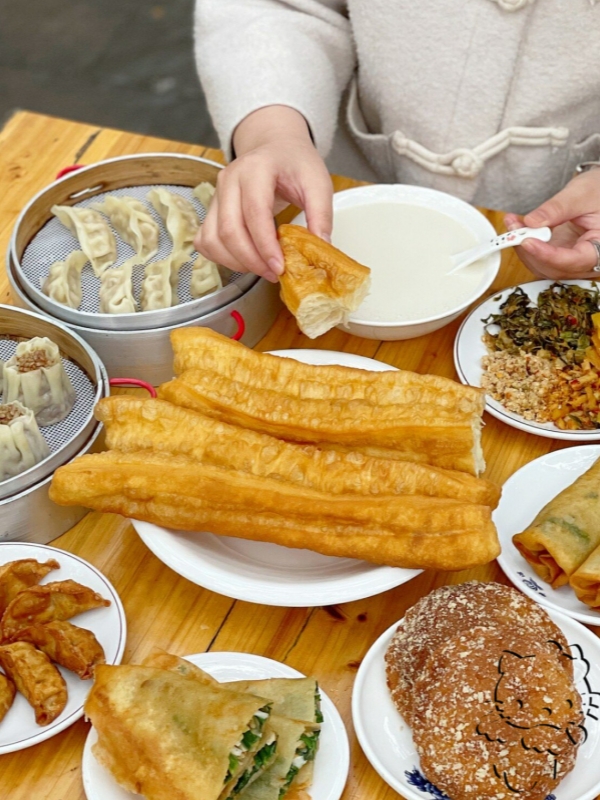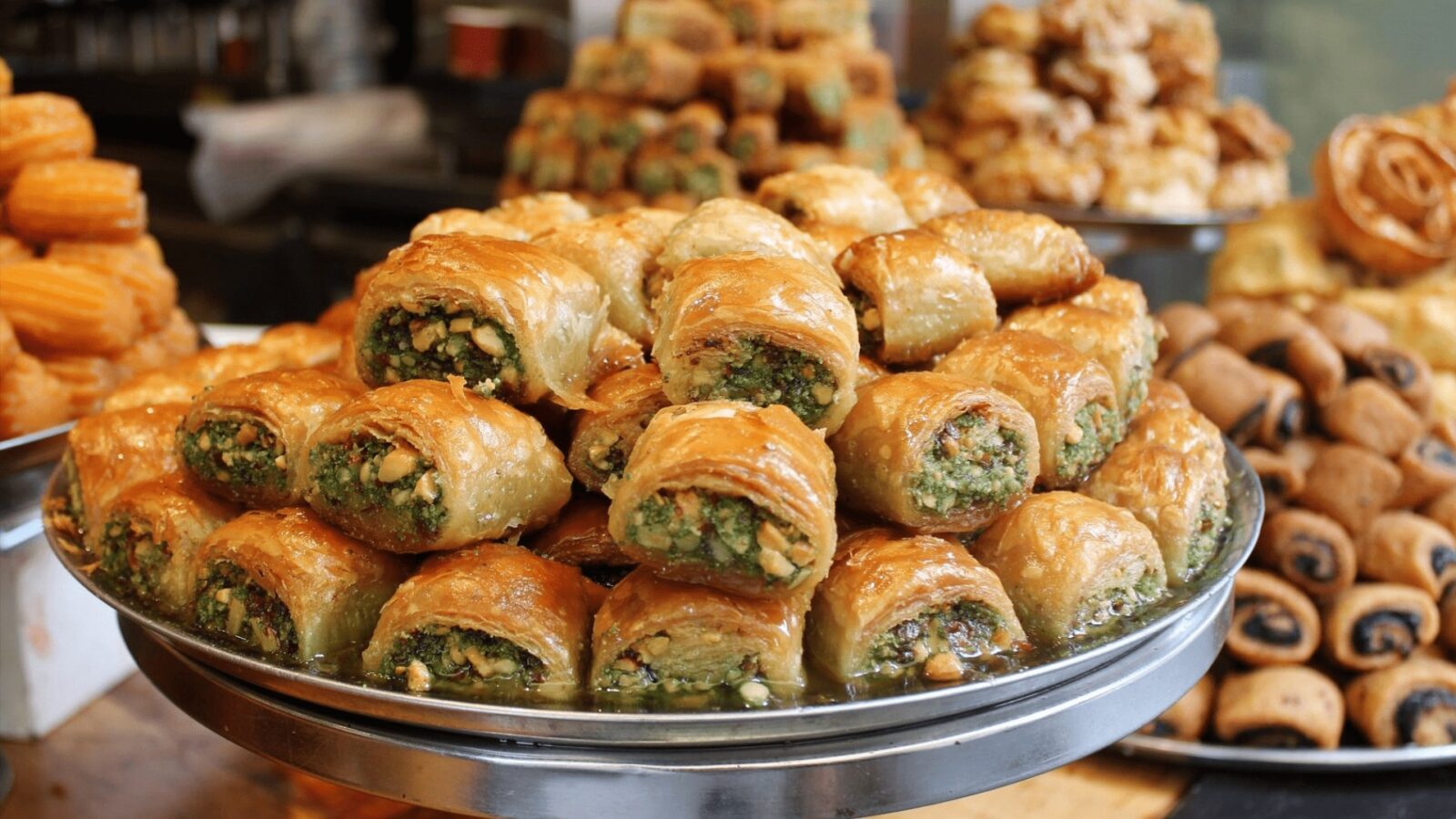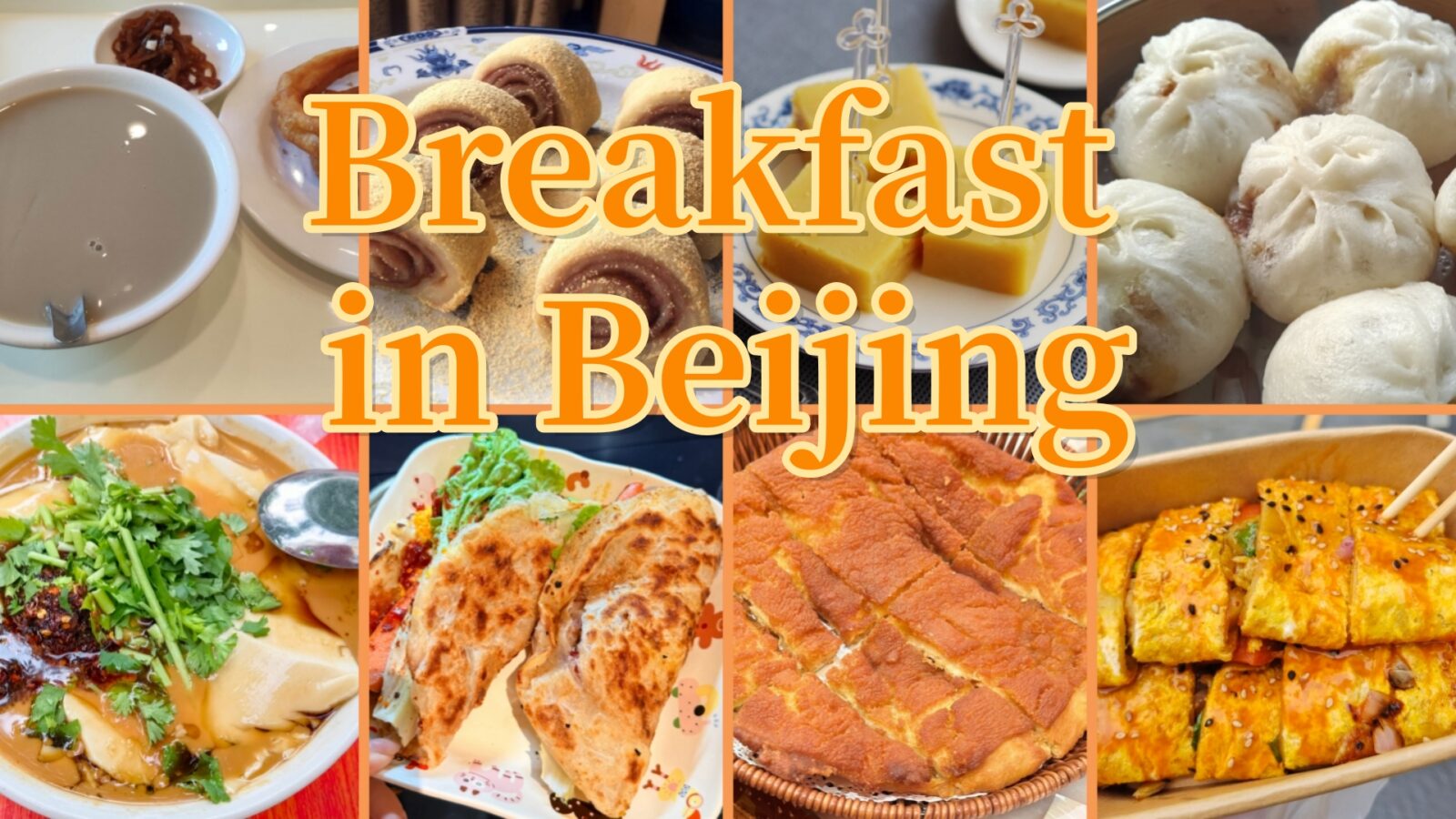
Best Breakfast in Beijing:Fermented Soups, Glutinous Sweets, Savory Steamed Buns
🌅 Walking into a Beijing hutong at dawn, you understand beijing breakfast before ordering a thing. Steam rises from clay pots. Vendors fold crepes at furious speed. Neighbors crowd benches over steaming tofu pudding. This city wakes up hungry — and it is impossible not to feel it.
Beijing breakfast maps the city’s culture across three ancient pillars: Bing (flatbreads), Bao (steamed buns) and Bowls (soups and porridges). It’s a framework that echoes decades of living history — from plain mantou in the rationed years to today’s altars to hutong tradition and global café culture. We move stall by stall, bowl by bowl, through Beijing’s most genuine morning streets. Is your stomach ready?
Beijing Breakfast at a Glance
Before diving into the hutong details, here is a fast overview of Beijing's morning food universe. Prices reflect spring 2026 market rates (CNY) and may vary by location. The Must-Try Index weighs cultural significance, flavor appeal, and visitor-friendliness — five stars means unmissable. 🗺️
| Category | Breakfast Option | One-Line Highlight | Price (CNY) | Must-Try Index |
|---|---|---|---|---|
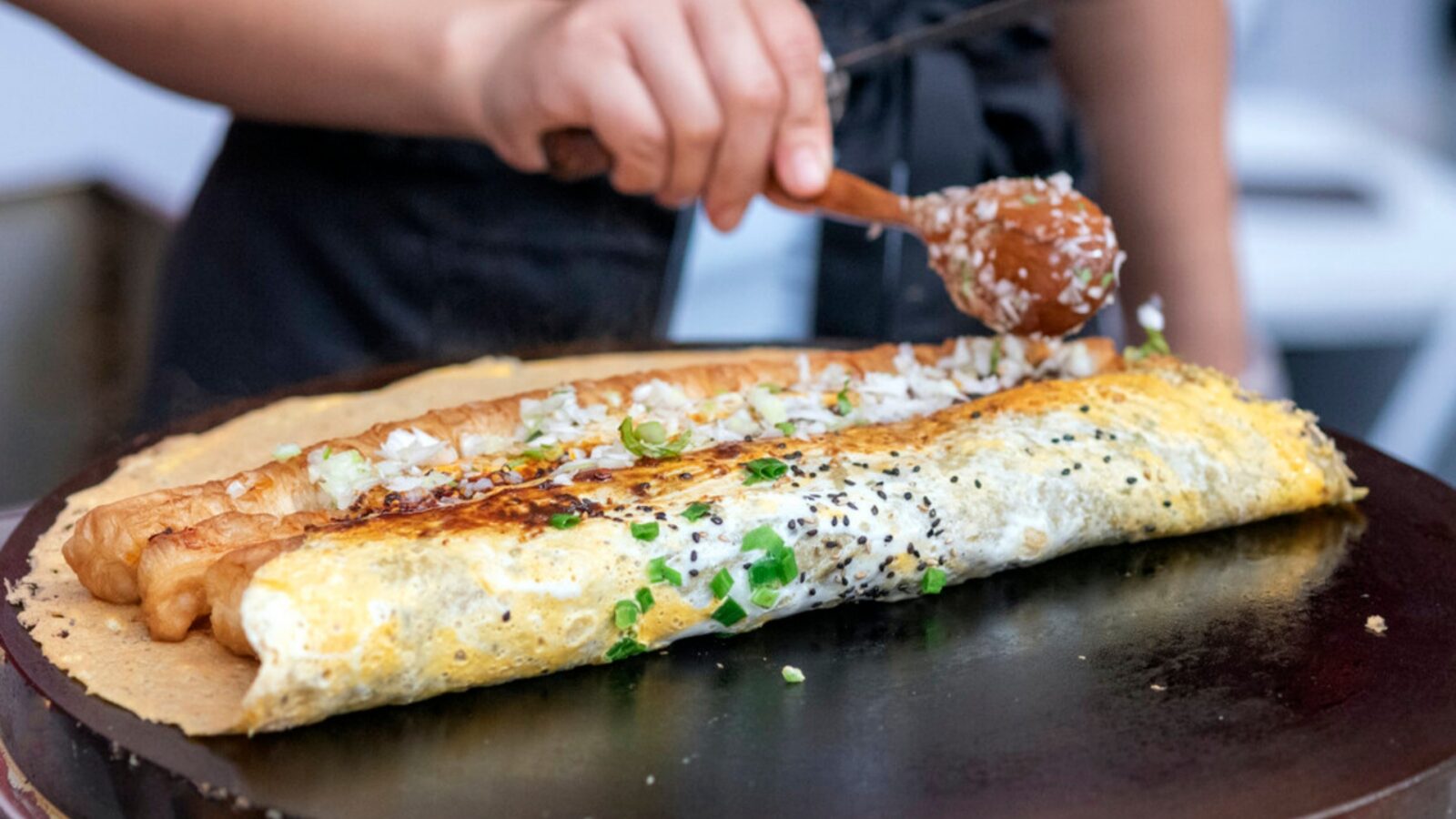
Bing (Flatbreads) | Jianbing Guozi | Beijing's street breakfast king — crispy cracker meets soft egg crepe. | ¥8–15 | ★★★★★ |
| Tang You Bing | Brown-sugar caramel crust on fluffy dough — a sinful morning pleasure. | ¥3–5 | ★★★★☆ | |
| Sesame Shaobing | Lamb soup's golden companion — flaky, sesame-crusted, endlessly fragrant. | ¥2–4 | ★★★★☆ | |
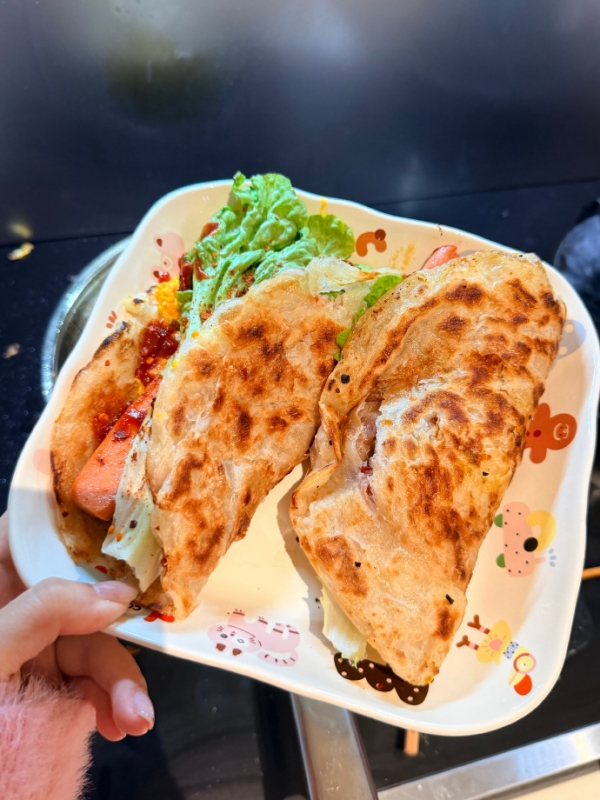
| Shou Zhua Bing | Thousand-layer flaky flatbread that wraps anything — the commuter's pick. | ¥5–10 | ★★★☆☆ | |
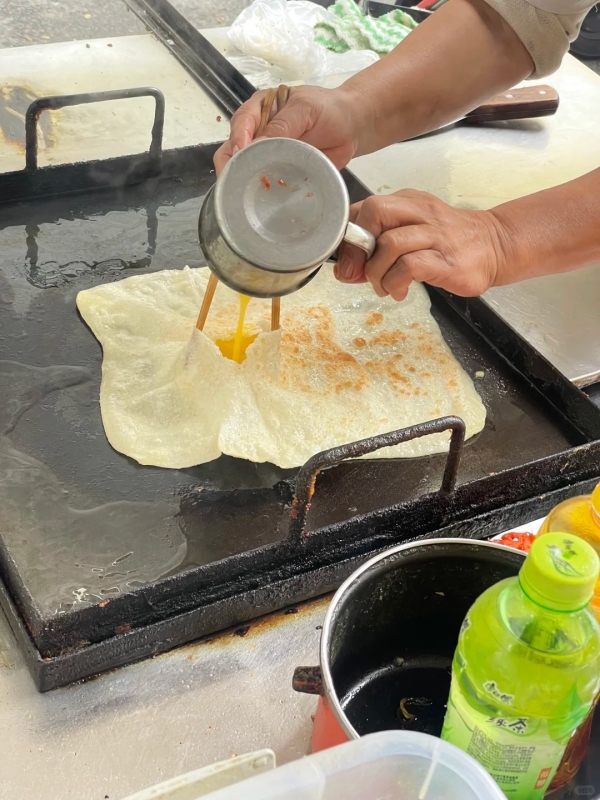
| Ji Dan Guan Bing | Watch egg poured into a puffed flatbread — crispy outside, silky within. | ¥6–12 | ★★★☆☆ | |
Bao (Steamed Buns) | Pork & Scallion Baozi | Juicy northern-style meat bomb — bold, hearty, and deeply satisfying. | ¥2–4 each | ★★★★☆ |
| Vegetable Baozi (San Xian) | Fresh vegetables in dough — gentle, clean flavors for a lighter morning. | ¥2–4 each | ★★★☆☆ | |
| Beef Baozi (Niu Jie Style) | Halal classic — firm meat, bold aroma, rooted in centuries of tradition. | ¥3–5 each | ★★★★☆ | |
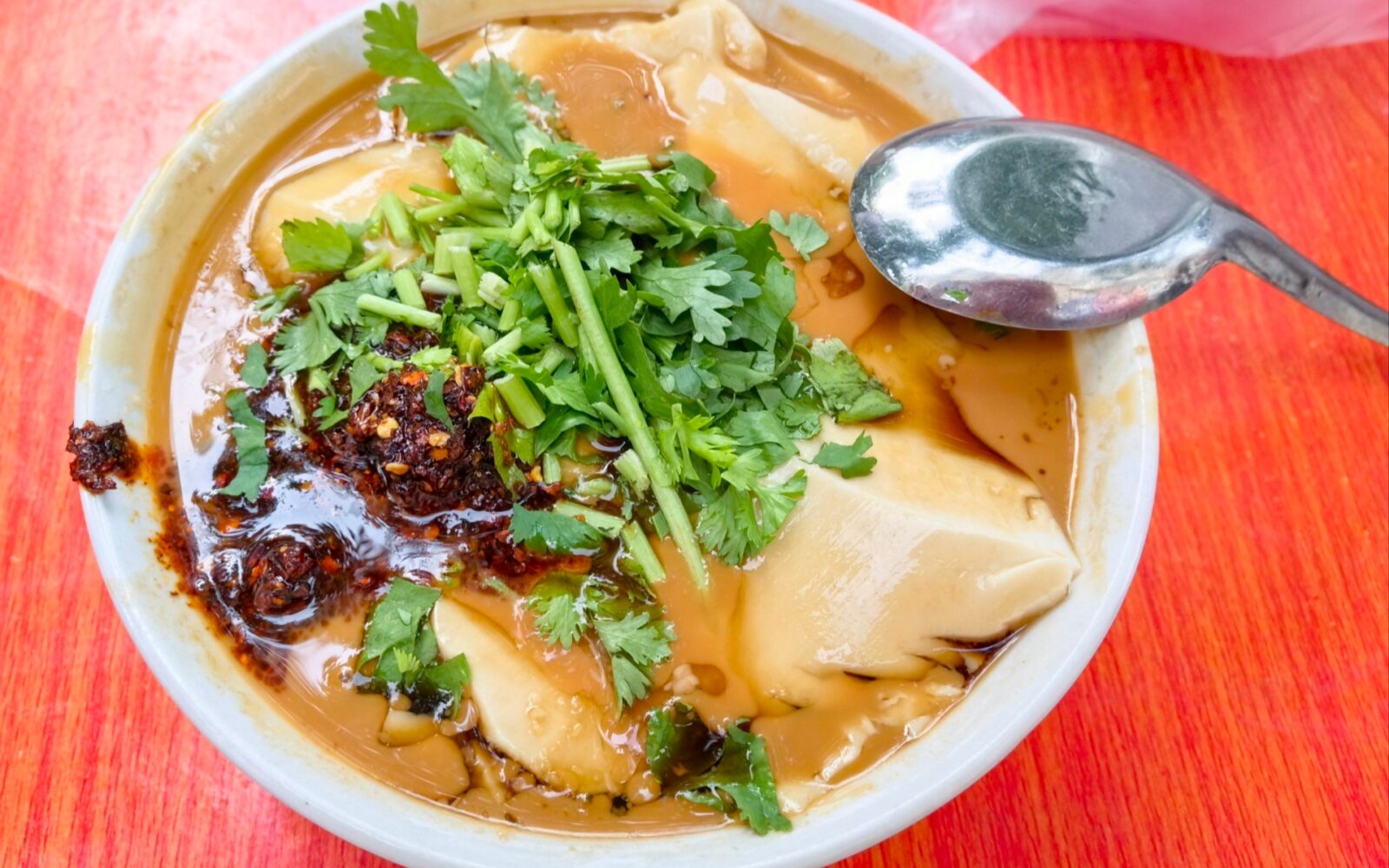
Bowls | Xian Doufu Nao | Northern-style savory tofu pudding — silky, layered, wake-up bold. | ¥5–8 | ★★★★☆ |
| Yang Za Tang / Lamb Soup | Rich, body-warming bowl — warms from throat to toes on cold mornings. | ¥15–25 | ★★★★☆ | |
| Douzhir & Jiaoquan | Old Beijing's identity test — love it or hate it, you'll remember it. | ¥8/set | ★★★☆☆ | |
| Miancha | Millet porridge with sesame paste — drunk by rotating the bowl along its edge. | ¥6–10 | ★★★☆☆ | |
Pastries & Sweets | Lü Da Gun | Glutinous rice rolled in soybean powder — a humble name, a gentle flavor. | ¥10–20/portion | ★★★★☆ |
| Wandou Huang | Cool pea cake that dissolves without chewing — imperial elegance in every bite. | ¥10–20/portion | ★★★★☆ | |
| Aiwowo & Shanzha Gao | Refined old-style sweets — small additions that complete a traditional breakfast. | By weight or portion | ★★★☆☆ | |
| Jiaoquan | Douzhir's soul companion — hollow, impossibly crispy, addictive on its own. | ¥1–2 each | ★★★☆☆ | |
| Zha Gao & Tang Er Duo (Niu Jie) | Halal fried sweets — crispy-chewy and honey-soaked, Niu Jie's hidden morning gem. | ¥3–8 each | ★★★☆☆ |
Traditional Classics: Old Beijing’s Morning Heritage
Push through the heavy cotton door curtain at Hu Guo Si Snack Bar and time visibly slows. This is Beijing breakfast as a living museum — your first and most important acclimatization lesson. Complex aromas layer immediately: the signature fermented tang of Douzhir, the thick nutty weight of sesame paste, the restrained sweetness drifting from golden pastries. Old Beijing men in loose shirts discuss the morning news in broad local dialect. In front of each is a bowl of grey-green Douzhir and a ring of Jiaoquan — half a century of mornings compressed into a single tray. Arrive here with curiosity and without expectations. That is the right posture. If you want to explore more stops across the city, our complete Beijing food tour guide maps out a full-day route through the best neighborhoods.
Douzhir & Jiaoquan (¥8/set)
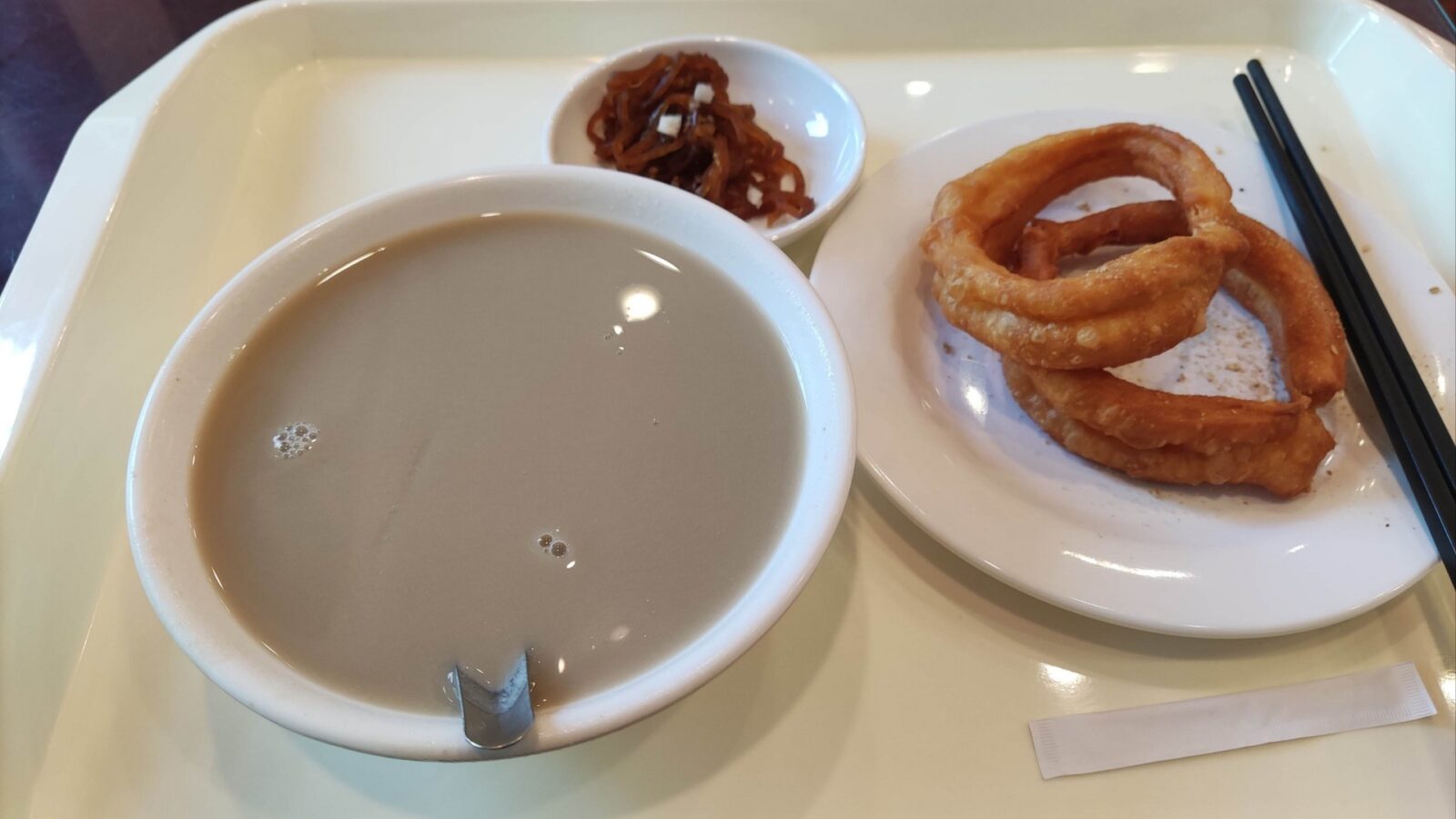
Douzhir & Jiaoquan
And then the real adventure begins! Once you lift that bowl of grey-green Douzhir to your lips, no preparation is truly enough. The smell is the first to assault you: a sharp fermented sourness reminiscent of pickled cabbage, but with something truly funky lurking in the background. It’s the famous identity test of Old Beijing, and its citizens wear it with pride. But take a deep breath and down the stuff like a shot! Sour and astringent, a little crudely made but with a complexity that finishes your palate off in style, it is neither polite nor pretty, but it is definitely unforgettable!
Rescue arrives immediately in the form of Jiaoquan (¥1–2 each). These golden, hollow fried rings are impossibly light. Each bite produces a soft crackle, and the oil-kissed crunch neutralizes the Douzhir's sharpness in an almost miraculous way. The correct sequence: bite the Jiaoquan first, then sip the Douzhir. Together, they walk a razor's edge of flavor — one that Beijingers have navigated every morning for generations. As a local friend once put it: "I can't stand it, but my dad craves it daily." That says everything. It was never designed to delight visitors. Instead, it is an emotional anchor — memory and identity compressed into a single grey-green bowl.
📍 Where to Eat
Name: Hu Guo Si Snack Bar — Main Branch (护国寺小吃总店)
- About: Beijing's most comprehensive traditional snack institution, open since 1956. Virtually every classic hutong breakfast — Douzhir, Jiaoquan, Lü Da Gun, Wandou Huang — is available under one roof. A living museum of morning food culture visited by locals and visitors alike.
- Tip: Avoid weekend morning rush hours. Order the mixed snack sampler to try multiple items in one go. Miancha and lamb offal soup are also worth ordering alongside the sweets.
- Address: No. 93 Hu Guo Si Street, Xicheng District (opposite the People's Theatre)
- Hours: Approx. 06:00–21:00
Lü Da Gun & Wandou Huang (¥10–20/portion)
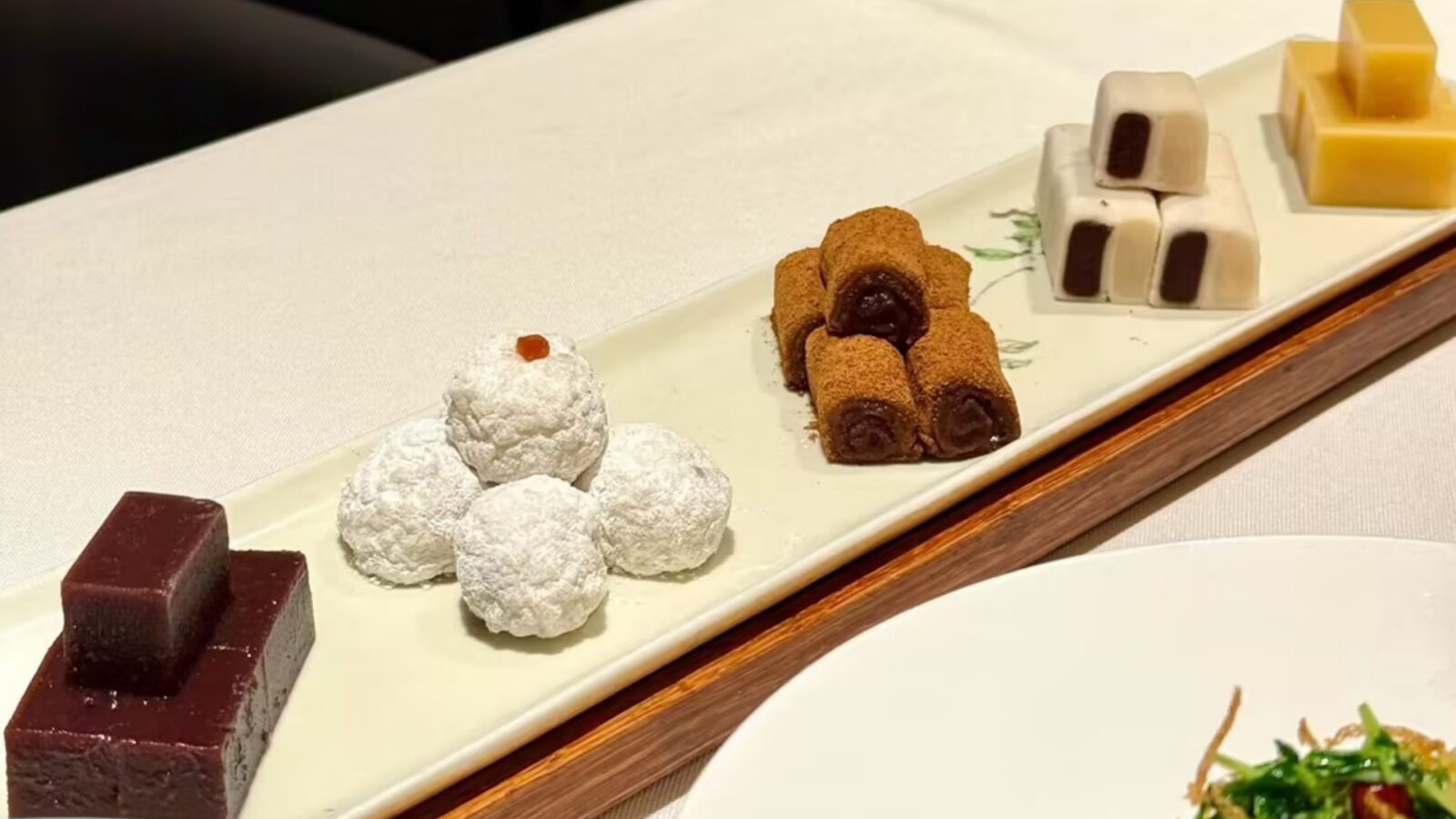
Lü Da Gun & Wandou Huang
Besides the Douzhir face-off, we want something soothing for palate reset. Lü Da Gun seems to be wrapped in yellow soybean powder as the first salty, earthy nut to greet us. Sink teeth in to find the layer of glutinous rice bursting with deep, elastic soft. Sneak a taste of red bean paste inside, it bring only the quietest of sweetness, just enough, no more. Ugly name for a lovely thing (i.e. donkey rolling in dust).
Wandou Huang operates on a different register entirely. Cut into small diamond-shaped pieces, pale amber and slightly trembling, it barely needs a spoon — it dissolves on the tongue in a wave of cool, clean pea sweetness. No chewing required. This is the delicacy that Beijing's great writer Lao She's characters always ordered at the teahouse. It carries that same unhurried, contemplative quality.
Additionally, you may encounter snow-white Aiwowo or ruby-red Shanzha Gao (hawthorn cake). Neither is a filling food. However, both reflect a distinctly Beijing sense of refinement — the idea that a morning deserves small, beautiful things alongside its substantial ones.
📍 Where to Eat
Name: Jinfang Snacks — Ciqikou Branch (锦芳小吃磁器口店)
- About: A century-old brand founded in 1926. Their savory tofu pudding uses non-GMO soybeans and a signature gravy recipe enriched with dried scallop — a subtle distinction that longtime regulars notice immediately. The cream-filled fried cake and tangyuan are also house specialties.
- Tip: The atmosphere is more old-school and unpolished than Hu Guo Si. Lead with the tofu pudding; pair it with a Tang You Bing or fried cake.
- Address: South Ground Floor, Ciqikou Dushi Street, Dongcheng District (near Ciqikou subway station)
- Hours: Approx. 06:00–20:00 (confirm with shop)
Steamed & Fried: The Hutong Comfort Staples
Step out of the old snack house and into the more visceral energy of the street-side kitchen. The scene shifts immediately. In visible open kitchens, chefs move like performers — pinching dough, spooning filling, folding the classic 18-pleat top, sending baozi arcing into bamboo steamers. Next to them, a wide iron wok holds rolling oil. Dough pieces drop in and swell into golden rounds within seconds. White steam billows to the ceiling. Oil crackles in steady rhythm. The air is hot, fragrant, and unmistakably alive — wheat, pork, and oil fat braided into something irresistible.
Pork & Vegetable Baozi (¥2–5 each)
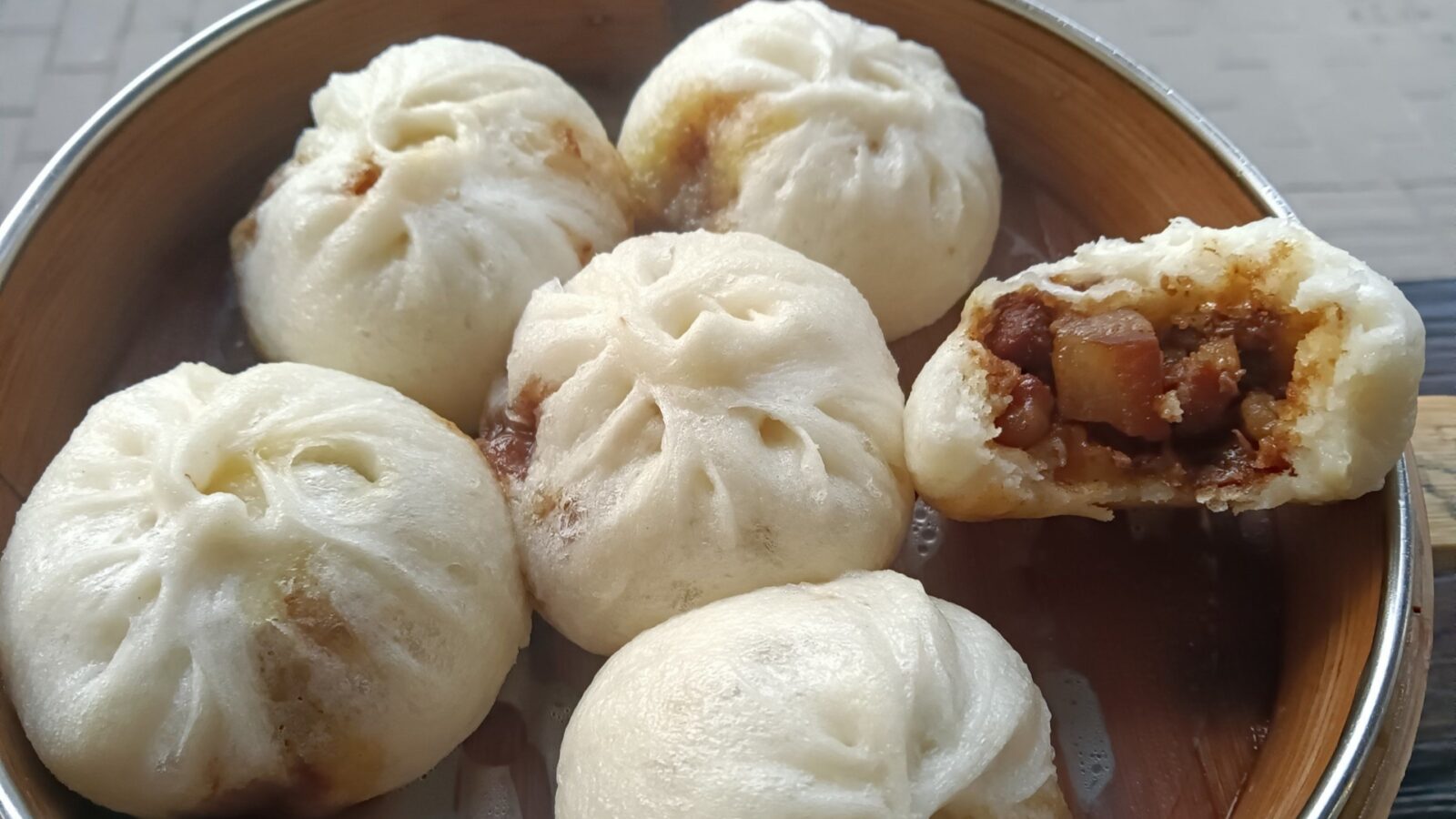
Pork & Vegetable Baozi
The steamer lid lifts. Through the cloud, Pork and Scallion Baozi emerge — round, plump, and perfectly risen. Pull one apart gently. Steam and fragrance burst out together. Inside is a firm, juicy meatball: fat and lean in the right balance, juices locked in and ready to release. Scallion cuts through the richness cleanly. This is northern-style satisfaction — unapologetic, hearty, and complete.
For a different character, Beef and Scallion Baozi from a halal shop offers firmer meat with a more direct, wilder fragrance. Meanwhile, Vegetable Baozi (San Xian — egg, glass noodles, wood ear mushroom, chives) brings spring freshness in every bite. The filling is light and clean, perfect for mornings when you want energy without heaviness. All three baozi types work with tea or soy milk on the side.
📍 Where to Eat
Name: Qingfeng Baozi — Dengshikou Branch (庆丰包子铺灯市口店)
- About: Beijing's most recognized baozi chain, with branches across the city. The range spans classics — pork and scallion, vegetable san xian — to newer fillings like dried preserved vegetables and shrimp with greens. Consistent quality, clean environment, and a reliable introduction to Beijing's baozi culture.
- Tip: Order alongside Chao Gan (stewed pork liver) or purple rice porridge for the full northern breakfast set. Ideal for a fast, no-fuss morning meal.
- Address: No. 57 Dengshikou Street, Dongcheng District (multiple branches citywide)
- Hours: Approx. 06:00–21:00
Tang You Bing (¥3–5)
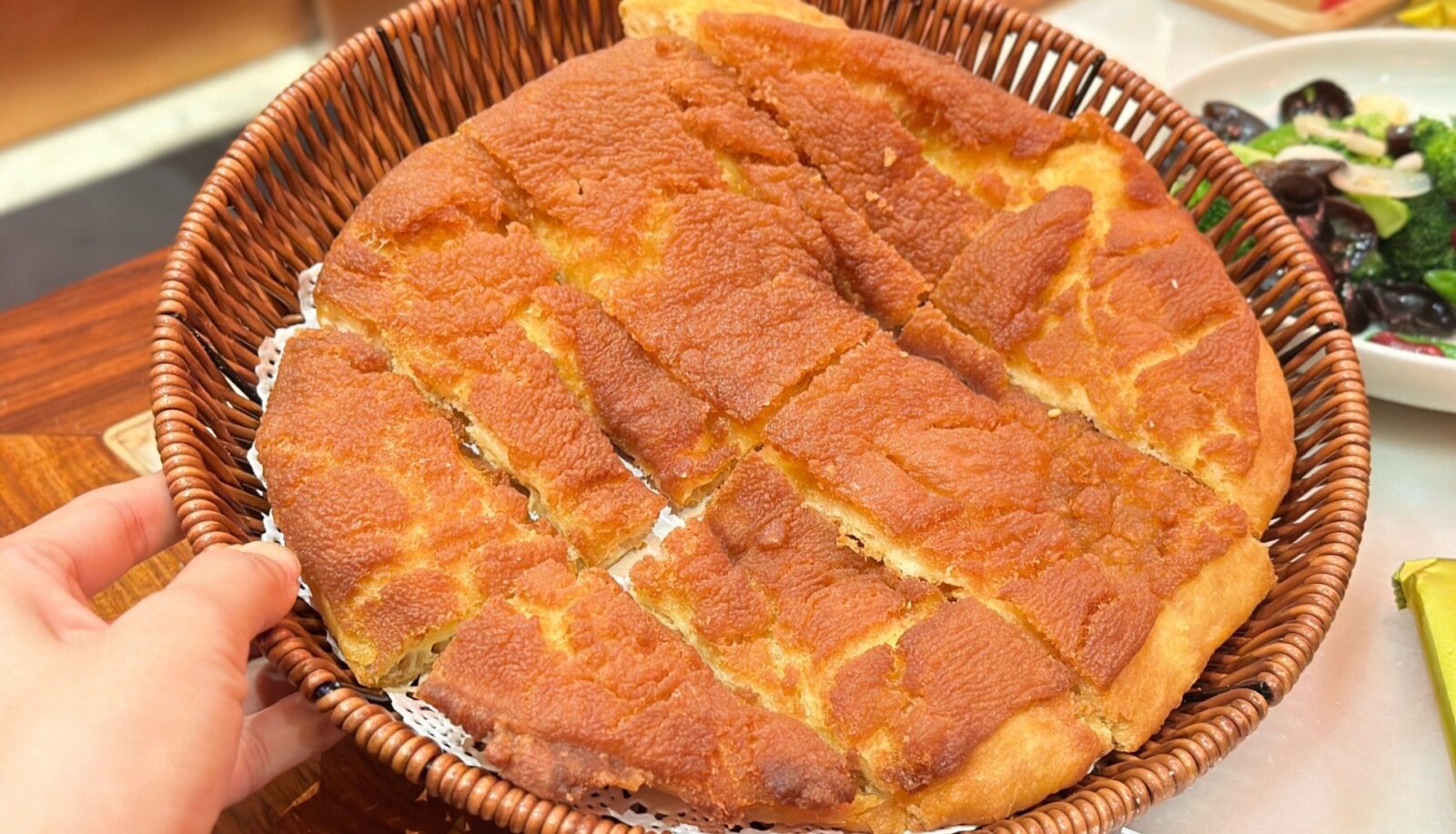
Tang You Bing
This is the one to get most excited about. Tang You Bing has an element of bizarre contrast quite unlike anything else on the Beijing morning menu. A round, plain disk of leavened dough, spread on the underside with brown sugar, is plunged into hot oil. The sugar melts, then caramelizes — forming a dark molten glass shell. One side of the disk stays soft and bouyant; the other becomes a suit of lacquered armor.
Bite into it and first you hear the crack — the caramel shell splintering. Then, a rush of the deep, slightly bitter sweetness floods in. The dough follows, soft, chewy, pillowy. Crunchy versus yielding. Dark sugar versus soft bread. Heady sin versus bland carbs. All of it extracted into that one moment, delivered perfectly. This is the gift from the city to us in the morning; the honest reward for our backtracking. And it is an astonishingly inexpensive one at ¥3-5 each.
📍 Where to Eat
Name: Hei Yao Chang Street Tang You Bing — Zengseng Snack Shop (黑窑厂街增增小吃店)
- About: Arguably the most celebrated Tang You Bing stall in Beijing, with devoted regulars willing to cross the city for a single order. Their signature "double sugar" version coats both sides — the brown sugar crust is thick, glassy, and deeply caramelized. Locals pair it with a bowl of savory tofu pudding, their accepted gold standard combination.
- Tip: The shop is tiny and bare-bones but the flavor is unquestionable. Eat immediately — it does not survive the commute. Weekday hours end at 09:30; weekends extend to 10:30. Sells out early; arrive by 07:30 to be safe.
- Address: Siping Yuan South Pingfang 3-1, Hei Yao Chang Street, Xicheng District (near Taoranting Park north gate)
- Hours: Weekdays approx. 06:00–09:30; weekends until 10:30
Xian Doufu Nao (¥5–8)
Xian Doufu Nao
In Beijing, the sweet-versus-savory debate is settled. Savory wins, and decisively. Northern-style Doufu Nao is heftier than its southern cousin: it holds its shape when lifted with a spoon, silky but with quiet dignity. Its soul is the savory gravy ladled over the top: mushroom, lily bud, and wood ear simmered into a lightly starch-thickened, amber-colored sauce.
Here’s where the magic happens — as a skilled vendor spoons tofu into the bowl, pours the gravy, presses garlic paste, douses it with chili oil, and tops it with fresh cilantro — all in accordance with your preferences. One spoonful tells the whole story: silky, tender, savory, fragrant, faintly spicy — five sensations in one bite. Gentle force, the kind of thing that wakes up a reluctant morning palate without slapping it. Pair it with a sesame shaobing and you have the full Beijing experience.
📍 Where to Eat
Name: Zengshengkui Snack Shop (增盛魁小吃店)
- About: A five-generation halal institution tucked inside the Dongsi commercial district, featured on A Bite of China. Their tofu pudding gravy is slow-cooked with lamb and straw mushroom — noticeably richer than most. The Tang You Bing is equally well-regarded, and the Men Ding Meat Pie is a must-try house specialty.
- Tip: The shop is very small and queues form fast at peak hours. Prices are exceptionally low for the quality. Come hungry — portions are generous.
- Address: No. 26 Dafo Temple East Street, Dongcheng District (near Longfu Hospital)
- Hours: Breakfast-focused; recommend visiting in the morning
Street Icons: The Famous Griddle Delights
Leave the fixed shops behind. The next stage of Beijing breakfast belongs to the street. Subway exits, hutong corners, office building forecourts — anywhere a tricycle can park and a round iron griddle can heat up, you'll find the city's most theatrical morning performance. Vendors work with calm efficiency, but watch their hands. Every movement is practiced and deliberate. People queue in a kind of sleepy reverence — tired faces, early commutes — but everyone pauses for those two minutes with genuine anticipation. This is not just eating. This is urban ritual.
Jianbing Guozi (¥8–15)
Jianbing Guozi
The movement comes fluent as a fountain. A deft smear of oil across the hot griddle. A swoop of green mung bean batter into the middle. T-shaped rubber spreader — quick, smooth, curling, making one arc till it blooms outward into a paper-thin circle — calligrapher's arc, cook's fast flick.
An egg cracks in the center. The spreader returns, distributing yolk and white evenly across the crepe. Black sesame seeds and chopped scallions scatter down. When the egg just sets, a spatula flips the whole thing in one clean movement. Then the sauces: sweet bean paste for the savory base, fermented tofu for depth, chili paste if you want heat. The soul goes in next — a golden Bao Cui cracker (or a you tiao for the Tianjin variant). The crepe folds over it all — left, right, top, bottom — like wrapping a gift. A decisive cut. Two halves, warm paper bag.
Two minutes, start to finish. Bite into it: the mung bean crepe gives softly, the egg adds richness, and the cracker detonates with satisfying crunch before surrendering to the sauce's layered sweet-salty heat. It is the perfectly portable, perfectly complete Beijing morning — designed to be eaten while walking, which is, of course, exactly how most locals do it.
📍 Where to Eat
Name: Dahua Jianbing — Jiaodaokou Branch (大华煎饼交道口店)
- About: A legendary window counter hidden inside a neighborhood supermarket on Bei Jianzi Lane, featured multiple times by Beijing TV and local food guides. Known for generous size and exceptional crunch — their Bao Cui cracker is made fresh on-site every morning, fried to a snapping golden crisp with zero greasiness.
- Tip: Easy to miss — follow your nose. Upgrade options include double egg, bacon, and cheese. The stir-fried Miancha next door, recommended by the owner, is worth adding.
- Address: Inside Youhui Wanjia Supermarket, No. 21–25 Bei Jianzi Lane, Dongcheng District
- Hours: Approx. 06:00–11:00 (sells out early)
Guan Bing & Shou Zhua Bing (¥5–12)
-

- Guan Bing
-
- Shou Zhua Bing
Ji Dan Guan Bing (Egg-Stuffed Flatbread, ¥6–12) demonstrates a different kind of street magic. The raw dough is pressed onto the griddle and heated until it puffs dramatically — a round, blister-like bubble forms, almost like a small football. The vendor pokes a hole through the top with chopsticks and pours beaten egg directly inside. The pocket fills with golden egg. Both sides are pressed crispy. Outside: flaky and crackling. Inside: tender, custardy, fragrant with egg. It is startling every time you see it, and even better to eat.
Shou Zhua Bing (Flaky Hand-Pulled Flatbread, ¥5–10) works on an oil-rich layered dough. Pre-made rounds hit the griddle and brown into something shatteringly crispy. The vendor shakes the flatbread loose and fans it apart with tongs — it opens like a flower, revealing dozens of delicate layers. Add egg, bacon, lettuce, or fried chicken cutlet and it becomes a full-format Chinese wrap. Clean, fast, genuinely satisfying. Students and office workers in particular rely on it.
📍 Where to Eat
Name: Bai Mao Jianbing Wang — White Hair Jianbing King (白毛煎饼王)
- About: Master Chen Qiusheng has been running this stall since 1987, earning his nickname from his signature white hair. Over three decades of unbroken daily service have made him a living institution in Beijing's street food culture — a stall generations of locals grew up eating at.
- Tip: Now operating at fixed locations including No. 55 Hu Guo Si Street and the B2 level of Wangfujing Department Store. Hours vary by location; the hutong stall is the most atmospheric.
- Address: No. 55 Hu Guo Si Street, Xicheng District (and other locations)
- Hours: Breakfast hours; confirm with specific location
Kao Leng Mian (¥8–12)
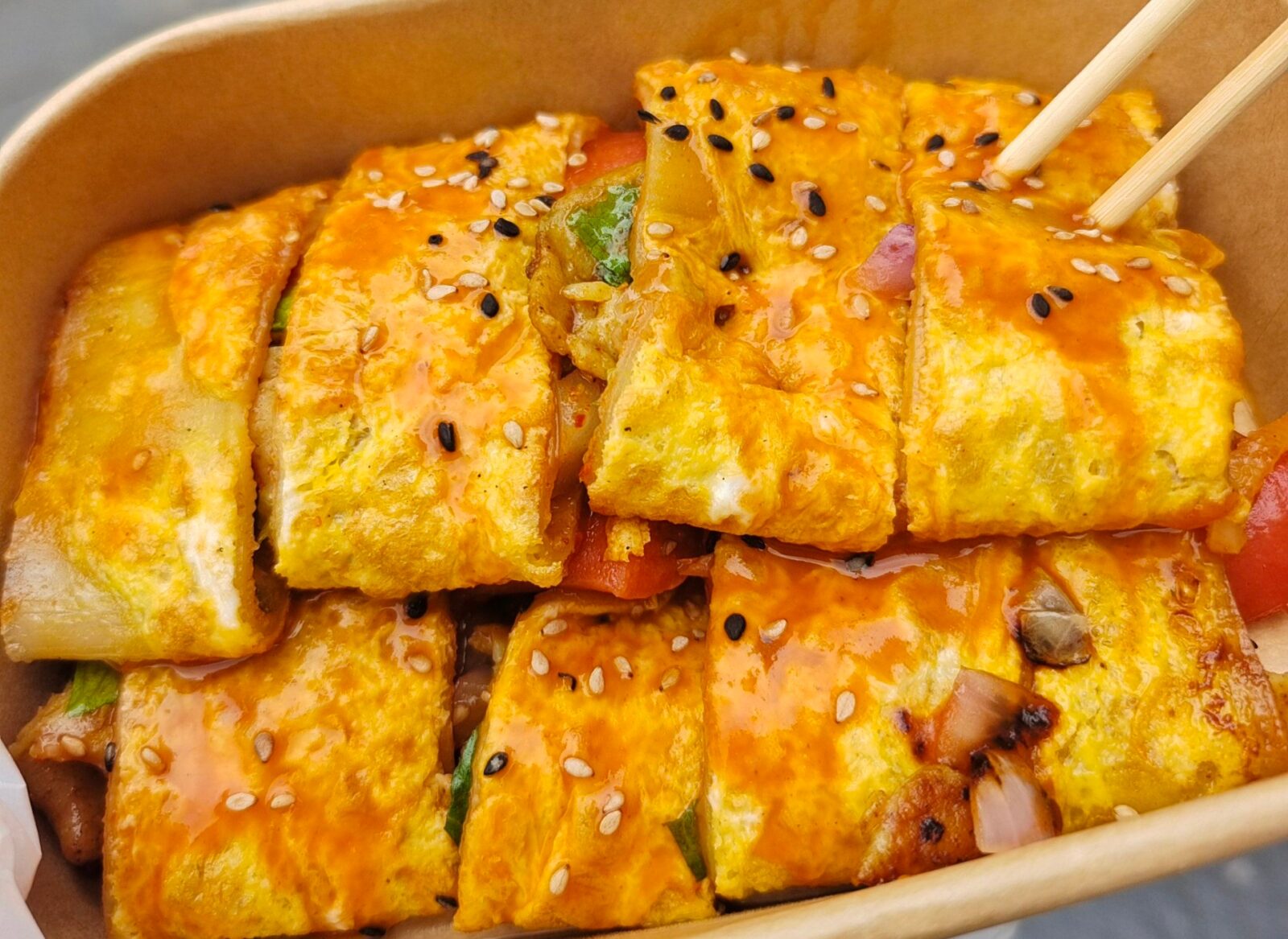
Kao Leng Mian
Kao Leng Mian originated in China’s northeast, but has been a Beijing resident for decades now, never a mere guest. As a pressed sheet of cold noodle slaps the flat iron griddle, its edges start to sizzle and blacken. An egg is cracked above it. When set, the vendor paints on a mixture of sweet and sour sauce, sprinkles on granulated sugar, douses with vinegar and scatters bits of raw onion and fresh cilantro. The entire concoction is rolled tightly into a cylinder and cut into segments.
The result is simultaneously sweet, sour, chewy, and deeply savory — a flavor profile that sits comfortably between breakfast and late-night snack. It is a more casual order, often found near university neighborhoods. Nevertheless, it represents something important about Beijing's food culture: the city absorbs and naturalizes flavors from everywhere in China, making them its own.
Deep Hutong Fuel: Hearty Morning Bowls
Move further from the main streets. The further you go, the quieter and more honest the eating gets. These shops may have no prominent sign. The environment is sometimes bare. But a massive pot of milky lamb broth simmers here all morning, and the fragrance carries down an entire alley like a gentle summons. The regulars are different here — neighborhood elders, morning exercisers, manual workers fueling up for physical days. This is Beijing breakfast stripped of any performance, closest to what it has always been.
Yang Za Tang (¥15–25)
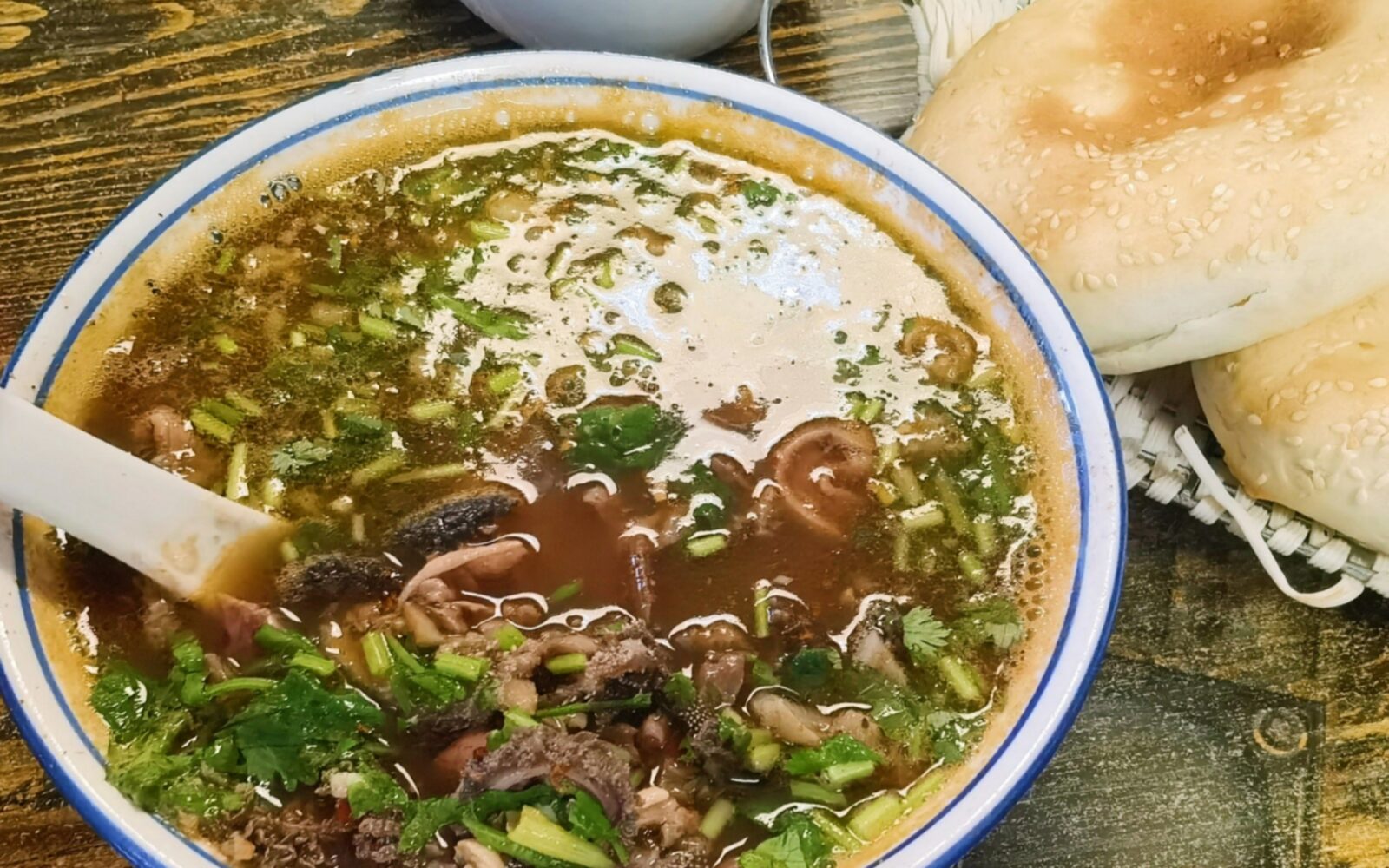
Yang Za Tang
“One bowl of lamb offal, extra broth!” The bowl arrives steaming. The color is milky white or pale gold. The contents are generous — lamb stomach, heart, liver, and lung — long-simmered until very tender. A fistful of fresh cilantro lands on top. Salt, white pepper, and chili oil are for you to adjust at the table.
The first sip is the one that matters. Scalding, rich, and savory — it slides from throat to stomach and sends warmth outward through the body in an almost instantaneous wave. There is no off-putting gamey note here. Long cooking removes that. What remains is clean, deep, animal richness: protein and collagen and time. Pick up a piece of lamb stomach and dip it in chive flower paste. Tender, yielding, satisfying in the most fundamental way. This is Beijing's food philosophy made liquid — fighting cold, fighting hunger, keeping you upright.
📍 Where to Eat
Name: Niu Jie Hong Ji Snack Shop (牛街洪记小吃店)
- About: A halal landmark on Niu Jie with thirty years of roots in the neighborhood. The lamb offal soup is generous and deep-flavored with a clean, rich broth. Beef baozi are firm and boldly seasoned. Zha Gao fried cakes and Tang Er Duo honey pastries round out one of the most complete halal breakfast menus in the city.
- Tip: Breakfast service (05:30–09:30) operates separately from lunch and dinner, with items sold from a dedicated window. Queues form quickly — arrive before 07:00 for a relaxed experience.
- Address: No. 12 Niu Jie, Xicheng District (opposite the Niu Jie Halal Supermarket)
- Hours: Daily 05:30–09:30 (breakfast); 11:00–21:30 (lunch/dinner)
Niu Jie Halal Specialties (¥3–8)
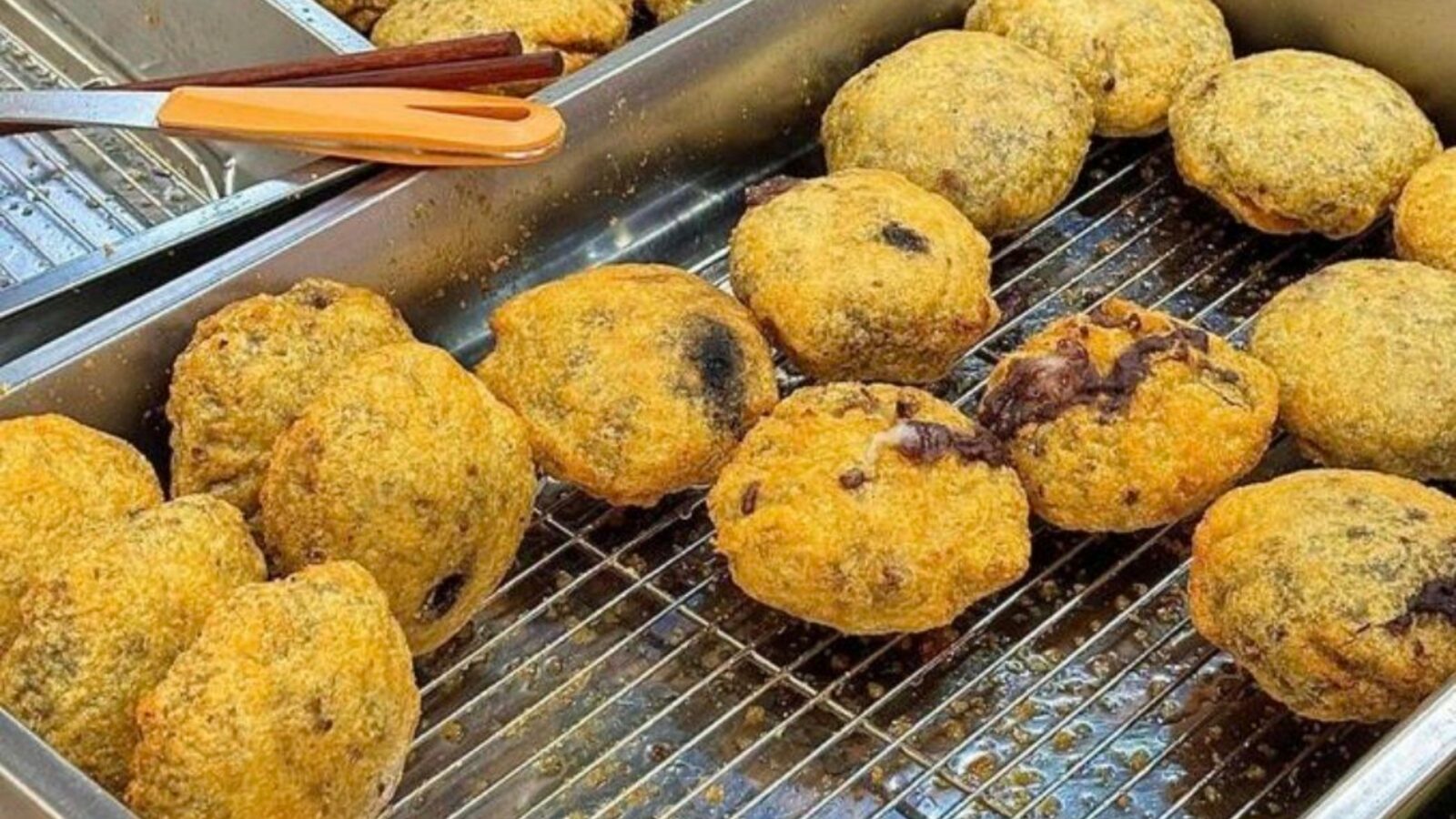
Zha Gao
For a full immersion in halal breakfast culture, Niu Jie (Ox Street) is the essential destination. The morning air here carries a different fragrance — devout, layered, intense. Beef Baozi (¥3–5 each) lead the menu: the meat filling is firmer and more assertive than pork versions, with a bold directness that is immediately compelling.
Additionally, seek out Zha Gao (Fried Cake). These swell in the fryer until golden and puffed, then yield to reveal hot bean paste or cream filling inside — sweet, immediate, and irresistible. Tang Er Duo ("Sugar Ear" pastries, ¥3–8 each) take their name from their shape. Deep-fried, then soaked in honey, they are dense, sweet, and substantial — a morning indulgence that feels both ancient and very much alive. At Niu Jie, breakfast is not merely food. It is the daily expression of a living cultural tradition spanning hundreds of years.
📍 Where to Eat
Name: Lao Bao Du Man — Niu Jie Branch (老爆肚满牛街店)
- About: Famous primarily for Bao Du (exploded tripe), but the lamb offal soup and sesame shaobing here are equally beloved by regulars. The offal is cleaned meticulously, the broth is bright and savory, and the shaobing comes out flaky, fragrant with sesame, and loaded with pepper salt flavor.
- Tip: Do not skip the Bao Du — blanched to the precise second, dipped in the house sesame sauce, it is a textural experience unlike anything else. Shaobing stuffed with meat is also a house specialty worth ordering.
- Address: Niu Jie Shudu Hutong, Xicheng District (navigate to nearest branch)
- Hours: Morning through evening service; confirm hours with specific branch
Modern Scene: Cafés and New Rituals
After the Bing-Bao-Bowl circuit warms the body, the city's other face appears. Beijing is also a place of independent cafés hidden in hutong courtyards, rooftop tea houses, and brisk young people queuing for specialty lattes on their way to startups. These are not replacements for the traditional breakfast. Rather, they are extensions — modern chapters in a very long story about how a city chooses to begin its day. Between a tea house visit and exploring the broader city, there is genuinely no shortage of things to do in Beijing to fill a satisfying day.
Hutong Coffee Shops (¥15–50)
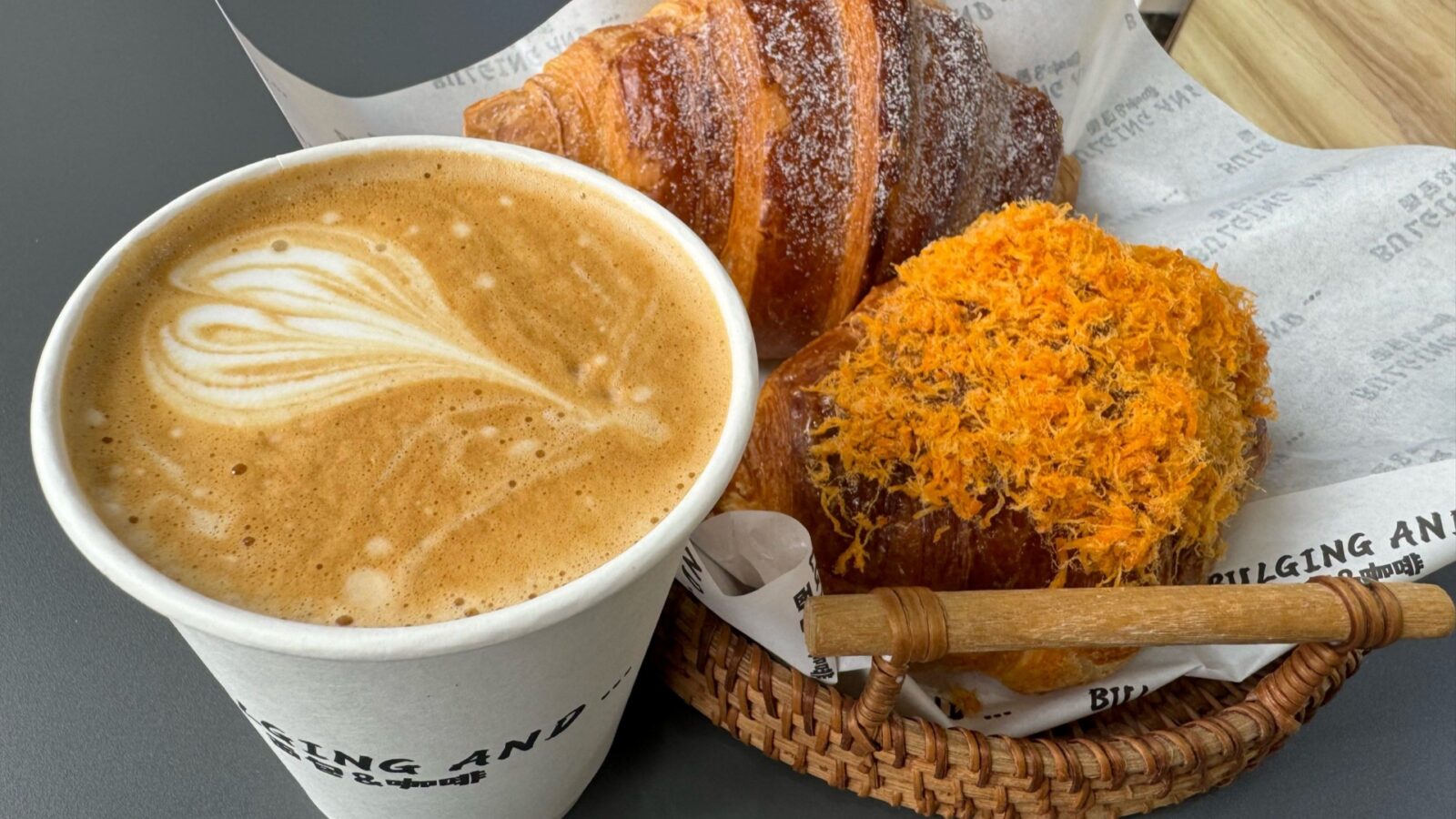
Hutong Coffee Shops
Enter your Douzhir at Hu Guo Si. Turn off that sizzling thoroughfare and into a quieter alley. Open the door that tinkles with wind chimes. Inside, exposed brick, raw wood tables, lazy jazz. This is Metal Hands or any number of indie cafés colonising hutong courtyards around the city. Order a light-roast Ethiopian pour-over; a cup blooms with floral-citrus notes. Sit by the window, watch the grandfather go by on a Flying Pigeon bicycle.
That intersection of old Beijing street life and third-wave coffee culture is perhaps the city's most photogenic daily contrast. For faster options, Manner Coffee windows (¥15/Americano) and the omnipresent Luckin Coffee branch nearby cover the efficient end of the spectrum. Grid Coffee occasionally experiments — a salted mocha or a locally-sourced single-origin — for those wanting to push further. All of them reflect how naturally global café culture has settled into Beijing's morning rhythm.
New-Style Milk Tea (¥15–30)
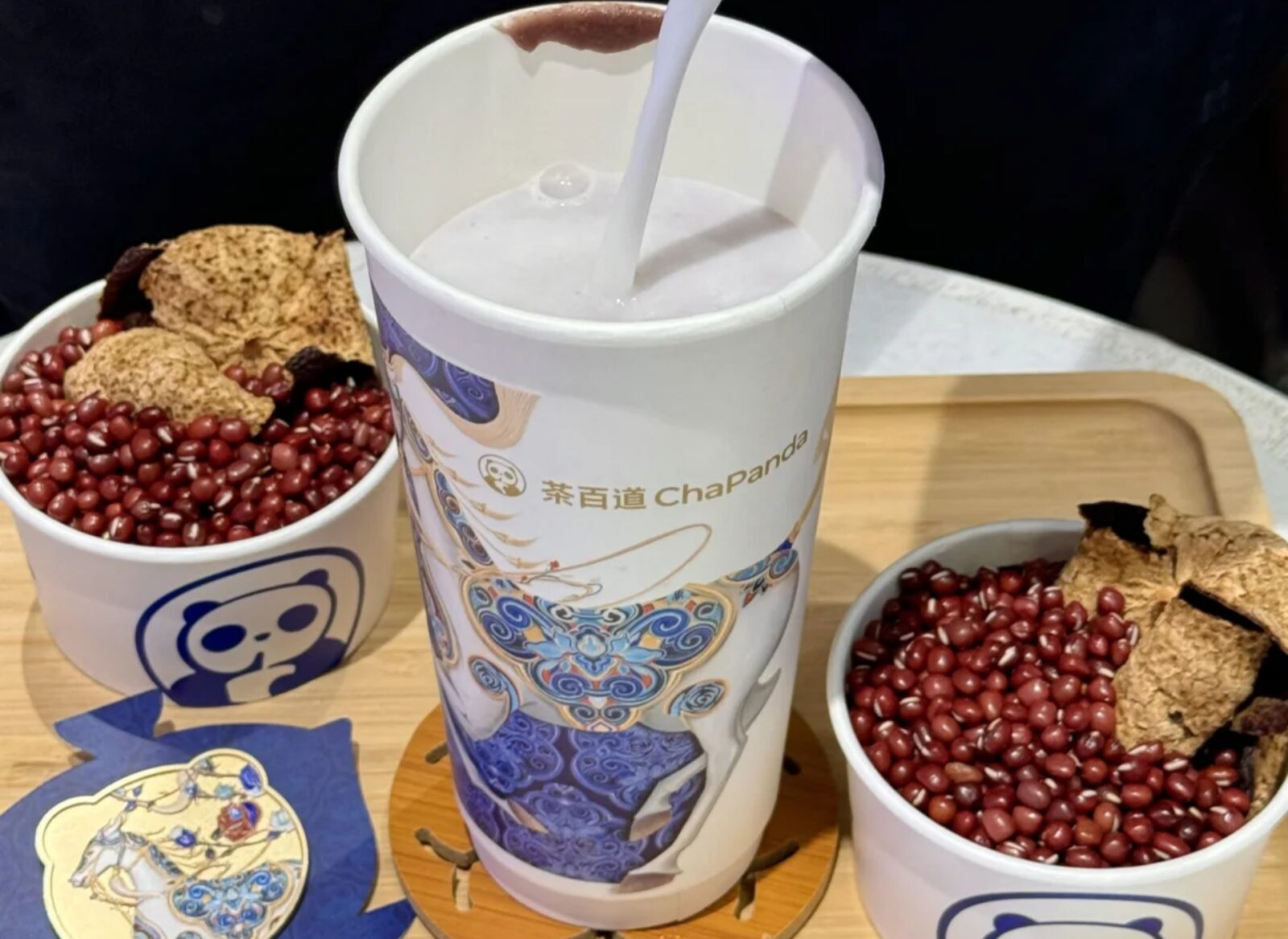
New-Style Milk Tea
When the weekend shifts breakfast toward a leisurely brunch, new-style milk tea becomes the natural companion. Brands like Heytea and Nayuki Tea serve Cheese Milk Cap Tea as a centerpiece: a savory, salted cream cheese foam over a clear, high-quality tea base. Drink it through a straw (cheese and tea together) or tip the cup directly to your lips (cheese alone). Both are intentional and both reward.
Alternatively, Fresh Fruit Tea options are clean, bright, and refreshing — a guilt-free pairing with a simple croissant or almond pastry. Newer Chinese tea brands like Cha Baidao emphasize the tea itself: more floral, less sweet, more considered. That direction signals a broader shift in how Beijing's younger generation thinks about morning drinking — less sugar rush, more considered ritual.
Traditional Tea Houses (¥50–100/person)
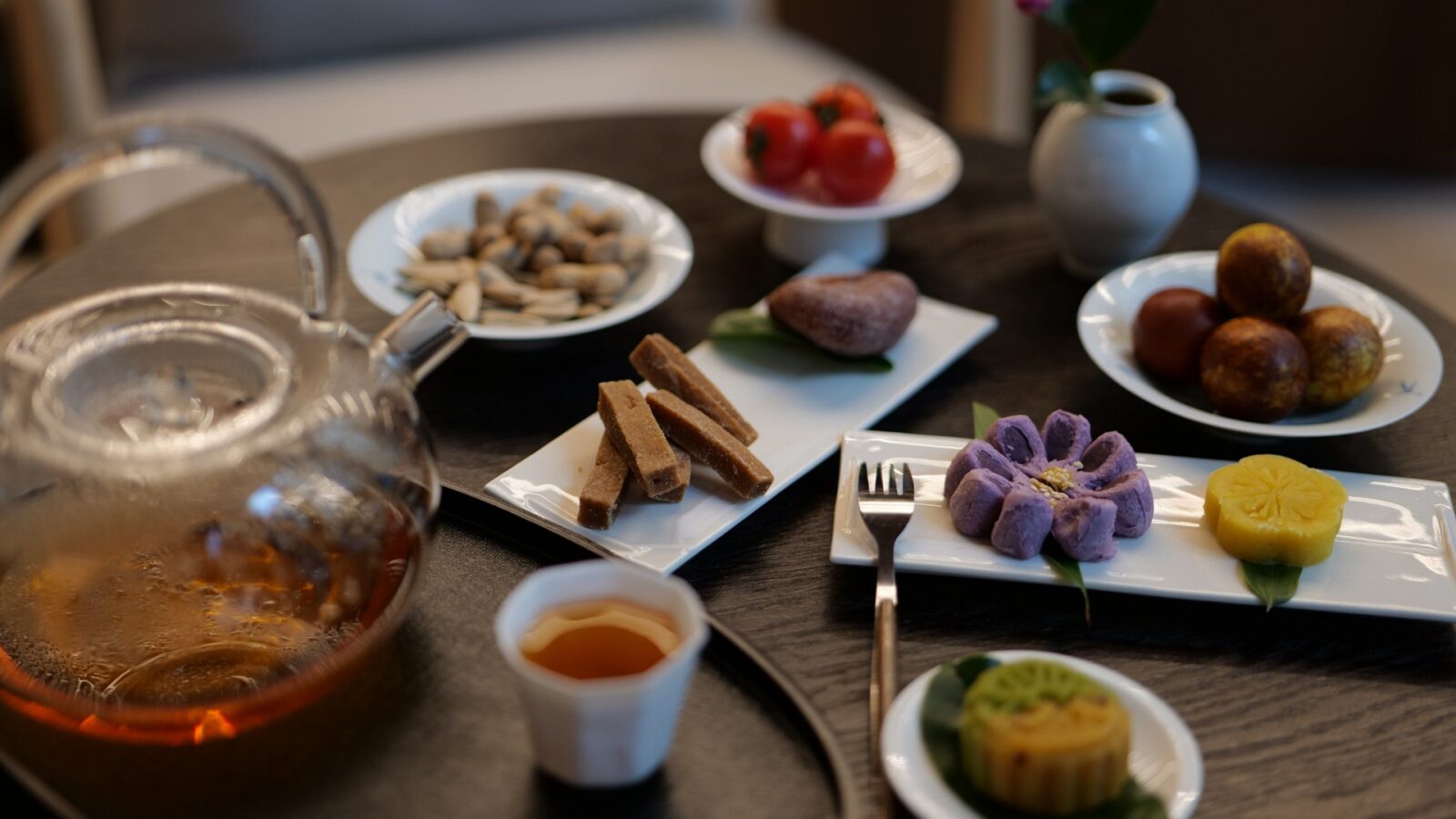
Traditional Tea Houses
For the truly free, there is a third way – almost classical, and completely unhurried. At Laoshe Tea House or some of the hutong tearooms that still hold a morning market, the old tea regulars arrive early. They order a pot of good jasmine flower tea and make themselves comfortable. The leaves open up. The fragrance floats up with the steam. Perhaps a Wandou Huang appears on a small plate. Perhaps nothing – just a newspaper and a radio softly quarrelling with the wind.
This is not breakfast in the conventional sense. It is closer to meditation. Furthermore, it represents something genuinely rare in fast-moving Beijing — a living practice of slowness. The morning does not happen around you. It drifts past, softened and lengthened by tea. If you can afford one such morning during your stay, take it.
Beyond Breakfast: Indulgent City Feasts
As the morning light fully settles and the breakfast stalls begin to slow, Beijing's culinary stage shifts to something broader and more spectacular. The "Three B" philosophy evolves here into full-scale theater — historical, technical, and deeply indulgent. These are not morning meals. However, they are the natural continuation of the same food story that started at dawn, and they deserve their own section.
Peking Duck (¥150–400/person)
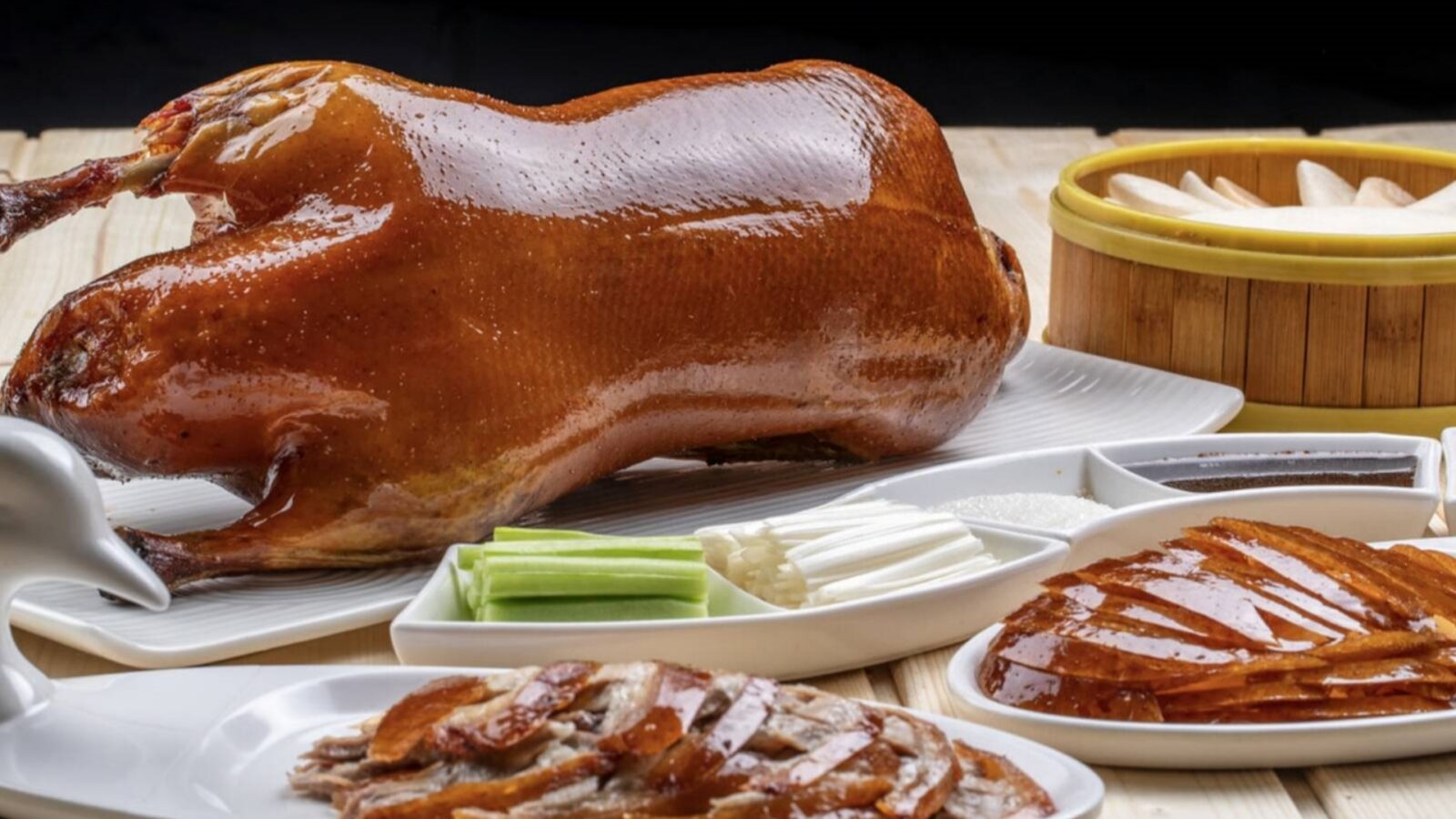
Peking Duck
“No duck walks out of Beijing alive” — the old joke, but one is hardly alive after an eating experience at the top of the culinary art, and that is the way you are likely to be treated when you are served Peking duck in Beijing. The bird has emerged from the date-wood oven, amber brown, glowing, lacquered. The carving chef has come to your table, and with knife lifted to go hewn!
First comes the best piece: a slice of pure chest skin, no meat — served immediately with white sugar. Dip it. The sugar melts against the still-sizzling skin and the crunch ignites something primal. This is the first ritual. Next, the lotus-leaf wrapper rolls: paper-thin pancake, brushed with Liubiju sweet bean sauce, scallion strips, cucumber batons, and two or three slices of skin-on duck meat. Roll it. Bite. Every element — the wrapper's flex, the skin's shatter, the meat's juice, the sauce's sweetness, the scallion's bite — harmonizes perfectly.
For a curated shortlist of where to eat this, see our guide to the best restaurants in Beijing. Quanjude offers historical weight. Dadong brings creative interpretation. Siji Minfu positions you in front of a Forbidden City corner tower view. Each is a different lens on the same extraordinary dish. For special-occasion dining during the festive season, the Beijing Christmas dinner guide covers the city's finest holiday tables.
Copper Pot Hot Pot (¥80–150/person)
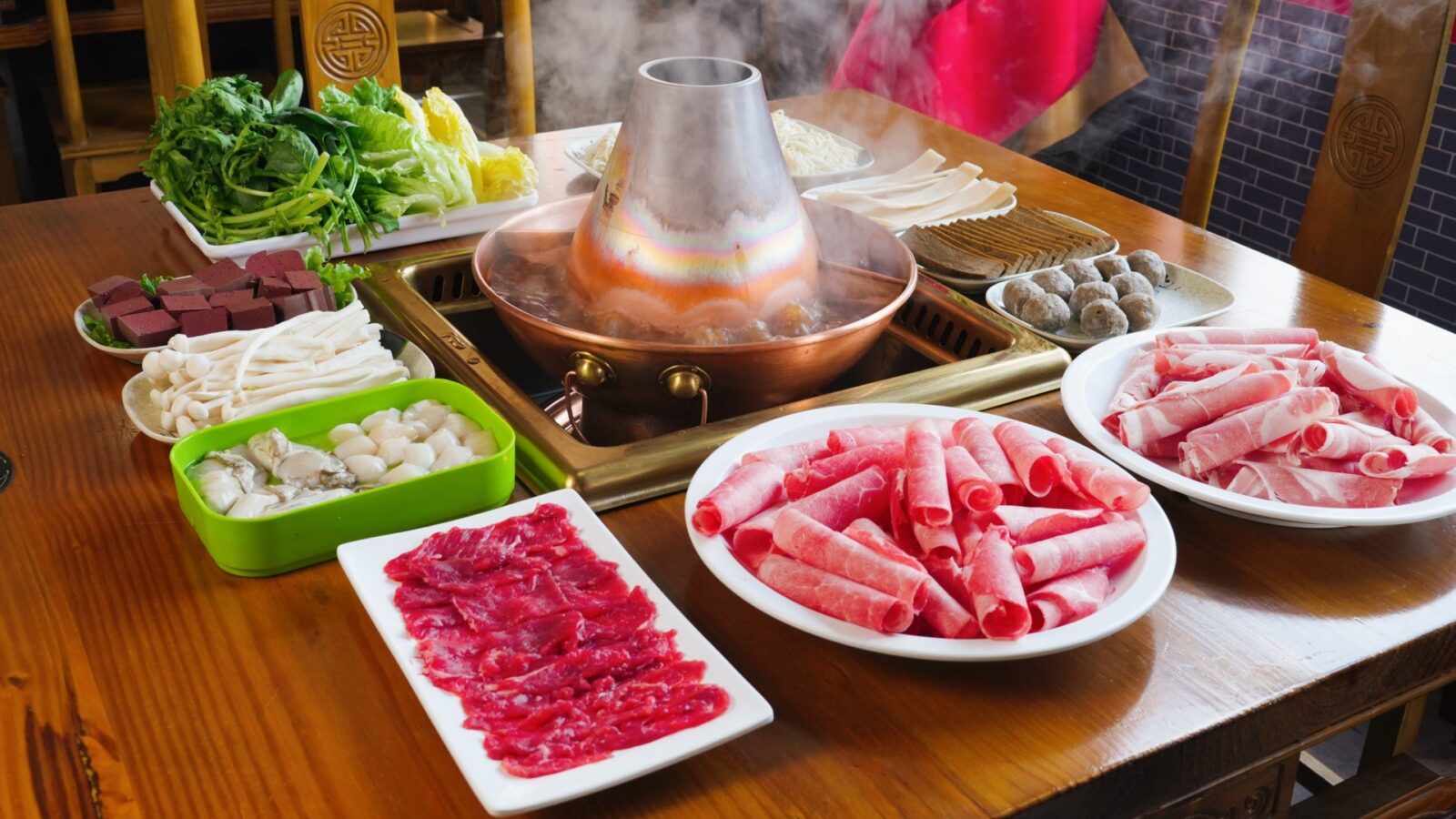
Copper Pot Hot Pot
If Peking duck has palace pedigree, our copper pot lamb hot pot belongs to the jianghu of Beijing: streets, teahouses, unpretentious drinkers sharing shots and cutting ass. A Jingtailan charcoal pot stands centre, and into the clear broth we steep only ginger slices and scallion and a lucky handful of wolfberries. Nothing else. This is the respectful antithesis to the red oil flood of Sichuan hot pot.
The lamb does the talking. Hand-cut fresh slices — "shang nao" (upper brain, fattest), "huang gua tiao" (leaner but never dry), "da san cha" (fat-lean balanced) — stand upright on the plate, bright red. Into the rolling clear broth for eight to twelve seconds. The color shifts and they are done. Pull them out immediately. Then into the sesame sauce bowl: two-eight ratio of sesame paste and peanut butter, plus fermented tofu, chive flower paste, chili oil, and cilantro. Thick, aromatic, deeply satisfying. The scalding lamb, wrapped in that sauce, is warmth made edible. Queue for it at Juyuan. Or eat it watching Shichahai Lake at Nanmen Shuanrou as the light changes.
Night Street Bites (¥5–60/dish)
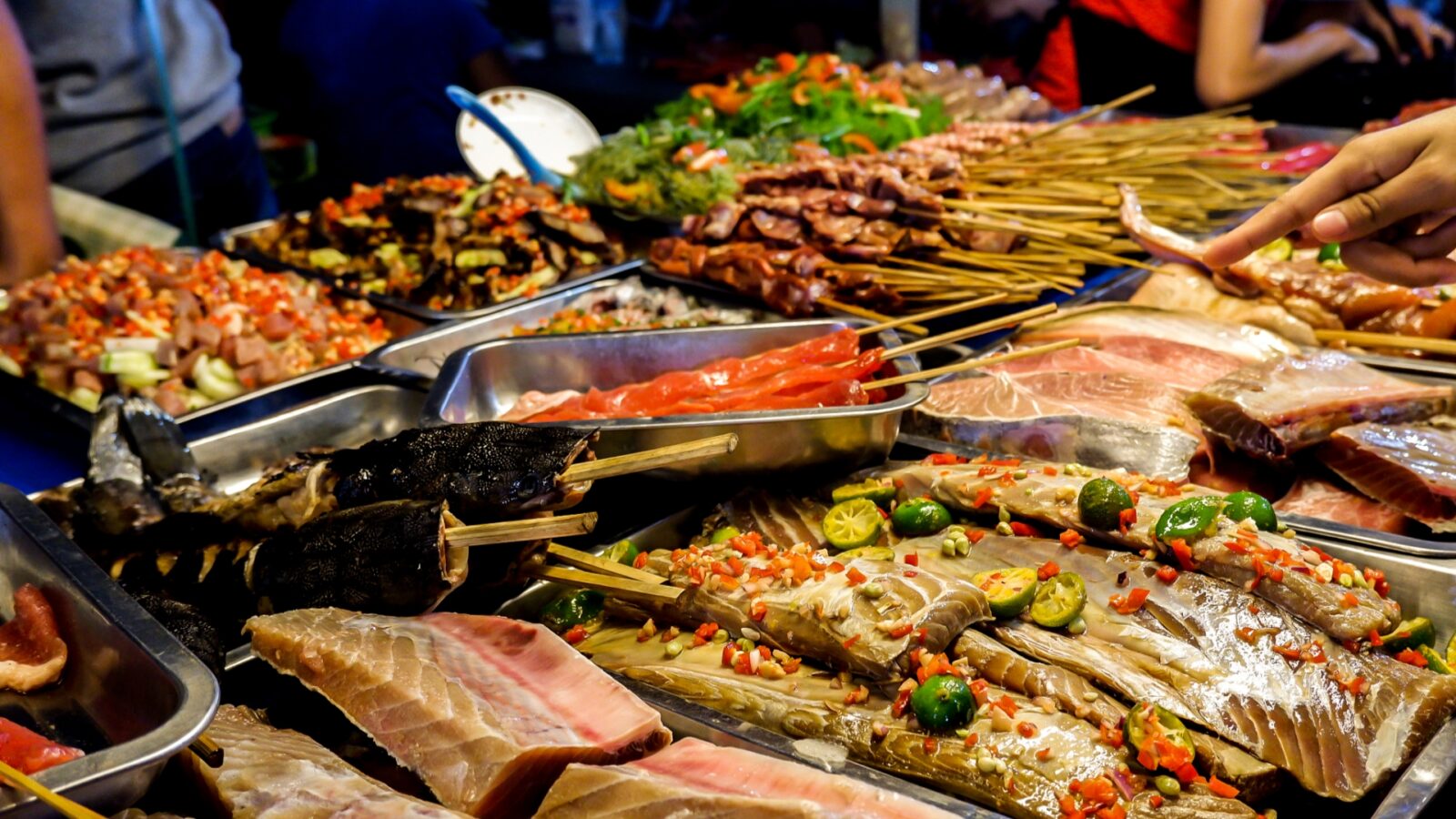
Night Street Bites
After dark, Beijing's appetite shifts again. Night markets and open-air stalls light up a second world. Yang Rou Chuan (Lamb Skewers, ¥5–10 each) rule the charcoal grill. Fat-lean alternating chunks rotate over red-hot coals. Oil drips and ignites small flames. Cumin and chili powder land with a hiss. Bite: charred outside, juicy within. Broth erupts at the first pressure. This is the most direct, primal pleasure on the Beijing menu.
For offal enthusiasts, Bao Du (Exploded Tripe, ¥40–60/portion) delivers a precision experience — lamb or beef tripe, divided by cut (heart, scattered, collar), blanched in boiling water for exactly the right number of seconds. Texture: crispy, audible, startling. Dip in the same sesame sauce as the hot pot. Meanwhile, Lu Zhu Huo Shao (¥30–50/bowl) goes deep: pork intestine, lung, fried tofu, and dense flatbread in a thick, dark, intensely savory old broth. Classic Zha Jiang Mian (¥20–40/bowl) — wheat noodles under seven or eight plates of fresh vegetable toppings, finished with home-made meat sauce — requires patience to assemble and seconds to devour. Each of these dishes is a vivid portrait of Beijing's character. When the skewers run out, the night is just beginning — see where to head next in our Beijing nightlife guide.
Practical Guide: Ordering and Tours
Inspired enough to go? Good. Here is how to move from enthusiasm to actual eating — especially if Mandarin is not in your toolkit. Beijing's food infrastructure is set up to reward the curious visitor who comes prepared with the right apps, a willingness to point at things, and a printed hotel address in Chinese characters. After a morning in the hutongs, your afternoon could lead you to a nearby Beijing shopping mall for a comfortable break — many house excellent food courts with familiar ordering systems.
In-Restaurant Ordering (Point & Smile)
Remember three words: Point. Scan. Smile. Most street-side shops and hutong eateries display physical food or models in glass cases — point directly at what you want. No language needed. For restaurants with paper menus, open Dianping (大众点评) on your phone, find the restaurant page, and show the server the recommended-dishes photo grid. They understand instantly.
Translation apps are essential backup. Download Tencent Yiyou or Baidu Translate before your trip and practice the camera translation feature — point it at any menu and tap the shutter button. The result may be mechanical but it is always sufficient for basic identification. Finally, stay relaxed. Ordering the wrong dish occasionally leads to a happy accident. Locals are generally pleased when visitors show genuine interest in what they are eating.
Delivery Apps (Meituan & Ele.me)
Beijing's delivery system is genuinely extraordinary. Famous hutong restaurants, beloved baozi shops, and specialty lamb soup vendors all deliver to your hotel door — often within 30 minutes. Here is how to set it up:
- Download: Install Meituan (美团外卖) or Ele.me (饿了么) from the App Store or Google Play.
- Payment: Under "My" → "Wallet," bind an international Visa or Mastercard, or use Alipay with a linked card.
- Address: Ask hotel front desk to write your full address in Chinese — hotel name, street, building number. Save the photo.
- Search: Use restaurant name in Chinese (e.g. 紫光园) or dish name (e.g. 糖油饼, 烤鸭半套). Check minimum order amount and delivery fee.
- Notes field: Paste this template before submitting: "您好,我不太会说中文。麻烦送到后放在酒店前台,不用打电话。房间号:XXX。谢谢! (Hello, my Chinese is limited. Please leave at hotel front desk — no need to call. Room number: XXX. Thank you!)"
- Track: A live rider map shows order status from acceptance to pickup to delivery in real time.
- Receive: Some premium hotels send orders via robot to your floor. Most will call the front desk and notify you.
Professional Food Tours (¥300–500/person)
For those who want depth without logistics, a guided food tour is the highest-efficiency investment on the Beijing itinerary. Operations like Lost Plate run small groups — typically six to eight people — through hutong alleys that most visitors never find, stopping at shops known only to longtime locals. You sample ten to twelve dishes across five or six stops in a single morning.
Critically, every dish arrives with context: the history of the recipe, the story of the family behind the stall, the cultural ritual embedded in the eating technique. You are not just tasting food — you are reading the city through its flavors. For first-time visitors or those wanting a genuinely deep cultural immersion, our unforgettable Beijing food tour guide covers everything you need to plan the morning. Additionally, our broader Beijing food tour guide maps out multiple themed routes — from imperial snacks to street food circuits — for those planning multiple meals across a longer stay.
Wear elastic-waisted trousers. Bring an open mind. Let your palate lead you around the corner, past the familiar, and into the next bowl. The best Beijing morning is always the one that surprises you. 🥢
Faqs: Beijing Breakfast Questions Answered
Q: What is the most famous dish in Beijing breakfast?
Jianbing Guozi sits at the top of every beijing breakfast conversation. This savory green mung bean crepe — layered with egg, fried cracker, sesame paste, and scallions — is folded fresh at hutong stalls every morning. However, Douzhir (fermented mung bean soup) holds equal cultural weight as Beijing's most distinctive and challenging acquired taste.
Q: How much does Beijing breakfast typically cost?
Most beijing breakfast staples are extremely affordable. A Jianbing runs ¥8–15. Baozi cost ¥2–5 each. Lamb offal soup with sesame shaobing totals roughly ¥20–30. Therefore, a full and satisfying morning meal rarely exceeds ¥30–50 per person. However, specialty snack restaurants or traditional tea houses may run higher, from ¥50 to ¥100 per person.
Q: Are there vegetarian options in Beijing breakfast?
Yes, beijing breakfast offers solid vegetarian choices throughout the city. Vegetable Baozi — filled with egg, glass noodles, wood ear mushrooms, and chives — are widely available at most stalls. Similarly, traditional sweets like Wandou Huang (pea cake) and Lü Da Gun (glutinous rice rolls) are fully plant-based. However, confirm with vendors, as some broths and sauces may contain animal products.
Q: What is Douzhir and should first-timers try it?
Douzhir is a fermented mung bean soup that sits at the center of beijing breakfast identity. Its sour, funky flavor divides opinion sharply — locals love it deeply; many visitors find it challenging on first encounter. Nevertheless, pairing it with crispy Jiaoquan fried rings creates a surprisingly balanced combination. Try one sip at Hu Guo Si Snack Bar and form your own verdict — there is no neutral ground.
Q: How do I order Beijing breakfast without speaking Chinese?
Navigating beijing breakfast without Mandarin is easier than it appears. First, download Baidu Translate or Tencent Yiyou before arriving and practice camera translation on menus. Additionally, most hutong stalls display visible food models — pointing works immediately. Furthermore, the Dianping app (大众点评) shows recommended dishes with photos for every restaurant, making picture-based ordering straightforward for any visitor.
Q: When do Beijing breakfast spots typically open?
Most beijing breakfast stalls and traditional snack shops open between 6:00 and 7:00 AM. However, popular spots like Hu Guo Si Snack Bar often sell out of key items — particularly Douzhir and fried snacks — by 9:00 AM. Therefore, arriving early is strongly recommended. Street vendors near subway stations tend to operate until around 10:00 AM, giving later risers a workable window.
Q: Are there halal-friendly options in Beijing breakfast?
Niu Jie (Ox Street) is the city's most celebrated halal beijing breakfast district. There, dedicated restaurants serve beef baozi (¥3–5), Zha Gao fried cakes, and honey-soaked Tang Er Duo pastries. Additionally, certified halal vendors operate across many hutong neighborhoods. Look for green and white halal certification signs displayed in the front windows or above the counter.