How Long Does LASIK Take-15–30 Minutes
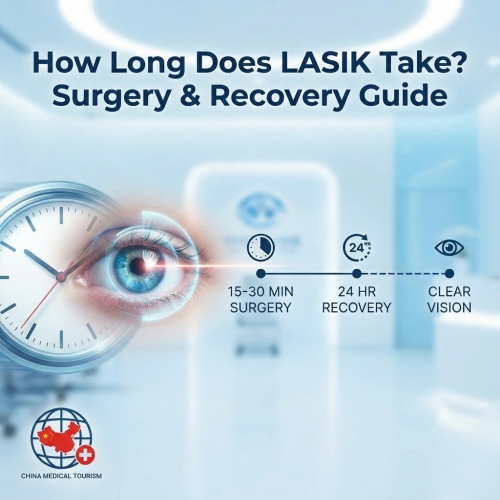
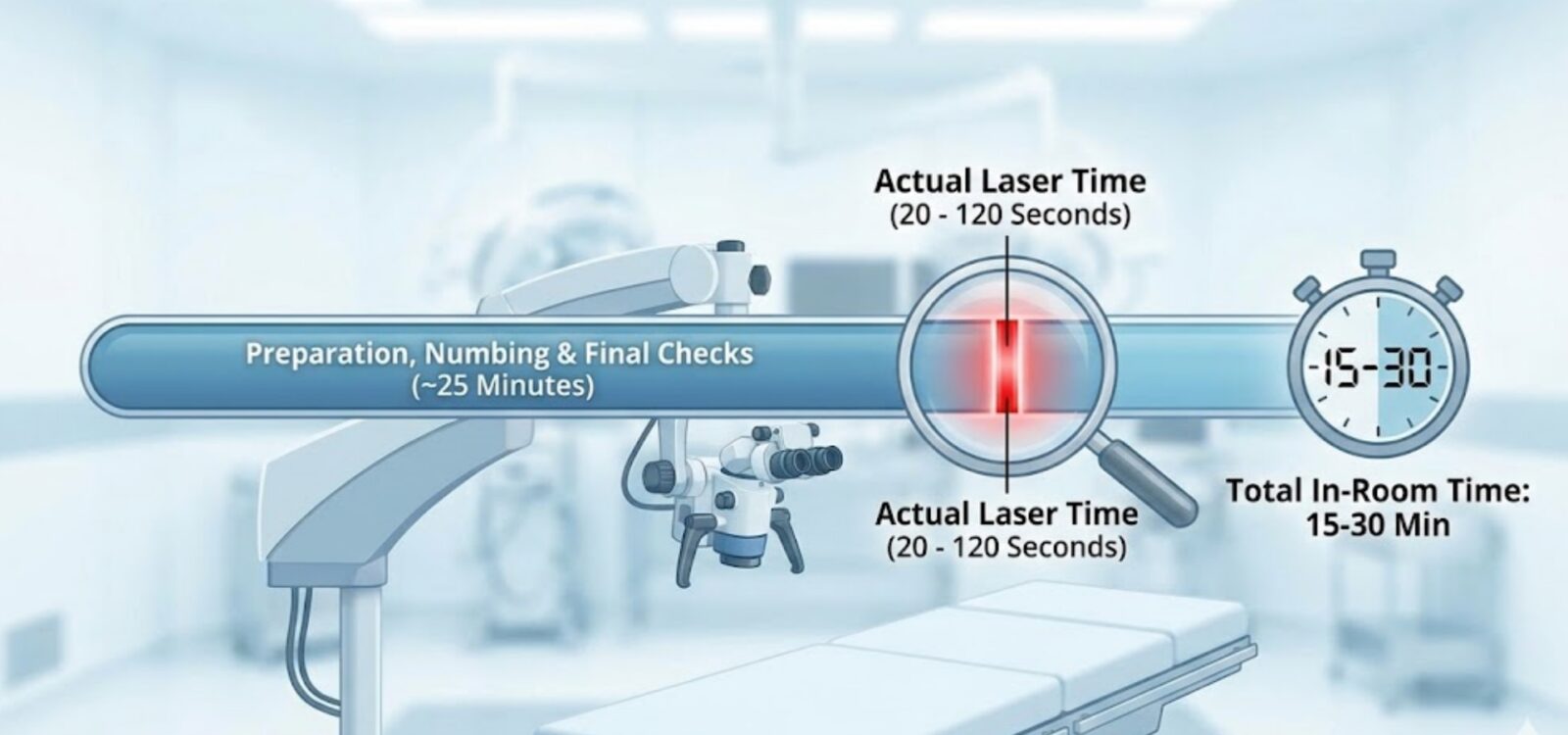
How long does LASIK take? Laser eye surgery takes about 15 to 30 minutes for both eyes; the laser treatment itself is only about 20 to 120 seconds per eye. Still, you should expect to spend about 1.5 to 2 hours at your eye center on the day of surgery. Knowing how long LASIK takes helps schedule your day. This guide covers every phase of LASIK—from the first drop of numbing medication to full recovery of vision—based on current 2026 clinical data.
Quick Answers: 15–30 min surgery | Under 2 hrs at clinic | 24–48 hrs basic healing | 3–6 months full stabilization | 90%+ achieve 20/20 vision
👁️ Thinking about the long-term results? Once those 15 minutes are over, you’ll want to know how your vision holds up over the next decade. Read our deep dive into permanence: [How Long Does LASIK Last? Permanence, Longevity, and What to Expect].
LASIK Surgery Takes 15–30 Minutes: What Happens Inside the Laser Suite
LASIK Surgery Takes 15–30 Minutes
Step 1 — Numbing Your Eye: The 5-Minute Preparation
Rarely do people feel anything more than mild pressure. An eyelid speculum keeps your eye open. Nothing about it press on your eye with discomfort, and your surgeon will check that your eye is completely numb before he starts. This short stage in the general procedure establishes the paving stone for the rest to follow.
- Numbing drop application: 60 seconds per eye
- Eyelid speculum placement: immediate and comfortable
- Anxiety medication: available optionally upon request
💡 Tip: Tell your surgeon if you feel anxious before surgery. Many clinics offer a mild sedative to help you relax before the laser suite.
Step 2 — Creating the Flap: About 18 Seconds Per Eye
The laser creates thousands of tiny bubbles inside the cornea. These bubbles then create clean, precise pockets of separated tissue. Eye-tracking technology monitors your pupil’s movements at a rate of 100 times a second. The laser switches off automatically if your eye moves out of position by more than 2mm.
- Femtosecond laser duration: ~18 seconds per eye
- Eye-tracking response rate: 100 times per second
- Safety shutdown threshold: any movement over 2 mm
💡 Tip: Focus on the blinking target light directly above you. Keeping your gaze steady allows the laser tracker to perform most accurately.
Step 3 — Reshaping the Cornea: 20 to 120 Seconds of Laser Time
Most complete this phase in under 2 minutes per eye. You may hear a faint ticking sound during treatment. Some report a fleeting smell, similar to burning hair. Both sensations are normal — they’re a sign the laser is doing its job.
| Stage | Single Eye | Both Eyes |
|---|---|---|
| Preparation (numbing drop + instruments) | ~5 min | ~10 min |
| Creating corneal flap | ~18 sec | ~36 sec |
| Laser reshaping (mild prescription) | ~20 sec | ~40 sec |
| Laser reshaping (high prescription) | ~120 sec | ~4 min |
| Total surgery room time | ~10 min/eye | 15–30 min |
💡 Tip: The smell during laser treatment is entirely normal. It results from the laser vaporizing corneal cells. It does not signal any problem with your procedure.
✈️ LASIK's short timeline makes it one of the most travel-friendly procedures under Medical Tourism in China — many international patients combine their surgery with a broader trip to Beijing or Shanghai.
Plan 1.5–2 Hours at the Clinic on Your Surgery Day
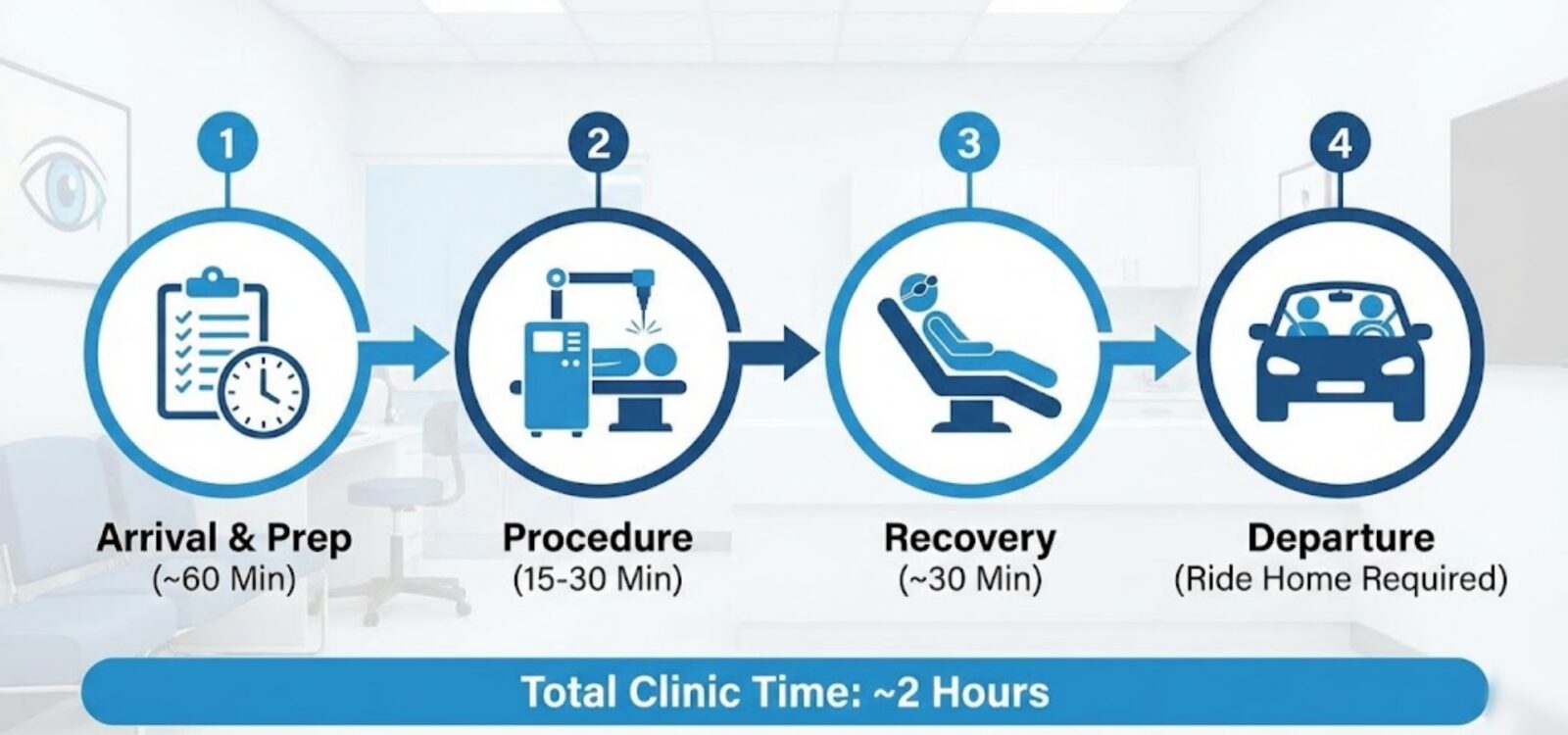
1.5–2 Hours at the Clinic
Arrival to Surgery: The 60-Minute Preparation Window
After you check in, you sign any remaining paperwork, a nurse goes over your medical history and medications, and your eye doctor puts in some numbing drops before taking you to the laser suite. Some offices offer optional sedation to comfort patients who are very anxious. Preparing for treatment is quicker and easier when you come on time and well prepared.
- Check-in and paperwork: 10–15 minutes
- Pre-surgical eye exam and drops: 20–30 minutes
- Walk to laser suite and final positioning: 10–15 minutes
💡 Tip: Do not wear contact lenses on surgery day. Also avoid applying lotions, perfumes, or eye makeup before your appointment.
After Surgery: Why You Need Someone to Drive You Home
Most people see improvement in their vision very quickly—often within a few minutes of surgery. But your eyes will remain sensitive to light for several hours, and halos and glare will be common in the early hours. Your surgeon will recommend that you take a nap as soon as you are get home. Sleep is one of your most useful early recovery tools.
- Transportation: arrange a driver before surgery day — not the day of
- Light sensitivity: peaks within the first 4 hours after surgery
- Rest recommendation: sleep or keep eyes closed for 3–4 hours after surgery
💡 Tip: Prepare your recovery space before you leave for the clinic. Set up dim lighting, sunglasses, and prescribed eye drops at home in advance.
LASIK Healing Takes 3–6 Months: Your Week-by-Week Recovery Guide
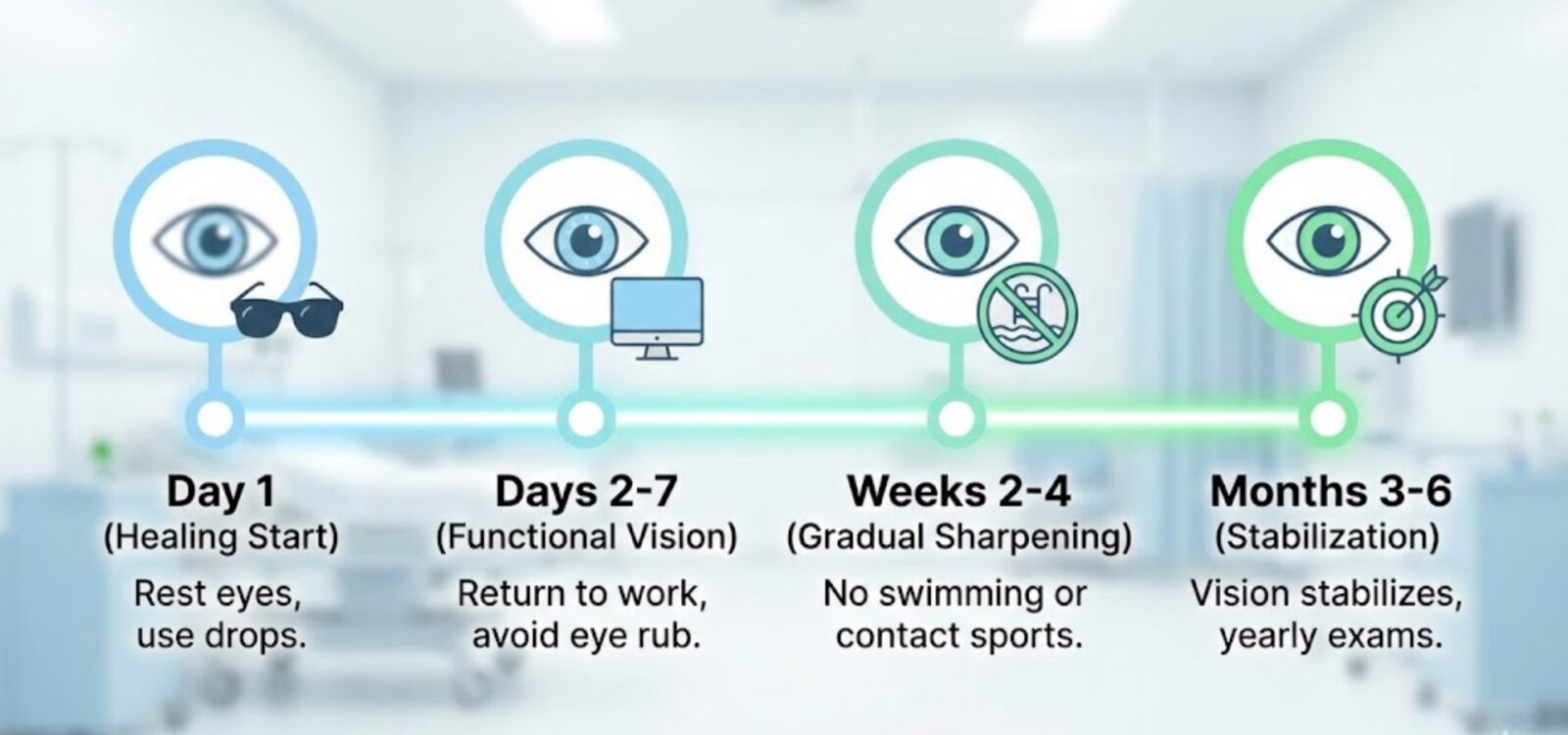
LASIK Healing Takes 3–6 Months
Day 1 — Expect Blurry Vision and Sensitivity to Light
Your surgeon now prescribes antibiotic and anti-inflammatory drops for your eyes which you are to start to take on the day of the surgery. They protect you from infection and reduce the tendency of the cornea to swell. During this time you are prohibited from rubbing, touching, or bathing your eye. You will soon see the importance of protecting your corneal flap from being dislodged prior to its healing. Shielding your eyes from accidental contact while asleep is a preventive measure.
- Eye drops schedule: begin prescribed drops immediately after surgery
- Light sensitivity: wear sunglasses both indoors and outdoors
- Eye rubbing: strictly avoid for at least 2 weeks post-surgery
💡 Tip: Contact your surgeon immediately if you experience severe pain or sudden vision loss. These symptoms are uncommon but require prompt medical attention without delay.
Days 2–7 — Most Patients Can Return to Work
You may experience some eye fatigue from prolonged use as you get used to the operation in the first week – frequent uses of lubricating eye drops alleviate this. Do not wear contact lenses in either eye during the recovery period. Your vision may fluctuate slightly throughout the first week. This is normal and will settle as the cornea becomes more stable.
- Return to desk work: typically Day 2 or Day 3 post-surgery
- Screen use: limit continuous screen time to 30-minute intervals
- Follow-up appointment: mandatory within 24–48 hours of surgery
💡 Tip: Use preservative-free artificial tears frequently during the first week. They reduce dryness and help your cornea heal more comfortably and quickly.
Weeks 2–4 — Avoid Hot Tubs, Makeup, and Contact Sports
Most patients achieve functional daily vision within the first two weeks. Nevertheless, certain activities remain off-limits for ongoing patient safety. Swimming and hot tub use introduce bacteria that can cause serious eye infections. Contact sports carry a direct risk of eye trauma before the flap fully heals.
- Eye makeup: avoid for at least 2 weeks after surgery
- Swimming and hot tubs: avoid for 4–8 weeks after surgery
- Contact sports (boxing, football, karate): avoid for at least 4 weeks
💡 Tip: Ask your surgeon for a written activity clearance timeline. This document helps you communicate restrictions clearly with coaches, employers, or travel companions.
Month 3–6 — When Does Vision Fully Stabilize?
You may still notice some glare and halos around lights during this period. Nighttime driving may not feel quite as comfortable as daytime driving. These symptoms should settle down substantially by month 3. Your surgeon will be seeing you at intervals during this time to assess how healing is progressing. Enhancement will not be permitted until two stable readings.
- Vision stabilization timeline: typically complete by month 3–6
- 20/20 vision achievement rate: over 90% of patients (Cleveland Clinic, 2024)
- Enhancement eligibility: requires stable measurements at least 3 months apart
💡 Tip: Avoid comparing your recovery timeline with others. Individual healing rates vary based on prescription strength, corneal thickness, and overall eye health.
Key Candidacy and Outcome Facts to Know Before You Decide
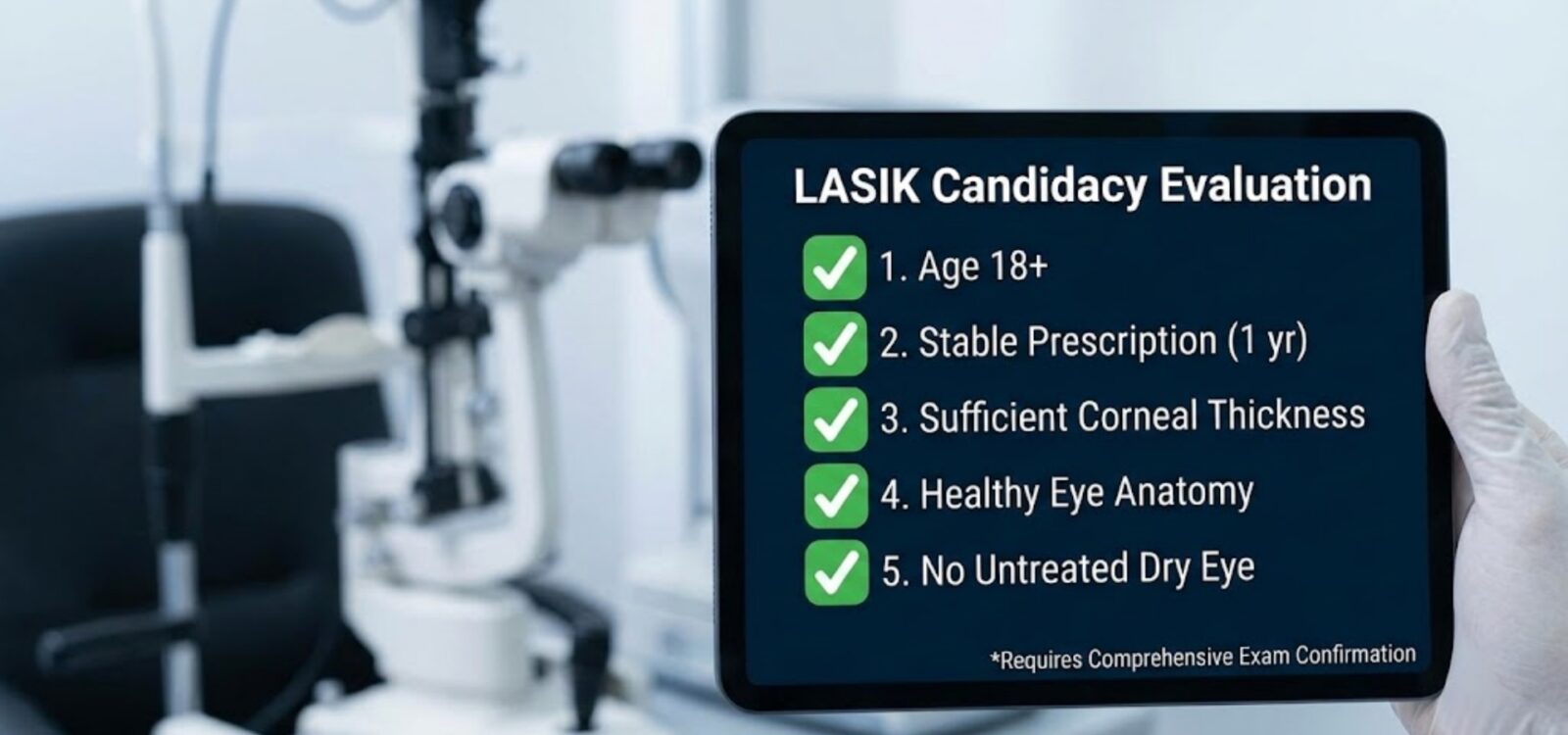
5 Core Criteria for LASIK
Are You a Candidate for LASIK? The 5 Core Criteria
The surgeon will measure your corneal topography, size of pupils, and tear film quality. If you wear contact lenses, do not wear these prior to your assessment. If you are in soft lenses, stop wearing them 2 weeks prior to the assessment. Wearers of hard lenses will need to be out of lenses for 4 weeks prior to obtain accurate measurements of the corneas.
- Age requirement: 18 years minimum; mid-20s preferred for prescription stability
- Prescription stability: unchanged for at least 12 consecutive months
- Corneal thickness: sufficient tissue must remain after flap creation
- Overall eye health: no active infections, dry eye disease, or corneal conditions
- Systemic health: no autoimmune conditions that impair normal wound healing
💡 Tip: Bring your full eyeglass prescription history to your consultation. Records from the past 2 to 3 years help your surgeon confirm prescription stability with confidence.
Is LASIK Worth It at 40 and Beyond?
Patients in their 40s who have LASIK may still need reading glasses afterward. This does not imply that the LASIK procedure “didn’t work”—it simply means that LASIK cannot change what is a natural part of the aging lens process. Monovision LASIK is a pragmatic partial solution for many patients. In this technique, one eye is corrected for distance vision and the other corrected for near vision.
- Presbyopia onset: typically begins around age 40
- Monovision LASIK: effective for selected patients with beginning presbyopia
- Alternative procedures: Refractive Lens Exchange may suit patients over 50 better
💡 Tip: Request a monovision trial using contact lenses before committing to monovision LASIK. This trial confirms whether your brain adapts well to the optical difference.
How Long Do LASIK Results Last?
Understanding how long LASIK lasts helps you set realistic long-term expectations before committing to surgery.
Clinical reporting demonstrates that more than 96% of people are satisfied with their LASIK results, and 85% of patients do not seek out enhancement surgery more than 20 years later. “Dry eye” is the most common side effect, affecting nearly 30% of individuals in the months following the surgery, commonly peaking at 3-months and resolving in the 6 - 12 month period following LASIK. Annual eye exams post-LASIK should indicate any slow onset changes in visual acuity allowing for monitoring and addressing.
- Long-term satisfaction rate: 96% (Cleveland Clinic data)
- Results maintained at 20 years: approximately 85% of patients
- Enhancement surgery need: approximately 10% of patients over a 10-year period
💡 Tip: Schedule annual eye exams even after successful LASIK surgery. Early detection of any vision changes allows timely, less complex intervention.
Why Patients Choose China: Same Technology at 40–60% Lower Cost
Advanced Technology: SMILE and Femtosecond LASIK in Chinese Hospitals
Beijing Tongren Hospital and Shanghai Aier Eye Hospital both accept international patients with English-speaking staff available. These facilities maintain international medical accreditation and rigorous clinical safety protocols. Equipment includes the ZEISS VisuMax femtosecond platform used worldwide for SMILE procedures. Patients receive the same diagnostic thoroughness available at top Western clinics.
- SMILE availability: widely available at Tier 1 city hospitals across China
- International patient services: English interpreters and dedicated coordinators on staff
- Accreditation: leading centers hold ISO certification and full government oversight compliance
💡 Tip: Request your full eye exam records from your home country before traveling. Bringing prior measurements helps Chinese surgeons streamline your pre-surgical evaluation significantly.
Cost Comparison: How Much Does LASIK Cost in China vs. the US?
Chinese hospitals charge substantially less for equivalent technology and equivalent surgical expertise. Costs vary between hospital tiers and city locations within China. First-tier cities like Beijing and Shanghai offer the widest range of available procedure options.
| Country/Region | LASIK Average (Both Eyes) | SMILE Average (Both Eyes) |
|---|---|---|
| USA | $4,000–$6,000 | $5,000–$8,000 |
| UK | £3,000–£5,000 | £4,000–£6,000 |
| Australia | A$4,500–$6,000 | A$5,500–$8,000 |
| China (Tier 1 cities) | ¥8,000–¥20,000 | ¥15,000–¥30,000 |
💡 Tip: Request an itemized cost breakdown from your chosen Chinese hospital before booking travel. This breakdown should include consultation, surgery, post-operative visits, and prescribed eye drops.
Planning Your LASIK Trip to China: A Suggested 3-Day Timeline
Many Chinese hospitals provide dedicated international patient coordinators. These coordinators assist with appointment scheduling, translation services, and local accommodation recommendations. Planning your trip carefully reduces stress and ensures every stage of care proceeds on schedule without delays.
| Day | Activity |
|---|---|
| Day 1 | Arrive → Eye exam & candidacy evaluation |
| Day 2 | Surgery day (15–30 min surgery + 2 hrs at clinic) → Rest at hotel |
| Day 3 | Post-op check → Vision test → Receive eye drops prescription |
| Day 4–5 (optional) | Light sightseeing → Depart when surgeon clears you |
💡 Tip: Book accommodation within 15 minutes of your chosen hospital. Minimizing travel time on surgery day and Day 3 reduces physical strain on your recovering eyes.
FAQs: Top Questions About How Long LASIK Takes — Answered
Q: How long does LASIK take per eye?
Understanding how long does LASIK take per eye helps you plan your surgery day realistically. The actual laser treatment lasts only 20 to 120 seconds per eye. Including flap creation and preparation, each eye takes under 10 minutes inside the laser suite. Total surgical time for both eyes ranges from 15 to 30 minutes.
Q: How long does LASIK take to heal completely?
Knowing how long does LASIK take to heal sets accurate expectations for your recovery journey. Basic healing completes within 24 to 48 hours for most patients. However, full visual stabilization requires 3 to 6 months. Your surgeon monitors progress through scheduled follow-up appointments throughout this entire recovery window.
Q: How long will my vision be blurry after LASIK?
How long does LASIK take to deliver clear vision depends on individual healing rates. Most patients notice significant improvement within 24 hours of surgery. Vision continues sharpening over the following 2 to 4 weeks. Complete clarity and full visual acuity typically arrive by month 3 to 6 post-surgery.
Q: Does LASIK hurt during or after surgery?
How long does LASIK take and whether it hurts are the two most common patient questions. Surgery itself is painless due to numbing drops applied beforehand. After the procedure, patients commonly feel a gritty or scratchy sensation for several hours. This discomfort resolves naturally and does not indicate any surgical complication.
Q: How long do I need to take off work after LASIK?
Patients frequently ask how long does LASIK take before they can return to normal work. Most desk-based workers return within 1 to 2 days after surgery. Patients in physically demanding or high-dust environments should take 5 to 7 days off. Your surgeon confirms your specific return date at the Day 1 follow-up appointment.
Q: Can I drive myself home after LASIK surgery?
Patients ask how long does LASIK take before they can safely drive again. You cannot drive yourself home immediately after surgery under any circumstances. Your vision remains unstable for several hours after the procedure ends. Arrange a responsible adult driver before surgery day. Your surgeon clears driving at the mandatory 24-hour follow-up visit.
Q: How long after LASIK can I use eye drops?
Understanding how long does LASIK take to require eye drops guides your post-surgical care routine. Prescribed antibiotic and anti-inflammatory drops continue for 1 to 4 weeks post-surgery. Lubricating artificial tears may continue for 3 to 6 months to manage dry eye symptoms. Your surgeon adjusts the drop schedule based on your individual healing progress.
Q: How long does LASIK last — is it permanent?
How long does LASIK take to produce permanent results is a key decision factor for every patient. LASIK permanently alters your corneal shape — this change does not reverse over time. However, natural aging affects your eye's internal lens independently. Most patients maintain excellent distance vision for 15 to 20 years or beyond without enhancement surgery.
Q: Is LASIK worth it at 40?
How long does LASIK take to benefit patients over 40 involves a nuanced clinical assessment. LASIK remains highly effective for distance vision correction at age 40 and beyond. However, presbyopia causes near vision decline regardless of corneal correction performed. Monovision LASIK addresses this partially for carefully selected patients. Your eye doctor advises the best approach based on your individual vision profile.
Q: How long does a LASIK consultation take before surgery?
Patients want to know how long does LASIK take from consultation to scheduled procedure. The initial evaluation typically takes 1 to 2 hours and includes a comprehensive eye exam. On surgery day, pre-surgical preparation requires an additional 30 to 45 minutes. Combining both stages into your schedule prevents unexpected time pressures on your procedure day.