How Long Does LASIK Last
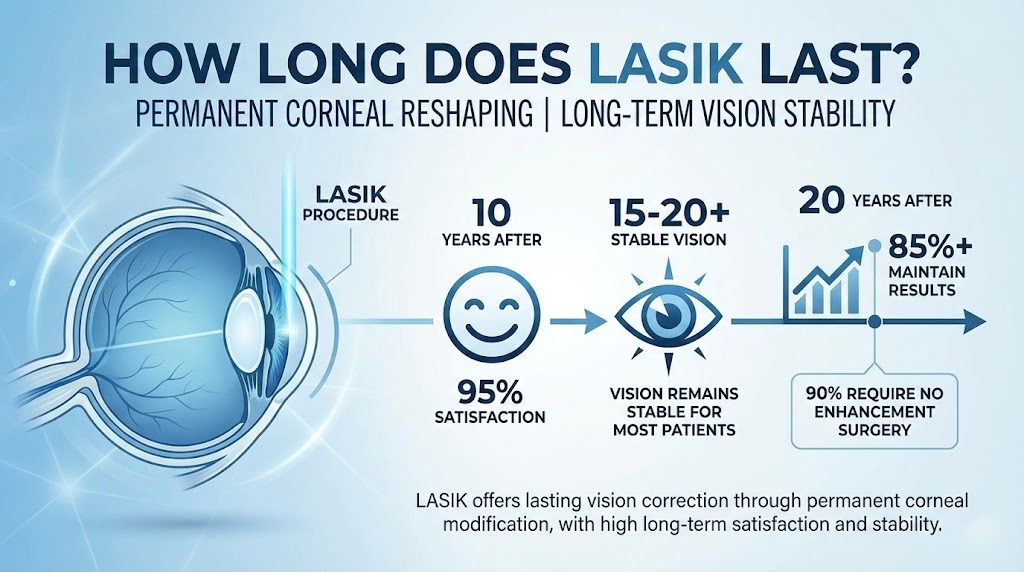
LASIK permanently reshapes your cornea through laser precision. This correction lasts a lifetime. However, your eyes continue aging naturally. These changes can affect vision over time. Most patients maintain excellent results for decades. About 95% remain satisfied after 10+ years. Understanding how long LASIK lasts helps you plan realistically. This guide provides evidence-based answers using 2026 clinical data.
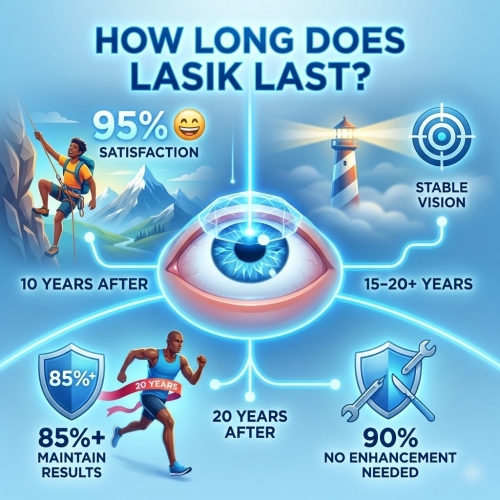
Quick Answers:Permanent corneal reshaping | 15-20+ years stable vision | 95% satisfaction after 10 years | 85%+ maintain results after 20 years | 90% require no enhancement surgery
⏱️ Need to know the procedure time instead? While the visual results can last a lifetime, the actual surgery is incredibly brief. See our minute-by-minute breakdown: [How Long Does LASIK Take? Surgery Lasts 15–30 Minutes — Here’s the Full Timeline].
Is LASIK Permanent? Understanding What "Permanent" Really Means
How LASIK Permanently Reshapes Your Cornea
Think of LASIK like sculpting. The surgeon removes microscopic layers of your cornea. This reshaping corrects how light enters your eye. The procedure targets the stromal layer specifically. This deep tissue layer provides structural stability. Once reshaped, it maintains this new form permanently. The FDA has tracked LASIK outcomes since 1998. Data confirms the physical changes remain stable over time.
- Tissue Removal: Ranges from 12-160 microns depending on prescription severity
- Healing Timeline: Corneal surface heals within 24-48 hours completely
- Structural Integrity: Cornea maintains 85%+ of original thickness after surgery
Why Your Vision Can Still Change After LASIK
Age-related changes happen to all eyes. LASIK cannot prevent these biological processes. Studies show different regression patterns by age group. Patients under 40 experience minor regression in some cases. The average shift measures -0.54 diopters over 18 years. Patients over 40 show minimal regression at -0.05 diopters. However, they face presbyopia development regardless of LASIK status.
💡 Tip: Schedule annual eye exams after LASIK. Early detection catches age-related changes. Your ophthalmologist can recommend timely solutions.
LASIK Results Over Time—What the Numbers Show
How Long Does LASIK Last
5-Year Outcomes: The First Milestone
The FDA requires rigorous 5-year follow-up data. These studies enrolled over 82,000 eyes through 2025. Results exceeded expectations consistently across different prescription ranges. Mild myopia patients (-1.00 to -3.00D) showed 97% stability. Moderate myopia (-3.00 to -6.00D) maintained 93% unchanged vision. Even high myopia patients (-6.00 to -10.00D) achieved 88% stability rates.
- Mild Myopia: 97% maintain results without regression or enhancement needs
- Moderate Myopia: 93% stability with 5% requiring minor enhancement procedures
- High Myopia: 88% success rate, 10% benefit from enhancement surgery
10-Year Outcomes: Long-Term Stability
Long-term studies published in 2025 analyzed 10-year outcomes comprehensively. Researchers found regression occurs primarily in first 5 years. After this period, vision changes stabilize significantly. The Journal of Refractive Surgery reports average regression of 0.31 diopters over 10 years. This minimal change rarely impacts daily activities or vision quality.
Consider your initial prescription when evaluating long-term expectations. Higher prescriptions may experience slightly more regression. However, even with minor changes, most patients avoid glasses completely. Enhancement procedures address any significant vision shifts effectively when needed.
| Time Point | Maintain 20/20 Vision | Enhancement Surgery Rate | Primary Factors |
|---|---|---|---|
| 1 Year | 98% | <1% | Post-operative stabilization |
| 5 Years | 95% | 2-3% | Minor regression |
| 10 Years | 90% | 5-10% | Prescription, age factors |
| 20+ Years | 85% | 10-15% | Presbyopia, cataracts overlay |
20+ Year Outcomes: The Longest Studies
Researchers tracking patients for two decades provide reassuring conclusions. LASIK's corneal reshaping remains structurally sound throughout this period. The Centre for Sight published findings from 18-year follow-ups. Patients maintained average uncorrected visual acuity of 20/25 or better. This level allows driving and most activities without correction.
Does LASIK Wear Off? Separating Myths from Medical Facts
What "Regression" Actually Means
The healing process triggers epithelial cell activity. These cells can cause minimal corneal thickening over time. This biological response explains regression patterns observed clinically. However, modern wavefront-guided LASIK reduces regression risks significantly. Enhanced surgical planning accounts for predicted healing responses. This proactive approach minimizes post-operative changes effectively.
- Epithelial Growth: Normal healing creates 1-2 microns of thickness increase
- Biomechanical Response: Cornea stabilizes after initial 6-month healing period
- Predictive Modeling: Surgeons now calculate expected regression in surgical planning
💡 Tip: Regression under 0.5D rarely requires treatment. Most patients maintain functional vision for daily activities without correction.
The Modern Risk Factor No One Talks About
The 2023 study examined lifestyle factors affecting LASIK longevity. Programmers, designers, and financial analysts showed higher regression rates. Sustained near work causes axial elongation in susceptible individuals. This mechanism differs from LASIK failure itself. The corneal correction remains intact while the eyeball lengthens slightly.
High-risk occupations include software development, graphic design, and data analysis. Moderate-risk jobs involve frequent computer use with breaks. Low-risk occupations include outdoor work and varied-distance tasks. Understanding your work environment helps predict long-term outcomes realistically.
💡 Protection Strategy: Follow the 20-20-20 rule. Every 20 minutes, look 20 feet away for 20 seconds. This reduces accommodation stress significantly.
Why "LASIK Every 10 Years" Is a Misconception
This misconception likely stems from presbyopia timing. Most people develop reading vision problems around age 40-45. Patients who had LASIK in their early 30s notice this change roughly 10 years later. They incorrectly attribute reading difficulties to LASIK wearing off. In reality, presbyopia affects everyone regardless of previous LASIK surgery.
Distinguish between different vision changes. Blurry distance vision may indicate regression. Difficulty reading suggests presbyopia onset. Schedule comprehensive eye exams to identify the actual cause. Your ophthalmologist can recommend appropriate solutions for each condition specifically.
LASIK Longevity by Age—What to Expect in Your 20s Through 60s
LASIK in Your 20s and 30s—The Optimal Window
The FDA recommends waiting until age 21 minimum for LASIK. Many surgeons prefer age 25+ when prescription stability is more certain. Your prescription should remain unchanged for 2+ consecutive years. This ensures the correction addresses a stable refractive error. Patients under 21 show higher regression rates due to continued eye growth.
- Healing Speed: Corneal epithelium regenerates within 24-48 hours at this age
- Stability Duration: Most enjoy 20+ years before presbyopia requires reading glasses
- Enhancement Rarely Needed: Only 3-5% require touch-up procedures in this age group
LASIK After 40—Managing Presbyopia Expectations
Presbyopia results from lens stiffening, not corneal shape. LASIK cannot prevent or reverse this age-related change. However, two solutions help minimize reading glass dependence. Monovision LASIK corrects one eye for distance, one for near. Blended vision uses partial corrections for both eyes. These approaches work well for 60-70% of patients.
- Traditional LASIK: Perfect distance vision, readers needed for close work
- Monovision: Dominant eye for distance, non-dominant for reading tasks
- Blended Vision: Both eyes partially corrected, brain adapts to mixed signals
💡 Trial Period: Test monovision with contact lenses first. This reveals whether your brain adapts comfortably to this approach.
LASIK After 50—When Lens Replacement May Be Better
Refractive Lens Exchange (RLE) replaces your natural lens with an artificial one. This prevents future cataract formation entirely. Multifocal lens implants can correct both distance and reading vision. Many patients over 55 choose RLE over LASIK for this reason.
Discuss both LASIK and RLE with your surgeon. Consider your lens clarity during pre-operative evaluation. If early cataracts exist, RLE may offer better long-term value. LASIK remains excellent for patients with clear lenses and good ocular health.
Maximizing Your LASIK Results—Cost, Quality, and Medical Tourism
The Lifetime Value of LASIK vs. Glasses and Contacts
Calculate your personal break-even point using actual expenses. Glasses require replacement every 2 years at $300-500 each. Contact lenses cost $500-700 annually including solution and cases. Add annual eye exams and prescription updates. These recurring costs compound significantly over decades.
| Expense Item | Annual Cost | 20-Year Total |
|---|---|---|
| LASIK (one-time) | - | $4,000 - 6,000 |
| Glasses replacement | $150 - 250 | $3,000 - 5,000 |
| Contact lenses | $500 - 700 | $10,000 - 14,000 |
| Care products | $200 - 300 | $4,000 - 6,000 |
| Eye exams | $100 - 200 | $2,000 - 4,000 |
| Total (non-LASIK) | - | $19,000 - 29,000 |
Why China Has Become a Global LASIK Destination
China completes 2+ million refractive surgeries yearly. This represents nearly 3x the annual US volume. Aier Eye Hospital Group alone performs 800,000+ procedures annually. Individual surgeons like Professor Wang Yan have completed 100,000+ lifetime procedures. This experience level is virtually unattainable in lower-volume Western markets.
- US SMILE Surgery: $5,000-9,000 (surgery only, no travel included)
- China SMILE Package: $4,000-6,000 (includes 7-day medical tourism itinerary)
- China Traditional LASIK: $3,000-5,000 (includes comprehensive pre/post-operative care)
💡 Quality Verification: Choose JCI-accredited hospitals in China. Verify surgeon credentials through hospital websites. Request English-speaking coordinators during booking.
💎 Combined with China's dramatically lower costs, LASIK's lasting results make it one of the most compelling procedures within [Medical Tourism in China] for international patients focused on long-term value.
Post-Surgery Care That Protects Your Investment
- First 3 Months: Avoid rubbing eyes completely. Use prescribed lubricating drops 4-6 times daily
- UV Protection: Wear sunglasses rated UV400+ outdoors. Prevent corneal UV damage long-term
- Dry Eye Management: Address symptoms immediately. Untreated dry eye causes discomfort and visual fluctuation
- Screen Habits: Implement 20-20-20 rule. Position monitors 20-28 inches from eyes
- Annual Exams: Schedule comprehensive eye health checks. Early detection prevents complications
Maintain a relationship with your ophthalmologist after LASIK. Report any vision changes promptly for evaluation. Most issues resolve quickly when caught early. Your surgeon can provide specific recommendations based on your healing pattern.
💡 Hydration Matters: Drink 8+ glasses of water daily. Proper hydration supports tear production and eye health.
Frequently Asked Questions About LASIK Longevity
Q: Does LASIK surgery last a lifetime?
Yes, how long LASIK lasts relates to permanent corneal reshaping. The laser removes tissue that never regenerates back. However, natural aging affects everyone's eyes over time. Most patients enjoy 15-20+ years of excellent vision. Age-related changes like presbyopia require separate management. Studies confirm 85%+ maintain significant improvement after 20 years.
Q: What happens after 20 years of LASIK?
How long LASIK lasts after 20 years shows remarkable stability. Research tracking patients for two decades reveals maintained vision correction. The corneal reshaping remains structurally sound throughout this period. Vision changes occur primarily from cataracts and presbyopia. These age-related conditions affect everyone, regardless of LASIK history. Enhancement procedures remain available if needed.
Q: Why is my vision blurry 10 years after LASIK?
Understanding how long LASIK lasts helps explain post-decade vision changes. Three factors cause blurriness at this timepoint. Minor regression affects 10% of patients over 10 years. Dry eye syndrome develops in some individuals post-operatively. Presbyopia onset occurs around age 40-45 universally. Schedule comprehensive eye examination to identify the specific cause accurately.
Q: Is LASIK every 10 years a requirement?
No, this misconception misunderstands how long LASIK lasts. Less than 5% of patients need enhancement surgery ever. The 10-year myth confuses LASIK stability with presbyopia timing. Patients who had surgery at 30 notice reading difficulties at 40. This stems from natural lens aging, not LASIK failure. Your corneal correction remains permanent.
Q: Can you get LASIK twice if your vision changes?
Enhancement surgery addresses regression when vision changes occur. Approximately 5-10% of patients benefit from enhancement procedures eventually. Surgeons evaluate corneal thickness before approving additional treatment. Sufficient tissue must remain for safe secondary correction. Enhancement success rates match original LASIK procedures. Most patients require only one enhancement maximum.
Q: Does LASIK work permanently for astigmatism?
Yes, the laser reshapes corneal irregularities causing astigmatic vision. This correction maintains stability with 90%+ success rates long-term. High astigmatism (>3.0 diopters) shows slightly higher regression rates. Most patients with moderate astigmatism enjoy permanent correction. Enhancement procedures effectively address any minor regression. Studies confirm astigmatic corrections remain stable over decades.
Q: How long does LASIK take to heal fully?
Vision stabilization determines surgical outcome before final assessment. Most patients achieve functional vision within 24-48 hours post-surgery. Near-complete healing occurs within one week typically. Final vision stabilization takes 3-6 months for most individuals. This timeline allows accurate evaluation of long-term outcomes. Premature assessment may not reflect ultimate results accurately.
Q: Is LASIK in China safe for international patients?
China offers excellent options for understanding refractive surgery firsthand. Top Chinese hospitals maintain JCI international accreditation standards. They use FDA-approved Zeiss and Alcon surgical equipment. Aier Eye Hospital provides dedicated English-speaking patient coordinators. Medical tourism packages include comprehensive pre-operative evaluation. International safety standards ensure consistent high-quality outcomes.
Q: How much does eye surgery cost in China vs. the US?
Comparing costs reveals vision correction as a financial investment. US surgery ranges from $4,000-9,000 for both eyes typically. China offers SMILE surgery at $4,000-6,000 including medical tourism support. This includes 7-day accommodation, translation services, and post-operative care. Adding international flights, total cost remains below US surgery-only pricing. Quality remains equivalent with experienced surgeons.