Hilarious Chinese Proverbs
Some of the funniest sentences in the world come from a language most visitors to China never learn to read. Chinese proverbs sound like riddles when translated word-for-word — a pig arguing with a mirror, a dead horse treated as alive, a mute eating bitter herbs. Yet behind these strange images lies wisdom that has guided daily life for over two thousand years. This guide collects twelve sayings that make native English speakers laugh out loud, then explains what they actually mean and how Chinese people use them in real conversations.
Whether you are planning a trip to Chengdu, bargaining in a Hangzhou market, or just want to understand the calligraphy on a tea-house wall, these twelve proverbs will unlock a layer of Chinese culture most tourists never reach.
Quick Facts
Why Chinese Proverbs Sound Hilarious in English
Chinese compounds meaning into dense four-character blocks. Each character carries a separate image or concept. When you translate one of these blocks into English, you get a string of short words that creates an absurd mental picture — a mute eating bitter herbs, a pig arguing with a mirror. The comedy is baked into the translation itself.
The mismatch comes from how the two languages compress information differently. A four-character chéngyǔ might need twelve to fifteen English words to capture the same scene. That expansion reveals the oddity that Chinese speakers barely notice, because the meaning is absorbed instantly. For English ears, the literal image is the joke.
😂 Humorous Expressions: Discover more lighthearted expressions and humorous traditional idioms with our curated list of Funny Chinese Proverbs In Chinese.
Three Types of Chinese Sayings Worth Knowing
These three formats dominate Chinese daily speech and written tradition.
The Comedy of Literal Translation
Consider 守株待兔 (shǒu zhū dài tù). Break it down: 守 (guard) + 株 (tree stump) + 待 (wait for) + 兔 (rabbit). The literal read is "guard a tree stump, wait for a rabbit." That sounds like nonsense in English. The real meaning: someone who sits around hoping luck will fall into their lap, based on the old fable of a farmer who saw a rabbit撞 a tree stump and decided to wait there all day for another one.
Chinese speakers absorb the full story in four syllables. English needs the backstory. That gap is where the humor lives.
12 Hilarious Chinese Proverbs Worth Knowing
Each entry below lists the Chinese characters, pinyin with tone marks, the literal English gloss, what the saying actually means in daily conversation, and one note on when a Chinese person would use it.
Procrastination, Stubbornness, and Wasted Effort

Guard a tree stump, wait for a rabbit.
- 守株待兔 (shǒu zhū dài tù): "Guard a tree stump, wait for a rabbit." Literal meaning: a farmer who wasted his days beside a stump, hoping another rabbit would crash into it. Real meaning: to sit idle hoping for luck instead of taking action. Usage: call out a colleague who skips meetings and expects a promotion anyway.
- 马后炮 (mǎ hòu pào): "Cannon fire after the horse has passed." Literal meaning: a cannon shot aimed at a target already gone. Real meaning: someone who offers advice or criticism only after a situation has already been resolved or ruined. Usage: tease a friend who suddenly says what you should have done, long after the decision was made.
- 死马当活马医 (sǐ mǎ dāng huó mǎ yī): "Treat a dead horse as if it were alive." Literal meaning: the image of a vet working on a clearly deceased animal. Real meaning: to make a desperate last attempt when success looks impossible. Usage: describe ordering one more round of expensive tests when the doctor has already given bad news.
- 姜太公钓鱼,愿者上钩 (jiāng tàigōng diàoyú, yuàn zhě shàng gōu): "Jiang Taigong fishes, the willing get hooked." Literal meaning: the ancient strategist Jiang Ziya fished with a straight hook, waiting for the right person to bite. Real meaning: to set up an opportunity and wait for the right person to take it voluntarily. Usage: describe a hiring manager who posts a vague job ad and waits for ideal candidates to apply on their own.
Pride, Showing Off, and Misfires
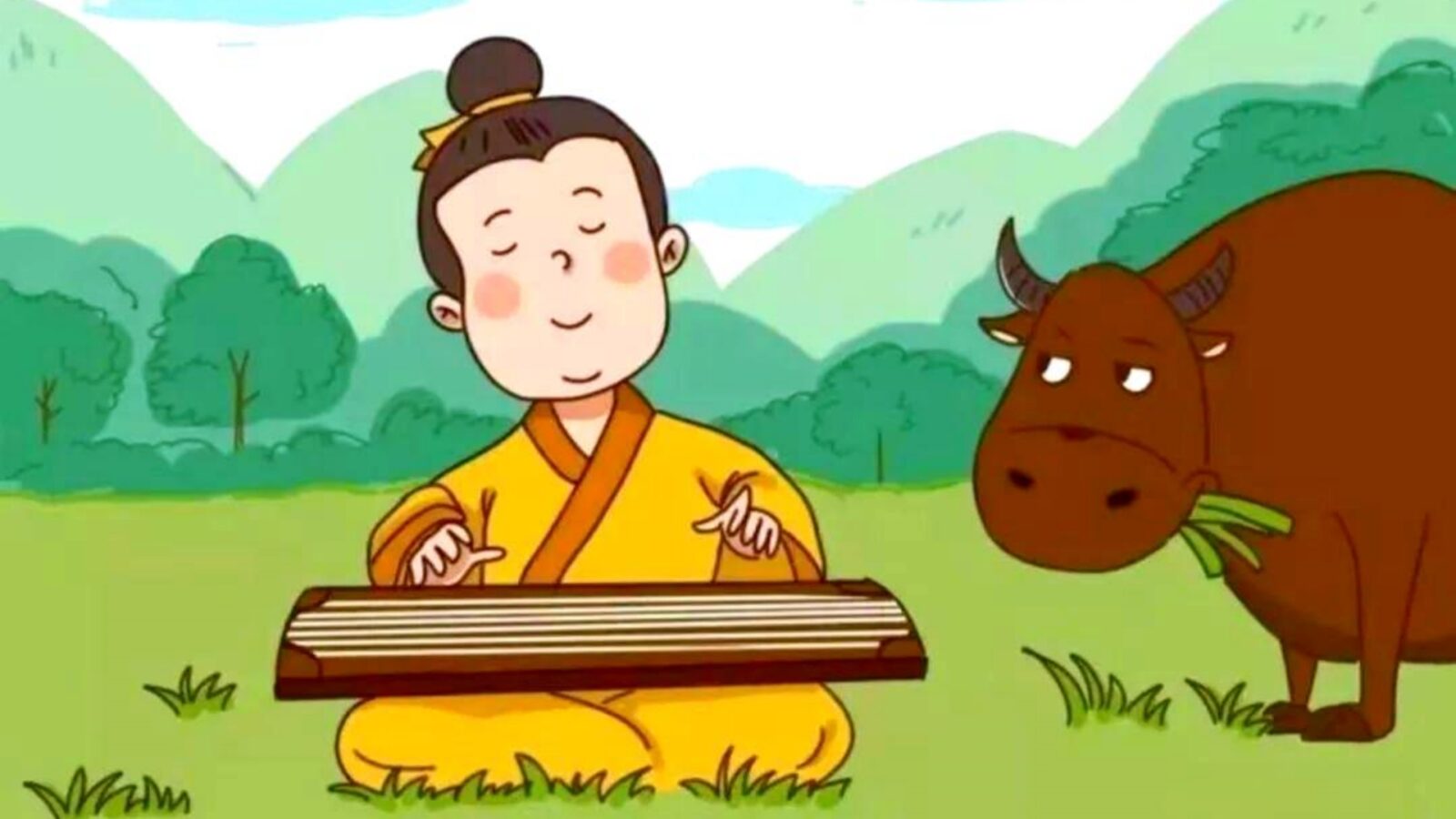
Play the zither to a cow.
- 班门弄斧 (bān mén nòng fǔ): "Show off your axe at Lu Ban's door." Literal meaning: the master carpenter Lu Ban's workshop is not the place for amateur carpentry. Real meaning: to demonstrate your skills in front of an expert, usually embarrassingly. Usage: correct your professor's grammar in front of the class.
- 对牛弹琴 (duì niú tán qín): "Play the zither to a cow." Literal meaning: wasting beautiful music on an audience that cannot appreciate it. Real meaning: trying to explain something sophisticated to someone who simply does not understand. Usage: walk away from an argument where the other person cannot follow your logic no matter how clearly you speak.
- 三个臭皮匠,顶个诸葛亮 (sān gè chòu píjiàng, dǐng gè zhūgě liàng): "Three cobblers equal one Zhuge Liang." Literal meaning: three lowly shoemakers combined can match the legendary strategist. Real meaning: collective brainpower beats a single genius. Usage: praise a team that solved a problem no individual could have cracked.
- 杀鸡用牛刀 (shā jī yòng niú dāo): "Kill a chicken with a butcher's cleaver." Literal meaning: deploying massive force for a tiny task. Real meaning: using overwhelming resources for something simple. Usage: hire a ten-person consulting firm to pick a lunch restaurant.
Power, Mischief, and Daily Chaos
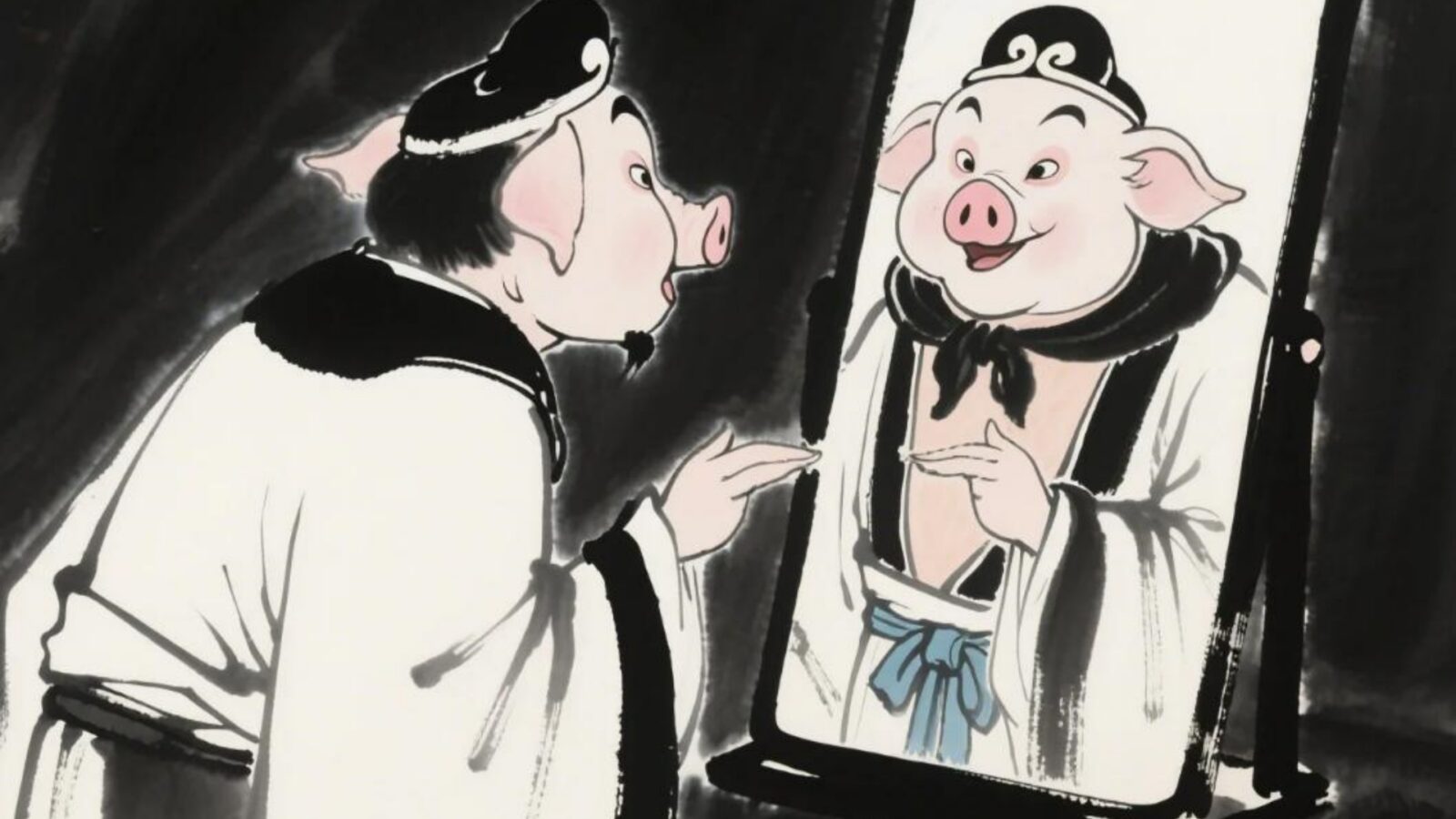
Zhu Bajie looks in the mirror.
- 一山不容二虎 (yì shān bù róng èr hǔ): "One mountain cannot hold two tigers." Literal meaning: two apex predators cannot share a single territory. Real meaning: only one dominant person can hold authority in any given domain. Usage: explain why two strong-willed managers in one department creates constant conflict.
- 老虎不发威,当我是病猫 (lǎohǔ bù fā wēi, dāng wǒ shì bìng māo): "If the tiger does not show its claws, you think I am a sick cat." Literal meaning: a tiger that stays quiet gets mistaken for a weak animal. Real meaning: warns that staying silent invites disrespect; sometimes used as a threat. Usage: a manager finally loses patience with endless budget overruns and reminds the team who signs the checks.
- 猪八戒照镜子 (zhūbājiè zhào jìngzi): "Zhu Bajie looks in the mirror." Literal meaning: the pig character from Journey to the West sees his own hog face reflected back. Real meaning: someone who only sees their own faults in others. Usage: call out a person who criticizes everyone around them for the exact flaws they possess.
- 半路杀出个程咬金 (bàn lù shā chū gè chéng yǎojīn): "Cheng Yaojin jumps out halfway down the road." Literal meaning: the warrior Cheng Yaojin bursts onto the scene unexpectedly in the historical novel. Real meaning: an unexpected complication or person appears at the worst possible moment. Usage: your boss drops a new deadline into a project that is already behind schedule.
💕 Romantic Idioms: If you want to explore how classic idioms express affection and devotion, read our guide to Chinese Proverbs About Love.
What These Proverbs Reveal About Chinese Thinking
These twelve sayings share four cultural threads visible across thousands of similar proverbs. First, a strong preference for indirect communication — Chinese speakers say "guard a tree stump" when they mean "stop being lazy." The image carries the criticism without naming it directly.
Second, animal and folk imagery dominates over abstract argument. Rather than debating whether procrastination is rational, the proverb puts a farmer beside a stump. The picture does the work. This approach makes advice memorable and, crucially, less face-threatening.
Third, the pragmatism embedded in these sayings is striking. Wasted effort, dead horses, and oversized knives all get named bluntly — but wrapped in metaphor so the delivery stays polite. Chinese culture values harmony, and indirect phrasing preserves it while still delivering a sharp message.
Fourth, literary canon feeds the sayings heavily. Journey to the West supplies Zhu Bajie and his mirror. Romance of the Three Kingdoms gives us Zhuge Liang and Cheng Yaojin. When someone cites one of these proverbs, they are quietly invoking centuries of shared narrative knowledge.
How to Use These Proverbs in Real Conversations
The tone matters more than the vocabulary. Deliver a proverb deadpan — never laugh at your own joke. If you smile, the other person smiles back, and the message softens into a joke. Keep a straight face and the meaning lands. Chinese listeners respect the effort and focus on the image.
Audience changes which proverbs are safe. Close friends and peers accept most of these. Coworkers in semi-formal settings respond well to collective-wisdom sayings like "three cobblers equal one Zhuge Liang." With elders or in first meetings, it is better to listen and nod rather than quote.
Three common mistakes foreigners make need careful avoidance.
- Dropping a 4-character chéngyǔ without context: It sounds theatrical and shows you learned it from a textbook, not from life. Use it only after the conversation naturally opens a door for it.
- Over-quoting in professional settings: One proverb per meeting is the ceiling. More than that reads as showing off, which contradicts the self-effacing tone these sayings are designed to create.
- Mixing up the two parts of a xièhòuyǔ: These proverbs have a setup and a punchline. Getting the order wrong signals you do not actually know the saying, which undermines the point you are making.
📱 Digital & Numerical Shorthand: Beyond traditional idioms, learn how modern internet users substitute numbers for full phrases with our guide to Chinese Number Slang.
Where You'll Hear These Proverbs in Real Chinese Life
These sayings are not relics. They appear in six specific everyday contexts across China today.
- Tea houses and traditional restaurants: Calligraphy scrolls on walls in Chengdu, Hangzhou, and Suzhou often feature chéngyǔ. Ordering tea in a centuries-old house means the walls are quietly teaching you proverbs whether you notice or not.
- Family dinners and Spring Festival banquets: Elders quote proverbs to deliver life lessons without lecturing. The Spring Festival Gala TV broadcast layers xièhòuyǔ into comedy sketches for national audiences.
- Workplace banter and WeChat group chats: Colleagues use "cannon fire after the horse has passed" to tease whoever brings up past failures. WeChat sticker packs compress popular proverbs into shareable emoji sets.
- Street markets and bargaining: A vendor might say "Jiang Taigong fishes" when refusing to lower a price, meaning the deal is on the table — take it or leave it. Customers reply with "kill a chicken with a butcher's cleaver" when they think the asking price is absurd.
- Temples and traditional architecture: Plaques, couplets, and carved inscriptions throughout temples and historic buildings embed chéngyǔ that visitors read without realizing they are encountering living vocabulary.
- TV historical dramas (古装剧) and stand-up comedy: Period dramas quote proverbs constantly as dialogue. Modern stand-up comedians twist the same sayings to make audiences laugh about contemporary problems.
Frequently Asked Questions
Q: What's the difference between a Chinese proverb and a chéngyǔ?
Chéngyǔ is a specific sub-type: exactly four characters, almost always drawn from classical texts. The English word "proverb" works as a broader umbrella covering chéngyǔ, yànyǔ, xièhòuyǔ, and 俗语 (súyǔ, common sayings). When Chinese speakers talk about 成语, they mean the formal four-character idioms used in writing and polished speech.
Q: Are Chinese proverbs still used in everyday speech today?
Yes, and frequently. Older colleagues deploy them in meetings. Family elders quote them over dinner. Younger speakers share them as WeChat stickers and memes more often than they say them aloud, but the core chéngyǔ remain part of daily conversation across all age groups.
Q: Which Chinese proverb is considered the funniest?
猪八戒照镜子 ("Zhu Bajie looks in the mirror") consistently ranks highest for pure image comedy — the pig-faced character's reflection is inherently absurd. Among the most widely recognized for wit, 班门弄斧 and 对牛弹琴 appear in almost every Chinese humor collection.
Q: How do you pronounce these proverbs correctly?
The article provides standard Mandarin pinyin with tone marks. Tones matter because several jokes depend on rhyming syllables and tonal contrast. The Pleco dictionary app offers audio clips for every chéngyǔ and is the quickest path to correct pronunciation.
Q: Can foreigners use Chinese proverbs without sounding rude?
Yes, among friends who know you are genuinely interested in the language. Avoid using them with elders on first meetings, in formal work emails, or any time the situation demands directness. Proverbs are inherently indirect — they let you make a sharp point while keeping a layer of deniability.
Q: What's the most famous Chinese proverb?
守株待兔 and 对牛弹琴 appear in nearly every beginner Chinese textbook worldwide and are the two most universally recognized outside China. Neither is universally declared "the" most famous, but these two lead in global name recognition.
Q: Do people in Taiwan and Hong Kong use the same proverbs?
The core chéngyǔ are identical across mainland China, Taiwan, and Hong Kong. Taiwan and Hong Kong write them in traditional Chinese characters rather than simplified characters. Some regional yànyǔ vary locally, and Cantonese has its own parallel proverbs that do not exist in Mandarin.
Q: Where can I learn more Chinese proverbs?
The 《现代汉语词典》 and 《成语大辞典》 are standard reference dictionaries. The Pleco app includes audio and example sentences. Classic source texts — 《三国演义》 (Romance of the Three Kingdoms), 《西游记》 (Journey to the West), and 《孟子》 (Mencius) — are where most chéngyǔ originate. Chinese-language podcasts focused on culture and language offer regular breakdowns with audio pronunciation.