Guangdong Cuisine
Guangdong cuisine—known in English as Cantonese food and in Chinese as Yue cuisine (粤菜 Yuècài)—is the exportable face of Chinese cooking. From the steam tables of Hong Kong Michelin-starred dining rooms to the neighborhood teahouses of Guangzhou, this tradition has shaped how hundreds of millions of people outside China understand Chinese food. Yet Guangdong Province itself is far more than the "mild and sweet" introduction most travelers first encounter abroad. The Pearl River Delta, the eastern Chaoshan coast, and the Hakka communities of northeast Guangdong each run distinct culinary lineages, and a visitor who knows only the Guangzhou menu is only partly tasting what the province actually offers.
This guide maps the full territory: the flavor principles that unify Guangdong cooking, the three major regional sub-cuisines that divide it, the dishes that define each tradition, and the practical logistics a traveler needs to eat well from Shenzhen to Shantou and from Meizhou to Macau.
Quick Facts
What Defines Guangdong Cuisine
Guangdong Cuisine
At its center, Guangdong cooking operates on a single governing principle: bring out the original flavor of the ingredient rather than impose flavor onto it. This sounds simple, but it reshapes every technique and ingredient choice. Chefs steam a fish whole to taste its own sweetness, stir-fry greens for seconds to keep them crisp, and braise pork belly long enough to render its fat silky but never overpowering. The result is a cuisine that registers as "mild" or even "plain" to visitors expecting the punch of Sichuan peppercorns or Hunan fermented chilies — but that mildness is deliberate, not a lack of ambition.
The flavoring palette uses warmth rather than heat. Ginger, scallion, white pepper, star anise, and chives appear in nearly every dish; sugar shows up in small amounts to round out savory notes; Shaoxing wine lifts the aroma without announcing itself. Hoisin, oyster sauce, and soy build layers of umami, but they are added with restraint. The goal is balance, not intensity — a dish should taste primarily of what it is, whether that is shrimp, pork, fish, or chicken.
Flavor Philosophy and Principles
Guangdong cuisine treats the wok and steamer as instruments of preservation rather than transformation. Steaming seals in moisture and lets the ingredient cook in its own steam; quick stir-frying at high heat cooks the surface while keeping the interior yielding. Both methods protect the ingredient's natural character. When braising or double-boiling, Cantonese cooks extend cooking time deliberately — a lao huo tang (slow-cooked soup) may simmer for four hours — but the aim is to extract collagen and mineral content into a clear broth, not to reduce the liquid into something thick or heavy. Freshness is the supreme value; dried or preserved ingredients serve as boosters, not protagonists.
How Cantonese Differs From Sichuan, Hunan, and Shanghainese
Visitors who arrive in Guangzhou expecting the "Chinese food" they know from other provinces may need a recalibration. Sichuan cuisine deploys Sichuan peppercorns and dried chilies for a mouth-numbing, tongue-tingling heat that overwhelms the palate; Hunan adds sour notes alongside its spice for a sharper, more aggressive profile; Shanghainese leans into sweet soy braises and red-cooking techniques that stain and glaze. Guangdong, by contrast, avoids chili entirely in its core tradition and uses sugar as a seasoning rather than a dominant flavor. The difference is not a matter of quality — it is a matter of intent. Cantonese cooking seeks to highlight what the ingredient is; these other traditions seek to transform what the ingredient becomes.
Historical Roots and Global Spread
The Pearl River Delta has supported rice-farming and fishing communities for over two thousand years, and the earliest Cantonese cooking traces to this agricultural abundance. Teahouses appeared along the Tang Dynasty trade routes passing through Guangzhou in the seventh and eighth centuries; the dim sum format — small dishes served with tea — solidified in these roadside teahouses and migrated with merchants into the city proper over subsequent dynasties. By the nineteenth century, Cantonese emigration carried the cuisine into Chinatowns across Southeast Asia, North America, Australia, and Europe. The diaspora version adapted to local ingredients and tastes, sweetening further to suit nonlocal palates, which is why many overseas Cantonese menus read as noticeably sweeter than the originals found in Guangdong. Modern Hong Kong elevated Cantonese cooking to Michelin-recognized heights, with three-star kitchens demonstrating that the tradition is far from provincial.
🥢 Explore Guangzhou's Culinary Scene: From morning dim sum and teahouse culture to historic night-market stalls, Guangzhou remains the undisputed heart of Yue cuisine. Plan your food tour with our guide to Guangzhou Food.
Must-Try Dishes Across Guangdong
Guangdong Cuisine
A visitor to Guangdong who knows only what appears on a standard overseas Cantonese menu is missing the better half of the story. The dish map below covers all three sub-cuisines, with clusters organized by category so you can plan a meal or an itinerary around specific targets.
Dim Sum Staples
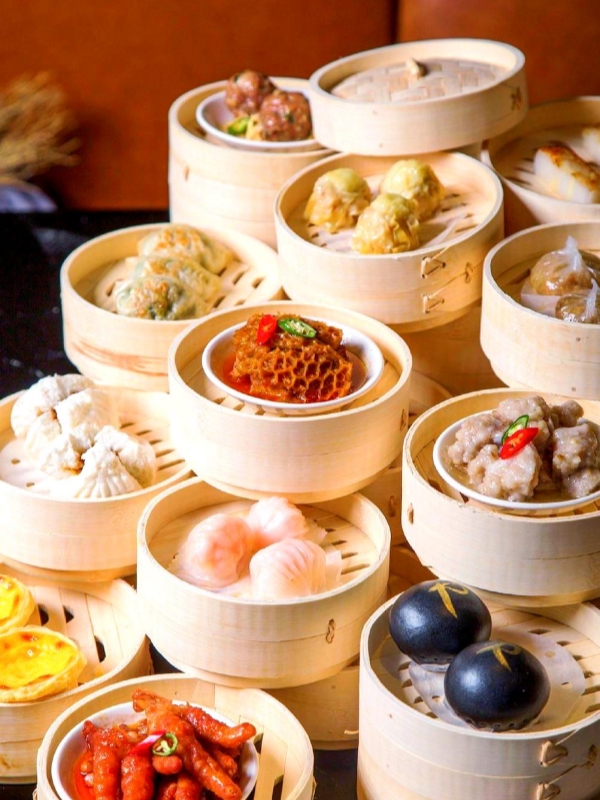
These eight items form the backbone of any yum cha session. Order freely and tap two fingers on the table when someone pours your tea.
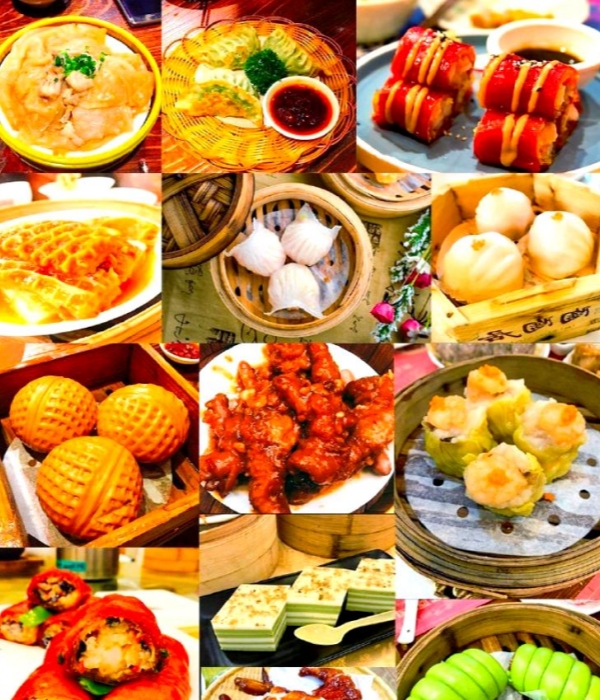
- Har gow (虾饺): Translucent-skinned shrimp dumplings folded by hand; the pleated edge and visible filling through the skin mark a well-made specimen.
- Siu mai (烧卖): Open-topped pork and shrimp dumplings topped with a dot of orange fish roe; the casing is slightly wheaty, the filling savory.
- Cheung fun (肠粉): Wide rice noodle rolls filled with shrimp, beef, or char siu and drizzled with sweet soy; the wrapper should be silky, not gummy.
- Char siu bao (叉烧包): Steamed BBQ pork buns with a snow-white dome; split them open to see the glossy pork filling inside.
- Feng zao (凤爪): Braised chicken feet in black bean sauce; the bones are soft enough to eat, and the sauce clings to the tendons.
- Pai guat (排骨): Steamed pork ribs with fermented black beans and garlic; the meat falls from the bone at the touch of chopsticks.
- Lo bak go (萝卜糕): Pan-fried turnip cake cut into rectangles; the exterior should be crispy, the interior soft with shreds of radish.
- Dan ta (蛋挗): Baked egg tarts with a caramelized custard in a flaky or puff-pastry shell; the top develops a slight char that adds bittersweet depth.
Roast Meats (Siu Mei) and White Cut Chicken
The siu mei family is the savory protein layer of Cantonese eating. Each item is roasted in a specialized oven and served over rice or as a standalone plate.
- Char siu (叉烧): Honey-glazed BBQ pork skewered and roasted until the exterior caramelizes into a lacquered, slightly charred edge while the interior stays moist.
- Siu yuk (烧肉): Roast pork belly with blowtorched crackling skin; the contrast between the crispy shell and the fat-marbled meat is the point.
- Siu ngo (烧鹅): Roast goose lacquered with a maltose and five-spice glaze; the best versions come from specific farms and are roasted to order.
- Soy sauce chicken (豉油鸡): Poached then roasted chicken in a soy-scallion braise; the skin takes on a deep mahogany color and the meat stays juicy.
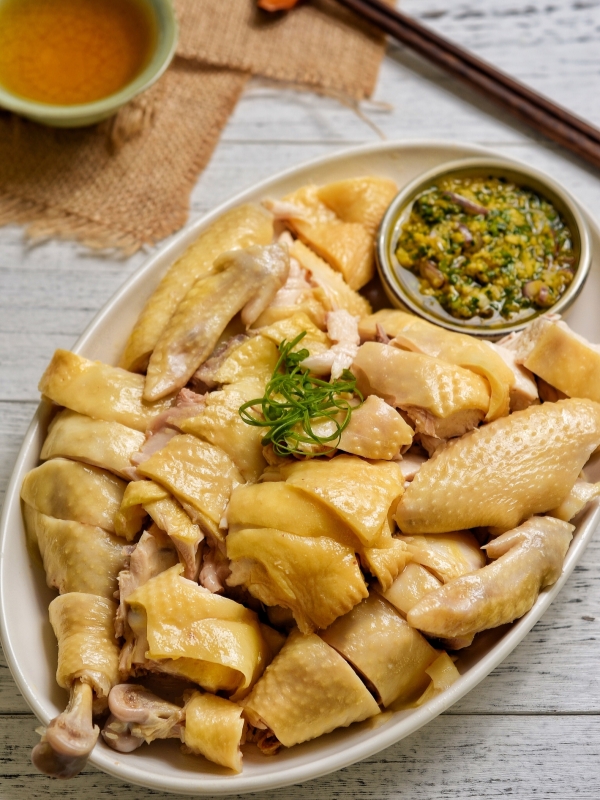
- Bai qie ji (白切鸡): White-cut chicken poached with ginger and scallion, served cold or warm with a ginger-scallion oil dip; this is the test dish of a Guangzhou kitchen — the quality of the bird shows immediately.
Seafood and River Dishes
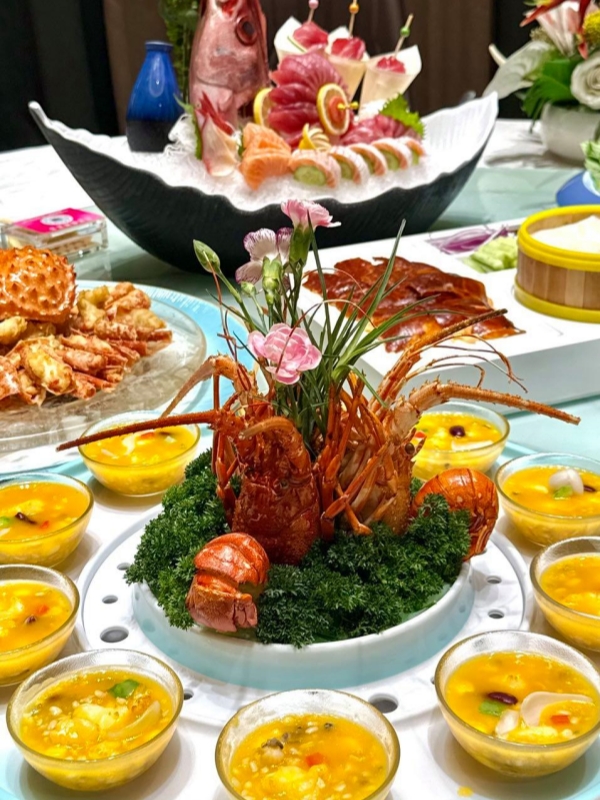
Guangdong's rivers and South China Sea coastline supply a live-fish-tank culture that shapes expectations. Restaurants in Guangzhou and Shantou display their catch in tanks; the fish is selected, weighed, and cooked to order.
- Steamed whole fish (清蒸鱼): Fish steamed with ginger and scallion, finished with hot oil and light soy; the flesh should flake cleanly and taste of the sea rather than of sauce.
- Typhoon shelter crab (避风塘炒蟹): Fried crab tossed with garlic, chili, and scallions in a high-heat wok; the coating is savory, slightly spicy, and crunchy.
- Shrimp with lobster sauce (龙虾酱虾): Large prawns in a custardy egg sauce that borrows from lobster cooking technique; the sauce is rich but restrained, the prawns snappy.
Soups, Claypot Rice, and Slow-Cooked Broths
Cantonese soup culture runs deeper than most visitors expect. Soups are categorized by function and cooking method, and many are believed in local tradition to restore internal balance.
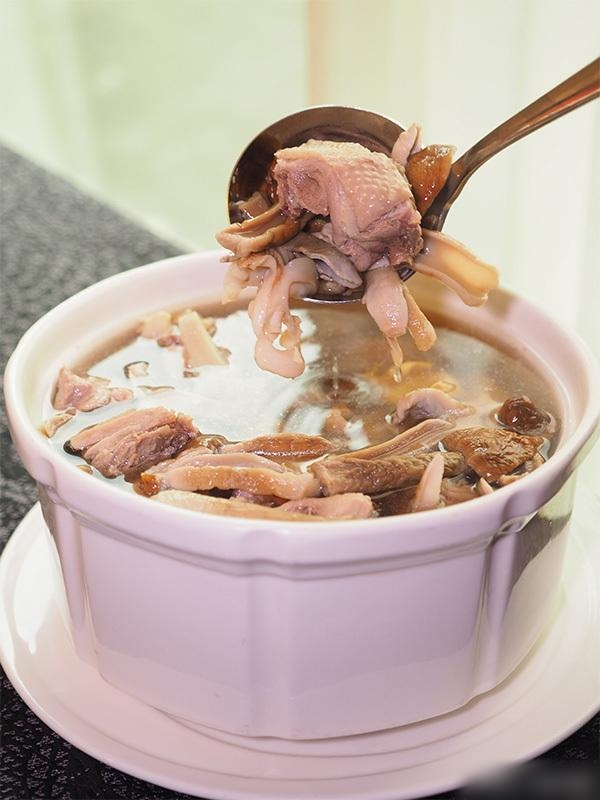
- Lao huo liang tang (老火靓汤): Slow-cooked soup simmered for two to four hours to extract minerals and collagen into a clear, golden broth; the flavor is concentrated and slightly sweet.
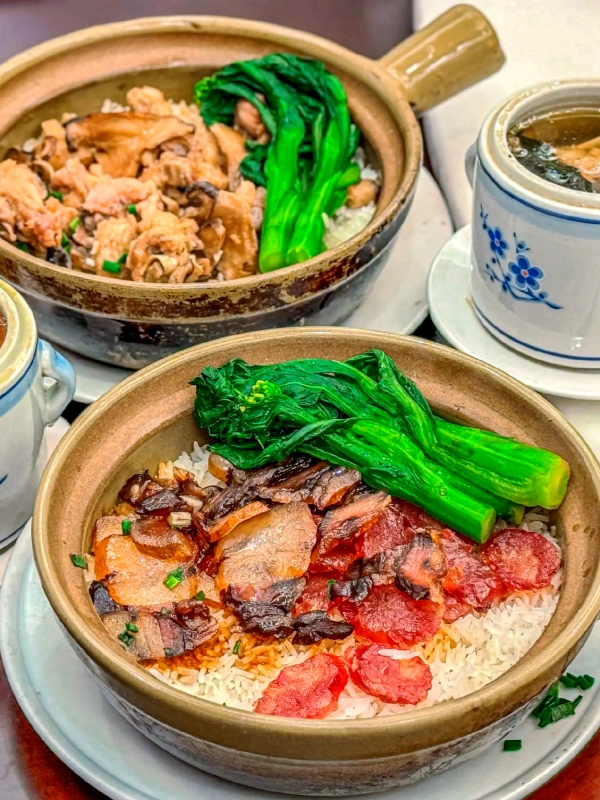
- Claypot rice (煲仔饭): Rice cooked in a small clay pot until the bottom forms a distinct crust; toppings range from Chinese sausage and pork to preserved egg and beef; the crust is the prize.
- Clear broth hotpot: A light, clean broth used as a cooking medium for thin-sliced meats and vegetables; the broth absorbs flavor from everything cooked in it.
How a Few Signature Dishes Are Actually Made
Understanding the technique behind a dish changes how you order it. These four examples show what separates a competent version from an exceptional one.
- White-cut chicken: The bird is cleaned, salt-rubbed, and poached at just below boiling for roughly 20 minutes, then cooled in ice water to set the skin. The result is a firm but silky texture. Served with a dipping oil of minced ginger, scallion, and salt stirred into hot peanut oil.
- Char siu glaze: A mixture of honey or maltose, five-spice powder, dark soy, and a splash of wine applied in multiple coats during roasting; each coat caramelizes before the next is added, building depth of color and flavor.
- Claypot rice crust: The crust forms from the moisture released by the rice itself as it cooks over sustained heat; the cook adds the topping at the right moment, then returns the lid to trap steam and drive the bottom to crispen without burning.
- Har gow wrapper: Made from wheat starch and tapioca starch mixed with boiling water; the dough is rolled thin and translucent, and the pleated edge seals without tearing when the filling is added. Machine-made versions lack the elasticity and bite of hand-rolled skins.
🦀 Taste Chaoshan's Distinct Specialties: Head to the eastern coast of Guangdong to discover a unique culinary tradition famous for ultra-fresh seafood, complex dipping sauces, and slow-braised meats. Learn more in our article on Chaoshan Cuisine in 8 Dishes: From Cold Crab to Braised Goose.
Regional Sub-Cuisines of Guangdong
Guangdong Cuisine
The most common mistake travelers make is treating Guangdong as a single cuisine. The province contains at least three distinct culinary traditions that share the Yue umbrella but differ significantly in geography, ingredients, and technique. Understanding these sub-cuisines is the key to eating purposefully rather than accidentally when you move between cities.
Guangzhou-Style Cantonese (The Core)
The Guangzhou tradition is what most visitors picture when they hear "Cantonese food." Dim sum, siu mei roast meats, white-cut chicken, claypot rice, wonton noodles, and slow-cooked soups all belong to this lineage. The cooking style centers on light soy, oyster sauce, and ginger-scallion aromatics, applied with restraint. Guangzhou and Foshan are the twin capitals of this tradition; the neighborhoods surrounding Shamian Island and along Beijing Road offer both historic teahouses and modern restaurants working in the same idiom.
Chaoshan / Teochew Cuisine
Move east to Shantou, Chaozhou, and Jieyang, and the cuisine shifts noticeably toward the sea. The Chaoshan tradition makes seafood the centerpiece rather than an option, and it favors a clear shang tang (上汤) broth as a base for hotpot and noodle dishes. Cold-marinated raw crab (生腌) — marinated directly in garlic, ginger, and rice wine without cooking — is a regional signature that reflects the Teochew preference for pure, briny flavor. Oyster omelet (蚝烙) and beef hotpot (牛肉火锅) round out a menu that is lighter and less sauced than Guangzhou style, though no less technically demanding.
Hakka (Kejia) Cuisine
The Hakka people are migrants whose ancestors moved from northern China into the mountainous regions of Guangdong, Jiangxi, and Fujian over centuries. Their cuisine reflects this history: it is heartier, saltier, and more centered on preservation and long cooking than the coastal Guangzhou style. Salt-baked chicken (盐焗鸡) — buried in coarse salt and heated until the meat draws the mineral flavor inward — is the signature dish. Meicai kou rou (梅菜扣肉), pork belly layered with preserved mustard greens and steamed until the fat dissolves into the greens, appears on nearly every Hakka menu. Stuffed tofu (酿豆腐) and pounded tea (擂茶) complete a tradition that rewards diners who appreciate depth and comfort over brightness.
Dongjiang and Coastal Variants
The eastern Dongjiang river basin runs a Hakka-influenced sub-stream that differs slightly from the Meizhou core — slightly lighter seasoning, more freshwater fish. Far more dramatic a shift occurs along the western Guangdong coast around Yangjiang and Zhanjiang, where the menu pivots entirely to ultra-fresh seafood. The difference between eating in Guangzhou and eating in a Zhanjiang fishing-village restaurant is as stark as switching between two different cuisines. Live tanks, the smell of the sea, and dishes built around just-caught fish replace the teahouse and dim sum table entirely.
🥟 Discover Essential Dishes: Whether you are ordering dim sum baskets or enjoying classic roast meats, knowing the signature dishes makes navigating menus effo
Guangdong Cuisine
rtless. Check out our guide to Cantonese Food Dishes.
Where to Find Authentic Guangdong Cuisine
Authenticity in Guangdong is less about finding a hidden restaurant than about choosing the right district and knowing what to expect when you walk in. The cities below each offer a different facet of the cuisine; a traveler who wants the complete picture visits at least two or three.
In Guangzhou, Foshan, and Shenzhen
The Pearl River Delta cities are the natural starting point. Guangzhou offers the widest range, from historic teahouses to Michelin-acknowledged kitchens.
- Panxi Restaurant (泮溪酒店): 151 West Longjin Road, Liwan District — a Guangzhou institution serving classic Cantonese fare including a white-cut chicken that has earned regional recognition; the ambiente carries decades of teahouse culture.
- Neighborhood teahouses: Scattered throughout Liwan and Yuexiu districts; look for steam rising from bamboo baskets and tables occupied by morning regulars.
- Siu mei windows: Roast-meat shops throughout the city sell char siu, siu yuk, and siu ngo over rice from takeaway windows; the quality at the best windows rivals sit-down restaurants.
- Shamian Island: A handful of western-style and hybrid restaurants occupy the colonial architecture; the neighborhood is also useful for a food-pace break between heavier meals.
- Shenzhen: The other Guangdong megacity offers a wide Cantonese-and-international dining scene as a byproduct of its population density; prices run slightly higher than Guangzhou but the quality at mid-range is competitive.
In Hong Kong and Macau
Hong Kong represents the global high point of Cantonese fine dining, while Macau contributes its own smaller Cantonese tradition within the Portuguese-influenced food landscape.
- Lung King Heen (龍景軒): IFC Tower, 8 Finance Street, Central — three Michelin stars, the Cantonese flagship of Hong Kong; the tasting menu traces the full range from dim sum to premium seafood.
- Dai pai dong and tea-house dim sum: Open-air and semi-outdoor food stalls throughout Hong Kong Island and Kowloon serve straightforward dim sum and roast meats at a fraction of fine-dining prices.
- Macau: Smaller Cantonese dining rooms operate inside the casino-resort complexes and in the older Peninsula neighborhoods; quality is consistent but the Cantonese scene competes with Portuguese cuisine and international offerings.
In Shantou and the Chaoshan Region
The eastern coastal city of Shantou rewards visitors who make the journey specifically for food. The Teochew tradition is concentrated in the old town district, where small family-run kitchens have operated for generations. Beef hotpot is the regional draw — thin-sliced beef cooked tableside in a clear broth, dipped in a sauce of your choice. Chaozhou cold-marinated crab and oyster omelet are the other two reasons to come; a visitor who leaves Shantou without trying both has missed the point. The region is less tourist-oriented than Guangzhou, which means menus are in Chinese and service may be brisk, but the food quality is uncompromising.
In Meizhou and the Hakka Heartland
Northeast Guangdong's Hakka heartland centers on Meizhou and extends into Heyuan. Salt-baked chicken, meicai kou rou, stuffed tofu, and pounded tea (擂茶) are available at nearly every home-style restaurant in the region — not as specials but as staples. The cuisine is consistent and unpretentious. Travelers who appreciate depth and richness over brightness will find this territory deeply satisfying. Meizhou's old towns offer the additional benefit of a slower pace than Guangzhou or Shenzhen.
Per-Person Budget and What to Expect
Budget levels in Guangdong run across a wide range, and knowing where you are in this spectrum shapes what you should expect from the meal.
- Street and snack level: $3–8 (¥20–55) — siu mei over rice from a takeaway window, wonton noodles from a street cart, egg tarts from a bakery. Quality can be exceptional; atmosphere is minimal.
- Casual dim sum: $15–25 (¥100–180) per person — a full yum cha session at a neighborhood teahouse with six to ten plates, tea included.
- Mid-range sit-down: $20–40 (¥140–280) per person — a restaurant with printed menus, air conditioning, and a broader menu including premium seafood and roast meats.
- High-end Michelin: $150–300+ (¥1,000–2,000+) per person — multi-course tasting menus at three-star kitchens like Lung King Heen; reservation required, often weeks in advance.
On the mainland, most restaurants accept cash and domestic mobile payments; WeChat Pay and Alipay are standard, and foreign cards are rarely processed. Hong Kong Michelin-tier restaurants are bookable through Trip.com and Klook, which serve international users. In Macau, both Hong Kong and mainland payment norms apply depending on the venue.
🍲 Dive into Chaozhou Flavor Profiles: Home to legendary beef hotpot, delicate oyster omelets, and savory rice gruel, Chaozhou offers one of China's most celebrated food cultures. Read our regional overview of Chaozhou Food.
How to Eat Like a Local in Guangdong
Guangdong Cuisine
Understanding the ritual structure of a Cantonese meal transforms the experience from ordering randomly to eating purposefully. The yum cha session and the formal dinner follow different logics, but both reward an understanding of what comes first, what comes second, and when you are expected to stop.
The Yum Cha Ritual
Yum cha — literally "drinking tea" — is the Cantonese breakfast-lunch ritual that runs from roughly 9 a.m. to noon. Arrive at a neighborhood teahouse during this window, sit at a round table, and order tea immediately. Jasmine, pu'er, oolong, and chrysanthemum are the standard options; your server will pour for the table and leave the pot. In older establishments, bamboo steamers arrive on pushcarts; in modern ones, you mark an order sheet. The session ends when you are full, not when a course is finished — there is no fixed number of plates. Weekend mornings are the peak family time, and tables fill quickly in popular teahouses.
Cantonese Meal Structure
Outside the yum cha context, a formal Cantonese dinner follows a clear sequence. Soup arrives first — not as an appetizer but as a functional course believed to prepare the stomach and aid digestion. Shared dishes come next: vegetables, meat, and seafood are distributed from common plates to individual rice bowls. Rice or noodles close the meal and balance the protein. At a shared table of four, expect four to six shared dishes plus soup and rice. Portions are sized for sharing, never for a single diner.
Etiquette and Ordering Tips
These five practices will smooth your experience in any Cantonese dining setting, from a street-level dai pai dong to a three-star kitchen.
- Tap two fingers: When someone at your table pours your tea, tap two fingers on the table as a silent thank you — this gesture replaces an explicit verbal acknowledgment.
- Signal for water: Lift the teapot lid and rest it on the saucer beside the spout; a server will understand you need hot water refilled.
- Never stick chopsticks upright: Placing chopsticks vertically in rice bowls resembles incense at a funeral and is considered deeply impolite; lay them across the top of your bowl instead.
- Sharing is the default: All dishes arrive at the center of the table. Use serving spoons or the blunt end of chopsticks to transfer food to your own bowl rather than eating directly from the shared plate.
- Request milder versions: If you are uncertain about strong offal flavors, ask the server for a lighter preparation — most kitchens will accommodate, and you will avoid dishes that overwhelm rather than reward.
Cooking Techniques, Sauces, and Pantry Basics
Behind every Cantonese dish is a small vocabulary of techniques and a handful of sauces that do most of the work. Familiarity with these building blocks makes the menu far less opaque, whether you are cooking at home or deciding what to order at a table.
Core Techniques
Five techniques cover the vast majority of Cantonese cooking. Each has a specific function and produces a characteristic result.
- Steaming (zheng 蒸): Preserves the ingredient's moisture and natural flavor; used for fish, dim sum, and chicken. A well-steamed fish should taste of itself, with only aromatics and a light sauce for company.
- Stir-frying (chao 炒): High-heat, short-duration cooking in a wok; keeps vegetables crisp and meat tender. The wok's breath — the smoky sear from oil meeting hot iron — is the signature flavor.
- Roasting (kao 烤): Used for the siu mei family; dry heat in a specialized oven caramelizes glazes and crisps skin without drying the meat.
- Double-boiling (dun 炖): A labor-intensive soup method where ingredients in a sealed vessel cook slowly in a water bath; produces crystal-clear broths with concentrated flavor and mineral extraction.
- Braising (men 焖): Slow-cooking in a covered pot with soy, sugar, and aromatics; used for soy-sauce chicken, red-cooked pork belly, and claypot rice.
Sauces and Seasonings
These six sauces form the backbone of the Cantonese pantry. Each has a distinct role, and together they account for most of the flavor you taste in a Cantonese dish.
- Light soy (sheng chou 生抽): The primary seasoning — adds saltiness without darkening the dish; used in almost every savory preparation.
- Dark soy (lao chou 老抽): Adds color and mild sweetness; used for braised dishes and dishes where a deep mahogany appearance is expected.
- Oyster sauce (hao you 蚝油): A reduction of oyster broth with soy; adds savory depth to vegetable dishes, noodle dishes, and stir-fries.
- Hoisin (hai xian jiang 海鲜酱): Sweet and faintly spiced; used primarily as a dipping sauce for roast meats and as an ingredient in some stir-fry preparations.
- Plum sauce (mei jiang 梅酱): Tart and sweet; specifically paired with roast duck and goose; the acidity cuts through the fat.
- Sweet-and-sour sauce (tian su jiang 甜酸酱): Used for lightly battered and fried dishes; balances the richness of the coating with acidity and sugar.
Offal, Snakes, and the Whole-Animal Tradition
Cantonese cooking's commitment to using the whole ingredient means that chicken feet, pig tongue, pork intestine, and beef offal appear in standard dishes — not as curiosities but as regular menu items with dedicated fan bases. Chicken feet in black bean sauce (凤爪) are among the most popular dim sum items in any teahouse. For visitors unfamiliar with these ingredients, it is worth knowing that the texture is the experience, not the novelty. Snakes and other exotic items historically appeared on certain older menus, particularly in winter, but modern tourist-facing restaurants in Guangzhou and Hong Kong have moved away from these unless a visitor specifically asks. Most restaurants now emphasize the more accessible mainstream dishes without requiring adventurous eating.
Frequently Asked Questions
Q: What is Guangdong cuisine?
Guangdong cuisine — also called Cantonese food or Yue cuisine (粤菜 Yuècài) — is the cooking tradition of Guangdong Province in southeast China. One of China's Eight Great Culinary Traditions, it emphasizes fresh, lightly seasoned, and slightly sweet flavors with an ingredient-forward philosophy that dates back over two thousand years.
Q: Is Cantonese food the same as Guangdong cuisine?
Yes in the broad sense — Cantonese is the English name for the Yue (粤) cooking tradition. In practice, "Cantonese cuisine" sometimes refers narrowly to the Guangzhou-centered style, while "Guangdong cuisine" includes the Chaoshan and Hakka sub-cuisines alongside the Guangzhou core.
Q: Is Guangdong cuisine spicy?
No. Guangdong cuisine is the mildest of China's Eight Great Culinary Traditions. Chili heat does not appear in core dishes; the only warm notes come from ginger, scallion, and a touch of white pepper. The mildness is intentional, not an absence of flavor.
Q: What should a first-time visitor order at dim sum?
Start with har gow (shrimp dumplings), siu mai (pork dumplings), cheung fun (rice noodle rolls), char siu bao (BBQ pork buns), and egg tarts. A good starting point for two people is four to six plates; you can always order more as the session develops.
Q: How are the regional sub-cuisines different?
Guangzhou (广府) centers on refined saucy dim sum, roast meats, and claypot rice. Chaoshan / Teochew (潮州) is seafood-dominant with clear broths and cold-marinated dishes. Hakka (客家) uses salt-baked and long-braised preparations that are richer and saltier. Each has its own signature dishes and geographic home within the province.
Q: Where can visitors from abroad find authentic Guangdong food?
Guangzhou, Foshan, Shenzhen, Shantou, Hong Kong, and Macau each offer authentic Guangdong cuisine at different price points. Overseas Chinatowns serve Cantonese food but tend toward a sweeter, adapted overseas style. Hong Kong's Michelin-tier Cantonese restaurants are bookable internationally through Trip.com and Klook.
Q: Are there recipes travelers can recreate at home?
White-cut chicken, char siu glaze, claypot rice, and basic steamed egg custard are among the most approachable home recipes from the Guangdong canon. The Cantonese slow-cooked soup (lao huo tang) is also accessible with a slow cooker and quality ingredients. Technique summaries are provided in the "How a Few Signature Dishes Are Actually Made" section above.