Giant Wild Goose Pagoda, Xi'an
Rising from the south of Xi'an's walled inner city, the Giant Wild Goose Pagoda (大雁塔, Dàyàn Tǎ) is a 64-metre brick pagoda that has anchored Buddhist life in this corner of Shaanxi for nearly 1,400 years. Built under Emperor Gaozong in 652 AD to house sutras brought back from India by the monk Xuanzang, and rebuilt to its present seven-story form under Empress Wu Zetian in 704, the pagoda stands at the north end of Da Ci'en Temple, one of Tang Chang'an's most important Buddhist complexes. Visitors climb an internal wooden stairway to a railed seventh-floor platform with a view across the city's southern half, while the vast North Square immediately north of the temple holds Asia's largest fountain plaza and a free music-light show that runs four times daily. The site sits a ten-minute walk east of the Xiaozhai metro station on Line 2.
Quick Facts
History and Why the Pagoda Was Built
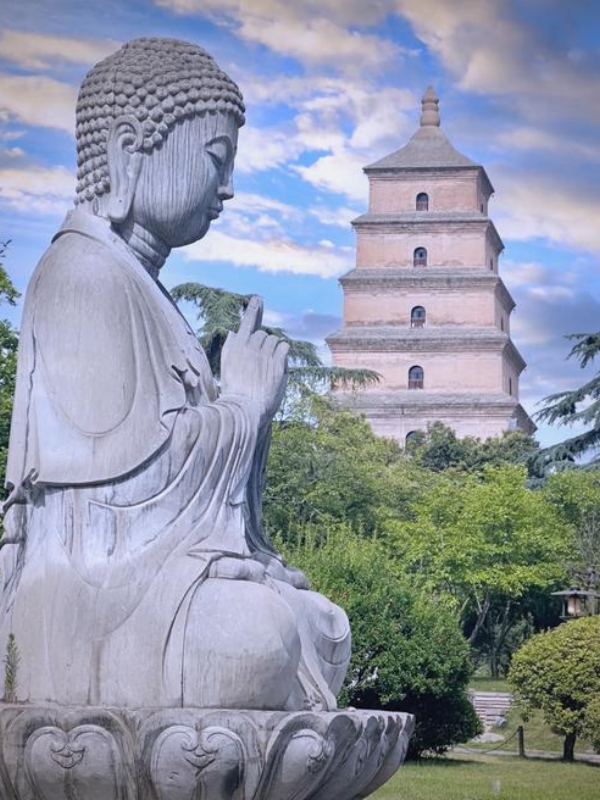
Giant Wild Goose Pagoda, Xi'an
The Giant Wild Goose Pagoda was commissioned in 652 AD by Emperor Gaozong of the Tang dynasty, with the monk Xuanzang (玄奘) acting as its architect and spiritual patron. After spending sixteen years studying in India between 629 and 645, Xuanzang returned with a collection of Buddhist sutras, statues and relics that needed a permanent home. He chose to emulate the Indian stupa form he had observed abroad, placing the relics at the heart of a purpose-built pagoda within the newly founded Da Ci'en Temple complex.
The structure as it stands today dates from a reconstruction ordered by Empress Wu Zetian in 704 AD. That project added two stories to the original five, expanding the brick shell and giving the pagoda its present seven-story square-pavilion profile. The exterior was renovated again during the Ming dynasty, and the pagoda has functioned throughout its history as a sutra repository, a translation centre and a hub of Buddhist learning. The site was inscribed on the UNESCO World Heritage register in 2014 as part of the Silk Road corridor.
The Xuanzang Story
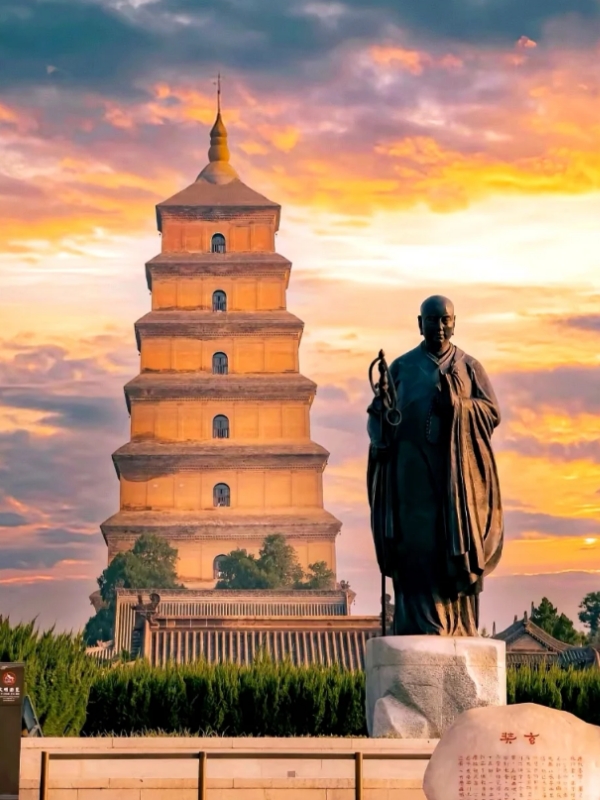
Xuanzang's legendary journey to India became the foundation of the classical Chinese novel Journey to the West (西游记), though the real monk spent sixteen years studying rather than battling demons. His bronze statue now stands directly in front of Da Ci'en Temple's main hall, facing the pagoda he commissioned. The Giant Wild Goose Pagoda is the most visited physical site on the Chinese mainland directly associated with Xuanzang's legacy.
Tang Dynasty Reconstructions
The original 652 AD structure was a five-story rammed-earth and brick pagoda. The 704 AD rebuild under Empress Wu Zetian expanded the base and raised the height to seven stories, creating the tapered square-pavilion form that still defines the skyline. The south-face stone stelae carry inscriptions attributed to Chu Suiliang, a celebrated calligrapher of the early Tang. In 2014 the pagoda, Da Ci'en Temple and the surrounding Buddhist complex were inscribed together on the UNESCO World Heritage list.
🏛️ Explore Top Xi'an Sightseeing Destinations: Beyond the Giant Wild Goose Pagoda, China's ancient capital offers walled city walks, ancient quarters, and historic temples. Plan your sightseeing route with our guide to Xi'an Tourist Places.
Architecture and the Famous Tilt
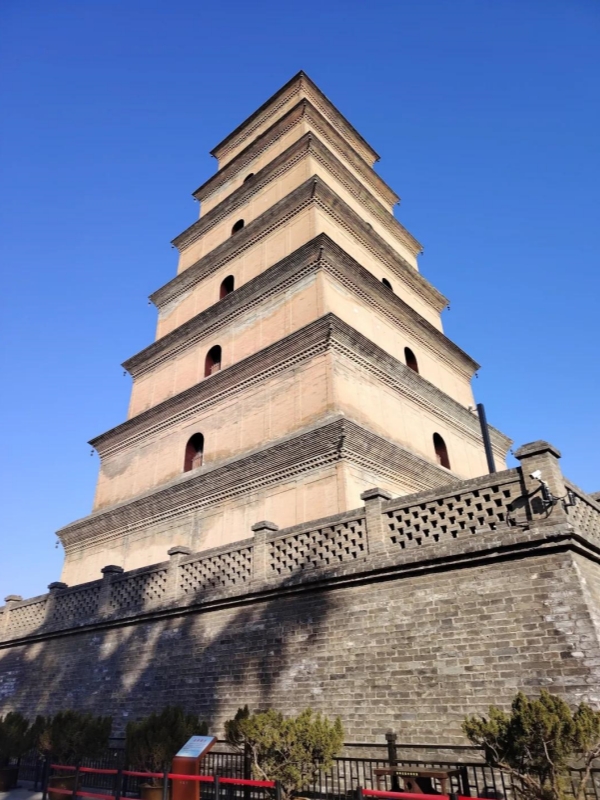
Giant Wild Goose Pagoda, Xi'an
The pagoda follows the square-pavilion (fang-ting) design common to central Chinese Tang-era Buddhist towers. The brick shaft sits on a stone base and tapers inward as it rises, with wooden floor slabs inside. The base measures roughly 25.5 metres per side, and the platform beneath adds a further 4.2 metres of height. Interior room counts vary by level: nine rooms on the first two floors, seven on floors three and four, and five on the upper stories.
- Height: 64 m / 211 ft
- Stories: 7
- Square base: ~25.5 m per side
- Room counts: 9 rooms (floors 1–2), 7 rooms (floors 3–4), 5 rooms (floors 5–7)
- Construction: brick shaft on a stone base, wooden interior floors
Exterior Structure
The square-pavilion style gives the pagoda its tiered, tapering silhouette. Lower floors carry four arched doors oriented to the cardinal directions, while upper levels open to smaller arched niches. The brick-and-clay body has been repointed several times; the Ming-dynasty renovation layer is the most visually apparent on the outer skin.
The Inclined Pagoda
Unlike its more famous counterpart in Pisa, Xi'an's lean has an environmental rather than a foundation cause. The tilt was first recorded in 1719, but accelerated sharply during the 1960s and 1980s when groundwater extraction lowered the water table beneath the pagoda. The lean reached 998 mm by 1985 and 1010.5 mm to the northwest by 1996. After remediation efforts — halting groundwater extraction and installing underpinning — the structure stabilised. The tilt measured 1001.9 mm in 2005, and since 2011 the lean has been returning at roughly 1 mm per year.
- 1719: first recorded lean
- 1985: 998 mm
- 1996: 1010.5 mm
- 2005: 1001.9 mm (post-remediation)
- 2011: stabilised; lean returning ~1 mm/year
🏺 Discover Ancient Tang Relics: Located just a short distance from the pagoda, one of China's premier national museums houses thousands of rare Tang Dynasty treasures and artifacts. Plan your visit with our guide to the Shaanxi History Museum in Xi'an.
Climbing the Tower: Stairs, Floors and What to See Inside
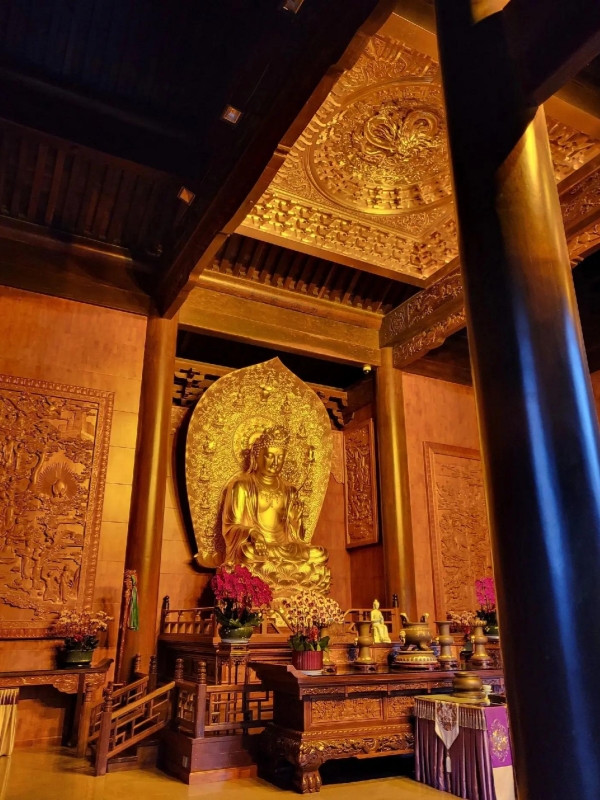
Giant Wild Goose Pagoda, Xi'an
The pagoda climb requires a separate add-on ticket of about $4 (¥30) on top of the Da Ci'en Temple entry. A wooden stairway spirals around the central column, carrying two-way foot traffic through all seven floors. There is no elevator. The passage is narrow and dark in places; visitors with severe mobility limitations or claustrophobia should weigh this before buying the climb ticket. Most visitors spend 25 to 40 minutes inside.
Each floor holds a distinct installation. Seven floors mean seven different exhibits — the pagoda functions as a small museum as much as a climb.
- Basement: stone gate; Sanzang Sheng Jiao Xu stele by Chu Suiliang; Tang-era Emperor Gaozong stele
- Floor 1: inlaid title steles on walls; photo exhibition of Chinese pagodas
- Floor 2: gilt-bronze Sakyamuni figure, Ming-era treasure
- Floor 3: wooden seat housing Buddhist relics; scale model of the pagoda itself
- Floor 4: stone inscription panels
- Floor 5: copied Buddha-footprint tablet (brought to the pagoda by monk Li Tianzhou at Xuanzang's invitation)
- Floor 6: Tang-poetry calligraphy panels (Du Fu, Cen Shen, Gao Shi, Xue Ju, Chu Guangxi)
- Floor 7: railed observation platform; view south across the inner walled city
Floors 1–3
Access begins at the basement level, which is entered through a stone gate at ground level before the main staircase starts. The most historically significant artefact here is the Sanzang Sheng Jiao Xu stele, carved in the calligraphy of Chu Suiliang and recording the circumstances of the pagoda's founding. Above that, floor 1 lines its walls with inlaid title steles and a photographic survey of pagoda architecture across China. Floor 2 rewards close attention: the gilt-bronze Sakyamuni figure dates to the Ming period and is the pagoda's most ornate single artefact. Floor 3 holds the relic-containing wooden seat alongside a precise scale model that makes the tower's proportions easier to read.
Floors 4–7 and the View
Floors 4 and 5 display stone inscription panels and the copied Buddha-footprint tablet respectively — quieter stops than the lower floors, but substantive for anyone interested in the history of Xuanzang's translation project. Floor 6 hangs calligraphy from five Tang poets, including Du Fu, whose hand is represented in copies of his verse. The climb ends at floor 7, a railed platform open to the sky. On a clear day the view extends south across the southern half of Xi'an's walled inner city, with the smaller Wild Goose Pagoda silhouette visible on the western horizon.
🍜 Taste Local Culinary Specialties: After visiting the pagoda and exploring the nearby Xiaozhai neighborhood, refuel with local favorites like biangbiang noodles and savory lamb stew. Discover regional flavors in our guide to Shaanxi Food.
Da Ci'en Temple, North Square and the Music Fountain
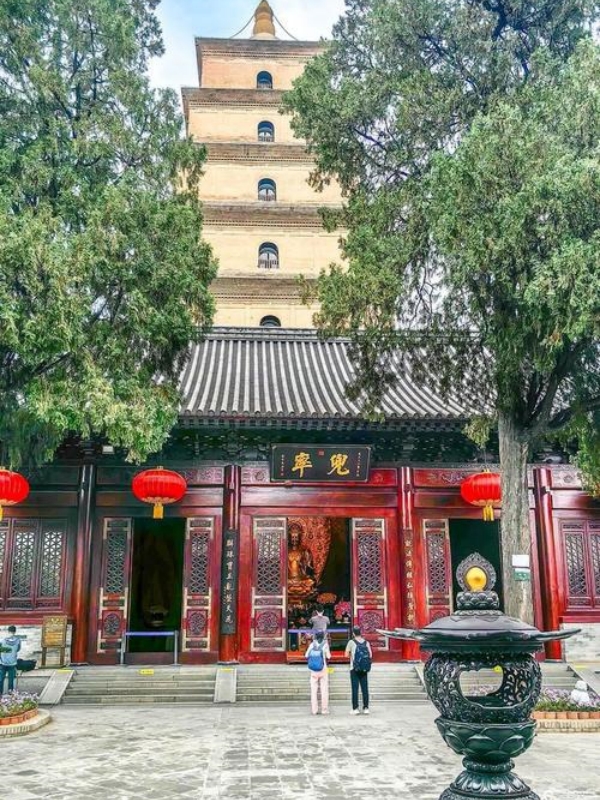
Da Ci'en Temple
The Da Ci'en Temple ticket covers entry to the temple grounds and the pagoda climb. The temple was founded in 648 AD to honour Empress Wu (then Empress Dowager) as the mother of Emperor Li Zhi, and its north-south axis runs directly from the southern gate to the pagoda at the north end. Two principal halls mark the approach: the Hall of Mahavira (大雄宝殿) and the Scripture Hall (藏经楼). The bronze Xuanzang statue stands in front of the main hall, facing the pagoda.
Immediately north of the temple lies the North Square (Da Yan Ta Bei Guang Chang), opened in 2003 and stretching roughly 1,000 metres east to west. It is Asia's largest fountain square by the venue's own description, centred on a large pool and flanked by a two-tower south gate. The square is free to enter and open 24 hours; the music fountain is its centrepiece. The surrounding complex also hosts the annual Big Wild Goose Pagoda Buddhist Culture Festival.
The free music-light fountain runs four times daily. Each show lasts about ten minutes. We recommend the 19:00 or 21:00 slot for the combination of crowd size and after-dark lighting effect.
- 12:00 — daytime show, ~10 min; cancelled every Tuesday
- 16:00 — daytime show, ~10 min; cancelled every Tuesday
- 19:00 — evening show; best for crowd atmosphere and lighting
- 21:00 — late evening show; largest crowds on weekends
- Shows may be cancelled or shortened in heavy rain, fog or high winds
Da Ci'en Temple
The parent temple dates to 648 AD, predating the pagoda by four years. Its two main halls — the Hall of Mahavira and the Scripture Hall — sit on a central north-south axis that leads directly to the pagoda at the northern boundary of the compound. The bronze Xuanzang statue in front of the main hall is the clearest landmark for orientation on entry.
North Square
The North Square opened in 2003 as a civic open space roughly one kilometre long. The central music fountain pool is flanked by a two-tower south gate and backed by an underground shopping concourse. The square is open all hours; the music-light shows run at fixed times but draw their largest audiences in the evening slots.
Music Fountain Showtimes
Four shows run daily at 12:00, 16:00, 19:00 and 21:00, each roughly ten minutes long. The 12:00 and 16:00 daytime shows are cancelled every Tuesday for maintenance. The two evening shows draw substantially larger crowds; on weekends the 21:00 slot is typically the most congested. Adjustments may be made in adverse weather — confirm with on-site signage on the day.
Best Photo Spots
Four locations consistently produce the most distinctive shots of the pagoda and its surroundings.
- North Square east terrace: captures the pagoda rising above the fountain plaza with the modern city skyline behind
- South Square: frames the pagoda alongside the Xuanzang bronze statue; best at dawn or dusk
- Joy City 4F viewing platform: elevated position across the square; strong for a full pagoda-plus-fountain composition
- Xiaoyan Ta Bei Jie (western horizon): at sunset the smaller Wild Goose Pagoda silhouette appears on the skyline beyond the main tower; visible from the west end of North Square or the upper floors of Joy City
Getting There: Metro, Bus and Taxi
Tickets, Opening Hours and Practical Tips
Two separate tickets cover the site: the Da Ci'en Temple base entry (about $7 / ¥50 in peak season, $4.50 / ¥30 off-peak) and a pagoda climb add-on of about $4 (¥30) valid year-round. A combined Day Pass is available on Trip.com and Klook, which we recommend for foreign visitors — the platforms handle payment in foreign currencies and remove the need to queue at the south gate ticket window. Children under 6 and seniors aged 65 and above enter free on presentation of a passport.
Opening hours run 08:00–17:00 from November through February and 08:00–18:30 from March through October. The last climb entry closes 30 minutes before the stated closing time; plan accordingly if you are climbing in the afternoon window. The temple and pagoda may close on certain public holidays — verify the schedule for your travel date before setting out.
- Book combined tickets online: Trip.com and Klook sell a Da Ci'en Temple + pagoda climb bundle; skip the on-site payment queue
- Climb in the morning: large tour groups typically arrive mid-morning; an early start keeps the stairway less crowded
- No elevator: allow 30+ minutes and prepare for seven floors of narrow wooden stairs in both directions
- Enter at the south gate: this is the main entrance and where the pagoda climb ticket is purchased
- Fountain shows are free: the North Square music-light shows require no temple or pagoda ticket; attend on a separate evening if your schedule is tight
Frequently Asked Questions
Q: Can you go inside the Giant Wild Goose Pagoda?
Yes. The pagoda is open for climbing with an add-on ticket of about $4 (¥30) on top of the Da Ci'en Temple entry. The ascent is via an internal wooden stairway only — no elevator — winding through seven floors. The passage is narrow and carries two-way traffic; visitors should allow 25 to 40 minutes total.
Q: Why was the Giant Wild Goose Pagoda built?
It was built in 652 AD to house the Buddhist sutras, statues and relics the monk Xuanzang brought back from India after sixteen years of study. The pagoda also served as a permanent translation and study site for the Tang Buddhist establishment at Da Ci'en Temple.
Q: Who built the Giant Wild Goose Pagoda?
The original pagoda was commissioned under Emperor Gaozong of Tang in 652 AD and built under the direction of the monk Xuanzang. The present seven-story structure dates from a reconstruction in 704 AD ordered by Empress Wu Zetian, which added two stories and gave the pagoda its current form.
Q: What is the Giant Wild Goose Pagoda called in Chinese?
大雁塔 (Dàyàn Tǎ), literally "Big Wild Goose Pagoda". The adjacent temple is 大慈恩寺 (Dàcí'ēn Sì), "Da Ci'en Temple".
Q: How tall is the Giant Wild Goose Pagoda?
The pagoda stands 64 metres (211 feet) tall. It has seven stories and a square base of about 25.5 metres per side. The square-pavilion design tapers inward as it rises.
Q: How much is the entrance fee?
The Da Ci'en Temple base ticket costs about $7 (¥50) in peak season (March–October) and about $4.50 (¥30) off-peak (November–February). The pagoda climb add-on is about $4 (¥30) year-round. A combined Day Pass is available on Trip.com and Klook. Children under 6 and seniors 65 and above enter free on presentation of a passport.
Q: When does the music fountain show run?
Free daily shows run at 12:00, 16:00, 19:00 and 21:00, each about ten minutes. The 12:00 and 16:00 daytime shows are cancelled every Tuesday for maintenance. Evening shows draw the largest crowds; on weekends the 21:00 slot is typically the most congested.
Q: Are there hotels near the Giant Wild Goose Pagoda?
Yes. The Wyndham Grand Xi'an South sits directly on the south side of North Square. The Crowne Plaza Xi'an is a short walk east. Mid-range and budget chains — including Hanting, Home Inn and Atour — cluster around the Xiaozhai metro area, two stops west on Line 2.