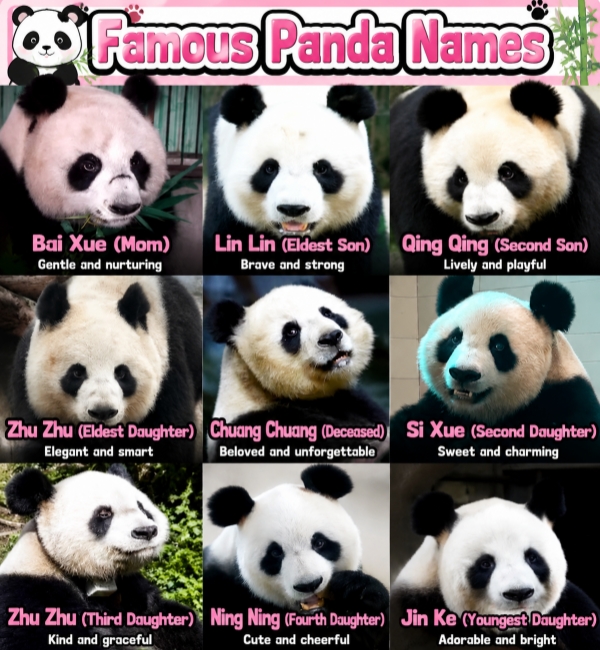
Famous Panda Names
Giant pandas have charmed the world since the first pair arrived in the United States as a diplomatic gift from China in 1972. Each panda carries a name chosen with care — two Chinese characters that encode wishes, symbols, or tributes. Understanding those names opens a window into the culture that raised the world's most recognizable bear. This guide lists the most famous panda names with their characters, pronunciations, and meanings, traces the lineages at the Smithsonian's National Zoo in Washington, D.C., surveys pandas in China and abroad, and offers practical day plans for anyone hoping to see a giant panda in person.
Quick Facts
Why Panda Names Carry Meaning in Chinese Culture
The Chinese word for panda is 熊猫 (xióngmāo), literally "bear cat" — a nod to the animal's round face and eye markings that recall a domestic cat more than a true bear. Chinese naming conventions for pandas tend to follow one of two patterns: characters that describe the individual or characters that express a wish. Double-character names, each made of two syllables, are the standard format; a single character repeated twice creates a sense of affection and endearment, as seen in names like Bao Bao (宝宝, "treasure") and Bei Bei (贝贝, also "treasure").
The character 宝 (bǎo), meaning "treasure," recurs more than any other in panda naming because pandas occupy a unique position in Chinese national identity. They are simultaneously a national treasure (国宝, guóbǎo) and a diplomatic asset, given or loaned to foreign zoos as goodwill ambassadors. Professor Di Qi of Georgetown University's East Asian Languages and Cultures department has noted that this dual status — beloved at home, celebrated abroad — shapes how names are chosen. Names like Tian Tian (添添, "more and more") and Mei Xiang (美香, "beautiful fragrance") express abundance and beauty, wishes that extend naturally to a species seen as a symbol of harmony and conservation.
🐼 Explore Famous Panda Naming Traditions: Interested in how individual pandas get their iconic, double-character names at public ceremonies? Read the full story behind popular names in our guide to Panda Bear Names.
The Smithsonian's National Zoo Pandas
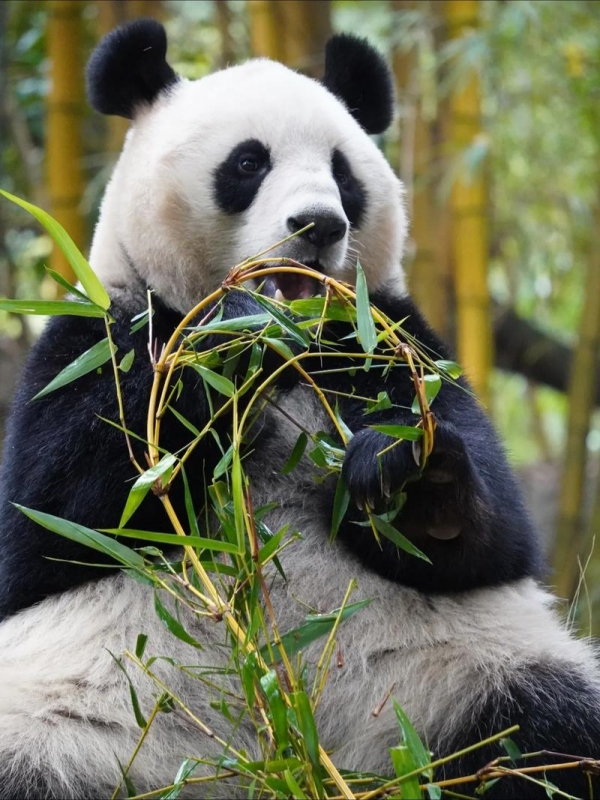
Famous Panda Names
The Smithsonian's National Zoo in Washington, D.C. has been home to giant pandas since April 1972, when Premier Zhou Enlai presented a pair to President Richard Nixon during his historic visit to Beijing. That first gift launched what became a decades-long pattern: pandas on loan from China, their offspring sometimes staying for a few years before returning to Chinese breeding programs. The zoo has hosted three distinct panda generations, each with its own story and naming arc.
Bao Li and Qing Bao: The Current Residents
The Smithsonian welcomed a new chapter in fall 2024 when two juvenile pandas arrived from the China Conservation and Research Center for the Giant Panda in Sichuan Province. Both are grandchildren of Mei Xiang and Tian Tian through their daughter Bao Bao, who herself spent her formative years at the National Zoo. Keepers describe them as distinct personalities settling into the same habitats their grandparents once occupied.
- Parents: Both are offspring of Mei Xiang and Tian Tian via Bao Bao, making them second-generation Smithsonian-born pandas.
- Birth date: Bao Li was born August 4, 2021; Qing Bao was born September 12, 2021.
- Name meaning: Bao Li (宝力) combines treasure (宝) with strength or vitality (力); Qing Bao (青宝) pairs the character for green or lush habitat (青) with treasure (宝).
- Arrival: Both reached Washington in fall 2024 under the current U.S.–China panda cooperation agreement.
- Personality: Zoo staff have noted Bao Li as unusually vocal and people-oriented; keeper Mariel Lally describes Qing Bao as feisty and independent.
Mei Xiang, Tian Tian, and Their Cubs
From 2000 to 2023, the National Zoo's adult giant panda habitat was home to Mei Xiang (美香, "beautiful fragrance," born July 22, 1998) and Tian Tian (添添, "more and more," born 1997). The pair produced four surviving cubs over their 23-year residency, each one drawing enormous public attention and extending the zoo's panda legacy well beyond the original pair's years.
- Tai Shan (泰山, "peaceful mountain"): Born July 9, 2005 — the first surviving cub at the National Zoo since Ling-Ling and Hsing-Hsing decades earlier. Nicknamed "butterstick" by fans for his pale fur coloring. Sent to China in 2010.
- Bao Bao (宝宝, "precious treasure"): Born August 23, 2013. Sent to China in 2017, where she later became the mother of Bao Li and Qing Bao, making her the matriarch of the next Washington generation.
- Bei Bei (贝贝, "precious treasure"): Born August 22, 2015. Named jointly by Michelle Obama and Peng Liyuan at a ceremony at the White House. Underwent intestinal surgery in 2016. Sent to China in 2019.
- Xiao Qi Ji (小奇迹, "little miracle"): Born August 21, 2020, during the COVID-19 pandemic. Approximately 639,000 people watched the zoo's panda cam during his debut. Sent to China in 2023.
Ling-Ling and Hsing-Hsing (1972–1999)
The Smithsonian's original panda pair arrived in April 1972, approximately 18 months old, as part of the landmark diplomatic gesture Premier Zhou Enlai made at a banquet honoring President Nixon. The gift marked a turning point in U.S.–China relations, and the two pandas became instant celebrities upon their arrival at the National Zoo. Both lived far longer than the typical panda lifespan in captivity, with Ling-Ling reaching 23 years and Hsing-Hsing surviving to 28.
- Origin: Gifted by Premier Zhou Enlai; Zhou reportedly said at the Nixon banquet, "I'll give you some. Pandas."
- Naming: Ling-Ling (玲玲, "tinkling/bright") is a common girl's name; Hsing-Hsing (兴兴, "happy/energetic") is a common boy's name.
- Lifespan: Ling-Ling died December 30, 1992 (age 23); Hsing-Hsing was euthanized November 28, 1999 (age 28).
- Cubs: Five cubs were born over the years, but none survived beyond infancy.
Famous Pandas in China and Around the World
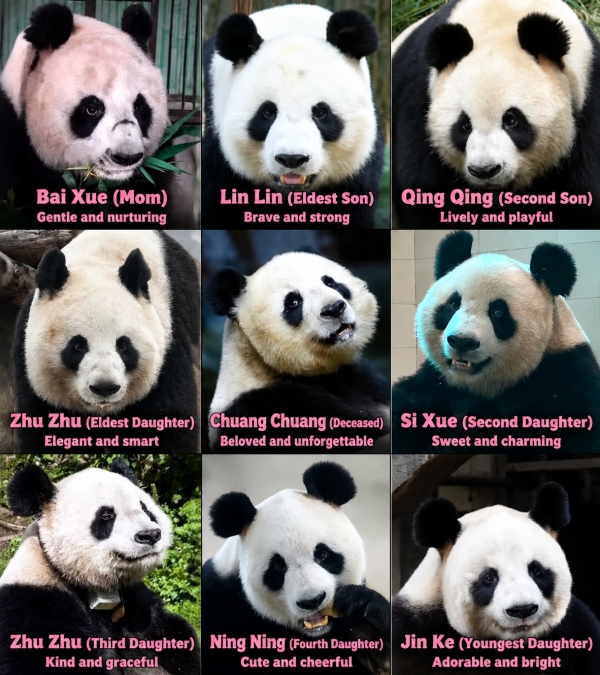
Panda Bear Names
Beyond Washington, D.C., giant pandas have lived in zoos across Asia, Europe, and the Americas under conservation partnership agreements. Each program has produced its own recognizable residents, some of which have become household names in their host countries. The naming conventions remain rooted in Chinese tradition, but the animals themselves carry different cultural weight depending on where they live.
Iconic Pandas at the Chengdu Research Base
The Chengdu Research Base of Giant Panda Breeding is the world's most important center for panda conservation, and its residents are among the most photographed pandas on the planet. Several have gained individual fame for their appearance, behavior, or genetic significance.
- Hua Hua (花花, "flower"): A female born around 2020 at the Chengdu base, notable for her compact size and short legs. Her distinctive silhouette makes her easy to identify among a crowd of pandas, and she has become one of the most recognizable residents of the base.
- Qi Zai (七仔, qī zái): A male panda at the Qinling subspecies research center, famous for his brown-and-white coat — a rare color variation caused by a recessive gene. He is one of fewer than ten known brown pandas in existence.
- Jingjing (晶晶, "crystal"): One of the five Fuwa mascots for the 2008 Beijing Summer Olympics. The stylized panda represented one of the five Olympic rings and embodied the Olympic spirit of harmony.
- Xiang Xiang (香香): A female born at Tokyo's Ueno Zoo in 2017 to parents Rin Tin and Shin Shin (the same pair that arrived in Tokyo in 2012). Her public debut in 2017 required a lottery system for visitors due to overwhelming demand.
Pandas in Europe, Mexico, and Asia
International panda programs have been major conservation milestones and tourism drawcards for their host cities. Each arrival typically involves a formal ceremony and years of collaborative research between Chinese and local veterinary teams.
- Zoo Berlin: Meng Meng (梦梦, "dream") and Jiao Qing (骄庆, "treasured celebration") arrived in 2017. Two cubs were born in 2019 and a third in 2023, marking one of the most successful European breeding programs.
- Edinburgh Zoo: Tian Tian and Yang Guang ("sunshine") were the United Kingdom's only giant pandas during their decade-long loan, which ended without cubs born in Edinburgh.
- Vienna Schoenbrunn Zoo: Long a pioneer in panda breeding, the zoo hosted pairs under the old gift/diplomatic model before transitioning to the loan program era.
- Mexico City Zoo: Xin Xin (星星, "star"), a female born at the zoo, is descended from Pe Pe, one of the first pandas gifted to Mexico in 1972. The lineage has continued at the zoo for more than 50 years.
- Moscow Zoo: Rinchin and Bears, recent arrivals under the cooperative agreement framework, represent Russia's current panda residents.
Famous Pandas in Movies and Pop Culture
Pandas have moved well beyond zoo enclosures into the mainstream of global popular culture. The animal's black-and-white markings, rounded forms, and somewhat clumsy movements make it instantly recognizable as a cartoon or mascot figure, while documentary filmmakers have found rich material in the species' breeding challenges and cub-rearing stories.
Animated and Cartoon Pandas
The most commercially successful panda character in history is undoubtedly Po, the Dragon Warrior from DreamWorks' Kung Fu Panda franchise, which debuted in 2008 and spawned four sequels, television series, and a theme park land. Po — whose name in the film is Po Ping — functions as a hero who defies expectations, a narrative that parallels the panda's real-life status as an underdog conservation story.
- Po: The protagonist of the Kung Fu Panda series (2008–present), trained by Master Shifu in the Jade Palace. The character's name carries the sense of a simple, relatable identity — "Po" is close to the Chinese pinyin pò, suggesting a modest, approachable figure.
- Jingjing (晶晶): The panda mascot from the 2008 Beijing Olympics Fuwa set, representing one of the five Olympic rings and symbolizing health and warmth.
- WWF logo panda: The World Wildlife Fund adopted the panda as its logo in 1961, inspired by Chi Chi, a female panda at London Zoo. The image has since become one of the most recognized brand symbols in the world.
Real Pandas on the Big Screen
Documentary filmmakers have brought pandas from Wolong and the Chengdu base into theaters and IMAX screens, offering audiences close views of panda behavior, maternal care, and conservation work that zoos alone cannot replicate.
- Pandas (2018): An IMAX 3D documentary that follows a panda cub named Tau Tau and his mother at the Wolong Nature Reserve, capturing the critical first two years of the cub's life.
- Born in China (2016): A BBC Earth documentary produced by Disney Nature, using camera teams embedded in the wild panda reserves of central China to film natural panda behavior.
- The Secret Life of the Panda (1980s): An early nature documentary that brought panda cub-rearing behavior to Western television audiences for the first time.
Where to See Pandas in China
Map of Panda in China
Sichuan Province is the center of the panda universe. The three main destinations foreign visitors can practically access are the Chengdu Research Base, the Bifengxia Panda Base in Ya'an, and the Wolong National Nature Reserve near Wenchuan. Each offers a different experience in terms of crowd levels, setting, and the depth of panda access available.
📍 Locate Panda Sanctuaries & Habitats: Planning a trip to see these famous bears in person across Chengdu, Wolong, or foreign zoos? Find research base locations and viewing routes on our Map of Panda sanctuaries.
Chengdu Research Base of Giant Panda Breeding
The Chengdu base is the most visited panda facility in the world and the most accessible for travelers based in Chengdu. Its location in the Chenghua District puts it within 10 kilometers of Tianfu Square, reachable by Chengdu Metro Line 3. The base is organized into three main visitor zones: the original giant panda area with mature adults in expansive outdoor enclosures, the newer Moon Moon Nursery housing sub-adults in a more naturalistic setting, and a red panda zone that visitors often pair with the giant panda tour for comparative viewing.
- Address: 1375 Panda Road, Chenghua District, Chengdu.
- Hours: Typically 07:30–18:00, with last entry around 17:00; confirm on the day of your visit as seasonal adjustments occur.
- Ticket: Adult tickets from about $8–14 (¥55–99), child and student discounts from about $4–7 (¥27–55), bookable on Trip.com or Klook.
- Transport: Take Chengdu Metro Line 3 to Panda Avenue Station (熊猫大道站) — the base is a short taxi ride or shuttle bus from there.
- Best time: Arrive at or shortly after the 07:30 opening. Pandas are most active in the cooler morning hours, and feeding time brings them out of their shelter into the outdoor enclosures before the midday crowds build.
- Walking routes: Allow 3–4 hours for a comfortable visit covering all three main zones. The base is large enough that visitors who rush through in under two hours miss the red panda area and the more remote adult enclosures.
Bifengxia and Wolong Panda Bases
For visitors who want to go beyond Chengdu, the Bifengxia Panda Base and Wolong National Nature Reserve offer settings that feel considerably wilder than the urban research base. Both are in mountain regions southwest and northwest of Chengdu respectively, with forested valleys that give pandas a more naturalistic environment.
- Bifengxia Panda Base: Located in Ya'an (雅安碧峰峡熊猫基地), approximately 150 kilometers southwest of Chengdu, about a 2.5-hour drive via tourist bus from Chengdu. Ticket costs about $11–17 (¥80–120) on Trip.com. The smaller visitor numbers make this a better option for families or anyone who wants to spend unhurried time at each enclosure.
- Wolong National Nature Reserve: The most research-oriented of the three sites, located around 130 kilometers from Chengdu with a longer travel time of 3–4 hours by road. Some mountain roads may close or be restricted after the monsoon season. Wolong is where the famous brown panda Qi Zai originated and where the species' behavioral research programs are centered.
- Reservations: Bifengxia and Wolong both require advance booking on Trip.com or Klook, particularly during Chinese national holidays when domestic visitor numbers spike.
Day Plans by Scenario: Family, Layover, Deep Visit
Choosing the right panda experience depends on how much time you have and what kind of pace suits your group. These three pre-planned frames cover the most common visitor scenarios, with cost estimates for tickets and transport.
Frequently Asked Questions
Q: What is the most famous panda name?
Ling-Ling is widely regarded as the most famous panda name in the West. She lived at the Smithsonian National Zoo from 1972 until her death in 1992, becoming a centerpiece of American–Chinese cultural exchange during her two decades on display. However, the WWF panda logo, adopted in 1961, was inspired by Chi Chi, a London Zoo resident — making her arguably the world's most reproduced panda image even though she never lived in the United States.
Q: What are some famous female panda names?
Several female pandas have become internationally known. Mei Xiang (美香) was the National Zoo's matriarch from 2000 to 2023. Ling-Ling (玲玲) was the Smithsonian's first female panda, gifted in 1972. Bao Bao (宝宝) was born in Washington in 2013 and returned to China in 2017, where she became the mother of the current Washington residents. Hua Hua (花花) is one of the most photographed pandas at the Chengdu base, and Chi Chi was the London Zoo female who inspired the WWF logo.
Q: What are some famous male panda names?
Notable male panda names include Tian Tian (添添), the National Zoo's adult male who lived in Washington from 2000 to 2023. Tai Shan (泰山) was the zoo's first surviving male cub, born in 2005 and nicknamed "butterstick" for his pale coloring. Bei Bei (贝贝) was born in 2015 and named at a joint ceremony with Michelle Obama and Peng Liyuan. Tuan Tuan (团团) was the male in the Taipei Zoo pair, whose paired name with Yuan Yuan means "reunion."
Q: Who is the panda named Ling-Ling?
Ling-Ling (玲玲) was a female giant panda who arrived at the Smithsonian National Zoo in April 1972 as one of the two pandas Premier Zhou Enlai gifted to the United States during President Nixon's historic visit to Beijing. She lived at the zoo for 20 years, reaching age 23 before her death on December 30, 1992. During her residency she gave birth to five cubs, none of whom survived beyond infancy, a circumstance that was shared by her partner Hsing-Hsing.
Q: What are famous pandas in movies and cartoons?
The most recognizable panda in film is Po, the Dragon Warrior from DreamWorks' Kung Fu Panda franchise. The 2008 Beijing Olympics Fuwa mascot set included Jingjing (晶晶), a stylized panda representing one of the five Olympic rings. The WWF logo panda, which has been in continuous use since 1961, was inspired by Chi Chi of London Zoo. The IMAX documentary Pandas (2018) brought a real Wolong cub named Tau Tau to international audiences.
Q: Are red pandas also famous?
Red pandas (Ailurus fulgens) are a separate species from giant pandas and much smaller, with fox-like faces and rust-colored fur. Some have gained pop-culture recognition — Master Shifu from Kung Fu Panda is a red panda, and Pabu from The Legend of Korra is a fire ferret often compared to a red panda. Live red pandas in zoos include Roux at the Smithsonian's small-mammal exhibit and Mosi at the Cincinnati Zoo, though the term "famous panda" almost always refers to the giant panda.
Q: How do you write famous panda names in Chinese characters?
All of the Smithsonian's famous pandas use two Chinese characters written together: Bao Li (宝力), Qing Bao (青宝), Mei Xiang (美香), Tian Tian (添添), Tai Shan (泰山), Bao Bao (宝宝), Bei Bei (贝贝), Xiao Qi Ji (小奇迹), Ling-Ling (玲玲), and Hsing-Hsing (兴兴). International pandas follow the same pattern: Chi Chi (池池), Tuan Tuan (团团), Yuan Yuan (圆圆), and Hua Hua (花花).
Q: Where can I see giant pandas outside China?
Several foreign zoos currently host or have recently hosted giant pandas. The Smithsonian National Zoo in Washington, D.C. has Bao Li and Qing Bao as of fall 2024. Zoo Atlanta housed the Lun Lun line through 2024 under its cooperative agreement. Zoo Berlin's Meng Meng and Jiao Qing have had multiple cubs. Ocean Park Hong Kong and Taipei Zoo have also maintained panda programs. Note that as of 2025, many foreign-zoo panda agreements are in renewal phases and several programs have ended their initial terms — check current status on the relevant zoo's official website before planning a visit.