Autumn in China
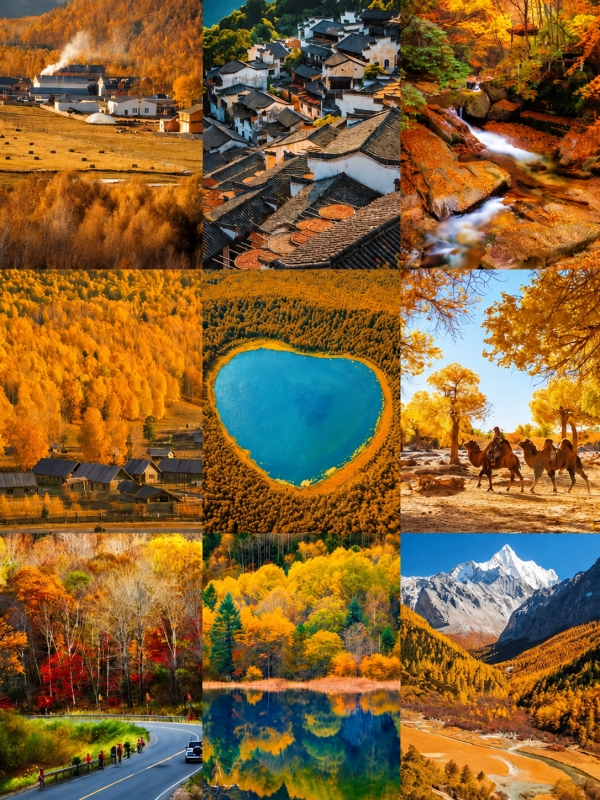
China transforms each autumn. The summer heat breaks, temperatures drop into comfortable ranges across most of the country, and the landscape erupts in gold, amber, and crimson. September through November marks the prime travel window for foreign visitors — foliage peaks cascade from the northern provinces down to the south, and the Mid-Autumn Festival brings lantern-lit streets and family feasts under the harvest moon. Whether you want to walk the Great Wall in cool air, photograph Kanas Lake ringed in birch gold, or share a mooncake with locals in Hong Kong, autumn is the season to go. This guide covers when to go, where the leaves turn first, the 2025 Mid-Autumn Festival dates and traditions, and the practical steps to book and pay for a trip from abroad.
Quick Facts
Best Autumn Destinations in China by Region
China's autumn scenery varies dramatically by latitude, altitude, and ecosystem. Northern provinces offer the earliest color — poplar forests blazing gold and larch turning amber in Inner Mongolia — while the southwest and east peak later as maples and ginkgo dress ancient villages in crimson. The destinations below are organized by region so you can plan coherent routes and compare entrance fees in one place.
Northern China and Inner Mongolia
Northern China and Inner Mongolia
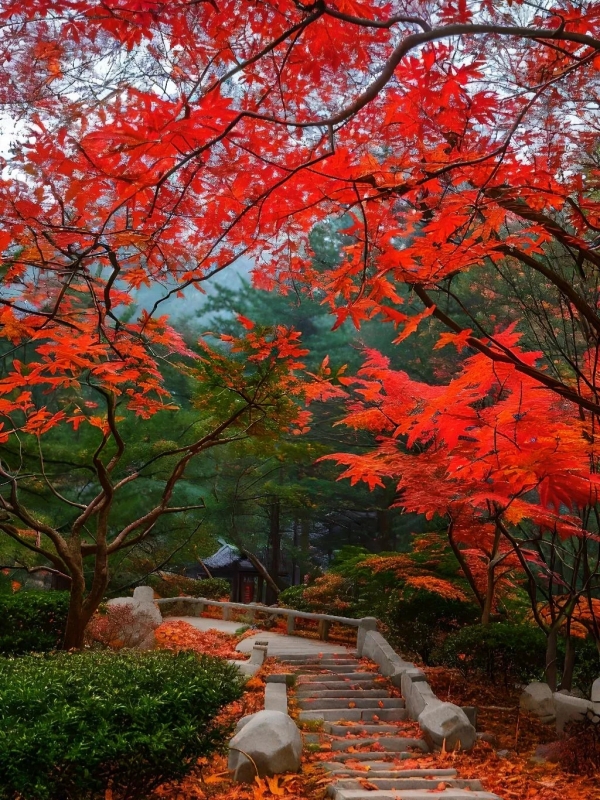
Beijing and the northern Hebei rim offer the most accessible autumn color for travelers based in the capital. The following four spots provide distinct experiences — from a UNESCO-listed Great Wall section to a grassland that turns amber in weeks.
- Xiangshan (Fragrant Hills) Park, Beijing: About $1–2 (¥10) entrance. Maple and ginkgo color peaks late October to mid-November. Arrive early on weekends to avoid crowds.
- Simatai Great Wall, Miyun: About $6 (¥40). The UNESCO-listed "Primitive Great Wall" section retains original battlements. Foliage peaks late October; the wall catches low sun beautifully in the afternoon.
- Bashang Grassland, Northern Hebei: Grassland access typically free. The plateau turns golden mid-September to early October — grass fades fast, so timing matters.
- Ejin Banner Poplar Forest, Inner Mongolia: Forest access free; specific scenic patches charge about $4–7 (¥30–50). The most photographed poplar forest in China peaks late September to mid-October. Hotels book out two months ahead — reserve early.
🍂 Experience Autumn in the Capital: For crisp air, golden ginkgo avenues, and stunning fall foliage along the Great Wall, explore our detailed guide to Beijing Autumn.
Kanas Lake and Hemu Village
Kanas Lake and Hemu Village
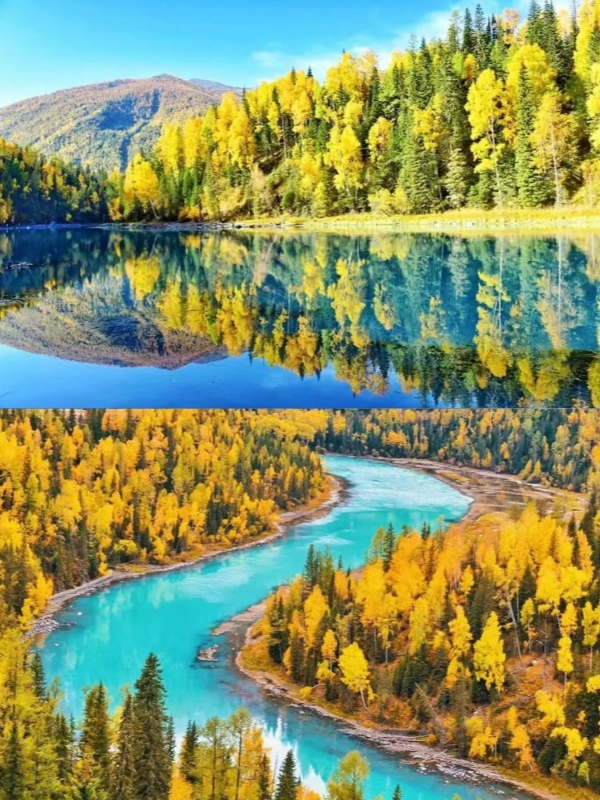
The Altay region in northern Xinjiang holds the most dramatic autumn scenery in China — a remote setting that rewards the extra travel time. Kanas Lake and the nearby Tuvan village of Hemu form a natural two-to-three day circuit.
- Kanas Lake, Altay: About $26 (¥185) peak season (May 1 – Oct 15), $13 (¥90) off-peak, plus roughly $11 (¥80) for the mandatory sightseeing bus. The lake's water shifts color through the day; the "lake monster" legend adds local color. Foliage window runs mid-September to early October. Access via Urumqi flight plus 4–5 hour drive.
- Hemu Village: About $7–11 (¥50–80) entry. Iconic wooden Tuvan cabins sit beneath birch groves turning gold. Best visited as a day trip or overnight from Kanas. The village gives the best aerial views at sunrise when mist settles over the valley.
🏮 Master Seasonal Vocabulary & Traditions: Learn how traditional lunisolar terms define China’s seasonal transitions and cultural celebrations in our guide to Seasons in Chinese.
Sichuan and Yunnan Highlands

Sichuan and Yunnan Highlands
The highland provinces of Sichuan and Yunnan deliver a double attraction — some of China's most spectacular natural parks and some of its most vivid autumn foliage. Altitude drives the timing, so October covers most of the peak windows.
- Jiuzhaigou Valley, Northern Sichuan: About $24 (¥169) peak (Apr 1 – Nov 15), $11 (¥80) off-peak. UNESCO 1992 site. Colored lakes (Nuorilang, Five Flower) sit beneath conifer forests turning gold and red. Peak runs mid to late October. Buy the official sightseeing bus add-on — the park is too large to walk between lakes.
- Daocheng Yading, Western Sichuan: About $38 (¥270) combined ticket plus bus; optional ~$11 (¥80) battery cart to Luorong Pasture. Altitude exceeds 4,000 m. Mid-October to early November brings crisp air and gold rhododendron forests against snow-capped peaks.
- Shangri-la / Pudacuo National Park, Northwest Yunnan: About $14–20 (¥100–140). Wetland and forest scenery at 3,500 m; foliage peaks late September to mid-October.
- Dongchuan Red Land, Yunnan: About $4 (¥30). Striped red and ochre soil palettes photograph best mid-October through November. The red intensifies after the first autumn rains.
- Miyaluo, Lixian, Sichuan: About $4 (¥30). The largest contiguous red-leaf area in China; maples and birches turn October to early November. Less visited than Jiuzhaigou, with lower entrance fees.
🌸 Planning a Spring Trip Instead? If your travel schedule falls earlier in the year when flowers are in full bloom across the country, check out our seasonal guide on Where to Visit China in Late April.
Yellow Mountain, Wuyuan and Anhui Villages

Yellow Mountain, Wuyuan and Anhui Villages
Eastern China's Hui-style villages and mountain scenery offer a different aesthetic — white-wall grey-tile architecture framed by maple and ginkgo. This region suits travelers who want to combine natural color with historic towns and shorter travel times from Shanghai or Hangzhou.
- Huangshan (Yellow Mountain), Anhui: About $32 (¥230) entrance plus $11–14 (¥80–100) one-way cable car. UNESCO mixed heritage. October through November peaks. The sea of clouds above the granite peaks pairs with foliage for one of China's most photographed natural scenes.
- Wuyuan, Northeast Jiangxi: Single-village access often free; about $8 (¥60) for the 12-scenic-spot pass. Late October through November brings ancient Hui-style villages (Chengxi, Likeng) framed by maple. It is the most popular rural destination for photographers in eastern China.
- Tachuan Village, Yi County, Anhui: About $3–4 (¥20–30). A small village of white walls and grey tiles backed by forested hills. Late October to mid-November is peak. Combine with nearby Hongcun and Huangshan for a three-day Anhui loop.
- Qixia Mountain, Nanjing, Jiangsu: About $3–5 (¥25–40). Seven hundred fifty hectares of maples turn mid-October. Easy day trip from Nanjing; less crowded than Huangshan.
☀️ Compare Autumn vs. Summer Travel: Curious about how fall weather compares to the peak summer heat and midyear travel surge? Read our guide to traveling in China in July.
Gorges and Mountains of Central China
Gorges and Mountains of Central China
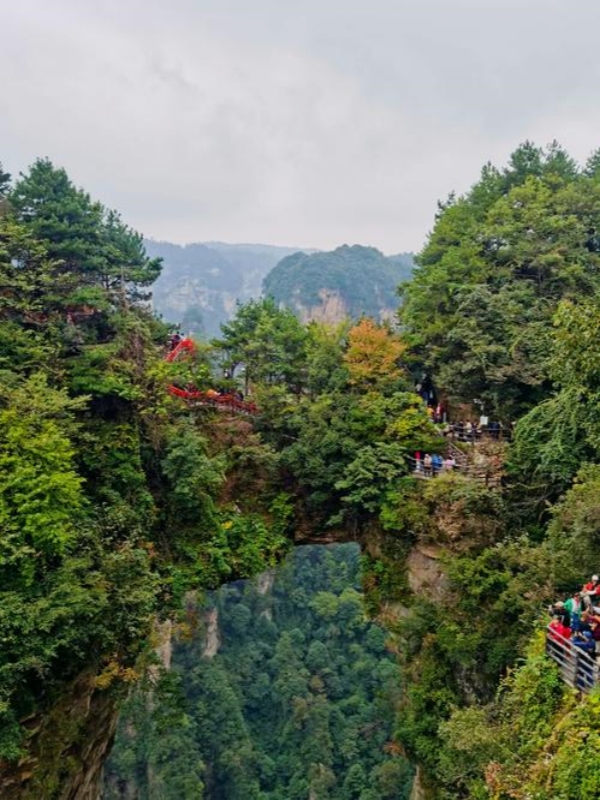
Central China's autumn offering spans Hunan's pillar-like sandstone formations, the Yangtze's cliff-bound gorges, and Jiangxi's lakeside peaks. This region works well as a second leg after the east or southwest.
- Zhangjiajie National Forest Park, Hunan: About $32 (¥225). UNESCO 1992 Wulingyuan complex. October brings red-leaf accents to the pillar formations; misty mornings add drama. Budget a full day — the park covers four separate areas connected by shuttle buses.
- Wu Gorge, Yangtze River: Gorge access free; river cruises run $140–700 (¥1,000–5,000) for 3–4 night sailings. September and October deliver red-leaf cliffs along the Qutang and Wu stretches. Chongqing and Yichang serve as boarding ports.
- Mount Lu (Lushan), Jiangxi: About $18–23 (¥135–160). UNESCO 1996. A UNESCO-listed mountain with villas, temples, and pine forest from a summit crater. Late October brings yellow ginkgo and red maples. The UNESCO designation covers both the natural and cultural landscape.
Mid-Autumn Festival Dates and Traditions
The Mid-Autumn Festival (Zhongqiu Jie) ranks as one of China's two most important traditional holidays, alongside Chinese New Year. It falls on the 15th day of the 8th lunar month — always a full moon night. In 2025 the festival lands on Monday, October 6, with a three-day statutory holiday running from Saturday, October 4 through Monday, October 6. Transport and hotel prices surge during this window, particularly in tier-1 cities and near major scenic areas. When the Mid-Autumn date falls close to National Day (October 1), the two holidays merge into an 8-day Golden Week stretch that floods the first half of the period and empties the second.
For travelers, the festival offers a rare window into Chinese domestic culture — mooncake stalls fill streets, lanterns appear in parks and temples, and families gather outdoors to gaze at the moon. Regions like Fujian, Guangdong, and Hong Kong preserve the most vivid traditional practices, including fire-dragon dances and temple lantern processions.
2025 Dates and Public Holiday Schedule
The 2025 Mid-Autumn Festival falls on Monday, October 6. The statutory holiday runs Saturday October 4 through Monday October 6, with the prior weekend shifted to create three consecutive days off. Plan high-speed rail and internal flights at least two weeks ahead — domestic travel demand spikes sharply during the holiday window. Looking ahead, the 2026 festival falls on Monday September 21, and 2027 lands on Wednesday September 15. Every few years the Mid-Autumn date coincides with National Day, producing the extended "Golden Week plus" travel pattern.
Traditions, Mooncakes and Lanterns
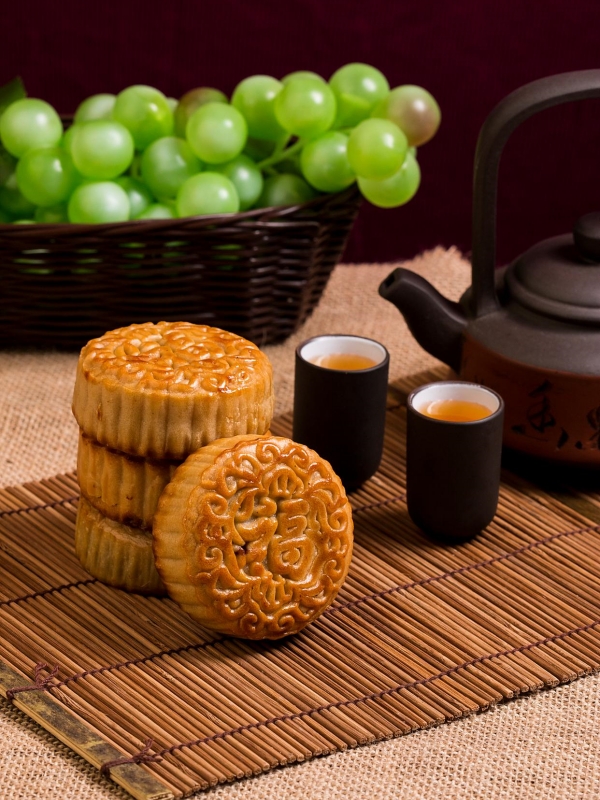
Mooncake of Mid-Autumn Festival
Five core traditions define the Mid-Autumn Festival. Each offers a distinct angle for travelers who want to participate rather than just observe.
- Family reunion dinner: The defining meal of the festival — extended families travel from across the country to eat together under the full moon. Restaurants in cities like Guangzhou, Xiamen, and Chengdu fill to capacity; book tables three to five days in advance.
- Mooncake gifting: Moon cakes (yuebing) are the festival's signature food and a ubiquitous gift. Prices range from about $1–$7 (¥10–¥50) for single cakes up to $14–$70 (¥100–¥500) for premium gift boxes featuring lotus-paste, mixed-nut, or snow-skin varieties.
- Pomelo: The pomelo ripens in autumn and features prominently in southern households as a seasonal marker and offering placed on family altars.
- Moon gazing: Parks, rooftop bars, and lakeside promenades fill with people watching the full moon. Beijing's Houhai district, Shanghai's Yu Garden area, and Guilin's Li River banks are popular urban spots.
- Children's lanterns: Paper, electric, and increasingly recycled-material lanterns appear on streets and in parks across the country. Hong Kong's Victoria Park lantern carnival and Tai Hang fire-dragon procession are among the most spectacular displays.
Where to Experience Mid-Autumn in China
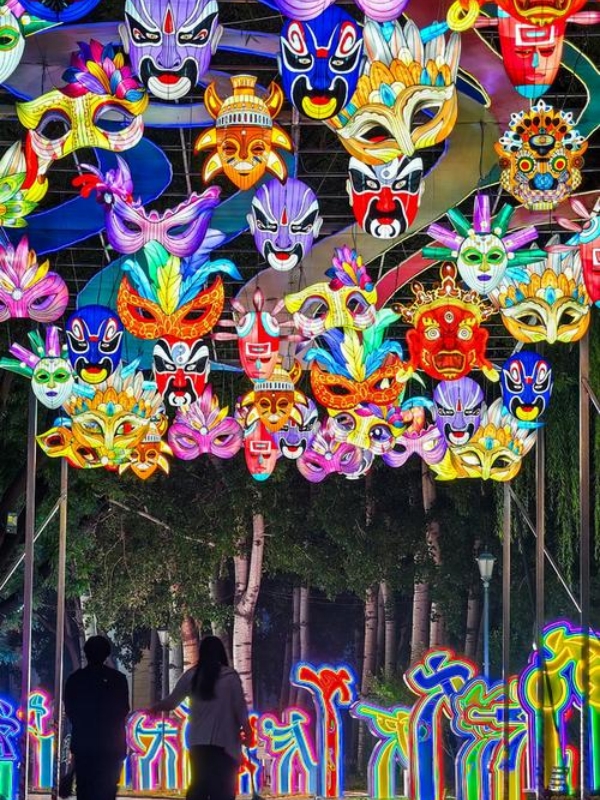
Mid-Autumn Festival Lanterns
The liveliest Mid-Autumn atmosphere for foreign visitors concentrates in a handful of cities. Xiamen (Fujian) maintains strong temple lantern traditions and the Hulishan Cannon Platform offers moon gazing over the sea. Hong Kong delivers the most dramatic public spectacle — the Tai Hang fire dragon weaves through streets and Victoria Park hosts a lantern carnival. Beijing's Beihai Park runs moon-viewing events, while the Houhai bar district fills with locals and visitors sharing mooncakes by the lake. Shanghai's Yu Garden and City God Temple area host lantern festivals and night markets.
For photographers, Guilin and Yangshuo along the Li River provide karst silhouetted peaks under a full moon — a sought-after combination. Avoid booking hotels in tier-1 cities during the holiday window unless you can absorb 2–4× price spikes; smaller towns like Yangshuo, Wuyuan, and Lijiang offer a more affordable and intimate festival experience.
Autumn Timing and Weather Across China
Autumn in China means different things depending on where you stand. The meteorological season runs September through November. Foliage, however, moves southward over roughly ten weeks — northern provinces peak first, followed by the highlands and central ranges, then the southern rim in November and December. The drop in humidity and summer haze makes autumn the clearest season for photography at high-altitude destinations like Daocheng Yading and Kanas Lake. However, rainfall persists in the south and along the Qinghai-Tibet Plateau edge, while the north dries out quickly after September.
Daylight shortens fast after the autumnal equinox (around September 23). In Xinjiang and Inner Mongolia, sunsets arrive before 6:30 PM by late October. Pack a headlamp if you plan early-morning or late-afternoon hikes.
Regional Autumn Timing and Temperature
What to Pack for Autumn in China
Layering is the key principle. Mornings can be cold even in Beijing by October, while afternoons in the sun feel almost warm. The packing list below covers the practical essentials for a multi-region autumn trip.
- Layered clothing: Bring base layers, a mid-layer fleece or sweater, and a shell jacket — mornings hover near 5°C in the north while afternoons reach 20°C.
- Light windbreaker or fleece: The wind on exposed ridges (Simatai Wall, Huangshan) cuts through single layers fast.
- Comfortable hiking shoes: Trails at Kanas, Yading, and Miyaluo are uneven; waterproof soles handle morning frost and muddy patches.
- Compact umbrella: Autumn rain lingers in Yunnan, Guangxi, and along the Qinghai-Tibet Plateau edge — a collapsible umbrella takes no space.
- High-SPF sunscreen: UV at altitude (Daocheng Yading at 4,000 m, Kanas at 1,400 m) remains intense well into October.
- Lip balm and moisturizer: Continental autumn air dries quickly; this is especially relevant in Xinjiang and Inner Mongolia.
- Camera with spare batteries: Cold temperatures drain charge faster — carry at least one spare battery per camera body.
Booking Autumn Trips to China from Abroad
Foreign visitors face specific booking and payment challenges in China. Domestic platforms like Meituan, Dianping, and most scenic-area WeChat mini-programs require a mainland phone number and either Alipay or WeChat Pay — none of which most tourists have on arrival. The good news: major international platforms now cover most attractions, and payment apps have opened to foreign credit cards. Plan these logistics before you arrive rather than on the ground.
Visa Entry and Travel Documents
Many nationalities currently qualify for visa-free entry to China — this includes nationals of Singapore, Malaysia, Thailand, France, Germany, Italy, Spain, the Netherlands, Australia, New Zealand, South Korea, and Japan, among others. Stays typically range from 15 to 30 days depending on nationality. A 240-hour visa-free transit is also available at most major hub airports. Visa on arrival is not available for most nationalities. Always re-check the Ministry of Foreign Affairs list immediately before booking — visa policies shift. Your passport needs at least six months of validity and one to two blank pages.
Channel-Bookable Platforms and VAT Refunds
Two platforms serve foreign visitors reliably for scenic-area tickets, hotels, and airport transfers: Trip.com and Klook. Both accept international credit cards in USD or EUR and list admission prices for most parks in this guide. TripAdvisor booking partners offer an additional option. For VAT refunds on shopping, the rules are straightforward.
- Spend at least ¥500 (~$70): Purchases must meet this threshold at any "Tax-Free Shopping" authorized store (look for the blue duty-free sign in windows).
- Request the Tax-Free Shopping Form: Ask at point of purchase; the store staff will provide the form and a receipt.
- Claim at the airport on departure: Present the form, receipts, goods, and your passport at the VAT-refund counter. Approved departure airports include Beijing Capital, Shanghai Pudong, Guangzhou Baiyun, and Chengdu Shuangliu. The refund rate is roughly 11% after a small processing fee.
- Alipay Tour Pass and WeChat Pay: Both now allow Visa and Mastercard top-ups for foreign visitors without a mainland bank account. Set this up before arrival to cover taxis, convenience stores, and small restaurants.
Spotting Genuine Experiences and Avoiding Crowds
A few practical checks save frustration once you are in the country. Autumn is peak season — crowds at popular parks can be substantial, and not every "English guide" listing meets professional standards.
- Verify foliage timing against two independent recent reports: Blog posts frequently miss the window by one to two weeks. Look for dates from the current calendar year.
- Buy the official sightseeing bus at Jiuzhaigou, Kanas, and Yading: The parks are too large to cover on foot; the bus is mandatory at these three sites.
- Visit the Sunday after a three-day holiday for the lowest density: Crowds spike during holiday windows (Mid-Autumn, National Day) and drop sharply the following day.
- Book Ejin Banner hotels two months in advance: The poplar forest's small hotel supply sells out fast during peak late September.
- Request a guide's official certificate number: Some aggregator-site listings describe a "translator and driver" as an "English guide." A licensed guide holds an official tourism certificate — ask for the number and verify it on the local tourism bureau site.
Frequently Asked Questions
Q: When is autumn in China?
Meteorological autumn runs September through November. The solar term "Beginning of Autumn" (Liqiu) falls around August 7–8, but the user-meaningful season — cool weather and colorful foliage — begins in September. The autumnal equinox around September 23 marks roughly the midpoint of the season.
Q: What month is best for fall foliage in China?
Late September suits Xinjiang's Kanas Lake and Inner Mongolia's Ejin Banner poplars. Mid to late October covers Beijing's Xiangshan Park, northern Sichuan's Jiuzhaigou, and the Simatai Great Wall. Late October through mid-November brings peak color to Huangshan, Wuyuan, Tachuan, and Mount Lu. November through early December is the window for Dongchuan Red Land in Yunnan and southern provinces.
Q: When is the Mid-Autumn Festival in 2025?
Monday, October 6, 2025 — the 15th day of the 8th lunar month. The statutory public holiday runs Saturday October 4 through Monday October 6. The 2026 festival falls on Monday September 21; 2027 lands on Wednesday September 15.
Q: How long is the Mid-Autumn Festival holiday?
The holiday runs three consecutive days — the festival day plus the surrounding weekend, adjusted so the block is continuous. When the festival falls near National Day (October 1), the two holidays merge into a 7–8 day "Golden Week plus" stretch.
Q: How is the Mid-Autumn Festival celebrated in China?
Families gather for a reunion dinner under the full moon and share mooncakes — the festival's signature sweet. Lanterns appear on streets and in parks, particularly with children's paper and electric varieties. In southern regions (Fujian, Guangdong, Hong Kong) more elaborate customs persist: pomelo offerings on family altars, dragon dances, and the Tai Hang fire-dragon procession in Hong Kong. The three-day window also triggers large domestic tourism surges.
Q: Is the Mid-Autumn Festival a public holiday in China?
Yes. The Mid-Autumn Festival is one of China's two most important traditional public holidays, alongside Chinese New Year. Banks, government offices, and most businesses close for the full three-day statutory holiday block.
Q: How do I get a VAT refund when shopping in China?
Spend at least ¥500 (~$70) at a "Tax-Free Shopping" authorized store — look for the blue sign in shop windows. Ask for the Tax-Free Shopping Form at the point of purchase. On departure, present the form, receipts, goods, and your passport at the VAT-refund counter at Beijing Capital, Shanghai Pudong, Guangzhou Baiyun, Chengdu Shuangliu, or other approved departure ports. The refund is roughly 11% of the purchase price after a small processing fee.
Q: Do I need a visa to visit China in autumn?
Many nationalities qualify for visa-free entry of 15–30 days — this covers much of Europe, Australia, New Zealand, South Korea, Japan, Singapore, Malaysia, and Thailand. Other nationalities must apply for a visa at a Chinese consulate before travel. Visa on arrival is not available at ports of entry for most passport holders. Re-check the Ministry of Foreign Affairs visa policy immediately before booking, as rules change.