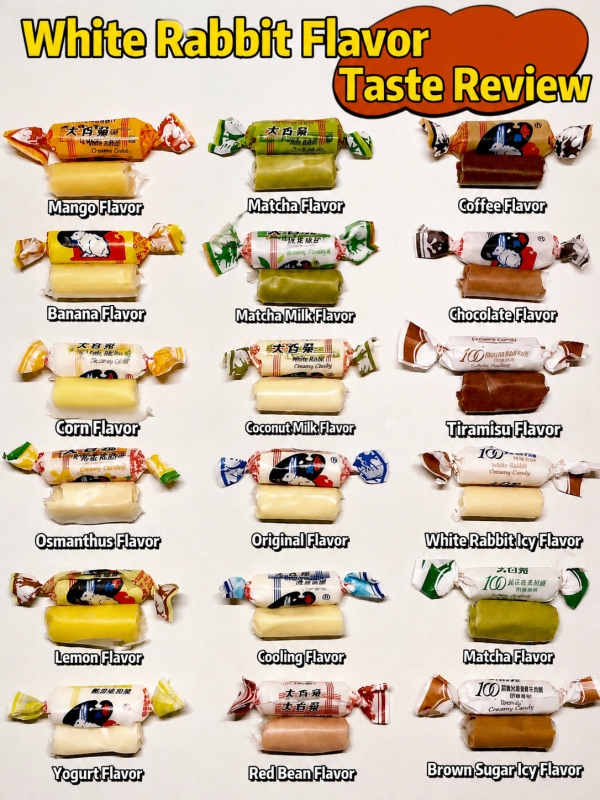
White Rabbit Candy Full Flavor Showcase Chart
White Rabbit: You’ve probably heard of weird Asian candies in flavors like wasabi and durians. Get ready to try a whole base level of candies from China. Packaged in a thin edible layer of rice paper, these chewy candies are milk-based, more mellow than caramels but creamier than Western taffy. Each flavor of white rabbit candy develops a gentle, milky sweetness and slowly melts under your tongue. The candy “experience” has matured—candy is just candy anymore: it’s become a cultural moment, from its flagship milk tea store on Shanghai’s Nanjing East Road, to high-fashion collabs. Outside of the classic full-bodied milky baseline, the candy story now has a tapestry of 16 different flavors, from earthy red bean and refreshing herbal mint to wilder things like durian.
Ready to dive into the full collection? This guide acts as your personal roadmap to every White Rabbit candy flavor, breaking down the nuanced taste profiles, unveiling the ingredients inside, and revealing exactly where you can get your hands on them—whether you're wandering the streets of China or shopping from home across the globe. Let’s get into it!
Taste Rankings: 16 Varieties Evaluation
Not sure where to start? Here's the full picture at a glance. Each white rabbit creamy candy flavor has a distinct wrapper color, so use this table to decode what you're holding — or what to reach for first.
| Flavor | Wrapper Color | Taste Profile | Intensity | Rating | Best For |
|---|---|---|---|---|---|
| Original | Blue & white stripe | Pure milk, lightly sweet | 2/5 | ⭐⭐⭐⭐⭐ | Everyone |
| Mint | Bright green | Herbal mint, cool finish | 3/5 | ⭐⭐⭐⭐⭐ | Mint lovers |
| Coconut | White & yellow | Toasted coconut, rich | 3/5 | ⭐⭐⭐⭐⭐ | Coconut fans |
| Coffee | Brown | Mild café au lait | 2/5 | ⭐⭐⭐⭐ | Coffee drinkers |
| Red Bean | Dark red | Earthy, gently sweet | 2/5 | ⭐⭐⭐⭐ | Asian flavor fans |
| Yogurt | Pink | Tangy, milky base | 3/5 | ⭐⭐⭐⭐ | Sweet-sour lovers |
| Matcha | Deep green | Faint tea, powdery | 2/5 | ⭐⭐⭐ | Matcha fans |
| Mango | Yellow-orange | Light fruit, underwhelming | 2/5 | ⭐⭐⭐ | Fruit candy lovers |
| Banana | Yellow | Artificial banana | 3/5 | ⭐⭐⭐ | Banana milk fans |
| Osmanthus | Light orange | Floral, rose-like | 2/5 | ⭐⭐⭐ | Osmanthus lovers |
| Corn | Pale yellow | Sweet buttered corn | 2/5 | ⭐⭐⭐ | Adventurous eaters |
| Chocolate | Dark brown | Faint cocoa, milk-heavy | 2/5 | ⭐⭐⭐ | Light choc fans |
| Hua Mei (Plum) | Purple | Sour plum, tangy | 4/5 | ⭐⭐⭐ | Sour candy lovers |
| Wasabi | Vivid green | Sweet-spicy, surprisingly mild | 4/5 | ⭐⭐⭐⭐ | Thrill seekers |
| Durian | Bright orange-yellow | Intense durian, very sticky | 5/5 | ⭐⭐ | Durian devotees only |
| Mustard | Light yellow | Low-heat mustard, unusual | 4/5 | ⭐⭐ | Extreme curiosity only |
⚠️ Availability note: Not all 16 white rabbit candy flavor are sold everywhere year-round. The core lineup — Original, Yogurt, Red Bean, Mint, Chocolate, and Corn — stays on shelves consistently. Seasonal and specialty flavors like Durian, Wasabi, and Coconut appear at brand flagship stores or online platforms. Check your specific retailer before making a trip.
Classic Choices: Safest Bets Overview
These six flavors are the backbone of the lineup. They're the easiest to find and the safest bets for first-timers and seasoned fans alike. Each one shares the same soft, pull-apart texture — what differs is the top note.
1. Original: Pure Creamy Milk Baseline
The original white rabbit candy flavor is pure, simple milk. Think lightly sweetened condensed milk pressed into a chewy square. It's softer than Werther's Original and cleaner in flavor than Milky Way nougat — no caramel, no chocolate, just cream.
The sweetness is mild, around 2/5. There's a faint salty edge right at the finish, then a whisper of caramel as the candy dissolves. It's reliable without being boring. If you've never had one, start here.
- Flavor intensity: 2/5
- Best for: First-timers, anyone who likes mild, milky sweets
2. Mint: Refreshing Herbal Cool Finish
The mint flavouring is incredible. It’s not the blast of mint cordial that you get from the Western variety of mint candy. It’s not even like toothpaste; it tastes like fresh leaves of spearmint fused in caramel.
The cool sensation comes on a few seconds after your teeth start to chew through the candy. The coolness then builds slowly before fading out, and there is no horrible taste of artificial chemicals in your mouth. The milk base is present in the background all throughout. Try one after a meal in Shanghai and you’ll know why this flavour is usually ranked the highest among non-original flavours in blind taste tests.
- Flavor intensity: 3/5
- Best for: Mint lovers, post-meal refreshment
3. Coconut: Rich Toasted Nutty Profile
Of all the classic flavors, coconut has the most fragile texture. It melts the fastest. The toasted coconut scent wafts through first - not that sunscreen-sweet island version, but more robust and nutty - like fresh shredded coconut in a Southeast Asian sweet.
Sweetness registers at 3/5. No artificial bite. This is the flavor that most people reach for and want to eat another immediately after. If you love coconut at all, this will be a guaranteed win.
- Flavor intensity: 3/5
- Best for: Coconut fans, anyone who enjoys rich, aromatic sweets
4. Coffee: Subtle Layered Café Notes
Coffee is the quiet achiever in this lineup. The first bite tastes almost identical to the original — milky, gently sweet. Then, around the third or fourth second of chewing, a soft café au lait note arrives.
It never gets bitter. There's no roasted edge. Think lightly sweetened coffee milk rather than espresso. People consistently underestimate this flavor, then finish the entire piece before they realize what happened.
- Flavor intensity: 2/5
- Best for: Coffee drinkers, anyone who prefers layered, understated flavors
5. Red Bean: Earthy Traditional Sweet Balance
Red bean went in as the least expected flavor in every test. It came out a top three. The earthiness of red bean paste is the more forward flavor, with the milk base rounding off any sharp edges. It is a taste of a more Japanese directly mochi filling in somen, condensed, one.
This is the softest of all the classic flavors. A thumb pressed into it shows a clear imprint. Sweetness is the lowest of the lineup flavors, about a twos on five. For anyone who had red bean desserts growing up it reads as deeply familiar. For everyone else it is a revelation.
- Flavor intensity: 2/5
- Best for: Asian dessert lovers, low-sugar snack seekers
6. Yogurt: Dynamic Tart Creamy Fusion
Yogurt is the only classic flavor with actual acid. The tartness leads — zingy and bright, like plain Greek yogurt minus the fat. Then the milk base comes in and smooths the finish into something close to creamy.
The texture is a hair denser and firmer than the OG. Sweet and tart are pulling in opposite directions all the way through. It’s a more thrilling chew than any other flavor in this family. If you’re a fan of sour candy, it will seem weak. If you’re a fan of balance, this will appeal.
- Flavor intensity: 3/5
- Best for: Sweet-sour lovers, yogurt fans
Adventurous Picks: Polarizing Taste Profiles
These aren't for everyone. But that's the point. Wasabi, durian, and their companions exist to push the boundaries of what a milk candy can be. Some of them pull it off. Some of them really don't.
7. Wasabi: Mild Sweet Savory Heat
The aggressively wrapped green package is practically a taunt. Inside lies a surprisingly civilized candy. There’s a wasabi heat coming in about two seconds, peaking for five. It’s a clean burn, warming rather than sharp, with a savory aftertaste that’s just a bit salty.
The milk base clicks in and softens everything so that this never verges into anything resembling real spiciness. It genuinely lives in that strange middle space between sweet and savory. As a gift for that friend who thinks they know what to expect from Japanese snacks, this is perfect. They won’t see it coming. And they won’t be mad about it.
- Flavor intensity: 4/5
- Challenge level: ★★☆
- Best for: Thrill seekers, anyone buying a unique souvenir
8. Durian: Sticky Intense Authentic Custard
If you really love durian, this is the one. The flavor is thoroughly real—custard-pungent, dense, and sweet for sure. The wrapper is bright orange-yellow and hard to overlook tucked on a shelf. The issue is not taste.
It’s texture. This is easily the stickiest of the 16 flavors. “Real” durian allows you to chew and swallow swiftly; this guy lingers on every tooth and renders the experience a whole lot more serious than most people anticipate. That will be endearing to fanatics. “Everyone else” should just keep walking.
- Flavor intensity: 5/5
- Challenge level: ★★★
- Best for: Durian fans exclusively
9. Corn: Surprising Sweet Buttered Nostalgia
Corn is the gentlest entry point in the adventurous category. It tastes exactly like sweet buttered corn on the cob — the kind you'd get at a summer fair. The flavor concept sounds strange. The execution doesn't.
Unlike the other white candies in the lineup, the corn flavor has a distinctly pale yellow tint. The aroma arrives before the first bite. Sweetness is mild, around 2/5, with a faint butter note lingering through the chew. No one expects to enjoy this one. Almost everyone does.
- Flavor intensity: 2/5
- Challenge level: ★☆☆
- Best for: Curious eaters who want adventure without risk
10. Other Varieties: Quick Flavor Verdicts
Six more flavors round out the lineup. None of them are bad. None of them are remarkable enough to prioritize over the classics.
| Flavor | Taste Verdict | Challenge Level | Worth Trying If You… |
|---|---|---|---|
| Chocolate | Faint cocoa, rice paper overpowers | ★☆☆ | Are a light chocolate fan |
| Mango | Light, underwhelming, disappoints | ★☆☆ | Really love mango candy |
| Banana | Artificial banana milk, inoffensive | ★☆☆ | Grew up with banana sweets |
| Hua Mei (Plum) | Sour plum, polarizing | ★★☆ | Love Chinese sour candy |
| Osmanthus | Floral, more rose than osmanthus | ★☆☆ | Enjoy floral tea flavors |
| Matcha | Powdery, very faint tea | ★☆☆ | Are a committed matcha fan |
Chocolate is the biggest disappointment — the rice paper wrapper actually overpowers the cocoa, which says everything about how light the flavor is. Mango runs a close second in underperformance. Hua Mei (plum) is the most polarizing: either deeply nostalgic or genuinely off-putting, depending on your relationship with Chinese sour candy. If you want to explore Chinese snack culture more broadly, these edge-case flavors give a good sense of how Chinese confectionery pushes flavor boundaries that Western candy rarely does.
Inside the Wrapper: Ingredients and Nutrition
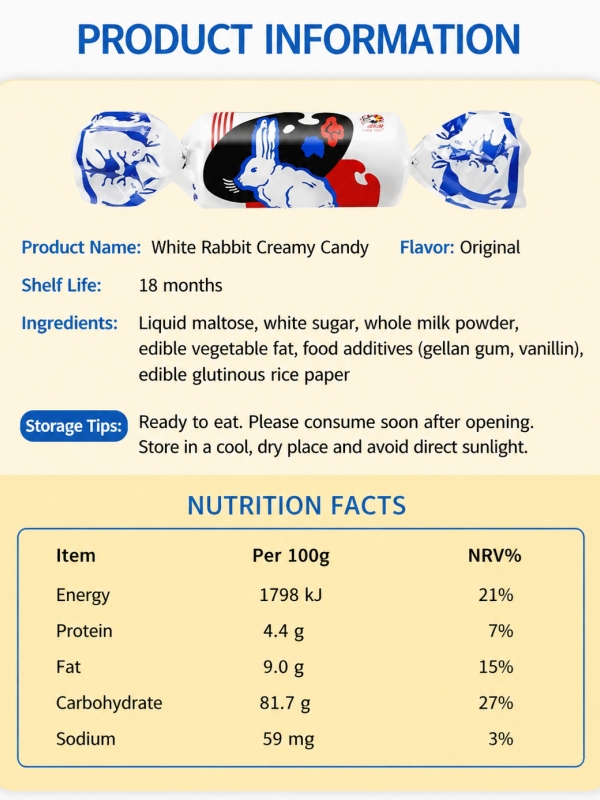
Nutrition Facts for White Rabbit Milk Candy
Core Formula: 7 Simple Ingredients
The original formula is simpler than most people expect. Seven ingredients, total. Here's what each one does:
| Ingredient | Role | Notes |
|---|---|---|
| Maltose | Primary sweetener, creates chewiness | Core structural ingredient |
| White Granulated Sugar | Secondary sweetness | — |
| Whole Milk Powder | Core milk flavor source | ⚠️ Contains dairy |
| Cream | Creamy texture and richness | ⚠️ Contains dairy |
| Gelatin | Texture stabilizer | ⚠️ Animal-derived — not vegetarian/vegan |
| Vanillin | Artificial vanilla aroma | Synthetic, not natural vanilla |
| Edible Rice Paper | Edible inner wrapper | Corn starch + cassava starch, dissolves in mouth |
The maltose is what gives the candy its characteristic chew — it behaves differently from regular sugar, creating a pull-apart elasticity rather than a hard snap. Gelatin provides structure without turning the candy firm. Vanillin adds warmth without tipping into artificial sweetness.
Heads-up: Ingredients can vary slightly by batch or flavor. Some versions list glucose syrup or hydrogenated vegetable oil as additional components. Always check the label on your specific pack, especially if you have dietary restrictions.
Nutritional Facts: Calorie and Sugar Counts
White Rabbit candy is a treat, not a health food. Here's the breakdown:
| Nutrient | Per 100g | Context |
|---|---|---|
| Calories | ~430 kcal | Higher than most Western hard candies |
| Total Fat | ~9g | Primarily from cream and milk powder |
| Saturated Fat | ~5g | — |
| Total Carbohydrates | ~80g | — |
| Sugars | ~70g | High — diabetics should be cautious |
| Protein | ~3g | From whole milk powder |
| Sodium | ~50mg | Low — not a concern |
For comparison, Werther's Original runs about 390 kcal per 100g. Regular milk candy clocks in around 400 kcal. White Rabbit is in the same range — sweet-dense, not heavily processed-fat-dense. The sodium is notably low, which surprises most people. The sugar is the main number to watch. Eat a few pieces as a treat and the numbers are perfectly reasonable.
Safety Check: Melamine Scandal Clarification
The short answer? Yes—current products are safe.
The longer story: In 2008, China’s dairy industry became embroiled in a massive melamine contamination scandal. White Rabbit candy was recalled in some markets purely as a precaution (not because the brand had knowingly added anything dangerous), but because dairy-containing items were then being cast under a wide net of scrutiny. That was more than 15 years ago.
The brand reconfigured its formulas and manufacturing methods thereafter. White Rabbit products are now available in more than 40 countries and territories across the world, including through some Costco Canada stores. Their product available in major international retail chains is probably the clearest indicator that safety and compliance are not a concern.
Dietary quick-check:
- 🚫 Not vegetarian / not vegan — contains gelatin (animal-derived)
- 🚫 No official Halal certification — no pork-derived ingredients, but the brand has not pursued Halal certification; Muslim consumers should verify the specific product label
- ✅ Gluten-free (original) — primary ingredients don't contain wheat
- ⚠️ Allergens — dairy (milk powder, cream) and gelatin
- 👶 For kids — high sugar content; rice paper poses no choking risk; best as an occasional treat rather than a daily snack
Brand Evolution: Modern Lifestyle Crossovers
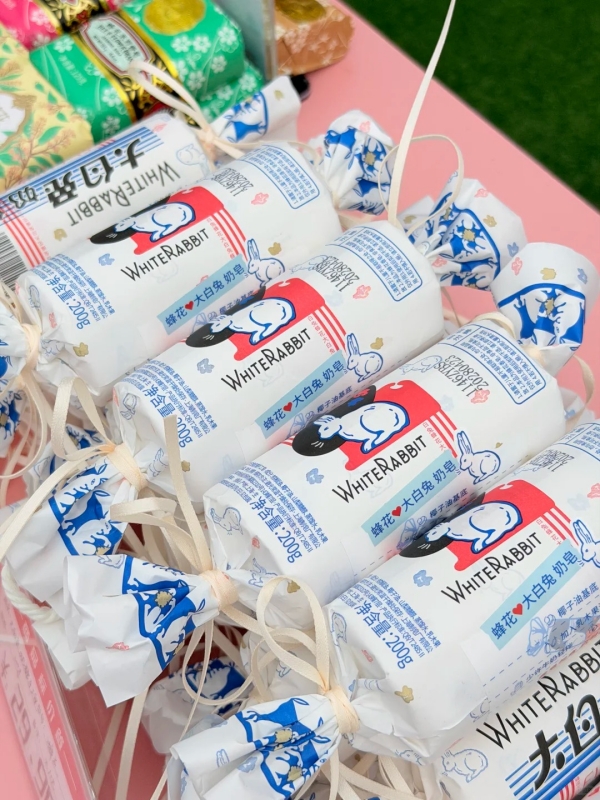
FLAUHRA × White Rabbit Co-Branded Hand Soap
White Rabbit isn't standing still. The brand has aggressively expanded its presence beyond the candy aisle in the past two years:
- 🧼 FLAUHRA x White Rabbit Artisan Soap (launched April 2026) — the classic candy scent translated into a bath product; available at the Shanghai flagship store and the brand's Tmall store
- 🎁 agnès b. x White Rabbit Limited Tin — a high-end gift collaboration with the French fashion house; the tin design is collectible; stock moves fast
- 🗺️ Where to find them: The milk tea flagship store at 371 Nanjing East Road, Shanghai is the primary launch point for limited collaborations. The official Tmall store carries pre-sale listings for major drops
These crossovers signal a brand leaning into lifestyle territory. Buying the candy gets you the flavor. Buying the tin or the soap gets you a piece of something with longer shelf life — and better gift-wrapping potential.
How to Buy in China: Local Purchase Guide
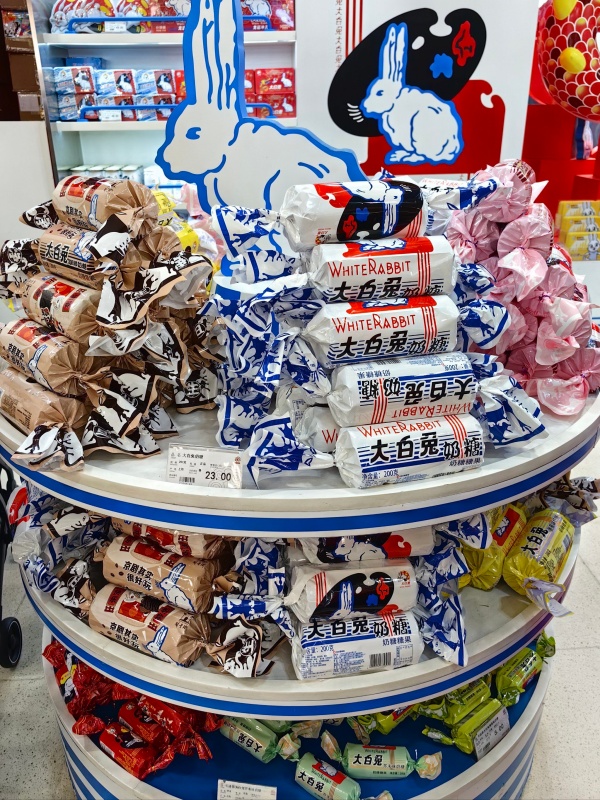
White Rabbit Candy Shelf In Supermarket
Channel 1: Convenience Stores
Every 7-Eleven, FamilyMart, and Lawson in China carries White Rabbit candy. It's stocked near the register, usually in small bags or individual pieces. Original is always available. Mint and coconut appear occasionally.
Pricing is minimal:
- Single piece: ~¥0.5
- Small bag (25–35g): ¥3–5
This is the move when you want to try one flavor before committing to a larger purchase. Don't expect variety — convenience stores run lean on SKUs.
Walmart, Carrefour, and Hema (Freshippo) carry 8–12 flavors simultaneously, often in a bulk-buy-by-weight section. This is the best format for anyone building a mixed assortment.
- Loose, weigh-your-own: ~¥50–80 per 500g
- Pre-bagged (180g/250g): standard retail pricing
- Gift boxes: also available at most locations
Pick-and-mix is the smartest approach here. Load up on two or three classics, throw in a wasabi for drama, and you've built a perfect sampler for the price of a coffee.
Channel 2: Airport and Train Station Gift Shops
If you're buying on the way out of China, airport and high-speed rail gift shops work — but you'll pay 20–30% more than supermarket prices.
- Standard gift box (200–400g): ¥100–200
- Flavor selection: mostly classics, limited adventurous options
- Packaging: polished and gift-ready
A useful 2026 addition: passengers on China Eastern Airlines domestic flights departing from Shanghai Hongqiao or Beijing Capital Airport can redeem frequent flyer points or access promotional pricing on White Rabbit candy and other Shanghai specialty goods through the Air China app or on-site events during major travel seasons. Check the app before your flight.
Channel 3: Official Flagship Stores
Shanghai is the brand's home city, and the official Guanshengyuan-authorized stores carry the fullest inventory: seasonal flavors, limited-edition tins, and collaboration products that never make it to convenience stores.
If you're a genuine fan, these locations are worth a stop.
White Rabbit Milk Tea Flagship Store — the newest reason to visit:
| Detail | Info |
|---|---|
| 📍 Address | 371 Nanjing East Road, Shanghai |
| 🗓️ Opened | April 20, 2026 |
| ☕ Menu | Original Milk Tea, Cloud Cheese Tea, Salted Peanut Dew, Plum Oolong Tea (4 drinks) |
| 🥛 Milk source | Bright Dairy's Jersey cow milk |
| 🔥 Demand | 500+ cups sold daily during soft launch |
| 💡 Timing tip | Weekday mornings are significantly quieter than weekend afternoons |
The store also sells the candy directly and stocks limited collaboration merchandise. One visit covers the full brand experience — drink, candy, and take-home souvenir. Milk tea culture in China moves fast; if you want context for where White Rabbit sits in that world, this guide to milk tea in China covers the broader landscape.
Channel 4: Taobao and JD E-Commerce Platforms
China's two dominant e-commerce platforms carry the full White Rabbit range, and both have official brand stores:
- Official channels:
- Tmall: White Rabbit Official Flagship Store (brand-operated, official after-sales)
- JD.com: White Rabbit JD Self-Operated Flagship Store (JD fulfillment, highly reliable)
- Pricing:
- Loose candy: from ¥5.2 per 500g
- Gift tins: ¥19.9–56.91 depending on size and design
- Flavor availability: The online flagship stores stock more flavors than any physical convenience store. Seasonal adventurous flavors (durian, wasabi) appear as limited drops. JD occasionally offers platform-exclusive sizes.
- International shipping: Some sellers ship internationally directly. Others work with freight forwarding services — useful for restocking after returning home.
- Avoiding fakes:
- Buy from the official flagship stores first
- Check the production date (Chinese products print the manufacturing date, not the expiry date)
- Avoid prices that are dramatically lower than market standard — counterfeits exist
How to Buy Globally: Overseas Sourcing Guide
Channel 1: Local Asian Grocery Stores
The best White Rabbit candy you'll find outside China is at a local Asian grocery store or Chinatown market. Freshness is highest, prices are closest to Chinese retail, and you can inspect the product in person.
- US, Canada, Australia, UK, Southeast Asia: All have strong Asian grocery networks
- Canada specifically: White Rabbit assorted gift boxes now appear at Costco locations, with bilingual English-French packaging — a clear sign of the brand's international push
- What to expect: Original flavor is universally available; mint and coconut appear in larger stores
Always check the production date. Chinese packaging shows the date the candy was made, not when it expires. A pack made six months ago is typically still well within quality range.
Channel 2: Amazon Prime Platform
Amazon is the path of least resistance for US and European buyers, but quality control varies by seller.
- Standard availability: Original flavor in 180g bags; multi-packs common
- Price range: $8–18 / 180g (wide variance — shop around)
- Watch for:
- Seller ratings below 4 stars — skip them
- Candy that arrives harder than expected (long transit affects texture)
- Packaging that looks blurry or off-color (counterfeits exist on the platform)
For first-time buyers, multi-pack bundles from established Asian food sellers tend to be the most reliable option.
Channel 3: Dedicated Asian Snack Platforms
For anyone who wants to explore beyond original flavor, dedicated Asian snack platforms beat Amazon handily:
- Yamibuy (US-focused): larger flavor selection than Amazon, community review system, good inventory transparency
- Yumsbox (international shipping): mixed-flavor gift boxes with full ingredient and date information included — ideal for first-timers who want variety without committing to a large single-flavor bag
Mixed boxes run $15–30 and are the most cost-efficient way to try six or more flavors in one order. It's also how most international buyers discover their personal favorites before they visit China in person.
How to Spot Fake Candies: Authenticity Check
Counterfeits exist, particularly on general e-commerce platforms. Here's the checklist:
- Print quality: Sharp, saturated colors; rabbit illustration has clean lines with no smearing
- Rice paper: Semi-transparent, intact, no tearing or sticking to the outer wrapper
- Candy color: Authentic pieces are bright white; fakes often appear off-white or yellowish
- Production date: Clearly embossed, formatted as "生产日期: YYYY.MM.DD" — if it's hard to read or missing, that's a red flag
- Price: Dramatically cheap loose candy with no packaging is almost always counterfeit
Stick to official channels when possible. If something feels off about the price or packaging, trust that instinct.
FAQs: Common Buyer Questions
Q: What does White Rabbit candy actually taste like?
The original white rabbit candy flavor is a clean, milky sweetness — softer than Werther's Original, with a gentle elasticity that builds as you chew. There's a light caramel note at the finish and a faint saltiness that keeps it from tasting cloying. Think condensed milk shaped into a candy. That's essentially what it is.
Q: Can you actually eat the white paper inside White Rabbit candy?
Yes — absolutely. The white rabbit candy rice paper inner wrapper is made from corn starch and cassava starch. It's completely edible, dissolves in seconds, and doesn't affect the flavor at all. Peeling it off actually makes things worse — the candy sticks to your fingers immediately. Leave it on and eat the whole thing.
Q: How many flavors does White Rabbit candy come in right now?
The official core lineup includes about six white rabbit candy flavors that are consistently available: Original, Yogurt, Red Bean, Mint, Chocolate, and Corn. Beyond that, the brand has released specialty and seasonal varieties — Coconut, Durian, Wasabi, Banana, Mango, Osmanthus, Matcha, Plum, and Mustard among them — bringing the total to over a dozen. Not all are in stock everywhere. Mixed gift boxes are the best way to sample multiple flavors in one purchase.
Q: Is White Rabbit candy suitable for vegetarians or halal diets?
The original white rabbit candy flavor contains gelatin, which is animal-derived — making it unsuitable for vegetarians and vegans. On Halal: the product doesn't contain pork-derived ingredients, but the brand currently holds no official Halal certification. Muslim consumers should check the specific label on the package they're buying rather than relying on general guidance.
Q: Why do some people say White Rabbit candy was banned?
The white rabbit candy flavor controversy traces back to 2008, when China's dairy industry was hit by a widespread melamine contamination scandal. The candy was pulled from some markets as a precautionary measure — not because White Rabbit had added anything deliberately, but because all dairy-based Chinese products came under review. That measure was temporary. The brand has since sold into 40+ countries and regions and is stocked at Costco Canada, among other mainstream international retailers.
Q: Where is the best place to buy White Rabbit candy outside of China?
Your local Asian grocery store or Chinatown market is the best starting point — freshest product, fairest price. In Canada, Costco carries gift box assortments. Online, Yamibuy (US) and Yumsbox (international) offer the widest white rabbit candy flavor range outside of China. For pure convenience, Amazon works — just prioritize sellers with strong reviews and clear product photos.
Q: What is the rice paper wrapper in White Rabbit candy made of?
The inner wrapper is edible rice paper made from corn starch, cassava starch, water, and glycerin monostearate. No wheat, no animal products. It's standard food-grade material used in Chinese confectionery. The rice paper is part of what makes white rabbit candy flavor-delivery so distinctive — it keeps the candy clean and easy to eat straight from the wrapper.
Q: Which White Rabbit candy flavor should a first-timer start with?
Start with Original or Coconut. Original establishes the flavor baseline — everything else is measured against it. Coconut is the most universally loved non-classic option. If you're feeling bold, Wasabi is the best entry point into the adventurous category. The heat level is genuinely mild, and it's consistently the surprise favorite among people who expect to dislike it. Curious about where White Rabbit sits in the larger world of popular Chinese snacks? It holds a very particular place — nostalgic, globally recognized, and harder to categorize than it looks.
Q: Is White Rabbit candy good for kids?
White Rabbit candy is generally safe for children, but the sugar content is high — roughly 70g of sugar per 100g of candy. The rice paper poses no choking hazard and is completely non-toxic. For children under three, adult supervision is recommended because the chewy texture requires a reasonable amount of jaw strength. Treat it as an occasional snack rather than an everyday one. The candy is a fun, low-intimidation introduction to Chinese food and flavors for young eaters curious about something new.