Temple of Heaven Presidential Walking Route
BEIJING, May 14, 2026 — Chinese President Xi Jinping welcomed U.S. President Donald Trump at the Temple of Heaven on Thursday. 🏛️ No sitting American president to visit the site since Gerald Ford in 1975. The two leaders posed for photos before the Hall of Prayer (photo) then stepped inside. Xi showed Trump the hall’s astronomical symbolism as well as its philosophy of the harmony between humanity and heaven. Xi himself noted the visit echoes the 2017 Forbidden City walk — “a nine-year diplomatic cultural arc now complete.” Time noted the “pool reporters” listening in: "Great. Incredible. China is beautiful." That diplomatic stroll is now known as the Temple of Heaven presidential route. We’re taking that as our entry point. We walk you through each presidential stop and tell you the stories behind them. Then we expand the route into an entire visitor experience — well beyond any state visit scheduling.
Route Stop: Retrace the 2026 Historic Diplomatic Walk
-
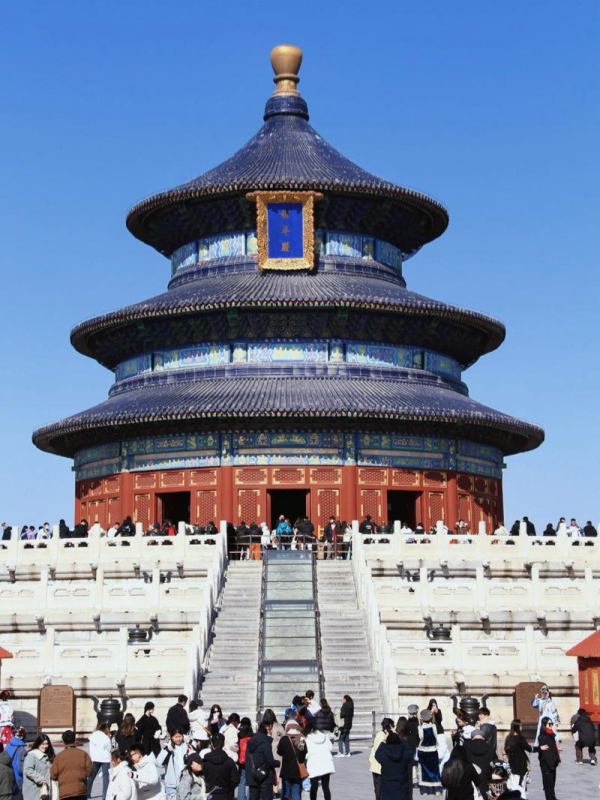

- Temple of Heaven
-
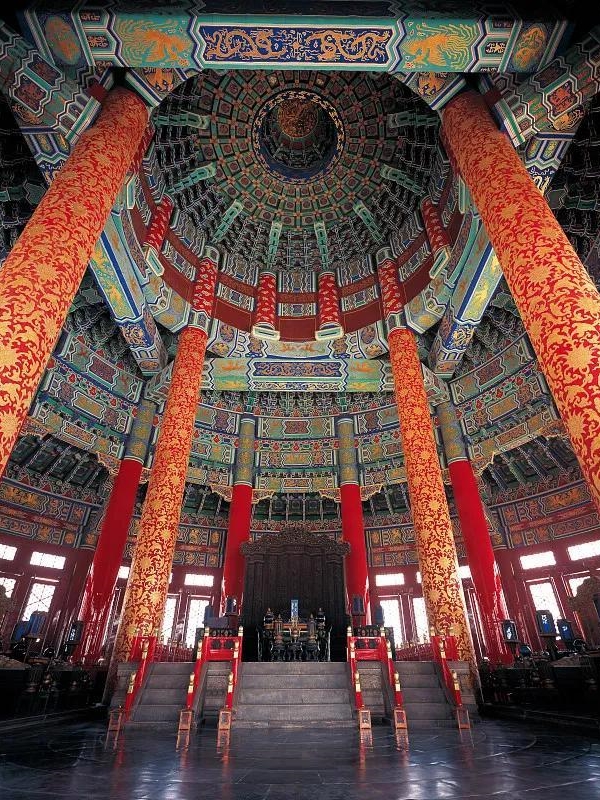
- Imperial Architecture Inside the Hall of Prayer
Based on official Xinhua dispatches and Foreign Ministry records, the 2026 presidential visit followed a tight, focused path. Media pool records show the motorcade arrived at approximately 13:25, with President Trump departing by around 13:41. However, what happened in that brief time was quietly significant.
Square Focus: Stand Where the Iconic Photo Was Taken
Xi greeted Trump on the so-called south plaza of the Hall of Prayer, where the triple-tiered blue-roofed structure rises dramatically above a wide stone terrace whose ancient cypress-tree canopy extends off toward the capital. Against this propitious background, the official diplomatic photo that was sent around the world was taken by Xinhua photographer Shen Hong. All of which rendered the image an ideal cultural and diplomatic token.
📸 Replicate the presidential photo: Stand on the central axis stone pavement south of the Hall of Prayer. Face north. Frame the triple blue-tiled roof at center. That is the exact composition from the official Xinhua photograph.
📸 Alternative angle: Move to the red walls on the east or west side of the complex. Lower your camera position. Use the vermilion wall as a foreground frame for the blue roof above. This technique avoids tour group crowds and adds dramatic depth to the shot.
Interior Design: Unpack Timber Craftsmanship and Imperial Philosophy
They walked into the hall together. Their eyes focused on the hardwood structure, the timber and bracket (more accurately, mortise and tenon) joints, the way the astronomical symbolism is imbued into every column and bracket. Xi guided Trump through ancient concepts of “harmony with all things, following heaven’s timing.” And the foundational idea of governance, that the people’s wellbeing is the basis of power. Not to overlook the carvings of dragon and phoenix on the coffered ceiling above.
✨ Your experience inside: Take a moment to look up at the coffered ceiling. Then let the 28 towering nanmu-wood columns settle into your field of view. The scale of the interior is easy to underestimate from outside.
💡 What those columns mean: Each one encodes a different unit of time or a layer of the cosmos. The full decoding is in Chapter 4 — for now, simply let the space do its work.
Hall Choice: Discover the Heart of Summit Cultural Symbolism
The Hall of Prayer was a deliberate choice; it is the most famous structure in the complex, and the one that is the best architectural manifestation of the Chinese philosophy of “heaven-human unity.” In visiting this one single site, maximum cultural bang for a few minutes was obtained — head-on symbolic impact, the precise opposite of the five-stop, multi-hour cultural tour of the forbidden City in 2017. Together, the two form a whole nine-year cultural diplomatic narrative: one stepping-back from the arc of power, the other pointing toward heaven itself.
🗺️ For the visitor: Understanding why the presidents chose this hall means you have already grasped the cultural core of the entire Temple of Heaven complex.
💡 Key takeaway: Start here, exactly as they did. The rest of the site will make deeper sense from this foundation.
Route Planning: Tour the Complete East-to-South Ceremonial Axis
-
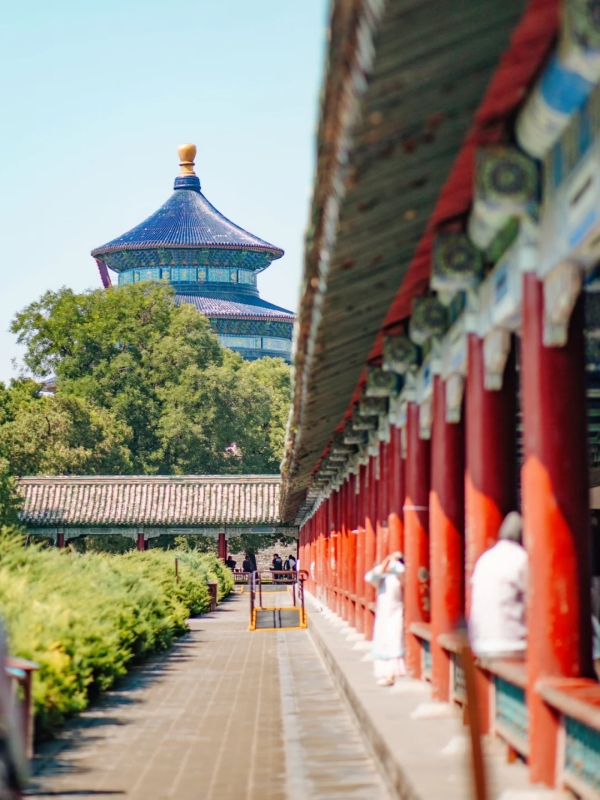
- Temple of Heaven Long Corridor
-
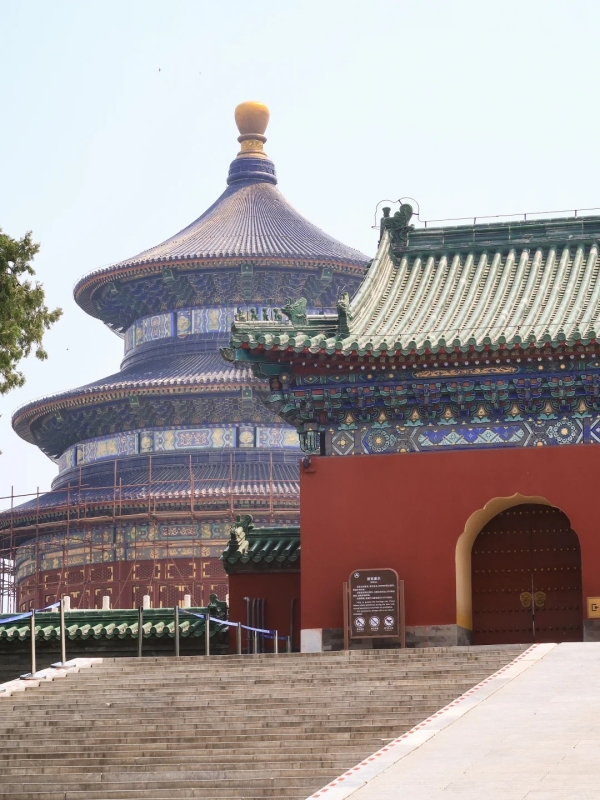
- Hall of Prayer Framed by Red Walls
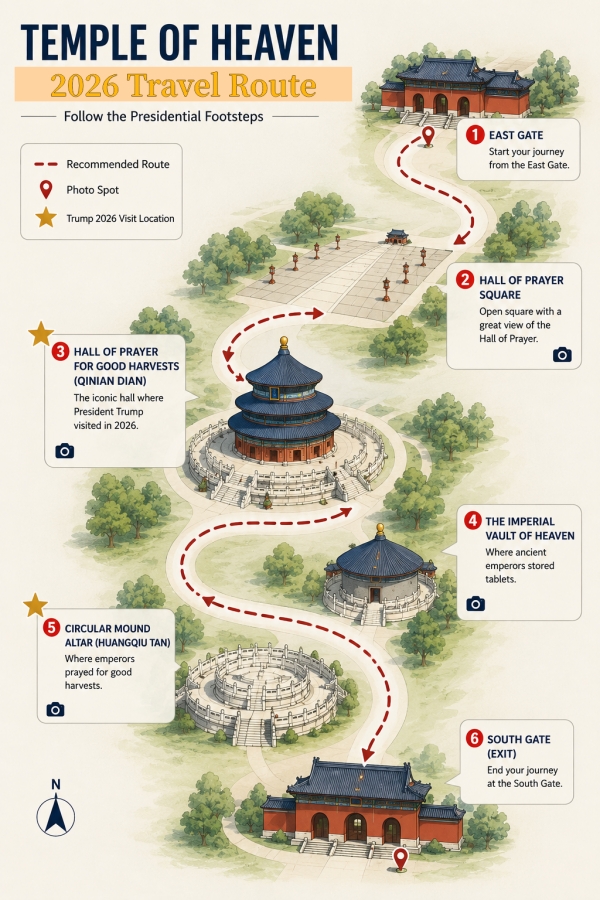
The presidential visit covered only the Hall of Prayer. However, the full Temple of Heaven complex holds much more. We recommend this east-to-south route for a complete, no-backtracking experience. Allow 3–4 hours for the full route, or 1.5 hours for the express presidential version.

 Stop 1: Start at East Gate and Long Corridor
Start at the East Gate — the most practical entry for subway visitors (Line 5, Tiantan Dongmen Station, Exit A). From there, your first sight is the Seven Star Stones. There are actually eight stones in total: seven represent the peaks of sacred Taishan Mountain, while a Qing dynasty emperor added an eighth later. Next, follow the path into the 72-Bay Long Corridor. Originally built as a covered passage for transporting ceremonial offerings, this shaded walkway today pulses with real Beijing life. 🌿 In the early morning, local residents gather here for tai chi, calligraphy, and games — one of the most genuine local scenes in the city.
💡 Timing tip: Arrive when core attractions open at 8:00 AM. This gives you a meaningful head start on tour group crowds. The Long Corridor is especially atmospheric in early morning light, and you will have the Hall of Prayer largely to yourself.
Stop 2: Frame the Ideal Midday Hall of Prayer Shot
This is the highlight of your Temple of Heaven presidential route experience. Using step by step instructions from the last chapter recreate the official photo. Then take your own shots as you stood at the red wall angles, one on the east and one on the west side. Then step inside the hall and let the 28 nanmu columns do the rest. As in look up at that coffered ceiling, that dragon-and-phoenix ceiling, it sure is. That’s what President Xi pointed out on his part of visit, in 2026.
📸 Best photography window: Between 11:00 AM and 1:30 PM, midday side-backlighting makes the blue glazed tiles glow at their most vivid. Notably, this also aligns with the approximate timing of the 2026 presidential visit itself.
Stop 3: Cross the Elevated 360-Meter Danbi Bridge
Head south from the Hall of Prayer along the Danbi Bridge — a 360-meter elevated walkway rising about 4 meters above the surrounding ground. Emperors processed along this path during the winter solstice ceremony, moving toward the Circular Mound Altar. Walking it today, the weight of that ritual procession is palpable. 🚶 Additionally, the views from this elevated walkway are excellent for photographing the site's architectural scale and the ancient tree-lined courtyards spreading out below.
🗺️ Route note: This section extends beyond the confirmed presidential route into the emperor's full ceremonial path. It connects the Hall of Prayer in the north to the Circular Mound Altar in the south, completing the site's north-south ritual axis — and giving you the full imperial narrative in a single walk.
Stop 4: Whisper Along the Curved Imperial Echo Wall
At the southern end of the Danbi Bridge lies the Imperial Vault of Heaven — a smaller circular hall used to store the sacred spirit tablets for ceremonial use. Its circular outer wall is the famous Echo Wall. Here is how to experience it: 🔊 have your travel companion stand at one end of the circular wall while you stand at the other. Face the wall. Speak softly — almost in a whisper. The smooth, perfectly circular surface reflects your voice all the way around to your companion's ear.
📸 Photo tip: Use the blue glazed tile and gilded pinnacle of the Imperial Vault of Heaven as your backdrop. The circular geometry naturally creates balanced, strong compositions from almost any angle you choose.
Stop 5: Stand Atop the Concentric Circular Mound Altar
Continue south to the Circular Mound Altar (Yuanqiutan) — the three-tiered white marble platform where the emperor performed the annual winter solstice sacrifice. This is the most ceremonially charged space in the complex. Climb to the top tier. Find the Heaven Heart Stone at the very center. Stand on it. Speak normally, or clap your hands. The sound comes back fuller and louder than expected — ancient engineers built this acoustic effect intentionally, and it still works perfectly today. ✨
📸 Photo tip: The Circular Mound Altar's perfect concentric symmetry means any angle produces a strong geometric composition. Take your time with it. By the time you exit through the South Gate, you have walked the complete ceremonial arc of a six-hundred-year-old ritual site — far beyond what any state visit schedule allows.
Symbol Decoding: Read Ancient Cosmology Written in Stone
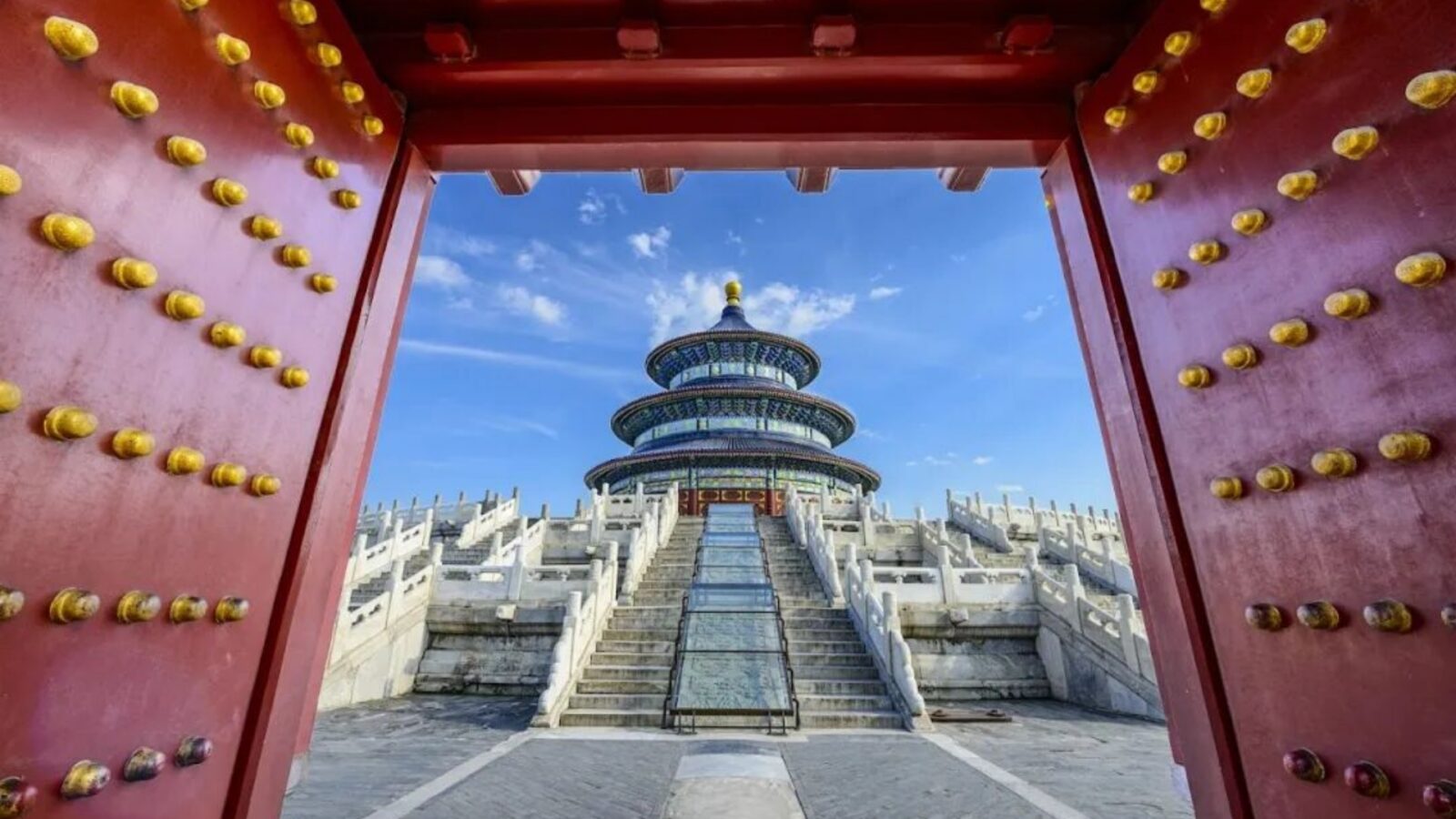
The Temple of Heaven in Beijing
The Hall of Prayer is not just beautiful — it is a message written in stone and wood. Here is what Xi Jinping walked Trump through, and what every visitor can read in the building's design.
Hall Pillar: Map the Universe and Seasons Under One Roof
Every element of the Hall of Prayer encodes the ancient Chinese conception of the cosmos. The circular body itself represents heaven. The deep blue glazed tiles represent the sky. And the 28 interior nanmu-wood columns represent time and the universe at once — all under one roof. In other words, standing inside this hall you are enveloped by every major unit of periodisation and a map of the cosmos above you at once.
| Design Element | Symbolic Meaning |
|---|---|
| Circular hall + blue glazed tiles | "Round heaven" and the blue sky above |
| 4 central "Dragon Well" columns | The four seasons: spring, summer, autumn, winter |
| Middle ring: 12 "Gold Columns" | The twelve months of the year |
| Outer ring: 12 "Eave Columns" | The twelve two-hour periods of the day |
| Inner + outer rings combined (24 columns) | The 24 solar terms of the agricultural calendar |
| All 28 columns together | The 28 lunar mansions (constellations) of the night sky |
Time and space meet under one roof — that is "heaven-human unity" made physical. It is the philosophy Xi Jinping pointed Trump toward during the 2026 visit, and the same one waiting for you inside today.
Altar Number: Claim Divine Power Through the Supreme Nine Geometry
In Chinese cosmology, nine is the highest of the single-digit “yang” numbers. It represents the emperor and heaven. The Circular Mound Altar etches “nine” into virtually every measurable detail of its design — a claim to divinity in stone.
- Stone rings: From center outward, each paving ring increases by nine — 9, 18, 27 … up to 81 (9 × 9) on the outermost ring of the top tier.
- Balustrades: The total number across all three tiers is 216, consistent with the I Ching passage describing "the strategy of Qian: 216."
- Tier diameters: Top tier 9 zhang; middle tier 15 zhang; bottom tier 21 zhang — totalling 45 zhang (9 × 5), the imperial "nine-five supremacy" symbolism.
- Heaven Heart Stone width: 0.95 meters — encoding both "9" and "5" in a single slab.
- The echo at the center: The amplified sound is acoustic physics, not magic. The smooth circular platform reflects sound waves outward; the circular balustrades reflect them back. All returning waves converge at the center simultaneously, overlapping and amplifying the original sound.
This system was not coincidental. It was the emperor's architectural claim to divine authority — every stone placed to say: this is where heaven and earth align.
Wall Physics: Guide Sound Waves Using Flushed Qing Dynasty Brickwork
Also, the "Echo Wall" of the Imperial Vault of Heaven works on the same principle. Its entire wall is a perfect circle and, ultimately, the surface is what makes it work (the Iliad got it wrong!). Unfortunately, its surface was finished in the "polished-brick flush-joint" technique – a kind of pre-Modern, all-over "mirroring" of the inner wall surface.
- Reflection principle: Sound traveling along the smooth curved surface bounces in a mirror-like reflection with very little energy loss — so it travels far without fading.
- Why it works across the full circle: Because the wall is perfectly circular, the sound curves all the way around from one end to the other. No technology required — just geometry and craftsmanship, built six centuries ago and working still.
These acoustic effects were deliberate design choices. They are evidence that ancient Chinese builders understood physics well before it was formalized as a science — and that they used it to make the divine feel close.
Visitor Guide: Check Essential Opening Times and Ticket Details
⏰ Lock In Opening Windows and Combo Pass Bookings
| Category | Peak Season (Apr 1 – Oct 31) | Off-Peak (Nov 1 – Mar 31) |
|---|---|---|
| Park Gates Open | 6:00 AM | 6:30 AM |
| Last Park Entry | 9:00 PM | 9:00 PM |
| Core Attractions Open | 8:00 AM; last entry 5:30 PM | 8:00 AM; last entry 4:30 PM |
| Weekly Closing Day | Mondays — except public holidays and summer peak (Jul 15 – Aug 31) | |
| Combo Ticket (Recommended) | ¥34 (park + all core attractions) | ¥28 |
Discounts apply for students, seniors, and other eligible visitors. Advance booking is strongly recommended via the "Changyou Tiantan" official WeChat public account. For the latest prices and step-by-step booking instructions, this Temple of Heaven ticket guide has everything you need.
🎯 Master Arriving Windows and Express Path Alternatives
A few practical details make a real difference between a rushed visit and a memorable one.
- Best time to arrive: 8:00 AM sharp, when core attractions open. This gives you a meaningful head start on tour groups and the best morning light for photography.
- Express route (1.5 hours): Hall of Prayer Square + interior + a short walk along the Danbi Bridge. This covers the full presidential experience with no detours.
- Full deep-dive route (3–4 hours): East Gate → Seven Star Stones → Long Corridor → Hall of Prayer → Danbi Bridge → Imperial Vault of Heaven → Echo Wall → Circular Mound Altar → South Gate.
- Evening lights: 🌙 The Hall of Prayer is illuminated on Friday and Saturday evenings and on major Chinese public holidays. Lights go off around 9:00 PM — the best window for atmospheric night photography.
- Best photography light window: 11:00 AM to 1:30 PM. Midday side-backlighting delivers the deepest blue in the glazed tiles — and it matches the timing of the 2026 presidential visit.
- What to bring: 👟 Comfortable walking shoes, drinking water, sun protection in summer, and warm layers in winter. The park grounds are extensive.
Combine the Forbidden City and Temple Axis Itineraries
Want to trace the full arc of both Trump–Xi diplomatic culture visits? Here is a simple two-day combination that covers every confirmed stop across both summits.
- Day 1 morning: Forbidden City Central Axis (Meridian Gate → Gate of Supreme Harmony → Three Great Halls → Baozhilou → Changyin Pavilion) — retracing the 2017 presidential route.
- Day 1 afternoon: Temple of Heaven Hall of Prayer route — walking the 2026 presidential route. Together, these two visits cover the complete Trump–Xi diplomatic cultural narrative across both summits.
If you're planning more time in the capital, this curated guide to things to do in Beijing is a great next step for building out your full itinerary beyond these two historic sites.
FAQs: Frequently Asked Questions
Q: Did Trump and Xi walk the full Temple of Heaven grounds — including the Echo Wall and Circular Mound Altar?
Official Xinhua and Foreign Ministry reports confirm the Temple of Heaven presidential route covered only the Hall of Prayer Square and the hall's interior. No official source confirms the leaders visited the Danbi Bridge, Echo Wall, Imperial Vault of Heaven, or Circular Mound Altar. Visitors who wish to explore those areas should allow extra time beyond the core presidential stops.
Q: Which entrance should I use to reach the Hall of Prayer and replicate the presidential photo?
The official vehicle entrance used by the motorcade was not publicly disclosed. For visitors following the Temple of Heaven presidential route on foot, the East Gate is the most practical option — take subway Line 5 to Tiantan Dongmen Station, Exit A. Alternatively, the North Gate offers a more direct approach to the Hall of Prayer if you prefer a shorter walk from the subway.
Q: Exactly where was the Trump–Xi photo taken inside the Temple of Heaven?
The official photo from the Temple of Heaven presidential route was taken on the south plaza of the Hall of Prayer, along the central axis. Official Xinhua photographs by photographer Shen Hong centered the triple-tiered blue roof directly behind both leaders. To replicate the shot yourself, stand on the central stone pavement south of the hall and face north.
Q: How long did Trump and Xi actually spend at the Temple of Heaven in 2026?
Media pool records show the motorcade arrived at approximately 13:25, with President Trump departing by around 13:41 — meaning the public portion of the Temple of Heaven presidential route lasted under one hour. For visitors, even a brief time at the Hall of Prayer can be deeply meaningful. Plan at least 30 to 45 minutes for that stop alone.
Q: What did Xi Jinping explain to Trump inside the Hall of Prayer?
According to the Chinese Foreign Ministry's official readout, the Temple of Heaven presidential route tour explanations covered three main areas: the interlocking timber-and-bracket construction; the symbolic meaning of the 28 interior columns, which encode seasons, months, hours, solar terms, and lunar constellations; and the philosophical principles of harmony with nature and the ancient ideal of people-centered governance.
Q: How is the 2026 Temple of Heaven visit different from the 2017 Forbidden City visit?
The two visits reflect very different diplomatic approaches. The 2017 Forbidden City tour was a multi-hour, five-stop cultural immersion. In contrast, the 2026 Temple of Heaven presidential route was a single-stop, high-symbolic-impact visit of under one hour. The Forbidden City tour prioritized cultural depth; the Temple of Heaven visit delivered one precise, resonant message in minimum time. Together, they form a complete nine-year diplomatic arc.
Q: Is the Hall of Prayer open every day?
The Hall of Prayer — the centerpiece of the Temple of Heaven presidential route — is closed on Mondays. However, exceptions apply during official Chinese public holidays and the summer peak season from July 15 to August 31. During peak season, core attractions are open from 8:00 AM with last entry at 5:30 PM. Always verify the schedule before visiting, particularly around public holidays or on Mondays.
Q: What is the best time of day to photograph the Hall of Prayer?
For photography along the Temple of Heaven presidential route, the 11:00 AM to 1:30 PM window is ideal. Midday side-backlighting brings out the most vivid blue tones in the glazed tile roof — the same quality of light present during the 2026 presidential visit. Arriving at 8:00 AM is still recommended for crowds, even if you return to photograph the Hall of Prayer closer to midday.
Q: How many pillars are inside the Hall of Prayer, and what do they symbolize?
There are 28 nanmu-wood pillars inside the Hall of Prayer. As Xi Jinping explained during the Temple of Heaven presidential route visit: 4 central columns represent the four seasons; 12 middle columns represent the twelve months; 12 outer columns represent the twelve two-hour periods of the day; the 24 outer columns together represent the 24 solar terms; and all 28 together represent the 28 lunar mansions — the constellations of the Chinese night sky.
Q: How much does it cost to visit the Temple of Heaven, and do I need to book in advance?
A combo ticket covering park entry plus all core attractions along the Temple of Heaven presidential route costs ¥34 during peak season (April through October) and ¥28 off-peak. Advance booking is strongly recommended via the "Changyou Tiantan" WeChat public account. Discounts apply for students, seniors, and other eligible groups. Check current policies before your visit as details may be updated.