SMILE Eye Surgery Cost in 2026 (Per mid-range per year by country)
The cost of SMILE eye surgery is an important factor when deciding whether or not to have vision correction. SMILE (Small Incision Lenticule Extraction), which is also known as, Third Generation Laser Surgery, uses a small incision (between 2-4mm) to correct nearsightedness, compared to the 20mm flap used by LASIK. The price of SMILE surgery in the United States ranges from $2,000 - $4,000 per eye depending on where you have surgery, the surgeon's level of experience and the items you receive as part of your package.
We've noticed that many people struggle with conflicting price information and hidden fees when researching SMILE surgery. This guide combines data from hundreds of clinics nationwide and internationally to help you navigate pricing confidently. You'll discover exactly what affects costs, how to save money without compromising quality, and whether SMILE truly delivers value for your investment.
💰 SMILE Eye Surgery Cost at a Glance: Pre-Op Testing: $50-$300 | Core Procedure: $1,500-$3,500 per eye | Post-Op Care: $50-$150 | Total Average (Both Eyes): $4,000-$8,000
What factors affect SMILE eye surgery pricing?
SMILE eye surgery cost varies significantly across the United States. Understanding these factors helps you budget appropriately. Moreover, it helps you compare quotes fairly.
1. Geographic location: Metropolitan areas charge $1,000+ more due to higher operating costs
Metropolitan areas charge $3,000-$4,000 per eye while small-town clinics offer $2,000-$2,800. This $800-$1,200 difference reflects higher rent, salaries, and operating costs in major cities. However, New York's premium doesn't guarantee better outcomes than midwest surgeons. Consequently, you can find identical ZEISS equipment and fellowship-trained surgeons in lower-cost markets. The key insight: location affects price, not necessarily quality.
2. Surgeon expertise: Experienced surgeons charge $400-$800 more but deliver 4x lower complication rates
Surgeons who have completed over 5000 SMILE procedures charge higher fees per eye than a surgeon who has performed 500 SMILE procedures—between $400 and $800 more per eye. This increases the quality of results from using an experienced surgeon. An experienced surgeon produces 20/20 vision in 92% of cases, while a new practitioner produces 85% of cases at that level.
The complication rate for an experienced surgeon is also significantly lower (0.3%) than the complication rate for a new surgeon (1.2%). Board certification and fellowship training in refractive surgery cost an additional $200-$400, but the additional training results in a lower need for revisional procedures of 60%. Consequently, paying for an experienced surgeon saves money in the long run.
3. Technology quality: Latest VisuMax 3.0 systems cost $300-$500 more but reduce dry eye by 40%
Clinics using the latest VisuMax 3.0 system charge $300-$500 more per eye than those with 2015-era equipment. Newer systems complete procedures 30% faster and create smoother lenticule edges, reducing dry eye by 40%. Furthermore, clinics maintaining multiple backup lasers prevent cancellations but increase overhead costs. Equipment age matters because precision degrades 15-20% after 8,000 procedures without recalibration. Consequently, asking "When was your laser last serviced?" reveals whether higher prices reflect genuine quality advantages.
4. Package inclusions: All-inclusive packages save $400-$1,000 compared to "budget" pricing with hidden fees
An all inclusive package costs $3,500 (per eye) and includes all the testing, medications and unlimited first year follow ups. The Budget Package costs $2,200 (per eye) and provides the following services separately: Pre operative Testing: $250, Medications: $120, Follow up Visits: $100 each (4 visits average). In total, when you factor in all the costs, the total amount for the "cheaper" options ends up being $2,690 - a difference of only $810 versus the Comprehensive options.
In addition, Enhancements (approximately $1,200 - $1,800) are not included in the Budget Clinic's pricing packages. The most critical benefit of the Comprehensive Pricing option is the added value it offers, along with providing peace of mind, which will help to eliminate the potential for receiving "surprise bills" that may negatively affect your budget.
💰 SMILE surgery's exceptional value is part of a broader pattern explored in our guide to Medical Tourism in China, where world-class procedures consistently cost 50–70% less than in Western countries.
Average SMILE eye surgery cost in the United States and worldwide
Smile Eye Surgery Costs Per Year
Now for the answer you're seeking: what does SMILE actually cost? Let's break down pricing by region. Moreover, we'll cover both domestic and international options.
United States pricing: what to expect in 2026
The Cost of SMILE Eyes Surgery on average is $2,000-$4,000 per eye; hence if you are having surgery for both eyes, the total amount will be approximately $4,000 - $8,000 depending on the clinic you go to.
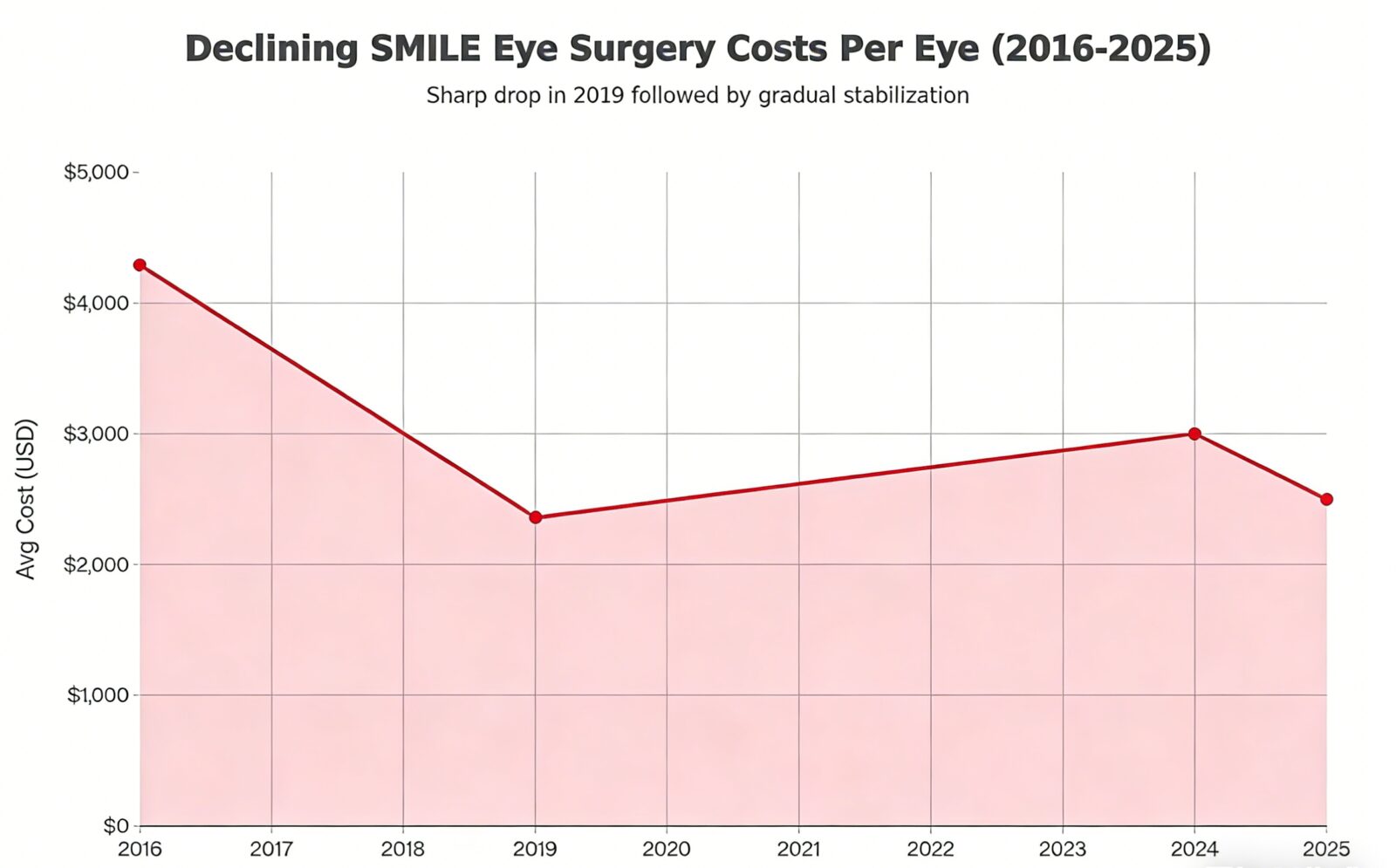
All of these amounts reflect all-inclusive prices at quality clinics. Prices appear to have stabilized over the past several years; in 2016, the average cost of SMILE Eye Surgery was $4,290 per eye and by 2019 due to increased competition, the price went down to $2,361 an eye. Currently prices for SMILE Eye Surgery across all regions are comparable.
Here's what you can expect by region:
| Procedure Region | Price per Eye | Both Eyes Total | Recovery Time | Average Surgeon Experience |
|---|---|---|---|---|
| NYC/Los Angeles | $3,000-$4,000 | $6,000-$8,000 | 1-2 days | 3,000-10,000+ procedures |
| San Francisco/Boston | $2,800-$3,800 | $5,600-$7,600 | 1-2 days | 2,500-8,000+ procedures |
| Chicago/Houston/Dallas | $2,500-$3,500 | $5,000-$7,000 | 1-2 days | 2,000-7,000+ procedures |
| Phoenix/Denver/Seattle | $2,400-$3,400 | $4,800-$6,800 | 1-2 days | 1,500-6,000+ procedures |
| Midwest/South states | $2,000-$3,000 | $4,000-$6,000 | 1-2 days | 1,000-5,000+ procedures |
| Small cities/rural | $2,000-$2,800 | $4,000-$5,600 | 1-2 days | 800-3,000+ procedures |
Data current as of January 2026
You'll pay toward the higher end if you choose high-volume prestigious clinics. Conversely, excellent surgeons in affordable markets offer reduced costs.
International price comparison and medical tourism opportunities
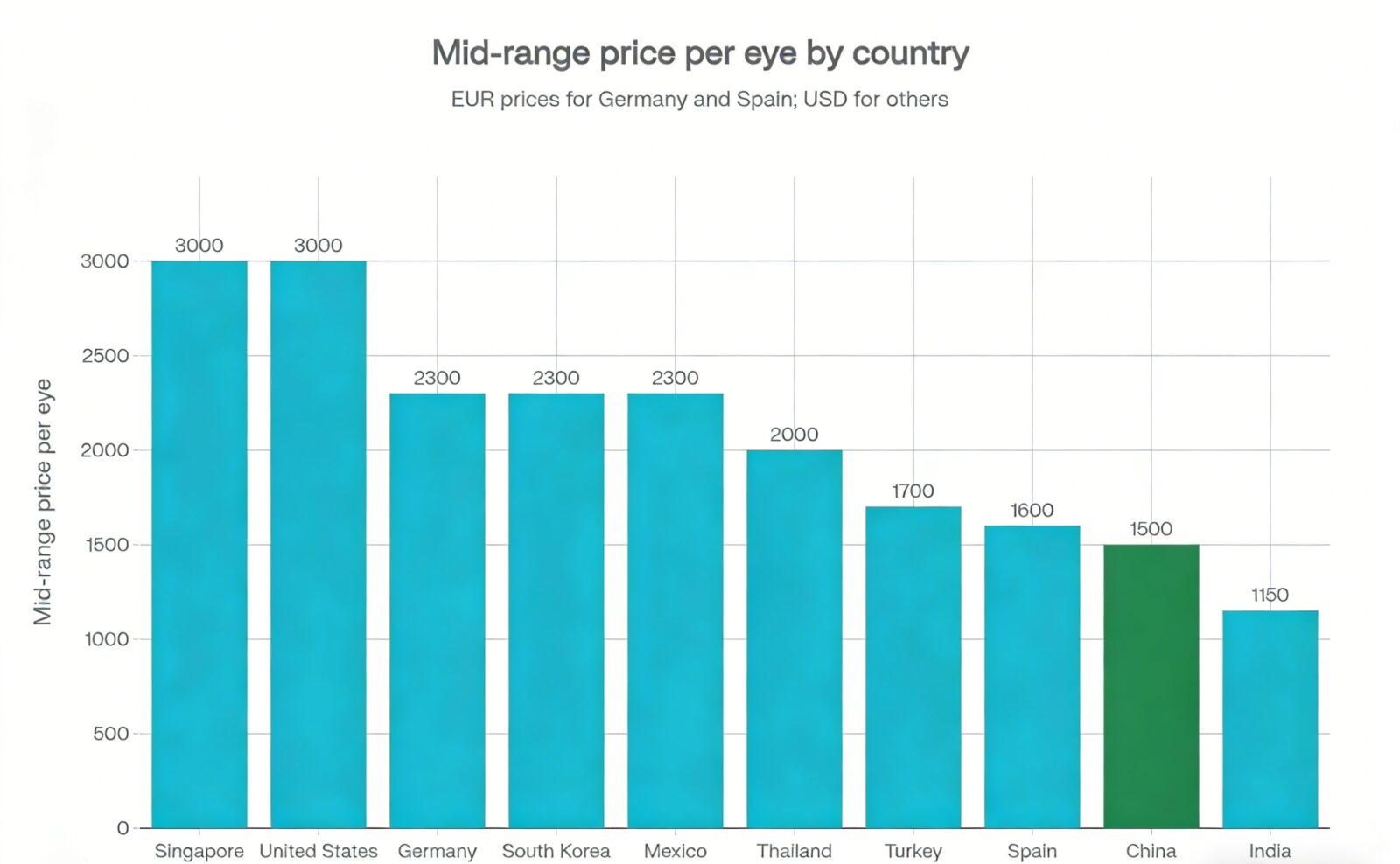
SMILE eye surgery cost drops significantly outside the United States. Medical tourism can save 40-70% on procedures. However, international surgery requires careful planning.
Here's what SMILE costs in popular medical tourism destinations:
| Country | Price per Eye | Both Eyes Total | Savings vs. US | Travel Time from US | Quality Rating |
|---|---|---|---|---|---|
| Singapore | $2,500-$3,500 | $5,000-$7,000 | Save 0-20% | 18-20 hours | ⭐⭐⭐⭐⭐ |
| United States | $2,000-$4,000 | $4,000-$8,000 | Baseline | N/A | ⭐⭐⭐⭐⭐ |
| Germany | €1,800-€2,800 | €3,600-€5,600 | Save 20-35% | 8-9 hours | ⭐⭐⭐⭐ |
| South Korea | $1,800-$2,800 | $3,600-$5,600 | Save 25-35% | 13-15 hours | ⭐⭐⭐⭐ |
| Mexico | $1,800-$2,800 | $3,600-$5,600 | Save 25-40% | 2-5 hours | ⭐⭐⭐ |
| Thailand | $1,500-$2,500 | $3,000-$5,000 | Save 30-45% | 18-22 hours | ⭐⭐⭐ |
| Spain | €1,200-€2,000 | €2,400-€4,000 | Save 30-40% | 8-11 hours | ⭐⭐⭐ |
| Turkey | $1,200-$2,200 | $2,400-$4,400 | Save 35-50% | 10-12 hours | ⭐⭐⭐⭐ |
| China | $1,000-$2,000 | $2,000-$4,000 | Save 40-50% | 12-16 hours | ⭐⭐⭐⭐⭐ |
| India | $800-$1,500 | $1,600-$3,000 | Save 50-60% | 15-20 hours | ⭐⭐⭐ |
Data current as of January 2026
Before booking international surgery, consider these costs:
- Round-trip airfare: $500-$2,000
- Accommodation: $280-$1,400 (7 nights)
- Meals and transport: $200-$800
- Travel insurance: $50-$150
Total additional costs typically run $1,000-$4,000. Nevertheless, you can still save $1,000-$4,000 total.
Why some patients choose SMILE surgery in China
Among international options, China offers an attractive combination: low prices and high quality. The SMILE eye surgery cost runs 40-50% less than US pricing while maintaining comparable standards.
Cost savings and quality healthcare combined
China SMILE surgery pricing: $1,000-$2,000 per eye
That's $2,000-$4,000 for both eyes. You save $2,000-$4,000 even after travel expenses.
China leads globally in SMILE surgery. The country performs over 1 million procedures annually. Furthermore, major hospitals use identical ZEISS equipment.
China SMILE Surgery Pricing Tiers:
| Surgery Type | Basic Tier (Both Eyes) | Standard Tier (Both Eyes) | Premium/Custom Tier (Both Eyes) | Recommended Hospitals | Key Features & Price Description |
|---|---|---|---|---|---|
| Full Flying-Spot SMILE | $1,700-$2,500 | $2,500-$3,500 | $3,500+ | Basic: Aier Eye Hospital Group branches Standard: Beijing Tongren Hospital, Shanghai Aier flagship Premium: Guangzhou Zhongshan Ophthalmic Center, Shanghai New Vision | Most advanced laser surgery, high technical and equipment requirements, comprehensive pricing often includes personalized customization and top expert surgeons |
| Half Flying-Spot FS-LASIK | $1,100-$1,600 | $1,600-$2,500 | $2,500-$4,500 | Basic: Regional Aier branches, local eye hospitals Standard: Beijing Tongren, Shanghai Eye & ENT Hospital Premium: Top-tier JCI-accredited centers with international patient services | Most common choice, widest price range, basic tier is traditional LASIK, premium tier uses femtosecond laser flap with personalized ablation (Femto LASIK) |
Data current as of January 2026
Top Chinese ophthalmologists train internationally. Many completed fellowships at prestigious institutions. They bring world-class techniques to China.
Hospitals in Beijing, Shanghai, and Guangzhou meet international standards. Many have JCI accreditation.
What to consider before medical tourism
Medical tourism requires thorough planning. Don't book impulsively. Consider these factors carefully.
- Language and communication: Choose hospitals with English-speaking services. Top hospitals employ coordinators for international patients.
- Post-operative follow-up: Minimum stay: 7-10 days in China. Arrange local follow-up care before traveling. Some clinics offer telemedicine support.
- Travel logistics: Budget for airfare ($600-$1,500), accommodation ($280-$1,400), and meals ($200-$800). Total additional costs: $1,200-$4,000 typically.
- Choosing the right clinic: Look for JCI accreditation and international patient services. Verify surgeon credentials (3,000+ procedures). Read reviews from international patients.
For detailed information, see our comprehensive guide: Cost of Laser Eye Surgery in China: Compare SMILE vs LASIK Prices, Hospitals & Recovery Tips 2026.
Understanding where your money goes: SMILE surgery cost breakdown
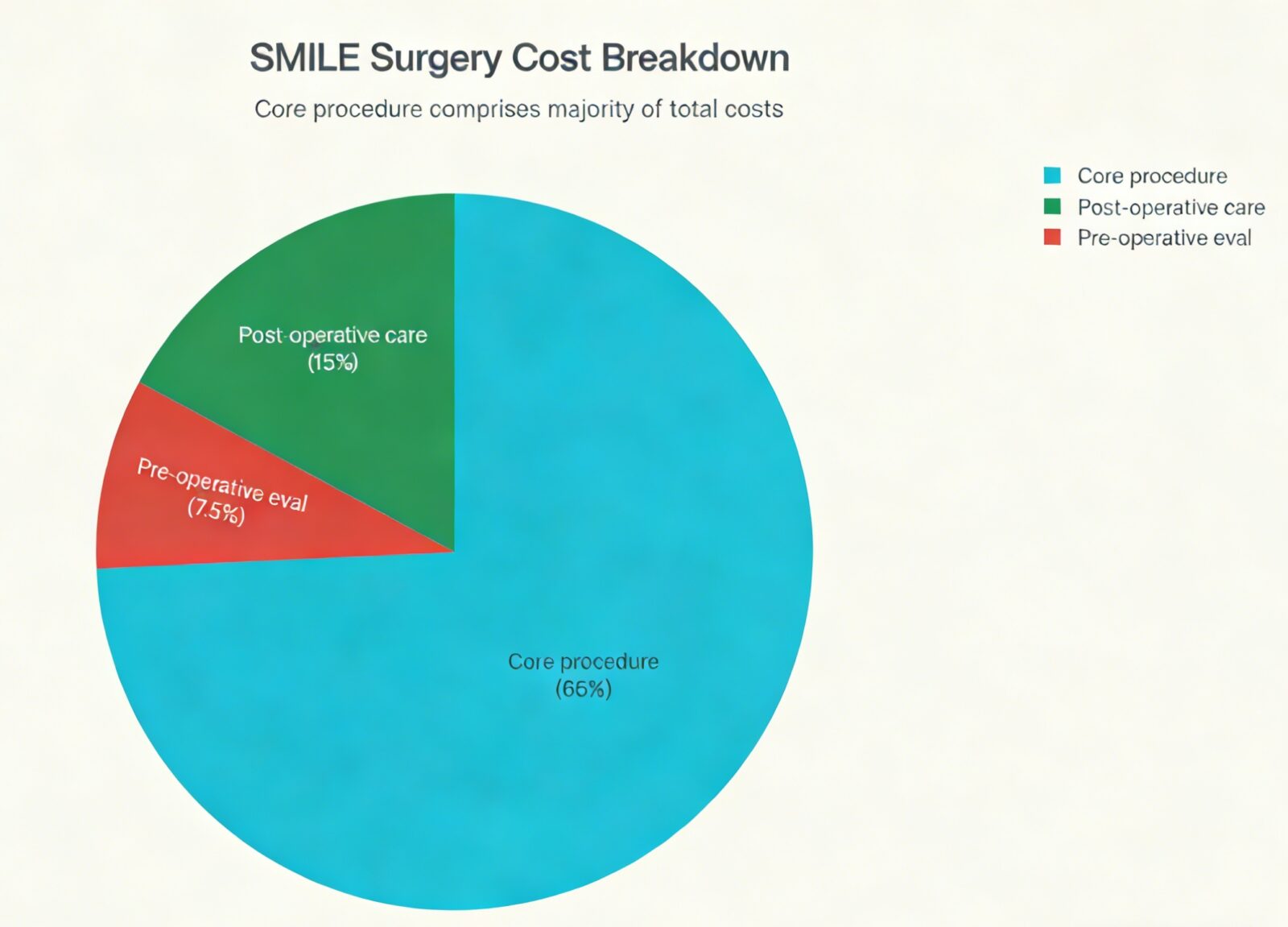
Pie chart showing SMILE surgery cost breakdown
Wondering why SMILE eye surgery cost runs several thousand dollars? Let's break down exactly where your money goes. Understanding these components helps you evaluate quotes fairly.
PART 1. Core procedure costs: surgeon, equipment, and facility (60-70% of total)
The bulk of your expense—typically 60-70%—covers the actual surgery. On a $3,000 per eye procedure, that's $1,800-$2,100. This includes three main components.
Surgeon’s professional fee constitutes the skill and time of the surgeon. This includes pre-operative consultation and planning, surgical procedure, and post-operative monitoring / immediate follow up. Surgeons who perform over 5000 procedures tend to charge higher professional fees.
The ZEISS VisuMax laser system has a purchase price between $500,000-$750,000, and will cost between $50,000-$100,000 per year to maintain. Thus, clinics must spread the amortized cost over their patients.
The facility and operating room fees also pay for supported surgical suites, personnel, and equipment used during your surgery. Leading clinics thrive on creating safe environments to practice patient safety. However, with this level of safety comes a corresponding higher cost.
PART 2. Pre-operative evaluation and testing (5-10% of total)
Before surgery, you'll undergo comprehensive testing. This costs $50-$300 and represents 5-10% of total expense. These tests determine if SMILE is safe for you.
Tests include:
- Comprehensive eye examination: Visual acuity, refraction, and overall eye health assessment
- Corneal topography mapping: 3D surface mapping to detect irregularities
- Wavefront analysis: Measures optical aberrations and higher-order distortions
- Corneal thickness measurement: Pachymetry to ensure adequate tissue for procedure
- Pupil size measurement: Important for night vision outcomes and treatment zone planning
- Tear film evaluation: Screens for pre-existing dry eye conditions
These tests customize your procedure. Moreover, they identify risk factors beforehand. Some clinics offer "free consultations" but charge separately for testing.
PART 3. Post-operative care: medications, follow-ups, and enhancements (10-20% of total)
The remaining 10-20% covers everything after surgery. On a $3,000 procedure, that's $300-$600. This includes medications, follow-ups, and enhancement guarantees.
Medications ($50-$150) include antibiotic drops, anti-inflammatory drops, and lubricating drops. Most clinics provide these as part of your package.
Follow-up visits typically occur at day 1, week 1, month 1, and month 3. These are usually included in total price. However, some clinics charge $50-$200 per visit separately.
Enhancement procedures may be needed by 2-5% of patients. Best clinics offer free enhancement within one year. Others charge 20-50% of original cost.
SMILE vs LASIK cost: Each has own advantages
Many people wonder about the cost difference between SMILE and LASIK. Let's compare both procedures honestly. Additionally, we'll examine long-term value.
Side-by-side pricing comparison
SMILE eye surgery cost runs very similar to LASIK. SMILE typically costs $200-$500 more per eye. Both procedures range from $2,000-$4,000 per eye.
| Procedure | Price per Eye | Both Eyes Total | Recovery | Dry Eye Risk | Success Rate (20/20) | FDA Approval |
|---|---|---|---|---|---|---|
| SMILE | $2,000-$4,000 | $4,000-$8,000 | 1-2 days | Lower (15-20%) | 88-92% | 2016 |
| LASIK | $2,000-$3,500 | $4,000-$7,000 | 1 day | Moderate (30-40%) | 85-90% | 1999 |
| PRK | $1,500-$3,000 | $3,000-$6,000 | 5-7 days | Higher (40-50%) | 85-88% | 1995 |
Data current as of January 2026
The small price difference shouldn't drive your decision. Instead, other factors matter more.
Long-term cost-effectiveness analysis
Both SMILE and LASIK pay for themselves over time. Let's compare them to continuing with glasses or contacts.
20-year costs comparison:
- Glasses: $5,000-$7,000 total cost over 20 years
- Contact lenses: $9,500-$14,000 total cost over 20 years
- SMILE surgery: $4,000-$8,000 one-time investment
Break-even timeline:
- With contacts: 5-7 years to recover investment
- With glasses: 8-12 years to recover investment
After break-even, you save money annually. Over 20 years, SMILE saves $5,000-$10,000 compared to contacts.
When SMILE is worth the premium over LASIK
SMILE costs slightly more than LASIK. However, for certain people, it's worth it.
Choose SMILE if you:
- Play contact sports regularly: No flap to dislodge during physical activity
- Experience dry eye symptoms: Lower nerve disruption means less dryness
- Work in dusty environments: Smaller incision reduces infection risk
- Worry about flap complications: No flap means no flap-related issues
- Have larger pupils: Better accommodation for night vision
Consider LASIK instead if you:
- Need fastest possible recovery: 1 day vs 1-2 days with SMILE
- Have astigmatism plus hyperopia: LASIK treats broader prescription range
- Want most established long-term data: 30+ years of LASIK research vs 10+ for SMILE
- Prefer lowest possible price: $200-$500 less per eye than SMILE
How to pay for SMILE surgery: insurance, financing, and savings tips
Worried about affording SMILE eye surgery cost? You have more options than you think. Let's explore insurance, tax-advantaged accounts, and financing strategies.
Does insurance cover SMILE eye surgery?
Most health insurance doesn't cover SMILE. Insurance companies classify it as elective surgery. They consider glasses and contacts adequate correction.
Exceptions exist:
- Military benefits (TRICARE, VA): May cover active duty personnel and eligible veterans
- Executive health plans: Sometimes include refractive surgery benefits for senior management
- Extreme prescriptions: Rarely qualify when glasses/contacts aren't viable options
Vision insurance typically doesn't cover procedures. However, VSP and EyeMed offer 15-50% discounts at participating providers.
Always call your insurance company first. Ask specifically about "refractive surgery coverage." Occasionally, plans surprise people with unexpected benefits.
Using HSA and FSA for tax-advantaged savings
Here's good news: SMILE qualifies as eligible medical expense. You can use HSA or FSA to pay. This saves you significant money through tax benefits.
How much can you save? Total typical savings: 22-28% of procedure cost
Example: $6,000 surgery with 24% tax savings = $1,440 saved
HSA advantages:
- Funds roll over indefinitely: Never lose unused contributions
- Triple tax benefit: Tax-deductible, grows tax-free, tax-free withdrawals
- Belongs to you permanently: Stays with you if you change jobs
- 2026 limit: $4,300 individual contribution maximum
FSA advantages:
- Funds available January 1: Access full annual amount immediately
- Don't need HDHP: Available through most employer health plans
- 2026 limit: $3,200 annual contribution maximum
- Contributions withheld from paychecks: Automatic pre-tax savings throughout the year
Bottom line: Using HSA or FSA saves $1,000-$2,000 typically.
Financing options and payment plans
Can't pay full SMILE eye surgery cost upfront? Most clinics offer financing. You have several options available.
CareCredit (accepted at 90%+ clinics):
- 0% APR promotional periods: Available for 6-24 months with approved credit
- Example payment: $6,000 surgery ÷ 24 months = $250/month
- Warning: Deferred interest applies if balance not paid by promotion end
In-clinic financing:
- Monthly payments: $100-$200 minimum depending on total cost
- Loan terms: 12-36 month repayment periods available
- Interest rates: 0-12% APR depending on credit score and clinic
- Down payment: Usually require 10-20% upfront
Personal loans:
- Interest rates: 6-15% APR depending on creditworthiness
- Loan terms: 2-5 year repayment periods
- Best for: Borrowers with excellent credit (700+ score)
Never choose based on monthly payment alone. Always calculate total cost including interest.
Smart ways to save without compromising quality
Strategy 1: Seasonal promotions Book during January-March or October-December. Typical discounts: $200-$500 per eye.
Strategy 2: Shop around Get quotes from 3-5 clinics. Prices vary $1,000+ between providers. Additionally, mention competitor prices directly.
Strategy 3: Employer benefits Check for refractive surgery allowances ($500-$2,000). Also look for vision benefit packages.
Strategy 4: Combine savings Example savings stack:
- Base price: $6,000 for both eyes
- Seasonal promotion: -$500 discount
- VSP member discount: -$400 off quoted price
- HSA tax savings: -$1,224 (24% bracket)
- Effective final cost: $3,876
Total savings: $2,124 (35% off original price)
Is SMILE eye surgery worth the cost? Making your decision
You've learned everything about SMILE eye surgery cost. Now comes the big question: Is it worth it?
The honest answer: Yes for most suitable candidates.
Value analysis beyond money
Economic value: If you spend $600 annually on contacts:
- SMILE cost: $6,000 (both eyes average)
- Break-even point: 10 years of use
- 20-year savings: $6,000+ compared to continued contact use
Quality of life improvements:
- Wake up seeing clearly: No fumbling for glasses first thing in morning
- Freedom in sports: No restrictions on physical activities or water sports
- Easier travel: No packing contact solution or worrying about lens care
- Time savings: 60+ hours annually not spent on lens maintenance
- Professional confidence: Choice to wear or not wear glasses on your terms
Safety and reliability:
- FDA approved since 2016: Proven technology with regulatory backing
- 99%+ success rate: Overwhelming majority achieve desired vision improvement
- Complications rare (<1%): Serious issues occur in less than 1% of cases
- Safer than contacts long-term: Lower infection risk than daily contact lens wear
When SMILE makes sense
SMILE is worth it if you:
- Spend $300+ yearly on vision correction: Faster break-even on investment
- Have active lifestyle: Sports and activities benefit from freedom from glasses
- Can afford the investment: Whether paying cash or financing comfortably
- Understand the risks: Informed about rare complications and realistic expectations
- Have stable prescription: No changes in past 12+ months
Think carefully if:
- Prescription still changing: Wait for at least 12 months of stability first
- Can't afford without strain: Don't go into debt that affects financial health
- Very risk-averse: Small risks may feel too significant for your comfort level
- Planning children soon: Hormonal changes can temporarily affect prescription
Schedule consultations with 2-3 surgeons. Get detailed pricing in writing. Compare options honestly. Don't compromise on quality.
Frequently asked questions about SMILE eye surgery cost 2026
Q: How much does SMILE eye surgery cost on average?
SMILE eye surgery costs $2,000-$4,000 per eye in the United States. For both eyes, expect $4,000-$8,000 total. Metropolitan areas charge more ($3,000-$4,000/eye) while Midwest states offer affordable pricing ($2,000-$3,000/eye). Your exact price depends on location and what's included in the package.
Q: Is SMILE surgery more expensive than LASIK?
SMILE and LASIK cost nearly the same amount. SMILE typically runs $200-$500 more per eye. Both procedures range from $2,000-$4,000 per eye. The slight premium reflects newer technology and specialized training. However, SMILE offers lower dry eye risk. Choose based on your needs, not price difference.
Q: Does health insurance cover SMILE eye surgery?
Most health insurance plans don't cover SMILE surgery. Insurance classifies it as elective or cosmetic. Some exceptions include military benefits, executive plans, and rare medical necessity cases. Vision insurance like VSP and EyeMed offer 15-50% discounts. Always call your insurance company to ask about refractive surgery coverage specifically.
Q: Can I use my HSA or FSA to pay for SMILE surgery?
Yes! SMILE qualifies as IRS-approved medical expense. You can pay with HSA or FSA pre-tax dollars. This saves approximately 22-28% depending on tax bracket. A $6,000 procedure saves about $1,440 in the 24% bracket. Plan strategically by maximizing contributions during open enrollment periods.
Q: Are there financing options for SMILE eye surgery?
Yes, most clinics offer multiple financing options. CareCredit provides 0% APR for 6-24 months with approved credit. Monthly payments typically start at $100-$200. Other options include in-house clinic plans (8-12% APR) and personal loans (6-15% APR). Compare total cost including interest, not just monthly payments.
Q: Why is SMILE surgery so expensive?
SMILE's cost reflects advanced technology and specialized expertise. The ZEISS VisuMax laser costs $500,000-$750,000 to purchase. Annual maintenance runs $50,000-$100,000. You're also paying for surgeon training, diagnostic testing, facility costs, and post-operative care. High-quality outcomes require appropriate resources and investment.
Q: Is SMILE eye surgery worth the money?
For most suitable candidates, yes—SMILE is worthwhile. If you spend $500 annually on vision correction, SMILE pays for itself in 8-12 years. Over 20-30 years, you save $5,000-$15,000. Additionally, quality-of-life improvements include freedom from glasses, sports convenience, and time savings. The 99%+ success rate adds value.
Q: What is included in the SMILE surgery price?
This varies significantly by clinic, so ask specifically. Comprehensive packages include pre-operative testing, consultation, surgical procedure for both eyes, medications, and first-year follow-ups. Some clinics quote low base prices but charge separately for testing ($100-$300) and follow-ups ($50-$200 each). Get detailed written quotes.
Q: Is SMILE surgery cheaper in other countries?
Yes, significantly cheaper internationally. India charges $800-$1,500 per eye (save 50-60%). China charges $1,000-$2,000 per eye (save 40-50%). Thailand charges $1,500-$2,500 per eye (save 30-45%). Factor in travel expenses ($1,000-$3,000) including airfare, accommodation, and meals. Research clinic credentials thoroughly before booking.
Q: How can I save money on SMILE eye surgery without sacrificing quality?
Use HSA/FSA for ~24% tax savings (biggest discount). Get quotes from 3-5 clinics and negotiate. Book during slower months for $200-$500/eye discounts. Leverage vision insurance discounts (VSP, EyeMed offer 15-50% off). Check employer benefits for surgery allowances. Never choose cheapest surgeon without verifying credentials and equipment.