Shenzhen Climate Overview:Warm, Humid, and Subtropical ⭐
Shenzhen sits on the southern coast of Guangdong Province, roughly 30 km north of central Hong Kong along the South China Sea. The city runs on a humid subtropical climate, which translates into short, mild winters, a long and sticky summer, and a brief warm shoulder in autumn. Typhoons are the main weather risk between June and October, with the strongest systems brushing or striking the coast from July through September.
This guide breaks Shenzhen weather down month by month, covering temperatures, rainfall, and humidity drawn from long-term climate averages. From there, it maps the typhoon risk window, ranks the best time to visit for most travelers, and ends with practical packing notes for each season.
Quick Facts
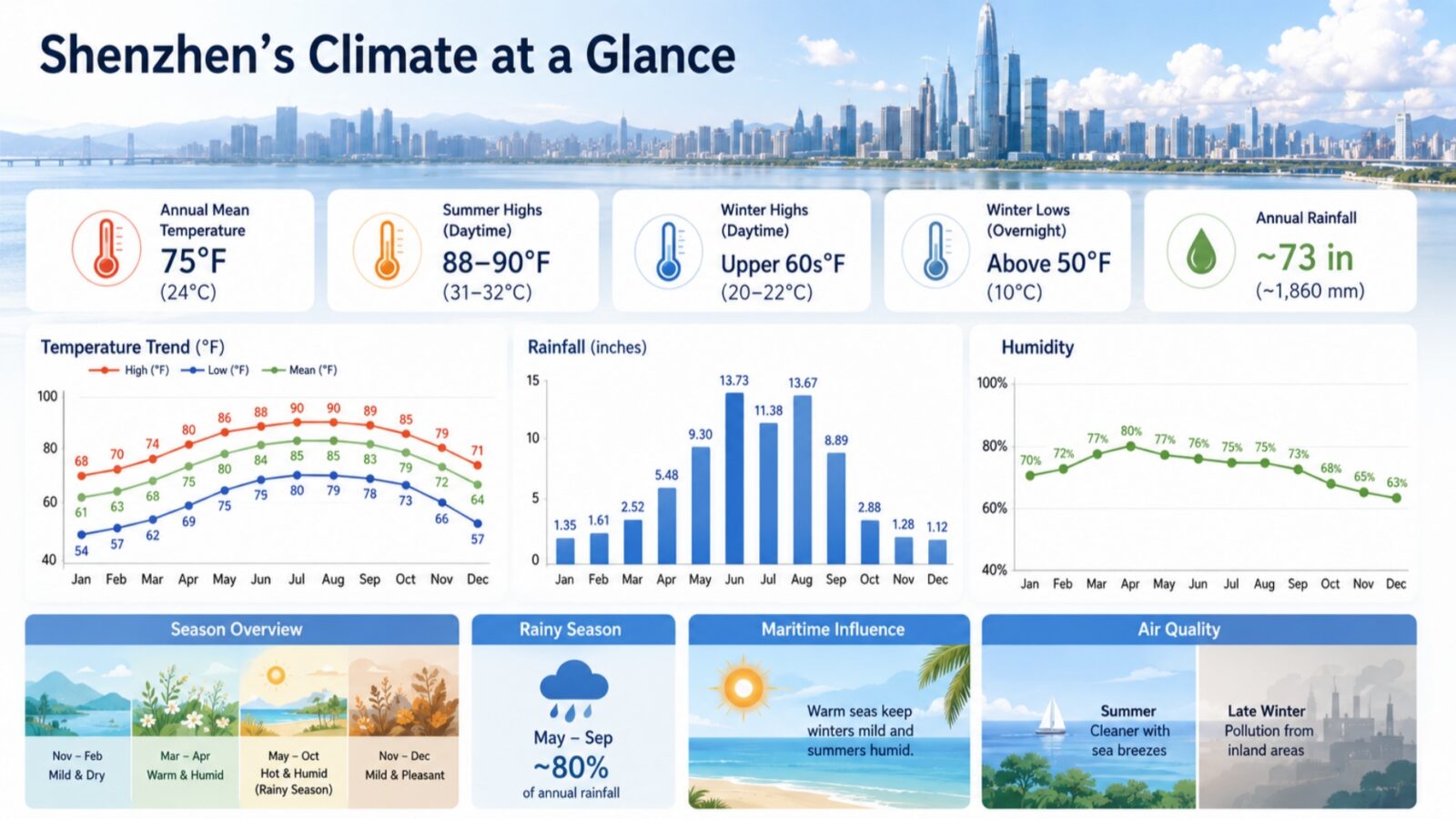
Shenzhen's Climate at a Glance
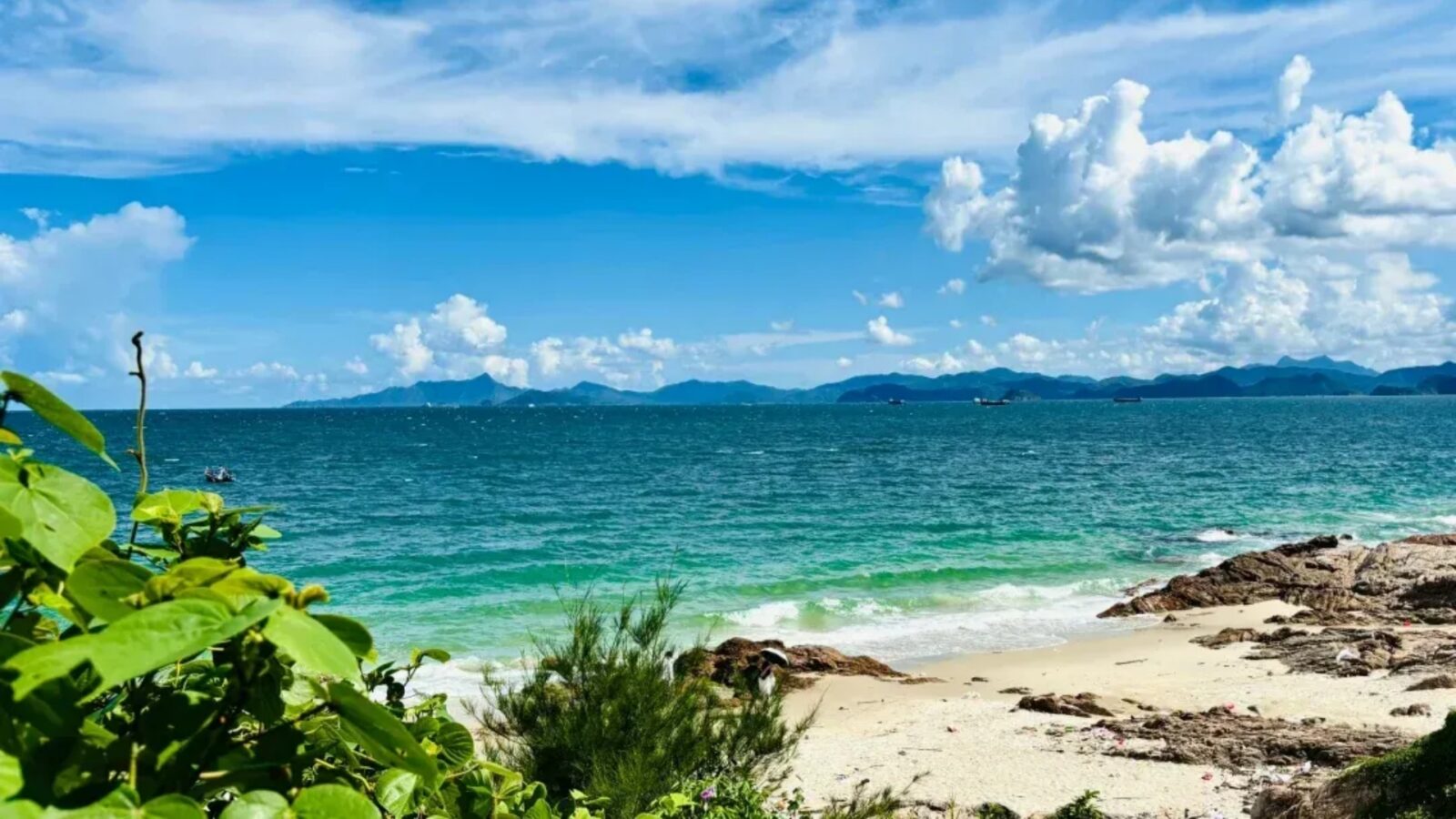
Beautiful Beach at Shenzhen
Shenzhen sits inside the South China Sea's monsoon belt, and that geography shapes nearly every weather pattern a visitor notices. Winters run short and mild from November through February, while summers stretch long, hot, and humid from May into October. The transition seasons last only a few weeks each, which is why most travel guides treat the city as having a four-mild-month, six-warm-to-hot-month rhythm.
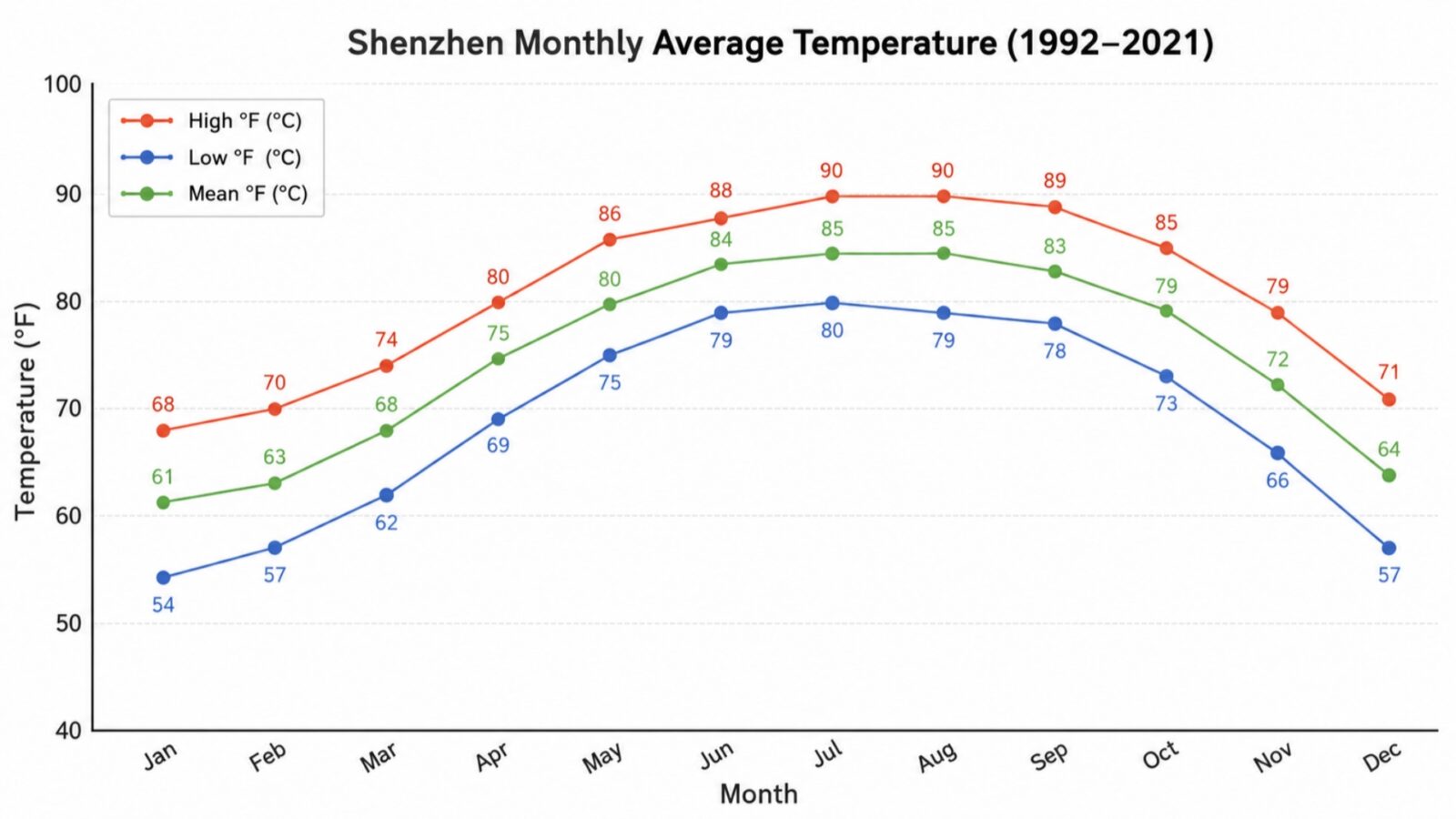
The annual mean temperature sits around 75°F (24°C). Summer daytime highs routinely reach 88–90°F (31–32°C), and once humidity is factored in, apparent temperatures push past 100°F (38°C). Winter daytime highs still reach the upper 60s°F (20–22°C), and overnight lows almost always stay above 50°F (10°C).
Rainfall totals roughly 73 inches (~1,860 mm) per year, with about 80% of that concentrated between May and September. June alone averages 13.73 inches (349 mm). Average relative humidity runs about 74% year-round, peaking in spring at 77–80% and easing to its annual low around 63% in December.
Maritime influence keeps winter lows from dropping near freezing; frost is exceptional in the city proper. Sea-surface temperatures sit warmest from June through September and coolest from December into February. Air quality shifts with the seasons too: cleaner sea breezes tend to dominate in summer, while late winter can see pollution drifting down from inland industrial zones.
Shenzhen Weather Month by Month
Shenzhen Monthly Temperature Trends
The seasonal arc shows up clearly in the monthly averages. May through September carries the rainy season, while October through December delivers the driest, most pleasant stretch of the year. The table below uses long-term climate means covering 1992–2021.
Regional Rainfall, Heat & UV Patterns
What the table shows is a textbook monsoon pattern. Monthly rainfall climbs from 9.3 inches (236 mm) in May to a peak of 13.73 inches (349 mm) in June, then holds above 8 inches (200 mm) through September. October marks a sharp dry swing, dropping to 2.88 inches (73 mm) almost overnight as the monsoon retreats. December runs the driest of the year at 1.12 inches (28 mm).
Heat climbs from April onward and stays put through September. Daytime highs reach 88–90°F (31–32°C) from June to August, while overnight lows hold at 79–80°F (26–27°C) and humidity stays in the upper 70s%. Combined, those conditions push summer heat-index values routinely above 100°F (38°C). The cool window is brief: late November through early February brings daytime highs of 68–71°F (20–22°C) and lows that occasionally dip to 50°F (10°C).
UV stays high or very high year-round, strongest between May and August. Daylight runs about 10.5 hours in winter and stretches to roughly 13.5 hours at the summer solstice. Sea-surface temperatures follow the air, warmest from June through September and coolest from December into February, which makes coastal side-trips most comfortable from late spring into early autumn.
For more, see our guide to Yitian Holiday Plaza.
Typhoon Season and Extreme Weather
Typhoon Season in Shenzhen
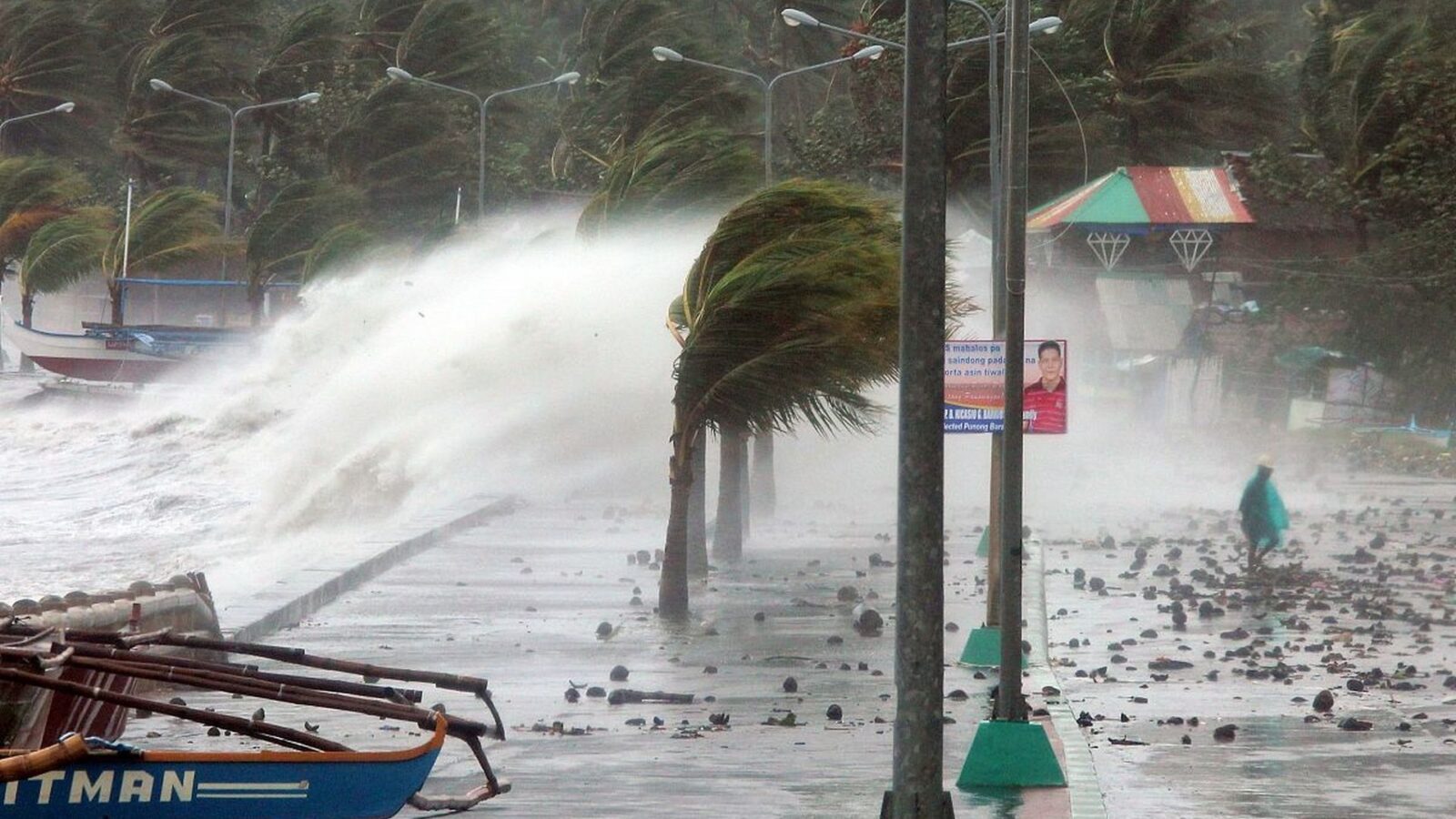
Shenzhen's typhoon season runs officially from June through October, with the highest frequency clustered in July, August, and September. That timing mirrors the broader Western Pacific peak, when the warm waters of the South China Sea fuel the strongest tropical cyclones in the basin.
Most typhoons deliver 1–2 days of heavy rain and strong wind rather than a direct landfall. Glancing brushes are far more common than head-on hits, but even a near-miss can trigger flight cancellations, ferry shutdowns, and temporary park closures. Storm surge becomes a real concern in low-lying coastal districts—Futian, Nanshan, and the Yantian harbor area—during the strongest systems.
Heat extremes matter as much as wind. From June through August, daytime highs of 88–90°F (31–32°C) combined with humidity in the upper 70s% push heat-index values into the 100–110°F (38–43°C) range. Cold extremes are minor by comparison: winter lows almost always stay above 45°F (7°C), and frost is essentially unheard of in the urban core.
April through September can each produce single-day rainfall totals above 3 inches (75 mm) during a heavy downpour or feeder band. For travelers, the practical move is to monitor the China Meteorological Administration (CMA) and Hong Kong Observatory (HKO) feeds during the peak months. Build at least a one-day buffer for outbound flights in July, August, and September, and book hotels and transport through Trip.com or Klook, where free cancellation within 24 hours is standard.
See also our Shenzhen Wutong Mountain Free Hiking Azalea Trails and Views All the Way to Hong Kong guide.
Best Time to Visit Shenzhen

OCT Loft Creative Culture Park
Top recommendation: October and November. Daytime highs sit comfortably in the 79–85°F (26–29°C) range, humidity drops sharply after the monsoon retreats, and the typhoon risk window has just closed. Rainfall totals tumble to 2.88 inches (73 mm) in October and 1.28 inches (33 mm) in November.
Secondary recommendation: March and April. Daytime highs reach 74–80°F (23–27°C), rainfall is lower than May, and crowds stay manageable before the May Day holiday rush. The window to avoid for most travelers is late June through August, when heat, humidity, and typhoon risk all peak.
Pricing reflects the calendar. Round-trip airfare from North America or Europe runs about $550–850 (¥3,900–6,100) off-peak but climbs to $1,000–1,800 (¥7,200–12,900) at Chinese New Year or National Day Golden Week. Budget hotels on Trip.com or Klook go for $35–60 (¥250–430) off-peak versus $60–100 (¥430–720) at peak. Mid-range rooms sit in the $70–120 (¥500–860) off-peak to $120–200 (¥860–1,430) peak band.
The cheapest stretch is late August through early September (excluding the Mid-Autumn Festival) and early December—two windows that sit between major holidays, when hotel rates soften and crowds thin.
For more, see our guide to Things to Do Shenzhen.
Peak vs Off-Peak Months
Peak season in Shenzhen is short and intense. Chinese New Year, the May Day holiday (May 1–3), and National Day Golden Week (October 1–7) draw the heaviest crowds and the highest hotel rates. School summer holidays, mid-July through the end of August, add a second peak driven by family travel. Shoulder months—October, November, March, April—strike the best balance between weather and crowds.
Off-peak months fall into narrow bands: late August (excluding the Mid-Autumn Festival), early December, and February (excluding Spring Festival week). Those weeks typically see the lowest hotel rates and the quietest attractions.
Festivals and Holidays
Chinese New Year, usually in late January or early February, shuts down much of the city for a week. The Lantern Festival falls 15 days into the lunar new year. Qingming, or Tomb-Sweeping Day, runs April 4–6 and is a public holiday. Labor Day on May 1–3 kicks off a three-day weekend.
The Dragon Boat Festival, on the fifth day of the fifth lunar month, usually lands in June. The Mid-Autumn Festival, on the 15th day of the eighth lunar month, falls in September or October. National Day Golden Week, October 1–7, is the busiest week of the year for domestic travel across China. Shenzhen also hosts the China Hi-Tech Fair, typically October 12–17.
What to Pack by Season
Year-round, Shenzhen calls for light breathable layers, sun protection (hat, sunglasses, reef-safe sunscreen SPF 30+), a compact umbrella or packable rain shell, and comfortable walking shoes—the metro plus park walking adds up. Modest covering (shoulders and knees covered) helps at temples on Hong Kong or Macau side-trips.
Spring (March–May)
Spring warms fast in Shenzhen. Highs climb from 74°F (23°C) in March to 86°F (30°C) in May, while lows run from 62–75°F (17–24°C). Humidity rises from 77% to 80%, and rainfall jumps from 2.5 inches (64 mm) to 9.3 inches (236 mm) over the same stretch. Pack light long-sleeve shirts, one medium-weight cardigan for air-conditioned malls, a compact umbrella, and breathable waterproof shoes.
Summer (June–August)
Summer in Shenzhen runs hot and wet. Highs hold at 88–90°F (31–32°C), lows stick to 79–80°F (26–27°C), humidity sits at 79–81%, and monthly rainfall reaches 11–14 inches (289–349 mm) before typhoon risk peaks. Pack ultra-light quick-dry clothing, a cooling towel, sun hat, sunscreen SPF 30+, a compact rain poncho, an anti-fog mask, and spare dry socks.
Autumn (September–November)
Autumn is the comfort season. Highs ease from 89°F (32°C) in September to 79°F (26°C) in November, lows drop from 78°F (26°C) to 66°F (19°C), humidity slides from 74% to 66%, and rainfall falls from 8.9 inches (226 mm) to 1.3 inches (33 mm). Pack light cotton layers, one light sweater for the evening, a foldable windbreaker, and sunglasses.
Winter (December–February)
Winter is short and mild. Highs reach 68–71°F (20–22°C), lows sit at 54–57°F (12–14°C), humidity drops to its annual low of 63–75%, and rainfall is minimal at 1.1–1.6 inches (28–41 mm) per month. Pack a light jacket or fleece, one or two sweaters, a light scarf, and long pants. Cold air-conditioned malls mean layers earn their keep.
Frequently Asked Questions
Q: What is the best month to visit Shenzhen?
October and November lead the ranking, with warm days around 79–85°F (26–29°C), falling humidity, no typhoon risk, and the rainy season already over. March and April are a strong second choice; both are milder and less crowded than May.
Q: When is typhoon season in Shenzhen?
June through October, with the highest frequency in July, August, and September. Most systems deliver 1–2 days of heavy rain and wind; direct landfalls are less common than brushes. Travelers should monitor CMA and Hong Kong Observatory feeds and keep a one-day buffer for flights in the peak months.
Q: How hot does Shenzhen get in summer?
Daytime highs average 88–90°F (31–32°C) in June, July, and August, and overnight lows stay around 79–80°F (26–27°C). Once humidity, which runs 79–81%, is factored in, the heat index routinely pushes apparent temperatures well above 100°F (38°C). Most nights stay muggy even after sunset.
Q: What should I pack for a winter trip to Shenzhen?
A light jacket, one or two sweaters, long pants, and a light scarf for air-conditioned restaurants and malls. Daytime highs reach 68–71°F (20–22°C), so heavy winter coats are not needed; lows of 54–57°F (12–14°C) only need a warm layer at night.
Q: Does Shenzhen have a rainy season?
Yes. May through September concentrates roughly 80% of the city's annual ~73 inches (1,860 mm) of rainfall. June is the wettest single month at 13.73 inches (349 mm). October through December is the driest stretch, with each month under 3 inches (75 mm).
Q: Is Shenzhen humid year-round?
Mostly yes. Average relative humidity runs about 74% for the year, with the most uncomfortable stretch in March through June (77–81%). The driest, most comfortable air arrives from November into early January (63–67%). Even winter mornings can feel damp, especially after a cold front passes.
Q: When is the cheapest time to visit Shenzhen?
Late August through early September (excluding the Mid-Autumn Festival) and early December are the cheapest windows. Round-trip flights from North America or Europe run about $550–850 (¥3,900–6,100) off-peak, rising to $1,000–1,800 (¥7,200–12,900) at Chinese New Year or National Day. Budget hotels on Trip.com or Klook start at $35–60 (¥250–430) in those off-peak weeks.