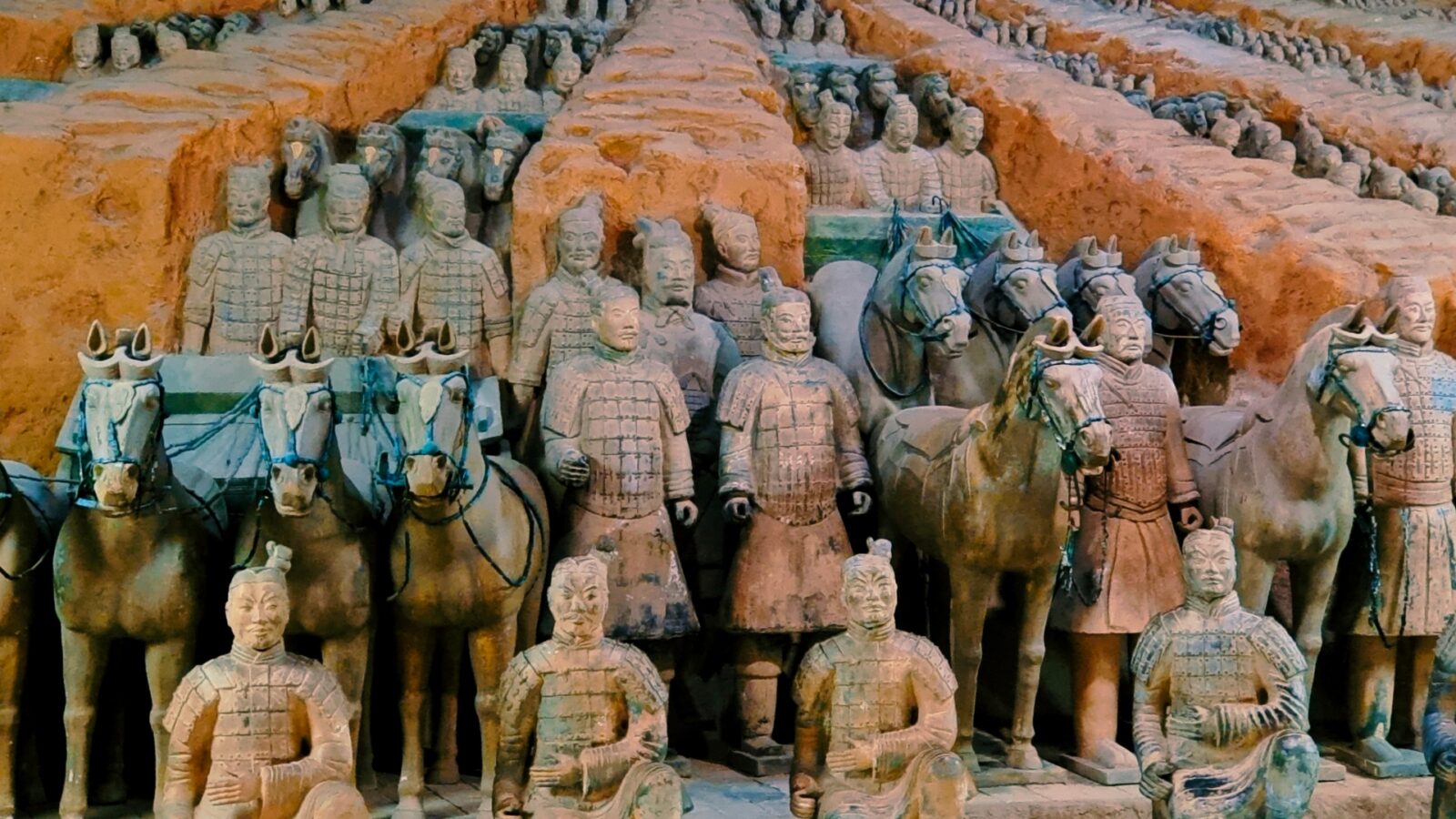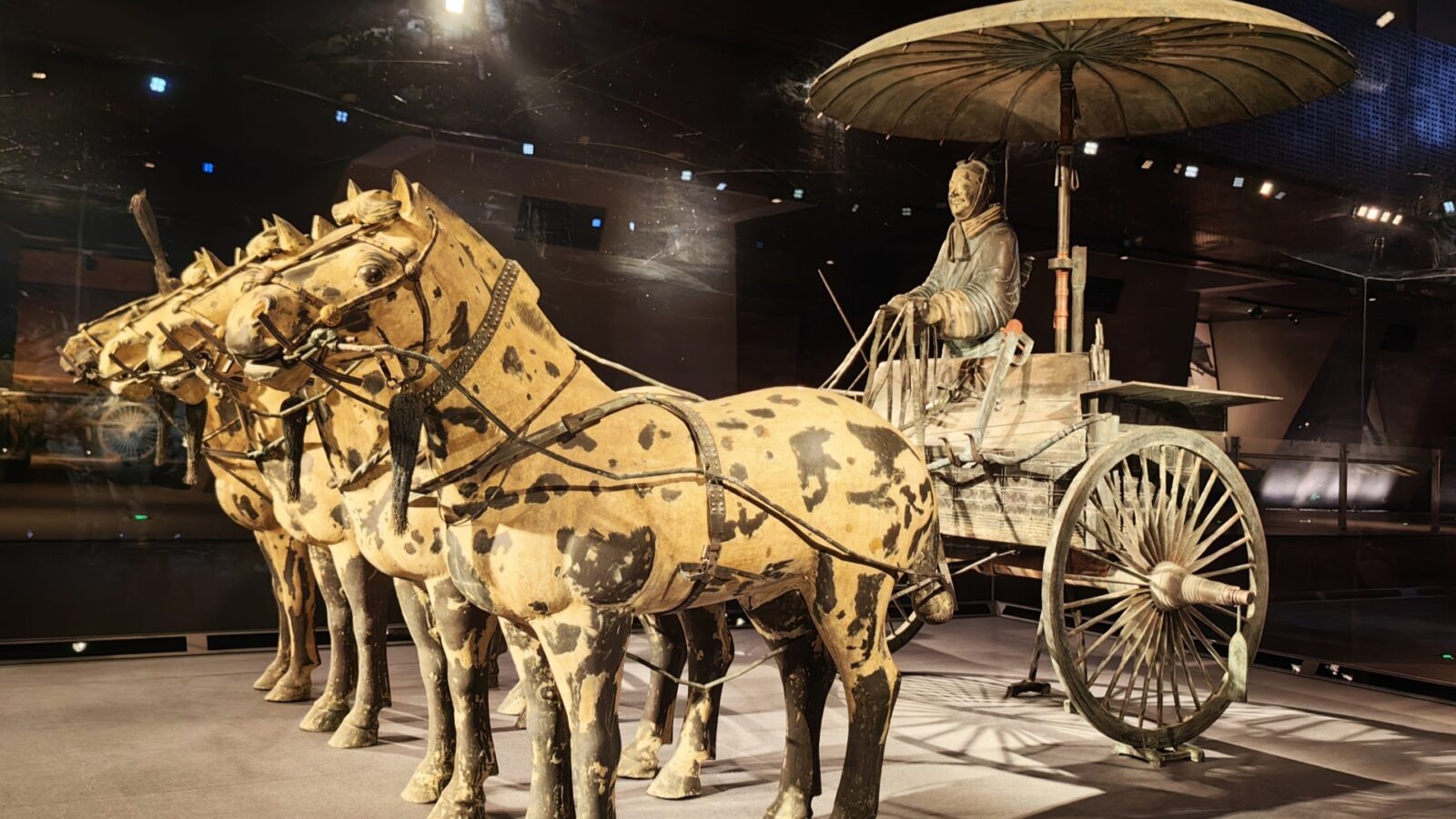
Qin Bronze Chariots
Two Qin bronze chariots — often called the "Bronze Crown" by the archaeological community — sit in a climate-controlled hall just 240 m from the burial pit where they were unearthed. Together the two sets weigh about 2,302 kg and contain more than 6,000 bronze components.
The hall opened in May 2021 inside the Emperor Qinshihuang's Mausoleum Site Museum, about 40 km east of Xi'an in Lintong District. Most visitors pair the chariots with the Terracotta Warriors, a few kilometers away. What follows covers the two chariots, what to see inside, tickets and hours, transport from Xi'an, and how to plan the day.
Quick Facts
The Two Chariots: No. 1 and No. 2
Two distinct chariots accompanied the First Emperor into the afterlife. No. 1 was built for ceremonial display; No. 2 served as the enclosed everyday carriage. Both are half the size of the full imperial vehicles they represent.
No. 1 — The High Chariot
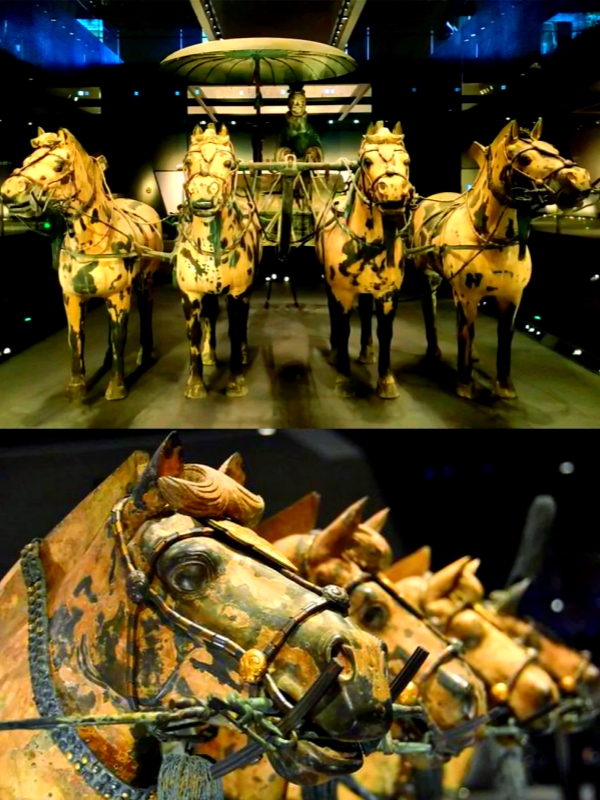
Qin Bronze Chariots
Chariot No. 1 was a stand-up ceremonial carriage. The single parasol canopy sat directly above the driver's head, elevated high enough to signal rank from a distance. The exaggerated height and deliberate tilt of the canopy were not accidental — they marked the occupant's elevated status.
The open-sided frame let the emperor be seen during processions. A bronze charioteer figure occupies the driver's position. Four bronze horses stand in harness, facing forward. The whole assembly was cast, inlaid, and welded from bronze — traces of the original paint survive in places.
No. 2 — The Enclosed Working Chariot
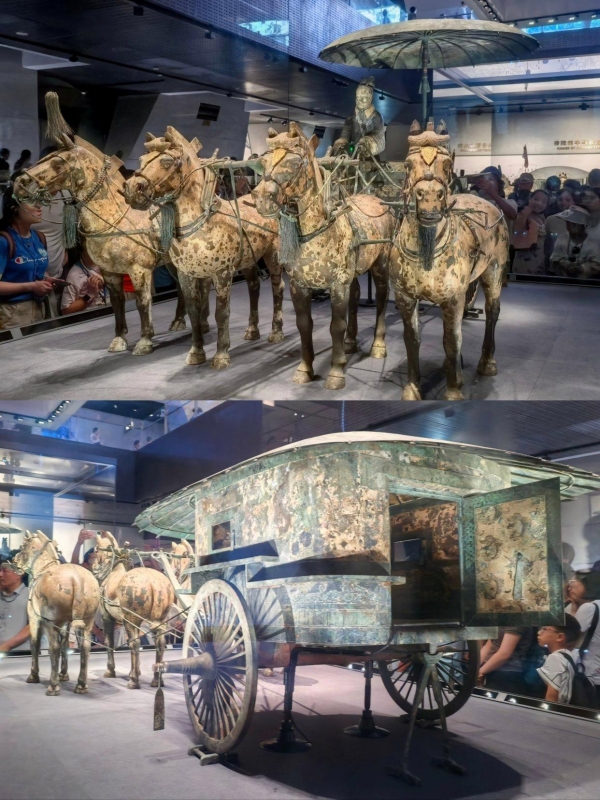
Qin Bronze Chariots
Chariot No. 2 served as the enclosed everyday carriage for the imperial pair. The cabin offered far more protection than the open No. 1 design. Several engineering details distinguish it.
- Adjustable lattice windows: the cross-hatched openings let air through while blocking wind and dust.
- Rear sliding door: a significant upgrade for getting in and out without climbing over the side.
- Circular umbrella canopy: opens and tilts exactly like a real parasol, with a tilt mechanism built into the shaft.
- Moving wheels: the four wheels are fully rotatable — the only bronze wheels in the world that actually turn.
What You'll See Inside the Museum
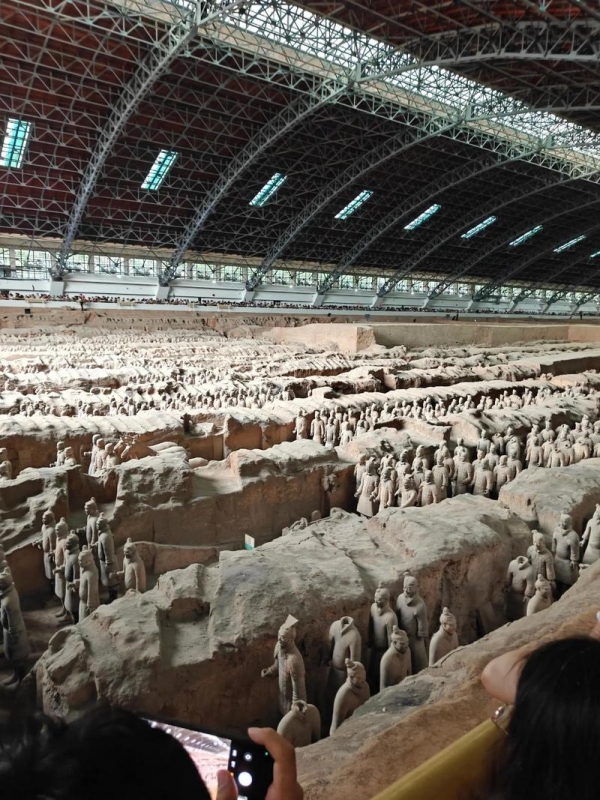
Qinshihuang's Mausoleum Site Museum
A single underground hall opened in May 2021, positioned 240 m from the original burial pit. The space is compact and climate-controlled. Two main display cases hold the chariots with their horses and charioteer figures; side cases show the fittings and harness ornaments in close detail.
- Two main vitrines: No. 1 (High Chariot) and No. 2 (Working Chariot) with bronze horses and charioteer figures
- Bronze fittings and harness ornaments: gold and silver inlays, tassels, and fastenings displayed alongside each chariot
- Bilingual interpretation panels: Chinese and English descriptions of function, construction, and restoration
- Short documentary: sometimes shown in an adjoining room — ask staff on arrival
- Photography: usually allowed without flash; tripods and selfie sticks may be restricted
- Suggested time: 30–60 minutes covers both vitrines and the panels thoroughly
The Display Vitrines
The two main display cases sit slightly below floor level. Visitors look down on the chariots — the same angle archaeologists see during an excavation. The glass cases are climate-controlled, maintaining stable temperature and humidity to protect the restored surfaces and surviving paint traces.
Bilingual Panels and Audio Guides
Chinese-English panels run alongside each chariot, covering construction methods, the restoration process, and the "Bronze Crown" nickname. Audio guides in English, Japanese, and Korean are available for a small fee. Free site maps are distributed at the entrance.
- Panel coverage: construction, restoration, and the "Bronze Crown" nickname explained in both languages
- Audio guides: English, Japanese, Korean available for ~$3–7 (¥20–50)
- Free maps: provided at the entrance
🏛️ Plan Your Full Xi'an Itinerary: Visiting the Terracotta Warriors and Mausoleum Site Museum is just one part of exploring China's ancient capital. Discover top attractions, local street food, and travel tips in our comprehensive Xi'an City Travel Guide.
Discovery, Restoration, and the 2021 Move
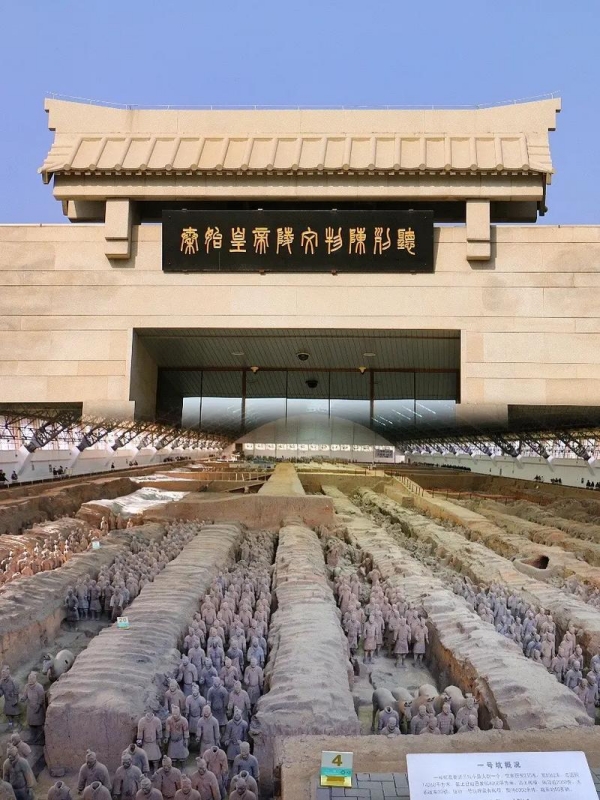
Qinshihuang's Mausoleum Site Museum
The two chariots were unearthed in December 1980 by an archaeological team from the Emperor Qinshihuang's Mausoleum Site Museum, in a burial pit about 20 m west of the main mound. Some published listings give 1978 — the verified record is December 1980. The wooden coffin had collapsed centuries earlier. One chariot alone shattered into more than 3,000 fragments.
Restoration took about 8 years. Museum experts reassembled the pieces using casting, inlaying, and welding — more than 6,000 bronze components across the two sets. The precision of the work earned the ensemble its nickname: the "Bronze Crown" (青铜之冠) in the archaeological community.
In May 2021, the new Bronze Chariots Hall opened 240 m from the original pit. The chariots had been disassembled into roughly 100 major parts and assemblies, packed in soft padding, sealed in dozens of boxes, and moved to the new facility.
👗 Explore Xi'an's Historical Fashion & Culture: Beyond the Qin Dynasty's imperial monuments, Xi'an later served as the heart of the Tang Dynasty, famous for its vibrant culture and iconic traditional clothing. Learn about ancient fashion trends in our guide to the Tang Dynasty Neckline.
Planning Your Day and Combining with the Terracotta Warriors
Most visitors see the Bronze Chariots and the Terracotta Warriors in a single day. The two sites are a couple of kilometers apart inside the same Lintong complex, connected by a free shuttle bus. A practical order starts with the pits in the morning when light is better for photography, then moves to the Bronze Chariots after lunch.
- Suggested order: Terracotta Warriors pits 1/2/3 in the morning (2–3 hours) → lunch → free shuttle to the mausoleum area → Bronze Chariots Hall (30–60 min)
- Free Lintong shuttle: connects the Bronze Chariots Hall, Terracotta Warriors visitor center, and Huaqing Palace
- Weekday afternoons after 14:00: the Lintong parking area clears after the morning Terracotta Warriors rush
- Best months: March–May and September–November for comfortable temperatures
- Photography: allowed without flash; tripods and selfie sticks may be restricted
Best Time of Day and Season
Arrive at the Bronze Chariots Hall after 14:00 on weekdays. The site is significantly quieter once the Terracotta Warriors morning crowd has moved through Lintong. Spring and autumn offer the mildest temperatures for walking between sites. Summer brings heat and large crowds; winter is cold but sparse.
- Time of day: after 14:00 weekdays for the lightest foot traffic
- Season: March–May and September–November for comfortable weather
- Weekends: expect larger crowds regardless of season
What to Bring
Pack light but practical. The underground hall runs cool regardless of outside temperature, and the Lintong site involves outdoor walking between stops.
- Passport: required for ticket purchase at the counter
- Sunscreen and water: summer sun on the outdoor portions is direct
- Comfortable walking shoes: the mausoleum area involves gravel paths and some stairs
- Light jacket: the underground hall stays cool even in summer
- Portable phone charger: useful for navigation and photography across multiple sites
Tickets, Hours, and Where to Book
The Bronze Chariots Hall is not covered by the Terracotta Warriors pit ticket. It falls under the Qinshihuang's Mausoleum combined ticket, which also gives access to the surrounding mausoleum area and the 0001 auxiliary pit.
- Bronze Chariots Hall ticket: included in the combined Emperor Qinshihuang's Mausoleum ticket — typically ~$17 (¥120) per adult on Trip.com or Klook
- Terracotta Warriors pits 1/2/3: separate ticket, ~$17–22 (¥120–160)
- Combo ticket (both areas): typically ~$28–35 (¥200–250) — confirm when booking
- Audio guide: ~$3–7 (¥20–50), usually available in English, Japanese, Korean
- Booking channels for foreign visitors: Trip.com, Klook, or GetYourGuide — no mainland phone number needed
- On-site counters: accept cash and major cards; queues can be long at peak times
- Passport required: bring it — needed for ticket purchase
- Child concession: free or reduced for children under the height/age threshold — confirm on site
Getting There from Xi'an
Four main routes connect central Xi'an with the Bronze Chariots Hall in Lintong District. All pass through or stop at the Terracotta Warriors visitor center, where the free Lintong shuttle picks up.
Within Lintong, a free shuttle bus runs between the Bronze Chariots Hall, the Terracotta Warriors visitor center, and Huaqing Palace — no need to return to Xi'an between sites.
Frequently Asked Questions
Q: Where exactly is the Qin Bronze Chariot Museum located?
Lintong District, Xi'an, Shaanxi — inside the Emperor Qinshihuang's Mausoleum Site Museum complex, 240 m west of the original 1980 burial pit. The dedicated Qin Bronze Chariots Hall opened in May 2021.
Q: Is the Qin Bronze Chariots Hall included in the Terracotta Warriors ticket?
No. The Qin bronze chariots fall under the Qinshihuang's Mausoleum ticket (~$17 / ¥120), which is separate from the Terracotta Warriors pits 1/2/3 ticket (~$17–22 / ¥120–160). Combo tickets covering both areas are available.
Q: How long do visitors need to see the Qin bronze chariots?
30–60 minutes is sufficient to view both vitrines and read the bilingual panels. The hall is compact. Most visitors then move on to the surrounding mausoleum area or the free shuttle to the Terracotta Warriors.
Q: Are English-language guides or audio guides available?
Yes. Chinese-English panels are installed throughout the hall. Audio guides are typically available in English, Japanese, and Korean for ~$3–7 (¥20–50). Private English-speaking guides can be arranged in advance through Trip.com.
Q: Can visitors photograph the Qin Bronze Chariots?
Non-flash photography is generally allowed. Tripods and selfie sticks may be restricted — verify with staff on site before setting up any equipment.
Q: How were the Qin bronze chariots found and restored?
Unearthed in December 1980, about 20 m west of the main mound, in more than 3,000 fragments. Restoration took about 8 years using casting, inlaying, and welding techniques to reassemble more than 6,000 bronze components.
Q: What makes the Qin bronze chariots so important archaeologically?
The archaeological community refers to them as the "Bronze Crown" of Qin archaeology. They are the largest and most complex ancient bronze objects found in China — half life-size, weighing ~2,302 kg, with more than 6,000 components across the two sets.
Q: How do you get from Xi'an to the Qin bronze chariots?
Tourist Bus 306 runs from Xi'an Railway Station for ~$1.50–2 (¥7–8), 60–90 minutes. Metro Line 9 to Huaqing Pool, then a free shuttle bus, takes about 80–100 minutes. Didi costs ~$28–35 (¥200–250) for the ~50-minute ride. Within Lintong, a free shuttle connects the Bronze Chariots Hall with the Terracotta Warriors visitor center.