Luoping County, Yunnan, China
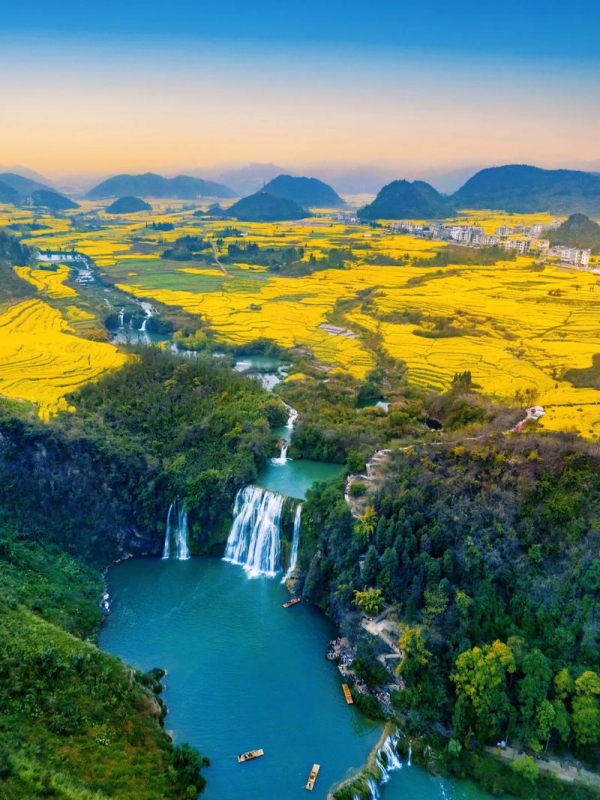
Luoping County Yunnan China sits at the eastern edge of Yunnan Province, where the Yunnan-Guizhou Plateau meets the borders of three provinces. The area draws photographers and nature travelers from across China each spring, when roughly 4,000 hectares of rapeseed fields burst into yellow bloom across a landscape carved with limestone karst peaks. Beyond the flowers, the county holds Jiulong — a cluster of ten cascading waterfalls formally listed as the largest calcified waterfall group in China — plus traditional Bouyei villages and mountain trails above the morning cloud seas. Getting here requires some planning: Luoping has no high-speed rail, and most visitors route through either Kunming or the closer Xingyi airport in Guizhou.
Quick Facts
Rapeseed Flower Fields and Bloom Season
Luoping County, Yunnan, China
The rapeseed bloom in Luoping typically begins shortly after Chinese New Year in late January and continues into early April, with the densest flower cover occurring from mid-February through late March. Year-to-year timing shifts depending on winter and early-spring temperatures, so travelers should check current conditions before arriving. During peak bloom, the county's fields are dense with yellow, and the air carries a faint sweet smell from the flowers. The landscape transforms daily as the flowers advance from lower terraces to upper slopes, which makes timing a factor in what visitors actually see.
Most foreign visitors structure a Luoping loop by pairing flower viewing with one other scenic area per day. The golden window for photography runs from early morning until roughly 9:30 AM, when warm light hits the cone peaks, and again in late afternoon when slanted sun creates long shadows across the karst formations. Overcast mornings reduce harsh contrast and push the yellow saturation higher, which many photographers prefer. Visitors driving the area independently should note that roads through the fields become congested on weekends during peak bloom — an early start on Saturday or Sunday helps.
Where to See the Rapeseed Fields
The county maintains four main viewing zones, each offering a different angle on the flower-and-peak composition.
- Jinji Fengcong (Golden Rooster Peak Cluster): Best for classic cone-peak-and-flower photographs. Visitors walk a marked trail or take the sightseeing bus to elevated viewpoints above the fields.
- Shiwan Dashan (Ten-Thousand-Rock Mountain): Best viewed from a distance. The broad karst backdrop reads most dramatically when framed across open fields rather than approached closely.
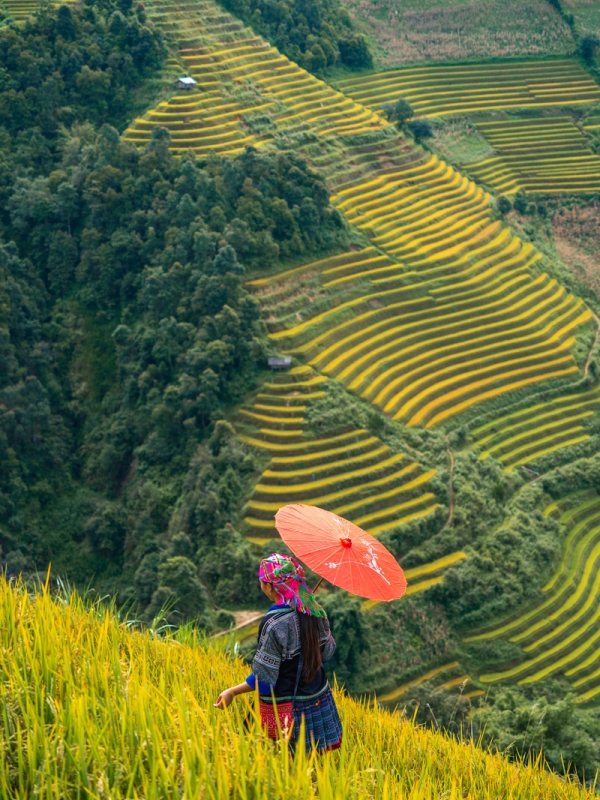
- Niujie Spiral Terrace: Best for the terraced-field effect. The spiral arrangement of cultivated rows creates concentric rings of yellow that photograph well from the viewing platform above the village.
- Majie Rapeseed Fields: Best for layered mountainside fields. Standout secondary viewpoints include Gegang Spiral Terrace and Songmao Spiral Terrace, both offering elevated angles across the slope.
Bloom Calendar and Photography Windows
The table below summarizes typical conditions by month. Visitors should verify current status via yr.no Luoping or the China Meteorological Administration before travel, since the exact bloom curve shifts each year.
🌿 Plan Your Trip Across Yunnan: If you are building an itinerary that links Luoping with Kunming, Dali, or Lijiang, discover practical advice on transport, local customs, and ideal travel seasons in our Yunnan Travel Tips.
Jiulong Waterfall Cluster
Luoping County, Yunnan, China
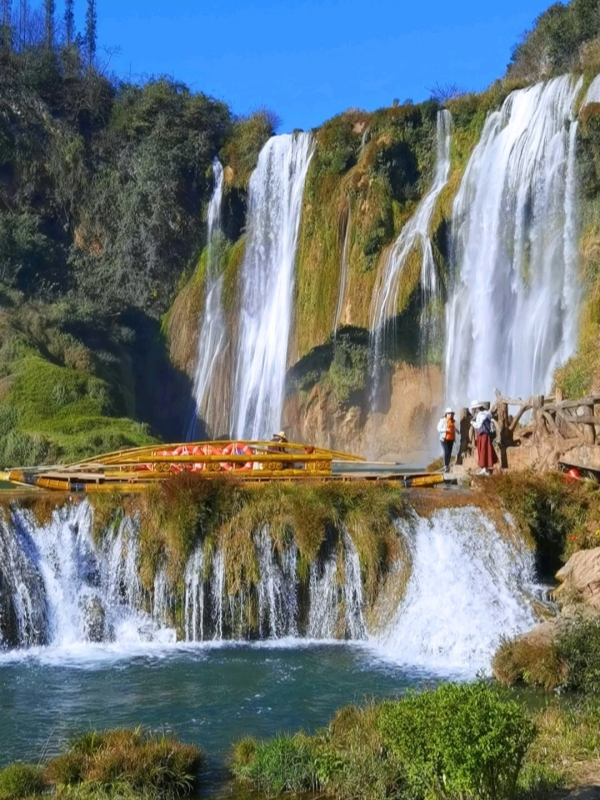
The Jiulong Waterfalls sit roughly 22 kilometers north of Luoping town, where ten waterfalls of varying levels cascade along the Ba River through limestone terrain. Official sources list the cluster as the largest calcified waterfall group in China. A standard visit takes about 2–3 hours, with a paved walkway and metal staircases connecting each level from upper to lower falls. The ticket costs about $11 (¥80) and is bookable on Trip.com and Klook. Between April and August, the volume increases as snowmelt and summer rain feed the cascades, producing more dramatic spray — though the stone surfaces stay wet longer.
For visitors deciding between hiking the full trail or using the sightseeing car: the one-way cart saves roughly 40 minutes of climbing but bypasses several mid-level platforms where photographers set up. Those with mobility limitations or traveling with children may prefer the cart. The walk itself is not strenuous for most fitness levels, but the metal walkways near the tallest drops can be slick even in dry months.
Hiking Routes and Visitor Logistics
The visitor center at the entrance provides a walking map that marks the falls in numbered order from the upper to lower sections.
- Ticket window: About $11 (¥80); confirm current pricing on Trip.com before arrival
- Route direction: Walk proceeds from upper falls downhill through numbered platforms; allow 2–3 hours for the full cascade
- Sightseeing car: One-way cart available for those who prefer to skip the climb; board at the lower platform for the ascent
- Footwear: Waterproof footwear is advisable April through August; wet stone near the upper drops requires care year-round
- Accessible viewing platform: A paved platform near the third level offers a wide angle for photography without climbing to the top tiers
Karst Peaks and Nase Mountains
Luoping County, Yunnan, China
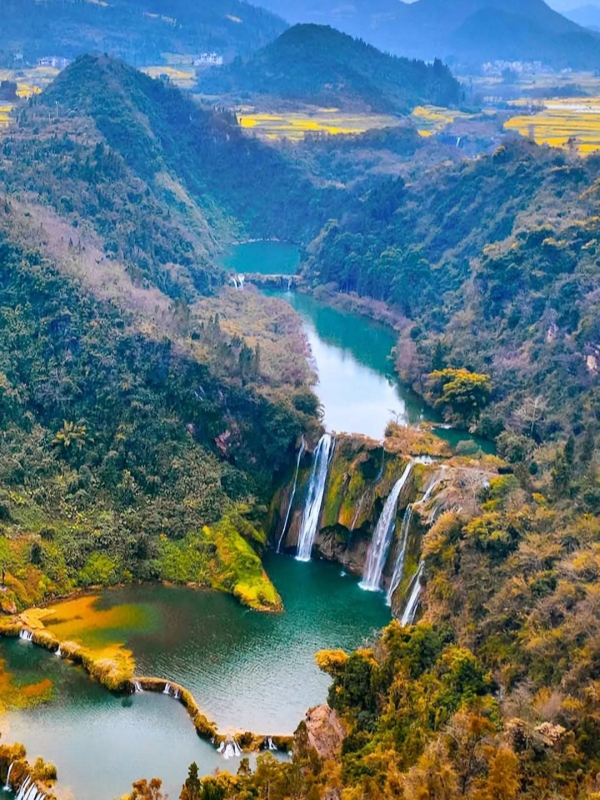
Luoping Luoping County Yunnan China sits on cone-karst (fenglin) terrain of the Yunnan-Guizhou Plateau, formed over tens of millions of years as Triassic limestone dissolved along fracture lines and dissolved further by rainfall and groundwater. The result is a landscape of isolated limestone towers rising from flat valley floors — the same formation type found in Guilin, though here the cones are taller and more densely clustered. This geological context shapes everything about the visual character: the rapeseed fields occupy the flat bottoms and lower slopes, while the peak clusters stand above the yellow as vertical punctuation marks.
The Nase Mountains (那色峰海, "Sea of Peaks") lie near Dabu Dong, a traditional Yi village. Two marked trails serve the area. The lower trail runs through forest to a sunrise and cloud-sea viewpoint — morning fog pooling between the cones creates the sea effect, most reliable from October through March. The higher summit trail climbs to an open ridge for a full panorama across the cluster; the ascent is steeper and takes roughly 2 hours one way. Visitors without a guide should carry an offline map, as signage in the higher sections is limited to Chinese characters.
Bouyei Culture, Festivals and Local Food
Luoping County, Yunnan, China
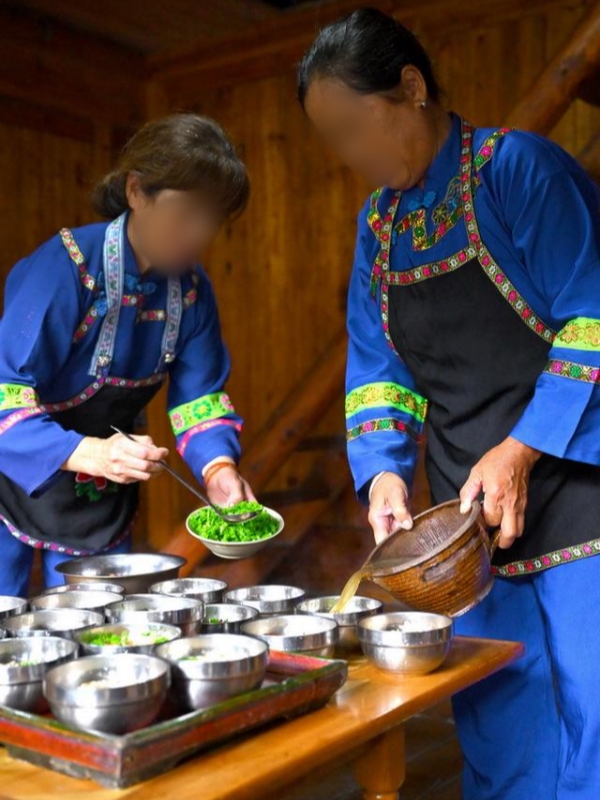
The Bouyei (also spelled Buyei) represent one of Luoping's principal ethnic groups, and their cultural markers are visible in the architecture, textiles and food of the surrounding villages. Stilted wooden houses, silver jewelry and embroidered textiles appear most concentrated in Dabu Dong and several smaller settlements in the county's western hills. The Song Festival on the second day of the second lunar month and the Water-Splashing Festival on the third day of the third lunar month draw the largest local crowds, though neither is staged specifically for visitors.
The food reflects the plateau's agricultural character. Five-Color Flower Rice uses plant-derived dyes to color sticky rice in violet, yellow, red, white and green — traditionally served during festivals but now available at village restaurants year-round. Whole Pot Soup features large chunks of pork, lamb or offal simmered with local spices in a clay pot; it carries strong associations with the March 3 festival but appears on menus across the county. Clay Pot Rice layers rice with sausage, cured pork and peas, cooked in a clay vessel over an open flame — a simple dish with deep local roots. Meals at local restaurants cost roughly $3–7 (¥20–50) per person.
- Five-Color Flower Rice: Plant-dyed sticky rice in five colors; traditional festival food now served year-round
- Whole Pot Soup: Large-chunk pork, lamb or offal cooked with local spice blend in a clay pot
- Clay Pot Rice: Rice cooked with sausage, cured meat and peas in a clay vessel over flame
- Song Festival: Celebrated second day of second lunar month; traditional singing and dance in Bouyei villages
- Water-Splashing Festival: Third day of third lunar month; water festivities and community meals
Getting to Luoping
Luoping occupies a junction position near three provincial borders, which shapes how travelers typically reach it. The county lacks high-speed rail service, and the nearest practical gateways are Kunming Changshui Airport (KMG) and the closer Xingyi Wanfenglin Airport (ACX) in Guizhou. Overland distances are substantial: Kunming lies roughly 210 kilometers away, while Xingyi is about 70 kilometers. A regular (non-high-speed) train operates on the Kunming–Guangxi corridor with a Luoping stop, and another line runs through Xingyi.
Routes from Kunming, Xingyi and Beyond
Getting Around Luoping
The Luoping Tourism Service Center operates four numbered shuttle lines connecting the major scenic areas, each priced between ¥5–20 ($1–3). Routes cover Jiulong Waterfalls, Nase Mountains, Luosi Fields in the rapeseed core area, and Duoyi River. Tickets are purchased at the tourism center or onboard in cash. Inside Jinji Fengcong, a sightseeing bus, ox cart and bicycle are available for short-distance mobility — the bicycle option suits visitors who want to stop and shoot at multiple angles without waiting for the shuttle schedule.
- Shuttle Line 1: Luoping town → Jinji Fengcong (rapeseed core area)
- Shuttle Line 2: Luoping town → Jiulong Waterfalls
- Shuttle Line 3: Luoping town → Nase Mountains (via Dabu Dong)
- Shuttle Line 4: Luoping town → Duoyi River scenic area
- In-park mobility: Sightseeing bus, ox cart and bicycle rentable within Jinji Fengcong zone
Planning Costs, Visas and Bookings
Luoping Top Attractions: Tickets, Duration & Travel Tips
The tables below set out entry fees, typical daily costs and visa eligibility in a side-by-side format. All prices reflect bookings through channels accessible to foreign visitors — Trip.com and Klook — with USD converted from CNY figures on those platforms.
Daily Travel Cost Breakdown for Luoping Visitors
The per-day cost table below covers budget, mid-range and comfortable traveler profiles. Figures assume two scenic entries per day, standard meals and shared transport within the county.
Visa Policy Guidelines for Foreign Tourists Visiting Luoping
Visa eligibility depends on passport nationality. The table below summarizes the main pathways relevant to foreign visitors planning a Luoping trip.
Foreign visitors should verify their specific passport's eligibility against the official visa policy page before booking travel, as rules update and eligibility criteria vary by nationality.
- Trip.com: Jiulong Waterfall, Jinji Fengcong, Nase Mountains and Duoyi River all list with English-language confirmation; accepts international cards
- Klook: Partial coverage of Jiulong Waterfall; confirmation in English; international cards accepted
- Meituan / Dianping / WeChat mini-programs: Mainland-only platforms requiring a Chinese phone number and Alipay or WeChat Pay for full activation; not usable by most foreign visitors
- Payment: Alipay Tour Card and WeChat Pay both work with foreign bank cards after ID verification; cash remains accepted at small restaurants and shuttle ticket windows; hotel desks and Jiulong ticket counter accept bank cards
Frequently Asked Questions
Q: When is the rapeseed bloom in Luoping County Yunnan China?
The rapeseed bloom typically runs from late January through early April. The densest flower cover occurs from mid-February to late March. Year-to-year timing shifts with winter and early-spring temperatures, so visitors should confirm current conditions via yr.no Luoping or the China Meteorological Administration before traveling.
Q: How do visitors travel from Kunming to Luoping County Yunnan China?
The overland distance from Kunming to Luoping Luoping County Yunnan China is roughly 210 kilometers. Options include a regular (non-high-speed) train taking about 4 hours, or a long-distance bus or hired car taking about 3 hours. There is no high-speed rail to Luoping. For visitors arriving from outside China, the standard route is to fly into Kunming Changshui Airport (KMG) first, then connect by bus or train.
Q: Do foreign visitors need a visa for Luoping County Yunnan China?
Luoping follows standard PRC entry rules. Eligible passport holders may use the 240-hour visa-free transit via Kunming or qualify under bilateral visa-exemption agreements. Those not covered by these schemes need an ordinary tourist (L) visa. Visitors should verify their passport against the official visa policy page before booking travel.
Q: Can Luoping attractions be booked on Trip.com or Klook?
Yes. Jiulong Waterfall, Nase Mountains, Duoyi River and Jinji Fengcong all list on Trip.com with English confirmation. Klook covers some attractions, though its Luoping inventory is thinner. Meituan, Dianping and WeChat mini-programs require a mainland phone number and are not accessible to most foreign visitors.
Q: How many days should I plan for Luoping County Yunnan China?
Two days covers the primary loop: Day 1 for the rapeseed fields and Jinji Fengcong sunrise, Day 2 for Jiulong Waterfall and Duoyi River. A third day is worthwhile if the Nase Mountains' sunrise cloud-sea view or a Bouyei festival coincides with the visit.
Q: Where should I stay in Luoping County Yunnan China?
Luoping town center offers the best access to dining, the transport hub and tourist shuttles. Homestays near Jinji Fengcong suit visitors who want to photograph the sunrise over the fields without an early-morning drive. Mid-range hotel rates run roughly $35–55 (¥250–400) per night.
Q: How do foreign visitors handle payments in Luoping County Yunnan China?
Alipay Tour Card and WeChat Pay both function with foreign bank cards after identity verification. Cash remains accepted at small restaurants, local markets and shuttle ticket windows. Hotel front desks and the Jiulong Waterfall ticket counter accept bank cards directly.
Q: Is English spoken at Luoping scenic areas?
English is limited at Luoping's scenic areas. Major signs include pictograms and English subtitles, but front-desk and guide staff typically speak Mandarin only. English-language tour guides are available but usually need to be booked in advance through Kunming-based operators. Trip.com attraction listings carry English notes that help with logistics.