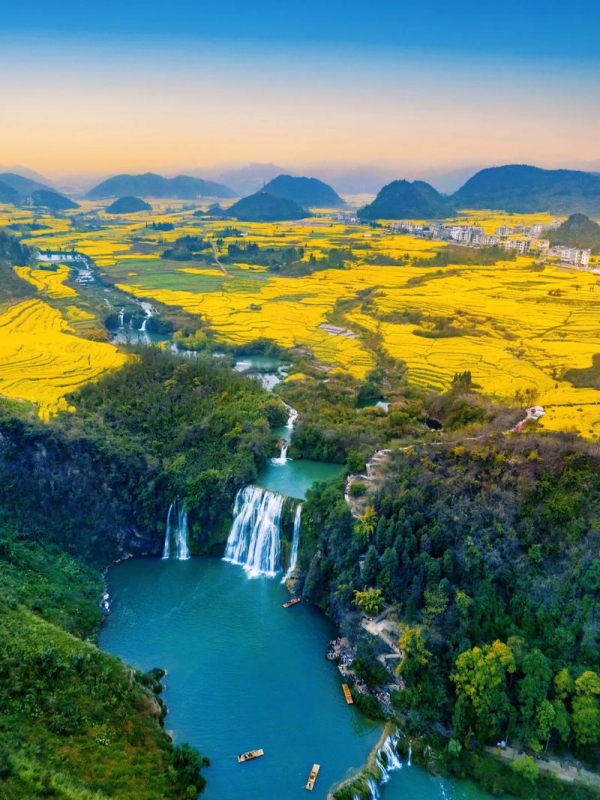
Shangri-La City, Yunnan
Shangri-La City, Yunnan sits at roughly 3,280 m above sea level in the northwest of the province — closer in feel to Tibet than to Kunming. Renamed from Zhongdian in 2001, it serves as the cultural capital of China's Tibetan region and the southern gateway to the Three Parallel Rivers landscape. A compact old town, a working monastery complex, and alpine lakes lie within an hour of the center.
Most foreign visitors come for three things: the golden roofs and prayer-wheel circuit of Songzanlin Monastery, the cobbled lanes of Dukezong Ancient Town, and the high-altitude scenery of Pudacuo National Park and Napahai Lake. The altitude catches nearly everyone on day one. This guide covers what to see first, how to acclimatize properly, the four routes into Shangri-La City, Yunnan (air, new railway, bus, or self-drive), and where to stay and eat once you arrive.
Quick Facts
🗺️ Comprehensive Itineraries: Discover key attractions and planning tips with Things to Do in Shangri-La.
Songzanlin Monastery & the Prayer Wheel Circuit
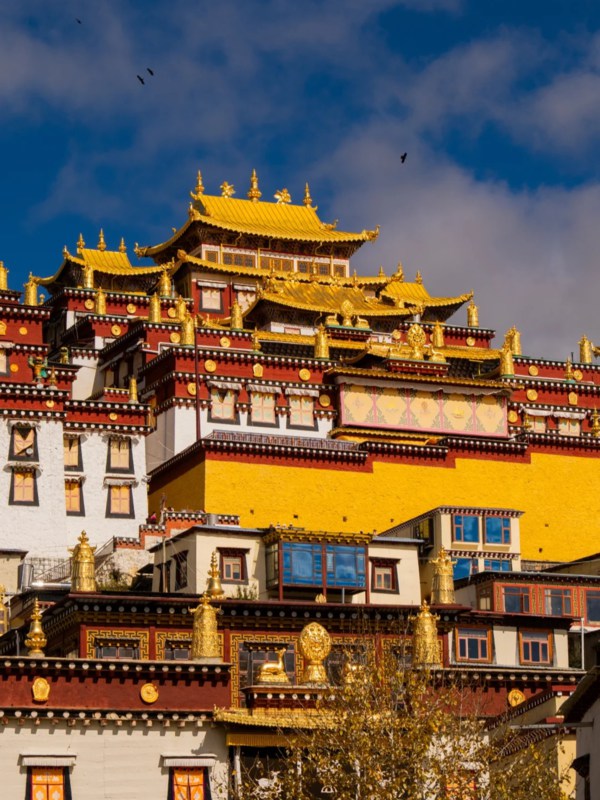
Songzanlin Monastery
Songzanlin Monastery sits 5 km north of the old town and holds the title of the largest Tibetan Buddhist monastery in Yunnan. Founded in 1679 under the direction of the Fifth Dalai Lama, its golden roofs and whitewashed walls sit at roughly 3,380 m. Allow 2–3 hours to walk the outer prayer-wheel circuit, explore the main hall, and absorb the atmosphere. Here is what to know before you go.
- Ticket: combo ticket about $25 (¥138) including the sightseeing bus; main hall only about $17 (¥85)
- Hours: 7:30–17:30 summer / 8:00–17:00 winter; mornings are less crowded
- Transport from town: Bus 3 runs the route for about $0.70 (¥5); a taxi costs roughly $3 (¥20)
- Prayer-wheel direction: always clockwise (kora); never counterclockwise anywhere on the grounds
- Dress code: cover shoulders and knees; remove hats and sunglasses inside halls
- Photography: interior of the main hall is generally not permitted
Visiting Hours, Tickets & Getting There
The monastery opens at 7:30 in summer and 8:00 in winter, closing at 17:30 and 17:00 respectively. The combo ticket at about $25 (¥138) covers the main hall and the internal sightseeing bus that shuttles visitors up the hillside — worth it on a hot afternoon. The main hall ticket at about $17 (¥85) covers the central structure only. Bus 3 departs regularly from the old town for roughly $0.70 (¥5), while a taxi runs about $3 (¥20) and takes roughly 20 minutes. Morning visits coincide with resident monks' morning prayers and tend to be quieter than the afternoon.
The Prayer Wheel Circuit (Circumambulation Order)
At Songzanlin the outer prayer-wheel circuit (called kora) is always walked clockwise. Enter through the main gate, turn right, and begin passing the long rows of copper prayer wheels on your right. Spin each wheel one full rotation with your right hand as you pass — clockwise, never back. Continue past the two side assembly halls (tratsang) and loop back to the foot of the central staircase.
- Step 1: Enter the main gate, turn right, and begin the clockwise circuit past the first row of prayer wheels
- Step 2: Spin each wheel one full rotation clockwise with your right hand as you pass — do not spin multiple times or lift wheels off their mounts
- Step 3: Continue clockwise past the left and right assembly halls (tratsang)
- Step 4: Complete one full outer loop and arrive back at the foot of the main-hall staircase
- Step 5: Then climb the steps and enter the main hall; once inside, walk clockwise around the central Buddha statues
The same clockwise rule applies at the giant prayer wheel in Guishan Park in Dukezong. Never move counterclockwise at either site.
Inside the Main Hall & What You'll See
The central hall stretches across three stories. The main statue is of Shakyamuni Buddha, flanked by a lineage of figures from the Tsongkhapa and Dalai Lama traditions. Butter-lamp offerings burn on the side altars, tended by a small number of resident monks. Photography inside the hall is generally not permitted. Speak softly, and keep your voice down throughout the interior.
Dress Code & Etiquette
Tibetan monasteries have clear dress expectations for entering sacred spaces.
- Cover shoulders and knees: no shorts, sleeveless tops, or bare shoulders
- Remove hats and sunglasses before stepping inside any hall
- Do not point feet at statues or monks: sit cross-legged or with feet tucked away
- Do not touch monks, prayer flags, or offerings: these are sacred items, not displays
- Spin each prayer wheel one full rotation: never multiple spins; never lift a wheel off its mount
🛕 Tibetan Culture & Architecture: Experience Yunnan's largest Tibetan monastery at Songzanlin Monastery.
Dukezong Ancient Town & Tibetan Culture
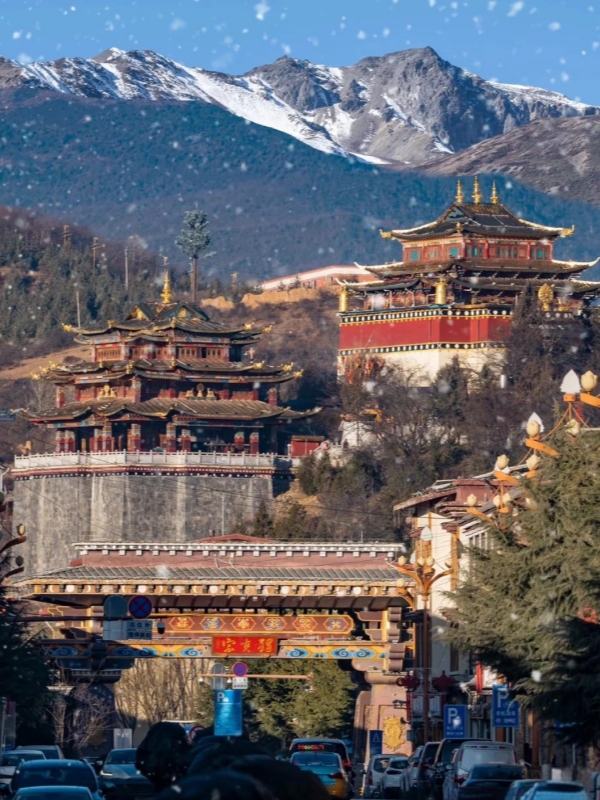
Dukezong Ancient Town
Dukezong Ancient Town is more than 1,300 years old. Its roughly 1.6 sq km of cobbled lanes, whitewashed Tibetan shopfronts, and silver workshops fill the southern part of town. A 2014 fire destroyed many buildings, but the layout and street pattern were carefully restored, and the town functions as both a living community and a cultural destination. Entry is free.
Old Town Layout & Moonlight Square
The town's north-south axis leads from the lower gate up to Moonlight Square, the central gathering point. The square hosts nightly group Tibetan dancing in summer, typically from 7 to 9 pm — visitors are welcome to join. Tibetan silver workshops, teahouses, and small guesthouses line the lanes on either side. Dukezong is open all hours, though the liveliest time is evening.
Guishan Park & the Giant Prayer Wheel
Guishan Park occupies the hilltop at the south end of Dukezong. The 21-m-tall, 60-ton gilded prayer wheel at the summit is officially described by the scenic area as the world's largest. Visitors push together — usually 8–10 people at once — to rotate it clockwise. The same kora direction applies here as at Songzanlin: clockwise only. Park entry is free; a small fee applies to climb the hill path.
Local Food, Tea Houses & Nightlife
The food reflects both Tibetan and Yunnan traditions. Yak hotpot is the standout cold-weather dish — rich, warming, and deeply local. Butter tea is salty and an acquired taste; order a small cup first before committing. Tsampa — roasted barley flour mixed into tea — is traditional trekking food and worth sampling. For Yunnan crossover, crossing-the-bridge noodles appear on menus with yak broth, and summer brings wild-mushroom hotpot (July–August). Several Tibetan teahouses offer floor seating and large copper pots of sweet tea. Nightlife is low-key; most venues wind down by midnight.
Pudacuo National Park & Napahai Lake
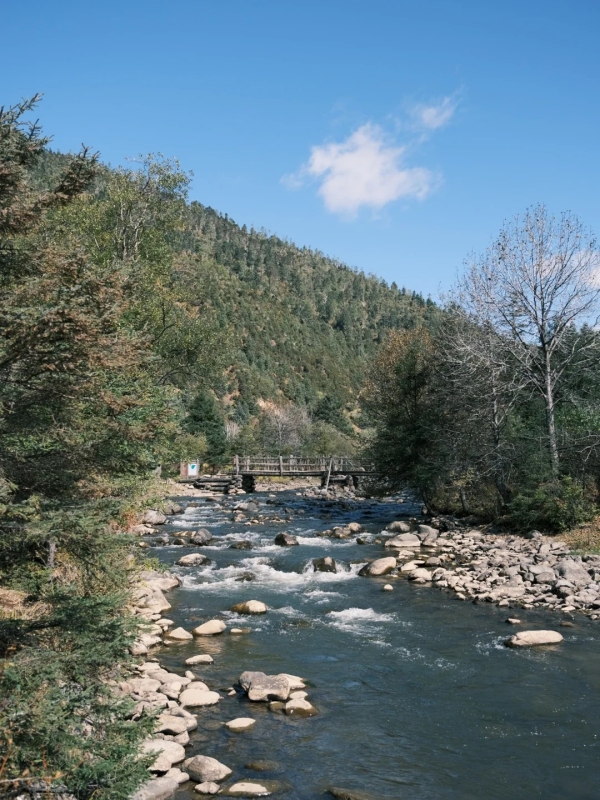
Lake of Pudacuo
Pudacuo opened in 2007 as China's first national park, designated by the General Administration of Sport. The 22 sq km of plateau lake, wetland, fir forest, and alpine meadow sit at roughly 3,500–4,000 m. Two signature lakes — Shudu Lake and Bita Hai — anchor the shuttle-bus loop. Plan four to five hours minimum.
- Shudu Lake viewing platform: first stop on the shuttle; the still lake reflects the surrounding peaks in calm weather
- Militang alpine meadow: second stop; best wildflower display in summer (June–July)
- Bita Hai (Pearl Lake) boardwalk: third stop; the signature photo location with a raised walkway over the water
- Seasonal note: temperatures at 3,700 m swing sharply — pack a light jacket even in midsummer
Routes & Highlights in Pudacuo
The ticket costs about $19 (¥138) and a mandatory shuttle bus adds roughly $5.50 (¥40). The shuttle makes three stops in sequence: Shudu Lake viewing platform, Militang alpine meadow, and Bita Hai boardwalk. A full loop takes about four hours at a comfortable pace. The boardwalk at Bita Hai is the most photographed spot in the park, with the lake framed by forest on three sides. Militang meadow fills with wildflowers in June and July. Bring a light jacket regardless of the season — at 3,700 m the temperature can drop 10–15 °C between sun and shade.
Wetlands & Horseback Riding at Napahai
Napahai lies 8 km northwest of town and is technically a seasonal lake — a wetland in summer and dry grazing land in winter. Tibetan horseback rides around the wetland edge run from June through September for roughly $11–17 (¥80–120) per rider for one to two hours. Winter brings migratory black-necked cranes and bar-headed geese from November through March, making it a birding destination in the cold season. Entry is free. Bicycle rental is also available from town if you prefer to pedal rather than ride.
🌲 Alpine Forests & Lakes: Walk boardwalks around pristine lakes in Potatso (Pudacuo) National Park.
Where to Stay, Eat & Drink in Shangri-La
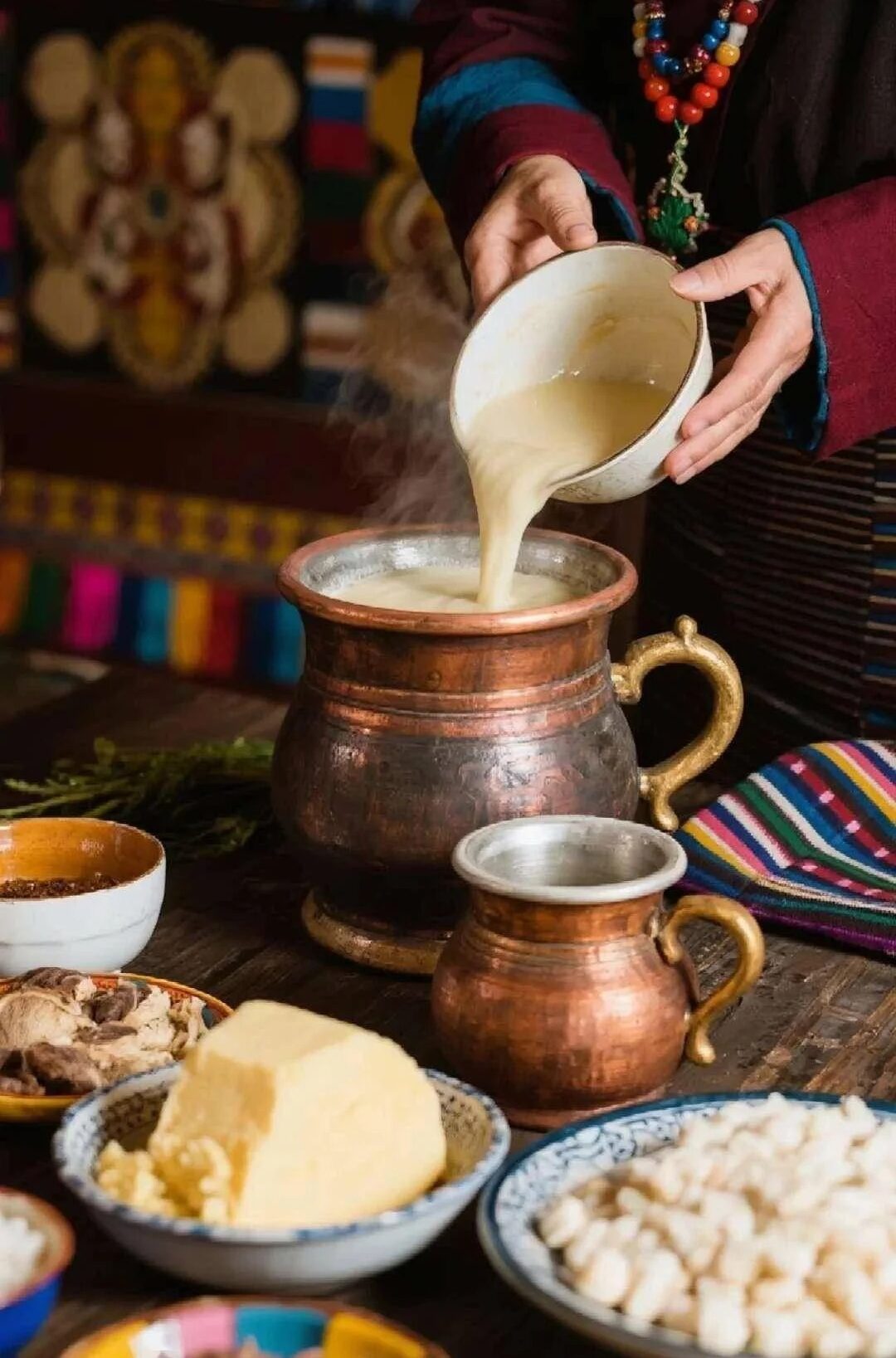
Tibetan Butter Tea
Three areas cover most visitor needs, each with a distinct character and price band. Tibetan guesthouses in Dukezong offer atmosphere but rarely have elevators; hotels north of the old town trade character for comfort; Changzheng Avenue in the new town suits early departures. Acclimatization days are a good excuse to sit in a teahouse or cafe rather than rush to the next attraction.
- Dukezong old town: Tibetan guesthouses and boutique inns, roughly $30–80 per night; walkable to everything; most buildings lack elevators — request a ground-floor room if you have heavy luggage
- North of old town: mid-range hotels $60–120 with elevators, heating, and more predictable service; a short walk to Dukezong
- Changzheng Avenue, new town: chain hotels $40–80; quieter and closer to the railway station; roughly 15 minutes by taxi to the old town
Best Areas to Stay
Most first-time visitors choose Dukezong old town for proximity to the main attractions and the atmosphere of a Tibetan guesthouse. Budget travelers and backpackers fill the lower-end inns along the cobbled lanes. Families or anyone uncomfortable with stairs should look north of the old town, where mid-range hotels offer heating and elevator access — Shangri-La gets cold at night even in spring. Travelers with an early train to Lijiang may prefer Changzheng Avenue in the new town to minimize the taxi ride to the station.
Tibetan & Yunnan Food & Drinks to Try
The food is one of Shangri-La's more memorable experiences — hearty, suited to cold nights, and distinct from lowland Yunnan cooking.
- Yak hotpot: rich broth with thin slices of yak meat, vegetables, and handmade noodles; warming and filling at altitude
- Butter tea: salty yak-butter tea; an acquired taste — order a small cup before committing to a full pot
- Tsampa: roasted barley flour stirred into butter tea and rolled into balls; traditional Tibetan trekking food
- Tibetan momos: steamed or fried dumplings stuffed with yak meat or vegetables
- Crossing-the-bridge noodles: a Yunnan classic served in Shangri-La with yak broth; order at mid-range restaurants in Dukezong
- Wild-mushroom hotpot: available July–August when local species are in season
Cafes & Where to Rest on Acclimatization Days
Several Western-style cafes have opened inside and around Dukezong — useful for a slow breakfast while your body adjusts to the elevation. Tibetan teahouses are a different experience: floor seating, large copper pots of sweet tea, and a pace that suits an afternoon spent doing very little. Wi-Fi is reliable in most cafes and teahouses. Use a rest day wisely — a relaxed morning in a teahouse is more useful than a rushed first afternoon on the prayer-wheel circuit.
Altitude Sickness & Acclimatization in Shangri-La
Shangri-La City sits at roughly 3,280 m, and Diqing Airport sits at 3,287 m — well above the 2,500 m threshold where most travelers begin to notice altitude effects. Most visitors arriving directly from lowland Yunnan feel a mild headache, fatigue, or insomnia within the first 24 hours. This section covers symptoms, when to act, and the six steps that make the difference between an uncomfortable first day and a genuinely risky one.
- Mild symptoms: headache, fatigue, mild dizziness, insomnia, slight nausea — typically resolve within 1–2 days with rest and hydration
- Moderate symptoms: vomiting, persistent headache not eased by rest — stop ascending, rest for 24 hours, consider descending
- Severe symptoms: confusion, loss of coordination, breathlessness at rest, blue-grey lips or fingertips — descend immediately and go to hospital
Why Shangri-La's Elevation Matters
The city sits at 3,280 m, Songzanlin Monastery at roughly 3,380 m, and Pudacuo National Park between 3,500–4,000 m. Most travelers arrive in a single jump — by air from Kunming (1,890 m) or Chengdu, or by bus from Lijiang (2,400 m). The faster the ascent, the less time the body has to adjust. Symptoms become common above 2,500 m, which means nearly every visitor to Shangri-La is affected to some degree.
Symptoms & When to Get Help
Mild symptoms — headache, fatigue, mild dizziness, insomnia, slight nausea — are normal during the first 24–72 hours. Rest, hydration, and slowing down usually resolve them. Moderate symptoms including vomiting or a persistent headache not eased by rest are a signal to stop ascending and give your body 24 more hours. Severe symptoms — confusion, loss of coordination, breathlessness at rest, blue-grey lips or fingertips — constitute a medical emergency. Descend immediately and go to Diqing People's Hospital. Keep your hotel address written in Mandarin on your phone or person at all times.
Acclimatization Tips Before & During Your Trip
Altitude tolerance is individual, but these six steps work for most travelers:
- Spend a night at intermediate altitude before arriving: one night in Kunming or two nights in Lijiang breaks the climb
- Hydrate with 2–3 liters of water daily on your first days — the dry air at altitude accelerates fluid loss
- Skip alcohol for the first 24–48 hours — alcohol worsens dehydration and impairs acclimatization
- Eat light, carb-heavy meals — rice, noodles, and bread are easier to digest than heavy protein at this elevation
- Walk slowly on day one and leave major hikes at Pudacuo for day two or three
- Ask your doctor about acetazolamide (Diamox) before travel if you have any prior altitude sensitivity
Who Should Take Extra Care
Certain travelers face higher risk and should consult a doctor before booking. Heart or lung conditions, severe anemia, pregnancy, children under roughly eight years old, and elderly visitors with cardiac or pulmonary comorbidities all warrant medical advice before travel. Anyone with a recent respiratory infection should delay the trip if possible. Carry travel insurance that explicitly covers helicopter evacuation from the plateau — standard policies often exclude high-altitude rescue.
Getting to Shangri-La & Getting Around
Flying to Diqing Shangri-La Airport
Diqing Shangri-La Airport (DIG) sits 5 km from town. Daily flights run from Kunming at roughly $80–140 (¥580–1000) for about one hour, and from Chengdu at roughly $90–160 (¥650–1150) for about 1.5 hours. Connecting flights from Beijing, Shanghai, and other hubs add onward options. A taxi from the airport to the old town costs about $7–10 (¥50–70) and takes roughly 20 minutes. One critical point: the airport sits at 3,287 m, so you will feel the altitude the moment you walk off the plane. Do not plan any strenuous activity on arrival day.
The Lijiang–Shangri-La Railway
The railway opened in November 2024 and runs from Lijiang Station directly to Shangri-La Station in about 1.5 hours. Second-class seats cost roughly $11–22 (¥80–150); first class runs about $28–34 (¥200–240). This is the most comfortable overland option from Lijiang, with smooth carriages and a scenic climb through mountain terrain. The terminal station sits roughly 7 km from Dukezong old town — a taxi costs about $4–5 (¥25–30), and Bus 3 also runs the route.
- Opened: November 2024
- Journey time: ~1.5 hours from Lijiang Station to Shangri-La Station
- Classes: second class ~$11–22 (¥80–150); first class ~$28–34 (¥200–240)
- Station transfer: taxi ~$4–5 (¥25–30) or Bus 3 to old town
Buses & Driving from Lijiang or Kunming
Long-distance buses from Lijiang depart hourly during the day from the Xi'an Bus Station, costing roughly $11–14 (¥80–100) for the 4–5 hour journey. The route follows the G5611 and is scenic but winding in places. From Kunming, an overnight sleeper bus covers the 10–12 hour run for about $30–35 (¥220–250) — not comfortable, but direct. Self-drivers from Lijiang cover 180 km via the G5611 in roughly 3.5 hours. The road is well-maintained, though it crosses one high pass near Hutiaoxia at roughly 3,300 m — the same altitude as Shangri-La itself.
Getting Around the City
Dukezong old town and the immediate surrounds are walkable — navigate by compass rather than by street name, as addresses are not always clearly signed in English. Songzanlin Monastery and the areas north of the old town require a taxi, DiDi (the Chinese ride-hailing app), or Bus 3. Taxi flag-fall is roughly $1.50 (¥10). Bicycle rental is common in the old town at about $3–5 (¥20–30) per day. There is no metro system. DiDi works with a mainland phone number — if you do not have one, a hotel can arrange a taxi for you.
Frequently Asked Questions
Q: Is Shangri-La safe for tourists?
Yes — Shangri-La is very safe for foreign visitors. Violent crime is rare, and the area sees substantial domestic and international tourism year-round. Standard precautions apply: keep passport copies, have your hotel address written in Mandarin, and watch for black ice on mountain roads in winter. Police checkpoints on roads approaching town are routine and not targeted at tourists.
Q: Do I need a special permit to visit Shangri-La?
No special permit is required for Shangri-La City itself, Songzanlin Monastery, Dukezong, Pudacuo, or Napahai. Permits are required for the Meili Snow Mountain area and Yubeng village, which are separate destinations outside the city and typically arranged through a local tour operator.
Q: How many days do I need in Shangri-La?
Three full days is the practical minimum. Day one is for arrival and acclimatization — walk Dukezong and climb Guishan Park at a gentle pace. And Day two covers Songzanlin Monastery and the prayer-wheel circuit. Day three is for Pudacuo National Park or Napahai. Two days is possible but tight; combining Shangri-La with two to three days in Lijiang makes a well-paced Yunnan loop.
Q: What is the best time of year to visit Shangri-La?
April through June brings mild temperatures and wildflowers, particularly at Militang meadow in Pudacuo. September through November offers autumn colors, clear skies, and the best photography conditions. Summer (July–August) is the greenest season but wetter. Winter is cold — often below −5 °C at night — but the skies are clearest and crowds are thinnest. Avoid Chinese National Day week (October 1–7) and the Chinese New Year period for a quieter visit.
Q: Is there a train to Shangri-La?
Yes — the Lijiang–Shangri-La Railway opened in November 2024, with direct trains from Lijiang Station. Second class costs roughly $11–22 (¥80–150) and the journey takes about 1.5 hours. There is no direct high-speed line from Kunming yet. The long-distance bus from Kunming remains the only direct overland option from the provincial capital.
Q: What direction do you walk around a Tibetan monastery?
Always clockwise — this is called kora. At Songzanlin, enter the main gate, turn right, and follow the prayer wheels clockwise around the main hall before climbing the steps. Turn each prayer wheel one full rotation clockwise with your right hand as you pass. The same clockwise rule applies to the giant prayer wheel at Guishan Park in Dukezong.
Q: Do people speak English in Shangri-La?
English is limited outside the largest hotels and tour guides. Download an offline translation app before arrival and carry a few key Mandarin phrases (你好 / 谢谢 / 多少钱). Booking a local guide through Trip.com or Klook for Songzanlin and Pudacuo is a practical option if you prefer not to navigate in Chinese.
Q: What should I pack for Shangri-La?
Layered clothing is essential — day and night temperatures can swing 15 °C or more at altitude. Strong sunscreen and lip balm are non-negotiable: UV intensity above 3,000 m is significantly higher than at sea level. Comfortable walking shoes with good grip are important on the cobbled lanes. Carry a refillable water bottle, any personal altitude medication your doctor has recommended, and a warm hat and gloves if traveling between November and March.