Lie-Flat First Class on China Trains
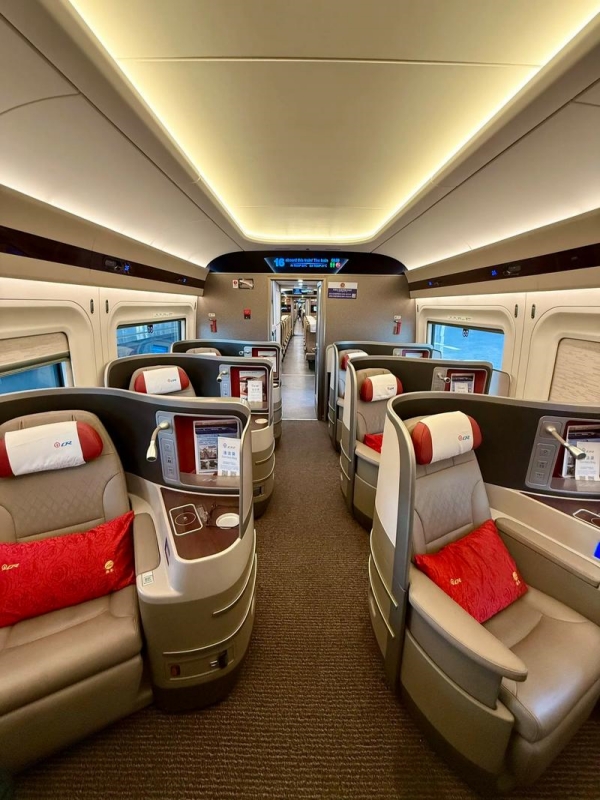
Seats that recline into a fully flat bed are not what most travellers expect on a high-speed rail system, the standout offering of lie flat first class china trains. Yet China's newest first-class carriages on Fuxing intelligent EMUs do exactly that — a true horizontal surface stretching roughly 190–200 centimetres, complete with footrest, reading lamp, and USB power. The feature first appeared around 2019 and has since spread to a handful of flagship daytime services and overnight sleeper-bullet routes. For foreign visitors, the entry point is straightforward: search on Trip.com or Klook, pay with an international card, and show up at the manual gate with your passport. This guide covers every train model that carries lie-flat first class, every route where it runs, and the exact steps to book from outside China.
China's high-speed network spans approximately 46,000 kilometres (2024), and the lie-flat first-class product occupies a narrow premium tier — above standard second class and regular first class, below business class on price, and ahead of both on long daytime trips where the ability to sleep flat matters. The seat class is tied to specific train numbers, not whole routes, so reading the fine print before booking saves surprises at the platform.
Quick Facts
What Is Lie-Flat First Class?
Lie-Flat First Class on China Trains
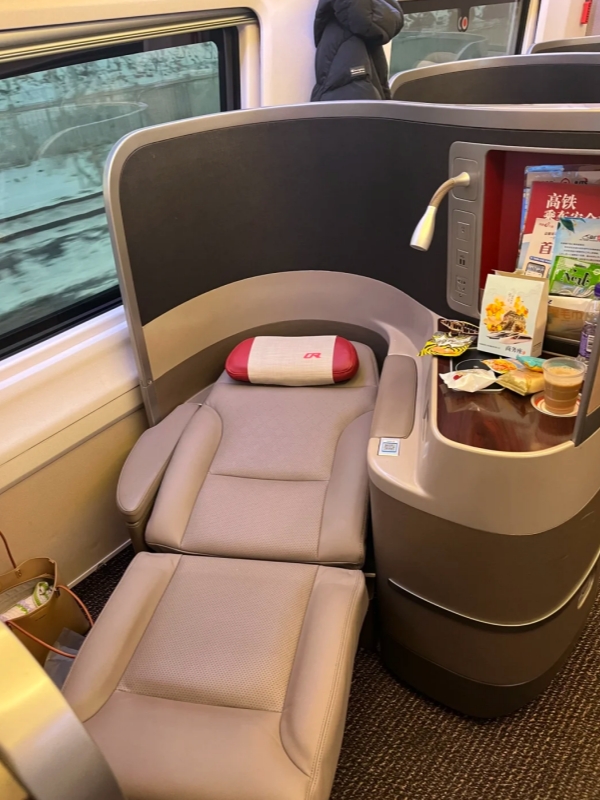
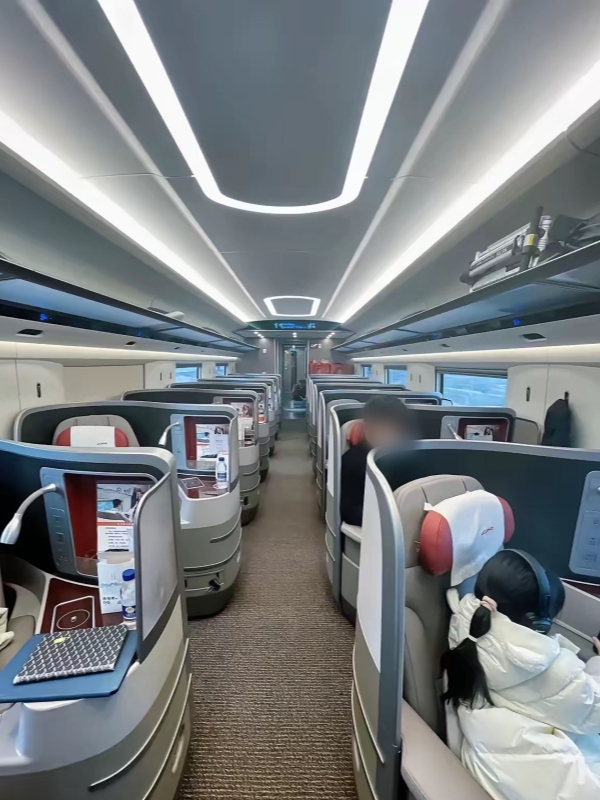
The term "lie-flat first class" refers to a seat that reclines to approximately 170–180°, aligning the seat pan, backrest, and footrest into a single horizontal surface roughly 190–200 centimetres long and 50–55 centimetres wide. That measurement matters: older first-class seats on G and D trains typically stop at around 30° of recline, and some business-class pods level off near 135° without reaching a true flat. On Fuxing intelligent EMUs, the seat also includes a flip-up calf rest alongside the footrest, giving the traveller a flat surface from shoulder to heel. Individual reading lamps, USB ports, and AC power sockets complete the setup.
China's railway authority introduced the feature to capture premium intercity demand and to compete more directly with short-haul domestic flights. The rollout began around 2019–2021 on Fuxing CR400AF-A and CR400BF-A "intelligent" (智能动车组) EMUs, with the Beijing–Shanghai corridor as the flagship deployment from 2021. On overnight sleeper-bullet trains, the lie-flat concept takes a different form: soft-sleeper berths arranged in four-berth compartments with a mattress, pillow, and blanket, all running at up to 250 km/h.
What "Lie-Flat" Actually Means
The technical threshold for "lie-flat" on China's HSR is a recline angle of roughly 170–180°. That is not a marketing label — it is a measurable geometry. The seat cushion, backrest, and leg rest fold together into a near-horizontal plane, creating a sleep surface approximately 190–200 centimetres in length. Some Fuxing intelligent seats also include a flip-up calf rest that bridges the gap between the seat pan and footrest, eliminating the angular bend at the knee that characterises angle-flat seats. Passengers taller than average may still find the width (around 50–55 cm per seat) constraining compared to a proper sleeping berth, but for a daytime train the surface is genuinely flat in a way that reclining armchairs are not.
Lie-Flat First Class vs Regular First Class
Regular first class on older G and D trains uses a 2+2 reclining armchair layout. The seats are wider and quieter than second class, and the cabin density is lower, but the recline mechanism stops short of flat — the backrest tilts back perhaps 30°, and the seat pan does not extend. Lie-flat first class sacrifices passenger density to deliver a horizontal bed, using either a 1+2 or 2+2 layout depending on the specific EMU formation. In exchange, travellers get individual reading lamps, USB and AC power outlets, and a fold-out table. The price premium over standard first class on the same train is roughly 1.6–2×, while the premium over second class runs 2.5–3.2× depending on the route.
When and Why China Introduced It
Lie-flat first class first entered revenue service on the Fuxing CR400AF-A and CR400BF-A "intelligent" EMUs around 2019–2021. The Beijing–Shanghai HSR corridor — served by G1, G3, G7 and similar Fuxing-intelligent trains from 2021 — became the flagship deployment, demonstrating the feature to domestic passengers and international visitors alike. The strategic purpose was twofold: capturing high-value business and leisure travellers who might otherwise choose a domestic flight, and positioning China's HSR product as a globally competitive premium experience. Subsequent expansions brought lie-flat-equipped Fuxing sets to Beijing–Xiongan intercity services, selected Beijing–Tianjin C trains, and parts of the Shanghai–Hangzhou corridor, as well as to certain overnight sleeper-bullet services on the conventional high-speed network.
Lie-Flat First Class by Train Model
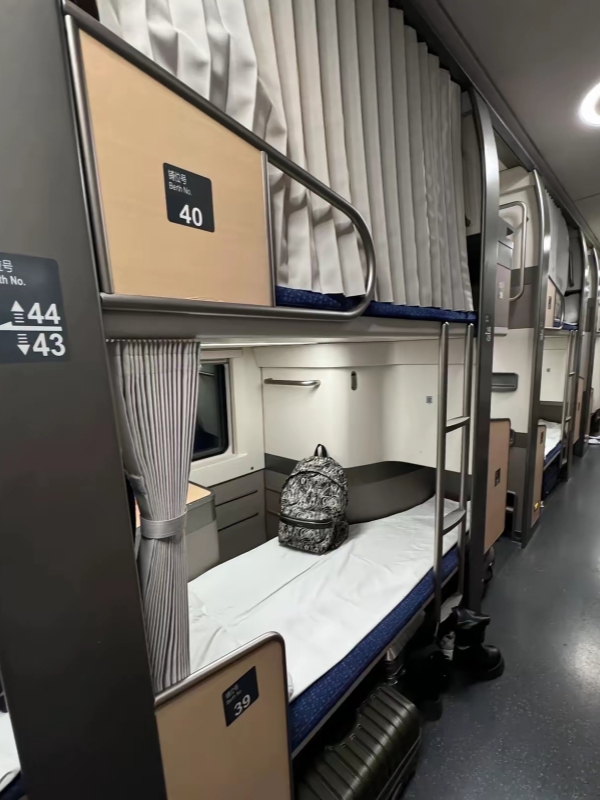
New Type Sleeper
Three distinct train families carry lie-flat first class, and each operates under a different logic. Daytime Fuxing intelligent EMUs deliver the flat seat in a dedicated first-class carriage. The overnight CRH2E sleeper-bullet uses soft-sleeper berths in enclosed compartments. The New Type Sleeper on D311 and D312 takes a third approach: lengthwise berths with individual curtains and a small desk. Knowing which model serves your intended train number is the key to booking the right product.
Fuxing CR400AF-A and CR400BF-A Smart Edition
The Fuxing CR400AF-A (built by CRRC Tangshan) and CR400BF-A (built by CRRC Qingdao Sifang) are China's flagship high-speed EMUs, operating at a maximum 350 km/h. The "Smart Edition" or "Intelligent" designation marks the configuration that includes lie-flat first class in the lead carriages. These trains run in 8-car or 16-car formations, with lie-flat first class arranged in a 2+2 layout. Assigned to flagship G-train numbers including G1, G3, and G7 on the Beijing–Shanghai corridor, and to selected Fuxing-intelligent services on the Beijing–Xiongan intercity route, this is the train most visitors will encounter when they book "First Class" on a daytime premium run.
CRH2E Sleeper Bullet Train
The CRH2E is a 16-car overnight sleeper high-speed train that reaches 250 km/h on selected services across the conventional and high-speed networks. Rather than a reclining seat, it offers lie-flat soft-sleeper berths inside four-berth compartments, each with a sliding door, mattress, pillow, and blanket supplied by the crew. The compartment layout gives passengers a private enclosed space — a meaningful upgrade over open-plan seating for an overnight journey. Top speed of 250 km/h means these trains run on upgraded conventional lines rather than dedicated HSR corridors, which also affects departure and arrival times compared to the faster G-class daytime services.
New Type Sleeper (D311, D312)
The New Type Sleeper (新型卧铺动车组) is currently unique to the Beijing–Shanghai overnight D-class services D311 and D312. The design departs from the standard four-berth soft-sleeper compartment: berths run lengthwise along the aisle rather than crosswise, giving each passenger a dedicated space with its own curtain, reading lamp, small desk, and power socket. This layout is more personal than the CRH2E's shared compartment but offers less total privacy. The D311 departs Beijing South in the evening and arrives Shanghai Hongqiao in the morning; D312 runs the reverse. Ticket availability is limited, and the fare class must be selected explicitly when booking.
🚇 Master the Modern Transit Network: While lie-flat first-class carriages offer a luxurious way to travel, understanding the broader high-speed rail, metro, and domestic flight systems is key to a smooth journey. Learn how to navigate the world's largest transit network in our comprehensive guide to Transportation in China.
Where to Find Lie-Flat First Class Routes
Lie-Flat First Class on China Trains
Lie-flat first class is not available on every G train across China. The seat class is tied to specific train numbers — specifically, those that run with a Fuxing intelligent EMU — rather than to entire corridors. This distinction matters at the booking stage: selecting "Beijing–Shanghai" on a platform will surface both lie-flat and non-lie-flat services, and the traveller must check the seat-class filter for each train number individually. The routes below are those where lie-flat-equipped trains most reliably appear, but availability still varies by date and operational roster.
Beijing–Shanghai HSR (G1, G3, G7 and Similar)
The Beijing–Shanghai corridor is the primary showcase for daytime lie-flat first class. The route covers 1,318 kilometres in approximately 4.5 hours on Fuxing-intelligent EMUs, and lie-flat first class costs about $246 (¥1,748) on the flagship G1, G3, and G7 departures. That price sits roughly 1.7× above standard first class on the same train and about 3.2× the second-class fare of roughly $78 (¥553). These three train numbers are the most reliably lie-flat-flagged services, but other G-class trains on the same corridor may also carry lie-flat first class depending on the specific EMU roster assigned on a given day.
Beijing–Xiongan Intercity
The Beijing–Xiongan intercity line connects the capital with Xiongan New Area in approximately 50 minutes over 91 kilometres. Selected C-train services on this route use Fuxing-intelligent EMUs with lie-flat first class available. The fare runs about $25–34 (¥180–240), making it a practical option for foreign visitors combining a Beijing stay with a day trip to the newly developed Xiongan area. Because the journey is under an hour, the flat bed sees limited use, but the first-class cabin's quieter environment and extra seat width still represent a meaningful upgrade over second class on this relatively short run.
❄️ Stay Cool During Your Travels: Booking a premium, climate-controlled train cabin is one of the smartest ways to escape the intense humidity of the warmer months. Discover more practical tips for staying comfortable on the move in our guide to surviving Summer in China with AC.
Beijing–Tianjin Intercity
The 137-kilometre Beijing–Tianjin intercity corridor is served by frequent C-class trains, with journey times around 30 minutes. Only certain services operate with Fuxing-intelligent EMUs that carry lie-flat VIP or business-class seating, priced at roughly $17–23 (¥120–160). Given the 30-minute duration, the seat never fully reclines during the trip, but the cabin environment is consistently quieter and more spacious than second class. For visitors heading to Tianjin for a day excursion from Beijing, confirming the specific train number and seat class at the booking stage ensures access to the best available product on this short link.
Shanghai–Hangzhou and the Yangtze Delta
The Shanghai–Hangzhou corridor spans 202 kilometres, with selected G-class services covering the distance in 60–75 minutes on Fuxing-intelligent sets. Lie-flat first class typically runs about $42–56 (¥300–400) when a lie-flat-equipped EMU is rostered. The Yangtze Delta network — which also includes Shanghai–Nanjing and Nanjing–Hangzhou services — occasionally fields lie-flat first class on other G trains, though availability is less consistent than on the Beijing–Shanghai flagship. Using the booking platform's seat-class filter and checking individual train numbers rather than relying on the route alone is the most reliable way to confirm lie-flat availability on any given departure.
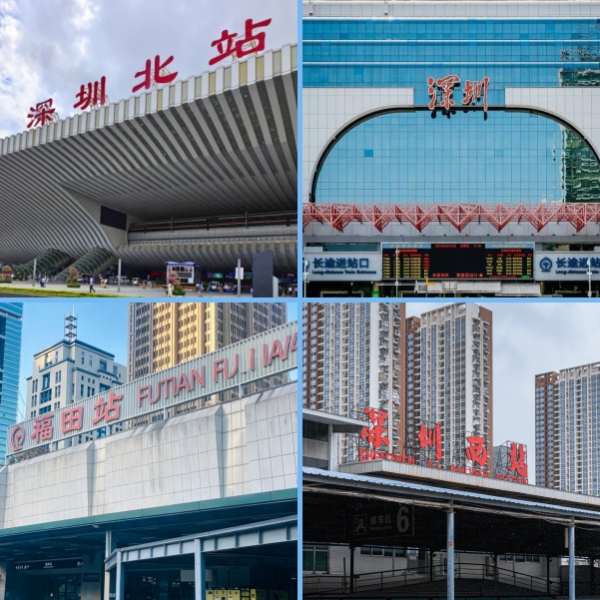
🚉 Navigate Major Transit Hubs: Flagship sleeper-bullet routes and high-speed trains connect many of the country's major economic centers and border crossings. If you are catching a premium train to or from the southern border, prepare for your departure with our detailed Shenzhen Railway Station Guide.
Lie-Flat First Class Ticket Prices
The table below shows daytime lie-flat first class fares alongside second-class references for the most commonly booked routes. Prices are drawn from Trip.com and Klook listings; ranges reflect variation between specific train numbers and booking dates.
Daytime HSR Lie-Flat First Class Prices
Overnight Sleeper-Bullet Prices
Overnight HSR sleeper services price their berths individually rather than by seat class. On CRH2E sleeper-bullet trains, a soft-sleeper berth in a four-berth compartment costs roughly $84–141 (¥600–1,000) depending on the route and booking date. Hard-sleeper berths are cheaper where available, though the comfort differential is significant for an overnight journey. On the New Type Sleeper services D311 and D312, pricing falls within the same range, with the per-berth cost reflecting the individual-curtain layout and dedicated desk space. Both Trip.com and Klook list these services under "Sleeper" or "First Class (Sleeper)" — selecting the specific berth class during the booking flow is necessary to confirm the product type before paying.
Lie-Flat First Class vs Second Class and Business Class
Lie-flat first class occupies a middle tier on both price and comfort. Against standard first class, the lie-flat version costs roughly 1.6–2× on the same train, delivering a flat bed instead of a reclining armchair. Against second class, the premium is steeper — about 2.5–3.2× on longer routes — but the trade-off on a four-hour daytime trip is substantial: the ability to sleep flat, plus a quieter 2+2 cabin, reading lamp, and personal power socket.
Business class sits above lie-flat first class in both price and privacy, using a single-aisle 1+2 layout with wider, more enclosed shells and complimentary snacks and drinks; the business-class fare runs roughly 1.7–2.5× the lie-flat first-class price. For long daytime trips where sleep is a priority, lie-flat first class wins on value. For short hops under two hours, standard first class is the better buy since the seat never fully reclines in time to justify the premium.
How to Book Lie-Flat First Class from Abroad
Foreign visitors can book lie-flat first class through two international-facing platforms: Trip.com and Klook. Both accept international card payment and require only a passport number — no Chinese ID, mainland phone number, or domestic payment app is needed. China's official ticketing platform, 12306, requires all three and is not a workable channel for most visitors outside mainland China.
Booking on Trip.com
The workflow on Trip.com follows a familiar search-and-select pattern. Open the app or desktop site, enter the departure and arrival cities and select a travel date. The results page lists train numbers with seat-class icons — tap "First Class" on the specific train you want (Trip.com labels lie-flat first class simply as "First Class" without a separate "Lie-Flat" tag; confirming the train number matches a Fuxing-intelligent service is the way to verify the product). Enter the passport number exactly as printed, upload a clear photo of the passport's information page, and complete payment with a Visa, Mastercard, or American Express card. An e-ticket is stored in the Trip.com app; we recommend screenshotting the booking confirmation and the passport page used during registration, since the manual gate staff will cross-check the passport number against the booking record.
Booking on Klook
Klook sells China HSR tickets as a third-party reseller. Search "China high-speed rail" on the Klook platform, enter the route and date, and Klook typically surfaces second class, first class, business class, and occasionally sleeper options for the relevant train numbers. Enter passport details at checkout and Klook sends the booking reference by email and through the Klook app. A small Klook service fee may be added to the base rail fare. As with Trip.com, verifying that the seat-class label matches a Fuxing-intelligent train number — rather than assuming every first-class listing is a lie-flat product — prevents arriving at the platform with the wrong ticket.
After Booking: Manual Gates and Passport Checks
At the station, foreign visitors holding an e-ticket booking must use the manual check-in desk rather than self-service kiosks. Staff will verify the passport against the booking. After security screening, locate the correct waiting hall by train number — Chinese stations split waiting halls by departure zone, and the boarding gate (A or B) corresponds to the carriage position: A for the first half of the train, B for the second half. At the boarding gate, the passport is scanned again against the e-ticket record. No paper ticket is required for e-ticket holders. On overnight sleeper-bullet services, the sleeper attendant will assign the specific berth on boarding, so arriving early at the platform is worthwhile to secure preferred berth positions.
Frequently Asked Questions
Q: What Does "Lie-Flat First Class" Mean on Chinese Trains?
It describes a first-class seat that reclines to a fully flat ~170–180° horizontal bed, approximately 190–200 centimetres long. The feature appears on Fuxing CR400 intelligent trains during the day and on selected overnight sleeper-bullet services. Regular first class on older G and D trains only reclines about 30° and does not go flat.
Q: How Much Does Lie-Flat First Class Cost on Beijing–Shanghai in China?
On the flagship Fuxing-intelligent G1, G3, and G7 services, lie-flat first class costs about $246 (¥1,748) for the 1,318-kilometre, 4.5-hour journey. That is roughly 3.2× the second-class fare of $78 (¥553) on the same train. Booking is available on Trip.com or Klook.
Q: Can Foreigners Book Lie-Flat First Class Online With Just a Passport?
Yes. Trip.com and Klook both accept passport-only bookings from foreign visitors, with payment via international Visa, Mastercard, or American Express. The official 12306 platform requires a mainland Chinese ID, a mainland phone number, and Alipay or WeChat Pay — none of which most foreign visitors have — making it inaccessible as a booking channel.
Q: Which Trains Have Lie-Flat First Class Seats in China?
Three train families carry the feature: Fuxing CR400AF-A and CR400BF-A Smart Edition (daytime, 350 km/h), deployed on Beijing–Shanghai G1/G3/G7, Beijing–Xiongan, and selected Beijing–Tianjin and Shanghai–Hangzhou services; CRH2E sleeper-bullet (overnight, 250 km/h); and the New Type Sleeper on D311 and D312 (overnight, 250 km/h). Availability is tied to specific train numbers, not to entire routes.
Q: Is Lie-Flat First Class Worth It vs Second Class?
For daytime trips longer than roughly 2.5 hours, the upgrade buys a horizontal bed, footrest, individual reading lamp, and a quieter cabin — worth the premium on the four-hour Beijing–Shanghai run ($246 vs $78). For trips under two hours, the seat never fully reclines during the journey and standard first class delivers better value.
Q: Do Lie-Flat First Class Tickets Include Meals in China?
No. Complimentary meals are a business-class perk on China HSR, not a lie-flat first-class one. Passengers should bring their own food or purchase items from the onboard trolley. Hot water dispensers are available at the end of each carriage for tea and instant noodles.
Q: What's the Difference Between Lie-Flat First Class and Business Class?
Business class uses a single-aisle 1+2 layout with wider, more private seat shells and complimentary snacks and drinks. Lie-flat first class is denser (2+2 layout) and has no complimentary service, but still delivers a fully flat bed at a lower price — roughly 0.4–0.6× the business-class fare on comparable routes.
Q: Can I Upgrade to Lie-Flat First Class After Booking in China?
Only if lie-flat first-class seats remain unsold at the station ticket counter on the day of travel. The counter staff can process a fare-difference payment and reissue the ticket. This is unreliable during peak periods — Chinese New Year, National Day, and summer holidays see lie-flat inventory sell out well in advance. Booking the correct class upfront through Trip.com or Klook is the dependable approach.