Guangzhou Dim Sum Tea Charge in 2026
Order one cup of tea at a Guangzhou dim sum restaurant and you'll see a small line on the receipt labeled 茶位费. The Guangzhou dim sum tea charge usually runs from around $0.40 to $3.50 (¥3 to ¥25) per person, depending on the tea you order, the branch you walk into, and whether you drink plain water. Since May 1, 2026, a city-level regulation has standardized how this charge appears on the menu — but it has not abolished the fee. This guide walks through each line of a real dim sum receipt so you know exactly what you are paying for, and where you can ask the server to skip it.
Quick Facts
What's in the Tea Charge (and What Isn't) — Reading the Menu
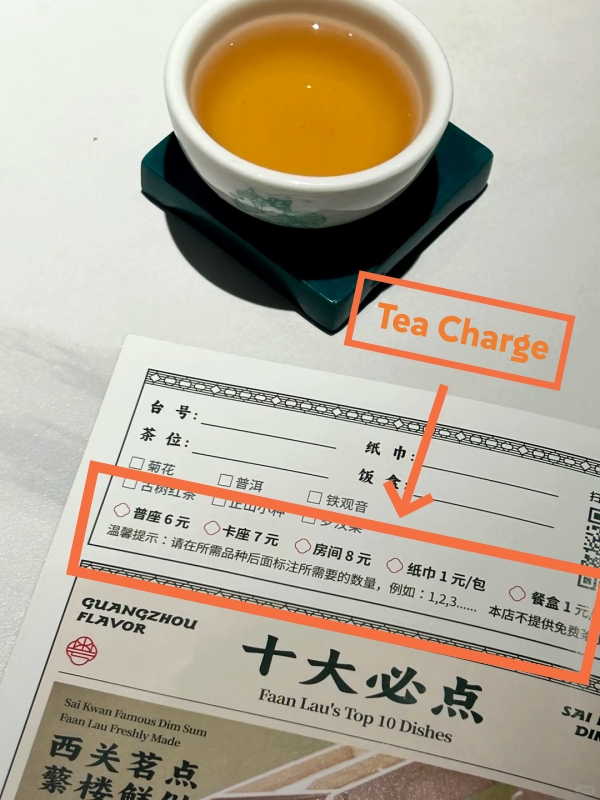
Tea Charge on the Menu
Before the server hands you the kettle, the menu in your hand already tells you whether to expect ¥6 or ¥25. This section walks through what to look for on the menu before you sit down, including the bring-your-own-tea rule that catches almost everyone.
Spotting the Tea Column Before You Sit Down
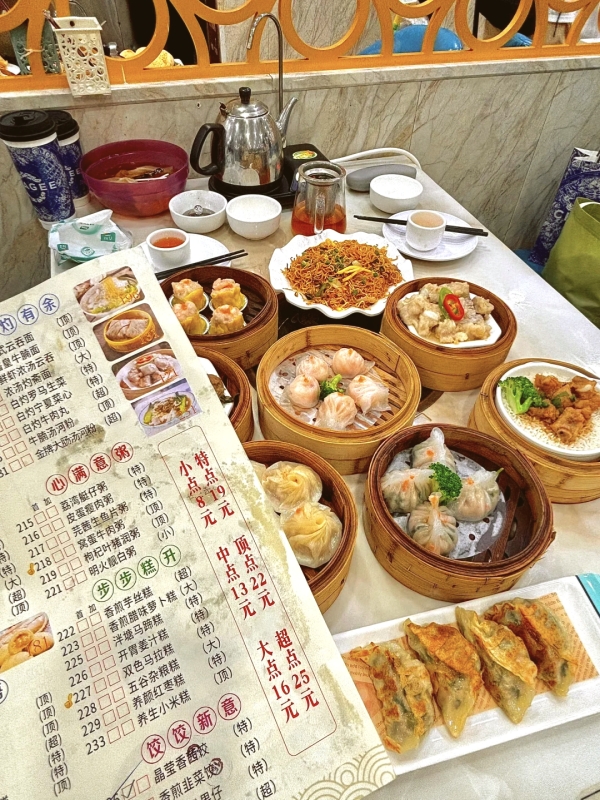
The tea fee line on the menu goes by several names: 茶位费, 茶位, or Tea Charge in English. Most chains list it under a dedicated row at the bottom of the menu or in the small-print area near the dishes. Two patterns are common.
- Per-person number on its own row: Look for a line that reads ¥6/位, ¥8/位, ¥10/位, or ¥15/位. Anything under ¥25 is the standard per-person range; anything over that is a private-room fee.
- No tea fee line at all: The menu may list only dish prices. In that case, ask the server "What is the tea fee here, and is it per person?" before you order. The 2026 rule requires the fee to be shown, but not every restaurant prints it on the physical menu yet.
If the line isn't on the menu, ask before the kettle arrives. Once the tea is poured, the fee is on the bill.
BYO Tea Bags — When You're Still Charged ¥3–¥15
Bringing your own tea bags sounds like the obvious loophole, but at most branches you will still see a line on the receipt. The May 2026 Yangcheng Evening News report recorded five named branches with very different policies for guests who bring their own leaves.
BYO doesn't mean free. It usually means the charge drops from $1.10 (¥8) to $0.40–$0.83 (¥3–¥6), but rarely disappears. The exception is Luk Wan Yangjiu, where one branch told a Yangcheng reporter that guests who refuse tea altogether don't get charged the fee.
The 5 Tea Types Every Menu Must List
The regulation is specific: if a branch charges a tea fee, it must offer at least five tea types and provide refill water. Article 7 names them directly.
- Red tea (红茶)
- Green tea (绿茶)
- Oolong tea (乌龙茶)
- Pu-erh tea (普洱茶)
- Chrysanthemum tea (菊花茶)
If you see only one or two on the menu, ask for the full list. The 2026 rule requires five. Branches that don't comply can be reported through 12345.
🛍️ Liwan District Guide: Walking between dim sum branches in the old city? See our Liwan district guide.
Beyond the Tea Charge — Dishes, Service Fees, and Hidden Extras
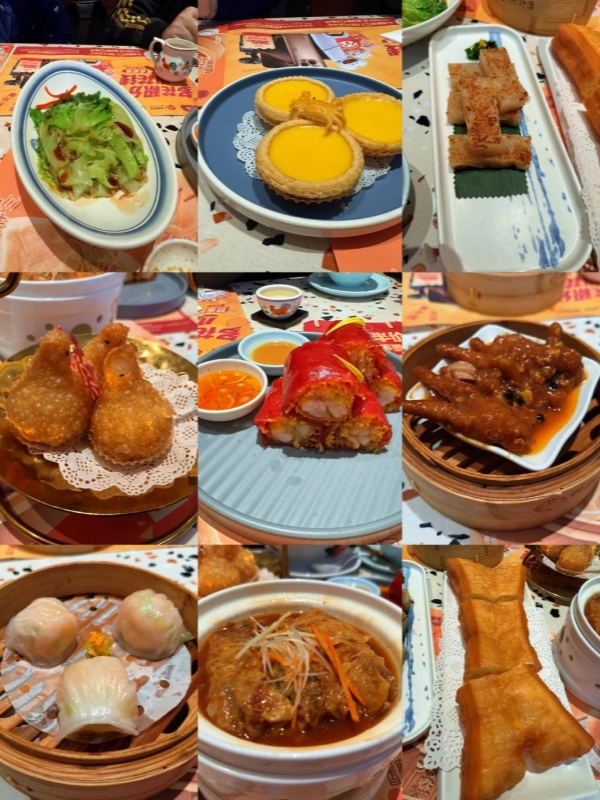
Classic Dim Sum Dishes
The tea fee is the floor of the bill. Once you order dishes, three more layers stack on top: dish prices, an optional service charge, and a handful of small items that can add $2 to $4.50 (¥14 to ¥32) to the receipt without you noticing. Total = dishes + Guangzhou dim sum tea charge ± discount. Service charge and the ¥2–¥3 napkin fee sometimes sneak in.
Classic Dish Prices — From ¥15 Egg Tarts to ¥38 Shrimp Dumplings
Dim sum dishes are sold by the basket (笼), by the portion (份), or by the bowl (例). The price moves with the dish, not with the diner. The table below shows what was reported across several branches between late 2024 and mid-2026.
For two diners, four baskets lands you around $15.30–$20.80 (¥110–¥150) before any discount. Article 8 of the 2026 rule lets restaurants charge a different price for "traditional on-site preparation" versus "non-traditional preparation" of the same dish — a 20% markup is typical where the menu labels it, but most branches have not started labeling it yet.
Service Charge — 0%, 10%, or 15% (and What's in the Base)
A service charge is not automatic at most branches, but it appears in three specific situations. The number on the receipt's base also matters more than the percentage.
The base — what the percentage is applied to — varies. Most chains apply the service charge to dish prices only, but some include the tea fee in the base. Ask before you order: "Is the tea charge part of the 10% base?" That single question can save you $1.50 (¥10) on a typical two-person bill.
Napkins, Parking, and Takeaway — The ¥2–¥32 Extras
Three small fees hide at the bottom of most dim sum receipts. None of them is mandatory under the 2026 regulation, and all of them depend on whether you use the service.
- Napkin fee: $0.28–$0.42 (¥2–¥3) per person. Look for the small notice on the table; if it's there, the napkin pack is chargeable when you take one.
- Parking fee: $1.10–$2.20 (¥8–¥16) per hour. Dim sum typically takes two hours, so $2.20–$4.40 (¥16–¥32) is realistic at CBD branches. Take the metro if you can.
- Takeaway box: $0.14–$0.42 (¥1–¥3) per box. Branches will add this when staff pack leftover baskets.
Two hours of parking in Tianhe costs $2.20–$4.40 (¥16–¥32), which buys you a basket of shrimp dumplings. Skip the car when you can.
🛍️ Beijing Road Walk: Pair your dim sum morning with a walk on Beijing Road Pedestrian Street.
When to Go, Which Branch, and How to Skip It
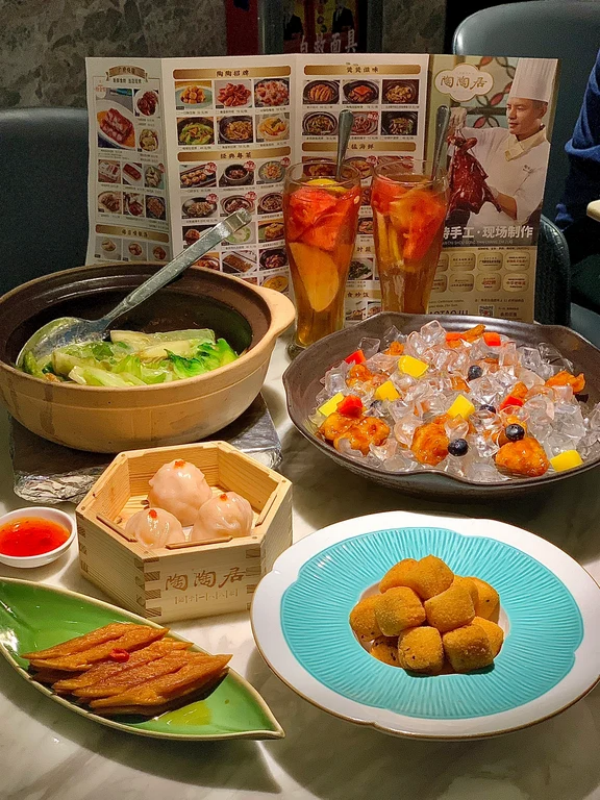
Tao Tao Ju at Guangzhou
Three ways to make the Guangzhou dim sum tea charge bill smaller — go at the right hour, pick the right branch, and ask the right question. None of these tricks require a discount code or a hotel concierge; they all depend on knowing when and where to sit down. Below is a sample weekday-morning bill for two — see how each line stacks.
3 Cheaper Time Slots — Before 11 AM, or After 2 PM
The same dim sum menu produces three very different totals depending on when you sit down. The pattern across most branches in Guangzhou looks like this.
- Early morning tea (早茶市), 7:00–11:00: Some chains, including Dim Dou Duk, offer early-bird specials on selected baskets for weekday mornings before 10:30. Dim Dou Duk does not run this on weekends.
- Regular hours, 11:00–14:00: Full menu price. This is the most expensive window.
- Afternoon tea (下午茶), 14:00 onward: Several branches drop selected baskets to 45–50% off. Cai Dian, Cai Dian Dian Xin, and Heng Bao run 50% off; Tang Ren Xuan runs 40% off between 14:00 and 17:00.
Discount baskets rarely cover the whole menu — check the mini-program before you sit. The same dish that costs $4.44 (¥32) at noon can cost $1.95 (¥14) after 14:00, but only on the listed baskets, and only at branches that run the afternoon promotion.
Same Brand, Different Branch — Where Prices Diverge
Three chains and six branches show how the same logo produces different bills within walking distance of each other.
Search the specific branch on review platforms — the price list won't be the same as a sister branch down the street. Three of the six rows above are reported by Guangzhou Daily and Yangcheng Evening News reporters in May 2026; the other three are user-reported sample rates that should be reconfirmed before you go.
Sample Bill #1 — Two Diners at Dim Dou Duk on a Weekday Morning
The numbers below come from reported branch rates and the user-reported sample, not a single verified receipt. Use them as a structure reference, not as your actual total.
Two more sample bills — a weekend Tao Tao Ju visit with the 10% service charge, and an afternoon 50%-off discount branch — are published as part of the Guangzhou dim sum tea charge checklist at the end of this guide.
🛍️ Guangzhou Food Overview: Looking for related planning information? Read our Guangzhou food guide.
Plain Water, Hotel Tiers, and Branch-to-Branch Surprises
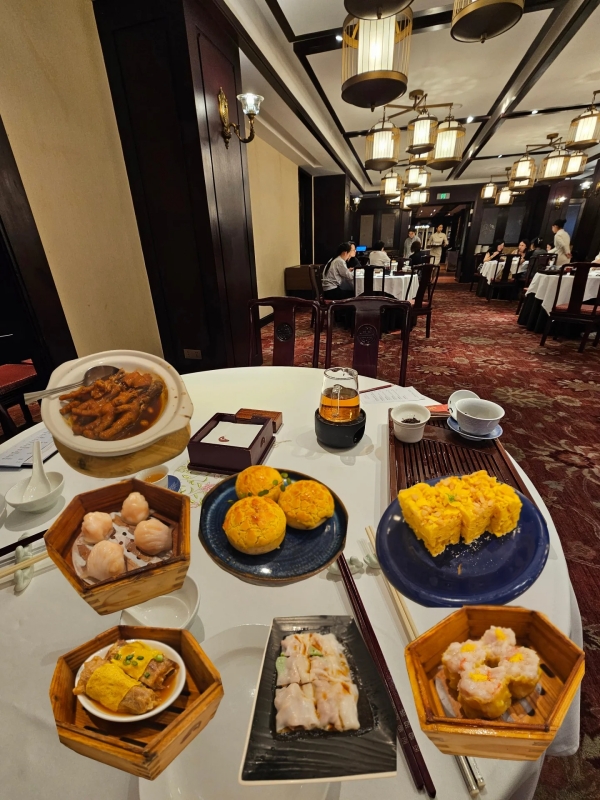
White Swan Hotel at Guangzhou
If you've covered the basics, here are the three edge cases that still surprise bills — plain water, hotel restaurants, and branch-to-branch math. None of them is governed by a uniform rule, which is exactly why each one catches first-time visitors off-guard.
Plain Water — The 8-of-13 Branch Question
The May 2026 Guangzhou Daily reporter survey asked each of 13 branches one question: "If I only drink plain water, do I still pay a tea fee?" Eight branches said yes. Five said no. The split is the headline of this entire section.
The 2026 regulation does not force plain water to be free, nor does it force a charge. Each branch decides and shows the policy on the menu. If you see a "plain water" line on the menu, that branch charges for it. If the line is missing, ask before the water arrives.
Hotel and Michelin Tiers — Where the Math Changes Again
Dim sum at a hotel restaurant or a Michelin-tier branch follows different math from the start. The tea fee is higher, the service charge is fixed, and the dishes are priced for the room and the view.
- White Swan Hotel, Yu Tang Chun Huan (白天鹅宾馆·玉堂春暖): Reported average per person $55.10 (¥397), 15% service charge, recognized on both Michelin and Black Pearl lists. Non-hotel guests should expect a 2–3 hour wait.
- White Swan Hotel, Hong Tu Zhu Fu (白天鹅宾馆·宏图府): Reported average per person $34.40 (¥248), 15% service charge, also Michelin-listed; Sha Mian Island river view; qipao-dressed service team.
- Garden Hotel, Tao Yuan Guan / Li Wan Ting (广州花园酒店·桃园馆 / 荔湾亭): Reported average $27.80+ (¥200+), service charge may apply; Li Wan Ting has an open kitchen where you can see the turnip cake being pan-fried.
- Cui Yuan, Taikoo Li branch (翠园·太古汇店): Reported average $27.80+ (¥200+), 10% standing service charge, plain-water tea fee $1.53 (¥11), private-room gongfu tea up to $23.30 (¥168) per room.
Hotel dim sum usually includes a 10–15% service charge and a tea fee of $2.08–$4.17 (¥15–¥30) per person, separate from dish prices. Hotel and Michelin listings move year to year — confirm the current rating on the branch's own page before you book.
From ¥2 to ¥25 Per Person — What the Tea Charge Actually Costs
The number you see on the receipt is not just the price of the tea leaves. How much you'll pay for the Guangzhou dim sum tea charge depends on three things: which tea you order, which branch you walk into, and whether you drink plain water. This section breaks down the three tiers and explains why the spread between ¥3 and ¥25 is wider than most travelers expect.
Three Tiers That Decide If You Pay ¥2 or ¥25
Order what you ask for, and the receipt moves silently from your pocket to the page. Most restaurants publish the tea fee in three tiers, and the difference between them is the tea itself, not the seat or the service.
Two people picking a plain Tieguanyin keep the per-person fee around $1.10 (¥8). Pick a Dancong and the same seat and the same kettle double to $2.20 (¥16) each. The third tier — private-room gongfu — is rarely charged per head, so splitting it across four or five diners actually lowers your share.
Per-Person, Per-Table, or Per-Pot — How Each Branch Bills You
The number you see is one thing; how the branch counts it is another. Three different units appear in Guangzhou, and they produce very different bills for the same group of diners.
The Cui Yuan case from June 2025 is the one to remember: the customer ordered one pot for three people, and the bill arrived as three separate tea charges. The restaurant's reasoning was that one pot shared among three diners equals three person-time fees. Same brand, different branch, different line on the bill — ask which unit applies before you order.
The 2026 Rule — Standardized, Not Abolished
The Guangzhou Morning Tea Protection Rules took effect on May 1, 2026, after the Standing Committee of the 16th Guangzhou People's Congress issued it on April 2, 2026. The rule does three things that change how you read a dim sum menu.
- Article 7, clause 1: Every fee item must be clearly priced, and the unit of measurement must be shown on the menu.
- Article 7, clause 2: If a restaurant charges a tea fee, it must offer at least five tea types — red, green, oolong, pu-erh, chrysanthemum — and provide refill water and service.
- Article 14: Effective May 1, 2026, statewide within Guangzhou's morning tea sector.
If a branch charges you a tea fee but then tells you the tea is extra, or only offers two types, that is a violation. The same article gives you the 12345 government service hotline to file a complaint.
Frequently Asked Questions
Q: How is the Guangzhou dim sum tea charge calculated — per person or per pot?
Most branches charge per person, with rates ranging from $0.83 to $1.95 (¥6 to ¥14) for routine teas. A few charge per table — one location applies a $2.80 ($20 flat) fee — and some split a pot across multiple diners. The 2026 Guangzhou Morning Tea Protection Rules require each restaurant to clearly show how it counts the fee on the menu, but no single rule applies to the whole city.
Q: Can I just drink plain water and skip the Guangzhou dim sum tea charge?
At 8 of 13 branches surveyed in May 2026, no. Branches including Yu Kou Fu Jin Dian, Zi Yue Li Cha Ju, Cui Yuan Taikoo Li, Luk Wan Liede, Wu Lin Chu Shen, Garden Hotel Tao Yuan Guan, Garden Hotel Li Wan Ting, and Shi Bi Ju Chigang all charge even for plain water. Five branches — Dim Dou Duk Huizhi Lou, Dim Dou Duk Zhujiang New City, Gold-label Tao Tao Ju Taikoo Li, Guangzhou Restaurant Huanshi East, and Cai Lan Guangzhou Tower — let you skip the tea charge if you only drink plain water. The regulation does not force either outcome.
Q: Does the 2026 regulation mean I no longer pay the Guangzhou dim sum tea charge?
No. The Guangzhou Morning Tea Protection Rules standardize how the charge appears on the menu, require at least five tea types plus refill service, and took effect on May 1, 2026. They do not abolish the fee. Any post claiming "tea is free now" misreads Article 7 and Article 14.
Q: What happens if I bring my own tea bags to a Guangzhou dim sum restaurant?
Most branches still charge. Tao Tao Ju Liying Plaza charges $0.83 (¥6) per person even if you only drink your own tea or plain water. Si Ji Ming Dian Tangxia charges $0.40 (¥3) when you BYO. Cui Yuan Taikoo Li charges $2.08 (¥15) per person. The number varies — ask the server "Can I BYO tea, and at what charge?" before you pour. One Luk Wan branch told reporters guests who refuse tea altogether don't get charged the fee at all.
Q: Will I pay a service charge on top of the Guangzhou dim sum tea charge?
At most casual and mid-range chains, no. At Tao Tao Ju on weekends and holidays, expect a 10% service charge. At White Swan Hotel restaurants, expect 15%. Some branches apply the service charge to dishes only; others include the tea charge in the base. Ask to see the bill breakdown before you pay, and ask specifically whether the tea fee is in the 10% base.
Q: When is the cheapest time to go for dim sum in Guangzhou?
Weekday mornings before 10:30 AM at chains like Dim Dou Duk offer early-bird specials on selected baskets. After 14:00, several branches — Cai Dian, Cai Dian Dian Xin, and Heng Bao — drop prices to 45–50% off, while Tang Ren Xuan runs 40% off between 14:00 and 17:00. The same dishes at full price between 11:00 and 14:00 can cost roughly twice as much, which is why the dim sum tea charge plus a discounted afternoon basket often beats a regular-hour visit.