
Guangzhou Temporary Accommodation Registration for Foreigners
If you are staying in Guangzhou anywhere other than a hotel—a friend's apartment, an Airbnb, a rented flat, or a university dorm—you must register that address with local police within 24 hours of arrival. Since September 21, 2026, you can complete the entire process online through China's national immigration platform, at zero cost, without visiting a police station. This guide covers who must register, the exact online steps, the documents you need, where to go if the system flags an error, and what happens if you miss the window.
Quick Facts
What Is Temporary Accommodation Registration
China's Exit-Entry Administration Law requires every foreign national staying in non-hotel accommodation to be registered with the local public security authority within 24 hours of arrival. This record links your legal status—visa, residence permit, or visa-free stay—to a physical address in China. Immigration authorities, banks, mobile carriers, and other institutions may request this registration when you open an account, extend a visa, or complete other official processes.
The requirement applies to every non-hotel address: a rented apartment, an Airbnb, a friend's spare room, a university dormitory, or a company-provided residence. It does not apply to hotel stays, because hotels are legally obligated to submit your information to police themselves within 24 hours of your check-in.
Until September 2026, completing this registration meant visiting a local police station or community police office in person. The national immigration authority now hosts a fully online process that carries the same legal weight as the in-person visit.
📝 National Policy Overview: Need complete guidelines on China's updated nationwide digital filing system for foreign visitors? Read our full feature on China Foreigner Accommodation Registration Online 2026.
Who Must Register
Any foreign national who stays overnight in Guangzhou outside a licensed hotel must register. This includes short-term visitors on tourist visas, business travelers on invitation letters, and long-term residents whose residence permit address has changed.
Certain categories have specific conditions:
- Visa-free tourists: Even a single night in a private residence triggers the 24-hour window.
- Business travelers staying in company housing: Your employer may handle registration on your behalf, but confirm this before assuming you are covered.
- University students in dormitories: Your school typically acts as the registering party—check with the international students' office.
- Airbnb or vacation rental guests: You and your host share responsibility. Initiate the process yourself to avoid gaps.
- Foreigners with a valid residence permit: If you move to a new address, you must re-register at the new location.
If you hold a Chinese Permanent Residence Card (中国永久居留身份证) and the address on your card matches your current address, re-registration at that same address is generally not required. Any change of address, however, triggers a fresh registration.
How to Register Online
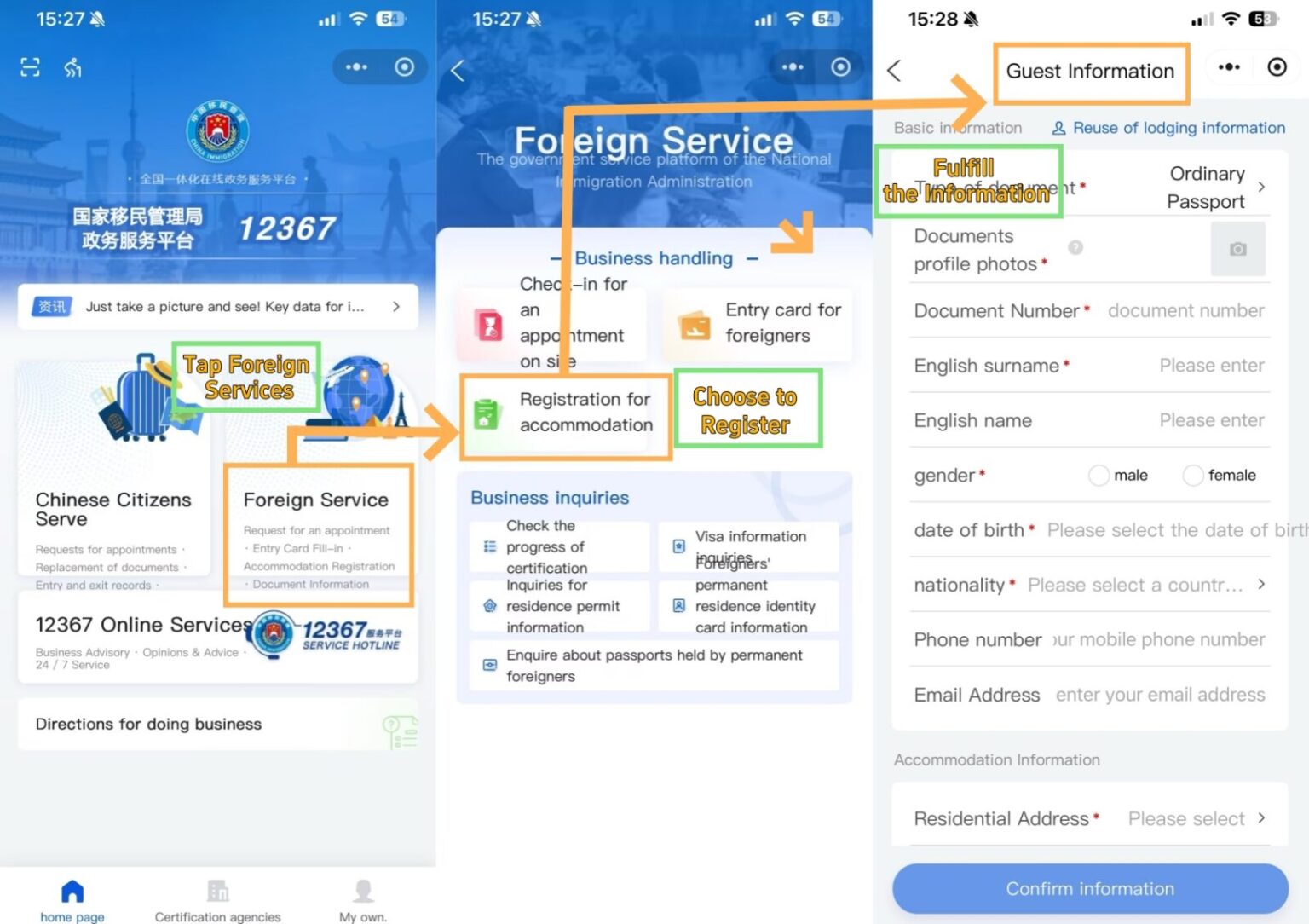
Step-by-Step Online Registration Process for Accommodation in China
The national online registration system launched September 21, 2026. It covers all non-hotel accommodation types nationwide and is the recommended first step for every eligible foreign visitor in Guangzhou.
Step 1 — Choose your platform
You have four options, all free and all carrying equal legal效力 (legal validity):
- National Immigration Administration政务服务网站: sso.nia.gov.cn — create an account, then navigate to 外国人服务 → 住宿登记
- 移民局12367 App: Available on iOS and Android app stores—download, register with your passport details, and select 住宿登记
- 移民局12367 WeChat mini-program: Search "移民局12367" in WeChat → 住宿登记
- 移民局12367 Alipay mini-program: Search "移民局12367" in Alipay → 住宿登记
- HELLO GUANGZHOU (广州优先入口): Open Alipay → City Services or search "HELLO GUANGZHOU" → 政务服务 → 境外人员住宿登记 — this platform is operated by the Guangzhou Municipal Public Security Bureau and offers the interface in Chinese with guided fields
Step 2 — Register or log in
First-time users complete identity verification using their passport information. The system walks you through registering your personal details, a valid phone number, and your current Chinese address.
Step 3 — Submit your accommodation information
Fill in the following fields as they appear on your supporting documents:
- Full name (as on passport)
- Passport number and nationality
- Date of arrival at this address
- Detailed residential address in Chinese (ask your host or check your rental agreement)
- Host or landlord's full name and contact number
- Accommodation type: rented apartment, private residence, university dorm, or other
Step 4 — Upload documents
Photograph or scan the relevant pages of your passport and any proof of address—lease agreement, property certificate, or a letter from your host. The system accepts Jpeg and PDF files. If you are using the HELLO GUANGZHOU platform, the interface provides field-level guidance in Chinese.
Step 5 — Submit and record your confirmation
After submission, the platform generates a registration record accessible through 登记记录查询 (Registration Record Query). Screenshot or save this confirmation. You do not need to visit a police station to collect a physical form unless the system specifically directs you to do so.
Document Checklist
Having the right documents ready before you start speeds up the online submission considerably. Requirements differ slightly depending on your accommodation type.
In most cases, only digital copies are needed for the online submission. Physical documents are requested on-site only if there is a system anomaly, a high-risk flag, or a specific instruction from the local police station.
Where to Go If the Online System Flags an Error

Local Police Station
Most submissions process without trouble. If the system returns a missing-record error—particularly when you are extending a visa or booking a consulate appointment and the platform shows no registration under your passport—take the following steps in order.
Check your registration record first
Use the 登记记录查询 function on the 12367 app or mini-program to verify whether a record already exists under your current passport number. A record may be present but linked to an older passport or a previous address. If you find a record, note the registration number and bring it to the relevant authority.
Call the national immigration hotline
Dial 12367 and explain the discrepancy. Agents can query the national database, confirm whether a record exists, and guide you on correction. This step resolves the majority of registration-related errors without a physical visit.
Contact Guangzhou 12345
For platform-specific issues or urgent matters tied to your Guangzhou address, call Guangzhou's general government service hotline 020-12345. They can escalate to the district public security bureau.
Visit the nearest police station or community police office
If the issue cannot be resolved by phone, go to your local派出所 (police station) or社区警务室 (community police office). These offices handle non-hotel accommodation registration for their jurisdiction and can correct records on the spot. Bring your passport, proof of address, and a screenshot of the online error message.
Guangzhou Foreign Entry-Exit Reception Hall (线下兜底)
The Guangzhou Municipal Public Security Bureau's Foreign Entry-Exit Reception Hall is located at 155 Jiefang South Road, Yuexiu District. This office handles urgent visa and residence matters. It is best reserved for cases where a registration error is blocking a time-sensitive visa or permit process. Confirm current operating hours through the 广州公安出入境 WeChat official account before visiting, as the window schedule has changed over time and may shift again.
🏨 Transit & Airport Stay Recommendations: Looking for seamless hotel stays near Baiyun International Airport where check-in registration is handled automatically? Check out our complete guide to Guangzhou Airport Hotel.
What Happens If You Miss the 24-Hour Window
Missing the registration deadline is treated as a violation under Article 76 of China's Exit-Entry Administration Law. Penalties in Guangdong follow a graduated schedule published in the provincial enforcement guidelines—the exact consequence depends on how long you overstayed and whether you have prior violations.
- Overstay up to 3 days: Warning; no fine in most first-time, minor cases.
- Overstay 4 to 10 days, or 2 to 5 separate failures: Warning plus a fine of up to ¥1,000 (~$140).
- Overstay more than 10 days, or 5+ failures, or a repeat violation within one year: Warning plus a fine of ¥1,000 to ¥2,000 (~$140–$280).
In all cases the penalty starts with a formal warning. A fine is not automatic for short overstays, particularly for first-time offenders who register voluntarily as soon as they realize the deadline has passed. The safest response is to register as quickly as possible once you become aware of the miss—delays compound the severity.
Hotel registration failures are handled separately. Under Chinese law, hotels must register foreign guests and report to police within 24 hours. If a hotel failed to file your information, the penalty falls on the hotel, not on you—but keep your receipt and confirmation as evidence if a discrepancy surfaces later.
🏙️ Neighborhoods & District Selection: Deciding where to anchor your stay in Guangzhou? Explore our comprehensive area breakdown on Where to Stay in Guangzhou.
Common Problems
The host refuses to cooperate
Guangdong provincial regulations place clear obligations on landlords: they must verify their foreign tenant's identity, register the accommodation with police, and file a rental contract with the housing authority. If a landlord or host refuses to provide documents or cooperate, bring your passport, your lease or evidence of the arrangement, and a copy of the owner's property documents to the local police station and explain the situation. You may also call 020-12345 to report the non-cooperative host. Do not fabricate a lease or use a false address—doing so creates a more serious violation.
A hotel refused to accept you
Some domestic hotels lack the proper license or system configuration to accommodate foreign guests. This is a known pain point. If a hotel declines your booking, try a hotel that explicitly lists 涉外接待 (foreign guest capability) or search for properties on platforms that filter for this requirement. If you have already paid and been turned away, contact the platform for a refund and report the hotel to the local tourism authority. Your registration obligation as a guest does not change—the hotel, not you, is responsible for reporting your stay to police.
The system only shows Chinese characters
The 12367 app and national platform currently operate in Chinese only. The HELLO GUANGZHOU platform in Alipay also defaults to Chinese. Use a translation app with your camera feature to photograph on-screen fields, or ask your host, a bilingual colleague, or the hotel concierge to help you complete the submission. This language barrier was a direct driver behind the 2026 national online expansion—future updates are expected to add English language support.
Your passport number changed
If you renewed your passport after arriving in China, your old passport number is linked to any existing registration record. When extending a visa or completing another official process, bring both your old and new passports to the immigration office or local police station so they can merge the records.
Frequently Asked Questions
Q: Do I need to register if I am staying in a hotel?
No. Hotels are legally required to register your information and report it to the police within 24 hours of your check-in. You do not need to take any action yourself. However, keep your hotel receipt as evidence of your accommodation in case any official process later asks for proof.
Q: Can I just use my Airbnb or booking platform confirmation as proof?
No. The registration must be filed through the official immigration platform or in person at a police station. A booking confirmation from a short-term rental platform does not satisfy the legal requirement under China's Exit-Entry Administration Law. Complete the online registration to ensure your address is properly recorded in the national system.
Q: What if I arrive late at night—is the 24-hour clock strict?
The law sets a 24-hour window from the time you arrive at the address. If you arrive late in the evening, register the following morning as soon as the platform is accessible. Minor inadvertent overstays of a few hours are generally treated leniently for first-time offenders, but the safest approach is to register as early as possible—even before you finish unpacking.
Q: Do I need to re-register if I move to a different address in Guangzhou?
Yes. Each distinct non-hotel address requires its own registration. If you move from one rented apartment to another within the city, file a new registration for the new address within 24 hours of arriving there. Your previous registration record remains on file and does not cover the new location.
Q: I have a residence permit. Does that change anything?
Your residence permit is linked to a specific address. If you are living at the address shown on the permit and have already registered correctly, you generally do not need to re-register each time you return to that same address. Any move to a different address—even within the same city—triggers a fresh 24-hour registration obligation.
Q: Is the online registration accepted for visa extensions?
Yes. The online registration record carries the same legal validity as an in-person police station registration. When you apply for a visa extension or a new residence permit, the immigration authority can query your registration record directly through the national system. Keep a screenshot of your confirmation page as a backup.
Q: My landlord says registration is not necessary. Should I believe them?
No. Under Guangdong provincial regulations, landlords who rent to foreign nationals are legally required to assist with temporary accommodation registration and to file the rental contract with the housing authority. If your landlord refuses, explain the legal obligation, show them the relevant regulations, and offer to bring all required documents to the police station yourself. If they still refuse, complete your own registration with whatever documents you have and report the matter to 020-12345.
Q: What if I cannot find my exact address in Chinese?
Ask your host, landlord, or the property management office to write the address in Chinese on a piece of paper. You can also search the address on Amap (高德地图) or Baidu Maps, which display the Chinese character address prominently. Copy those characters exactly into the registration form—addresses in China are highly standardized and even a small character discrepancy can cause a validation error.
Official source: National Immigration Administration of P.R. China