
New Policy:Online Accommodation Registration for Foreigners
🆕China’s National Immigration Administration has launched a digital accommodation registration system for foreigners in seven pilot provinces, effective March 20, 2026.This reform eliminates one of the most friction-prone bureaucratic steps faced by foreigners: the compulsory police station registration visit within the specified zones. For anyone trying to comply with China foreigner accommodation registration online 2026 rules, it means round-the-clock digital registration, legally recognized electronic document storage, and a degree of autonomy from host management. Knowing exactly what this regulation “requires” (and who gets a pass) is crucial for every foreign expatriate remaining temporarily in the designated regions.
🛃 Entry Prerequisite: Before you can register your stay, ensure you have completed the mandatory digital entry process. As of 2026, the traditional yellow slips are gone. Check our latest Policy Update: China’s Digital Arrival Card Now Replaces the Paper Form (With Step-by-Step Guide) to sync your arrival data with the national security system seamlessly.
China NIA Starts Digital Registration for Foreigner In March 2026
China’s National Immigration Administration (NIA) has introduced a significant policy change for foreign nationals in seven pilot provinces. Effective March 20, 2026, foreigners at private addresses in these regions can now complete their legally required accommodation registration entirely online. However, Article 39 of China’s Exit and Entry Administration Law has long mandated this registration for all non-hotel stays. Therefore, the NIA has now removed the in-person police station requirement for foreigners across these specific pilot regions, providing a digital alternative to the traditional process.
The NIA 12367 platform is now the online platform to register accommodation. Foreign nationals in the pilot provinces can submit their accommodation details and download a record of the registration at any time of the day, and the electronic record is fully equal in legal effect to the Temporary Residence Registration Form. The pilot covers Hebei, Liaoning, Zhejiang, Hubei, Guangxi, Chongqing and Sichuan.
Main Policy Rules
| Parameter | Detail |
|---|---|
| Effective date | March 20, 2026 |
| Legal basis | Exit and Entry Administration Law, Articles 39 & 76 |
| Who must comply | All foreign nationals staying in non-hotel private accommodation |
| Deadline to register | Within 24 hours of arrival at the address |
| Online vs. in-person registration | Legally equivalent — same legal effect |
| Pilot coverage | Hebei, Liaoning, Zhejiang, Hubei, Guangxi, Chongqing, Sichuan |
| Available platforms | NIA 12367 App, NIA website, WeChat Mini Program, Alipay Mini Program |
Changes From The Old System
| Dimension | Pre-March 2026 (nationwide) | From March 20, 2026 (pilot regions only) |
|---|---|---|
| Filing method | In-person visit to local police station | Online via NIA 12367 app, website, WeChat, or Alipay |
| Operating hours | Police station business hours only | 24 hours a day, any day |
| Documents required | Passport original, host ID, property documents | Digital passport details, address, host information |
| Proof of registration | Physical Temporary Residence Registration Form (TRRF) with official stamp | Electronic registration record (downloadable; same legal status) |
Hotel guests: no action required
Hotels have always registered guests automatically upon check-in. Therefore, this policy applies exclusively to private, non-hotel accommodation. If you are staying in a licensed hotel, no additional steps are needed.
How To Complete Online Registration
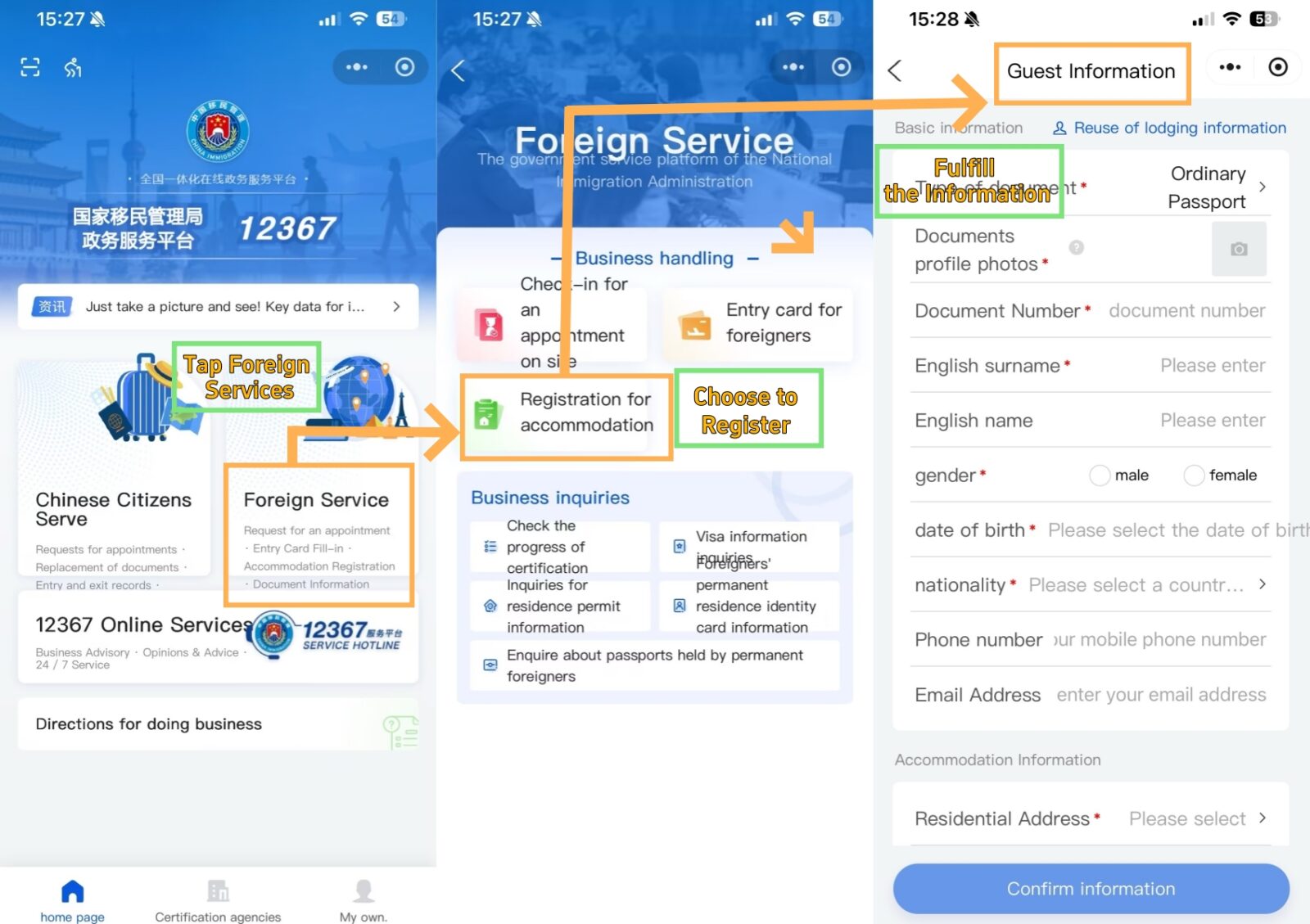
Step-by-Step Online Registration Process for Accommodation in China
Foreign nationals across seven pilot provinces can register totally online. These provinces are Hebei, Liaoning, Zhejiang, Hubei, Guangxi, Chongqing, and Sichuan. So basically, the NIA 12367 system does it all online. The steps we outline below apply to all the channels.
Approved Digital Platforms
| Platform | How to Access | Language Support |
|---|---|---|
| NIA Government Service Website | en.nia.gov.cn | English, French, Japanese, Korean, Russian |
| NIA 12367 App | iOS App Store or Android — search “NIA 12367” | Chinese + multilingual sections |
| WeChat Mini Program | Search “NIA 12367” inside WeChat | Chinese interface |
| Alipay Mini Program | Search “NIA 12367” inside Alipay | Chinese interface |
Recommended for non-Chinese speakers
The NIA official website at en.nia.gov.cn supports English, French, Japanese, Korean, and Russian. Therefore, if you cannot read Chinese, use the website directly. Alternatively, switch the language setting in the app before beginning the process.
Step-by-Step Registration Process
• Step 1. Access the Registration Platform
• Choose the NIA 12367 App, website, WeChat, or Alipay.
• Non-Chinese speakers should use the multilingual NIA website.
• Step 2. Complete Identity Verification
• Create an account using your passport or permanent resident card.
• Complete identity verification before accessing any registration functions.
• Step 3. Navigate to Registration
• Go to “Foreigner Services” in the main platform menu.
• Select “Accommodation Registration” to begin your submission form.
• Step 4. Enter Accommodation Details
• Input your full address, arrival time, and host information.
• Confirm your host’s identity details in advance for first-time registrations.
• Step 5. Submit the Form
• Submit the completed registration form through the NIA platform.
• Await the system confirmation message before proceeding further.
• Step 6. Retrieve Your Record
• Access “Registration Record Inquiry” after your registration is approved.
• View and verify your completed electronic registration on the platform.
• Step 7. Download and Secure
• Download the electronic registration record immediately after approval.
• Back it up to email or offline storage for safekeeping.
Required Verification Documents
- Valid passport or Foreign Permanent Resident ID Card
- Full street address of your accommodation in China
- Host’s full name and ID number (required for first registration at that address)
Required Registration Groups And Exemptions
Before using the NIA platform, confirm whether you must register at all. Additionally, determine whether your host’s involvement is required. The following rules apply equally to both online and in-person processes.
People Required To Register
- Any foreign national arriving at a private address in a pilot region must register within 24 hours. This includes rented apartments, friends’ homes, short-term rentals, and hostels.
- Registration can be completed by the foreign national or the accommodation host. This applies to both Chinese and foreign hosts.
- The 24-hour countdown starts at the moment of physical arrival at the address. Therefore, it is not based on booking platform check-in time. Additionally, the time of day does not affect this deadline.
Important: coordinate with your host before you arrive
For a first stay the host must send you their ID to complete registration, so this step requires some advance coordination. Before you even get there, check who will be filing that registration (other than you) and see to it that you provide them with the needed details and agree on a timeline for submitting them. If you leave this discussion until the day of the stay, especially if you're arriving at a late hour, you may miss that deadline.
Conditions For Independent Registration
- Foreign nationals who have previously completed registration at the same address through the NIA platform. Therefore, return stays at a recorded address can be self-filed.
- Foreign nationals who own their home in China and are returning to it can also register independently.
Criteria For Policy Exemption
- Holders of a valid residence permit or permanent residence card who return to the habitual residence address recorded on their permit, within its validity period.
- Foreign nationals returning to a property they own after domestic travel or a short overseas trip.
Airbnb, Meituan, and other short-term rental platforms do not handle registration
Booking through Airbnb, Meituan B&B, or any similar platform does not satisfy the registration requirement. These platforms have no connection to the NIA system. Therefore, they do not automatically submit any registration on your behalf. Either you or your host must complete the process manually through the NIA 12367 platform within 24 hours. Confirm this arrangement with your host explicitly before check-in — do not assume the platform has handled it.
Supported Pilot Provinces Under The Policy
Online registration availability depends entirely on your location. Specifically, the NIA 12367 online service is a pilot programme. It currently covers only the following seven provincial-level regions:
Liaoning
Zhejiang
Hubei
Guangxi
Chongqing
Sichuan
Significant cities within the pilot include Hangzhou and Wenzhou in Zhejiang, Wuhan in Hubei, Chengdu in Sichuan, Nanning in Guangxi, and Chongqing municipality.
Major Cities Using The Old System
These three major cities are not included in the NIA pilot. Therefore, foreigners at private addresses in Beijing, Shanghai, or Shenzhen must still register through city-specific channels. Alternatively, they can visit a local police station.
Shanghai — not in pilot
Shenzhen — not in pilot
- Shanghai: The Suishenban app (随申办) handles local residence reporting for eligible residents. However, check with the local exit-entry authority for the latest foreigner-specific guidance.
- Beijing: Beijing operates its own separate online system at english.beijing.gov.cn. This is independent of the NIA 12367 pilot.
- All other cities outside the pilot: Visit the nearest exit-entry administration service window or local police station (派出所).
Nationwide rollout: timeline unconfirmed
The NIA has stated the service will expand progressively based on pilot results. However, no confirmed date for national coverage has been announced. Therefore, monitor en.nia.gov.cn for official updates.
Legal Penalties For Missing Registration
Article 76 of the Exit and Entry Administration Law sets penalties for registration failures. These penalties apply to both the foreign national and the accommodation host. Specifically, both parties face consequences for non-compliance.
| Who | Violation | Consequence |
|---|---|---|
| Foreign national | Failed to register within 24 hours; did not arrange for host to register on their behalf | Warning (first instance); repeat or serious cases: fine up to CNY 2,000 (approx. USD 275) |
| Accommodation host | Failed to assist a foreign guest with registration when required to do so | Warning (first instance); repeat or serious cases: fine up to CNY 2,000 |
What “serious cases” typically means
The law does not define “serious cases” exhaustively. However, based on general administrative enforcement practice, this category typically covers multiple instances of non-registration. It also includes providing false accommodation information. Additionally, it covers violations that create additional compliance consequences for local authorities. Therefore, a single, first-time oversight by an otherwise compliant foreigner will most likely receive a warning rather than an immediate fine.
A missed or late registration does not in itself invalidate your visa or residence permit but does create a record of non-compliance. This could complicate your next visa extension, and residence permit renewal, and could even be mentioned by police during spotchecks. The risk is more administrative/record-keeping than legal - although it becomes ‘more legal’ over time - therefore the best way to maintain a clean entry record when in China is to register correctly on every stay.
Essential Resources For Expats In China
Registering your accommodation is one of the first hurdles to tackle once stepping foot in China, but it is by no means the only one. Crafting mobile payments, booking trains, staying connected, and understanding laws are just a handful of the niggly tasks that require a specific knowledge set. Extra practical resources make the difference for extras to your stay!
The China Travel Survival Guide covers these practical realities in detail. Specifically, it addresses payments, transport, accommodation, connectivity, and more. Furthermore, it is updated to reflect 2026 conditions for foreigners in mainland China. Therefore, it is a useful reference to read alongside this registration guide — particularly for first-time visitors.
Frequently Asked Questions about Registration Policy
Q: I’m staying in a hotel. Do I need to register separately?
No. Under china foreigner accommodation registration online 2026 rules, hotels register guests automatically at check-in. Therefore, this policy exclusively targets private, non-hotel stays. However, if you occupy any rented apartment, private guesthouse, or a friend’s home — even briefly — the 24-hour registration requirement applies without exception.
Q: My Chinese friend is hosting me in their apartment. Who is responsible for completing the registration?
Under china foreigner accommodation registration online 2026 procedures, your host is best positioned to file the initial registration at their address. However, the system requires host identity details for any first-time submission. Therefore, once an address is recorded on the NIA platform, you can handle subsequent registrations independently. Always confirm this arrangement before arriving.
Q: I booked through Airbnb. Will the platform automatically handle my registration?
No. Airbnb, Meituan B&B, and comparable platforms have no connection to the china foreigner accommodation registration online 2026 NIA system. Therefore, the booking platform does not satisfy the registration requirement. Either you or your host must complete registration manually within 24 hours of arrival. Confirm responsibility with your host explicitly before check-in.
Q: I’m in Beijing, Shanghai, or Shenzhen. Can I use the NIA 12367 online system?
These three cities are excluded from the china foreigner accommodation registration online 2026 NIA pilot. However, alternatives exist. Shanghai residents may use the Suishenban (随申办) app; Beijing operates a separate local system at english.beijing.gov.cn. For Shenzhen and all other non-pilot locations, in-person registration at a police station remains required.
Q: I hold a Chinese permanent residence card. Do I need to register every time I stay somewhere?
Under china foreigner accommodation registration online 2026 policy, permanent residence cardholders are exempt from re-registration when returning to their habitual address within the card’s validity period. However, if you stay at a different address while traveling within mainland China, the standard 24-hour registration requirement applies to you in full.
Q: The NIA app is in Chinese and I can’t navigate it. What should I do?
The china foreigner accommodation registration online 2026 process supports multiple languages. Therefore, non-Chinese speakers should use the NIA official website at en.nia.gov.cn, which supports English, French, Japanese, Korean, and Russian. Alternatively, switch the language setting in the NIA 12367 app before starting. However, WeChat and Alipay mini programs are Chinese-only and are not recommended.
Q: Will I receive a physical Temporary Residence Registration Form (TRRF)?
No physical form is issued through the china foreigner accommodation registration online 2026 system. However, the electronic registration record is legally equivalent to the traditional Temporary Residence Registration Form. Therefore, download your record immediately after approval. Save a backup copy to email or offline storage. Authorities may request it at spot checks.
Q: I arrived late at night. Does the 24-hour deadline still start from the moment of arrival?
Yes. The 24-hour window begins at arrival, regardless of the time of day. However, china foreigner accommodation registration online 2026 rules now work in your favor here. The NIA platform operates around the clock. Therefore, late-night arrivals no longer require waiting for police station opening hours — registration can be filed immediately upon arrival.
Q: Is accommodation registration the same as applying for a residence permit?
No. These are two entirely separate legal requirements. Accommodation registration under china foreigner accommodation registration online 2026 rules is a short-term reporting obligation only. However, a residence permit is a long-term legal status document for extended stays. Therefore, completing accommodation registration does not substitute for, or contribute toward, a residence permit application.
Q: When will the online registration system be available nationwide?
No confirmed timeline has been announced for nationwide expansion of china foreigner accommodation registration online 2026 coverage. However, the NIA has confirmed that expansion is planned following evaluation of the current pilot results. Therefore, foreign nationals outside covered regions should monitor the official NIA website at en.nia.gov.cn regularly for rollout updates.