Supermarket Chains in China
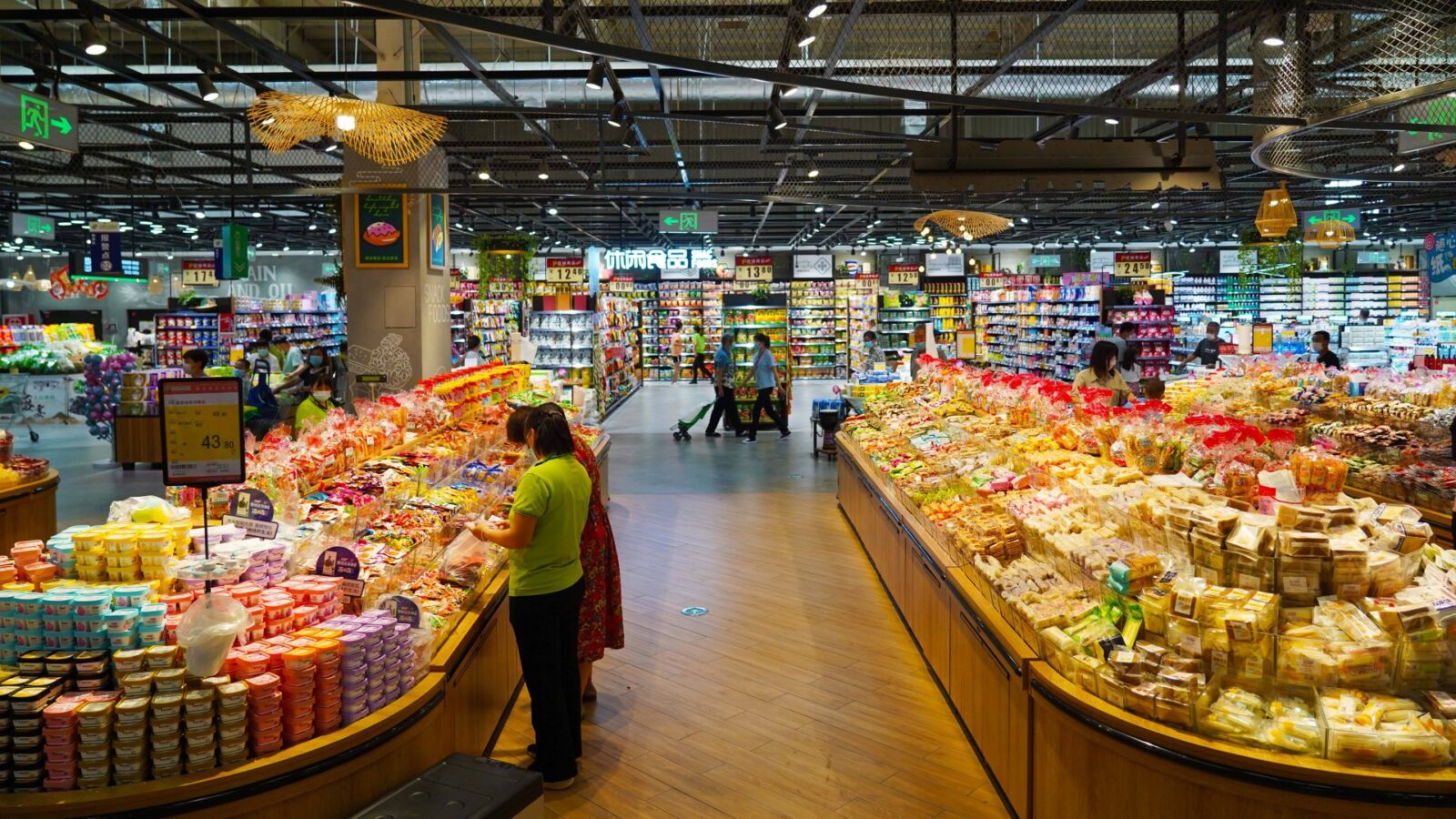
Supermarket chains in China have reshuffled sharply since 2020. Carrefour sold its mainland stores to Wumart and exited in 2024; meanwhile, Costco arrived in 2019 and now runs a growing warehouse footprint, while Hema scaled to several hundred tech-driven outlets. The convenience-store network now covers most city blocks. For a foreign visitor, the result is a market that looks unfamiliar compared with even five years ago.
Here's the picture for travelers: which foreign-backed brands still operate, which domestic giants dominate shelf space, how tech-driven chains like Hema work, and where the convenience layer fits in. Note also what to expect on payment — cash alone rarely works — and on delivery, which most chains now route through Meituan or Eleme.
Quick Facts
Foreign-Backed Chains
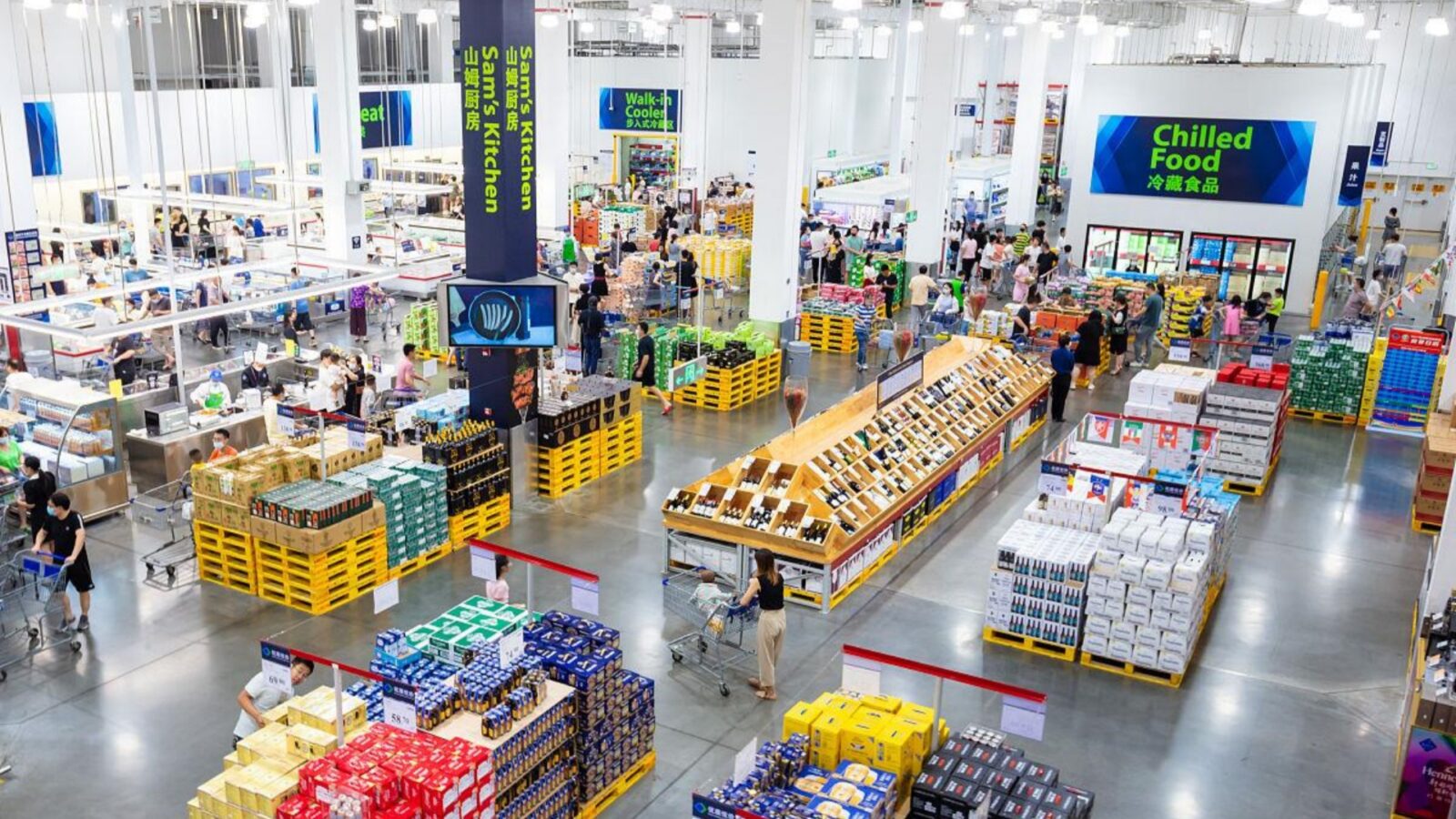
Sam's Club in China
Foreign supermarket chains in China have thinned sharply since 2020. Wal-Mart and Sam's Club remain at scale; Costco runs a small but growing warehouse footprint; Metro continues members-only wholesale. Auchan was largely absorbed after 2020 restructuring. Carrefour and Tesco are gone.
The lines often blur — several "foreign" chains in China are now domestically restructured:
- Wal-Mart: still owns Sam's Club in mainland China
- Wumart: acquired Tesco China in 2014
- Wumart: absorbed most Carrefour mainland stores in 2023–24
- Auchan: persists on legacy signage in some cities
Wal-Mart and Sam's Club
Wal-Mart entered mainland China in 1996 and still operates hypermarkets in many cities. Sam's Club, its premium warehouse banner, now ranks as the largest warehouse club in China by revenue, with a mid-50s store count still rising. Membership is required: the basic card runs about $36 (¥260) per year, and the Plus tier about $69 (¥499). Heaviest footprint sits in Shenzhen, Shanghai, Beijing, Guangzhou, and Hangzhou.
Metro Wholesale
Metro (麦德龙), a German-origin members-only wholesale chain, runs a smaller footprint in China. Membership cards are required for entry, and foreign visitors can apply on site with a passport. The chain is strongest on imported cheeses, biscuits, meats, spices, and bulk household items. Nationally there are well under 100 stores, concentrated in tier-1 cities.
Costco and Auchan
Costco entered mainland China in 2019 with its first Shanghai warehouse. It now runs about seven clubs across Shanghai, Suzhou, Shenzhen, Guangzhou, Hangzhou, and Nanjing. Annual Gold Star membership costs about $42 (¥299). Auchan (欧尚), the French hypermarket, was largely rebranded under Wumart after Auchan Retail's 2020 restructuring; legacy Auchan signage persists in some cities.
Carrefour and Tesco: Withdrawn from China
Carrefour exited mainland retail in stages, and the final sale of its remaining stores to Wumart closed in 2024. Tesco sold its 131-store China portfolio to Wumart back in 2014. Neither name operates as a standalone chain in mainland China today, and legacy branding has largely disappeared. The exits illustrate a recurring pattern among foreign supermarket chains in China: locally rebuilt competitors consistently outpaced them.
🛒 Mall-Based Grocery Shopping: If you want to combine your grocery run with a premium lifestyle experience, many of these top-tier supermarkets are located inside Beijing's most spectacular, high-tech retail complexes. Discover the best lifestyle hubs and shopping centers in our ultimate guide to the Beijing Shopping Mall.
Domestic Giants
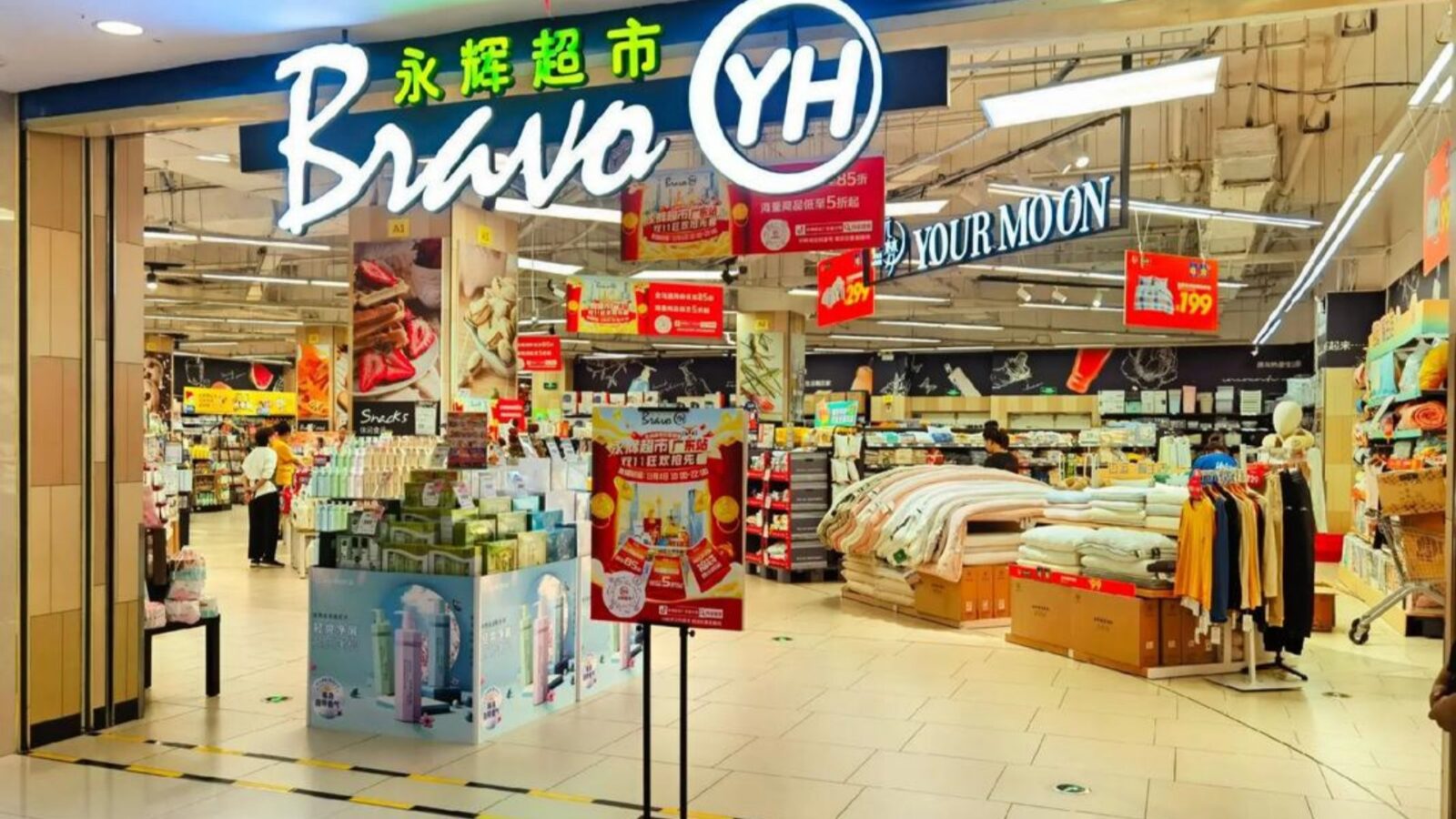
Yonghui Superstores in China
The supermarket chains in China that dominate shelf space are mostly domestic. CR Vanguard leads on store count; Yonghui dominates fresh produce; Wumart controls north China after absorbing Tesco China and most of Carrefour; RT-Mart sits inside Alibaba's retail ecosystem; Lianhua runs the legacy east-China network.
Three recent ownership transfers reshaped the market, leaving the supermarket chains in China consolidated around domestic owners:
- RT-Mart: original Taiwanese chain, acquired by Alibaba in 2017
- Wumart: acquired Tesco China (2014) and most Carrefour (2023–24)
- Lianhua: under Shanghai's Bailian Group, a state-owned enterprise
CR Vanguard
CR Vanguard (华润万家) sits inside state-owned China Resources and ranks as the largest supermarket chain in China by store count, running roughly 3,000+ outlets. The chain covers multiple formats including Vanguard supermarkets, Home World premium stores, and Ai Jia (IGA-affiliated) outlets. It is densest across southern and central China; standard hours run 08:30–22:30.
Yonghui Superstores
Yonghui (永辉超市) built its reputation on fresh produce, seafood, and live-fish counters. After opening its first Beijing store in 2023 — well beyond its southern base — the chain now runs about 1,000 stores. Recent restructuring has shifted it toward smaller Yonghui Select formats in tier-1 cities; most stores open 10:00–22:00.
Wumart
Wumart (物美集团), founded in Beijing in 1994, remains the dominant north-China chain. After acquiring Tesco's China business in 2014 and absorbing most Carrefour mainland stores in 2023–2024, Wumart controls roughly 1,500 Wumart-branded outlets. Strongest in Beijing, Tianjin, and Hebei.
RT-Mart and Lianhua
RT-Mart (大润发), originally Taiwanese-founded, was acquired by Alibaba in 2017 and is now closely integrated with Eleme delivery and Hema memberships, running about 500 stores concentrated in lower-tier cities. Lianhua Supermarket (联华超市), under Shanghai's Bailian Group, operates both legacy Lianhua hypermarkets and the Centemart (快客) convenience network — combined count above 3,000 stores.
🌃 Alternative Nighttime Shopping: If you want to switch from modern indoor grocery aisles to a more vibrant, open-air cultural experience filled with affordable local street food, rare souvenirs, and lively midnight crowds, explore our guide to the ultimate Night Market China.
Tech-Driven and Online-First Chains
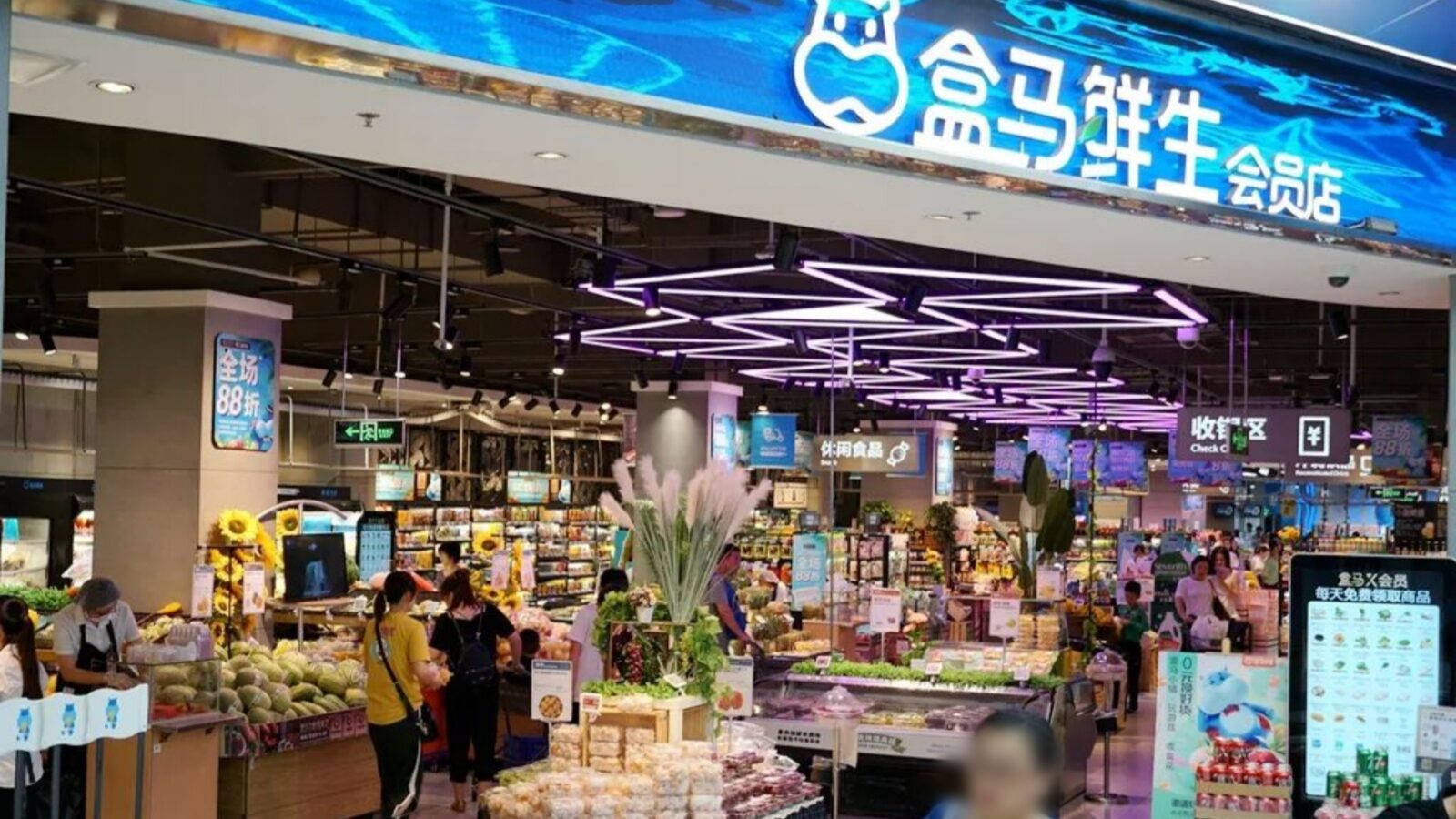
Hema Fresh in China
A separate category among supermarket chains in China was built around apps, 30-minute delivery, and Alibaba or JD logistics. Hema Fresh leads with several hundred stores that double as fulfillment hubs. JD's 7Fresh and Sam's Online cover similar ground. For foreign visitors, these chains are the easiest entry point because the apps often work in English and accept international cards via Alipay's Tour Card.
Hema Fresh
Hema Fresh (盒马鲜生), launched by Alibaba in 2016, runs roughly 400+ stores across tier-1 and tier-2 cities. Each store functions as both a retail floor and a 30-minute fulfillment hub within a 3 km radius. Hema is known for live seafood tanks, in-store cooking stations, and an English-capable app. Most stores open 09:00–22:00.
JD 7Fresh and Sam's Online
JD's 7Fresh (七鲜) operates a smaller footprint than Hema but follows the same online-plus-offline model; it is strongest in Beijing and Shanghai. Sam's Online extends Sam's Club into app-only and JD-Daojia fulfillment, letting members order through the Sam's app outside warehouse locations. Both accept Alipay and WeChat Pay, and some Sam's counters take Wal-Mart-affiliated cards.
Dingdong and Community Group Buys
Dingdong Maicai (叮咚买菜) is a pure-play online supermarket chain in China, focused on fresh produce and 30-minute delivery from app-only warehouses. It is strongest in the Yangtze River Delta and Shenzhen. Community group-buy platforms such as Pinduoduo's Duo Duo Grocery and Meituan Select are also active but increasingly Chinese-app-only, and have scaled back nationwide over the past two years.
Convenience Stores and Mini-Supermarkets
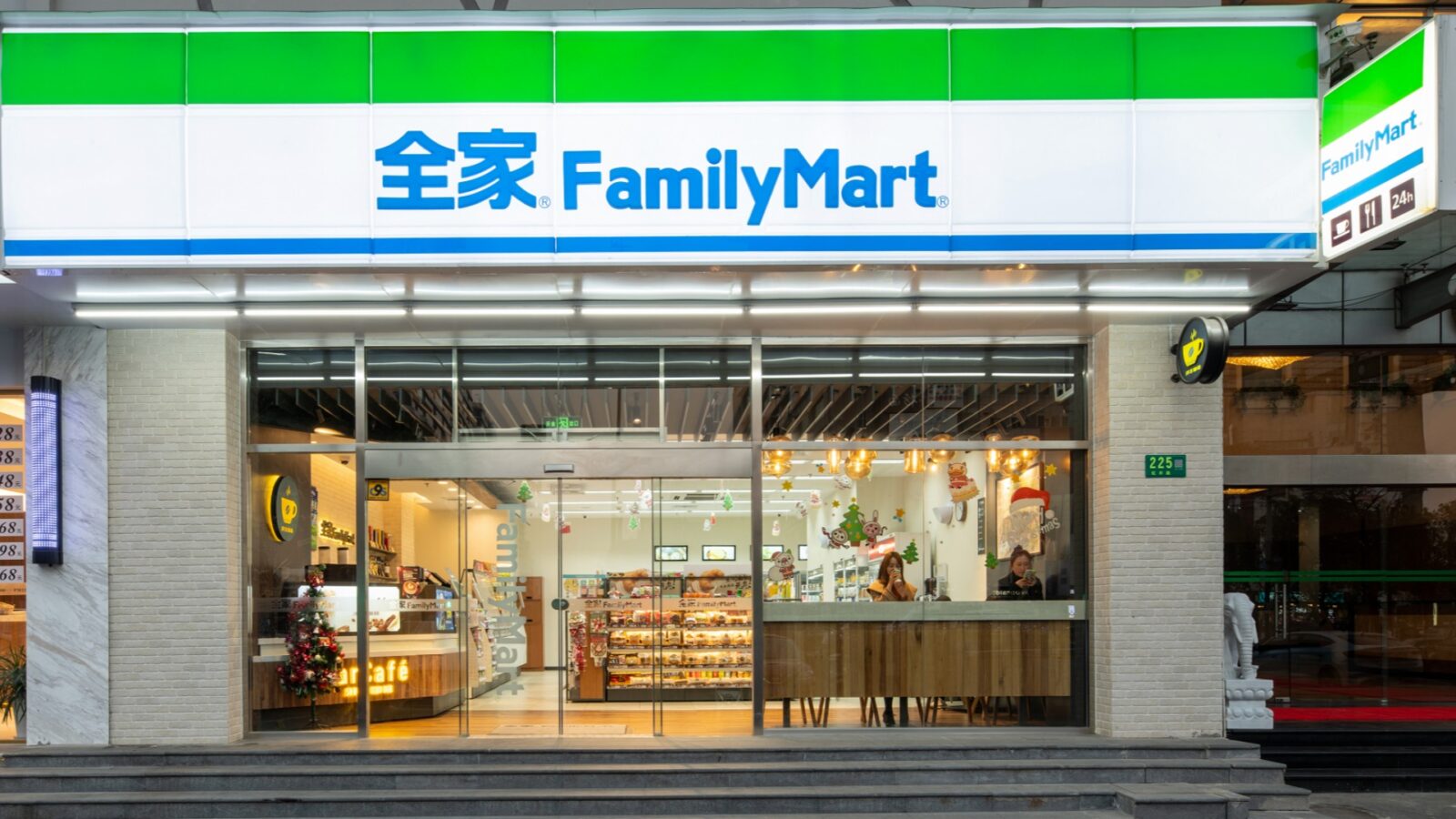
FamilyMart in China
Beyond the supermarket chains in China proper, the convenience-store layer matters because foreigners encounter it far more often than hypermarkets. International brands (7-Eleven, FamilyMart, Lawson) operate alongside strong Chinese networks. Combined national store count exceeds 300,000. Most convenience stores are open 24/7, while supermarket chains in China mostly close by 22:00.
International Brands: 7-Eleven, FamilyMart, Lawson
Chinese Networks: Quanjian, Bianlifeng, Everyday
Paying and Shopping as a Foreigner
Foreign visitors often find that supermarket chains in China do not accept foreign cards at the cashier. Alipay and WeChat Pay dominate, and both are now bindable to Visa and Mastercard in-app. Membership-warehouse chains still take international credit cards directly. Delivery runs through Meituan or Eleme, both bindable to foreign cards in 2025.
Payment Methods
Sam's Club, Costco, and Metro accept international credit cards (Visa, Mastercard, Amex, JCB) at the cashier directly. Most other supermarket chains in China default to Alipay or WeChat Pay. Both apps now run a "Tour Card" feature under Alipay, plus a foreign-card binding option under WeChat Pay, linking an international card without a Chinese phone number. Apple Pay works at chains with NFC-enabled terminals. Cash (RMB) remains legal tender everywhere, but change can be slow to produce.
Delivery Apps
Meituan (美团) and Eleme (饿了么) cover most supermarket chains in China for delivery within 3–5 km. Delivery typically costs $1–2 (¥8–12) per order, with about a $14 (¥100) minimum. Hema and Sam's run in-house delivery — often free above $21 (¥150) — within a 30-minute window. Tipping is not expected in Chinese retail.
Price Benchmarks
Indicative USD-first prices you'll encounter across mainland supermarket chains in China: imported cheese block 250 g about $8–14 (¥60–100); imported red wine 750 ml about $15–40 (¥100–280); fresh milk 1 L about $2–3 (¥15–22); imported snack packet about $3–5 (¥20–35); live crab about $7–11/lb (¥100–150/kg). Local produce, soy products, and dry goods usually run far cheaper than at equivalent stores abroad.
Frequently Asked Questions
Q: Which is the biggest chain in China?
CR Vanguard (华润万家) generally leads by store count at roughly 3,000+ outlets. By revenue, Sam's Club China has overtaken it in some recent reports. The honest answer depends on the metric — store count, revenue, or selling floor area — you're measuring against. Either way, both sit at the very top of the supermarket chains in China today.
Q: Are Carrefour and Tesco still in China?
No. Carrefour exited mainland retail in 2024 after selling its remaining stores to Wumart. Tesco exited in 2014, also to Wumart. Wal-Mart, Sam's Club, Costco, and Metro continue to operate. Auchan-branded stores still appear in some cities but are mostly managed under Wumart. Legacy Carrefour and Tesco branding has essentially disappeared.
Q: Can I pay with a foreign credit card?
Directly at the cashier, only at membership-warehouse chains — Sam's Club, Costco, and Metro. Elsewhere, link a Visa or Mastercard to Alipay's Tour Card or WeChat Pay's foreign-card binding inside each app. Apple Pay works at chains with NFC terminals. None of these methods require a Chinese phone number in 2025.
Q: Which chain has the best imported goods?
Sam's Club leads on imported packaged goods — snacks, wine, cheese, and baby products. Metro is a strong runner-up but requires a membership card. Hema Fresh carries an excellent imported range plus live seafood. RT-Mart is solid for general household imports. For most foreign visitors, our pick remains Sam's Club on variety.
Q: Do Chinese supermarket chains deliver?
Yes. Hema and Sam's run in-house delivery inside a 3–5 km radius, usually within 30 minutes. Meituan and Eleme cover most other supermarket chains in China for a small delivery fee. Both apps accept foreign cards via Alipay or WeChat Pay linkage. Standard minimum order is about $14 (¥100); tipping is not expected.
Q: Is Hema better than traditional chains?
For a foreign visitor, Hema is usually the easiest entry point — the app is English-capable, accepts foreign cards, and has strong seafood and fresh produce. For routine grocery runs, CR Vanguard, Yonghui, and Wumart tend to be cheaper. Hema is tech-driven; the others are legacy hypermarkets with broader dry-goods ranges and lower shelf prices.
Q: How expensive are Chinese supermarkets?
Local produce, soy products, and dry goods run inexpensive by Western standards. Imported cheese, wine, and snacks price comparably to international supermarket chains abroad. Membership-warehouse clubs (Sam's Club, Costco) charge $36–42 (¥260–299) per year, but offset that through bulk pricing — useful for longer-stay travelers.
Q: What should a visitor buy?
Practical picks for a foreign visitor: loose-leaf tea (stores in Beijing, Hangzhou, and Yunnan stock a wide range), dried noodles, Sichuan pepper, soy sauce, rice vinegar, fresh tofu, live or fresh fish (Hema and Yonghui carry a wide selection), instant hotpot bases, local fruit like lychee or Asian pear, and snacks such as white rabbit candy or mooncakes seasonally.