Chinese Dance Fans
The folding fan is one of the most recognizable performance props in Chinese dance, appearing in folk routines, classical stage works, and martial arts forms alike. Dancers use the fan to extend the arm line, frame the face, and create sweeping visual arcs that pair with music and movement. The fan itself carries centuries of craft tradition — bamboo ribs, silk or paper faces, painted motifs — while the dance form uses those objects with specific gestures, steps, and symbolic meanings. Whether you are selecting a first practice fan, sourcing matching props for a group piece, or studying the craft behind festival performances, understanding the fan types, materials, and selection criteria makes a clear difference in how the dance looks and feels.
Quick Facts
Types of Fans Used in Chinese Dance
Chinese dance fans divide into six recognizable types, each tied to a different performance context. The broadest split separates entry-level props — paper-faced bamboo fans for practice and group work — from stage-grade items built for visual impact and sustained movement. Between those poles sit silk folding fans, lace and embroidered models, feather performance fans, oversized stage fans, and martial arts fans designed to withstand strikes. Material, span, and construction determine which category suits a given routine. The same physical fan may appear in multiple contexts depending on how the choreographer frames it.
Folding Silk Dance Fans
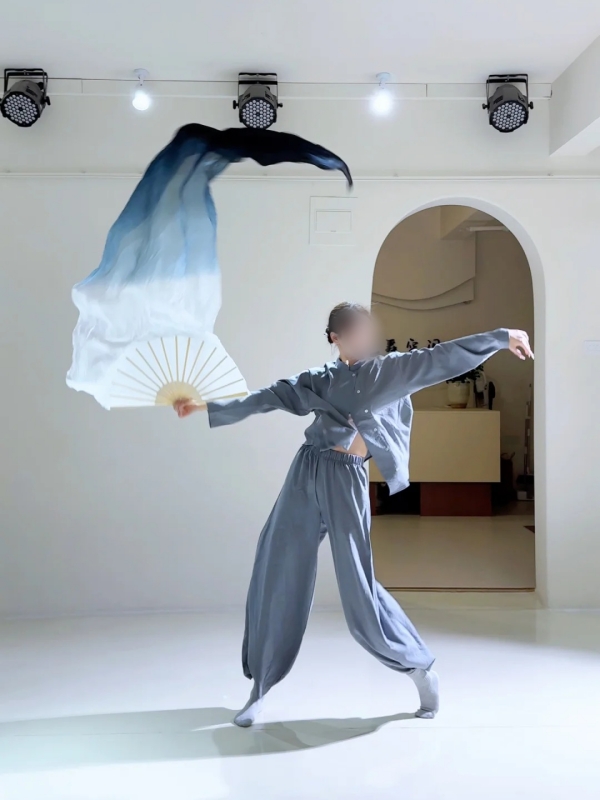
Folding Silk Dance Fans
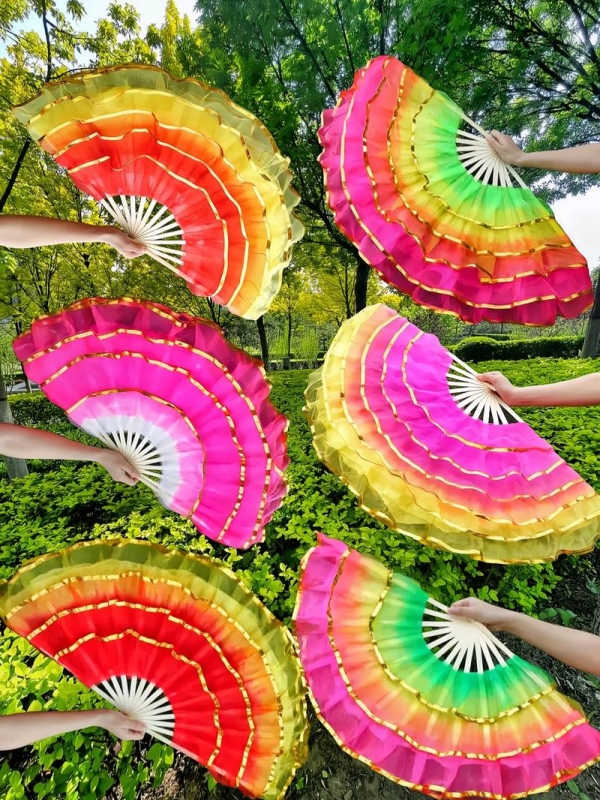
The folding silk fan is the most common prop on the Chinese dance stage. A silk face stretches across bamboo ribs, producing a surface that catches light and moves smoothly in the hand. Most models open to 30–35 cm when fully extended. The silk construction allows for vivid painted motifs — plum blossoms, peonies, calligraphy — that read clearly under stage lighting. Price bands for this type typically range $5–$15 (¥35–¥105). Solo practice and classical stage choreography are the primary use cases; the silk face responds to subtle wrist motion better than paper, but it costs more and requires more careful handling.
Bamboo and Paper Folding Fans
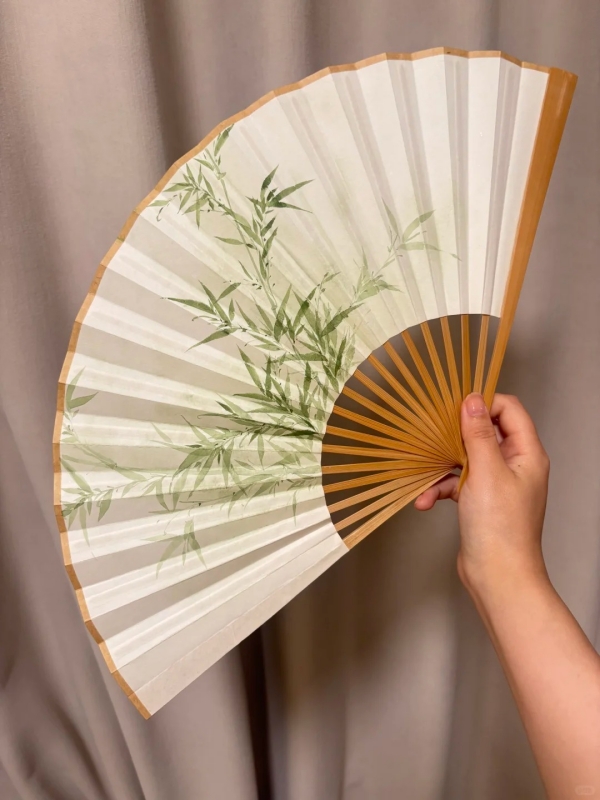
The Bamboo and Paper Folding Fans
Bamboo-and-paper fans are lighter and cheaper than silk models, making them the standard choice for beginners, children's classes, and group routines that need multiple matching props. A thin paper face spans bamboo ribs; the result opens crisply but lacks the silk's visual depth. Most fall in the 20–30 cm range, with prices from $2–$10 (¥14–¥70). Landscape paintings and classical motifs are common decorations. The lighter weight makes these fans easier to control during rapid open-shut sequences, which is why many instructors start students on paper fans before moving to silk.
Lace and Embroidered Dance Fans
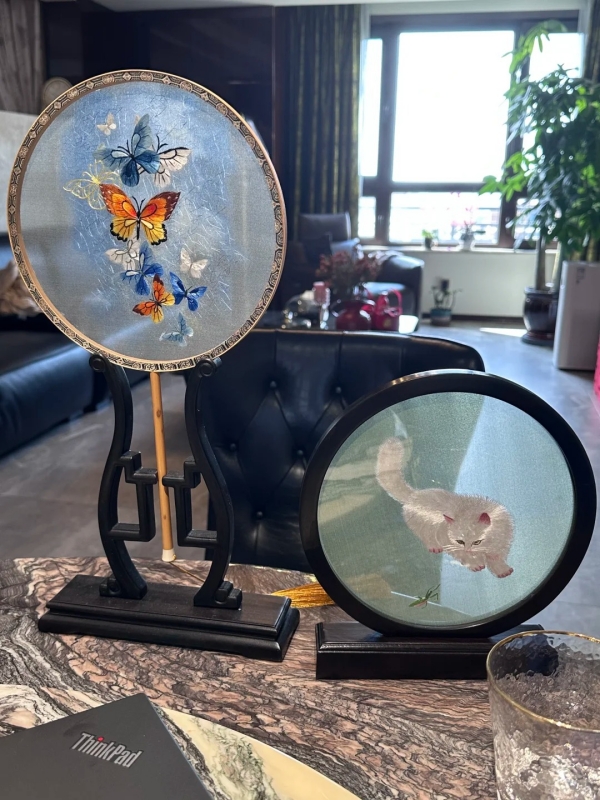
The Lace and Embroidered Dance Fans
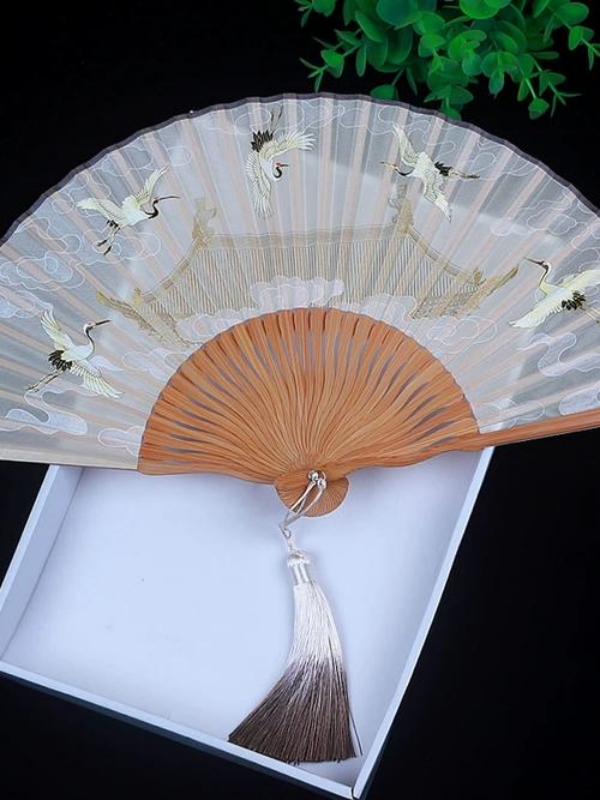
Lace and embroidered fans add a decorative dimension that works well in wedding performances, parties, and stage routines where visual delicacy is the priority. A lace or embroidered fabric overlays bamboo ribs, producing a semi-transparent effect. Spans typically run 25–33 cm. Ivory, black, and pastel tones dominate, and tassel pendants are common. The price range overlaps with silk fans at $7–$15 (¥50–¥105), but the lace face reduces air resistance in a way that changes how the fan feels during held positions and slow waves.
Feather Performance Fans
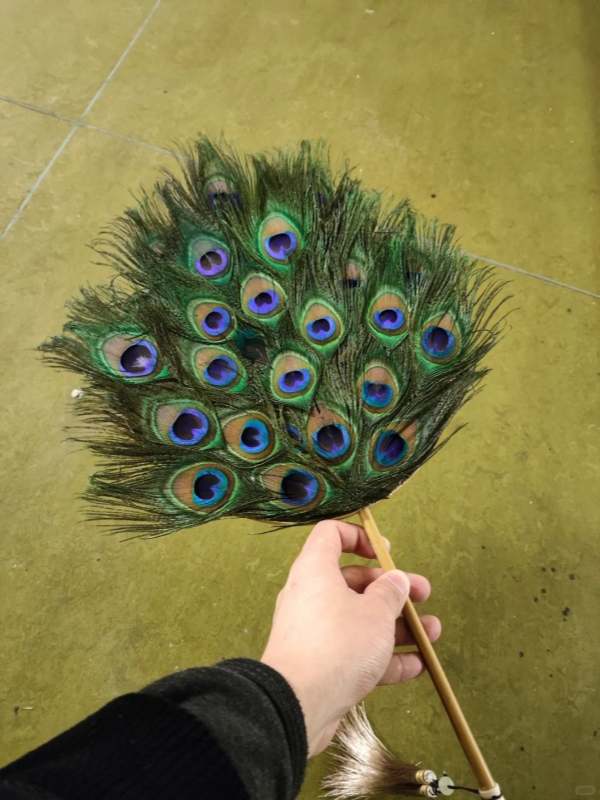
The Feather Performance Fans
Feather fans use natural or dyed feathers — sometimes peacock, goose, or ostrich — bound to a wooden frame. Spans run 30–40 cm. The feather construction shifts the weight distribution compared to fabric fans, and dancers hold them differently to account for the uneven surface. These fans appear most often in classical court-style repertoire and are closely associated with pieces like the Jasmine Flower folk melody. Prices fall in the $14–$20 (¥100–¥140) range. The heavier feel rewards dancers who have already developed grip strength and wrist control with lighter fans.
Large Performance and Clack Fans
Oversized folding fans — sometimes called clack fans for the percussive sound they produce on open-shut — range from 50–70 cm. Reinforced ribs and heavier silk faces give these props the durability needed for stage visibility and group choreography. Some variants emphasize the clacking sound as a rhythmic element in festival parades and opening ceremonies. Prices run $5–$12 (¥35–¥85), lower than silk or feather models despite the larger size because the materials are less expensive. The span and weight require more arm strength, which limits this type to experienced performers working in large-venue settings.
Tai Chi and Martial Arts Fans
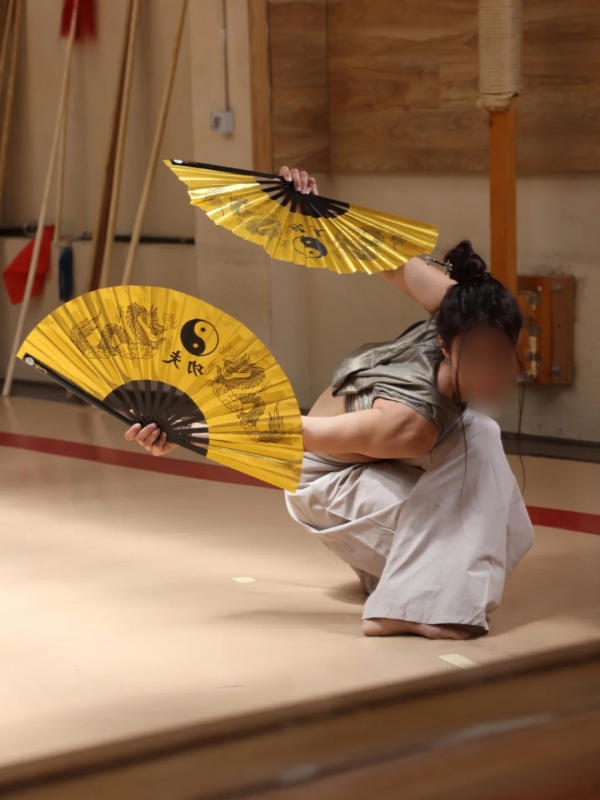
The Tai Chi and Martial Arts Fans
Martial arts fans are built to handle striking and blocking motions that would damage a standard dance fan. Reinforced ribs, shorter grip sections, and heavier silk faces define this category. Spans typically match standard dance fans at 30–35 cm. Red, gold, and natural bamboo finishes are common. The $15–$25 (¥105–¥180) price reflects the reinforced construction. Tai chi fan routines use the same basic open-shut and wave motions as dance fan, but the martial framing adds a functional dimension that shapes how the grip is held and how the fan's edge is used.
🥻 Learn About Historical Attire in Classical Performance: To ensure your dance group’s costumes match the era of your props, explore necklines, embroidery patterns, and garment cuts in our feature on the Tang Dynasty Neckline.
History and Symbolism of Chinese Fan Dance
Origins of Chinese Fan Dance
Chinese fan dance draws on two converging traditions. Decorative fans have been part of Chinese material culture for more than a thousand years — folding fans are documented since at least the Song dynasty, and round fans are older still. The second tradition is the use of fans as performance props in folk dance, opera, and court ritual. When those two threads combined, the result was a movement practice that used fan handling to extend the body and communicate meaning alongside music. The modern codified stage form emerged in the 20th century as part of Han ethnic folk dance, when individual folk practices were organized into standardized performing arts curricula.
Symbolic Meanings Behind the Movements
Fan movements do not carry fixed symbolic meanings the way a specific gesture might in some other classical dance traditions; instead, the meaning comes from the choreography, music, and context. Open-and-close motions can signal welcome, surprise, or concealment depending on the surrounding sequence. Slow waves evoke flowing water or gentle wind. Quick flicks suggest birds, butterflies, or laughter. Held positions frame the dancer's face or body in a specific way — the fan becomes a visual border rather than a moving prop. Joyful celebration, feminine grace, melancholy, and seasonal change all appear as common thematic frames in classical Chinese fan dance repertoire.
When Chinese Fan Dance Is Performed
The dance appears across a wide range of occasions, from formal cultural showcases to community celebrations. Lunar New Year and Mid-Autumn Festival are two of the most common performance moments, when fan dance contributes to public festivities and stage productions alike. Weddings, school recitals, and cultural exchange events round out the typical calendar. In international settings, the Jasmine Flower melody is frequently paired with fan dance as an immediately recognizable Chinese cultural reference — the combination has become something of a signature outside China.
Choosing the Right Fan for Dance
Chinese Dance Fans
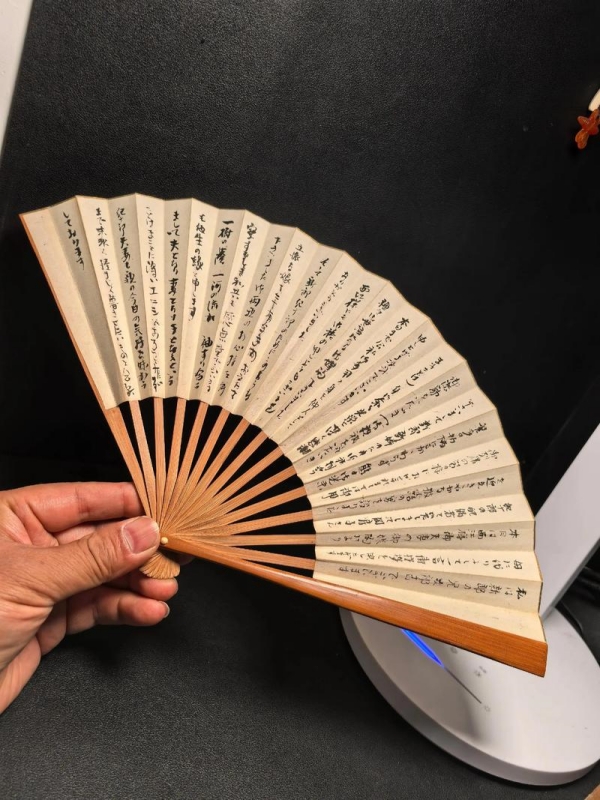
Selecting a dance fan comes down to matching construction to purpose. A fan that works well for solo practice may lack the durability for stage performance; a fan built for martial arts handling may feel too heavy for a beginner learning basic movements. The key variables are span, material, weight, grip length, and structural quality. Before purchasing, it helps to know whether the fan will be used for practice, classical performance, group choreography, or martial arts — each context pushes the requirements in a different direction.
Fan Size and Span
Open span is measured in centimeters when the fan is fully extended. Pocket practice fans run 20–25 cm and are the easiest to control for beginners. Standard dance fans span 30–35 cm and work across most solo and group contexts. Large performance fans reach 50–70 cm for visibility on big stages. Smaller fans are easier to manage during rapid open-shut sequences; larger fans create more visual impact but demand more arm strength and clearance space.
- 20–25 cm: Pocket practice fans — ideal for beginners and young dancers
- 30–35 cm: Standard dance fans — most common for solo and group work
- 40–49 cm: Extended performance — intermediate size for larger stages
- 50–70 cm: Large stage fans — parade, opening ceremonies, big venues
Material and Weight
Material determines both the fan's visual character and how it feels in the hand. Silk is the traditional stage material — it moves smoothly, catches light, and takes paint well. Paper-faced bamboo is the lightest option and the most forgiving for beginners. Lace adds visual delicacy but creates less air resistance during held positions. Feathers shift the center of gravity and require a modified grip. Martial-arts fans use reinforced ribs to handle striking, which adds weight but increases durability. Aim for under 6 oz for general dance and 6–10 oz for tai chi fan routines.
- Silk on bamboo: Standard stage material; smooth motion, vivid surface
- Paper on bamboo: Lightest and cheapest; best for beginners and group sets
- Lace over bamboo: Delicate look; reduces air resistance during slow waves
- Feathers on wood: Heavier; requires grip adjustment; classical repertoire
- Reinforced bamboo ribs: Martial arts and tai chi; handles strikes and blocks
Decoration, Tassels, and Pattern
Common motifs include plum blossom, peony, lotus, bamboo, and Chinese calligraphy. Tassels add visual motion but can tangle in group routines, which is why many performers remove them for choreography. Solid colors read best under stage lighting; complex painted patterns photograph well but require matching sets for group work. When sourcing for a group, plain-color models are easier to match across multiple fans.
- Plum blossom and peony: Most common classical motifs; strong visual identity
- Lotus and bamboo: Symbolically rich; popular for cultural showcase performances
- Tassels: Add motion but tangle easily; remove for fast group choreography
- Solid colors: Best for stage lighting and group matching
Quality, Durability, and Where to Source
Check three quality markers before buying: rib count, pivot pin tightness, and fabric adhesion. More ribs produce a smoother curve when the fan opens. A loose pivot pin causes wobble during spins. Peeling fabric is the most common failure in lower-priced fans. Source from global dance-supply retailers, cultural-goods marketplaces, and festival-season listings. Specialty dance suppliers carry matching sets for group choreography. When buying in person, hand-feel differs from photos — verify on site that the fan opens smoothly and the ribs are evenly spaced.
- Rib count: More ribs = smoother curve when open; 13–18 for standard dance fans
- Pivot pin: Must be tight; wobble during spins indicates poor assembly
- Fabric adhesion: Check for peeling at the rib edges before purchasing
Basic Techniques of Chinese Fan Dance
Chinese Dance Fans
Four foundational movements form the core vocabulary of Chinese fan dance: open/close (kai he), wave (bo lang), spin (zhuan), and held position (liang xiang). Every routine combines these four actions with footwork and hand positions. The movements themselves are straightforward; what changes across styles is the tempo, the arm level, and the symbolic framing that the choreography assigns to each one.
Common Fan Movements and Hand Positions
Open/close is the foundational motion and the visual signature of the form. The dancer holds the pivot end and snaps the fan open — often on a musical beat — then closes it with a controlled release. Wave moves the open fan in a serpentine path from one side to the other, creating a visual arc. Spin rotates the open fan around the wrist, either continuously or in a single rotation. Held positions fix the open fan at a specific level: above the head, at shoulder level, at the waist, or extended to the side. The same fan can be switched between hands mid-routine.
- Kai he (open/close): The signature motion; opens on beat, closes with control
- Bo lang (wave): Serpentine path of the open fan from side to side
- Zhuan (spin): Rotation of the open fan around the wrist
- Hand positions: Gao wei (high/above head), jian wei (shoulder), yao wei (waist), ce wei (side)
Basic Steps and Formations
Standard footwork includes step-slide patterns, gentle plie bends, slow turning walks, and small turning jumps. Formations range from solo work to mirror pairs, lines, and circles. Group choreography often staggers open-shut motions across the line to produce a ripple effect. Classical pieces like Jasmine Flower tend toward slow waves and held positions rather than rapid spins, which makes them accessible for beginners but visually refined.
- Step-slide (zou bu): Basic movement pattern; coordinated with open or close
- Slow turning walks: Common in classical repertoire; pairs with held positions
- Line formations: Staggered open-shut motions create ripple effects
- Circle formations: Often used for finale sequences; fan arcs face outward
Practice Tips for Beginners
Start with the lightest available fan — a 25–30 cm bamboo or paper model is easier to control than silk. Rehearse the open-shut motion until it is silent and smooth before adding music. Use a full-length mirror to check that the fan opens fully on the beat. Practice without choreography first to isolate timing from movement. Build up to group rehearsals only after solo timing feels automatic. Grip the pivot end firmly rather than holding the ribs mid-span — this gives better control and protects the fabric from pressure damage.
- Light fan first: 25–30 cm bamboo or paper; easier to control during open-shut
- Silent motion: Open-shut should be smooth and quiet before adding music
- Mirror check: Full-length mirror reveals arm angles and fan level
- Solo before group: Timing must be automatic before joining ensemble rehearsals
- Grip at pivot: Hold the pivot end, not mid-rib; better control, less fabric stress
Costume, Music, and Performance Setting
The fan does not perform alone. Costume, music, and makeup complete the visual and auditory frame that makes a fan dance recognizable as a Chinese performance tradition rather than a generic prop exercise. Each element has practical constraints as well as aesthetic ones — the wrong costume choice can catch on the fan's pivot, and the wrong music tempo can make basic movements feel awkward.
Traditional Costume Elements
Long flowing sleeves are the visual partner of the open fan — both extend the dancer's arm line and create sweeping visual arcs. Common garments include hanfu-inspired wide-sleeve tops with long skirts, Tang dynasty-style bodices with high-waisted skirts, and modernized folk-dance uniforms in red, pink, or white. Avoid costumes with hard buttons, zippers, or sharp trim that catch on the fan's pivot during spins. The sash or belt should sit at the natural waist to leave the arm line unobstructed.
- Wide sleeves: Extend the arm line; partner the fan's visual arc
- Hanfu-inspired styles: Most common; wide-sleeve top plus long skirt
- Tang dynasty bodice: High-waisted skirt; clean silhouette for stage
- Avoid sharp trim: Buttons and zippers catch the pivot during spins
Music Choices for Fan Dance
Traditional Chinese instrumental works best. The Jasmine Flower folk melody is the most recognized pairing with fan dance in international settings. Other common choices include Moonlight on the Spring River and High Mountains and Flowing Water. Tempos range from very slow for sustained waves to moderately paced for step-slide footwork. Beginners should avoid music with abrupt tempo changes, which make it harder to isolate and practice individual movements.
- Jasmine Flower: Most recognized melody for classical fan dance
- Moonlight on the Spring River: Slow tempo; suits held positions and waves
- High Mountains and Flowing Water: Moderate pace; good for step-slide sequences
- Avoid abrupt changes: Complex tempo shifts complicate beginner timing
Makeup and Hair for Performance
Stage makeup aims for visibility from a distance. Defined brows, red or pink lip color, and light blush form the base. A small red mark on the forehead may be included to match traditional aesthetics, though this varies by troupe and context. Hair is typically pulled back into a low bun with floral pins or secured as a simple ponytail. The key practical requirement is keeping hair clear of the face so the fan's motion is not obscured, and keeping long hair tied back prevents the fan from catching strands during spins.
- Stage makeup: Defined brows, red lip, light blush; visible from distance
- Hair in low bun: Keeps face clear; floral pins add decorative touch
- Secure ponytail: Works for energetic routines; prevents fan catching strands
- Face clearance: Hair must not obscure the fan's motion during waves and spins
Frequently Asked Questions
Q: What is the Chinese fan dance called?
In Mandarin the form is called shan zi wu — fan dance — and it falls within Han ethnic folk dance traditions. The props are folding fans (zhe shan) or round fans (tuan shan) depending on the style. Related categories include classical fan dance, folk fan dance, and tai chi fan routines.
Q: How do you do the Chinese fan dance?
Start with the open/close motion. Hold the fan at the pivot in one hand and snap it open on a beat while extending your arm. Close it with a controlled release. Build from there by adding a wave motion and a held position before introducing footwork. Practice without music first to isolate timing.
Q: When did Chinese fan dancing start?
Folding fans have been documented in China for more than a thousand years. The modern stage form of fan dance was codified in the 20th century as part of Han ethnic dance curricula. The tradition developed over centuries rather than from a single verifiable starting date.
Q: What props are used for the Chinese fan dance?
The folding fan is the primary prop. Secondary props sometimes include silk handkerchiefs, lanterns, or parasols in extended choreographies. Tai chi fan routines use the same folding fan but treat it as a martial implement with reinforced ribs for striking and blocking.
Q: What does the Chinese fan dance symbolize?
Symbolic meaning is set by choreography, not by the fan itself. Common readings include feminine grace, seasonal change (especially spring blossoms), joy and welcome, and sometimes melancholy or longing. The open fan suggests openness; the closed fan suggests reserve or concealment.
Q: How do you make a Chinese fan for dancing?
A working dance fan requires bamboo ribs — typically 13–18 for a standard model — a fabric or paper face attached across the ribs, and a pivot pin. Ready-made blank fans (called shan pi, or fan blanks) are sold in bulk for custom decoration. Before adding fabric, verify that the pivot pin is tight and the ribs are evenly spaced.
Q: How do you learn Chinese fan dance?
Foundational open/close and wave motions can be practiced alone with any light folding fan. Community cultural centers, university East Asian studies programs, and Chinese folk dance troupes often offer beginner classes. Online video tutorials labeled shan zi wu jiao xue (fan dance tutorial) cover basic routines for solo practice.
Q: Where did Chinese fan dancing originate?
Roots lie in long-standing Chinese folk and court traditions that combined decorated fans with music and dance. Modern stage fan dance developed from Han ethnic folk dance in the 20th century. Specific geographic origins are diffuse rather than traceable to a single location.