How to Use Beijing's 240-Hour Visa-Free Transit in 2026
If you are a citizen of an eligible country transiting through Beijing, you may qualify for a 240-hour visa-free stay. As of August 20, 2026, the policy expanded to 57 countries, adding Vietnam and Kyrgyzstan. This article explains exactly who qualifies, which Beijing airports accept the policy, what documents you need, and how the step-by-step border inspection process works. The 240-hour clock starts on your arrival day in Beijing time, and you must depart China within that window—leaving from Beijing or any other Chinese city is permitted as long as you exit before the deadline.
Quick Facts
Who Can Use Beijing's 240-Hour Transit Visa in 2026
Eligible Countries and Nationality Requirements
The 240-hour visa-free transit policy covers citizens of 57 countries as of August 20, 2026. The most recent expansion added two nations: Vietnam and Kyrgyzstan, bringing the total from 55 to 57. You must hold an ordinary passport—diplomatic and service passports do not qualify. The full official list is maintained by the National Immigration Administration and takes precedence over outdated third-party guides. Citizens of the United States, United Kingdom, Australia, Canada, Germany, France, Japan, South Korea, and most European nations are among the eligible countries. If your nationality is not on the list, you need a standard Chinese visa regardless of your transit plans.
Transit Route Conditions
Even if your passport qualifies, you must meet the transit route requirement. Your journey must pass through China on the way to a third country or region. A round-trip ticket returning to your country of residence does not satisfy this rule unless your itinerary includes a genuine third-country stop. Flying into Beijing and out again to your home country without any third-country destination is generally not accepted. Similarly, traveling A country → Beijing → Your home country does not meet the condition. However, routes such as Japan → Beijing → Vietnam → Your home country do qualify. The onward destination must be a country different from both your departure point and your citizenship country.
🌍 Nationwide Visa Rules: Want to check if your passport qualifies for complete visa exemption without transit requirements? Explore our comprehensive breakdown of China Visa-Free Countries.
What Documents Do You Need
Core Required Documents
Preparing the correct documents before you board your flight to Beijing is essential. Without them, border inspection officers may deny you entry even if your nationality qualifies. The three core requirements are an ordinary passport, a confirmed onward ticket, and proof you can enter your next destination. Each component has specific conditions worth understanding before you travel.
- Ordinary passport: Must be valid for at least 6 months beyond your planned entry date, with at least one blank page for the entry stamp.
- Confirmed onward ticket: A printed or digital ticket showing fixed dates and a confirmed booking is required. Award tickets, standby tickets, and unconfirmed reservations do not meet the requirement. If your connecting flights are booked under separate tickets, confirm with your airline in advance.
- Third-country entry permit: You must demonstrate you are permitted to enter your destination country. This can be a visa, electronic travel authorization, or proof of visa-free entry for your nationality.
Supporting Materials That Speed Up Processing
Several additional documents are not strictly required but can significantly reduce your time at the counter. The Arrival Card must be completed during the flight or upon landing, listing your intended third-country destination and length of stay. Printed hotel reservations and a brief travel itinerary help officers verify the purpose of your visit quickly. Travelers who completed this procedure in early 2026 reported that having all confirmations ready shortened their time at the 240-hour counter.
- Electronic Arrival Card: Available on most flights to Beijing; complete it before landing to avoid delays at immigration.
- Hotel and itinerary confirmations: Printed proof of accommodation and your planned domestic movements within China demonstrates a clear transit purpose.
- Third-country visa or entry proof: Particularly important if your destination is visa-free for your nationality—carry printed confirmation of those rules.
🚄 Short-Term Transit Options: Only staying for a quick layover? Learn about regional rules and 6-day stay policies in our detailed guide on China Transit Visa 144 Hours.
Step-by-Step Beijing Airport Immigration Process
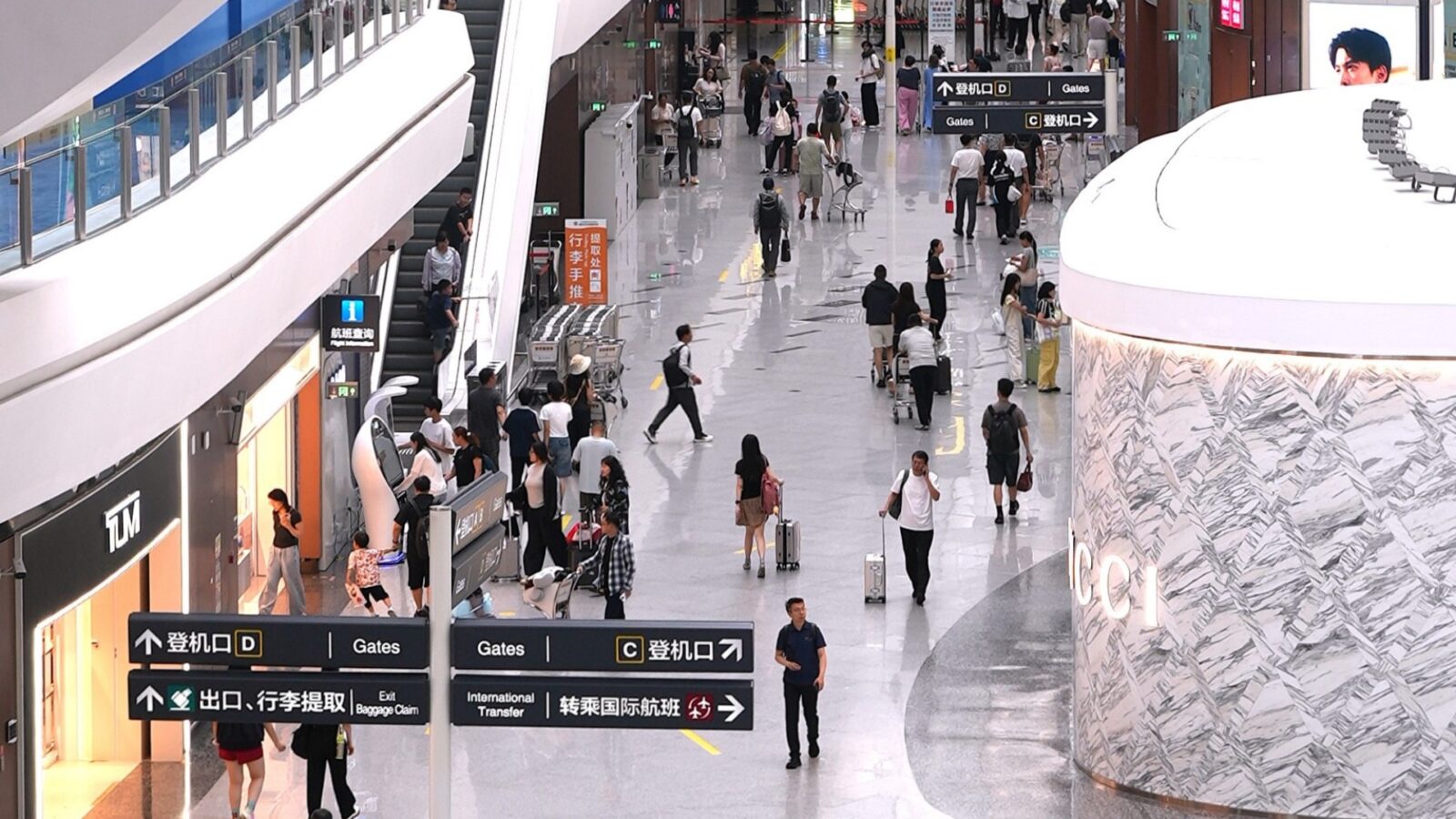
Beijing Daxing Airport
Before and During Your Flight
The process begins before you even land in Beijing. Inform your airline at check-in or during boarding that you will use the 240-hour visa-free transit option. Airline staff may verify your onward ticket at this stage. During the flight, complete the Arrival Card provided by cabin crew, marking your purpose as transit and listing your intended third-country destination. Having this card ready when you reach the counter saves significant time.
Upon Arrival at PEK or PKX
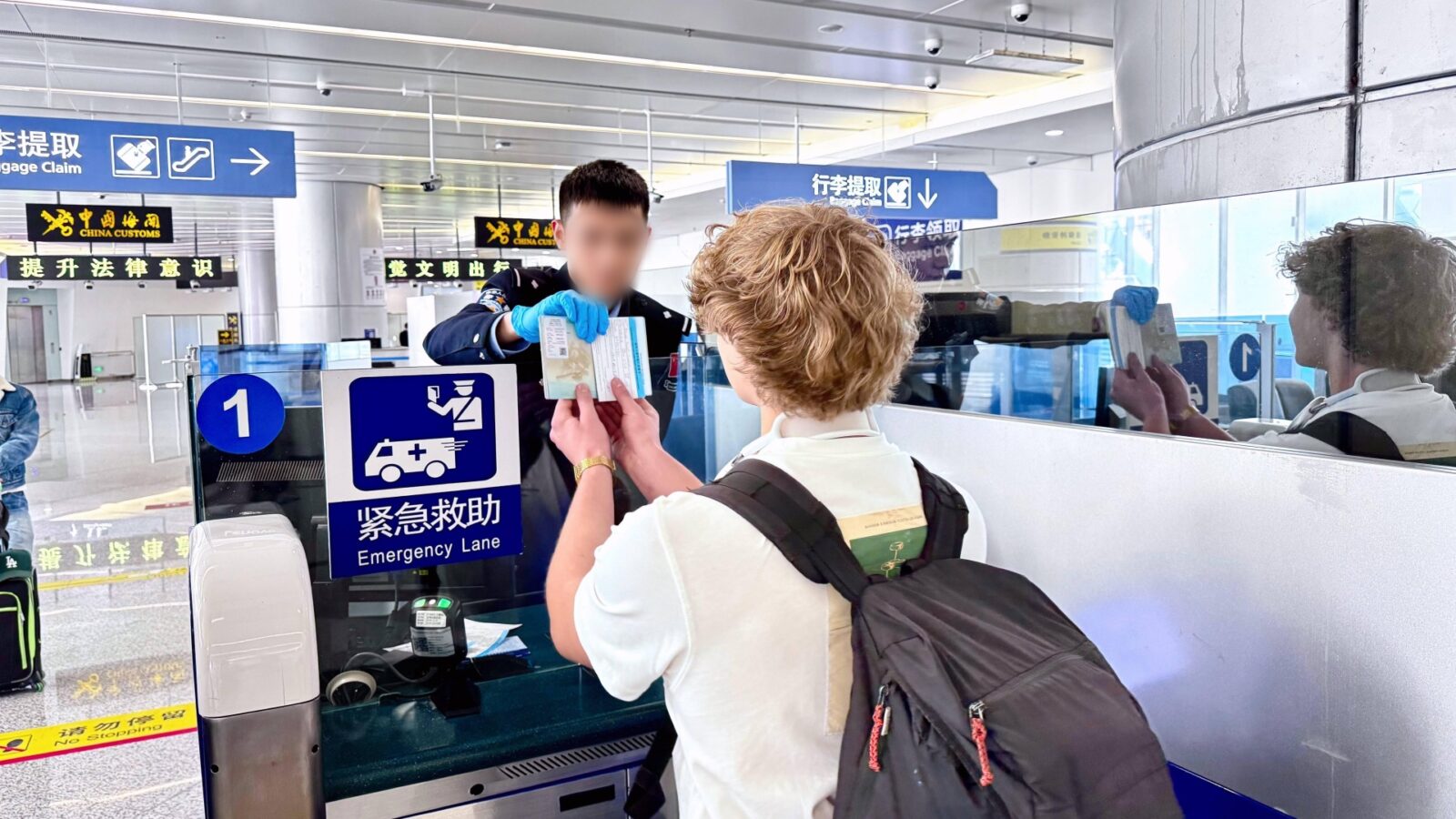
After landing, follow airport signs directing you to the 240-hour visa-free transit counter. At Beijing Capital International Airport, this counter operates in the immigration inspection zone of both Terminal 2 and Terminal 3. At Daxing Airport, follow signs to the immigration hall and look for the designated transit lane. Present your ordinary passport, confirmed onward ticket, completed Arrival Card, and your third-country entry permit to the officer. Beijing Capital Airport has operated a streamlined one-stop counter since April 2026, combining permit issuance and document verification at a single station.
- Informed airline at boarding: Confirm your transit status before departure to avoid boarding complications.
- Complete Arrival Card: Fill it out during the flight with your transit destination and planned stay duration.
- Locate the 240-hour counter: Follow signs in the immigration zone; at PEK check Terminal 2 or Terminal 3.
- Submit documents: Present passport, onward ticket, Arrival Card, and third-country entry permit.
- Receive temporary entry permit: The officer issues a permit stamped with your exit deadline.
- Pass through border gate: Proceed to standard inspection lanes where your passport receives the entry stamp.
- Collect baggage and clear customs: Retrieve luggage and pass through customs; green channel if nothing to declare.
Once you exit the arrivals hall, you are free to move throughout Beijing and, in most cases, other Chinese cities. Your exit does not need to be from Beijing—it can be from any of the 65 approved ports nationwide.
✈️ Beijing Airport Hubs: Choosing between Capital Airport and Daxing Airport for your connection? Compare terminals, transport links, and layover facilities in our analysis of PEK vs PKX.
🛫 China Aviation Overview: Navigating multiple layovers or connecting through other major transport hubs? Browse our complete guide to China Airports.
Understanding the 240-Hour Window
How the 240-Hour Clock Works
The 240-hour limit is among the most common sources of confusion for transit travelers. The clock starts on your arrival date in Beijing time, not at the exact minute you pass through immigration. If you land at 8:00 AM on October 16, your 240 hours run until 8:00 AM on October 26. You must have crossed China's border and begun your exit journey before that moment. Arriving early in the day gives you a full 240 hours; arriving late at night means your window begins at midnight Beijing time on your arrival date, not at your landing time. Confirm the exact calculation with the border inspection officer when you receive your permit.
Domestic Travel and Exit Deadline
You may travel within China during your 240-hour window. Flying from Beijing to Shanghai, then to Hangzhou, and exiting via Shenzhen to Vietnam is permitted. The countdown does not reset at each domestic connection—it measures your total time inside China from the moment of entry. Overstaying is a serious immigration violation. Penalties include fines, forced deportation at your own expense, denial of future Chinese visa applications, and potential re-entry bars for several years. Record the exact entry stamp time on your passport, calculate your deadline in Beijing time, and set a phone reminder 24 hours before the cutoff.
What to Do in Beijing During Your Transit

How Many Steps on the Great Wall of China
Popular Stops Within the 240-Hour Window
With up to 240 hours in Beijing, transit travelers with an early morning arrival and a late evening departure can comfortably explore several key areas of the city without missing their connection. Most attractions are accessible via the city subway system, which connects both airports to central Beijing. A two-day itinerary covering the Forbidden City, Tiananmen Square, and a section of the Great Wall typically fits within a 48-hour window. Travelers arriving later in the day can focus on shorter options such as the Lama Temple in Dongcheng District or the night markets near Nanluoguxiang.
- The Forbidden City: Plan at least three hours to walk through the main halls and the Imperial Garden. Arrive early in the morning to avoid the largest crowds. The palace complex is closed on Mondays.
- Great Wall excursions: The Mutianyu and Badaling sections are the most accessible from Beijing's city center. A half-day trip by bus or organized tour is sufficient for a short visit.
- Beijing's food scene: Sample Peking duck, dumplings, and lamb hotpot at restaurants in the Donghuamen Night Market or the Dashanzi art district. Most establishments accept major credit cards and mobile payment apps.
Getting Around the City
The Beijing subway is the fastest way to move between the city center and both airports. Line 4 connects Daxing Airport directly to the city center, while the Airport Express Line serves Terminal 2 and Terminal 3 at Capital Airport. Taxis and ride-hailing apps are also widely available. Store your luggage at your departure airport or at central railway stations if you want to explore hands-free before your onward flight.
What You Can and Cannot Do During Transit
Permitted Activities Under the Transit Policy
The 240-hour transit visa permits a range of short-term activities beyond simply waiting in an airport hotel. According to the National Immigration Administration, foreign nationals using this policy may engage in tourism, business negotiations, family visits, and other similar activities throughout China. You are not confined to Beijing. You could attend a business meeting in Shanghai, visit a relative in Chengdu, or tour attractions in Xi'an during your window, as long as you depart on time. The permitted scope covers most activities a short-term visitor would reasonably need.
Activities That Require a Separate Visa
The policy explicitly excludes activities requiring separate visa categories. Working in China, even for a single day, requires a work visa. Enrolling in a Chinese university requires a student visa. Journalism, including filing reports for foreign media, requires special press credentials. Attempting these activities on a transit visa violates your immigration status and may result in immediate deportation and future entry bans. Travelers planning any professional activity in China should apply for the appropriate visa in advance rather than relying on the transit policy.
It is also critical to distinguish the 240-hour transit visa from unilateral visa-free agreements. Several countries have separate bilateral deals allowing their citizens to visit China for tourism without a visa for up to 15 days—without any third-country transit requirement. Mixing these up is a common error that leads to rejected boarding and denied entry at the border.
Frequently Asked Questions
Q: Which countries' citizens can use Beijing's 240-hour transit visa?
As of August 20, 2026, citizens of 57 countries holding ordinary passports qualify. Vietnam and Kyrgyzstan were added on that date, expanding the list from 55 countries. The complete updated list is published by the National Immigration Administration and takes precedence over older guides that have not been refreshed since the expansion.
Q: Which Beijing airports accept the 240-hour transit visa?
Both of Beijing's international airports accept the policy. Beijing Capital International Airport (PEK), roughly 32 kilometers northeast of central Beijing, and Beijing Daxing International Airport (PKX), roughly 46 kilometers south of central Beijing, both operate dedicated 240-hour visa-free transit counters. PEK has operated a streamlined one-stop counter since April 2026.
Q: Do I need a separate onward ticket, or can I use a connecting flight?
You need a confirmed onward ticket with fixed dates to a third country. A single booking covering your full itinerary generally satisfies this requirement. Two separately booked connecting flights may also work, but confirm with your airline before departure. Standby tickets, award tickets without confirmed dates, and open-jaw tickets typically do not meet the requirement.
Q: How is the 240-hour window calculated, and what happens if I miss the deadline?
The window starts on your entry date in Beijing time. If you land on October 16 at any time, the window closes at the same time on October 26. You must have completed your exit crossing before that moment. Missing the deadline is an immigration overstay, carrying penalties including fines, forced deportation, and potential bars on future Chinese visa applications.
Q: Can I visit Hong Kong, Macau, or Taiwan under this policy?
Hong Kong and Macau have immigration systems separate from mainland China. Entering either region from Beijing does not count as exiting China for the 240-hour transit window. Taiwan does not accept mainland's transit visa. If your itinerary includes any of these as a third destination, verify the specific entry requirements for your nationality before departure.
Q: I hold a passport from an eligible country but my connecting flight is to my home country. Can I still use this policy?
A route like A country → Beijing → Your home country generally does not satisfy the "transit to a third country" requirement, because your home country is not a third country in immigration terms. However, an itinerary with a genuine third-country stop—such as Japan → Beijing → Vietnam → Your home country—may qualify. Carry documentation showing your complete routing and confirm eligibility with your airline before booking.
Official source: National Immigration Administration