Badain Jaran Desert China
Between the steppe and the Gobi, where Inner Mongolia bleeds into Gansu, a desert taller than any sand structure you've seen rises behind a chain of cobalt lakes. Badain Jaran covers roughly 49,200 square kilometers — one of China's largest — yet it stays off most tourist radars. The reason is simple: you cannot walk in. Access requires a registered 4×4, a guide, and a sense of adventure. What waits is a landscape of paradox — a hyper-arid sea of dunes that harbors more than 100 lakes, a dune that ranks as the world's tallest stationary peak of sand, and campsites where the night sky has no competing light. This is what makes Badain Jaran worth the logistics.
Quick Facts
Where Is Badain Jaran Desert and How to Get There
Badain Jaran Desert, China
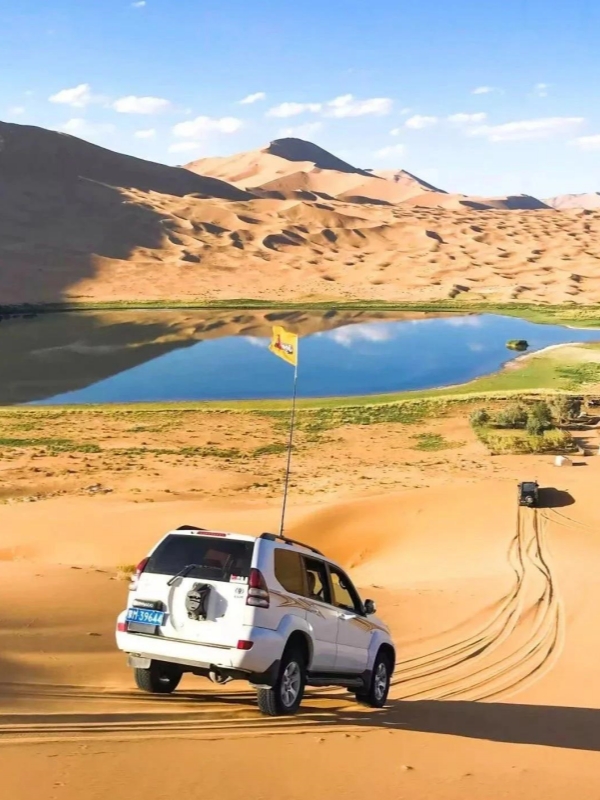
Getting to Badain Jaran is a two-stage process. First you reach Alxa Right Banner, the only town with infrastructure near the desert gate. Then you transfer into the dunes by registered 4×4. No public transit enters the interior. That boundary between the accessible town and the wild sand is where most trips start, and understanding it early saves confusion later.
Location, Size, and Why It's Distinct
Badain Jaran sits in Alxa (阿拉善) Banner, western Inner Mongolia. The desert sprawls across Alxa Right Banner with edges reaching into Gansu and Ningxia provinces. At roughly 49,200 km², it ranks among China's largest deserts — bigger than some countries. The closest major cities are Zhangye roughly 400 kilometers to the east and Jiayuguan about 400 kilometers to the northwest.
The feature that sets Badain Jaran apart from neighboring Tengger Desert is both geographic and visual. Tengger occupies Alxa Left Banner north of the Yellow River bend and lacks the megadune scale that defines its western neighbor. Badain Jaran is drier, taller, and — critically — threaded with more than 100 lakes that sit between the dune ridges like blue seams in orange fabric.
Reaching the Desert Gate by Air, Rail, or Road
Permits, Checkpoints, and the Self-Drive Rule
Badain Jaran operates as a regulated scenic area. All visitors must register at the checkpoint near Alxa Right Banner before entering. The permit system exists for environmental protection and safety — the interior has no mobile signal beyond the lake circuit.
- Entrance/eco fee: ~$20 (¥140) per person, paid at the checkpoint
- Vehicle permit: ~$30–55 (¥200–400) per car; private 4×4s must register and follow designated tracks only
- Guided convoy required: Heavy sand sections between the lakes are not negotiable — an off-road guide must lead the convoy
- Outer dunes, limited self-drive: Some areas near the entrance are open to registered self-drive visitors with a vehicle permit and 4×4; however, the lake circuit and megadunes are off-limits without a guide
- No public transit: The only way to reach the lakes and megadunes is by guided off-road convoy — there is no alternative
🏜️ Silk Road Oasis: Discover the ancient Buddhist caves, sand dunes, and desert oases of the northwest in our guide to the Taklamakan Desert.
The Lakes of Badain Jaran: A Sea of Oases Between the Dunes
Badain Jaran Desert, China
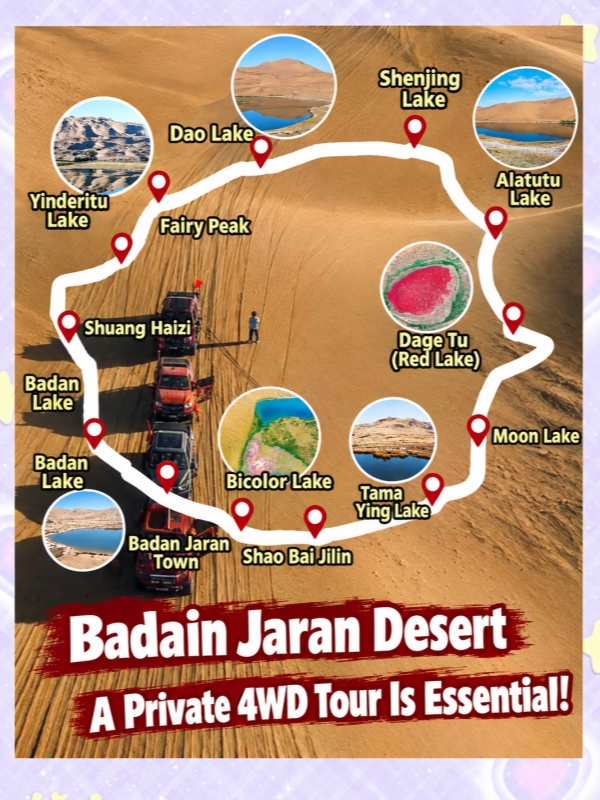
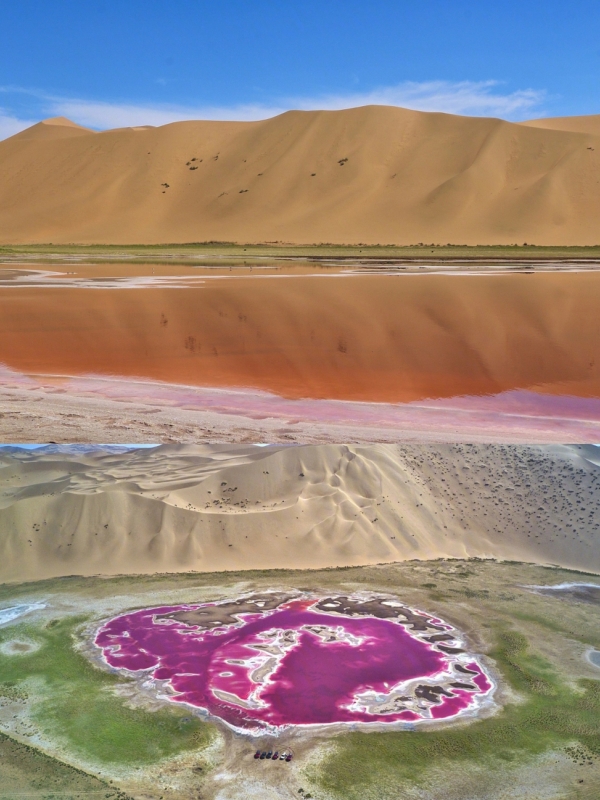
The lakes are the reason Badain Jaran is not just another dune field. More than 100 bodies of water sit between the dune ridges — some the size of ponds, others large enough for reed beds and sustained birdlife. The lake circuit is the practical backbone of any Badain Jaran itinerary, and understanding which lakes to prioritize shapes the entire trip.
Why a Hyper-Arid Desert Has More Than 100 Lakes
The lakes are fed by underground aquifers that recharge from rainfall on the distant Qilian Mountains. The water travels through bedrock fissures and surfaces between dune ridges where the sand is thin enough to allow it. Salinity varies: freshwater lakes sit at higher elevation, while saltwater lakes occupy lower basins. Some lakes shrink or expand year to year depending on groundwater levels. The contrast — blue or green water against orange-red dunes — is the signature visual of Badain Jaran and the reason it appears on China's World Heritage Tentative List.
Named Lakes Worth Detouring For
Five lakes appear consistently on expedition itineraries and justify the logistics of getting there.
- Naoeritu / Swan Lake (诺尔图): The largest and most photographed; reed beds, freshwater, often the first overnight stop on Day 1
- Badain Lake (巴丹湖): Closest to the entrance checkpoint; accessible as a half-day option for self-drive visitors with a registered vehicle and permit
- Halahu (海拉鲁): Saltwater lake with vivid color contrast against surrounding dunes; often combined with other stops on Day 2
- Zhuhaitu (桃花海): Popular for sunrise reflections; the morning light on still water surrounded by megadunes is a signature photo opportunity
- Suogebu (索果布鲁): Deeper into the lake circuit; reached only with a guided convoy on a 4–5 day trip
A Three-Day Lake-and-Dune Route Sketch
- Day 1: Convoy departs Alxa Right Banner, drives to Badain Lake near the entrance, then pushes on to Naoeritu / Swan Lake for the first lakeside camp.
- Day 2: Morning dune climb at a named viewpoint, midday drive to Halahu and Zhuhaitu, overnight camp near Suogebu.
- Day 3: Sunrise photography, return drive toward town via the central dune ridge, exit through the checkpoint.
Operators customize this loop. Ask for the specific lake names in writing before booking — not every 3-day itinerary covers all five lakes.
🏜️ Northern Desert Geography: Learn about the expansive arid regions spanning China and Mongolia in our full feature on What Desert Is Located in Northern China and Southern Mongolia.
The Megadunes: Why the Sand Towers 500 Meters Tall
Badain Jaran Desert, China
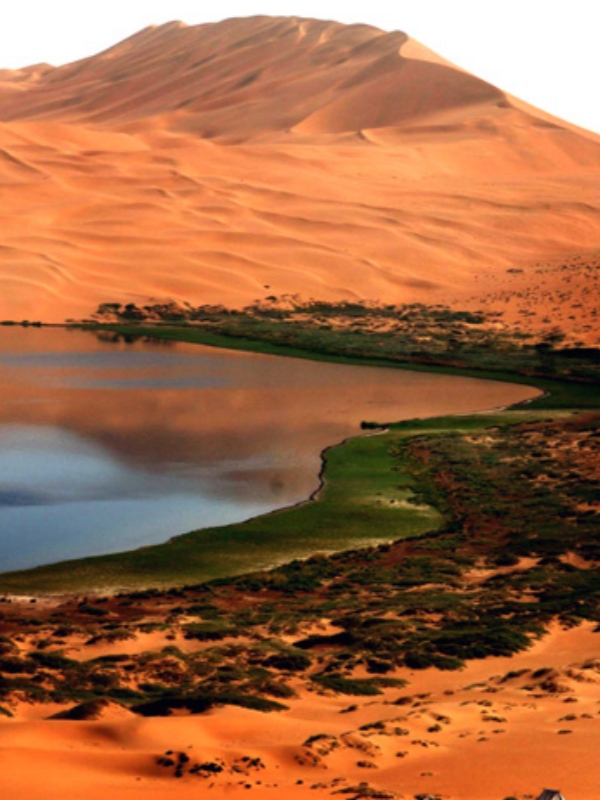
Most deserts have migrating dunes — hills of sand that slowly move in the direction of prevailing winds. Badain Jaran's megadunes break that rule. They grow taller but do not travel. This geological oddity is the second half of what makes the desert remarkable.
Bilutu Peak and the World's Tallest Stationary Dune
Bilutu Peak (必鲁图峰) stands at 1,611 meters elevation with a relative height of roughly 589 meters from its base. The operator bills it as the world's tallest stationary dune, and that claim appears in the UNESCO Tentative List nomination text. Climbing it is a guided activity — the approach involves a steep sand ascent from camp and is usually scheduled as a Day 2 highlight. The dune sits within the central lake circuit and is reachable on a standard 3-day expedition.
Why These Dunes Don't Migrate
The dunes stay in place due to a combination of factors. Underlying bedrock pins the dune bases. Vegetation at lower elevations anchors the sand. Opposing wind patterns from different directions cancel each other out, preventing net migration. This stability is what allows the lakes to persist — a migrating dune would eventually bury them. The dunes continue to add height over time while remaining anchored in the same position, which is why the oldest and tallest dunes here are also the most structurally complex.
🏛️ Silk Road Ruins: Explore nearby ancient Silk Road garrison cities and desert ruins in our feature on Yarkhoto.
Off-Road Tour Realities: How a Badain Jaran Trip Actually Works
Badain Jaran does not accommodate casual visits. The desert rewards planning and punishes improvisation. Understanding how an expedition runs day-to-day — before you book — is the difference between a well-organized trip and a frustrating one. Most visitors go through registered local operators in Alxa Right Banner; a handful list on international platforms like Trip.com and Klook.
What a Standard 3–5 Day Expedition Looks Like
A typical day starts before dawn at your Alxa Right Banner hotel. The convoy — usually 3–5 vehicles with a lead guide — drives into the dune field for 2–6 hours between lake stops. Lunch is cooked on the sand near a lake. In the late afternoon you reach a dune ridge for a climb or photography position. Lakeside camp is set up before dark, dinner is served, and after dark the stars become the main event.
A 3-day trip covers the central lake circuit. Four to five days push further to the Heicheng Ruins edge and the tallest dunes near Bilutu Peak. One rest day between driving legs is standard on longer itineraries. The pace is deliberately slow — the terrain does not allow fast progress, and that is intentional.
How to Pick a Legitimate Operator (and Spot a Bad One)
The operator you choose determines the quality of your entire trip. Use these criteria to vet before paying any deposit.
- Operating permit number: Ask for the company's registration number on Alxa's tourist-registration list; a legitimate operator will provide it without hesitation
- Convoy structure: Multiple 4×4s with a lead guide — not a single SUV with one driver
- Safety equipment: Satellite phone or signal relay, recovery boards, and first-aid kit on every vehicle
- Written itinerary: Named lakes and dune climbs listed explicitly — not vague language like "explore the desert"
- Insurance: Confirm it explicitly covers off-road desert rescue; do not assume standard travel insurance applies
- English-language support: Only some operators offer an English-speaking guide or translator — ask before booking
Red flag: any operator quoting under roughly $280 (¥2,000) per person for 3 days is cutting corners on vehicle maintenance, emergency protocols, or guide quality.
Pricing, What's Included, and Hidden Costs
A standard 3-day group expedition runs about $420–700 (¥3,000–5,000) per person. A private 4–5 day custom route starts from roughly $1,000 (¥7,000) per person. Prices through Trip.com and select Klook-listed regional operators are quoted in these ranges.
What is typically included: 4×4 transport, driver-guide, camping gear, all meals in the desert, entrance fee, and park permits. What is typically excluded: your Alxa Right Banner hotel night before and after the trip, flights or rail to the gateway town, personal gear, tips (¥200–500 per vehicle is standard), and any Heicheng Ruins entry fee on extended itineraries. Reconfirm every line item in writing before paying a deposit.
Where You Sleep: Desert Camps and Town Hotels
There are three realistic accommodation options in a Badain Jaran trip. Operators bundle most of them, so knowing what to expect helps with packing.
- Lakeside fixed camps: Dome tents or simple cabins at the larger lakes; ~$42–70 (¥300–500) per person per night; usually bundled into the expedition cost rather than booked separately
- Wild dune camping: Standard on most 3–5 day trips; operators provide tents and sleeping bags; bring your own liner for comfort and warmth
- Alxa Right Banner town hotels: The only realistic pre-trip and post-trip option; standard Chinese mid-range hotels run $30–60 (¥200–420) per night; very limited English signage; arrange operator pickup in advance rather than walking in
Best Time to Visit and the Weather Reality
Badain Jaran's climate is extreme in both directions. Summer bakes; winter freezes. The comfortable windows are narrow and seasonal planning is essential for a safe trip.
Seasonal Windows at a Glance
Heat, Cold, and Kharaa Sandstorms
Summer midday sand surface temperatures can exceed 60°C. Winter nights regularly drop below -20°C. Sandstorms — locally called kharaa — peak in July and August and can strand convoys for hours. Most operators suspend departures if a sandstorm warning is issued, which is worth knowing if you are booking a summer trip. Layered clothing is essential for shoulder seasons: a T-shirt during the day and a down jacket by night. The temperature gap between sunny ridge and shaded valley can exceed 20°C on the same afternoon.
Frequently Asked Questions
Q: How do foreign visitors actually reach Badain Jaran Desert China?
Fly to Alxa Right Banner Airport (RHT) from Hohhot or Chengdu, then take a 30-minute taxi to town. Alternatively, fly to Zhangye Ganzhou (YZY) or Jiayuguan (JGN) and bus 5–6 hours to Alxa Right Banner. From the town, all access into the dune interior is by guided 4×4 convoy — there is no other way in.
Q: Can tourists self-drive into Badain Jaran Desert China without a guide?
Outer areas near the checkpoint allow registered self-drive with a vehicle permit (~$30–55 / ¥200–400). The lake circuit and megadunes require a guided convoy — no exceptions. Remote areas have no mobile signal and no rescue access without an operator.
Q: How much does a 3-day Badain Jaran Desert China off-road tour cost?
A standard 3-day group expedition runs about $420–700 (¥3,000–5,000) per person. Private 4–5 day custom routes start from roughly $1,000 (¥7,000) per person. These typically include 4×4 transport, guide, camping gear, meals, and park permits. Bookable through Trip.com and select Klook-listed regional operators.
Q: When is the best season to visit Badain Jaran Desert?
April–May and September–October offer the most manageable conditions — mild daytime temperatures, cold nights, stable weather, and moderate crowds. Summer is feasible but hot and sandstorm-prone. Winter trips exist but are specialized and extremely cold.
Q: Is Badain Jaran Desert China the same as the Tengger Desert?
No. Tengger sits in Alxa Left Banner north of the Yellow River bend and is a separate desert with its own access logistics. Badain Jaran is further west, drier, taller, and threaded with more than 100 lakes. Some tours combine both deserts, but they require different permits and vehicle arrangements.
Q: Are there dangerous animals or safety risks in Badain Jaran Desert China?
Venomous snakes and scorpions are present — shake out boots and sleeping bags each morning. Extreme heat and cold pose a larger practical risk. Sandstorms can strand convoys. Medical evacuation from the interior is slow. Disclose any health conditions to your operator before departure.
Q: Do I need a special permit to enter Badain Jaran Desert China?
Yes. An entrance or eco fee of roughly $20 (¥140) per person applies, plus a vehicle permit of about $30–55 (¥200–400) per vehicle. Tour operators handle permits for guided trips. Reconfirm permit handling in writing when you book.
Q: What should I pack for a Badain Jaran expedition?
Layered clothing — T-shirt, fleece, and a down jacket for shoulder seasons. Sun protection: hat, SPF 50+, and sunglasses. A headlamp, a sleeping bag liner if you are renting camp bedding, a dust mask for sandstorms, and a power bank. Pack out all waste — the desert has no municipal collection infrastructure.
Q: How tall are the dunes in Badain Jaran really?
Bilutu Peak is officially listed at 1,611 meters elevation with a relative height of roughly 589 meters — the most commonly cited figure for the world's tallest stationary dune. It appears on the UNESCO World Heritage Tentative List as "Badain Jaran Desert — Towers of Sand and Lakes."