Reed Flute Cave Guilin China
Guangming Hill rises quietly northwest of Guilin's downtown, its flanks carved by one of southern China's oldest known tourist caves. Reed Flute Cave Guilin China — Ludi Yan in Mandarin — stretches 500 meters underground, its limestone formations growing at a glacial pace of less than a millimeter per year. The cave's temperature holds steady around 20°C year-round, making it a comfortable escape regardless of season. Visitors enter through a purpose-built gateway and descend into chambers where color-shifting LEDs have replaced the oil lamps that once lit Tang-dynasty poets through the passages.
The cave has drawn ink to stone for roughly 1,500 years. Wall inscriptions stretching back to AD 792 record visits from scholars, officials, and curious travelers — a paper trail of human wonder running parallel to the stalactites above. Today, the cave operates as a managed scenic area with a guided route, a daytime LED light-and-sound show, and ticket prices foreign visitors can book in advance online. This guide covers every practical detail: what formations to look for, how the light show works, 2026 ticket pricing, and the best ways to reach the site from downtown Guilin or the airport.
Quick Facts
What to See Inside the Cave
The visitor route runs one direction through roughly 30 named chambers. Stalactites hang from the ceiling, stalagmites rise from the floor, and stone pillars grow where the two have nearly met — some still fusing, millimeter by millimeter. The scenic area groups formations into named "scenes," each with a visual pun or historical reference that guides will point out. Flash photography is prohibited throughout; ISO 800–1600 works well in the LED-lit chambers, and small tripods are permitted. Phone low-light modes handle most wide-chamber shots without blur, provided you hold steady.
Crystal Palace & Lion Rock at Sunrise
Reed Flute Cave Guilin China
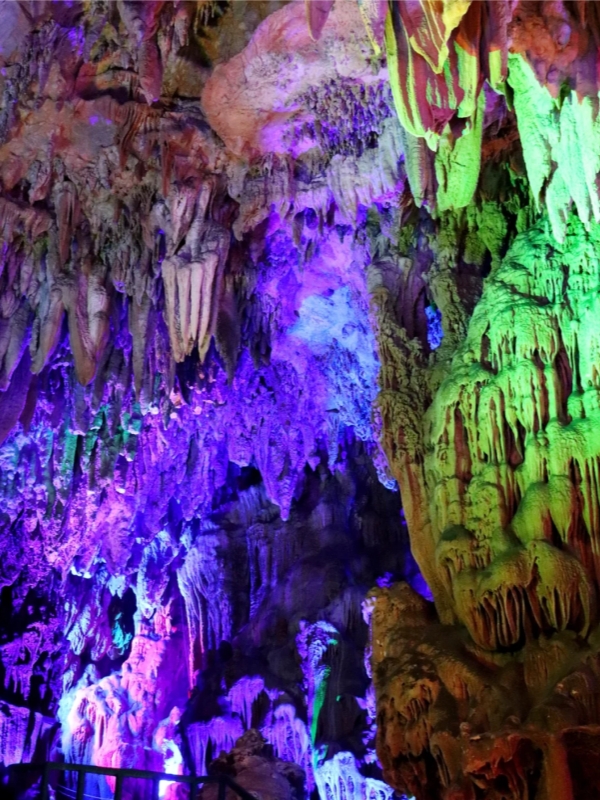
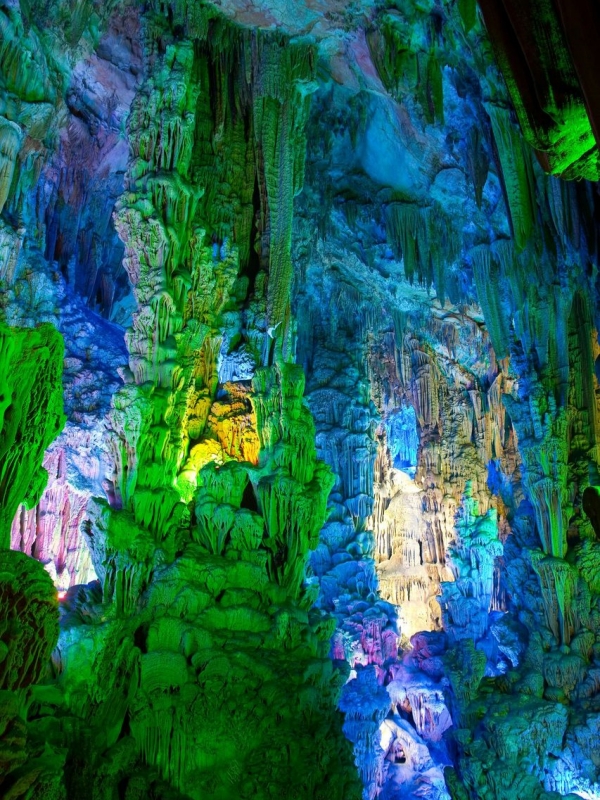
The Crystal Palace chamber is the cave's most dramatic space. At the widest point, one published reading gives the hall as roughly 93 meters across and 18 meters high — a scale that becomes tangible only when standing inside it. A single massive stalactite hangs from the upper-left ceiling like a palace lamp, and the LED system bathes the entire chamber in slowly shifting blue, gold, and jade light that plays off the mineral surfaces. This chamber appeared as the Dragon King's underwater palace in the 1986 television adaptation of Journey to the West — a detail the scenic area notes in its own materials.
Further along, Lion Rock at Sunrise presents a roughly 3-meter stalactite shaped by water and mineral deposits into a form that resembles a lion with smaller cub-like formations clustered around it. The cave's oldest reliably dated inscription — ink marks from AD 792 — specifically references this formation, recording a Tang-dynasty visitor's observation of the scene. The inscription remains visible on the chamber wall if guides point it out.
Sky-Scraping Twin & the Primitive Forest
Deep in the Primitive Forest chamber, two stone columns stand side by side, each roughly 3 meters tall. From the viewing angle, one appears fused to the ceiling; the other looks separated. In reality the second pillar has already joined the ceiling above, and the two will eventually become a single continuous column. The growth rate here is geological — less than a millimeter per year — so the fusion happening underfoot right now began centuries ago and will continue for centuries more. Surrounding clusters of stalagmites read as a frozen stone forest, their surfaces smooth and pale in the LED light.
Pines in the Snow & Other Formations
Reed Flute Cave Guilin China
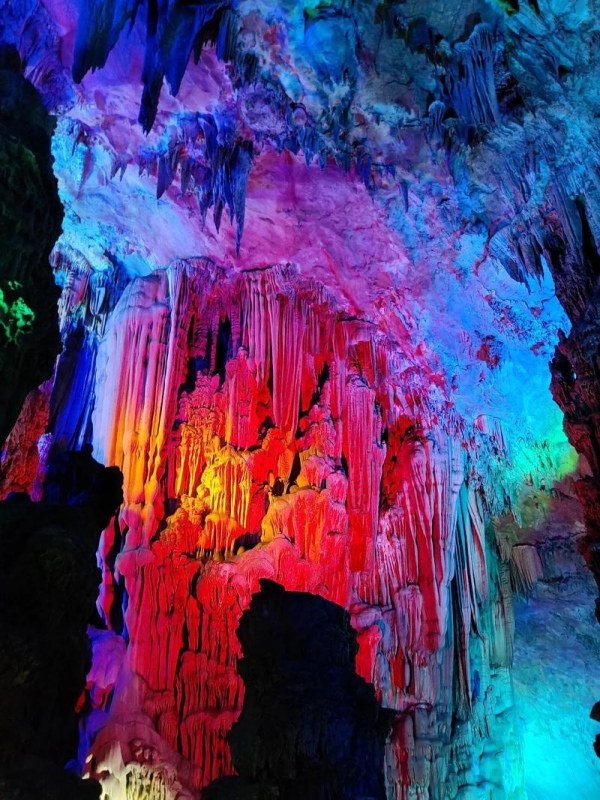
Pines in the Snow is a slender, nearly white stalagmite that narrows toward the top like a pine branch heavy with frost. Under the jade-colored LEDs, the formation takes on a cold greenish glow that the name captures well. The cave contains numerous other named formations along the 500-meter route, each pointing toward a visual metaphor the guides will illustrate.
- Red Silk Drapes — flowstone cascading in layered folds
- Coiled Dragon Pagoda — a twisted pillar with a capped top
- Snow Mountain Reflection — pale formation mirroring a snow peak
- Flower-Fruit Mountain — a bulbous formation with a rounded crown
- Carp Leaping Over the Dragon Gate — a fish-shaped rock poised near a low arch
- Pigsy Looking in the Mirror — a rounded formation referencing the Journey to the West character
These appear at various points along the route and are highlighted during the guided walk included with the ticket.
Ancient Inscriptions Across 1,500 Years
The cave's walls carry 77 surviving ink inscriptions in visitors' handwriting — poems, travel notes, and records ranging from local construction projects to accounts of uprisings. The oldest reliably dated mark is from AD 792 during the Tang dynasty, recording a visitor's name and the observation of Lion Rock at Sunrise. Some scholars cite an even earlier Southern Qi inscription from roughly AD 483–493, though that attribution is less settled among sources. Either date makes Reed Flute Cave one of China's earliest documented tourist sites, predating the formal scenic-area designation by more than a millennium.
Between the 8th century and the mid-20th century, the cave fell in and out of use. It was essentially abandoned for centuries, then rediscovered in the 1950s during regional geological surveys. The site reopened to the public in 1962 and has operated continuously since. Guides can point out the clearest inscriptions along the passage between chambers — look for faded black ink marks on the limestone walls, particularly near the older-named formations.
Light Show Times & Experience
Reed Flute Cave Guilin China
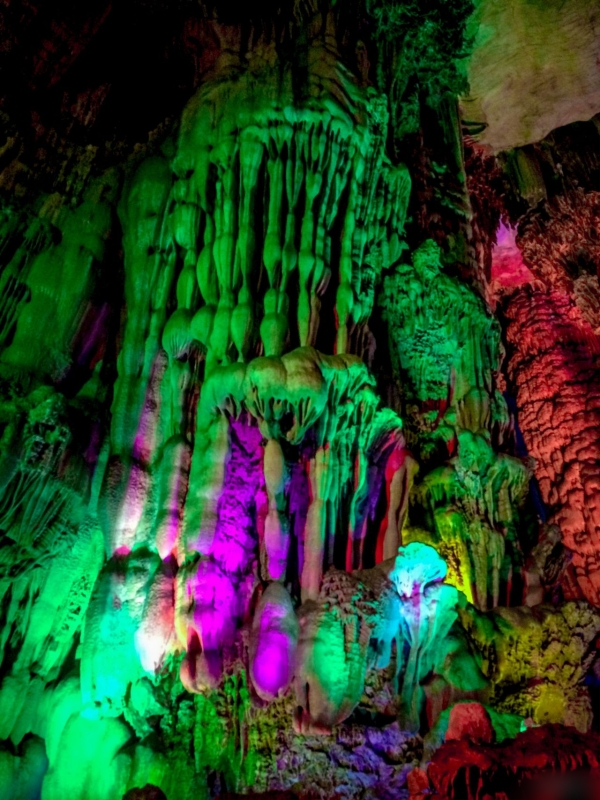
The light-and-sound system runs during all open hours along the main visitor route. Color-shifting LEDs illuminate each chamber differently — deep blue in the Crystal Palace, warm amber near Lion Rock, cool jade-green in the Primitive Forest — and soft ambient music plays at a low volume through the passages. Some sections add subtle wall projections showing ancient ocean imagery and geological cross-sections, reinforcing the cave's 180-million-year backstory without overwhelming the formations themselves.
Guided groups depart throughout the day. The first entry aligns with opening hours — 08:00 in summer (April through October), 08:30 in winter (November through March) — and new groups typically form every 20 to 30 minutes during operating hours. The last guided entry falls roughly 30 minutes before the closing time, though this varies with group size and day-of-day demand. Confirm the exact slot at the ticket gate on arrival; the schedule shifts seasonally and is not posted far in advance online.
No separate ticket is required for the light show — it is built into the standard admission price. The experience changes subtly as you move from chamber to chamber, and guides narrate each formation's name and origin while the LEDs cycle through their palette. Walking slowly in wide chambers gives the lights time to shift and your eyes time to adjust; rushing through misses much of what the system is designed to show.
Tickets, Opening Hours & 2026 Prices
Book online before arrival if you want the discounted rate and confirmed English-language narration. Trip.com and Klook both list Reed Flute Cave with international card acceptance — the gate price applies if you pay in cash on-site. The guided tour is included in standard admission regardless of booking channel; the online booking simply secures the lower rate and sometimes faster entry during busy periods.
How to Get to Reed Flute Cave
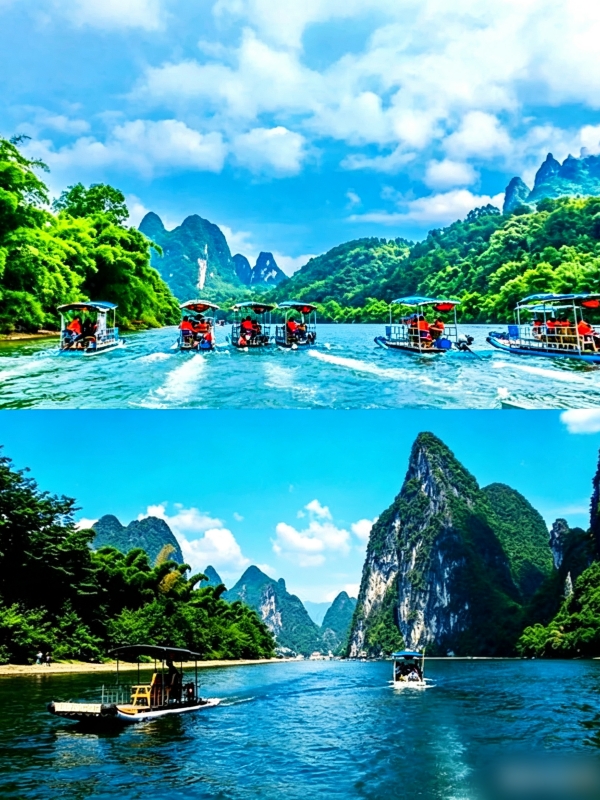
Reed Flute Cave sits on Guangming Hill roughly 5 to 7 kilometers northwest of Guilin's city center. Most visitors choose between three options: a direct taxi or Didi ride, a public bus, or a pre-booked private transfer. A river-boat route along the Peach Blossom River also exists for those who want a scenic approach.
For more, see our guide to Li River Guilin to Yangshuo.
From Guilin City Center
The fastest option from downtown Guilin is a taxi or Didi ride — roughly $4 (¥25–30) and 15 to 20 minutes depending on traffic. Didi works in English and accepts international cards, making it the most straightforward cashless choice for foreign visitors. Parking at the cave costs around $1.50 (¥10) if you arrive by car. The budget alternative is Bus 3 or Bus 213, which stop at Reed Flute Cave Station after about 30 minutes from downtown — follow that with a 5-minute walk to the scenic gate. Buses 4A, 13, and 58 also serve the area. Sightseeing boats along the Peach Blossom River offer a more leisurely approach, running toward the cave's riverfront section.
See also our Yangshuo Guilin Guangxi guide.
From the Airport or Railway Station
Guilin Liangjiang International Airport lies roughly 25 kilometers south of the cave — a significant haul. The most direct option is a taxi or Didi at roughly $15–18 (¥100–130), taking 40 to 50 minutes in normal traffic. The budget alternative involves an airport shuttle to Guilin Railway Station (about $3 / ¥20), then Bus 3 to the cave. For visitors arriving by high-speed rail at Guilin North Railway Station, a taxi costs roughly $8–10 (¥55–70) and takes 30 to 35 minutes; Didi is easier than flagging a passing cab. From Guilin Railway Station itself, the cave is only 6 to 8 kilometers away — Bus 3 covers it directly in about 20 to 25 minutes by taxi.
For more, see our guide to Reed Flute Cave.
Best Time to Visit
Reed Flute Cave operates year-round with no scheduled closure days in the 2026 calendar. Because the cave interior holds a constant 20°C regardless of outside weather, the season matters less inside than out. April through October offer the most comfortable conditions for walking between the cave gate and the cave mouth. January and February bring Guilin's cooler but dry winters — still entirely workable, just bundle up near the entrance.
Nearby Attractions & Local Food
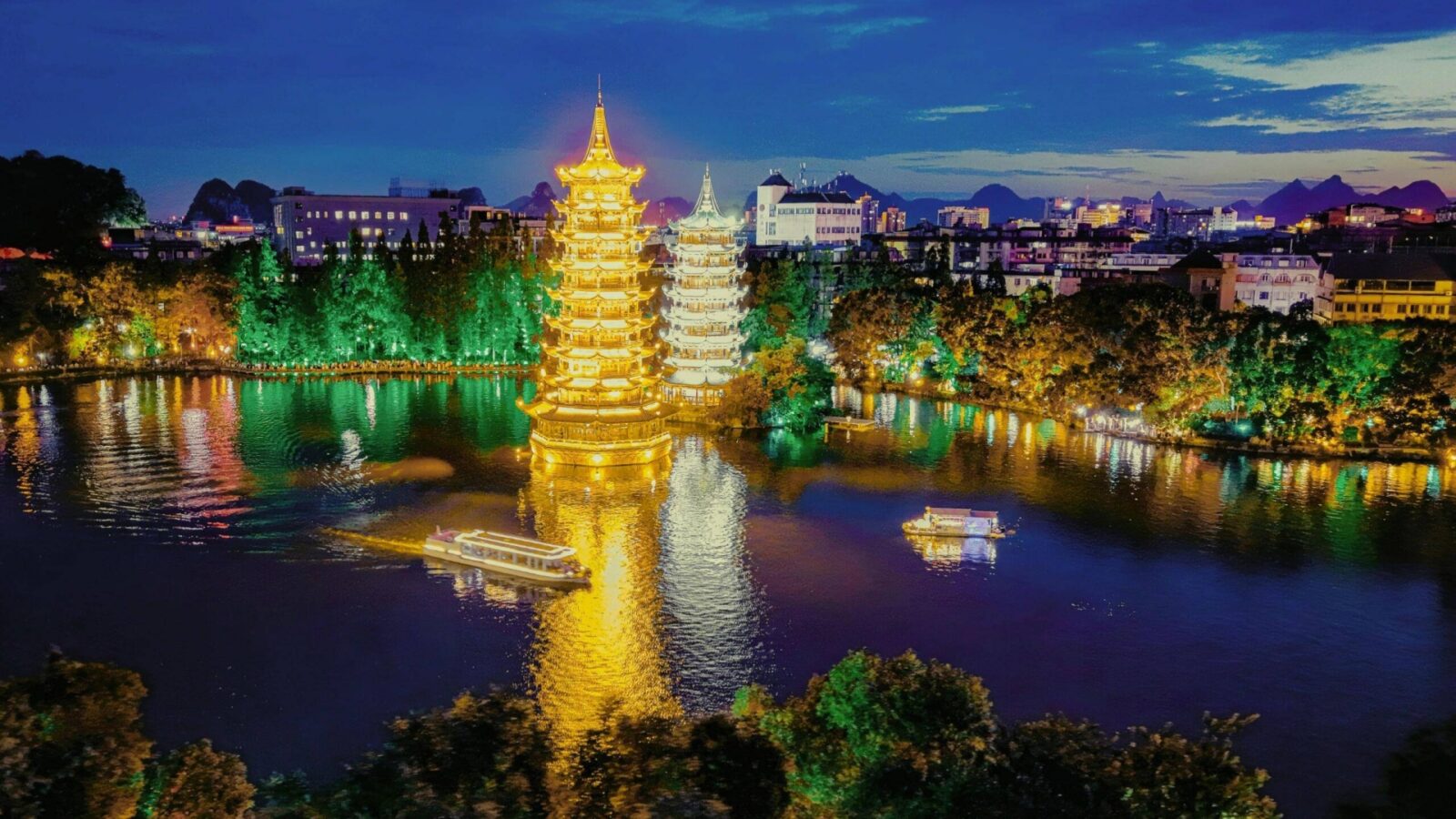
Guangming Hill sits close enough to the Peach Blossom River that a short walk from the cave gate brings you to the water's edge. The Flying Phoenix Bridge — Feiluan Qiao in Mandarin — is an arched stone crossing built in the Ming dynasty, photogenic in soft morning or late-afternoon light. Boat rides on the Peach Blossom River run from nearby docks and provide a calmer alternative to the Li River tourist boats. Within a 15-minute taxi ride, you can reach Elephant Trunk Hill (the landmark hill at the confluence of the Li and Peach Blossom Rivers), Fubo Hill, and Diecai Hill. A practical half-day itinerary: Reed Flute Cave in the morning, Elephant Trunk Hill after lunch, then the Two Rivers and Four Lakes night cruise as the city lights come on.
Guilin rice noodles — roughly $0.70–1.00 (¥5–7) at local counters — are the city's signature starch, and a bowl near the cave gate or near Elephant Trunk Hill costs the same as it would downtown. Xiong Ayi Rice Noodles is one of the more widely referenced names for a sit-down bowl; street-side counters offer faster service at the same price point. Osmanthus cakes and ai-grass pastries from stalls near the scenic gate gate make a portable snack. For something heavier, riverside restaurants serve taro steamed pork, roasted chicken, and the Guilin specialty pot of river-snail duck feet — all shareable plates meant for a leisurely meal before or after the cave visit.
Frequently Asked Questions
Q: How long does it take to visit Reed Flute Cave Guilin China?
A relaxed walk through all 30 chambers takes 1 to 1.5 hours. Adding time for photography — particularly in the Crystal Palace and Pines in the Snow chambers — extends the visit to roughly 2 hours. The route is a single 500-meter path with no loops, so you cover everything once and exit at the far end.
Q: What is Reed Flute Cave Guilin China famous for?
The cave holds 180-million-year-old limestone formations lit by a daytime LED light-and-sound show. The Crystal Palace chamber — roughly 93 meters across at its widest point — and the Lion Rock at Sunrise formation are the signature sights. The 77 Tang-dynasty wall inscriptions (oldest from AD 792) make it one of China's earliest documented tourist destinations, and the 1986 Journey to the West television production filmed its Dragon King scenes here.
Q: Is Reed Flute Cave Guilin China suitable for children and elderly visitors?
Yes. The path inside is single-level and paved with handrails along steeper sections. The year-round 20°C temperature removes weather as a factor, and sedan chairs are available on request for visitors who need them. From the ticket office to the cave mouth is roughly a 10-minute walk — the optional mini-train covers this for about $3 (¥20) round trip. Guided narration is included with the ticket and helps children follow along through the chambers.
Q: When is the Reed Flute Cave Guilin China light show?
The LED light-and-sound experience runs throughout all open hours along the main route — no separate ticket or timed entry slot is required. Guided groups depart roughly every 20 to 30 minutes. First entry is 08:00 (April through October) or 08:30 (November through March); the last guided entry falls about 30 minutes before the 17:30 or 17:00 close. Confirm the exact group departure window at the ticket gate on arrival.
Q: How much are Reed Flute Cave Guilin China tickets in 2026?
Adult tickets cost about $13 (¥90) at the gate and roughly $12 (¥82) when booked online through Trip.com or Klook. Students, children, and seniors with valid ID pay half price. The guided tour is included in both rates. English-language guides are available on request but should be confirmed when booking online, as not every slot has an English-speaking guide on duty.
Q: How do I get to Reed Flute Cave Guilin China from the airport or railway station?
From Guilin Liangjiang International Airport (roughly 25 kilometers away), a direct taxi or Didi costs about $15–18 (¥100–130) and takes 40 to 50 minutes. The budget option is an airport shuttle to Guilin Railway Station (about $3 / ¥20), then Bus 3 to Reed Flute Cave Station. From Guilin Railway Station (6–8 kilometers away), a taxi runs roughly $4–5 (¥30–35) and 20 to 25 minutes, or Bus 3 covers it directly. From Guilin North Railway Station, taxis are about $8–10 (¥55–70) for the 30-to-35-minute ride; Didi is the easier option for payment and pickup.
Q: Is flash photography allowed inside the cave?
No. Flash is prohibited to protect the mineral surfaces from heat damage. Raise your camera or phone ISO to 800–1600 and use a steady hand or small tripod. The LED-lit chambers provide enough ambient light for clean handheld shots in most areas; the Crystal Palace and Pines in the Snow are the best-lit chambers for photography.
Q: Where can I find more background on Reed Flute Cave's geology and history?
The cave's official scenic-area materials cover the limestone geology (bedrock roughly 180 million years old; formations growing for over 700,000 years), the AD 792 Tang-dynasty inscription, and the 1950s rediscovery and 1962 reopening. Wikipedia's English article on Reed Flute Cave summarizes the same history in an accessible format for further reading.