Orchids for Chinese New Year
In the final days before Chinese New Year, southern Chinese cities transform. Temporary canvas covers the lanes of Guangzhou's Liwan district as families crowd the stalls, inspecting potted orchids stacked three rows deep. The air carries the cool-weather sweetness of thousands of blossoms. Grilled chestnuts smoke from a nearby cart. Three days before Chuxi (除夕) — Chinese New Year's Eve — the night markets run nearly round the clock.
This article covers orchids for Chinese New Year as a cultural and travel experience, not a shopping catalog. Readers will find what to see at the markets, which orchids carry meaning and why, how to select a lucky plant, and how to navigate the stalls as a foreign visitor. The focus is on Guangzhou, Hong Kong, and the orchid capital of Foshan Chencun — places a traveler can actually reach.
Quick Facts
Why Orchids Own Chinese New Year
Orchids for Chinese New Year
Orchids are the most-purchased Festive Bloom — the flowers of the New Year market. Their dominance rests on symbolism that runs deeper than aesthetics. Confucian tradition links orchids to noble purity (高洁). In Cantonese culture, a well-chosen orchid carries layered meaning that guests recognize instantly.
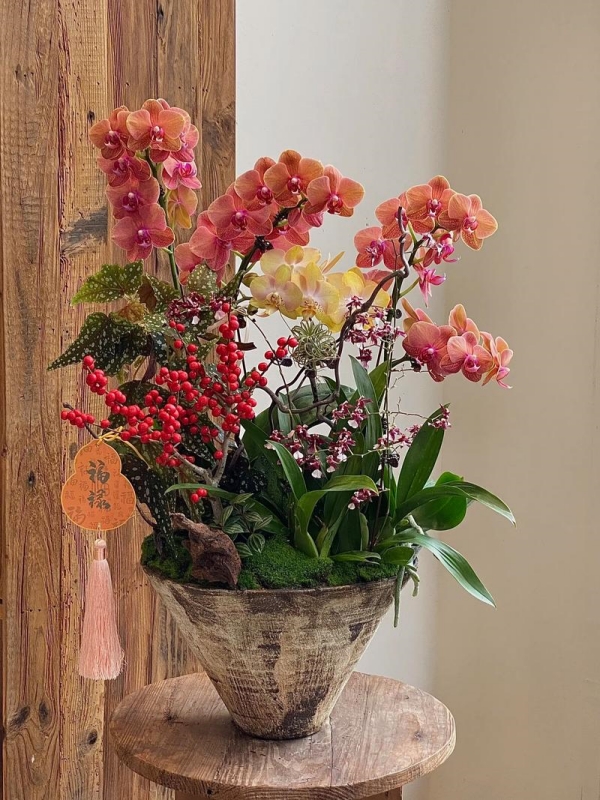
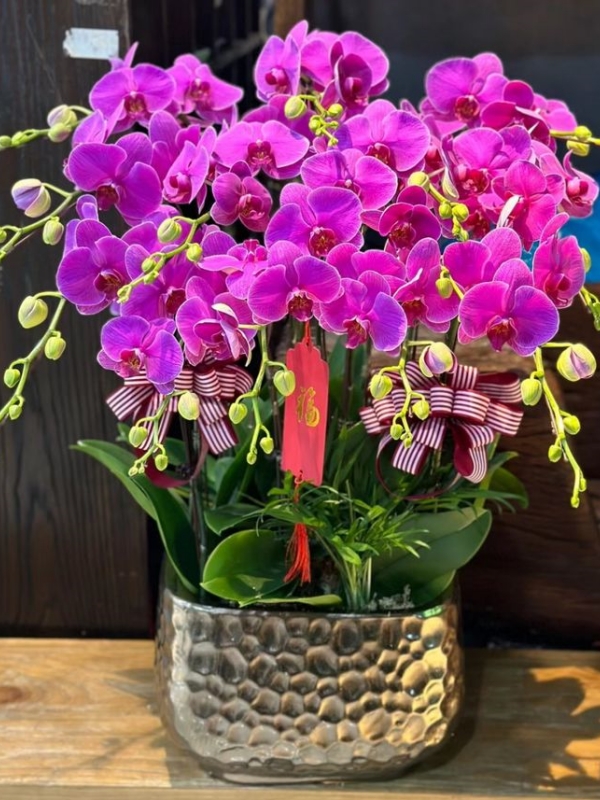
The visual language matters as much as the history. On Phalaenopsis, each flower resembles a butterfly. This reads as "幸福飞来" — happiness flying in. Stem count is read like a lucky number. The plant itself becomes a message. Color adds a second layer: red and pink signal joy and prosperity, yellow brings wealth and royalty, white represents purity, and purple connotes nobility. The combination of color, count, and plant condition creates a meaning that most Chinese visitors read at a glance. For a foreign visitor, cracking even the basic code transforms the shopping experience from browsing into participation.
Inside the Orchids Flower Markets
Orchids for Chinese New Year
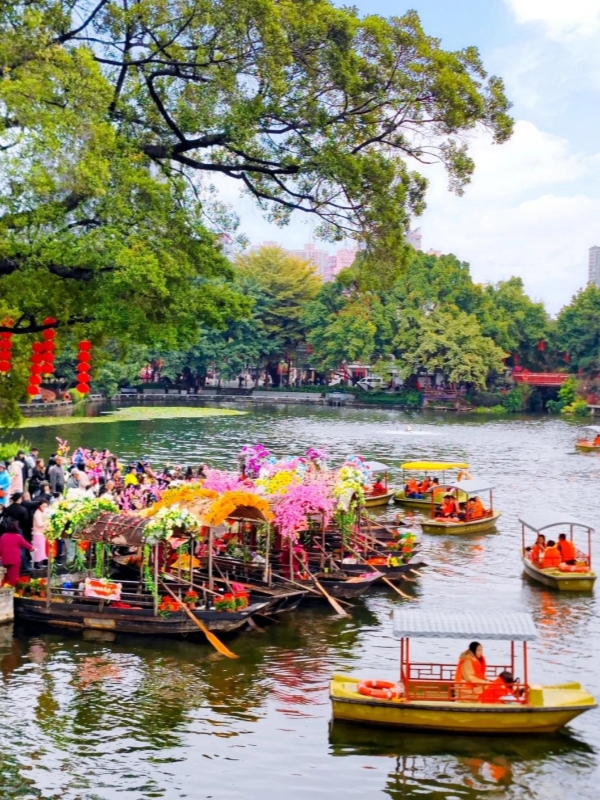
The Festive Bloom tradition is a temporary festival of flowers. Across Guangdong, Hong Kong, and southern China, cities set up street markets in the final 3–10 days before Chuxi (除夕). Vendors sell orchids alongside kumquat trees, peach blossoms, and narcissus. The orchid aisle is always the widest.
Markets at a Glance
Guangzhou's Liwan Water-Side Flower Street
The Liwan flower street runs beside Liwan Lake in Guangzhou's old Cantonese quarter. It is the spiritual home of the Festive Bloom tradition. Nearest metro stations are Changshou Lu (Line 1) and Liwan (Line 5). The street hosts over 500 stalls, with peak crowds on the three nights before Chuxi (除夕) when many vendors do not close at all.
Beyond the flower market, the surrounding Litchi Bay Creek (荔枝湾涌) area is strung with lanterns during the festival period. The same footprint later hosts the Lantern Festival celebrations that mark the end of the 15-day holiday. Visitors combining the flower street with an evening walk along the creek will see the full arc of the holiday's visual language in one neighborhood.
🏮 Festive Night Markets: Experience the vibrant holiday atmosphere and flower stalls in southern China with our visitor guide to the Guangzhou Spring Festival Market 2026.
Hong Kong's Lunar New Year Flower Markets
Hong Kong organizes Festive Bloom markets across roughly 15 locations each year, with 维多利亚公园 (Victoria Park, Causeway Bay) as the flagship. The MTR delivers visitors directly — Causeway Bay on the Island Line is a two-minute walk from the park entrance. The market typically runs from Lunar Dec 25 through Chuxi (除夕), with the final night often extending past midnight.
The Hong Kong market carries a different botanical emphasis than its Guangzhou counterpart. Peach blossom (桃花), kumquat trees (年桔), and water narcissus (水仙) dominate alongside orchids. The markets are officially overseen by the Food and Environmental Hygiene Department, which publishes stall counts and opening schedules each year. Victoria Park remains the most accessible and most photographed location for foreign visitors.
💐 Floral Gifting Etiquette: Avoid cultural missteps when presenting floral gifts in professional settings with our guide to Hong Kong Taboos on Giving Flowers to Businessmen.
Foshan Chencun, the Orchid Capital
Chencun (陈村) in Foshan's Shunde district has grown orchids since the Qing dynasty. Most of the Phalaenopsis and Dendrobium sold at Guangzhou markets originate here. For a visitor with a specific interest in orchids, Chencun is a year-round destination — the permanent wholesale hall and retail greenhouses operate whether or not Chinese New Year is approaching.
The CNY pop-up displays run alongside the permanent site. Reaching Chencun from Guangzhou takes roughly 30 minutes: the HSR from Guangzhou South (广州南站) to Shunde station is about 15 minutes, followed by a 15-minute Didi or taxi to Chencun Flower World (陈村花卉世界). This is the angle that distinguishes a travel article from a flower catalog — most visitors to the markets never learn where their orchid was grown.
🏡 Classical Garden Blossoms: Discover traditional garden architecture and seasonal blooms with our feature on Spring Flowers in Suzhou Gardens.
Orchids Loved for Chinese New Year
Orchids for Chinese New Year
Four orchids dominate the Chinese New Year market. Each carries a distinct cultural profile and price range. The choice between them shapes both the symbolism and the cost.
Top 4 Orchids Compared
Why Phalaenopsis Took Over
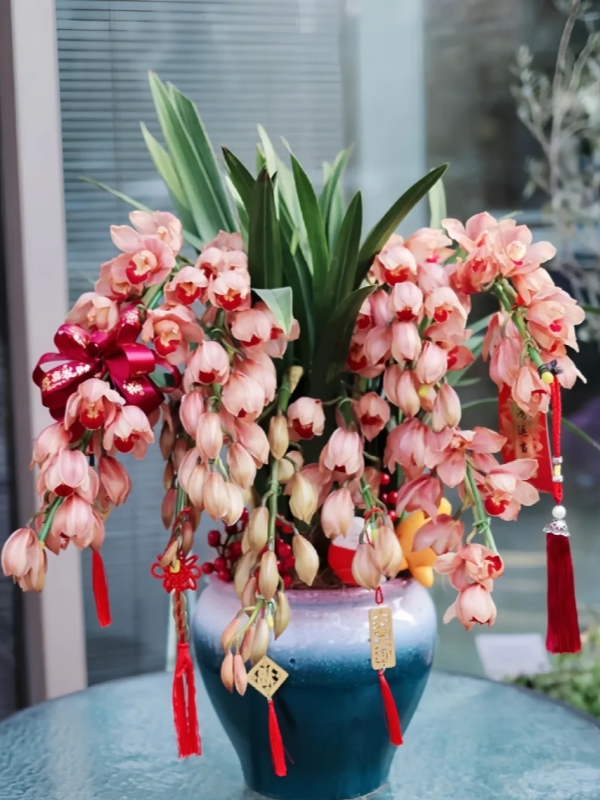
Cymbidium held the position of top CNY orchid for older Cantonese households through most of the 20th century. Its waxy, long-lasting blooms signaled cultivated taste. From the 2000s onward, Phalaenopsis displaced it for several connected reasons.
Mass production from greenhouses in Shunde and Yunnan brought Phalaenopsis prices down significantly. The bloom window expanded to 8–12 weeks against Cymbidium's 4–6. The butterfly-shaped flowers photograph better in a festival context. The shift was economic and cultural at once. A visitor seeking the traditional Cantonese choice should specifically ask for Cymbidium by name. Most younger households now default to Phalaenopsis as the modern classic.
🌸 Spring Blossom Destinations: Plan your seasonal floral travel across the country with our overview of China March 2026 Flower Blossom Destinations.
How to Pick a Lucky Orchid
Orchids for Chinese New Year
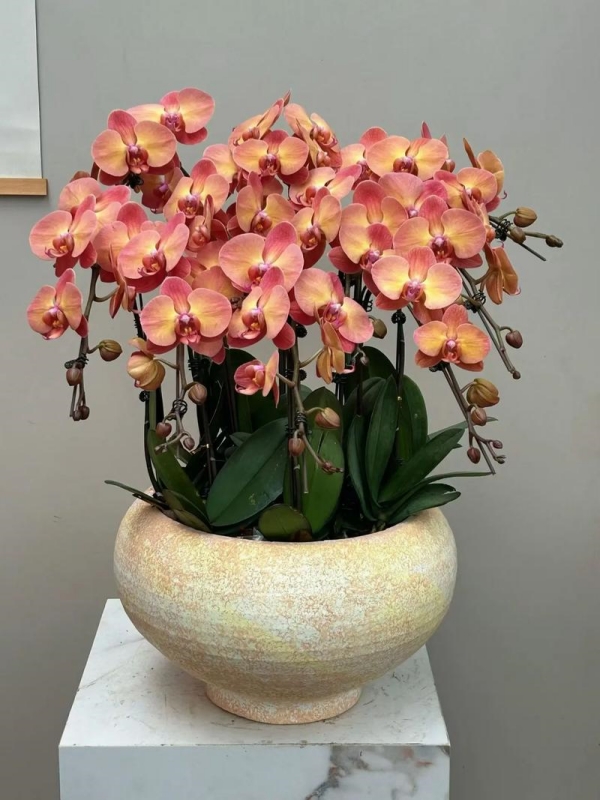
Choosing a lucky orchid requires reading three signals simultaneously: stem count, color, and plant health. The first two carry the symbolism; the third determines whether the plant survives the full 15 days.
- Stem count: 6, 8, 9, 12, and 16+ carry positive meaning. 6 means 六六大顺 (smooth luck); 8 sounds like 发 (wealth); 9 means 久 (longevity); 12 represents a full year. Avoid 4 (sounds like 死, death) and odd numbers without cultural resonance.
- Color by wish: Red or pink for love and joy. Yellow for wealth. White for purity (common in mixed arrangements). Purple for nobility.
- Buy buds, not blooms: A plant with many unopened buds will carry color through the full 15 days. One already in full bloom may fade before 元宵节 (Lantern Festival).
- Check the roots: Inspect through the clear pot or drainage hole. Firm roots in green or silver indicate health. Black or mushy roots signal rot.
- Reject yellowing leaves: Lower leaves that have turned yellow suggest the plant is under stress. A sour smell from the crown confirms root problems.
- Request a red ribbon: Most vendors add a 红包 (red ribbon or handle wrap) at no charge. It is part of the traditional presentation.
Caring for Orchids Through the 15 Days
CNY orchids arrive already in bloom. Your task is not to coax flowers open but to keep the plant alive and presentable through the holiday period. After that, most households discard them, though a patient visitor can keep the plant long-term.
- Light: Place in bright indirect light. Direct winter sun through a south-facing window will burn the leaves.
- Water: Once every 7–10 days is sufficient. The ice-cube method — three cubes placed on the bark — works well for visitors unsure of moisture levels. The pot should never sit in standing water.
- Temperature: Keep above 15°C. A cold windowsill will cause the plant to drop its buds. This is the most common way visitors kill their holiday orchid.
- Humidity: A daily mist on the aerial roots helps, especially in heated hotel rooms where air dries quickly.
- Deadheading: Snap off wilted flowers at the node. On Phalaenopsis, do not cut the green flower spike — it may produce a second flush of blooms in 2–3 months.
- After the holiday: Most people discard the plant. To keep it, repot in fresh orchid bark and move to a bright bathroom window where humidity stays higher.
A Foreign Visitor's Survival Guide
Three practical obstacles catch most foreign visitors at the markets: payment, transport, and communication. A little preparation handles each one. The rule of thumb is simple — assume cash only at stalls, plan to carry your own plant, and learn five phrases that earn both a better price and a warmer interaction.
Payment at the Market
Most vendors at Orchids markets operate on cash. Before heading to a stall, understand the payment landscape.
- Cash is king: Small-denomination RMB notes (¥10, ¥20, ¥50, ¥100) are the most reliable option. Larger stalls may have a card machine, but stalls do not.
- Alipay and WeChat Pay: These work for foreign visitors whose international card is linked to the app. Alipay's Tour Pass and WeChat Pay's international card feature serve this purpose. Always carry a cash fallback.
- Foreign cards: Visa and Mastercard rarely work at market stalls without a Chinese-issued merchant setup.
- Confirm the pot is included: Some vendors quote the plant price and add the ceramic pot separately. Ask before agreeing to a price.
- No tax refunds at markets: Most vendors do not issue receipts for VAT-style refunds. Treat the purchase as final.
Getting Your Orchids Home
Orchids travel better than most people assume. The method depends on your destination and timeline.
- Same-city transport: A 1–2 stem Phalaenopsis fits in a standard shopping bag or backpack. Brace the pot upright and protect the flower spike with tissue paper. The metro or a Didi works for 30-minute journeys.
- Hotel delivery: Most hotels in Guangzhou and Hong Kong offer paid plant delivery. Ask the concierge for rates and cut-off times.
- Domestic flights: Most airlines permit orchids in cabin baggage. The four species sold at 年宵花 markets are not CITES-restricted. Wrap the spike in tissue, brace the pot in a cardboard box, and confirm the airline's live-plant policy before arriving at the airport.
- Shipping: SF Express (顺丰) and China Post both ship potted orchids domestically within 1–2 days. Vendors at Chencun often arrange this for roughly ¥30–80.
- International transport: Declare the plant at customs. Many countries require a phytosanitary certificate from the local inspection and quarantine bureau. Confirm requirements with your destination country before purchasing.
Language and Bargaining
A few phrases transform the market experience. Vendors respond to effort, and closing with "Happy New Year" in Mandarin is nearly universal goodwill.
- 老板, 便宜一点 (laǒbǎn, piányi yīdiǎn) — Boss, a bit cheaper. The universal Cantonese-market opener.
- 多少钱? (duōshǎo qián?) — How much? and 最便宜几多? (zuì piányi jǐduō?) — What's your lowest price?
- 两盆一起便宜点吧? (liǎng pén yīqǐ piányi diǎn ba?) — Cheaper for two pots together?
- 蝴蝶兰有几多枝? (húdié lán yǒu jǐduō zhī?) — How many stems does this Phalaenopsis have? Signals you know what you are buying.
- 不要花盆, 便宜点可以吗? (bù yào huāpén, piányi diǎn kěyǐ ma?) — Skip the pot, can you lower the price?
- 谢谢, 新年快乐 (xièxiè, xīnnián kuàilè) — Thank you, Happy New Year. The closer that often unlocks a small extra or a warmer goodbye.
Expect 10–20% off the opening quote at street stalls. Fixed-price sections exist in malls and chain flower shops, where bargaining is not expected.
Frequently Asked Questions
Q: What does an orchid symbolize for Chinese New Year?
Orchids represent high cultivation and moral purity in Confucian tradition. Phalaenopsis specifically carries the message of happiness arriving (butterfly flowers = 幸福飞来). Color adds a second layer: red for joy, yellow for wealth, white for purity, purple for nobility. Stem count matters — numbers 6, 8, 9, 12, and 16+ are considered lucky, while 4 is avoided.
Q: When do the Chinese New Year flower markets open?
Markets typically open 3–7 days before 除夕 (Chinese New Year's Eve). Guangzhou's Liwan Lake market runs from roughly Lunar Dec 23–30. Hong Kong's Victoria Park market opens around Lunar Dec 25 and closes on 除夕 night, sometimes extending past midnight for last-minute buyers.
Q: Where is the biggest Chinese New Year flower market?
By raw stall count, Guangzhou's Haiyin Bridge South and Hong Kong's Victoria Park are the largest. By atmosphere and visitor appeal, Guangzhou's Liwan Lake water-side street wins — it is the most photographed and the most historic. For orchid sourcing specifically, Foshan Chencun is the supply base behind both.
Q: How many orchid stems are lucky for Chinese New Year?
The lucky numbers are 6 (六六大顺, smooth luck), 8 (发, wealth), 9 (久, longevity), 12 (full year of luck), and 16+ (abundant blessing). Avoid 4, which sounds like the word for death. Odd numbers without cultural meaning are also generally avoided at CNY.
Q: How long do orchids last after Chinese New Year?
Phalaenopsis lasts 8–12 weeks from purchase if bought with unopened buds still developing. Cymbidium holds for 4–6 weeks. Dendrobium typically 3–4 weeks. Oncidium around 4–6 weeks. Most Chinese households discard the plant once the blooms fade rather than maintaining it long-term.
Q: Can foreigners buy orchids at a Chinese flower market?
Yes. Markets are public and vendors do not restrict sales by nationality. The practical constraint is payment: cash RMB is the fallback, Alipay or WeChat Pay works if your international card is linked, and foreign credit cards are rarely accepted at stalls.
Q: What is the difference between Phalaenopsis and Cymbidium?
Phalaenopsis (蝴蝶兰) features large, flat butterfly-shaped flowers on a single compact spike. It blooms for 8–12 weeks and is the modern CNY default. Cymbidium (大花蕙兰) has tall sprays of smaller waxy flowers, lasts 4–6 weeks, and is the traditional Cantonese choice — larger plants, higher cost, aristocratic reputation.
Q: How do I get my orchids home on the plane?
Most airlines allow live orchids in cabin baggage. Wrap the flower spike in tissue paper and brace the pot in a cardboard box. The four species sold at 年宵花 markets are not CITES-restricted, but long-haul international flights often require a phytosanitary certificate from the local inspection and quarantine bureau. Confirm the specific airline policy on the day of travel.