Chinese New Year Floral Arrangement
The perfume of narcissus fills the night air. Walls of pink peach-blossom branches glow red under string lights. This is the year-end flower market (年宵花市), the oldest commercial tradition in southern China, and for a foreign visitor it is one of the most photogenic, fragrant, and deeply local experiences the Spring Festival offers. Unlike a vase bought online, the market is where the ritual lives — bargaining for a kumquat tree at midnight on Lunar New Year's Eve, carrying a wrapped peach branch onto the metro. This guide covers the four best markets to visit, what each flower symbolises, when to go in 2026, and exactly how to buy and transport plants as a non-Chinese speaker.
Quick Facts
What Is a Chinese New Year Floral Arrangement?
A Chinese New Year floral arrangement (年花, nián huā) refers to fresh flowers, potted plants, and ornamental branches purchased in the days leading up to Lunar New Year. The goal is symbol-driven selection — each bloom carries a meaning meant to influence household fortune in the coming year. This differs sharply from Western floral design, where composition and aesthetics lead. Here are the key distinctions:
- Symbol-first selection: Buyers choose plants for their luck meanings first, display appearance second.
- Potted over cut: Potted plants symbolise rooted, growing fortune and last through the festival.
- Branch-heavy displays: Tall peach and plum branches dominate doorways rather than bouquets in vases.
- Family-grouped purchases: Multiple plants are bought together and placed in specific rooms — a system, not a centrepiece.
Lunar New Year Floral Tradition Explained
The tradition stretches back over two thousand years, tied to Spring Festival's agricultural roots. Flowers are believed to channel fortune into the home for the coming year. Most purchases concentrate in the final three to five days before Lunar New Year's Eve because the tradition holds that plants must "bloom through New Year and into spring" — buying too early risks wilting before the festival peak. Traditional placement follows a room-by-room logic: peach blossom at the front door, kumquat by the entrance hall, orchids in the living room, and narcissus on a table near a window where sunlight can reach the bulb.
How Year-End Flower Markets Work
Temporary open-air markets spring up across southern Chinese cities in the week before Lunar New Year. Vendors sell direct from stalls in an atmosphere that blends commerce with festival energy — lion dance rehearsals echo between the rows, food vendors sell steamed dumplings, and calligraphy booths brush out spring couplets. In Guangzhou each district runs its own flower street (天河, 越秀, 海珠, 荔湾). In Hong Kong the tradition centres on Victoria Park in Causeway Bay. Every market is free to enter.
🌸 Nationwide Spring Destinations: While southern flower markets celebrate indoor holiday blooms, you can also explore full-scale outdoor landscapes with our guide to China March 2026 Flower Blossom Destinations.
Traditional Lucky Blooms & Their Meanings
Each year-end flower carries a specific symbol. The table below covers the most purchased blooms, their meaning, pronunciation pun, typical price range, and recommended placement in the home.
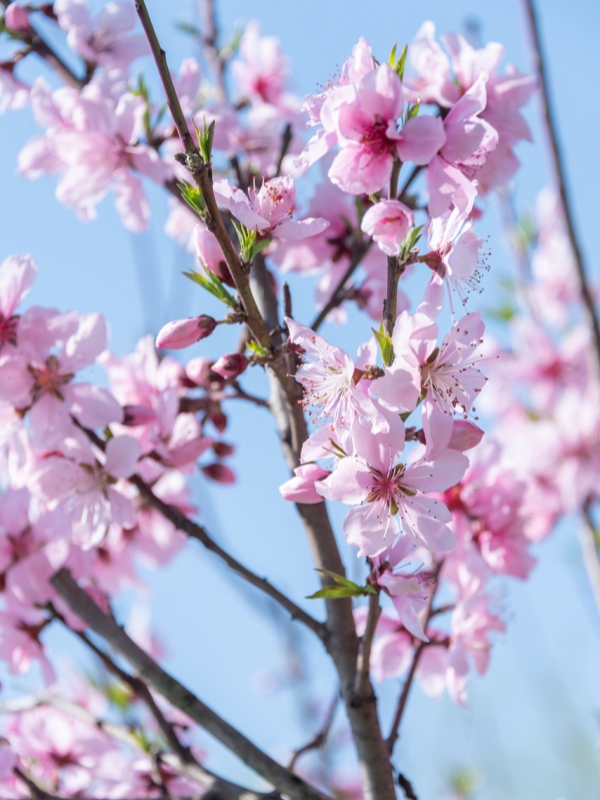
Peach Blossom (桃花) — Romance & Prosperity
Peach Blossom (桃花)
The most visually dramatic CNY plant. Large flowering branches with vivid pink blossoms are hung in doorways — traditionally in pairs, one male and one female branch, to symbolise family harmony and marriage luck. The pronunciation pun runs through Cantonese and Mandarin: 桃 (táo) echoes 淘, implying prosperity. Premium branches cost $35–110 (¥250–780); shorter stems run $14–28 (¥98–198).
- Bud tightness: Choose branches where most buds are still tightly closed — open flowers at purchase will wilt before New Year's Day.
- Branch diameter: Thicker branches indicate a stronger, longer-lasting plant.
- Vase-fit length: Measure your doorway height before buying; branches typically run 1–2 metres.
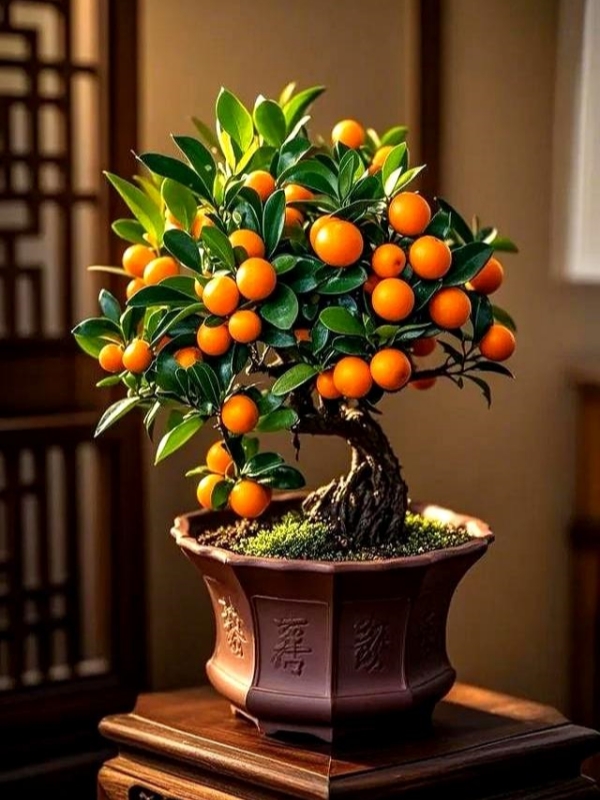
Kumquat (金桔) — Wealth & Good Fortune
Kumquat (金桔)
A small potted citrus tree covered in orange fruit is one of the most recognizable CNY plants. The symbolism is doubly strong: gold colour plus the homophone 桔 (jú) ≈ 吉 (luck) creates a double wealth charm. Trees range from tabletop pots ($14–28 (¥99–198)) to full-sized specimens ($70–170 (¥498–1,198)) with fruit density pushing the price up.
- Fruit firmness: Gently squeeze a few fruits — they should be firm, not soft or wrinkled.
- Leaf colour: Leaves should be a deep, even green; yellowing indicates age or poor root health.
- Pot stability: Tip the pot gently — a stable root ball means the plant will hold fruit longer.
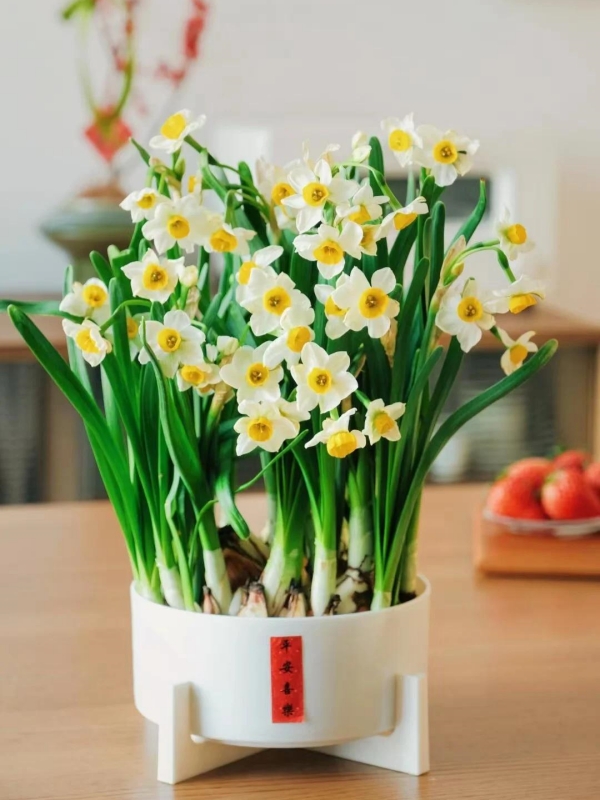
Narcissus (水仙) — Self-Discovery & Good Luck
Narcissus (水仙)
Narcissus bulbs are grown in shallow water bowls and traditionally bloom around New Year's Day itself if bought a week early. The character 仙 (xiān, immortal) carries auspicious weight. They are the cheapest CNY plant — pre-soaked bowl sets cost $7–14 (¥49–99). One practical warning for foreign visitors: the bulbs and sap are toxic to pets and can irritate skin. Handle with gloves and keep cats and dogs well away.
- Shallow bowl: Use a tray or bowl with just enough water to cover the bulb base.
- Room-temperature water: Cold water slows blooming; room temperature encourages it to open by New Year.
- Sunny window: Place near a window that gets 4–6 hours of indirect light daily.
- Discard after blooming: Narcissus bulbs are spent after one season; they are not reusable houseplants.
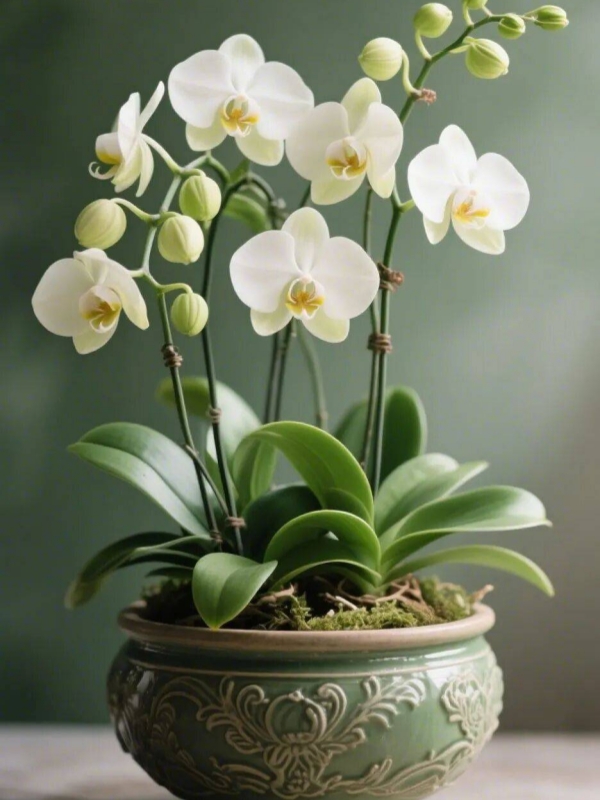
Orchid, Plum Blossom & Other Classics
Orchid (兰花)
Beyond the top three, five other plants carry strong traditional weight.
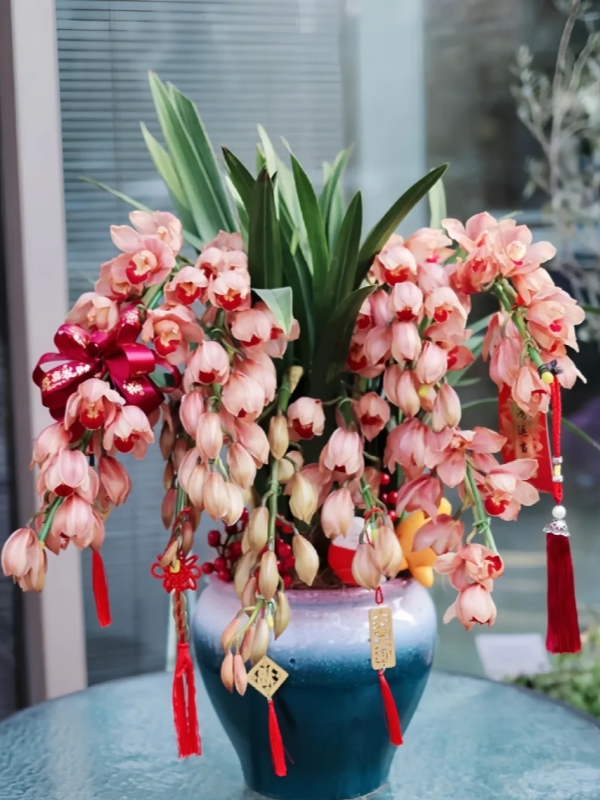
- Orchid (兰花): Symbolises refinement and friendship; phalaenopsis in decorative pots runs $28–70 (¥198–498).
- Plum blossom (梅花): Represents perseverance through adversity; forced branches cost $14–35 (¥99–248).
- Lucky bamboo (富贵竹): Stands for steady-rising wealth; bundles of five stalks sell for $7–21 (¥49–148).
- Money tree (金钱树): Carries household wealth associations; potted plants run $20–50 (¥140–358).
- Silver willow (银柳): Symbolises long-term income; bundles of 5–10 branches cost $7–14 (¥49–99).
2026 Picks: What's Trending This Year
Current market trends favour the phalaenopsis orchid (蝴蝶兰) for premium displays, anthurium (红掌) for entryways, and the money tree for office spaces. Smaller potted plants are outselling large specimens in urban apartments. Pre-arranged gift sets — a kumquat tree paired with a small orchid in festive wrapping — make popular purchases in the final hours before Eve.
- Trending pick — Phalaenopsis orchid: Dominates premium displays; long bloom life.
- Trending pick — Anthurium: Bold red spathes read well in small entryway spaces.
- Trending pick — Money tree: Compact, hardy, and popular in office receptions.
- Avoid — Chrysanthemum: Strong funeral association in Chinese culture.
- Avoid — White lilies and white roses: Associated with mourning.
- Avoid — Cacti and spiky plants: Sharp forms symbolise conflict and discord.
- Avoid — Four-stalk lucky bamboo: The number four (四, sì) sounds like the word for death.
🌺 Floral Symbolism & Species: To compare these festival choices against classical Chinese garden blooms, read our detailed China Rose Hibiscus Flower Guide China Travel.
Top Year-End Flower Markets to Visit
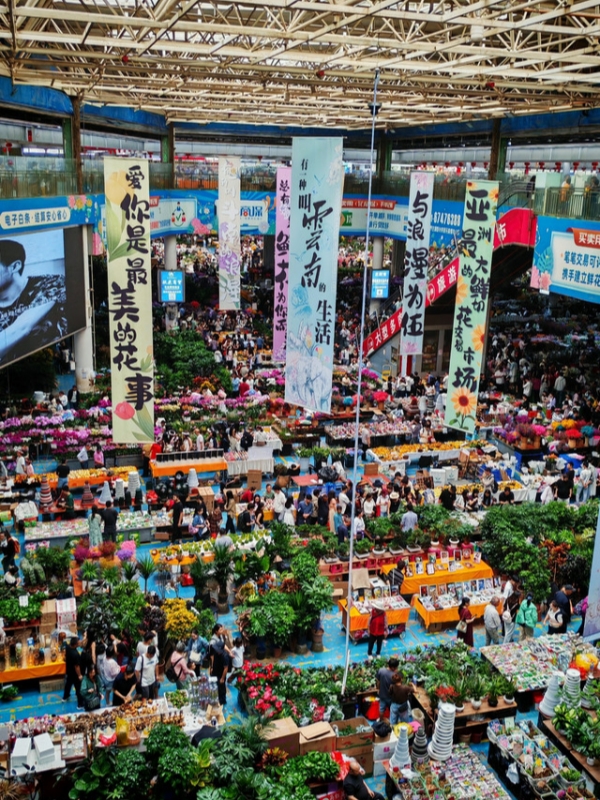
Dounan Flower Market
Four cities anchor the year-end flower market circuit. Each offers a distinct scale, atmosphere, and price point.
- Guangzhou: The Lingnan heartland — district-level flower streets, the widest variety, the most photogenic
- Foshan: Heritage temple district setting — smaller, quieter, strong traditional plant selection
- Hong Kong: Victoria Park — bilingual, internationally accessible, credit cards accepted at larger stalls
- Kunming: Dounan wholesale hub — cheapest fresh-cut flowers on earth, bulk-buy atmosphere
Guangzhou: The Original Lingnan Flower Market
Guangzhou is where the Lingnan (岭南) year-end flower market tradition runs deepest. Each city district opens its own flower street in the final three to five days before Lunar New Year's Eve — the largest are 天河花市, 越秀花市, 海珠花市, and 荔湾花市. Entry is free; hours run roughly 9:00 to 22:00, with the final day often extending later. Signature buys include peach blossom branches ($28–85 (¥198–598)), potted kumquat trees ($42–140 (¥298–998)), and phalaenopsis orchids ($28–70 (¥198–498)). The metro connects every district; a taxi from Baiyun Airport to central flower streets costs about $17–22 (¥120–150).
🏮 Festive Night Markets: Plan your route through Guangzhou's famous district stalls with our practical visitor guide to the Guangzhou Spring Festival Market 2026.
Foshan: Ancestral-Temple Flower Street
Foshan's Zumiao (祖庙) flower street runs through the historic temple district, combining market shopping with heritage surroundings. It is smaller and less crowded than Guangzhou, with a stronger emphasis on traditional Lingnan plants — peach blossom, kumquat, and narcissus dominate. The market pairs well with a Zumiao temple visit on the same day. From Guangzhou, a taxi or ride-hail costs roughly $22–28 (¥160–200); alternatively, the high-speed train from Guangzhou South to Foshan West takes about 30 minutes and costs about $5–8 (¥35–55).
Hong Kong: Victoria Park New Year Flower Market
Hong Kong's largest and most internationally accessible year-end flower market occupies Causeway Bay's Victoria Park for several days up to Lunar New Year's Eve. The metro drops you directly at Causeway Bay station. Bilingual signage helps foreign visitors navigate, and larger stalls accept credit cards — a practical advantage over mainland markets. Signature purchases include peach blossom ($35–110 (¥250–780)), orchids, bamboo arrangements, and potted citrus. On the final day the market operates roughly noon to midnight. From Central, the MTR costs about $2 (¥15).
💐 Business & Gifting Protocol: If you are buying flowers for local hosts or business contacts in Hong Kong, review essential customs in Hong Kong Taboos on Giving Flowers to Businessmen.
Kunming: Dounan & City Markets
Kunming is the year-round wholesale capital of Asian cut flowers — Dounan Flower Market (斗南花卉市场) handles the world's largest fresh-cut flower trading volume. For Chinese New Year, both Dounan and a city-center temporary market sell affordable bulk fresh-cut flowers: roses, gerberas, and lilies. This is the cheapest place in China to buy premium cut flowers — a bunch of high-quality roses costs about $5–7 (¥38–48). The trade-off is a wholesale atmosphere rather than a decorated festival street. Fly into Kunming Changshui Airport; a taxi to Dounan costs about $14–18 (¥100–130).
🌙 Evening Market Operations: To extend your flower shopping into Yunnan's local street food and nocturnal shopping scene, explore our guide to the Kunming Night Market.
When to Go: Market Dates, Hours & Crowds
Timing is the single most important planning factor for a CNY flower market visit. Markets operate for only a few days; they peak on the last day and close before or on the second day of the new year.
Market Season Window for 2026
Chinese New Year 2026 falls on Tuesday, February 17. Most year-end flower markets open three to four days before Lunar New Year's Eve and run through Eve on February 16. Hong Kong's Victoria Park market typically runs the longest window — from around January 31 through February 16 in 2026. Guangzhou and Foshan markets open around February 11–13. Kunming's city-center CNY market follows the same approximate February 13–16 window. The best day for foreign visitors is the second-to-last day — Sunday, February 15 in 2026 — when selection is still wide and queues are shorter than on the eve.
Daily Hours & Best Times to Visit
Most markets open around 9:00 and close around 22:00, with the final 24 hours running overnight into Lunar New Year's Eve. Crowding peaks between 18:00 and 22:00 on the eve itself.
- Weekday mornings: Quietest conditions; plants are in the best condition before the day's foot traffic.
- Weekend mornings: Busier but still manageable; best balance of atmosphere and selection.
- Weekday afternoons: Moderate crowds; vendors more willing to negotiate as the day wears on.
- Eve overnight: Maximum festive energy, maximum crowds, and vendors discounting remaining stock — but chaotic logistics.
Plan for a minimum of two to three hours. Choosing plants, bargaining, and getting them safely to transit takes longer than expected.
Getting There & Getting Around
The transit table above covers the four anchor cities. A few additional notes: Hong Kong's MTR accepts contactless bank cards and Apple/Google Pay at every station. Mainland city metros — Guangzhou, Foshan, and Kunming — are cash or WeChat/Alipay only. For foreign visitors without a Chinese payment app, a taxi or ride-hail (Didi, available in English) is the most practical option within mainland cities.
Buying Flowers as a Foreigner
Year-end flower markets are open to everyone, but small practical gaps can trip up foreign visitors — payment, language, and plant transport. Here is what you need to know.
- Cash on the mainland: Bring small RMB notes (¥10, ¥20, ¥50). Most mainland stalls do not accept cards and rarely break ¥100 bills.
- Bargaining is normal: A modest 10–20% discount on larger items is expected and easy to achieve.
- Hong Kong cards: Larger vendors in Victoria Park accept credit cards; still carry HKD cash for smaller stalls.
- Metro limits: Small potted plants and wrapped branches fit on metro trains; large kumquat trees may exceed space limits during peak hours.
- Vendor delivery: Ask about delivery — many vendors offer it for a small fee ($7–14 (¥50–99)) within the city.
Bargaining, Language & Payment
Bargaining is a normal and expected part of the transaction. It is always modest — aim for 10–20% off the asking price on higher-ticket items, less on cheap potted plants. Here are useful phrases.
- 便宜一点? (piányi yìdiǎn?) — "A bit cheaper?" (Mandarin); péng-máh yí-dím? (Cantonese)
- 可以刷卡吗? (kěyǐ shuākǎ ma?) — "Can I pay by card?" (usually no on small mainland stalls)
- 支付宝 / 微信 (zhīfùbǎo / wēixìn) — names of the two payment apps; asking signals you know the system
- 太贵了 (tài guì le) — "Too expensive"
- 这个多少钱? (zhège duōshao qián?) — "How much is this?"
- 谢谢 (xièxie) — "Thank you"
If language fails, show the Chinese character to your phone dictionary. Most vendors are patient with this approach.
Taking Plants Home & Shipping Overseas
Within China, most plants fit on high-speed trains and metros if pot-bound and compact. Large kumquat trees are usually better delivered by the vendor for a small fee.
- International borders: Most countries — the US, EU member states, the UK, Australia, New Zealand — restrict or prohibit soil and live plant imports. Customs may seize and destroy them on arrival.
- Cut flowers: Bouquets without soil or roots are easier to transport and face less stringent rules, though inspection is still required.
- Cold-chain shipping: DHL and FedEx offer refrigerated international shipping from Kunming. Costs run $50–100 or more per shipment, and customs clearance is not guaranteed.
- Safe souvenir option: A small bare-root narcissus or bulb set travels more easily and carries strong symbolic value without the customs risk.
Check your destination country's official agricultural import rules before purchasing any live plant. Requirements vary by country and change frequently.
A Practical Shopping Checklist
- Small RMB notes: ¥10, ¥20, and ¥50 bills for mainland stalls; HKD for Hong Kong.
- Durable clothing: Markets involve soil, water splashes, and crowds — dress accordingly.
- Large reusable bag or foldable cart: Essential for carrying a potted plant or wrapped branches through the metro.
- Charged phone: Needed for translation apps and, on the mainland, for payment if you have WeChat Pay or Alipay set up.
- Photo each plant before buying: Vendors will usually replace a damaged plant, but proof helps.
- Buy narcissus bulbs last: They are the most fragile purchase; get everything else first.
DIY Chinese New Year Floral Arrangement Basics
A CNY arrangement follows a distinct logic. The goal is not a symmetrical centrepiece but a symbol-driven display that channels specific fortunes into the home. Five principles guide the composition.
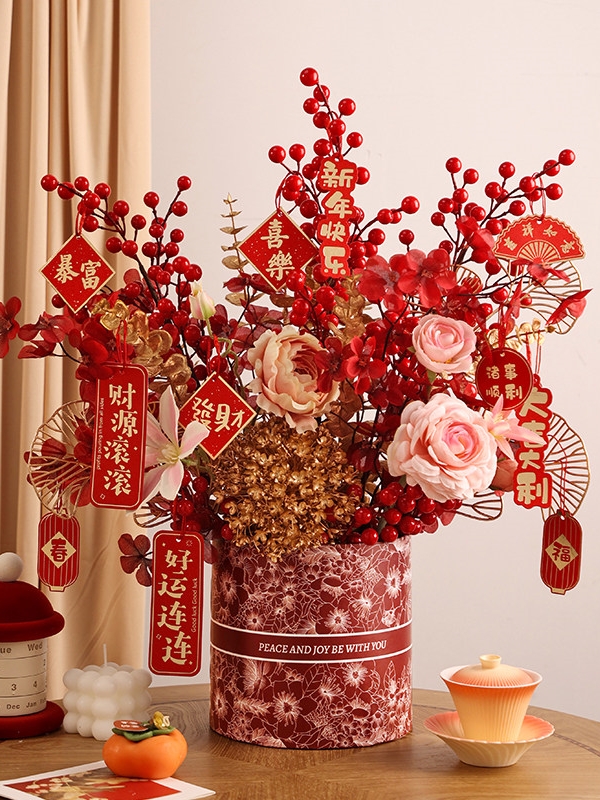
- Colour: Red and gold dominate. Pink, orange, and purple work as secondary accents. Avoid white and full yellow.
- Odd numbers: Stems are arranged in odd quantities — three, five, seven — because odd numbers are auspicious in Chinese numerology.
- Asymmetrical upward growth: Taller elements in the back or off-centre symbolise upward momentum and growing fortune.
- Wealth plus bloom: Pair one "wealth" plant (kumquat, money tree) with one "bloom" plant (peach branch, orchid, plum) for a balanced composition.
- Height and door placement: Doorway arrangements should rise above head height; table arrangements sit lower and face inward.
A simple starter arrangement for travellers: place a small potted kumquat on the floor by an entrance, lean one short peach blossom branch against a wall nearby, and set a shallow narcissus bowl on a side table near a window. The three together cover wealth, prosperity, and good luck with minimal effort.
Frequently Asked Questions
Q: When do Chinese New Year flower markets open?
Most markets open three to four days before Lunar New Year's Eve and run through Eve. For CNY 2026, that means roughly February 13–16 for mainland cities. Hong Kong's Victoria Park market typically starts earlier, around late January, and runs through February 16. Markets close on or before the second day of the new year.
Q: What are the best flowers for Chinese New Year?
The classic trio is peach blossom (桃花 — romance and prosperity), kumquat (金桔 — wealth and good fortune), and narcissus (水仙 — good luck). Orchid, plum blossom, lucky bamboo, and money tree are also widely purchased. All are available in peak condition during the year-end market window.
Q: Can foreigners buy flowers at year-end markets?
Yes — markets are open to everyone with no entry fee or restrictions. On the mainland, bring small RMB notes for stalls. In Hong Kong, larger vendors accept credit cards. Bargaining is normal and expected at all markets, regardless of who the buyer is.
Q: How much do flowers cost at a Chinese New Year flower market?
Prices vary by plant type and size. Typical 2026 ranges: narcissus bulb set $7–14 (¥49–99), small kumquat tree $14–28 (¥99–198), orchid $28–70 (¥198–498), premium peach blossom branch $35–110 (¥250–780). Prices rise on the final day; buying a day earlier typically offers better selection at slightly lower prices.
Q: Where is the biggest Chinese New Year flower market?
By trade volume, Kunming's Dounan is the world's largest cut-flower trading hub year-round. By cultural fame, Guangzhou's district flower streets (天河, 越秀, 海珠, 荔湾) offer the most iconic CNY market experience. Hong Kong's Victoria Park is the most internationally accessible, with bilingual signage and card payment at larger stalls.
Q: When should I throw away my Chinese New Year flowers?
Traditionally, year-end plants are disposed of on or after Lantern Festival — the 15th day of the new lunar month, which falls on March 3, 2026. Many families keep lucky bamboo, money trees, and orchids as permanent houseplants. Peach blossom branches and kumquat trees, which deteriorate after the festival, are typically composted or discarded at that point.
Q: What flowers are bad luck for Chinese New Year?
Avoid chrysanthemums and white lilies (funeral associations), cacti and spiky plants (symbolising conflict), four-stalk lucky bamboo (the number four sounds like the word for death), and entirely white or yellow bouquets (connected to mourning). Stick with red, pink, gold, orange, and purple blooms.
Q: Can I ship flowers home after visiting a China flower market?
Difficult and risky for live plants — most countries restrict soil and live plant imports, including the US, EU, UK, Australia, and New Zealand. Cut flowers without soil are easier to transport but still face inspection. Cold-chain international shipping from Kunming via DHL or FedEx costs $50–100 or more per shipment, and customs may still seize the package. Check your destination country's official agricultural import rules before purchasing.