Lingyin Temple Hangzhou China
Lingyin Temple Hangzhou China stands in the foothills northwest of West Lake, a 1,700-year-old monastery carved into Hangzhou's limestone landscape. The temple complex draws visitors for its towering Qing dynasty halls, a gilded Shakyamuni statue coated in roughly 60 taels of gold, and the adjoining Feilai Feng cliff face with more than 300 Buddhist stone carvings spanning the 10th to 14th centuries. Few sites in China combine this density of historic statuary, rock art, and active monastic life within a single scenic area. This guide covers the three practical gaps that most English-language resources leave open: how foreign visitors can actually book tickets through channels that accept international cards, when the evening lighting brings the courtyard to life, and how to link Lingyin with the Bird's Nest Garden and Yongfu Temple on a single loop.
Quick Facts
History and Buddhist Significance
Lingyin Temple was founded in 328 CE by the Indian-trained monk Hui Li, who chose a quiet valley in the Wulin foothills west of West Lake for his monastery. The name "Ling-yin" translates directly as "Soul's Retreat," a reference to the sense of withdrawal the site's natural setting created. During the Eastern Jin dynasty the temple received its current name, and it became a center for Chan Buddhism over the following centuries.
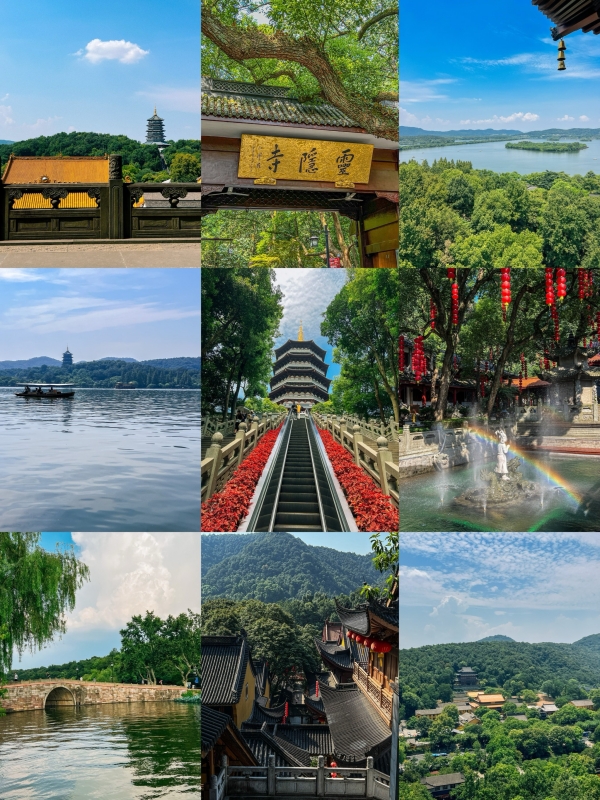
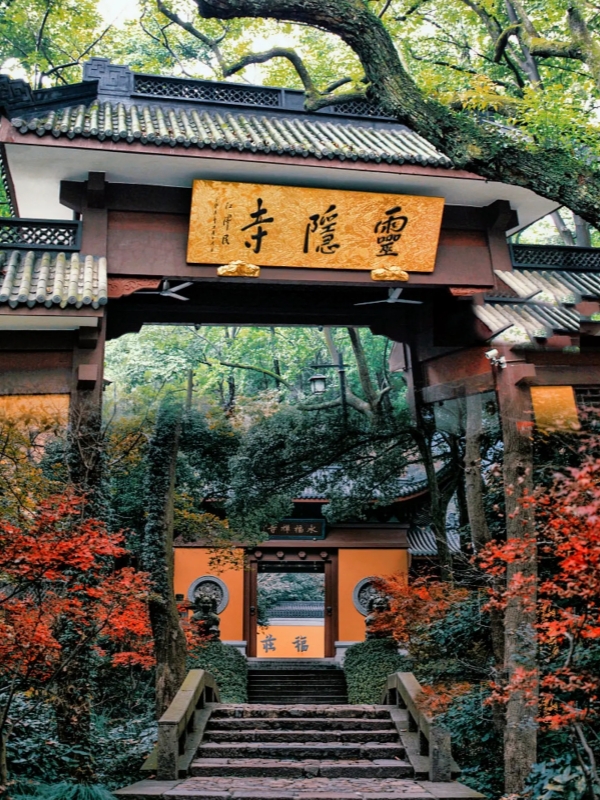
The Wuyue Kingdom period from 907 to 978 CE marked the temple's peak, when more than 3,000 Chan monks are said to have studied here. The inscription above the entrance plaque reads "咫尺西天," meaning "the Western Heaven is just a foot away," a phrase that frames the visit as a threshold between the ordinary world and the sacred. Wars repeatedly damaged the complex, but major restorations in the late 20th century brought it back to life. Today Lingyin ranks among the wealthiest and largest monasteries in China, operating within the Lingyin-Feilai Feng Scenic Area and drawing both worshippers and visitors from around the world.
📍 Plan Your Sightseeing Route: Pair your temple visit with clear transit routes and district breakdowns using our Hangzhou City Map.
Inside the Temple: Halls and Statues
-

- Lingyin Temple Hangzhou China
-
- Lingyin Temple Hangzhou China
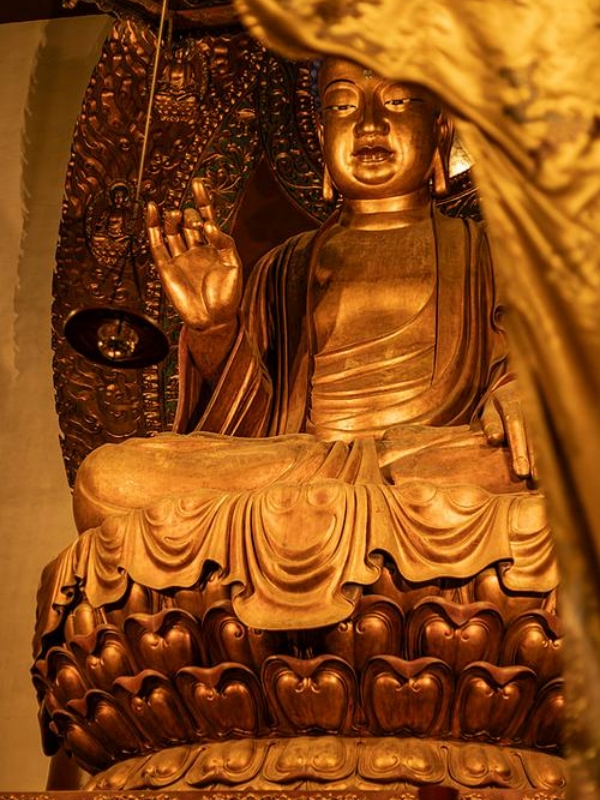
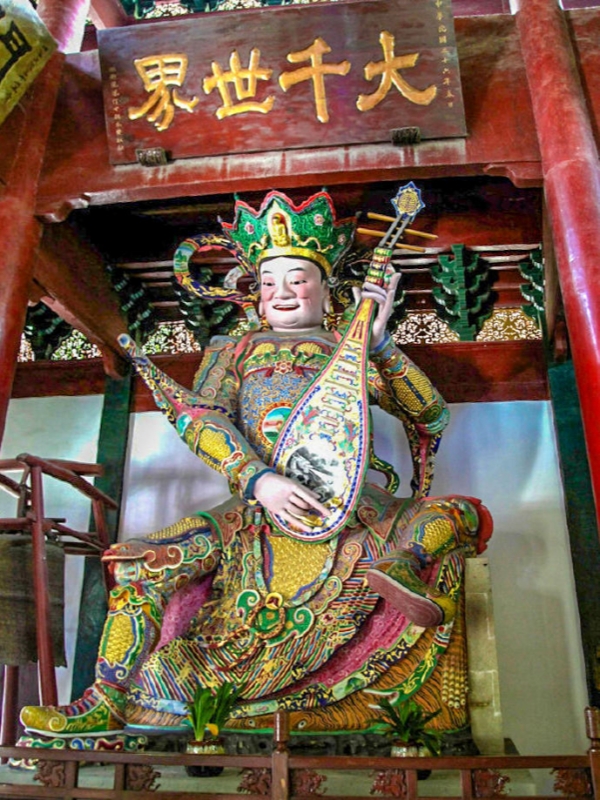
The temple follows a five-hall Chan layout along a formal north-south axis, with the three front halls rebuilt during the Qing dynasty and the two rear halls reconstructed in modern times. Moving uphill from the entrance, visitors pass through each hall in sequence, encountering statuary that ranges from the 9th century to the present day. This layered construction means the complex contains both original Qing craftsmanship and contemporary additions, making it one of the most complete monastic complexes in eastern China. The scale escalates as you move inward: what begins with guardian figures at the gate builds to the towering Shakyamuni in the Grand Hall, the largest wooden Buddhist statue in the country.
Hall of the Heavenly Kings and the Skanda Buddha
The first major structure inside the gate is the Hall of the Heavenly Kings, where Maitreya appears in his familiar Laughing Buddha form holding prayer beads and a cloth sack, a symbol of contentment in Buddhist teaching. Behind Maitreya stands the Skanda Buddha, also known as Weituo, a guardian figure that is roughly 800 years old — the oldest large statue in the Lingyin complex. The Four Heavenly Kings flank the entrance, each representing a direction and a virtue. This hall serves as both an introduction to Buddhist iconography and a transition into the more solemn spaces ahead.
Grand Hall of the Great Sage
The Grand Hall of the Great Sage (Daxiong Baodian) is the largest structure at Lingyin, standing 33.6 meters tall. At its center sits a 24-meter seated Shakyamuni Buddha gilded with approximately 60 taels of gold. This statue is the largest wooden Buddhist figure in China, backed by a carved wooden screen depicting around 150 arhats in varied poses and expressions. Guanyin, the Bodhisattva of Compassion, stands to one side, completing the hall's central triad. The sheer height of the hall and the gleam of the gilded surface make this the climactic interior sight of any Lingyin visit.
Medicine Buddha Hall, Sutra Library and the Five Hundred Arhats
Behind the Grand Hall lies the Medicine Buddha Hall, which houses the seated Medicine Buddha alongside attendant bodhisattvas. Adjacent to it, the Sutra Library preserves Buddhist texts in a setting that reinforces the temple's scholarly function alongside its devotional role. The Hall of Five Hundred Arhats, a modern installation, features life-size painted statues, each with a distinct expression and posture. This hall has become one of the most photographed spots in the complex, and it serves as a logical endpoint before visitors exit back toward the temple gate.
🛶 Discover Hangzhou's Water Trails: Combine your morning monastery tour with a afternoon visit to lush marshlands by reading our guide to Xixi Wetland.
Feilai Feng and the Stone Grottoes
-
- Lingyin Temple Hangzhou China
-
- Lingyin Temple Hangzhou China
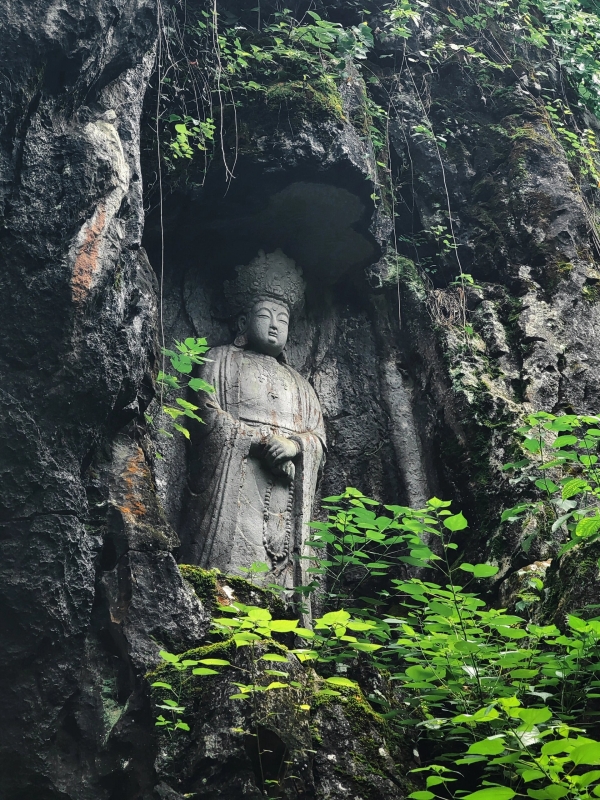
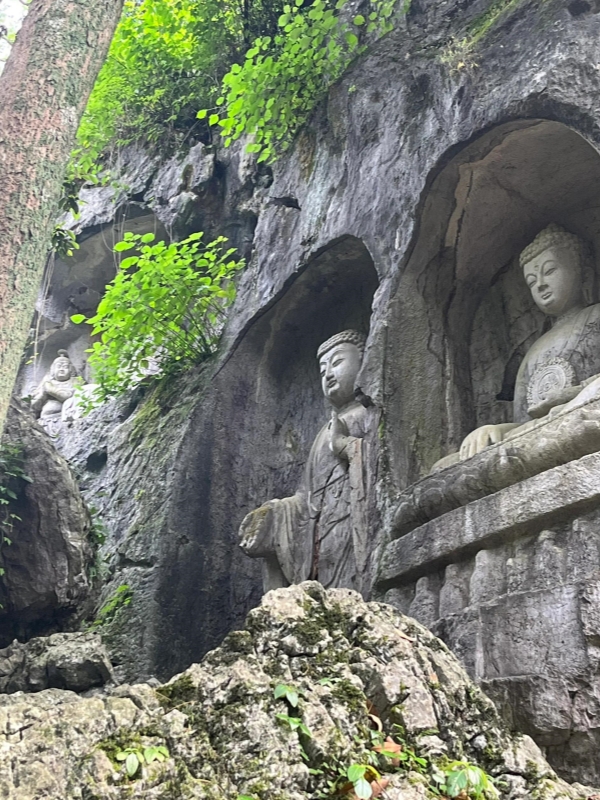
Feilai Feng, which translates as "The Flying Peak," is a limestone outlier rising beside the temple. Unlike the granite hills surrounding it, this peak's limestone formation is geologically distinct, which gave rise to the legend that it flew overnight from India to demonstrate Buddhist power. The cliff face holds more than 300 stone carvings created during the Five Dynasties through the Yuan dynasty, spanning roughly the 10th to 14th centuries. This makes Feilai Feng one of China's largest surviving Buddhist rock-art sites. The carvings are best photographed in the morning when raking light catches the limestone texture and highlights the relief against the rock face.
- Qinglin Cave: the deepest grotto with the most intact carvings, including clustered figures from the Yuan period
- Yuelian Cave: contains early figures from the Five Dynasties era, among the oldest on the peak
- Longhong Cave: features a seated dragon and lotus motif, a frequent subject in Buddhist cave art
- Maitreya Niche: the most iconic carving on the western slope, depicting Maitreya in a relaxed posture
- Yuan-era Guanyin Group: a multi-figure carving showing Guanyin with attendants, dating from the 13th–14th centuries
Night Visit, Lighting Times and Nearby Routes
Evening lighting transforms Lingyin's courtyard during peak season, illuminating the Heavenly Kings gate, the Grand Hall exterior, and the 咫尺西天 inscription wall in a warm glow. The temple interior closes with the complex, so the night visit is atmospheric rather than a full open-hall experience. In spring and summer, lighting typically runs until roughly 21:00; in autumn and winter it ends closer to 20:30. These times shift year to year, so confirming on the day is the safest approach. Feilai Feng does not open in the evening, so night visits focus on the temple grounds themselves. Several complementary routes extend the evening into a longer loop.
- Bird's Nest Garden Loop: exit the temple's north gate and walk to the Bird's Nest Garden, a small landscaped aviary-style space with bamboo and bird enclosures, then return via Fajing Lane through the old village path
- Yongfu Temple Tea Garden: the quieter sister temple is covered by the combo ticket and has a tea garden open during the same evening window — pair with Lingyin for a two-temple circuit
- West Lake Sunset Combo: finish at West Lake's Beishan Road for sunset, then Didi back to central Hangzhou in about 15 minutes — total evening loop roughly 4 hours with transport
Evening Hours and Temple Lighting
The temple gates close around 18:30 in winter and later in summer, with the interior halls shutting when the complex officially closes. The illuminated areas are the Heavenly Kings gate, the Grand Hall exterior facade, and the inscription wall at the entrance — these create a striking backdrop for evening photography without requiring access to the interior. The lighting schedule depends on sunset time and season, so checking locally on the day of your visit gives the most accurate window.
The Bird's Nest Garden and Fajing Village Link-Up
The Bird's Nest Garden sits just outside the temple's north exit, a compact green space designed around bird habitats and bamboo groves. Fajing Lane connects back toward Yongfu Temple via a low-traffic walking lane lined with boutique guesthouses and tea houses. Linking all three — Lingyin, the Bird's Nest, and Fajing Lane — takes roughly 30 to 45 minutes and avoids backtracking through the main temple gate.
Yongfu Temple and West Lake Sunset Combos
Yongfu Temple occupies the same scenic area and is included in the combo ticket, making it a natural add-on for visitors who want a quieter experience than Lingyin itself. The temple's tea garden stays open through the same general hours. From Yongfu or Lingyin, West Lake's Beishan Road is roughly 15 minutes by Didi, making a same-evening loop entirely feasible. Return transport from West Lake to central Hangzhou is straightforward by Didi or metro.
🌊 Explore Famous West Lake Views: Located just east of the foothills, Hangzhou's most famous UNESCO World Heritage site offers historic causeways, pagodas, and boat rides. Read our visitor overview of Hangzhou Xi Hu.
Tickets, Opening Hours and How to Book
Lingyin Temple charges about $4–6 (¥30) for entry, while Feilai Feng requires a separate ticket of about $6–8 (¥45). The best value option is the combined ticket covering Lingyin, Feilai Feng, and Yongfu Temple at roughly $10 (¥75) — this bundle saves money and covers the full scenic area. Children below the height threshold enter free and students with valid ID receive a reduced rate, though both policies should be confirmed on site since thresholds can change. The temple gates close at 18:30 in winter and later in summer; Feilai Feng shuts at 17:30 with last entry typically one hour before close. Morning queues peak between 09:00 and 11:00, while the gates are noticeably calmer after 14:00. Free-entry windows are occasionally announced for major Buddhist holidays, so checking the official site before visiting is worthwhile.
Getting There and Visitor Tips
Reaching Lingyin Temple is straightforward from Hangzhou's transport hubs. From Hangzhou East HSR station, the fastest option is Didi for about 40 minutes at a cost of roughly $12–17 (¥80–120); the alternative is Metro Line 1 combined with a bus transfer, which takes longer but costs significantly less. From the West Lake area along Beishan Road or Hubin Road, Didi covers the distance in 10 to 15 minutes for about $3–5 (¥20–35). City buses K7, 807, Y1, and Y2 all stop directly at the Lingyin Temple station, making public transport viable without a metro connection. On-site parking is limited and fills quickly, so public transport is preferable during busy periods.
- Dress code: cover shoulders and knees inside all halls; comfortable shoes for the Feilai Feng stairways
- Incense: provided free at the entrance — buying outside is unnecessary
- Photography: allowed in courtyards; flash is prohibited inside halls
- Behavior: keep voices quiet; avoid pointing feet at statues when seated
- Best timing: visit just after opening or after 14:00 for the calmest halls; arrive early for Feilai Feng to catch morning raking light on the carvings
- Peak days: the 1st and 15th of the lunar month and major Buddhist holidays draw larger crowds — plan accordingly
Frequently Asked Questions
Q: How much does Lingyin Temple Hangzhou China cost to enter?
about $4–6 (¥30) for the temple alone, about $6–8 (¥45) for Feilai Feng, or about $10 (¥75) for the combined ticket covering Lingyin, Feilai Feng, and Yongfu Temple. Book via Trip.com or Klook for international card access. Children below the height threshold enter free and students with valid ID qualify for reduced rates — confirm thresholds on site.
Q: Can you visit Lingyin Temple Hangzhou China at night?
The temple closes around 18:30 in winter and later in summer, with the interior halls shut when the complex closes. The courtyard, Heavenly Kings gate, and Grand Hall exterior are illuminated during evening hours in peak season — an atmospheric experience rather than an open-hall visit. Feilai Feng does not operate at night.
Q: How long does a visit to Lingyin Temple Hangzhou China take?
Allocate 2–3 hours for the temple complex alone. Adding Feilai Feng extends the visit to 3–4 hours. A full half-day route that links Lingyin, the Bird's Nest Garden, and West Lake sunset runs roughly 4 hours with return transport factored in.
Q: How do you get from West Lake to Lingyin Temple Hangzhou China?
Didi takes 10–15 minutes from Beishan Road or Hubin Road at a cost of about $3–5 (¥20–35). City buses K7, 807, Y1, and Y2 stop directly at the Lingyin Temple station. No direct metro connection exists, so bus or car is the practical option.
Q: Do I need to book Lingyin Temple Hangzhou China tickets in advance?
Advance booking is not mandatory, but it is recommended during weekends and Buddhist holidays. Trip.com and Klook sell combo tickets that are usable by foreign cardholders and skip the on-site domestic-only queue — this is the most reliable path for international visitors.
Q: What should I wear to Lingyin Temple Hangzhou China?
Covers for shoulders and knees are required inside all halls. Comfortable walking shoes are essential for navigating the Feilai Feng steps and the temple's uneven paths. Modest colors are respectful but not strictly enforced.
Q: What is Feilai Feng and is it worth the extra ticket?
Feilai Feng is the limestone peak beside the temple, covered with more than 300 Buddhist stone carvings from the Five Dynasties through the Yuan dynasty. The Maitreya niche on the western slope and the Yuan-era Guanyin group are the standout carvings. The separate ticket of about $6–8 (¥45) is worth it for anyone with an interest in Buddhist rock art.
Q: Is Lingyin Temple Hangzhou China walkable from West Lake?
Only as a long walk of roughly 1.5 hours via Beishan Road. Didi or a city bus is the practical choice for most visitors, taking 10–15 minutes by car.