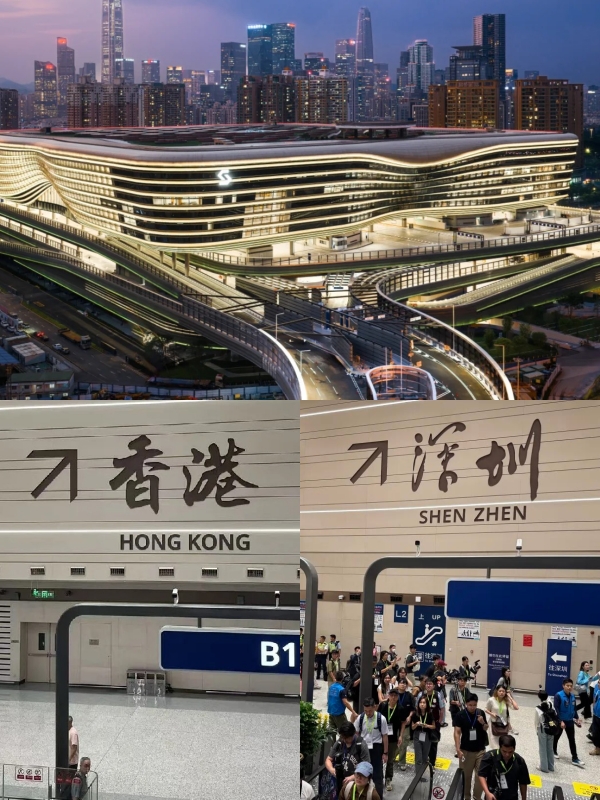
Huanggang Port Foreign Passport
At the new Huanggang Port, most foreign passport holders step into the wrong lane, walk up to the wrong floor, and only realize the mistake when an officer waves them back. Since 12 October 2026, the Shenzhen–Hong Kong border has run through a single 24-hour terminal — and almost everything a foreign passport holder assumed about the old crossing needs to be re-learned.
If you carry an ordinary foreign passport, the new self-service lane will not read your book. The right lane is the manual counter, where you present your documents to both Shenzhen and Hong Kong officers separately. The floors have changed, the hours have changed, the customs thresholds have changed. This guide walks a Huanggang Port foreign passport crossing through what actually applies after 12 October 2026.
Quick Facts
🛍️ Hong Kong Arrival Planning: Looking for related planning information on the Hong Kong side after you cross? Read our Hong Kong maps and transport guide.
From 12 October 2026, a Single 24-Hour Terminal Replaces Two Old Ones
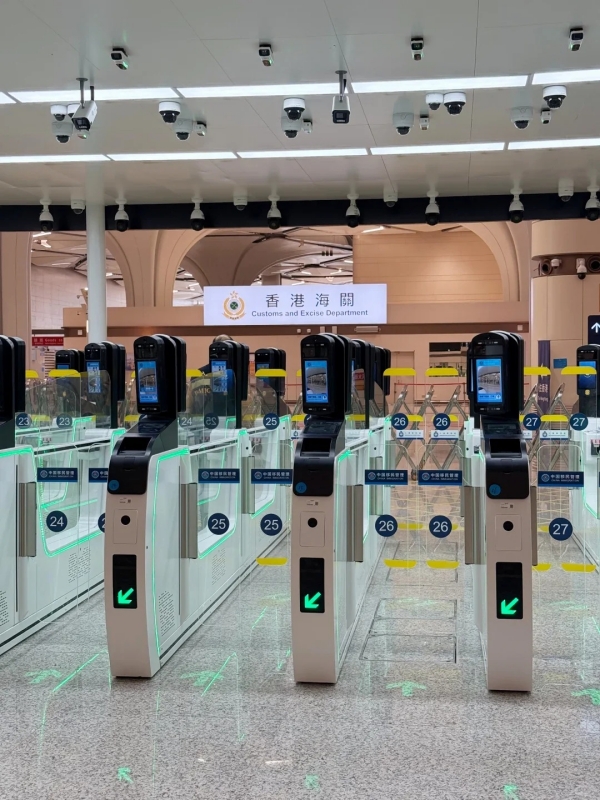
Automated immigration gates in new Huanggang Port terminal
The single biggest change for any Huanggang Port foreign passport crossing is that the building itself is new. What used to be two separate facilities straddling the Shenzhen–Hong Kong border became one 24-hour terminal that opened at 06:30 on 12 October 2026. The old crossing the old maps remember is gone.
For visitors coming from Shenzhen, the practical effect is simple: there is one address, one set of floors, and one rule set that covers both the mainland exit and the Hong Kong entry. For visitors coming from Hong Kong, the practical effect is just as simple — one building, one entry floor, and one shared customs zone.
What Actually Opened on 12 October 2026
At 06:30 on 12 October 2026, the new Huanggang Port began handling both passenger and cross-boundary coach traffic through a single building. The 24-hour service window is carried over from the previous arrangement; it isn't a new hub. The new building absorbs the function of the two old crossings and runs it from a single terminal that operates every hour of every day.
For a Huanggang Port foreign passport holder, what that means in practice:
- One building, not two side-by-side checkpoints.
- 24-hour service is the baseline, not a special extension.
- Same floors serve the same direction every day — no seasonal rotation between old and new halls.
What Closed on the Same Day
The old checkpoints closed at the same hour the new building opened. The old temporary inspection building on the mainland side and the Lok Ma Chau control point on the Hong Kong side both stopped handling passenger traffic at the moment of the switchover.
Two things this switchover did not affect:
- The Lok Ma Chau Spur Line rail link and Futian Port still operate on their existing schedules — only the road-based passenger facilities on each side closed.
- Cross-boundary vehicle permits issued for other crossings are not automatically invalid; the change is about the building, not about the vehicles.
If you have an old map or a screenshot from before October 2026 showing a different address or a different building name, treat it as outdated. Navigate to the new Huanggang Port by name and by metro station, not by a pre-October pin.
How "One Country, Two Systems" Reads on This Crossing
Hong Kong and the mainland run separate immigration systems. The new Huanggang Port's "collaborative inspection, joint clearance" model aims to make this invisible — but only for travelers who qualify for it. For everyone else, two checks still happen, just in the same building.
For the manual lane, you queue once. At the counter, Shenzhen and Hong Kong officers conduct their respective checks side by side or back-to-back at the same workstation — you present your documents once, but both sides process your clearance before you are released. It is still two sovereign checks, but they happen in a single stop rather than at two separate buildings.
Read that again if you carry a foreign passport: the manual lane is not the same workflow as the self-service lane. One scan does not do two clearances.
Five Documents, Three Real Lanes — Where Your Passport Actually Sends You
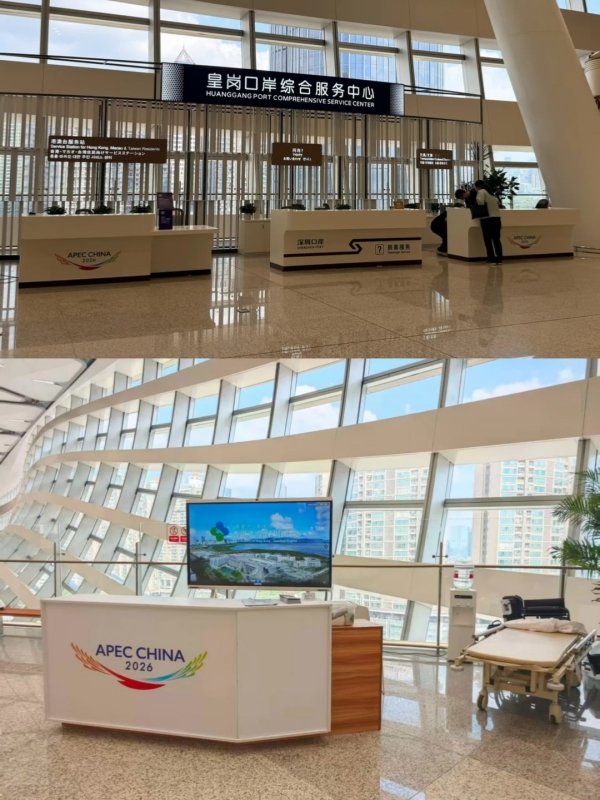
Huanggang Port Comprehensive Service Center
The cleanest test of a Huanggang Port foreign passport crossing is the lane test. Walk up to the hall, look at the gates, and the gate itself will tell you whether you qualify. The official rule is set by the Hong Kong Immigration Department, not by the country printed on your passport cover.
The gate will refuse the scan, the queue will move on, and the only path left is the manual counter. That is the lane every foreign passport holder should plan for unless they hold the specific combination listed below.
The Five Categories That Decide Your Lane
Hong Kong Immigration Department publishes the categories that qualify for the collaborative self-service lane at the new Huanggang Port. None of them is "ordinary foreign passport." A Huanggang Port foreign passport holder needs to find their category on this list before expecting the gate to open.
The five categories — none of which is nationality alone — include:
- Hong Kong residents holding a valid Hong Kong permanent identity card.
- Mainland residents holding the Mainland Travel Permit for Hong Kong and Macau Residents, with a valid endorsement.
- Non-Chinese passport holders who hold the Mainland Travel Permit for Hong Kong and Macau Residents (Non-Chinese Version) and have completed mainland-side fast-channel registration.
- Cross-boundary students and frequent travelers registered for the joint service under specific conditions published by Immigration.
- Other document classes explicitly listed by Immigration — the list is updated as the service expands.
The combination that matters most for foreign passport readers is the third: a Hong Kong permanent resident who holds the non-Chinese version of the Mainland Travel Permit and has completed the mainland-side fast-channel registration. That is the only combination in which a non-Chinese passport automatically reaches the self-service lane.
Self-Service Reads Biometrics, Not Just Your Passport
For the categories that do qualify, the lane reads two things: the document scan and the biometric registration on file. The biometric registration has to be set up in advance — it is not a step you can complete at the gate. A face scan and a fingerprint match done on the spot will not substitute for prior registration.
For an ordinary foreign passport holder walking up to the gate, the practical sequence is short and predictable:
- Present your passport at the manual counter on the side of your direction — Shenzhen exit or Hong Kong entry.
- Complete the second check at the next station in the same hall (mainland or Hong Kong, depending on direction).
- Collect the entry / exit stamp or slip from each side as you would at any older crossing.
- Keep the slip — both sides may request it at exit or during your stay.
The self-service lane is a benefit reserved for travelers who already match the published categories and have completed biometric registration. If you are reading this from your hotel room and you do not match a category, skip the self-service lane entirely.
The HKPR + Non-Chinese Permit Exception
There is one category worth calling out separately because it looks like nationality on the cover but is actually a document combination. A Hong Kong Permanent Resident (HKPR) who also holds the non-Chinese version of the Mainland Travel Permit for Hong Kong and Macau Residents, and who has completed the mainland-side fast-channel registration, can use the new self-service lane at the new Huanggang Port.
The logic is three-part:
- Hong Kong permanent residency confirms right of abode in Hong Kong.
- The non-Chinese permit confirms mainland-side entry eligibility as a non-Chinese traveler.
- The mainland fast-channel registration ties the two together with a biometric record.
Missing any one of the three means the self-service lane is not for you. The non-Chinese permit does not, by itself, unlock the gate — and the Hong Kong ID card alone does not, either. If you carry only one of the two, walk to the manual counter.
Walk Through the New Terminal — Floor by Floor from Metro to Bus
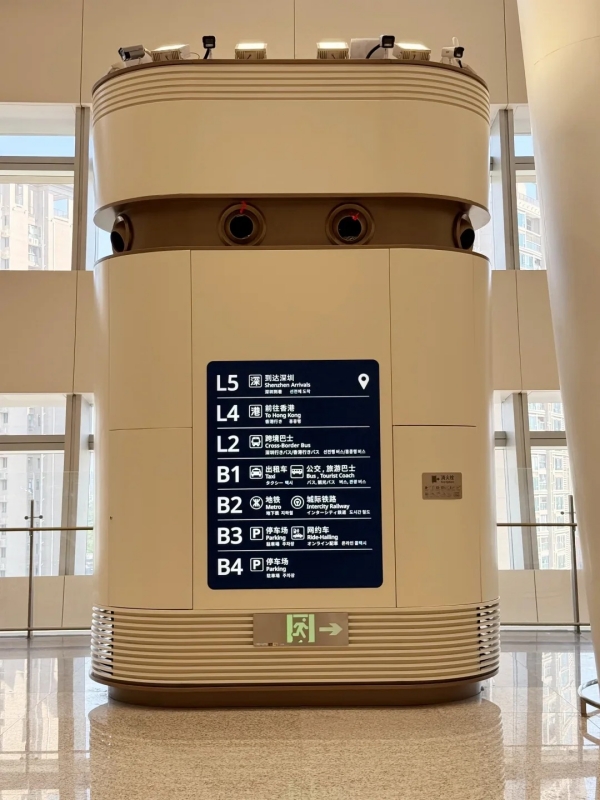
Huanggang Port New Terminal Multi-Floor Direction Sign
You won't need a translator for a Huanggang Port foreign passport crossing — you need to know which floor you are on. The building is split between above-ground levels (L2, L4, L5) where the actual clearance happens, and below-ground levels (B1, B2, B3) where you arrive from Shenzhen. Each level has a fixed role, and the signs only help if you already know what you are looking for.
The two questions every foreign passport holder should answer before stepping into the building: am I going from Shenzhen to Hong Kong (south), or from Hong Kong to Shenzhen (north)? And after I clear, am I changing to the metro or staying on a cross-boundary coach? Those two answers set your floors.
Heading South (Shenzhen → Hong Kong)
Coming from Shenzhen, you arrive at one of three below-ground levels depending on how you got there, and you finish clearance on L4. After clearance, you drop down to L2 to pick up a cross-boundary coach, a taxi, or a minibus into Hong Kong.
The four-step southbound path:
- Arrive at B1 (taxi / public bus drop-off), B2 (Shenzhen Metro Line 7, Huanggang Port Station), or B3 (ride-hailing).
- Take the elevator up to L4, the Shenzhen-departure clearance hall.
- Clear mainland exit at the manual counter — present your foreign passport and any required Chinese entry document.
- Drop to L2, the Hong Kong-side transport hub, and pick a cross-boundary coach, taxi, or minibus to your destination in Hong Kong.
Two timing traps on the southbound path: the elevator bank between the B levels and L4 can back up around peak times, and L2 is where the cross-boundary coaches queue — walk past the queues and find your line by destination, not by queue length.
Heading North (Hong Kong → Shenzhen)
Coming from Hong Kong, you arrive at L2 by whatever mode of transport you took from the Hong Kong side. Clearance happens on L5. After clearance, you drop to one of the B levels depending on how you plan to leave Shenzhen.
The four-step northbound path:
- Disembark at L2 from your cross-boundary coach, taxi, or minibus.
- Take the elevator up to L5, the Hong Kong-departure / mainland-entry clearance hall.
- Clear Hong Kong exit and mainland entry at the manual counter — present your foreign passport and any required Chinese entry document.
- Drop to B1, B2, or B3 to continue by taxi, Shenzhen Metro Line 7, or ride-hailing.
One branching decision matters: if you are staying on the same cross-boundary coach all the way through, you re-board at L2 after clearance — you do not drop to the B levels. The building handles both terminating trips and through trips, but they use different exits from the clearance hall.
Which Floor to Tell Your Taxi or Didi
Three different pickup layers, three different destinations. Telling the driver the wrong one is the most common reason foreign passport holders end up circling the building.
How the layers split:
- B1 — taxi stand and public bus drop-off on the Shenzhen side. Tell your taxi driver to drop you at "Huanggang Port B1" or "皇岗口岸 B1."
- B2 — direct indoor link to Shenzhen Metro Line 7, Huanggang Port Station. No taxi access at this level.
- B3 — ride-hailing pickup only. Tell your ride-hailing driver to drop you at "Huanggang Port B3" or "皇岗口岸 B3."
If you are arriving from Hong Kong by cross-boundary coach, your floor is L2 — the coach drops you inside the building at that level, not outside on the curb.
Before You Leave the Hotel — Passports, Visas, Apps, and Customs Cash
Five things to do before you leave the hotel, and customs won't slow you down. The first three are documents and apps; the last two are the cash and tobacco thresholds that trip up first-time foreign passport holders most often.
Your Passport, Visa, and Onward Ticket
Whether your Huanggang Port foreign passport crossing needs a visa depends on three things: your nationality, the length of your stay, and whether you are transiting onward to a third country. Each path has different rules, and the document you need is set by that path, not by the building.
Three paths to know:
- Tourist / business stay: a valid Chinese visa (L, M, or other appropriate category) issued before arrival.
- Unilateral visa-free entry: passport holders from eligible countries can enter without a visa for a published stay length.
- 240-hour transit visa-free: 57 eligible countries, 65 approved ports, 24 approved provinces — confirm the current port list includes Huanggang Port for your specific itinerary before relying on this.
Two things this does not change: a Chinese visa is not a substitute for Hong Kong entry eligibility, and the Mainland Travel Permit for Hong Kong and Macau Residents (the standard blue booklet) is not a general-purpose document for foreign passport holders. Bring the document that matches your entry path, not the one that matches the building.
Money, Apps, and Offline Backups
Three app-level things to set up before you reach the new Huanggang Port. None of them are optional in 2026.
- Alipay or WeChat Pay with a foreign Visa or Mastercard linked before departure — the international version of Alipay accepts most foreign cards after upload of the passport page.
- Didi (English version) with a foreign phone number and a foreign card — accepts ride-hailing without a Chinese SIM.
- Offline maps and translation — Amap (Gaode) or Maps.me for offline navigation, Pleco or Apple Translate for offline Chinese, with the hotel address saved in Chinese characters.
The hotel address in Chinese matters more than the map language. Even on Google Maps the drivers navigate by Chinese address, and ride-hailing apps route by Chinese building names. Print or screenshot the address in Chinese before you leave the hotel.
Cash, Tobacco, and What Not to Pack
The two customs sides have separate rules. Don't combine them.
Mainland side:
- RMB cash limit: ¥20,000 per person per crossing (approx. HK$21,600 / US$2,800).
- Foreign currency entry: declaration required above USD 5,000 or equivalent.
- Foreign currency exit: amounts above USD 5,000 may require a bank-issued "Carrying Certificate" depending on prior entry records — confirm the exact rule with your bank before relying on it.
Hong Kong side:
- Cash and bearer-negotiable instruments (BNI): declaration required at entry above a total value of $15,400 (HK$120,000).
- Cigarettes: 19-cigarette duty-free allowance for travelers aged 18 and over for personal use; amounts above the allowance must be declared.
- Alternative smoking products: banned from import into Hong Kong, including via land crossings — this covers e-cigarettes, related devices, and other listed items.
The phrase "declare and you can take anything" does not apply on either side. Each side has a separate rule set, and the declarations are different in scope.
After Midnight and Beyond — When the Port Is Open but Nothing Else Is
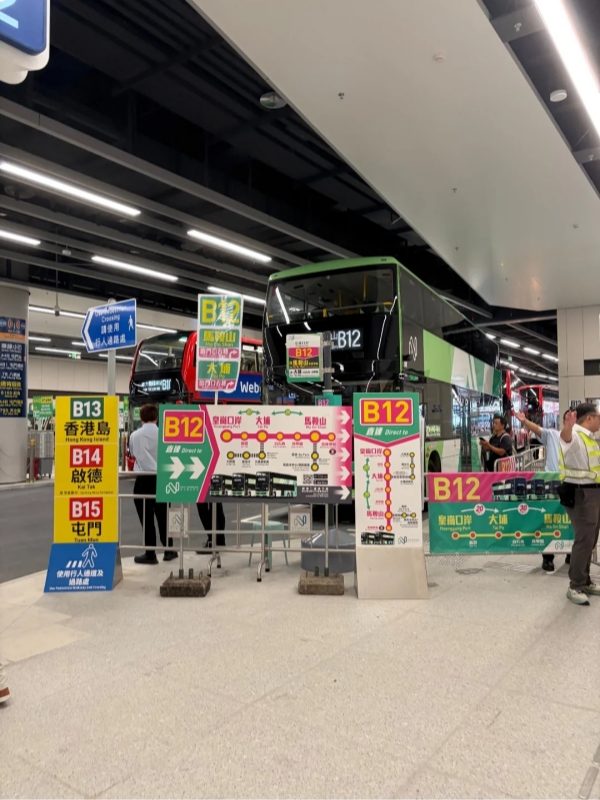
Huanggang Port Cross-Border Bus Stops
The new Huanggang Port is 24 hours. The Shenzhen Metro is not. The cross-boundary coaches on L2 mostly are. Knowing which side of the 24-hour line you are on is what makes the difference between a clean 2 a.m. crossing and a stranded cab rank.
The Port Is 24-Hour — Your Ride May Not Be
The terminal operates every hour of every day. The Shenzhen Metro Line 7 — the direct link to B2 — closes overnight on its own schedule, not on the terminal's. The last trains on Line 7 leave the Huanggang Port Station around 23:00 on weekdays; the first trains resume around 06:00.
Past midnight, your real options collapse to:
- Overnight cross-boundary bus lines on L2 — see the next section for routes and operators.
- Taxis at B1 on the Shenzhen side and at the Hong Kong-side taxi rank — wait times are longer overnight.
- Ride-hailing at B3 — Didi works overnight but the matching time stretches past midnight.
If your flight lands at Shenzhen Bao'an or you have an early-morning train, build your plan around the overnight buses, not the metro. The metro will not save you at 03:00.
Late-Night Bus Lines Worth Knowing
The new terminal's published transport list includes a set of overnight routes that run from L2. Routes and operating hours are listed by the terminal's transport desk and by the individual operators — treat those as the live source, since routes can shift on short notice.
Routes that are routinely listed as overnight or 24-hour service:
Several short-distance cross-boundary coaches (Mong Kok, Wan Chai, Tsuen Wan lines, for example) also publish 24-hour service windows. Confirm the timetable at the L2 coach desk before assuming a 24-hour run on a specific date.
Racing for a Flight or the Park? Prices and Schedules Move
Late-night and early-morning cross-boundary rides serve two main purposes: getting to a flight out of Hong Kong International Airport, and getting to a pre-opening slot at Hong Kong Disneyland.
Two practical notes for that trip:
- The published city-airport check-in desk at L2 is the place to ask about current schedules, operators, and prices. Schedules and fares have shifted since the old temporary building closed — assume nothing older than the October 2026 opening still applies.
- The older published ¥80 fare and 45-minute ride time were tied to the old temporary building. Do not assume those numbers apply to the new building — confirm on the day.
If you are aiming for a flight or a park open, the safe pattern is the official coach desk at L2 plus a buffer of 30 minutes. Pin your time on the operator's published timetable, not on a memory of the old service.
Edge Cases — 240-Hour Transit, Vehicle Permits, On-the-Spot Renewals
Three conditions that catch foreign passport holders off guard at the new Huanggang Port: the 240-hour transit rule versus the older 144-hour talk; cross-boundary vehicle permits in the first phase of operation; and on-the-spot visa renewal or extension. None of them has a clean yes/no answer from the public material, so plan around the limits.
The 240-Hour Transit Rule vs. the Old 144-Hour Talk
The current mainland transit-visa-free framework is 240 hours, 57 eligible countries, 65 approved ports, and 24 approved provinces. It is not the older 144-hour, 54-country framework. Travel-blog posts and travel-agency sites that still mention 144 hours are repeating an outdated rule.
For a Huanggang Port foreign passport crossing, three conditions must hold for the 240-hour rule to apply:
- Eligible nationality — confirm your country is on the current 57-country list.
- Onward ticket to a third country or region with a confirmed date and seat.
- Entry and exit through approved ports — confirm the published current port list before relying on Huanggang Port as your entry point.
Traveling into mainland China as part of a Shenzhen–Hong Kong–onward routing? Critical caveat: the 240-hour transit visa-free scheme applies at designated air, sea, and land ports. Not every land border crossing between Hong Kong and Shenzhen is automatically on the eligible port list. As of the new terminal's opening, publicly published eligible-port lists for the 240-hour scheme have not uniformly included Huanggang Port — confirm against the National Immigration Administration's current list before planning your itinerary around this rule. If Huanggang is not listed, you will need a valid Chinese visa or another eligible entry document.
Vehicle Permits, Airport Counters, and the Onward-Borrow Plan
Cross-boundary vehicle permits were a deliberate part of the 06:30 opening choice — at that hour only vehicles registered for Huanggang Port are typically the active cross-boundary fleet. The official briefing noted that vehicles registered to other crossings can use those other crossings at the same time, which means the first-phase arrangement is more about scheduling than about an outright ban.
For a foreign passport holder, three practical readings:
- If you are taking a cross-boundary coach, the operator's permit covers the vehicle; you don't need to do anything extra.
- If you are driving, confirm your permit covers the Huanggang Port route on the date you plan to cross.
- If you are met by a driver on the other side, confirm the same with the driver before you set off.
For airport-city terminal services (the L2 desk for Hong Kong International Airport check-in), confirm on the day. Schedules and fares have moved with the new building.
Renewing a Visa or Extending a Stay on the Spot
Don't plan on fixing a visa problem at the new Huanggang Port. The terminal is built for clearance, not for visa renewal. Whether there is an in-building renewal or extension desk is not confirmed by public material, and the closest published mainland-side renewal points (for example, the local Public Security Bureau offices in Shenzhen) sit some distance from the new building.
The safer rule for a foreign passport holder:
- Confirm visa and entry-document validity before you leave the hotel — passport validity, visa validity, the correct endorsement, the correct number of entries.
- Confirm 240-hour transit eligibility in advance if you are relying on the transit rule.
- Bring copies of your onward ticket and accommodation — both sides may ask at clearance.
If your visa or endorsement is borderline, sort it before you reach the building, not after.
Frequently Asked Questions
Q: As a foreign passport holder, can I use the self-service lane at Huanggang Port?
No, not by default. The self-service lane is for five published categories that do not include "ordinary foreign passport." A Huanggang Port foreign passport holder should plan to use the manual counter, presenting the passport separately to the mainland-side officer and the Hong Kong-side officer. The HKPR + Non-Chinese Mainland Travel Permit combination, with mainland fast-channel registration completed, is the only path that opens the self-service lane for a non-Chinese passport.
Q: Is Huanggang Port really 24 hours?
Yes for the terminal itself — passenger and cross-boundary coach clearance runs every hour of every day after 12 October 2026. The Shenzhen Metro Line 7 link at B2 closes overnight, and several bus routes run limited late-night schedules. For overnight crossings, the practical options are the published overnight bus routes from L2 and taxis at B1.
Q: What documents do I need to cross Huanggang Port with a foreign passport?
Three paths set the requirement: a valid Chinese visa (L, M, or another category), a passport from an eligible unilateral visa-free country, or the 240-hour transit rule (57 countries, 65 ports, 24 provinces — confirm Huanggang Port inclusion for your itinerary). A Chinese visa does not substitute for Hong Kong entry eligibility. The standard Mainland Travel Permit for Hong Kong and Macau Residents is not a general-purpose document for foreign passport holders.
Q: Which floor should I tell my taxi or Didi driver at Huanggang Port?
Taxi: B1. Ride-hailing: B3. Metro Line 7: B2, Huanggang Port Station. Do not search just for "Huanggang Port" in the ride-hailing app — different pickup layers exist for different modes, and the wrong pin sends you circling the building. If you arrive from Hong Kong by cross-boundary coach, your floor is L2 inside the building, not the curb outside.
Q: Do I need to declare cash in either direction?
Yes, separately. Mainland side: RMB cash limit is $2,800 (¥20,000) per person; foreign currency entry requires declaration above USD 5,000 or equivalent. Hong Kong side: cash and BNI entry requires declaration above $15,400 (HK$120,000) total value. The two rule sets do not combine, and "declare and you can take anything" does not apply on either side.
Q: Can I bring e-cigarettes or extra cigarettes into Hong Kong?
E-cigarettes and other alternative smoking products are banned from import into Hong Kong, including via land crossings at Huanggang Port. Travelers aged 18 and over have a 19-cigarette duty-free allowance for personal use; amounts above the allowance must be declared. Carrying untaxed amounts without declaring them is treated as smuggling, not as a small overage.
Q: Can I apply the 240-hour transit visa-free at Huanggang Port?
Conditional on your itinerary. The current public framework is 57 countries, 65 approved ports, and 24 provinces for 240-hour transit. Confirm the published current port list explicitly includes Huanggang Port for your specific routing before relying on it. The older 144-hour / 54-country figures are outdated and should not be used for planning.
Q: Is the ¥80 airport coach from Huanggang Port still available?
The ¥80 fare and 45-minute ride time published earlier in 2026 were tied to the old temporary Huanggang Port building, not the new terminal that opened on 12 October 2026. For the new building, the safe pattern is to confirm schedules and fares at the official city-airport check-in desk on L2 on the day, with a buffer of 30 minutes if you are catching a flight.