Chinese Panda Names
Every giant panda born at a Chinese research base receives a deliberate Chinese name before its public debut. Enclosure signs display the characters, a Pinyin romanization, and sometimes a short English meaning. The names are rarely arbitrary — they tend to cluster around a small set of auspicious characters that carry wishes for fortune, preciousness, sprouting vitality, or floral beauty. This article explains how Chinese panda naming works, introduces the most famous pandas living in China today, profiles the celebrity pandas now drawing crowds in South Korea, Japan, and the United States, and lays out what foreign visitors need to know to see them in person. One thing to know upfront: the Chinese term 熊猫 (xióngmāo) literally translates as "bear cat," not "panda."
Quick Facts
How Chinese Panda Names Work
Chinese Panda Names
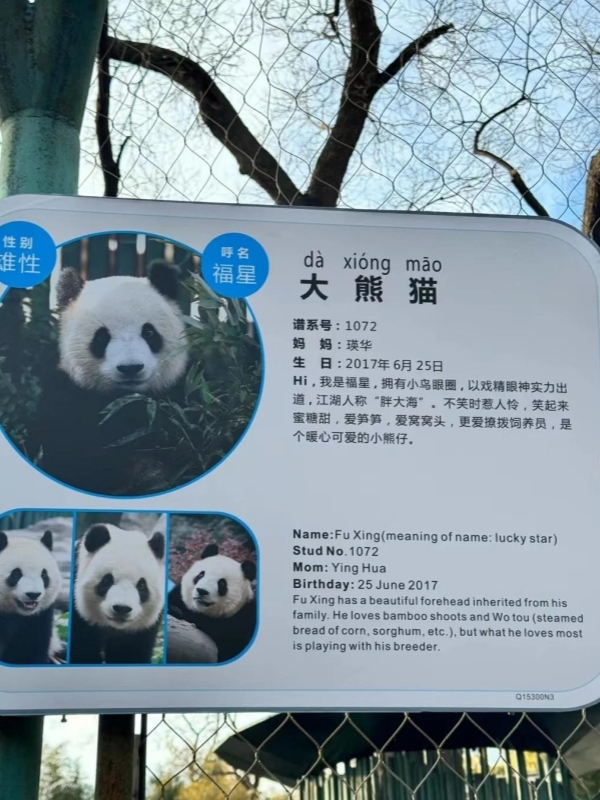
Chinese research bases assign every giant panda a one- or two-character name before the public introduction. The characters chosen tend to carry positive meanings, and siblings often share one character to reflect lineage. Enclosure signs at major bases display the Chinese characters, Pinyin spelling, and a short English translation.
The Word "Panda" in Chinese
The standard term for the giant panda is 大熊猫 (dàxióngmāo, "big bear-cat"). In everyday speech, the shortened form 熊猫 (xióngmāo, "bear-cat") is used instead. The word refers to the giant panda unless context makes clear otherwise. Early museum labeling in the 20th century used the reversed form 猫熊 ("cat-bear"), but spoken usage flipped the order and 熊猫 became standard. The English word "panda" was first applied to the red panda in the 1820s–1830s and later reused for the giant panda; the etymology likely traces to a Nepali or Tibetan source rather than Chinese. The giant panda's scientific name is Ailuropoda melanoleuca; the red panda's is Ailurus fulgens.
Common Meaning Patterns in Panda Names
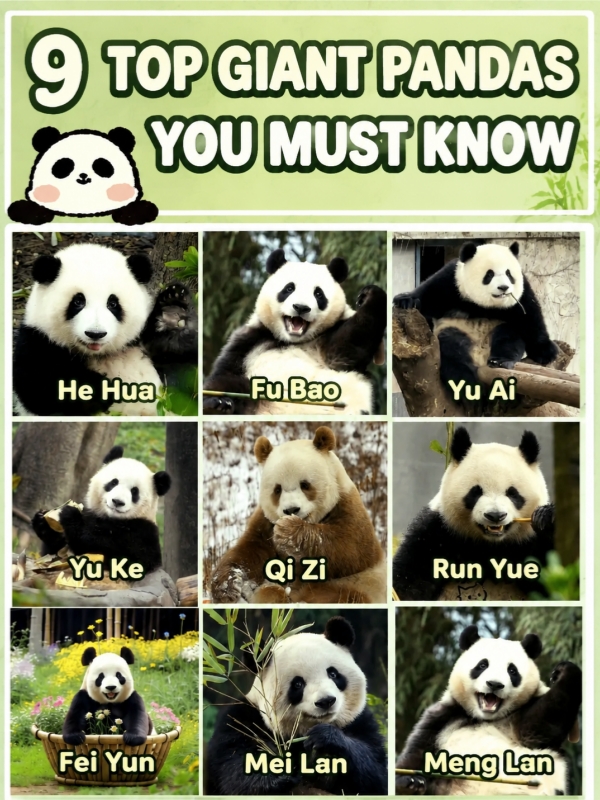
Panda names cluster around a recognizable set of auspicious characters. Here are the most common patterns with a real example panda for each.
- 福 (fú) — fortune and luck: Fu Bao (福宝, "Fortune Treasure") at Everland before returning to Wolong; Fu Shun (福顺, "Fortune Smooth") at the Chengdu Base
- 宝 (bǎo) — treasure and preciousness: Bao Bao (宝宝, "Baby Treasure") at the Smithsonian before returning to Bifengxia; Bao Li (宝力, "Treasure Strength") at Madrid Zoo
- 萌 (méng) — cute and sprouting: Meng Lan (萌兰, "Sprout Orchid") at Beijing Zoo; Meng Da (萌大, "Sprout Big") at Beijing Zoo
- 奇 (qí) — unique and strange: Qi Yi (奇一, "Strange One") at the Chengdu Base; Qi Fu (奇福, "Strange Fortune") at the Chengdu Base
- 花 (huā) — flower: Hua Hua (花花, "Flower Flower") at the Chengdu Base
- 美 (měi) — beautiful: Mei Lan (美兰, "Beautiful Orchid") at Atlanta before returning to China; Mei Xiang (美香, "Beautiful Fragrance") at the Smithsonian
Red Panda Names in Chinese
The red panda carries the standard name 小熊猫 (xiǎoxióngmāo, "small bear-cat"). The folk name 九节狼 (jiǔjiéláng, "nine-segment wolf") refers to the nine colored rings on its tail. Some sources use 红熊猫 (hóngxióngmāo, "red bear-cat") to avoid confusion with the giant panda. The English word "panda" was originally coined for this species; the giant panda was named later for its apparent resemblance.
Most Famous Pandas in China
Chinese Panda Names
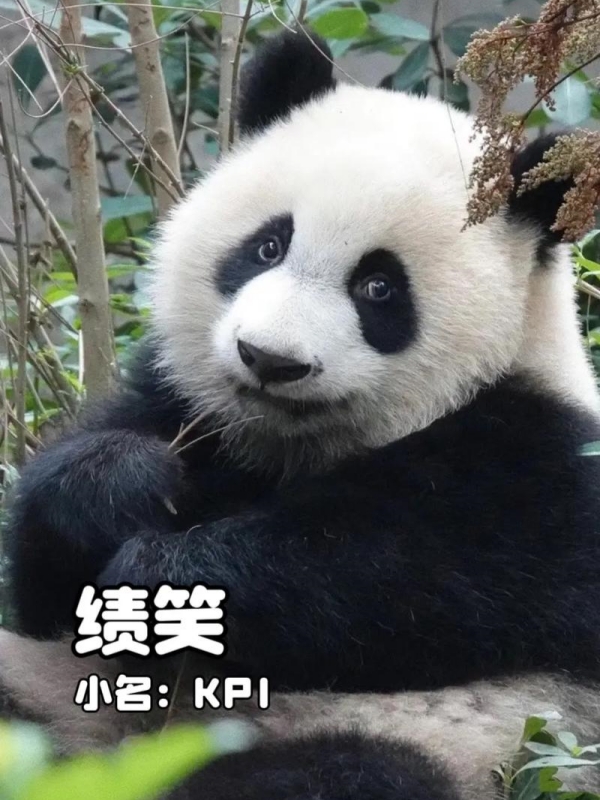
The Chengdu Panda Base is the main home of the current "idol" generation — named pandas who have become public figures through social media, viral videos, and a devoted fan base that tracks them by their Chinese names. Other mainland zoos also hold notable residents worth knowing before a visit.
Chengdu Panda Base Stars
- 花花 (Huāhuā, "Flower Flower") — female, born July 2020, Chengdu Base; nickname "rice ball" due to her triangular short-legged build; a turned-out right hind leg makes her the only base panda unable to climb trees; widely considered the top idol of the current generation
- 奇一 (Qíyī, "Strange One") — female, born July 1, 2016, Chengdu Base; the WiFi-shaped head tuft and a 2017 CCTV video of her clinging to a keeper's leg went viral worldwide; her image served as the visual basis for the 18 mascot icons of the 2021 Chengdu Universiade
- 福顺 (Fúshùn, "Fortune Smooth") — male, born July 14, 2016, Chengdu Base; twin sister Fu Lai; famous for a head-first fall from a baby stage in September 2016; the photo was selected by Time magazine as one of its 2016 photos of the year
Other Noteworthy Chinese Pandas
- 萌兰 (Ménglán, "Sprout Orchid") — male, born 2015, Beijing Zoo; playful personality and an escape artist who briefly climbed out of his enclosure in 2023; younger brother of Meng Da, Meng Er, and Meng Shuang; siblings share the 萌 character
- 七仔 (Qīzǎi, "Seventh") — male, rescued in November 2009 from Foping National Nature Reserve in Shaanxi; the world's only captive brown-and-white panda; round head earned him a nickname referencing the film character "CJ7"
- 新星 (Xīnxīng, "New Star") — female, Chongqing Zoo; died in December 2020 at age 38, the longest-lived captive giant panda on record
- 飞云 (Fēiyún, "Flying Cloud") — female, born August 2010, Dalian Forest Zoo; known for her rounded face and calm demeanor
Famous Pandas Overseas
Chinese Panda Names
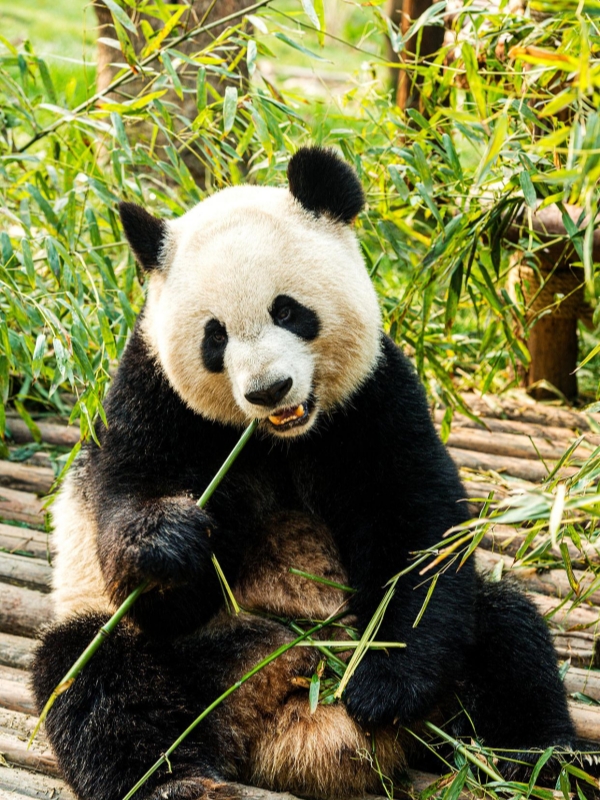
China sends giant pandas abroad under long-running research and breeding loan agreements. Each overseas panda carries its Chinese name alongside a translated version used in the host country. Most pandas eventually return to China for breeding programs or as agreements expire.
South Korea — Fu Bao at Everland
Fu Bao (福宝, "Fortune Treasure") was the first naturally-bred panda born in South Korea on July 20, 2020 at Everland Resort in Yongin. Her mother is Ai Bao (爱宝, "Love Treasure") and her father is Le Bao (乐宝, "Joy Treasure"). She was raised under Chinese keeper Song Bao-gom, nicknamed "Grandpa Jiang" in Korean media. The name carries 宝 ("treasure") reflecting her status as a symbol of China-Korea friendship. She was returned to China in April 2024 and now resides at the Wolong Shenshuping Panda Center in Sichuan.
Japan — Xiang Xiang at Ueno Zoo
Xiang Xiang (香香, "Fragrance") was born June 12, 2017 at Ueno Zoo in Tokyo, daughter of Bi Li and Xian Nu. The name was selected through a public vote in 2017, with 香 ("fragrance") as the winning choice. She was treated as a symbol of China-Japan friendship throughout her Tokyo residency. She was returned to China in February 2023 and now lives at the Chengdu Research Base of Giant Panda Breeding.
United States: Smithsonian, Memphis, San Diego
- Ya Ya (丫丫, "Yā Yā") — female, born August 3, 2000 at Beijing Zoo; lived at Memphis Zoo from 2003 to 2023 with companion Le Le; Le Le died in February 2023; Ya Ya returned to China in May 2023 and now resides at Beijing Zoo
- Xiao Qi Ji (小奇迹, "Little Miracle") — male, born August 21, 2020 at the Smithsonian's National Zoo in Washington DC; son of Mei Xiang ("Beautiful Fragrance") and Tian Tian ("Add"); named for being born during the pandemic; currently at the Smithsonian
- Bao Bao (宝宝, "Baby Treasure") — female, born August 23, 2013 at the Smithsonian; returned to China in February 2017; subsequently moved to Bifengxia where she has produced cubs
- Bei Bei (贝贝, "Baby Shell/Treasure") — male, born August 22, 2015 at the Smithsonian; returned to China in November 2019 to join the breeding program at Wolong
- Bai Yun (白云, "White Cloud") and Hua Mei (华美, "China-America Beautiful") — long-running pair at San Diego Zoo; Hua Mei, born in 1999, was the first US-born panda to survive to adulthood via artificial insemination; both returned to China over the 2010s and 2020s
Europe and Southeast Asia
- Tian Tian (甜甜, "Sweet") and Yang Guang (阳光, "Sunshine") — Edinburgh Zoo pair since December 2011; both returned to China in December 2023 after the loan agreement ended; Tian Tian is female, Yang Guang is male
- Lin Hui (林惠, "Forest Grace") — female, Chiang Mai Zoo in Thailand; partner Chuang Chuang died in September 2019; Lin Hui has remained at Chiang Mai as a long-term resident
- Yuan Yuan (园园, "Garden Garden") and Huan Huan (欢欢, "Happy") — Beauval Zoo, France; exchanged from China in 2012 and 2017 respectively; Huan Huan gave birth to Yuan Meng ("Dream Come True") and Mi Ni at Beauval, two of the first pandas ever born in France
Where to See Pandas: A Visitor Guide
Foreign visitors can see pandas at several major bases and zoos across China. Ticket prices below are quoted in USD with CNY in parentheses and are bookable on Trip.com or Klook so international visitors can purchase them in advance without needing a domestic payment method.
Chengdu Research Base of Giant Panda Breeding
The Chengdu base (成都大熊猫繁育研究基地, Chenghua District, Chengdu) is the most popular panda destination in China. The pandas are most active during morning feeding sessions from 8:00 to 11:00 AM; they nap through the afternoon. Summer heat above 30 °C (86 °F) drives them indoors, so the best visiting window is October through April.
- Adult ticket: about $11 (¥55)
- Child ticket: under 1.3 m, about $8 (¥55)
- Combined ticket with IMAX film: about $19 (¥135)
- Hours: 7:30 AM – 6:00 PM daily, last entry at 5:00 PM
- Metro: Line 3 to Xiongmao Avenue Station (熊猫大道站), then about 10 minutes on foot or shuttle bus
- Taxi: roughly $7 (¥50) from Chunxi Road, 30–40 minutes depending on traffic
Bifengxia and Other Sichuan Bases
Several other bases in Sichuan Province offer a quieter panda-viewing experience, often paired with an overnight stay.
- Bifengxia Panda Base (碧峰峡熊猫基地, Ya'an City): adult ticket about $14 (¥100); roughly 2 hours west of Chengdu by car or tourist bus; often combined with an overnight hotel stay
- Dujiangyan Panda Base (都江堰熊猫基地): adult ticket about $10 (¥70); about 1 hour from Chengdu by car or intercity bus from Chadianzi Bus Station; part of the Wolong conservation network; smaller and quieter than the main Chengdu base
- Wolong National Nature Reserve (卧龙国家级自然保护区): the original conservation area; visitor access is limited to the Wolong Shenshuping section; primarily a research base rather than a public viewing venue
Beijing Zoo and Other Mainland Locations
Beyond Chengdu, several major cities offer reliable panda exhibits that are easy to fit into broader travel itineraries.
- Beijing Zoo (北京动物园, Xicheng District): adult admission about $3 (¥19); panda hall about $3–5 extra (¥20–30); hours 7:30 AM – 7:00 PM (April–October), 7:30 AM – 5:30 PM (November–March); subway Line 4 to Beijing Zoo Station, exit D; home to Meng Lan and family
- Chongqing Zoo (重庆动物园): adult ticket about $3 (¥25); small but reputable panda exhibit; often included as a half-day add-on in Chongqing city itineraries
- Shanghai Wild Animal Park (上海野生动物园): panda exhibit; larger and more popular for panda viewing than the standard Shanghai Zoo
- Shanghai Zoo (上海动物园): smaller panda exhibit than Shanghai Wild Animal Park
Frequently Asked Questions
Q: What are red pandas called in Chinese?
The standard term is 小熊猫 (xiǎoxióngmāo, "small bear-cat"). The folk name 九节狼 (jiǔjiéláng, "nine-segment wolf") refers to the nine colored rings on the tail. 红熊猫 (hóngxióngmāo, "red bear-cat") is a variant used to distinguish it from the giant panda. The English word "panda" was originally coined for this species; the giant panda was named later for its resemblance.
Q: Why are some Chinese restaurants named "Panda"?
The giant panda is a national symbol of China and carries strong global brand recognition. Restaurant chains use "Panda" to evoke Chinese identity, friendliness, and warmth; the name also reads cleanly in English. Examples include Panda Express and Panda Inn in North America. Most "Panda" restaurant names are English-language brand names rather than direct Chinese translations.
Q: What is the Chinese name for a giant panda?
大熊猫 (dàxióngmāo, "big bear-cat") is the formal term. In everyday speech, 熊猫 (xióngmāo, "bear-cat") refers to the giant panda unless context indicates otherwise. The scientific Latin name is Ailuropoda melanoleuca; the red panda's is Ailurus fulgens.
Q: What does 熊猫 (xióngmāo) literally mean?
熊 (xióng) means "bear" and 猫 (māo) means "cat," so 熊猫 literally translates as "bear-cat." The original labeling in early 20th-century Chinese museums used the reversed order 猫熊 ("cat-bear"), but everyday speech flipped the order and 熊猫 became the standard form.
Q: How do giant pandas get their Chinese names?
Newborn cubs at major bases receive provisional names shortly after birth. For high-profile births, names may be chosen through public votes or naming ceremonies. Keepers and breeding staff often select names with auspicious characters such as 福 (fortune), 宝 (treasure), 萌 (sprouting), 奇 (unique), or 花 (flower). Siblings commonly share one character to reflect family lineage, as seen in the Meng family: 萌兰, 萌大, 萌二, 萌双.
Q: Where can visitors see a celebrity panda in China?
The Chengdu Research Base of Giant Panda Breeding (成都大熊猫繁育研究基地) is the most reliable place to see today's top idol pandas, including Hua Hua and Qi Yi. Bifengxia in Ya'an and Beijing Zoo, where Meng Lan lives, are also strong options. Ticket prices, hours, and transport details are in the Where to See Pandas section above.
Q: What is the scientific name for a giant panda?
The giant panda's scientific name is Ailuropoda melanoleuca. The red panda's scientific name is Ailurus fulgens.
Q: Are panda names shown in English at Chinese panda bases?
Yes — at major bases like Chengdu and Bifengxia, enclosure signs typically display the Chinese characters, the Pinyin romanization, and a short English meaning. Pinyin is the most common way foreign visitors encounter panda names written in English.
Q: What is the Chinese title of the "Kung Fu Panda" movies?
功夫熊猫 (gōngfu xióngmāo), literally "Kung Fu Bear-Cat." The main character is referred to as 熊猫 in the franchise and as 阿宝 (Ābǎo) in some early Chinese-language translations.