China Tour Guide Cost in 2026
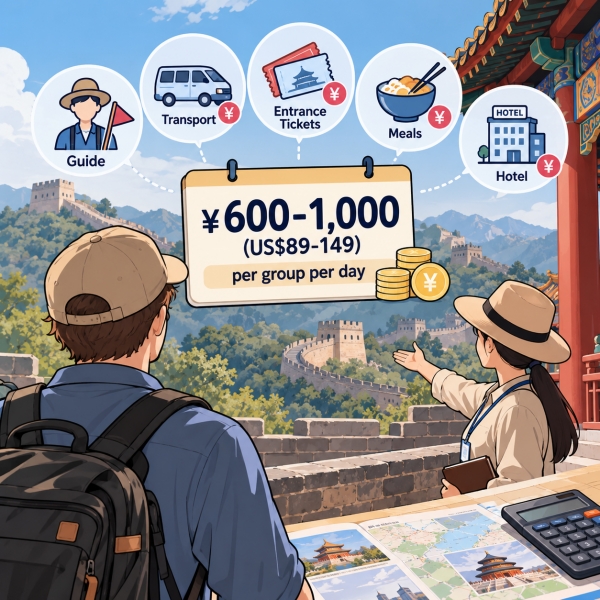
A private English-speaking guide in China runs $89–$149 (¥600–1,000) per group per day on a standard eight-hour day, and every published 2026 rate prices it that way — per group, not per person. But the rate alone tells you almost nothing about the day you are buying. In Chongqing the guide is most of your sightseeing budget, because the headline sights are free. In Zhangjiajie the guide is the smallest line on it, because the park ticket and the cableway rides cost more than the person showing you round. This guide covers all six cities where these quotes originate: what the rate buys, what you pay on top of it, and where a guide earns its place. China publishes no market average for this service, so none appears here.
Quick Facts
- 🛍️ China Travel Costs: Want the wider picture before committing to guided days? Read our China travel cost breakdown.
- 🛍️ Travel Buddy or Tour Guide: Weighing a cheaper companion service against a licensed guide? See how the two differ in our China travel buddy guide.
- 🛍️ Bundled Tour Packages: Comparing a day rate against an all-inclusive price? Review our Beijing tour package options.
China Tour Guide Cost by City in 2026
China tour guide cost means something different in every city, and the difference is not the rate. It is what the rest of your day costs around it. A ¥600 guide in Chongqing sits next to free sights and becomes the bulk of your spend. A ¥600 guide in Zhangjiajie sits next to a ¥236 park ticket and ¥65 cableway rides and becomes a rounding error. Judge the rate against the table below, never on its own.
Zhangjiajie, Chongqing, Chengdu — About $89–$119 (¥600–800) per Group
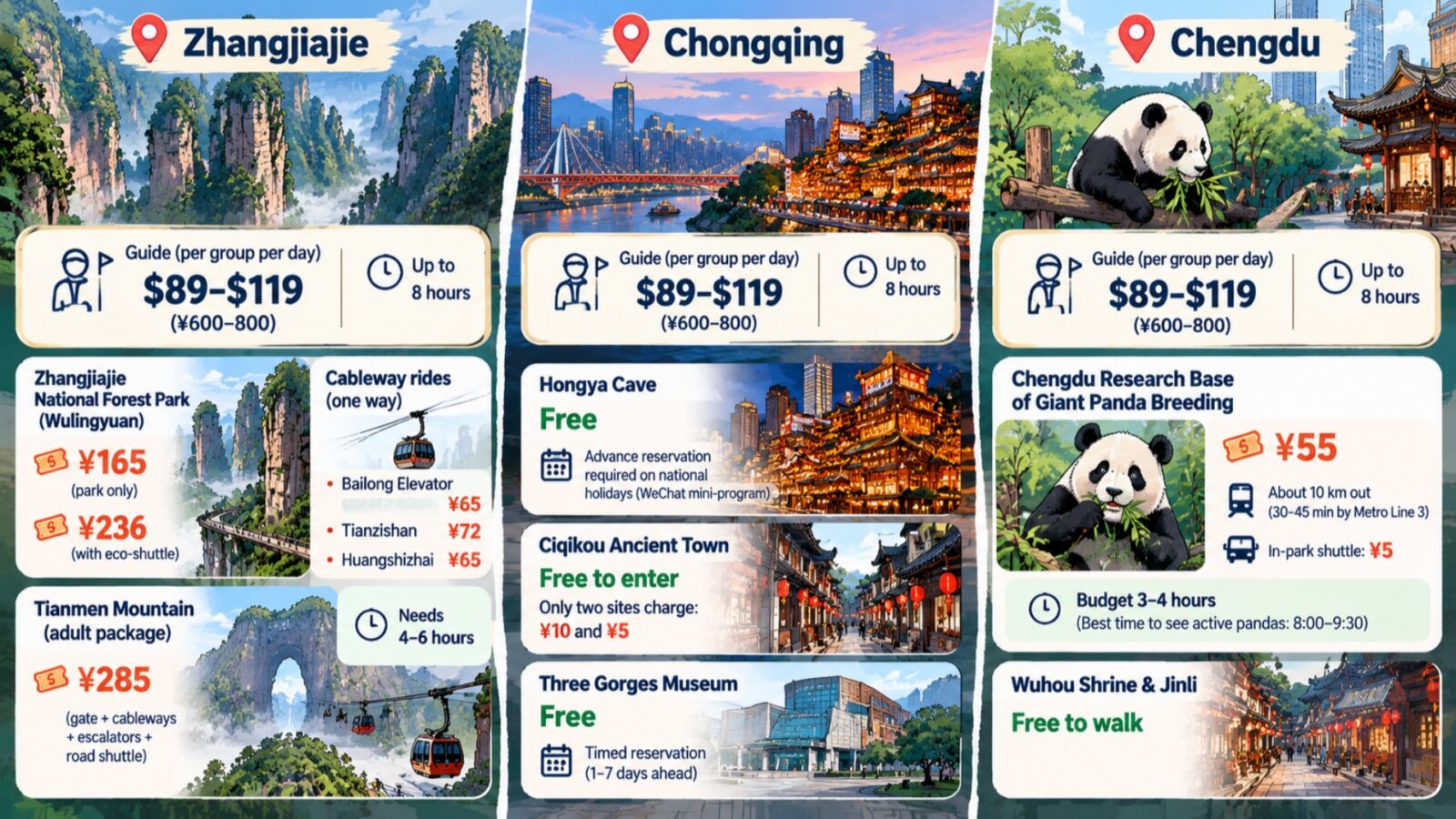
China Tour Guide Cost in Zhangjiajie, Chongqing and Chengdu 2026
The Cost in Zhangjiajie
Zhangjiajie is the case that breaks the intuition. One operator selling an English guide as a standalone product lists $89 (¥600) for the group, up to eight hours, with the vehicle priced as a separate line. The cheapest full day you can assemble there costs more than the guide does. Zhangjiajie National Forest Park at Wulingyuan runs ¥165 on its own, or ¥236 with the internal eco-shuttle, and covers four consecutive days with re-entry. Cableway rides sit on top again — ¥65 one way on the Bailong Elevator, ¥72 for Tianzishan, ¥65 for Huangshizhai. Golden Whip Stream alone is 7.5 km of level valley path, three to three and a half hours of walking, and the park covers a plateau big enough to feel like a small town with its own bus network.
Tianmen Mountain sells a different product entirely: one ¥285 adult package covering the gate, the cableways, the escalators and the road shuttle, and it needs four to six hours on its own. Its main cableway is out of service for construction, so the route runs on a reduced, date-dependent lineup. The two mountains sit 40 km apart on separate ticket systems, and nobody should try both in one day. Worth knowing before you book: mist can hide the sandstone pillars for hours, which is exactly the situation where a local guide earns their fee.
The Cost in Chongqing and Chengdu
Chongqing inverts the arithmetic completely. Hongya Cave is free, and on national holidays it needs a free advance reservation through a WeChat mini-program. Ciqikou Ancient Town is free to enter; only two sites inside it charge, at ¥10 and ¥5. The Three Gorges Museum is free, indoors and air-conditioned, on a timed reservation booked one to seven days ahead. Nothing here has a ticket price worth quoting, so a $89–$119 guide is effectively the whole cost of a properly informed day. What makes it demanding is the terrain: Hongya Cave stacks eleven storeys into a cliff face on the Jialing River, and you enter at street level and leave several floors lower near the water.
Chengdu sits between the two. The panda base charges ¥55 and lies about 10 km out on Metro Line 3, thirty to forty-five minutes from most hotels, with an in-park shuttle at ¥5. Budget three to four hours for it because the animals dictate the schedule: they feed and play between roughly 8:00 and 9:30 in the morning, then climb into trees and sleep. Arrive after ten and your ¥55 buys a viewing of pandas napping. Afternoons pair naturally with the Wuhou Shrine lanes and Jinli, which cost nothing to walk.
Beijing, Shanghai, Guangzhou — Roughly $119–$149 (¥800–1,000) per Group
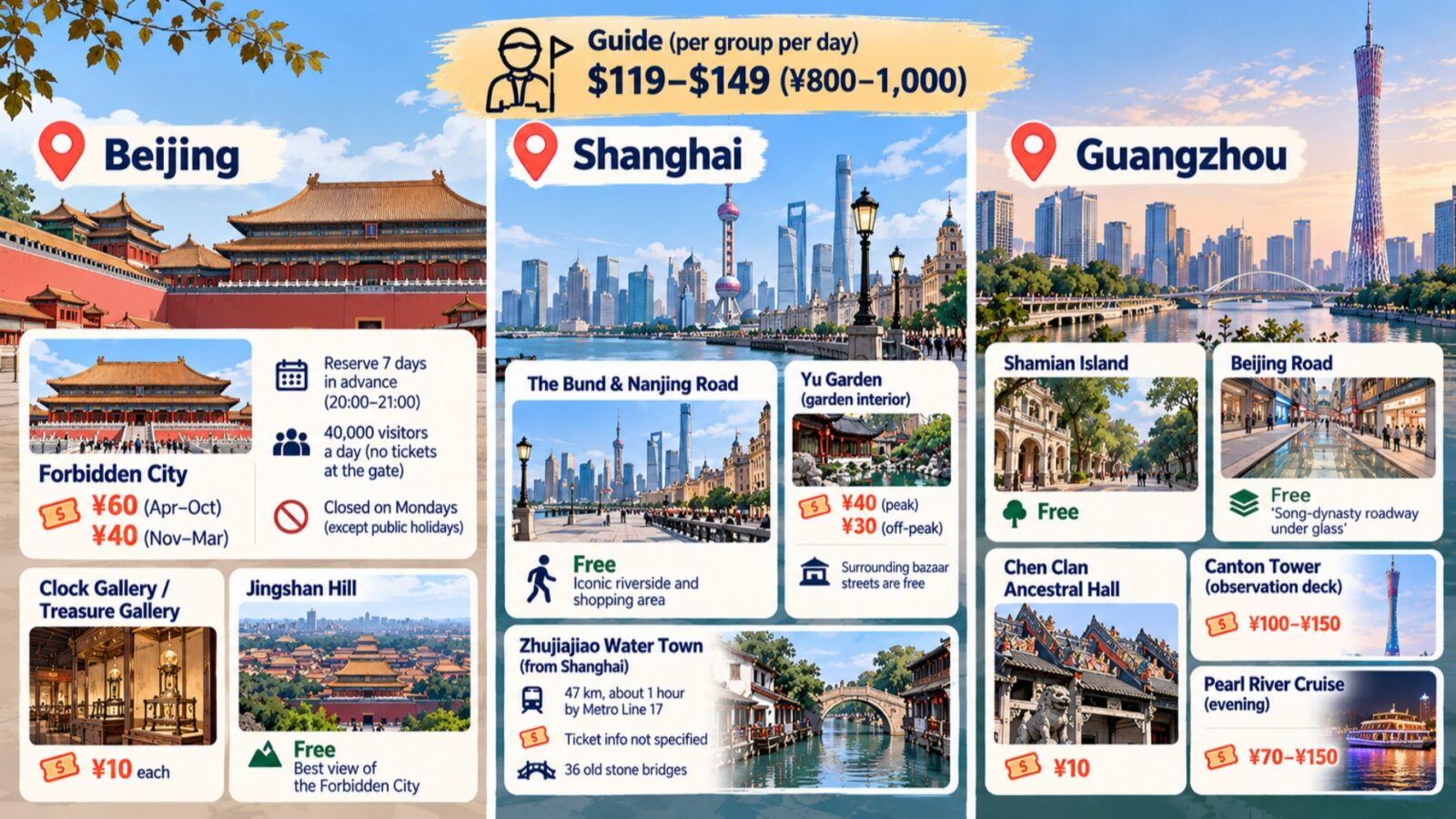
China Tour Guide Cost in Beijing, Shanghai, and Guangzhou 2026
The Cost in Beijing
Beijing's rate buys you the least access and the most sequencing. The Forbidden City caps entry at 40,000 visitors a day, sells no tickets at the gate, and opens reservations exactly seven days ahead in a one-hour window between 20:00 and 21:00 Beijing time. Tickets are non-refundable and non-transferable, and the palace closes on Mondays except public holidays. Entry runs ¥60 from April to October and ¥40 from November to March, with the Clock Gallery and Treasure Gallery at ¥10 each on top.
Inside, the complex covers 72 hectares and 980 buildings. Tour-bus crowds peak between 10:00 and 1:00, which is why the early slot matters more than the guide. A local guide can reroute you to the eastern and western wings while the central axis is shoulder-to-shoulder, then bring you back after the groups thin. Jingshan Hill, ten minutes north of the north gate, gives the best elevated view of the whole complex and stays uncrowded. What no guide can fix is a ticket that sold out in under a minute.
The Cost in Shanghai and Guangzhou
Shanghai is the inverse problem. Almost everything you want to see is free — the Bund, Nanjing Road, the former French Concession blocks. Yu Garden charges ¥40 peak and ¥30 off-peak, and only for the garden interior; the surrounding bazaar streets and the night-view zones cost nothing. Because the core walks well and the metro reaches it, a $119–$149 guide here buys routing, history and a working knowledge of which lanes are worth your time, rather than access to anything gated. If you want the canal town at Zhujiajiao, it is 47 km west and about an hour on Metro Line 17, with 36 old stone bridges once you arrive.
Guangzhou is compact and largely free. Shamian Island charges nothing. Beijing Road has an excavated Song-dynasty roadway under glass, also free, and the Shangxiajiu bazaar alongside it runs on open stalls. The Chen Clan Ancestral Hall, the finest intact piece of Lingnan wood, brick and ceramic carving in the city, asks about ¥10. Only the headline items cost real money: the Canton Tower observation deck at ¥100–¥150, and an evening Pearl River cruise at ¥70–¥150. With so much free material to interpret, the guide rate does more work here than the tickets do. Between May and October the heat is severe enough to push the middle of the day indoors.
Overtime Hours — $14.90–$29.81 (¥100–200), or $18–25 by Language
Overtime is the one fee that appears consistently across otherwise unrelated quotes. Operators bill it by the hour rather than folding it into the day. The Zhangjiajie page lists $14.90 (¥100) per hour. It applies only when you ask the guide to keep going. A 2026 quote sheet widens that to $14.90–$29.81 (¥100–200).
A national agency's Beijing product works differently again. It prices overtime by language at $18–25 per hour, denominated in US dollars rather than yuan. The base service still runs a full eight hours. Language therefore stops being a free option the moment the schedule slips.
No single standard overtime rate exists in China. Nor do these terms explain how operators round a part-hour up. Write the treatment into the booking message instead of assuming it.
Four Numbers to Fix Before You Ask for a Quote
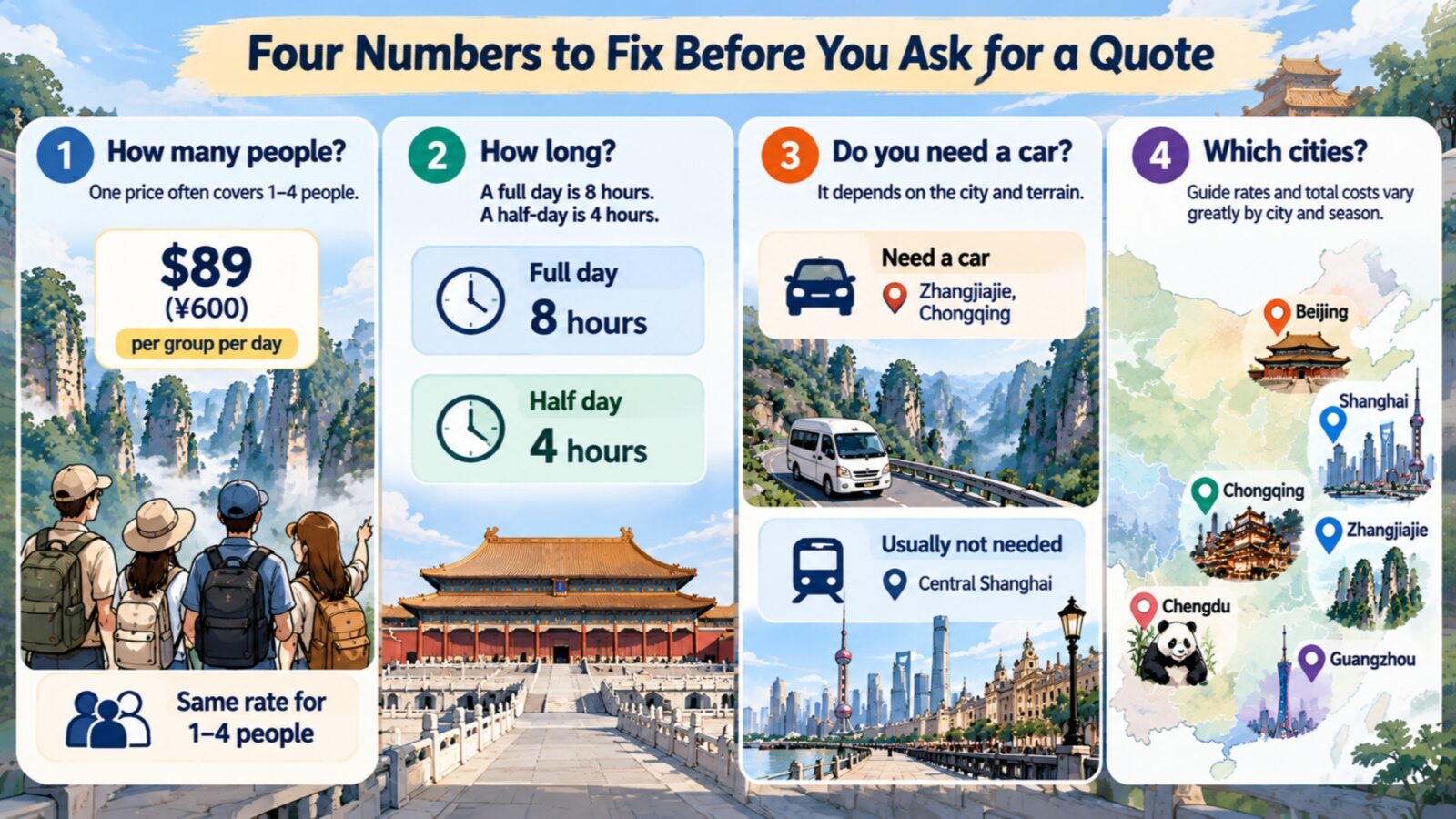
Four Key Factors For China Tour Guide Cost Quotes 2026
Send these four before you send a deposit, and whatever comes back becomes genuinely comparable. Fix them first and your China tour guide cost comparison stops being guesswork. Skip them and you do not compare prices — you compare four different products that happen to share an inbox.
- How many people: In the clearest published case the rate stays identical for 1–4 people, so a solo traveller pays the whole figure alone. Other operators cap the party and quote beyond it.
- How long: The standard day runs eight hours. A half-day is a separate four-hour product, and it does not arrive at half the price.
- Whether you need a car: In Zhangjiajie and Chongqing, almost certainly yes. In central Shanghai, almost certainly not.
- Which cities: Quote sheets follow city and season, and the day's real cost swings by a factor of ten depending on where you point the guide.
Group Size — One Price Covers 1–4 People
Group size is the only variable on this list that changes what you personally pay. In the clearest published example it changes nothing at all.
The Zhangjiajie day rate holds at $89 (¥600) whether the group is one traveller or four. Solo cost and per-head cost in a party of four therefore sit in very different places. Splitting a group fee does not make the supplier charge you per person. It only means you divide a fixed number between more people.
The ceiling is where the risk sits. Operators set group limits product by product, and a booking platform returns anything above its limit to an enquiry. A four-person allowance quoted by one supplier tells you nothing about another. State your headcount in the first message and get the limit confirmed in writing.
Full Day or Half Day — 8 Hours vs 4 Hours
A day rate buys eight hours of a guide's attention, not a calendar day. That distinction matters more than it sounds. The most common miscalculation in this market assumes a half-day costs exactly half.
The published Shanghai listing defines the two products separately: a full day as within eight hours, a half-day as within four. It then shows a single starting figure without breaking out an independent half-day price. The arithmetic shortcut therefore does not hold.
City geography makes the choice for you in some cases. Tianmen Mountain runs four to six hours on its own, so a four-hour half-day buys you the walk up and very little else. Chengdu's panda base needs three to four hours and a fixed morning window, which makes it a natural full-day booking. If you only need one afternoon in a single district, ask for the half-day rate explicitly and get it as its own number.
Guide Only, or Guide Plus Vehicle
Booking a guide does not get you a car. The Zhangjiajie price sheet lists the guide fee and the vehicle as two separate entries. The vehicle runs in addition rather than inside the number. A national agency's product page names transportation as its very first exclusion.
A day rate with a car attached and one without are not competing offers. The guide figure looks identical on both sides, and the totals do not.
Whether you actually need the vehicle depends entirely on the terrain. The Zhangjiajie forest park has an internal bus network because the distances between viewpoints are real, and Chongqing's cliff-face walkways are not somewhere you want to navigate unguided. Central Shanghai is the opposite case, where the sights sit within a walkable core and a car adds cost without saving time.
Turning a Day Rate Into the Bill You Actually Pay
The day rate is the first line of the invoice, not the whole of it. Published exclusions run to transport, entrance tickets, cableway cars, in-park facilities, meals, accommodation, show tickets and tips. In Zhangjiajie, where park entry runs ¥236 and cableway rides stack up, those exclusions can dwarf what your China tour guide cost looks like on paper. On a heavy sightseeing day they routinely cost more than the guiding itself.
The Exclusion List Decides Your Real Total
Two products can both quote $89 (¥600) and leave you in very different positions by Wednesday.
One covers a compact walking route with no tickets and no vehicle. The other runs through three paid sites and a cableway car, plus transport between them. The guide did the same job in both cases. Everything else on the receipt came from the exclusion list rather than the quote.
Read that list against your own itinerary instead of in the abstract. A day on foot in Guangzhou leaves you barely noticing the exclusions. Cross a Zhangjiajie forest park with three cableway rides on top of a ¥236 entry, and the guide fee becomes the smallest line you will pay. Where the terms stay silent — meal allowances, tax, an overnight rate if the guide travels onward — treat that silence as unknown. It is not free.
Overtime, Half-Day and Cancellation Terms to Lock Down
Three terms change the final total, and all three tend to surface far too late. Overtime runs at $14.90–$29.81 (¥100–200) per hour on most published terms. One national agency charges $18–25 per hour by language.
The half-day exists as a defined four-hour product with no independently confirmed price in these terms. Cancellation and amendment conditions appear on none of them at all.
So put all three in the booking message, in writing, before the deposit goes anywhere. Ask what triggers overtime, and how operators treat a part-hour. Also ask what the four-hour product costs on its own. Find out what happens if you need to move or drop a day. You may not get an instant answer on all of them. Starting that conversation in writing keeps a dispute from becoming an argument at the end of a long day.
Confirming a Licensed, Agency-Dispatched Guide
One check costs nothing and settles more arguments than you would expect. Ask to see the electronic guide certificate and the identity badge when you meet. Under the Measures for the Administration of Guides (导游管理办法), travellers have exactly that right. The same rules require guides to work under a travel agency's dispatch rather than taking private work on their own account.
That matters for price comparison as much as for peace of mind. A licensed, dispatched guide quotes against a published product with inclusions and exclusions attached. An English-speaking companion offering conversation on the side sells something else. That service prices differently, and often costs less for reasons unconnected to geography.
A 2025 answer from a provincial tourism authority restated the point directly. Holding a guide's certificate does not authorise taking guide business independently. Check the credential, then compare the quotes on equal terms.
When the Guide Line Sits Inside a Package Price
Most quotes in your inbox will not arrive as a single line. Open one operator's breakdown and the guide sits on its own row at per group, per day. The finished private-tour total at the bottom reads per person and states the party size it assumes.
The Guide Row Is Per Group; the Package Total Is Per Person
Same sheet, two different pricing levels. Seeing "per person" at the bottom does not mean the supplier charges you for the guide twice. Check the row before you read the total.
Language Tier Changes the Overtime Rate
Where China tour guide cost shifts inside a package is language. One agency product breaks overtime out by language band at $18–25 per hour in US dollars. Yuan-denominated quotes elsewhere run $14.90–$29.81 (¥100–200). Nobody states which end the English band takes.
A 2025 Quote Is Not a 2026 Price
A 2025 Xi'an sheet split English guiding into off-season ¥600–800 per day and peak-season ¥800–1,000, with overtime at ¥50–100 per hour. It shows how seasonal banding works. It is not a current price.
Half-Days, Tips and the Limits of This Data
Three things sit outside the normal day rate. Each bites differently depending on where your China tour guide cost sits, and each deserves a decision before you book rather than a surprise during it.
Non-Standard Attractions and Larger Groups Go Back to Inquiry
Online starting prices carry a scope. The Shanghai listing covers conventional central-city sights. Anything beyond that scope goes back to a direct enquiry. Overtime, a larger party and a non-standard attraction all qualify. None of them appears as a fixed figure on the page.
Treat that headline number as the entry point of a conversation rather than the end of one. It tells you roughly what a day in the city centre looks like. It says nothing about Tianmen Mountain's separate ¥285 package, or the 47 km run to Zhujiajiao, or the group of seven you just added to the booking.
Tipping Is Not a Fee You Owe
Article 41 of the Tourism Law of the People's Republic of China draws a hard line. Guides and tour leaders may not solicit tips from tourists. Tips appear on published exclusion lists for exactly that reason.
That does not make voluntarily tipping unlawful. If someone asks you for money on the street, you can point at the article. A separate question is how an overseas package handles a service charge inside its own contract. That choice sits with the seller, not with the guide on the ground.
Meals, Cross-City Days and Half-Hour Rounding Stay Unverified
Some line items simply have no published figure. Pretending otherwise is how budgets fall apart in the third week of a trip. Six come up on almost every enquiry, and published terms confirm none:
- The final rate for your specific dates: quote sheets offer reference ranges rather than quotes
- English-language availability and party ceilings: some listings mix languages before you select one
- The guide's own meal allowance: no published amount exists
- An overnight rate when the guide travels with you: no published amount exists
- Peak-season or holiday uplifts: pages document seasonal banding but not percentage uplifts
- How a part-hour of overtime rounds up: no published terms address it
Each of those takes one line in your booking message. Asking costs nothing. The answers separate a budget you can hold to from one that quietly drifts all trip.
Frequently Asked Questions
Q: How much does a private tour guide cost per day in China?
China tour guide cost runs $89–$149 (¥600–1,000) per group per day on a standard eight-hour day. Zhangjiajie, Chongqing and Chengdu sit in the lower tier at $89–$119. Beijing, Shanghai and Guangzhou occupy the higher one at $119–$149. The clearest published list price is $89 (¥600), unchanged from one person to four. These are operators' own quoted figures, not an official rate.
Q: Is a China tour guide priced per person or per group?
Per group. Every published 2026 day rate in this guide prices itself per group per day. One Zhangjiajie product holds the same $89 (¥600) for one traveller or four. Party ceilings differ between operators, though, and a booking platform returns anything over its limit to an enquiry. Confirm the limit instead of assuming one operator's cap covers another.
Q: Is hiring a guide worth it in cities where the sights are free?
More so, not less. In Chongqing, Hongya Cave, Ciqikou and the Three Gorges Museum all charge nothing, so a $89–$119 guide is the entire cost of a well-informed day. What you are paying for is the terrain and the sequence — eleven stacked levels of cliff-side walkways and a museum booking window one to seven days ahead. Guangzhou works the same way, with Shamian Island and Beijing Road free around a ¥10 ancestral hall.
Q: Which cities need a vehicle with the guide?
Zhangjiajie and Chongqing, almost certainly. The Zhangjiajie forest park spans a plateau with its own shuttle network and walking routes measured in hours, and Chongqing's sights stack up cliffsides. Central Shanghai is the opposite — the Bund, Nanjing Road and the former French Concession all sit within a walkable core where a car adds cost without saving time.
Q: Do I need a guide at the Chengdu panda base?
Rarely for the base itself — it is flat, well-signed and the animals set the schedule. Arrive at opening, because pandas feed and play between roughly 8:00 and 9:30 and then sleep. A guide earns more on the afternoon pairing with the Wuhou Shrine lanes and Jinli. Note that ¥55 buys the entry, and any physical contact with the animals has been banned since 2019.
Q: Can a guide get me into the Forbidden City?
No. Entry caps at 40,000 visitors a day, tickets sell only online seven days ahead, and the release window runs one hour between 20:00 and 21:00 Beijing time. There are no gate tickets, and they are non-refundable. A guide can reroute you around the 10:00-to-1:00 tour-bus crush and take you to Jingshan Hill for the view, but a sold-out day is a sold-out day.
Q: Am I expected to tip my guide in China?
No — a guide cannot ask you for one. Article 41 of the Tourism Law prohibits guides and tour leaders from soliciting tips. Published exclusion lists repeat that rule for the same reason. This does not make voluntarily tipping unlawful. If someone requests a tip on the street, point to the article. Then, a service fee built into an overseas package contract is a separate matter.