BEIJING PASS
A BEIJING PASS costs $2.98 (¥20) to buy in Beijing in 2026; the rest is money you choose to load. Read BEIJING PASS costs as two numbers: a fee you cannot get back, and a balance you spend down. Metro rides start at $0.45 (¥3), and buses cost half the cash fare inside the city limits. Rail spending past $14.89 (¥100) in a calendar month cuts each later ride by 20%, then by 50%. That balance also buys park tickets at 75 Beijing parks and scenic areas, and pays for shopping in a thousand stores.
Quick Facts
Card Fee, Top-Ups and Stored Value
Beijing Pass Vending Machine Purchase
Two numbers decide what BEIJING PASS costs on day one. The $2.98 (¥20) fee at the counter, and the balance you load onto it. The operator sells the card, so the fee buys the card and the account behind it.
Purchase Fee, Top-Up Rules and Refund Terms
The operator sells the card rather than renting it. You cannot hand it back or report it lost, and no one credits the fee to your balance. The card itself carries no expiry date, so you can keep loading it for as long as you like.
Loading the card
- Fee, not a deposit: the $2.98 (¥20) fee disappears the moment the operator issues the card, and it never returns to your balance.
- Load in $14.89 (¥100) steps: keeping each load at or below the refund ceiling means your money stays recoverable if your plans shorten.
- Two bundled totals: the card arrives preloaded at one of two levels, depending on its face.
- No expiry date: a card you keep for years still accepts top-ups.
- Size the card to your route: the first discount tier needs $14.89 (¥100) of rail spend. A week of commuting-style travel reaches it; a walking visitor may never tap the card.
Loading in practice. The smallest useful bundle is a $7.45 (¥50) card carrying $4.47 (¥30), about ten short metro hops. The machines take only four denominations: $1.49 (¥10), $2.98 (¥20), $7.45 (¥50) and $14.89 (¥100).
The balance does the work, and it spends like the money in your wallet. It pays transport, it buys park tickets at the gates listed for the card, and it settles retail purchases without a second payment app. No Chinese bank account or Chinese mobile number applies.
🚆 China Comprehensive Transport Directory: Looking for a master overview of high-speed rail, regional transit, ride-hailing apps, and airport links across major mainland cities? Check out our complete guide to Transportation In China.
Buying, Topping Up and Using the Card
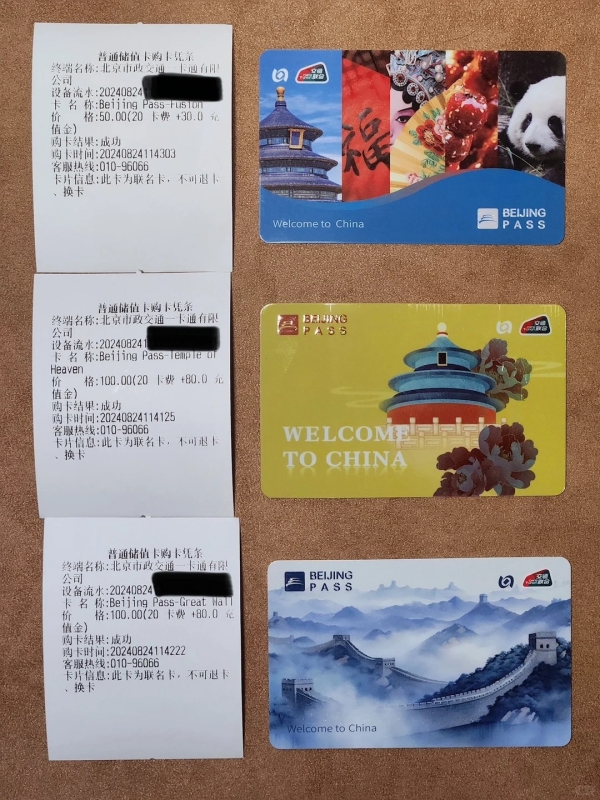
Beijing Pass Physical Cards And Receipts
Most visitors meet the card at the airport they land at, the easiest place to buy one and the quietest counter. Every hour of delay spends your loaded balance on fares you would rather see discounted. The running total of BEIJING PASS costs then stays visible from the first tap to the last.
Card Faces, Outlets and Recharge Channels
The channels below cover the whole cycle: buying the card, loading it and using it in a single day. Two details catch most newcomers out. Top up before the entry swipe, and never skip the exit tap.
Where to buy and top up
- Airports: Beijing Capital International (PEK) Terminals 2 and 3, the Foreign Guests Payment Service Centre in Terminal 3, and Daxing International (PKX). Counters follow airport hours.
- Metro stations: staffed counters and self-service machines at Xizhimen, Beijing Station, Beijing South, Beijing West, Fengtai and Qinghe, plus both airport lines. They follow metro hours.
- Yikatong service hall (一卡通营业厅): Xidan at 45 Fuxingmennei Street, and Dongzhimen inside the transport hub north of McDonald's. Card sales run 8:30–19:30, top-ups 8:30–19:00.
- Any metro station: top-ups at a staffed window or self-service machine.
- SilkPass app: any NFC-enabled smartphone, for loading the card wherever you happen to be.
Running the digital card
- iPhone first: the virtual card lands in Apple Wallet, and the operator still describes card issuance as Apple-only. The SilkPass app also lists Android, where it handles physical-card top-ups.
- Registration: an Apple ID or a +86 mobile number works best. The passport field asks for a document number and does not check it against the document.
- How you pay: the physical card takes cash, WeChat and Alipay but no credit card. SilkPass accepts WeChat or Alipay linked to a foreign card. Apple Wallet takes domestic debit only.
Before the first swipe
- Passport required: a valid passport, a Mainland Travel Permit or a Taiwan Travel Permit. The self-service machine in Terminal 3 has reportedly issued cards without checking one.
- No real-name registration: the physical card carries no name and links to no Chinese mobile number.
- Balance before entry: the card must hold at least the lowest single fare on the network, $0.45 (¥3), or the gate refuses the entry.
At the gate
- Tap in and tap out: a missed exit tap leaves an incomplete record, and the network may ask for a fresh ticket before you re-enter.
- One card, one person: cards cannot be shared between travellers. Children 1.3 m tall or under ride free on the rail network.
Receipts, digital cards and help. The operator's Beijing Yikatong (北京一卡通) app or its official WeChat mini-program turns top-ups into electronic invoices. The card hotline answers on 010-96066, and the rail network hotline on 010-96123.
🚖 Urban Transit Comparison: Deciding whether to take local taxis, app-based ride-hailing, or public subways for your daily city sightseeing? Explore our guide to Taxi Vs Didi Vs Metro.
Metro and Bus Fares on the Card
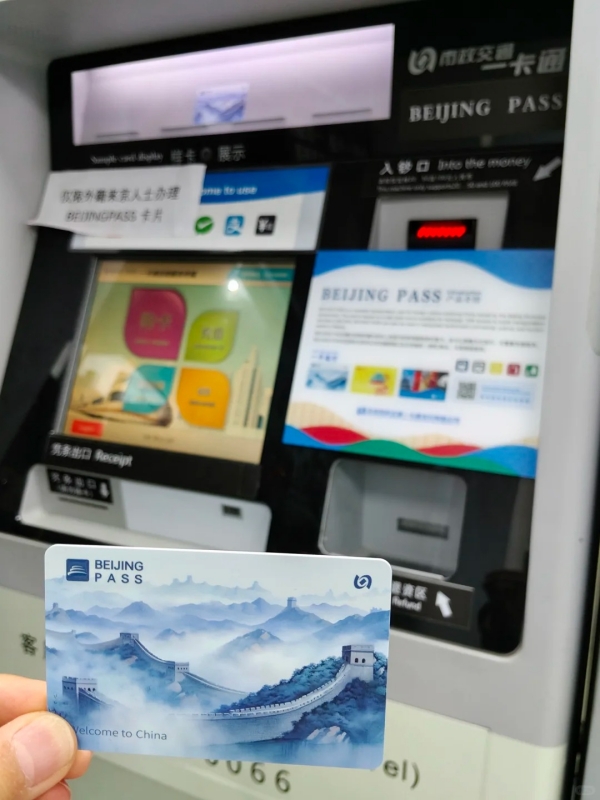
Beijing Pass Great Wall Card At Kiosk
Every fare on the card follows a published number. Rail pricing scales with distance, and the base fares apply to the card, to the standard transit card and to a mobile ride code alike. BEIJING PASS costs turn on two variables: how far you travel, and how much of the month you spend travelling.
Distance Fares and the Monthly Discount Ladder
The ladder rewards heavy rail use. A commuter-style month reaches the first tier, then the second, while a visitor who rides rarely never touches it. Over a short holiday, the first tier is the one most people meet.
On the rail
- Resets monthly: the rail spending counter clears at the end of every calendar month.
- Applies from the next ride: crossing $14.89 (¥100) or $22.34 (¥150) changes the price of the next journey. The ride that crossed the line keeps its full fare.
- Airport lines are a separate fare: the card taps on both airport express lines. They sit outside the distance fare and never count toward the monthly rail spending.
On the bus, and the alternatives
- Bus rides cost half: the $0.30 (¥2) standard city fare becomes $0.15 (¥1) on the card. Journeys beyond the city limits lose 20% instead, which is often the largest single cut in BEIJING PASS costs for a visitor who relies on buses.
- Excluded buses: customised, school and express services sit outside the scheme.
- Period passes are the alternative: one day $2.98 (¥20), two days $4.47 (¥30), three days $5.96 (¥40), five days $10.42 (¥70) or seven days $13.40 (¥90). Each pass covers one person.
The 25 early-bird stations
- Line 1 and Batong Line: Tucheng (土桥), Linheli (临河里), Liyuan (梨园), Jiukeshu (九棵树), Guoyuan (果园), Tongzhou Beiyuan (通州北苑), Baliqiao (八里桥), Guanzhuang (管庄), Shuangqiao (双桥), Chuanmei Daxue (传媒大学), Gaobeidian (高碑店).
- Changping Line: Nanshao (南邵), Shahe Gaoxiaoyuan (沙河高教园), Shahe (沙河), Gonghuacheng (巩华城), Zhuxinzhuang (朱辛庄).
- Line 6: Beiyunhe Xi (北运河西), Tongyunmen (通运门), Tongzhou Beiguan (通州北关), Wuziyuan Lu (物资学院路), Caofang (草房), Changying (常营), Huangqu (黄渠), Dalianpo (褡裢坡), Qingnianlu (青年路).
The early-bird rule
- Weekdays before 07:00: tap in before 07:00 on a working day at one of the 25 listed stations. The operator halves the fare when you exit. Weekends and public holidays do not qualify.
- It stacks with the monthly tiers: the half fare applies to the standard fare, and the monthly cumulative discount applies on top. At the 50% monthly tier, an eligible early tap can cost a quarter of the standard fare, and BEIJING PASS costs stop looking like a flat fare.
- Cards only: the early-bird rate needs a physical card tap. A mobile ride code or a single-journey ticket does not qualify, and station security delays earn no make-up discount.
Where the early-bird rate actually helps. All 25 stations sit in the far east and north, in Tongzhou and Changping. A visitor heading to the Ming Tombs saves on a weekday morning; a sightseeing trip in the centre does not.
🚇 Subway Systems Across Chinese Cities: Comparing metro lines, fare structures, QR code payment options, and operating hours in Beijing, Shanghai, and Guangzhou? Read our full breakdown on China Metro.
Parks, Retailers and Excluded Museums

Summer Palace
The commonest misreading treats a BEIJING PASS as an attraction pass, and BEIJING PASS costs get mistaken for the price of admission. Across the 75 parks and scenic areas on its list, the card simply buys the ticket, and the price matches what every other visitor pays.
Parks, Scenic Areas and Authorised Retailers
The operator publishes the roster in Chinese, and gate staff match your card against that list. The names below use the same wording, so you can check a site before you travel.
Paying at the gate
- Swipe to pay, not to enter: show the card to staff, tap it on the POS terminal they point to, and check the amount on screen.
- Admission prices stay put: the Beijing Zoo gate costs $2.23 (¥15) in peak season and $1.49 (¥10) off-peak, the panda combo $2.83 (¥19) and $2.08 (¥14), and the aquarium $26.06 (¥175) or $25.31 (¥170).
- Two institutions outside the network: the Forbidden City costs $8.93 (¥60) from April to October and $5.96 (¥40) off-peak. The National Museum of China stays free, with its own reservation.
Paying in the shops
- Shopping runs on the same balance: every purchase at an authorised retailer comes out of the stored value. An under-loaded card turns a shopping stop into a queue at a top-up machine, and quietly inflates BEIJING PASS costs.
- One balance, three spend categories: transport, admission and retail draw from the same wallet, so a single top-up covers a whole day of moving, seeing and buying.
- Not every branch reads the card: some branches of Wumart Supermarket (物美超市), Wedomore (味多美) and Shouhang Guoli Supermarket (首航国力超市) cannot take it, so telephone the branch first.
Do not read the card as an admission pass. None of the 75 parks and scenic areas charges less because you presented a BEIJING PASS. The card changes who holds the money, not the amount on the ticket.
Refund Rules, Limits and Exclusions
Three limits decide how much of your spending you keep. Each one is a specific rule rather than a courtesy. The published ceiling is a single card balance of $14.89 (¥100), and larger refunds reported at some airport counters remain unconfirmed.
Getting your money back
- Spend down first: the self-service machines only read a card whose balance is $14.89 (¥100) or less, and outlet practice on that ceiling varies.
- Where the machines are: Guomao (国贸), Xidan (西单), Wangjingdong (望京东), Yonganli (永安里), Qingnianlu (青年路), Beijing West Railway Station (北京西站) and Daxing Airport (大兴机场).
- Cash at the counter: the staffed metro window alone reportedly settles the card fee as well as the balance, and it pays out in cash.
- Lost card: the card carries no name and cannot be reported lost, so a lost card means a lost balance.
Where the card does not reach
- Check the card face: the card follows the China T-Union (交通联合) standard, and the operator's Chinese material describes it as working in 300+ mainland cities. The English product page limits it to Beijing. A card with the T-Union symbol works in Shanghai, Guangzhou or Hangzhou; one without it works in Beijing only.
- Airport express excluded: both airport express lines cost a separate fare and never count toward the monthly rail spending.
- Customised buses: the half-fare rate covers the normal city and suburban network, not customised, school or express services.
Check the balance before you fly. A card holding more than $14.89 (¥100) cannot go through a self-service refund machine. Spend down to the ceiling, and keep the card in your hand for the last evening of the trip.
Frequently Asked Questions
Q: How much does a BEIJING PASS cost in total?
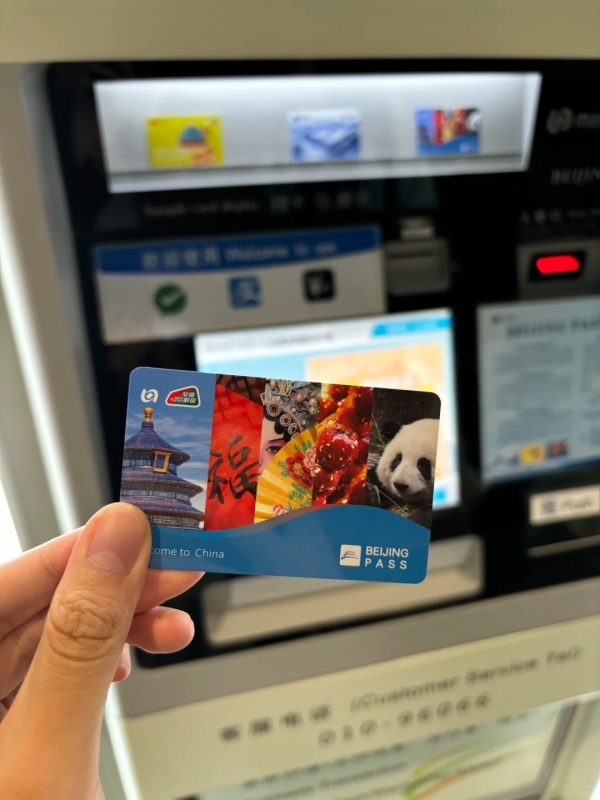
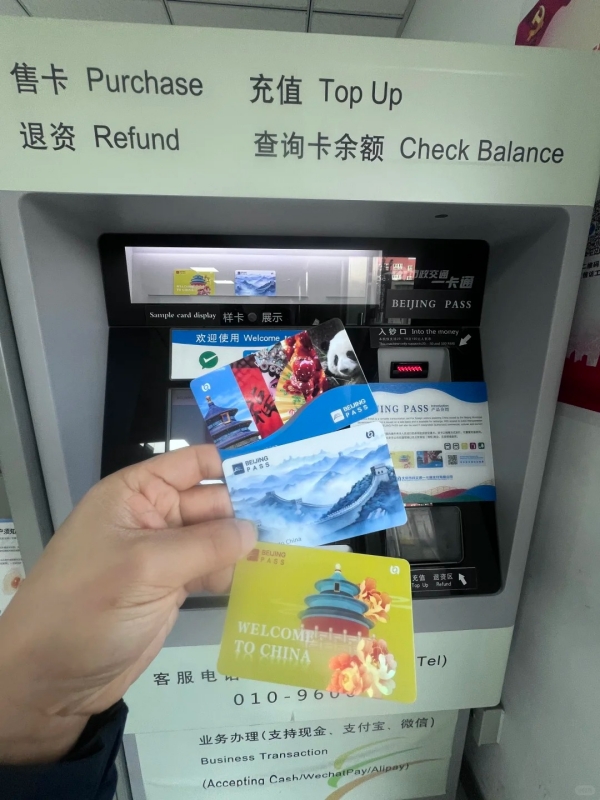
A standard BEIJING PASS costs $2.98 (¥20) to buy, and the operator never refunds that fee. You then load stored value in multiples of $1.49 (¥10), up to a maximum balance of $148.91 (¥1,000). Selected counters bundle a first preload with the card: $11.91 (¥80) on the ink-wash and Temple of Heaven faces, $4.47 (¥30) on the colourful China face.
Q: Does BEIJING PASS include entry to Beijing's main attractions?
No. BEIJING PASS pays for transport and for purchases. It buys a ticket at 75 parks and scenic areas, including the Summer Palace, the Temple of Heaven and the Beijing Zoo, but the admission price stays the same for everyone. The Forbidden City and the National Museum of China sit outside the list.
Q: Is the card cheaper than a one-day metro pass?
The card fee and a one-day metro pass both cost $2.98 (¥20), so one heavy metro day suits the pass better. Over several days BEIJING PASS costs work out differently: three days costs $5.96 (¥40) and seven days $13.40 (¥90). The card also adds the half-fare bus rate and the monthly rail discounts.
Q: Can I get my remaining balance refunded?
Partly. A BEIJING PASS refund at a self-service machine returns the balance to your WeChat or Alipay account, but only when the balance on that card stands at $14.89 (¥100) or less. A staffed metro window reportedly settles the card fee as well, in cash only. A damaged card must go to the Xidan or Dongzhimen halls.
Q: Can I use BEIJING PASS in other Chinese cities?
That depends on the card face. A card carrying the China T-Union mark (交通联合) taps public transport in 300+ mainland cities, but the operator's English page limits the card to Beijing, so check the symbol first. Either way it covers rail, buses, S2, airport lines and taxis, plus 75 parks and a thousand shops.