Alipay Refund To Foreign Card Successful But Not Received 2026
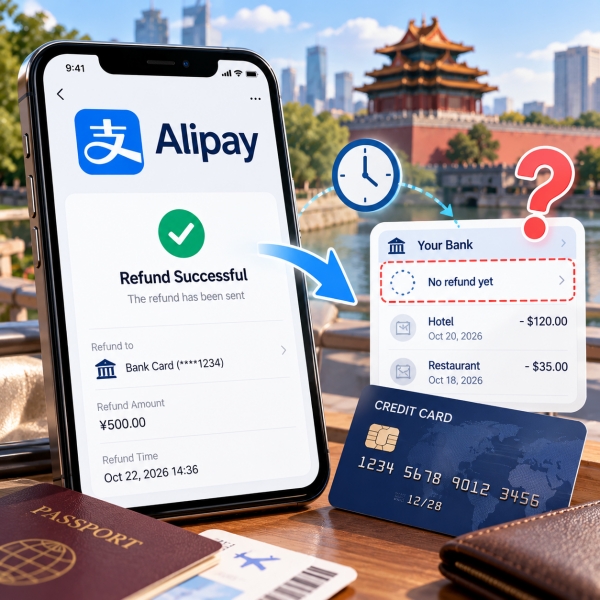
Alipay (支付宝) marking a refund as successful does not mean the money has landed on your card — that status only confirms that one side finished its work. An Alipay refund to a foreign card moves through three systems that update at their own speed: the merchant who issued the refund, Alipay itself, and the card issuer that actually posts the credit. When those three records disagree, the money is usually not lost. It is sitting in the gap between them, waiting for one of the three to catch up. Below are five situations in escalation order, each with the checks that belong to it. Find the one that matches your records, then work that section.
Quick Facts
🛍️ Alipay Card Fees: Paying Alipay with a foreign card and want to understand the charges around the original payment? See our guide to international card fees on Alipay.
Where a Refund Actually Stops
Before you can fix an Alipay refund to a foreign card, you need to know what each of the three systems is responsible for. Most people check one, see a status they do not understand, and conclude the refund is lost. It is almost never that simple. Understanding the handover between the three is what tells you which one is holding things up.
The Three Records That Never Sync
Each system records a different link in the same chain, and none of them reports back to the others.
- Merchant order page (商家订单页): Records that the merchant decided to refund you and pressed the button in their own system.
- Alipay refund detail (退款详情): Records that Alipay accepted the refund and shows you where it is sending the money.
- Your bank statement: Records that the issuer accepted and posted the credit to your account.
This is why a merchant being unable to produce a refund screenshot does not prove anything went wrong. Screenshot access sits with their system permissions, retention rules, or whether the refund was processed through a nightly batch rather than live. It is a weak signal in either direction.
Refund Success Is Not a Settled Balance
Alipay's own help pages describe a state where funds are temporarily unavailable during a transaction refund or a failed payment. That is the gap this entire guide is about. "Successful" is a status about a process completing, not a statement about your balance being spendable.
The synchronisation also runs one way. Alipay updates its record first and the issuer follows later. Your bank will not push a notification backwards into the app, which is why an app that looks settled can sit beside a statement that looks empty.
The Timeline Alipay Actually Publishes
Alipay publishes reference windows by payment category. They are useful as a starting point and useless as a countdown, because the bank sets the actual arrival time.
- International cards (Visa, Mastercard, JCB): 7 days.
- Credit card quick pay: 3–7 days.
- Debit card quick pay: 2–6 days.
- Your own issuer: whatever window that bank applies. Some issuers publish their own, and they may differ from Alipay's.
Two details trip people up. Alipay states these as days, not working days, so subtracting weekends and public holidays on your own changes the answer. And the debit card category is written around domestic cards, so do not assume a foreign debit card follows the 2–6 day shortcut. Set a follow-up date from your specific refund detail and your issuer's stated window — not from the day the app turned green.
🛍️ Payment Limits: Need to know what limits apply before a large payment? Read our Alipay and WeChat spending limits guide.
The Five Situations and the Fix for Each
These five situations run in escalation order: the most common and least complicated first, the hardest last. They are also hypotheses rather than diagnoses. A single refund can look like more than one of them at once, so treat each section as a set of checks to run, not a verdict you have been handed. Run them in order and stop when one produces an answer. Working an Alipay refund to a foreign card out of order is how people end up disputing something that was never issued in the first place.
Situation 1 — Still Inside the Processing Window
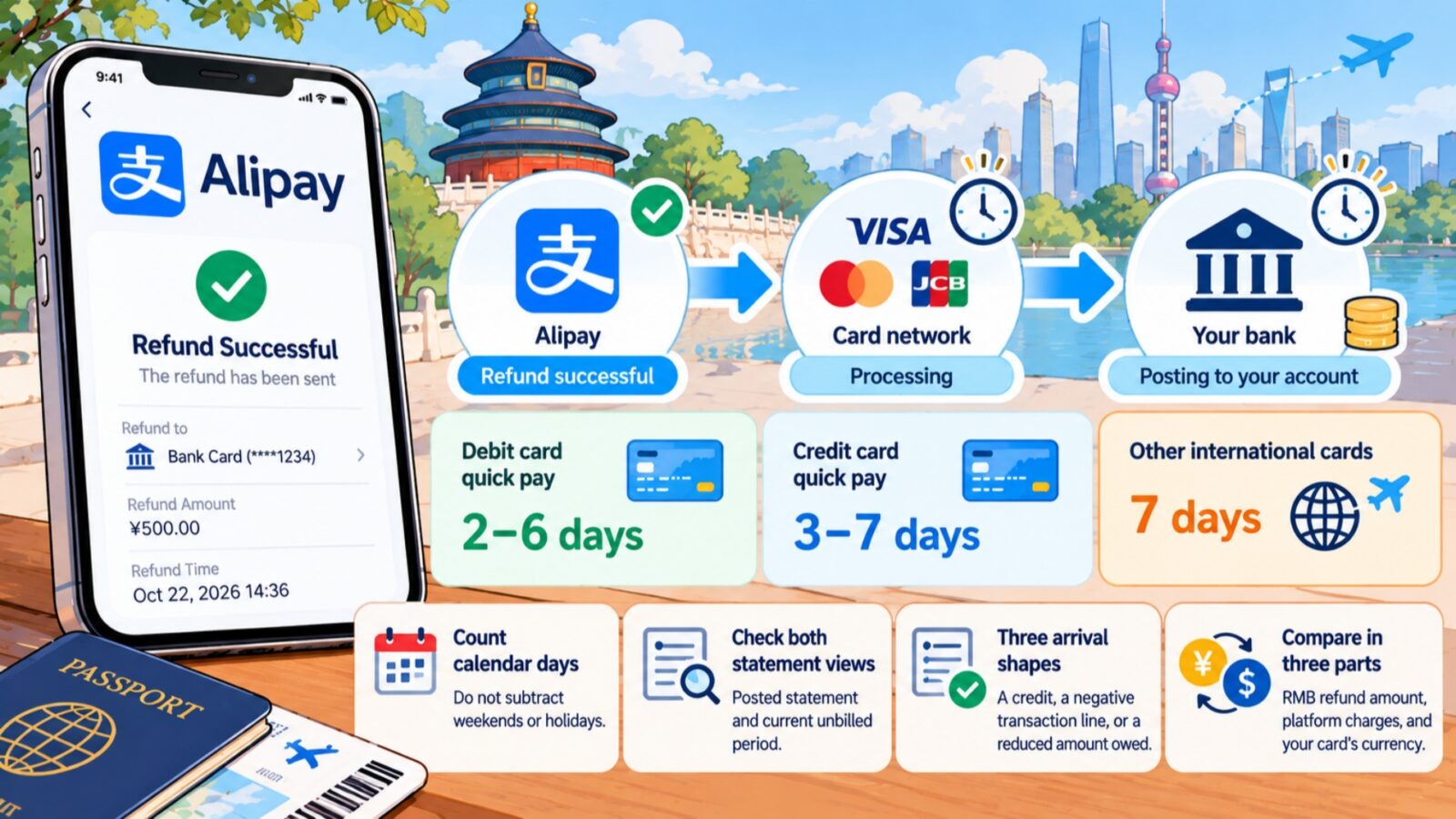
Alipay Refund Processing Time
A cross-border refund has to travel through Alipay, the card network, and your issuer, and each leg takes its own time. The mistake most people make here is not the missing money; it is counting the days wrongly and declaring the refund lost while it is still in transit.
- Check the right window: International cards 7 days, credit card quick pay 3–7 days, debit card quick pay 2–6 days. Find the one that matches how you paid.
- Count calendar days: Alipay publishes these as days. Do not subtract weekends or public holidays unless your issuer specifically says to.
- Look in both statement views: The posted statement and the current unbilled period can each hold part of the answer.
- Count three shapes as arrival: A credit, a negative transaction line, or a reduced amount owed. All three mean the money landed.
- Compare in three parts: The RMB refund amount, anything charged on the platform side, and what actually arrived in your card's own currency.
The labels you are looking for inside the app are 退款详情 (refund detail), 退款去向 (refund destination), 处理中 (processing), 交易号 (transaction number), and 退款流水号 (refund number). The English app may place these somewhere different — match them by meaning rather than by position.
App says refunded is not proof the money is safe to treat as yours. It only means Alipay's part is complete.
Situation 2 — The Bank Held It or the Details Do Not Match
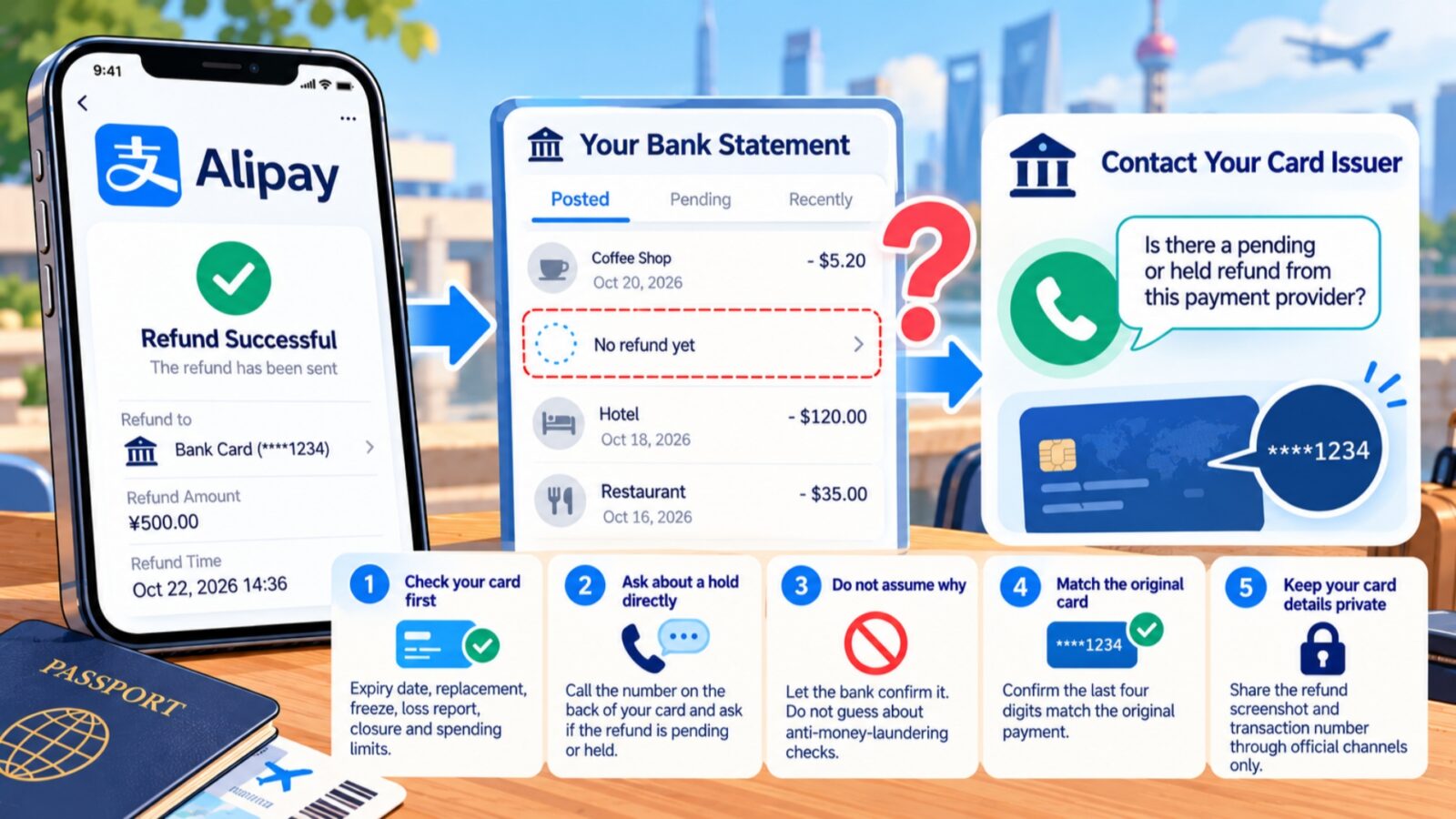
Alipay Refund Bank Hold
Money cannot reach your account without passing your bank's own posting rules. A card issuer has exactly three visible outcomes: posted, pending or held, or absent entirely. Only the third needs you to go looking, and it is the one worth chasing.
- Check the card first: Expiry date, recent card replacement, freeze, loss report, closure, and spending limits are all worth confirming.
- Ask about a hold directly: Call the number on the back of the card and ask whether an incoming credit from that payment provider is pending or held for that date and amount.
- Do not assume why: Without the bank confirming it, do not describe the money as blocked by anti-money-laundering checks. You will be guessing, and a wrong guess makes every later conversation harder.
- Match the original card: Confirm the last four digits on the original payment and the refund match. A refund that reverses a card purchase is not re-collected like an international wire transfer, so you should not be asked to rebuild a full set of recipient details.
- Keep your card details private: Share the refund screenshot and transaction number through official channels only. No legitimate support process requires your full card number in an ordinary chat window.
Waiting for the bank to confirm before blaming Alipay is what stops the two sides pointing at each other while nothing actually moves.
Situation 3 — Alipay Never Sent It, or It Came Back to Your Balance
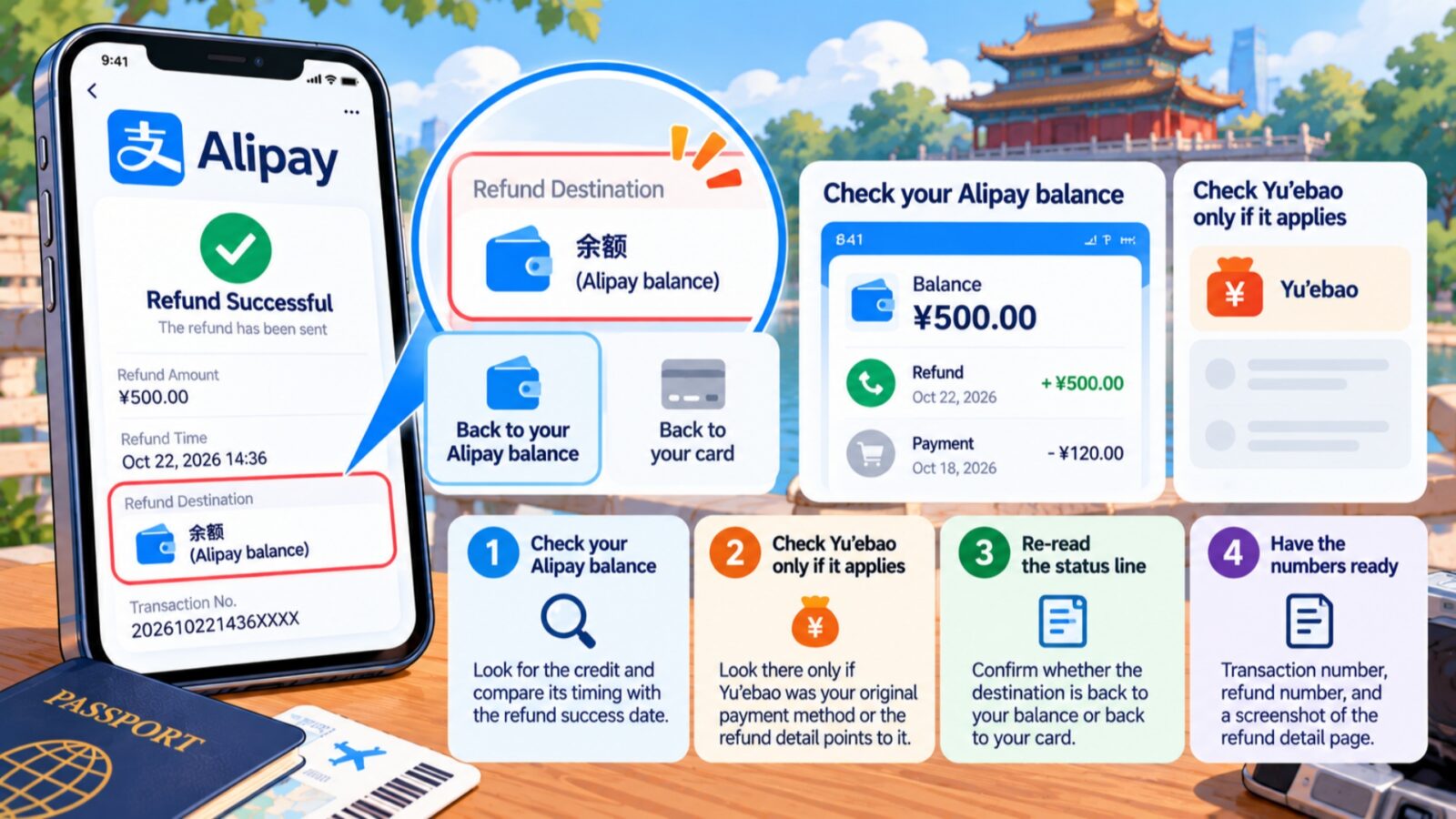
Alipay Refund to Balance
The refund destination field is the only thing that separates "still travelling" from "already returned". If you have read that field correctly, you already know more than most people who are still emailing support.
- Check your Alipay balance: Look for the credit and compare its timing against the refund success date so you do not confuse it with everyday spending.
- Check Yu'ebao only if it applies: Look there only if Yu'ebao was your original payment method or your refund detail points to it. It is not something to assume a foreign visitor has.
- Re-read the status line: The destination reads either back to your card or back to your balance. Confirm which before contacting anyone.
- Have the numbers ready: Transaction number, refund number, and a screenshot of the refund detail page. This is what support will ask for first.
Reach a human agent through the in-app customer service menu and ask the questions that move the case forward: whether the refund was actually submitted, on what date, against which last four digits, what status can currently be confirmed, whether any proof or tracking reference can be issued for your bank, and what happens next if it was returned.
One warning before you plan around the balance: Alipay's foreign card service terms state that the service is not to be used for transfers, financial products, or cash withdrawal. So money sitting in your balance is not the same as money you can move onto another card. Follow the written guidance support gives you for your specific account rather than assuming a new card will receive a second refund.
Situation 4 — The Merchant Never Submitted It
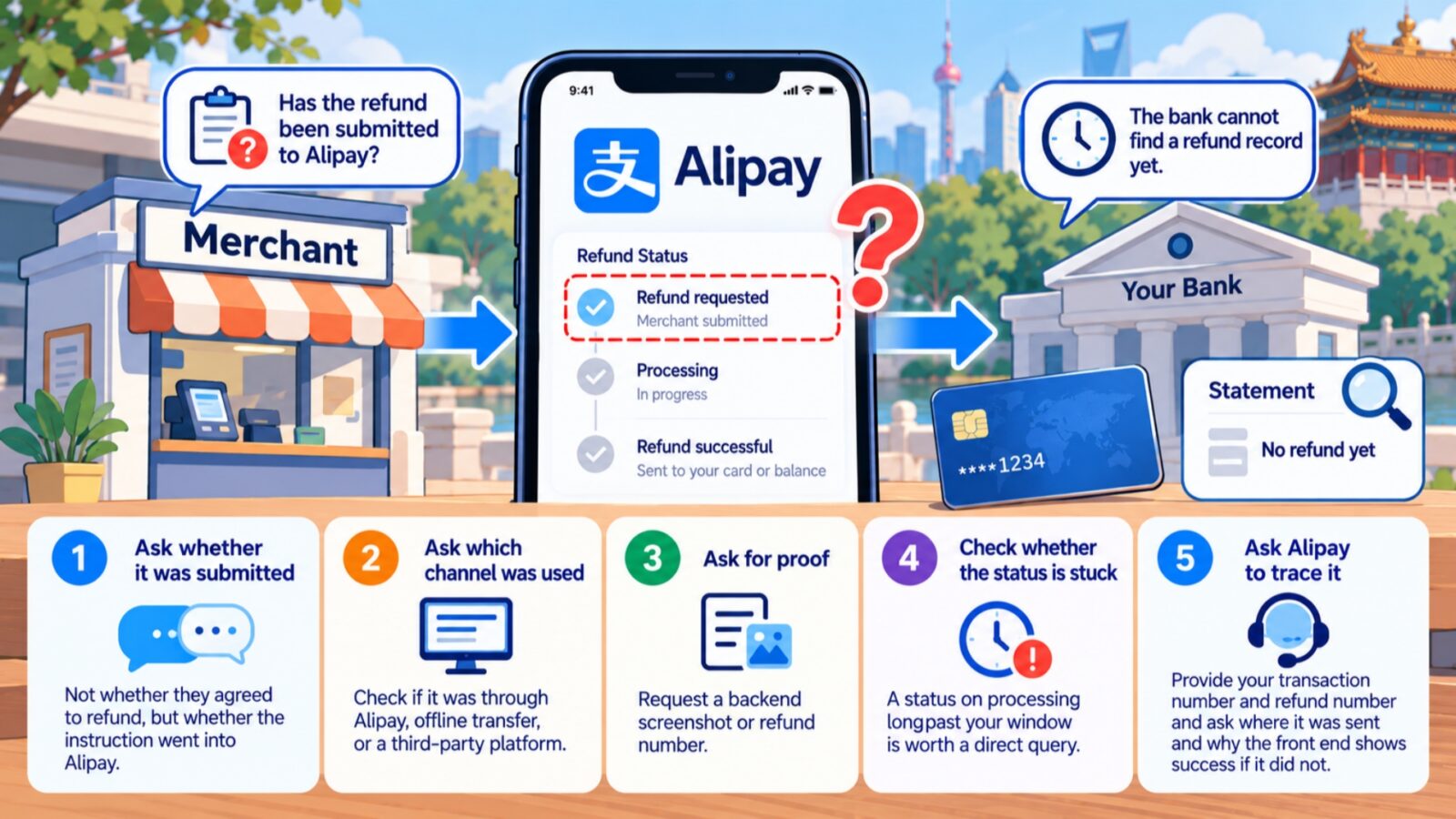
Alipay Merchant Refund Issue
A merchant pressing refund in their own system does not submit anything to Alipay. If that handover never happened, every screen you check afterwards is describing a refund that does not exist yet. This is the one situation where contacting your bank first wastes the most time.
- Ask whether it was submitted: Not whether they agreed to refund, but whether the instruction went into Alipay. Keep the written thread.
- Ask which channel was used: Refunds sent by offline transfer or a third-party platform leave odd states on the Alipay side.
- Ask for whatever proof they can produce: A backend screenshot or a refund number helps, but a merchant who cannot produce one has not necessarily done nothing.
- Check whether the status is stuck: A status sitting on processing long past your window is worth a direct query. That is not the same as concluding the system is broken.
- Ask Alipay to trace it: With your transaction number and refund number in hand, ask whether the merchant submitted anything, where it was sent, and why the front end shows success if it did not.
There may be a transaction statement or certificate option inside your bill details. Whether it exists and how completely it reflects refund movements is worth asking support about directly rather than relying on it as your strongest proof.
Situation 5 — Nothing Resolved, Time to Escalate
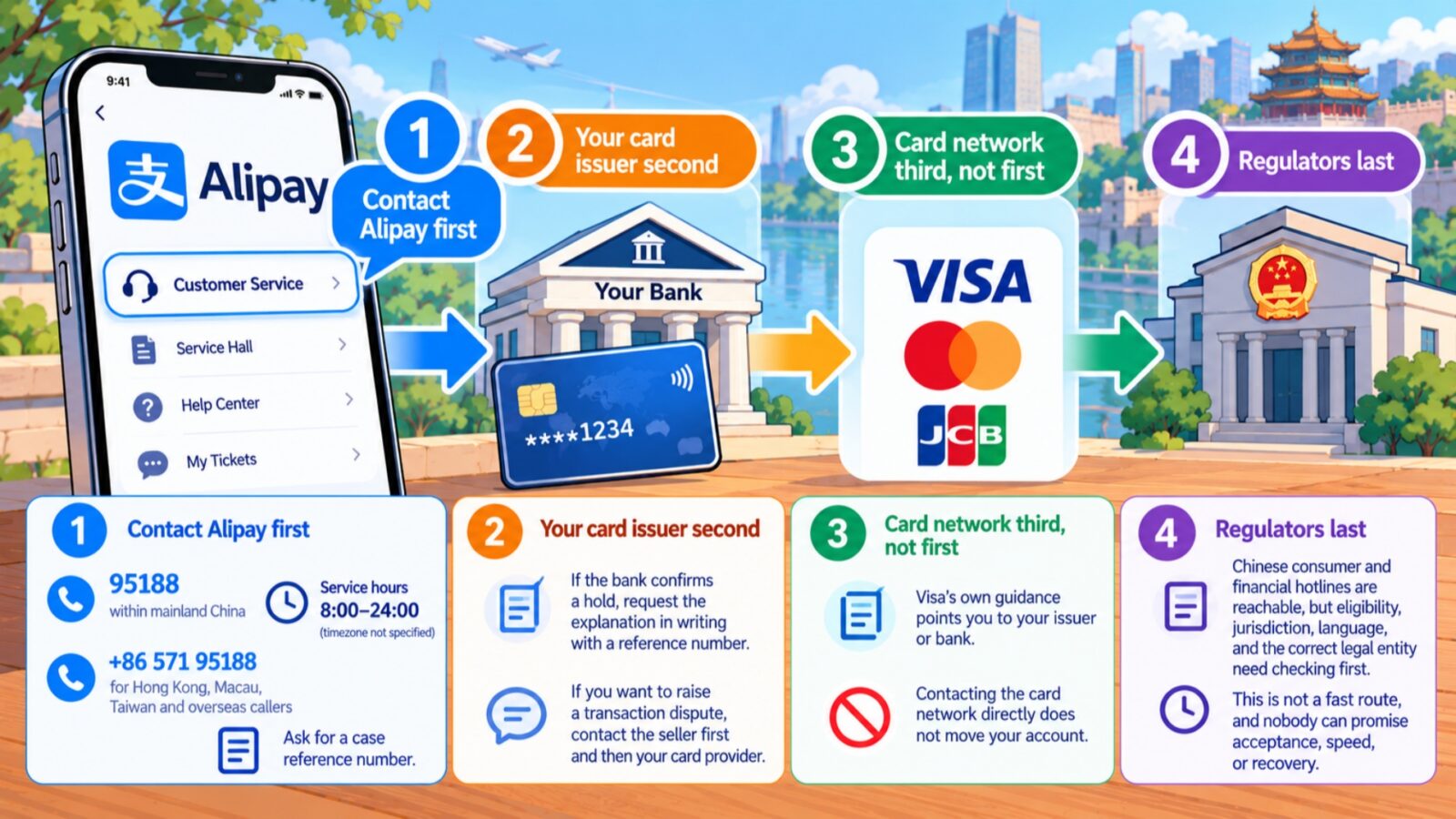
Alipay Refund Dispute Resolution
Escalation works when each step hands the previous step's paperwork forward. It stalls when you skip ahead to the most aggressive option first, because the regulator or card network will ask the same basic question — did the merchant and the payment platform actually process this — that you could not get answered yet.
- Alipay first: 95188 within mainland China, or +86 571 95188 for Hong Kong, Macau, Taiwan and overseas callers. The service hall lists main service hours as 8:00–24:00 without stating a timezone. Ask for a case reference number.
- Your card issuer second: If the bank confirms a held item and will not release it, request the explanation in writing with a reference number. If you want to raise a transaction dispute, Visa's own guidance is to contact the seller first and then your card provider — and it states plainly that a refund is not guaranteed. Visa also notes disputes are commonly available up to 120 days, while making clear the actual limit depends on your issuer.
- Card network third, not first: Visa's own support route for disputing a charge points you to your issuer or bank. Contacting the card network directly does not move your account.
- Regulators last: Chinese consumer and financial hotlines are reachable, but jurisdiction, the correct legal entity, local jurisdiction, eligibility, and available languages all need checking first. They are not a fast route, and nobody can promise acceptance, speed, or recovery.
Finally, keep records. If your issuer confirms a hold and wants supporting documents, supply what they ask for through official channels. If you have not received a refund you can demonstrate was issued, that is a materially different conversation from one where the refund was never submitted at all.
When the Card Itself Is the Problem
Two situations cut across all five above, because they can appear in any of them and change what the right next step is.
Card Lifecycle Across All Five Situations
Most of the worry around an Alipay refund to a foreign card gets attached to the card without first checking what state the card is actually in. These are materially different situations, and only your issuer can tell you which one you are in.
Repeat Requests and Paid Recovery Scams
Two habits cause real damage here, and both feel sensible in the moment.
The first is resubmitting the same refund because nothing has moved. Before you do, find out where the existing refund is and what state it is in. A duplicate request makes your case harder to trace, because now there are two entries and support has to work out which one you mean. Repeating a request is not a way of making it move faster.
The second is paying someone to chase it. Anyone who asks for money up front in exchange for recovering a refund is not an official channel — the official numbers are 95188 and +86 571 95188, both listed on Alipay's own service hall. Real recovery services do exist, so treat this as a serious risk signal rather than assuming every paid helper is fraudulent, and never hand over passwords or verification codes to anyone.
🛍️ Alipay Setup Guide: Setting up or checking your Alipay before you travel? Read our Alipay setup guide for visitors.
What to Capture Before You Contact Anyone
Every check below is faster when you already have four things saved. Ten minutes of setup at the start of the wait saves an hour of re-explaining at the end, and it is the only part of this process you can do entirely from your sofa. It is also what turns an Alipay refund to a foreign card from a week of guessing into a short list of checks.
The Three Reference Numbers
Three different numbers get quoted during a refund query, and they are not interchangeable.
- Alipay transaction number (支付宝交易号): Identifies the original payment. This is what your merchant or Alipay support will ask for first.
- Alipay refund number (退款流水号): Identifies the refund itself. It is a separate identifier from the payment it reverses.
- Bank tracking reference (银行追踪参考号): Issued by your card issuer for its own side of the transaction. Not every refund gets one, and its absence does not mean Alipay failed to submit anything.
Save only the ones your own screens actually display. Do not combine, shorten, or reconstruct them — a mismatched number is harder to trace than no number at all.
Card and Account Status Checks
Before you assume a delay is Alipay's fault, separate two states that are constantly confused: the card being unusable, and the underlying account being closed. An expired card is a payment instrument that reached its end date. A closed account means the destination itself no longer exists, and that is the genuinely high-risk state.
Neither diagnosis is safe to make on your own. Some issuers will still accept a refund to an expired or cancelled card; others will not. Ask yours directly rather than guessing, because the answer determines whether you should wait or escalate.
A Follow-Up Date, Not a Delivery Promise
Write down a date on which you will act, not a date on which you expect to be paid. The first is entirely within your control. The second is not, and treating it as a deadline is what turns a normal seven-day settlement into a week of anxiety.
Derive that date from your specific refund detail and your issuer's window. Nothing else. And if your card has been lost or stolen, deal with that first regardless of any pending refund — issuers treat a compromised card as urgent, and a pending refund is not a reason to sit on a security problem.
Small Differences That Are Not a Lost Refund
This section is for people whose Alipay refund to a foreign card has already landed and who are troubled by the number or the shape of it. If your statement is completely blank, you are in the wrong section — head to Situation 2 instead.
A Smaller Credit Than the RMB Amount
Compare three separate figures rather than one: the RMB amount Alipay refunded, anything deducted on the platform side, and what actually landed converted into your card's own currency. Alipay's own foreign card terms state that the amount in your card's home currency is governed by your issuer's statement, which is why the third figure is the one that counts.
Be careful with the explanation you jump to. A weaker currency is sometimes assumed to be the cause, but that reasoning does not hold from every cardholder's perspective, and a small unexplained deduction is not automatically a normal processing loss. If a difference shows up that you cannot account for, ask your issuer to explain it rather than writing it off.
🛍️ Alipay Currency Guide: Comparing the RMB amount against your card's currency conversion? Read our Alipay currency conversion guide.
Credit Card Offset Instead of a Deposit
Some issuers post a refund as an offset against your balance rather than as a separate deposit you can spot instantly. A negative transaction line, or a statement where the amount owed simply dropped, is that offset arriving. It is normal, and it is the same event as a deposit — just presented differently.
How issuers format this varies: negative lines, available credit, and statement balance do not all move the same way on every bank. Avoid treating an unchanged available credit limit as proof that a refund failed, and equally avoid treating it as proof of success without seeing the movement on your statement.
Working Days, Time Zones and Public Holidays
Alipay's published figures are in days, not working days. When you are chasing a specific refund, that distinction decides whether you are early or late, and counting it the other way is a common reason people contact support far too soon.
Timing also decides when you can reach anyone. Chinese public holidays affect Alipay's availability, and your issuer sits in a completely different working day. That changes when you can talk to someone — it does not change how safe your money is, and it is not evidence that any system is misbehaving.
Frequently Asked Questions
Q: How long does an Alipay refund to a foreign card take?
Alipay publishes 7 days for international cards, 3–7 days for credit card quick pay, and 2–6 days for debit card quick pay, expressed in days rather than working days. Alipay also states that the actual arrival time is set by the bank. Issuers keep their own windows, so there is no single timeline that applies to every foreign card.
Q: My Alipay says refunded but my bank balance is unchanged. What do I check first?
Identify which record you are actually looking at — the merchant order page, the Alipay refund detail, or your bank statement. They track different parts of the same refund and update at different speeds. Read the refund destination field, because it tells you whether the money is still travelling or has landed in your Alipay balance.
Q: Can a refund still go to a card I already cancelled or expired?
Yes, in at least some cases. Wise states that refunds can still be sent to a cancelled or expired card, which shows that an unusable card is not automatically a failed destination. Other issuers differ, and a closed account is a different situation entirely. Ask your issuer directly rather than assuming either outcome.
Q: The refund amount is less than what I paid. What's the difference?
Compare three figures: the RMB amount refunded, anything charged on the platform side, and what arrived in your card's own currency. Alipay's foreign card terms state that the home-currency amount is governed by your issuer's statement. There is no single published rule covering currency and fee differences, so ask your issuer to explain any deduction you cannot account for.
Q: Does an Alipay refund to a foreign card ever land in my balance?
The refund detail page shows the refund destination, and that destination is not always your bank card. Rather than assuming international card refunds can only return one way, read the destination field first. If the money is in your Alipay balance, what you can do with it depends on your account eligibility and the written guidance support gives you.
Q: Should I file a chargeback if my bank never received the refund?
Checking on a refund and raising a transaction dispute are different tasks. Visa's guidance is to contact the seller first and then your card provider, and it states plainly that a refund is not guaranteed. Disputes are commonly available up to 120 days, though the actual limit depends on your issuer. Contacting the card network does not replace contacting your bank.
Q: Which number should I give Alipay support?
Give the transaction number for the original payment and the refund number for the refund — they are separate identifiers. Only supply numbers your own screens actually show. A missing bank tracking reference does not mean Alipay failed to submit the refund, and not every transaction produces a tracking reference that can be handed to an issuer.
Q: Can I just submit the refund request again to speed things up?
Find out where the original refund is and what state it is in before requesting anything further. A duplicate request gives support two entries to reconcile and makes your case harder to follow. There is no established rule that a repeat request speeds anything up, so treat any advice suggesting otherwise as unverified.