Shenzhen Metro Foreign Bank Card Payment Now Covers Every Gate
You can use a supported overseas contactless bank card at every Shenzhen Metro fare gate following the September 10, 2026 upgrade. Shenzhen metro foreign bank card payment covers UnionPay, Visa, Mastercard, American Express, and JCB, provided your card supports contactless transactions and small payments without a PIN. That gives you a direct route through the gates without first setting up a local transport wallet. There are still a few decisions to make before your first ride: which card or device to use, how much available credit to keep, and how to handle children or a rejected tap. Start with those details, rather than downloading another app at the turnstile.
Quick Facts
🚇 Subway Systems Across Chinese Cities: Comparing metro lines, fare structures, QR code payment options, and operating hours in Beijing, Shanghai, Guangzhou, and Shenzhen? Read our full breakdown on China Metro.
September 10 Changes Your First Ride
The September upgrade means you can approach a fare gate with an eligible card instead of first looking for a special overseas-card channel. Shenzhen Metro's announcement describes acceptance across all gate channels, together with upgrades for ticket purchases, fare adjustments, and payment problems.
From Trial to Every Gate
The service began trial operation on June 30, 2026. The later announcement established full gate-channel coverage, describing 17 operating lines and 432 stations at that stage. Those figures describe the rollout; they are not a reason to assume a station's current timetable or route connections.
For a visitor, the useful change is simpler than the network statistics. You no longer need to choose your entrance around a small set of overseas-card readers. Instead, prepare the right payment credential and follow the gate's acceptance signs and instructions.
- An old trial guide: It may correctly describe its author's journey while giving outdated advice about which channels accept cards.
- A ticket-counter payment: Buying a ticket with a bank card is a separate action from using that card as your entry credential.
- The current gate service: It lets a qualifying card or linked device record your entry and exit directly.
This distinction also helps when someone says they have “used a foreign card on the metro.” Ask whether they bought a ticket or tapped through. Both are useful, but only the second establishes anything about direct gate acceptance.
Cards Inside the Acceptance List
The published list names five networks: China UnionPay (中国银联), Visa, Mastercard, American Express, and JCB. It also requires contactless capability and enabled small-value payments without a PIN. A familiar card logo by itself does not satisfy all those conditions.
Shenzhen metro foreign bank card payment is therefore an acceptance service with conditions, rather than a promise that every overseas card will work. Check the contactless symbol on your card and the relevant payment settings with your issuer before depending on it for a time-sensitive trip.
🚖 Urban Transit Comparison: Deciding whether to take local taxis, app-based ride-hailing, or public subways for your daily city sightseeing? Explore our guide to Taxi Vs Didi Vs Metro.
Prepare Your Card Before the Gate
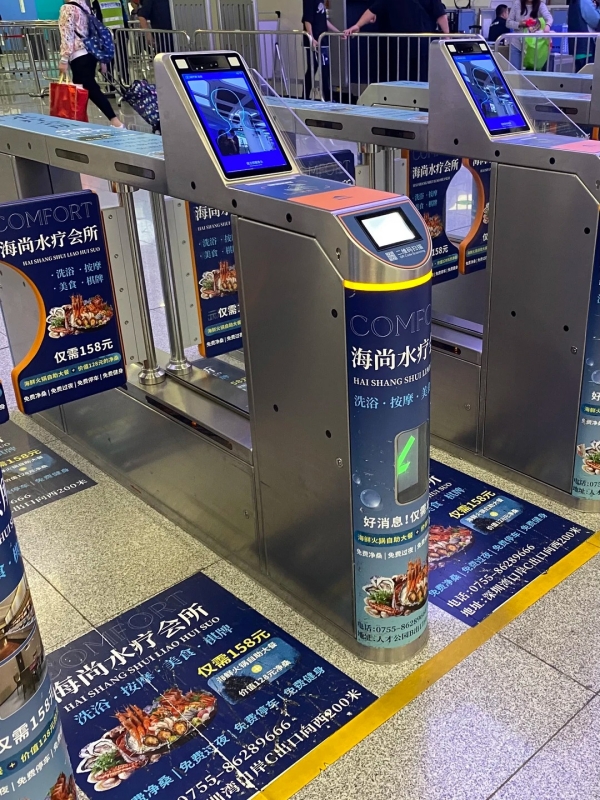
Metro in Shenzhen
Choose your payment medium while you still have room to stop and check it. The practical goal is one usable credential for the whole ride, with enough available funds for preauthorization. A small expected fare does not remove that second requirement.
A Card With Working Contactless
A physical card is a useful starting choice when you want to avoid setting up another transport account. Shenzhen Metro also accepts mobile devices linked to qualifying bank cards. However, that general description does not guarantee every wallet, handset, issuer, and card combination.
Keep the first journey straightforward. Select either the physical card or the linked device, and plan to use that same medium at the exit. This is a conservative operating recommendation: the published ticket rule requires the same ticket or card, without explaining every possible wallet-token combination.
- Physical card: Take it out separately so you can present the intended card and keep track of it afterward.
- Phone or wearable: Select the intended linked card and make sure the device remains usable through the end of the ride.
- Backup: Keep another way to buy a ticket available, particularly before an airport or railway connection.
Do not treat a wallet setup screen as proof of gate compatibility. The observable result you need is an accepted tap at the gate. If that fails, move to the service counter with the actual card or device rather than repeatedly changing credentials in the queue.
Enough Available Credit
The operator's international-card rule requires available funds or credit of at least the network's maximum business-carriage single fare. It applies to international bank cards using preauthorization. The rule does not tell you to keep only the cost of your planned ordinary-carriage journey available.
That matters when you have a low-balance travel card. A short ride may cost much less than the amount needed to authorize entry. Check available funds, including any existing holds, rather than assuming the visible balance equals the amount you can spend.
The same rule says payment problems caused by insufficient funds or credit can restrict further travel with the card. Adding funds may address your balance, but an existing journey problem can still require station assistance. Resolve that record before relying on the card again.
Separate Credentials for Each Rider
Shenzhen metro foreign bank card payment follows the one-passenger, one-ticket-or-card rule, with one entry and one exit. Do not tap one bank card repeatedly to send several adults through. Decide how each person will travel before your group reaches the gates.
For children, start at customer service rather than experimenting with an adult's bank card. The overseas-card upgrade includes payment for child-ticket purchases. Buying the appropriate ticket is different from expecting a direct bank-card tap to recognize a child's entitlement automatically.
💳 Beijing Transit Card Costs & Discounts: Heading to the capital next and want to understand card fees, monthly rail discount tiers, and park entry usage? Check out our complete breakdown on Beijing Pass Costs.
Tap In, Ride, and Tap Out
Shenzhen Metro Foreign Bank Card Payment Now Covers Every Gate
Complete the journey with the same payment credential. Shenzhen metro foreign bank card payment removes the ticket-purchase step for an eligible rider, while the entry and exit records still need to match. Keep your card accessible until you have left the paid area.
Enter Through a Fare Gate
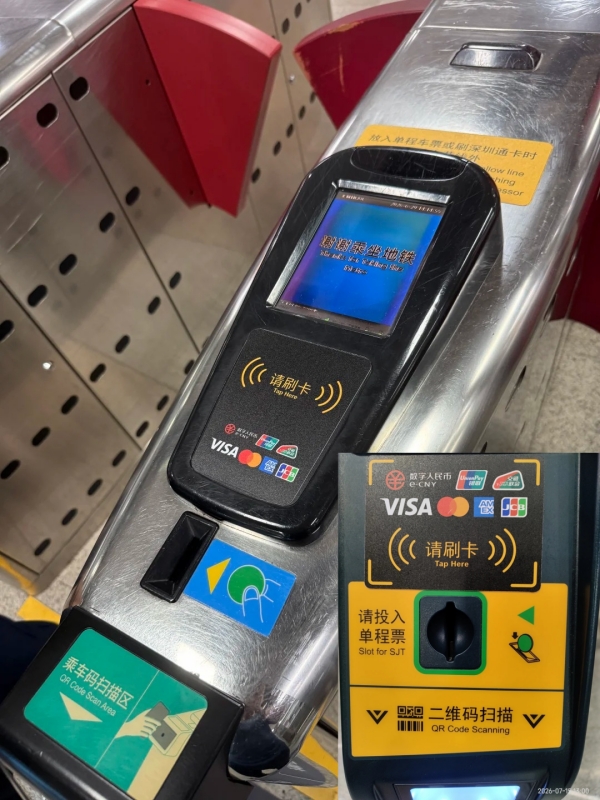
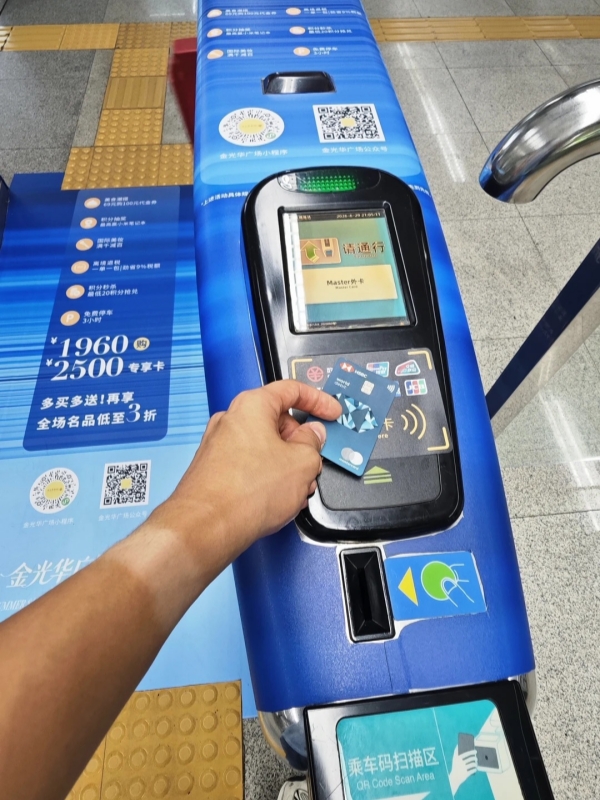
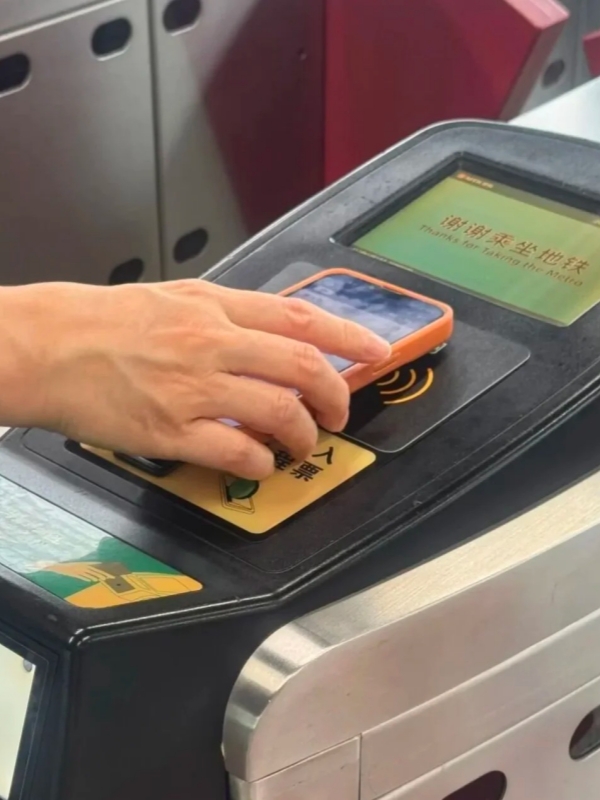
Use the contactless sensing area indicated by the gate's acceptance markings. Shenzhen Metro introduced bilingual interfaces, payment animations, and voice reminders as part of the upgrade. Read the result rather than assuming that a bank notification means the gate has accepted your entry.
- ① Choose your credential: Present the physical card or the linked device you intend to use for the entire journey.
- ② Make the tap: Bring it to the indicated contactless area, keeping other cards out of the way.
- ③ Watch the gate: Follow its payment display and proceed when it accepts entry and opens for you.
- ④ Keep the credential: Put it somewhere accessible, since you will need it again at the destination.
If the gate stays closed, step aside and check the displayed instruction. A failed attempt is not a reason to follow someone else through. Station service can help distinguish a card problem from a journey record that needs attention.
For a group, let each rider complete their own accepted entry. Avoid passing one credential back across the barrier. Otherwise, the people inside and outside can end up with different payment problems, especially if the group assumes the first successful tap covers everyone.
Keep the Same Payment Credential
Once inside, keep using the original card or device. Do not switch from the physical card to a phone merely because both draw on the same bank account. Likewise, avoid changing from a phone to a watch halfway through the journey.
The safe approach is easy to remember: physical card in, that physical card out; phone in, the same phone and selected card out. It respects the operator's same-card requirement without assuming that different devices create interchangeable records.
- Ordinary ride: Retain the entry credential until you complete the exit tap.
- Device problem: If the phone becomes unusable, explain the original entry method to station customer service before trying another card.
- Different payment method: Save a backup for an arranged replacement ticket or staff-assisted resolution, rather than assuming it closes the original ride.
This advice is particularly useful when the card owner carries several linked devices. Having the same bank account available in several places is convenient for shopping, but it is not a reason to gamble on matching metro entry and exit records.
Finish at Your Destination
At the exit, present the same credential and watch for acceptance before walking through. The operator's normal journey rule requires exit within 210 minutes, except for passengers who qualify for free travel. Plan sightseeing stops outside the paid area rather than treating it as an all-day pass.
If you need a fare invoice, visit customer service before that final exit. If the gate rejects your tap, remain available to station staff and explain where you entered. Completing the travel record is more useful than simply finding a way out of the station.
Handle Fares, Family Tickets, and Receipts
Shenzhen Metro Foreign Bank Card Payment Now Covers Every Gate
Separate the fare you owe from the amount your bank temporarily shows as unavailable. Also decide whether anyone needs a child ticket, a business-carriage authorization, or an invoice. These are distinct tasks, even when the same bank card pays for them.
Pending Amounts and Final Fares
International cards use preauthorization under the operator's rules. A pending amount is therefore not, by itself, proof that your short ride costs that amount. Keep the journey details and distinguish a pending authorization from a transaction that your bank identifies as settled.
The service handles currency conversion and fare deduction in the background. However, that does not promise a fee-free exchange or a particular foreign-currency total. Your issuer's overseas-payment terms still matter when you compare the eventual statement with the fare in renminbi.
- Fare question: Ask station service to check the journey and the applicable metro fare.
- Pending authorization: Ask your bank what the entry means and when it expects the hold to resolve.
- Settled foreign-currency amount: Compare the renminbi fare, conversion, and any separately disclosed issuer charges.
For Shenzhen metro foreign bank card payment, avoid treating ¥14, ¥15, or ¥36 as a universal hold. The operator's FAQ describes ¥15 ordinary and ¥36 business authorizations for its UnionPay/contactless-chip-card example, including amounts above those figures. Keep that example separate from the international-card available-credit rule.
Ordinary fares start at ¥2 for the first 4 km. Each additional ¥1 covers 4 km between 4 and 12 km, 6 km between 12 and 24 km, and 8 km above 24 km. Use the station's fare for your destination rather than measuring a straight line on a map.
Children and Business Carriages
The upgrade expressly allows international cards to pay for child-ticket purchases at customer service centers or self-service ticket-processing machines. Approach that purchase as a separate family task. Tell staff who needs the ticket, then use the ticket they issue as instructed.
Do not assume an adult's tap will automatically apply a child's fare. Likewise, buying a child's ticket with your card does not mean you can then share that bank card at the gates. Each passenger needs the appropriate travel arrangement under the one-passenger rule.
Line 11 Business Authorization
Line 11's business-carriage authorization machines also support international cards. Entering the station is not the same as completing that authorization. If you choose the business carriage, follow the authorization process at its machine before boarding, rather than treating ordinary gate entry as the upgrade.
This choice deserves a fare check of its own. Ask for the business-carriage charge for your intended journey before committing. The ability to authorize it with an overseas card changes how you pay; it does not make that carriage part of an ordinary-fare ride.
Luggage That Needs a Ticket
Card acceptance does not replace the luggage rules. The operator requires an additional luggage ticket, equal to the ordinary-carriage fare, for an item over 20 kg and up to 30 kg, or with combined dimensions over 1.4 m and up to 1.6 m.
Items over 30 kg or with combined dimensions above 1.6 m cannot enter. The luggage-ticket requirement has exceptions for passengers enjoying free travel and those riding the business carriage. If your bag is near a threshold, settle its eligibility and ticket requirement at customer service before tapping in.
Receipts Before You Leave
Shenzhen metro foreign bank card payment is explicitly covered by the operator's invoice rule. Before exiting, present your valid card or travel record at customer service to obtain an invoice equal to the journey fare. A bank notification and a metro fare invoice serve different purposes.
Some lines' self-service ticket-processing machines also issue electronic invoices for international cards. Availability is not stated as universal across every machine. If you need a receipt for expenses, make the service-counter stop before leaving the paid area rather than assuming you can retrieve everything later through a transport app.
Fix a Failed Tap Before Leaving
Start with where the failure occurred: before entry, after a recorded entry, or later on your bank statement. Shenzhen metro foreign bank card payment includes station equipment for fare adjustments and payment exceptions. Bring the original payment medium so staff can work with the relevant journey.
The Entry Gate Stays Closed
First, look at the gate's response and check the basic conditions. Is this one of the five named card networks? Does the card have working contactless payments and enabled small-value payments without a PIN? Is enough credit actually available for authorization?
Take the card out separately or select the intended card on your device. These are practical checks, not a guarantee that another attempt will succeed. If the response remains unclear, move to customer service instead of cycling through several cards while people wait behind you.
- Show the medium: Bring the physical card or device you attempted to use.
- Describe the stage: Explain that the entry gate did not open and whether you saw a bank notification.
- Arrange the next step: Ask staff to check the travel status and help you purchase a valid ticket if direct tapping remains unavailable.
That last check matters because “I did not walk through” and “the system has no entry record” are not necessarily the same thing. Avoid assuming that changing to another method automatically clears whatever the first attempt recorded.
The Exit Gate Rejects Your Card
Use the original credential first. If you entered with your phone, do not start with the plastic card at the exit. If you already tried a different medium, tell customer service so they understand the sequence rather than seeing only the most recent attempt.
The upgrade includes ticket-processing equipment for international-card fare adjustments and exceptions. Customer service is the useful route when you cannot establish a normal exit. Explain your entry station, approximate entry time, original card or device, and the message you saw.
Follow the resolution staff provide before leaving. The purpose is to finish the journey properly, not merely open a barrier. If you need proof of the fare for a later bank query, request the relevant invoice or available journey information while you are still at the station.
A Charge Still Looks Wrong
For a later query, keep the station names, travel date, approximate times, payment medium, and any invoice together. Then identify the question: an unfinished ride, a fare you do not recognize, or a pending bank authorization that has not cleared.
Station service can address the travel and fare side; your issuer can explain the account entry, settlement status, and its own charges. Neither a bank notification nor a screenshot of an older guide establishes the correct resolution for your particular transaction.
- Check the status: Ask whether an amount is pending or settled before calling it a duplicate fare.
- Protect account details: Use your bank's normal support channel rather than sharing card numbers in a casual message.
- Separate the records: Ask station service about the journey and your issuer about the account entry.
Frequently Asked Questions
Q: Do I need a Chinese phone number to tap a physical card?
The published physical-card route requires a qualifying contactless bank card with small-value payments without a PIN enabled. It does not list a Chinese phone number or transport-app account as a prerequisite. Bring the physical card, keep enough available credit for authorization, and retain it for your exit tap at the destination station.
Q: Can Discover or Diners Club cards go straight through the gates?
The published direct-gate list names UnionPay, Visa, Mastercard, American Express, and JCB. It does not establish Discover or Diners Club gate acceptance. A counter terminal accepting a card for ticket purchases is a different service. If either is your only card, arrange a valid ticket or another payment method before entering.
Q: Can I enter with my phone and leave with the physical card?
Use the same medium throughout the journey. The operator requires the same ticket or card for entry and exit, while its announcement does not explain every physical-card and wallet-token combination. Keeping the same device and selected card avoids depending on an unconfirmed match. If your device fails, ask station service for help.
Q: Does a short ordinary-carriage ride need extra available credit?
Yes. The operator's international-bank-card rule requires available funds or credit of at least the network's maximum business-carriage single fare for preauthorization. Its fare FAQ lists that maximum as ¥36. This requirement is separate from your planned fare, and it does not guarantee that every issuer displays an identical pending authorization amount.
Q: Can I tap my card once for myself and again for my child?
Do not use one card to send multiple passengers through. Shenzhen Metro requires one passenger per ticket or card and matching entry and exit. The upgrade lets international cards pay for child-ticket purchases at customer service or ticket-processing machines. Arrange the child's appropriate ticket before the gates instead of assuming an adult tap applies.
Q: Where do I get an invoice after using an overseas card?
Go to station customer service before exiting and present the valid card or travel record for an invoice equal to that journey's fare. International cards are explicitly included in the operator's invoice rule. Some lines also offer electronic invoices at self-service ticket-processing machines, but the rule does not promise that option at every machine.